
Unfiled Returns
Haven't Filed Taxes in a Year? What to Do Now (2026)
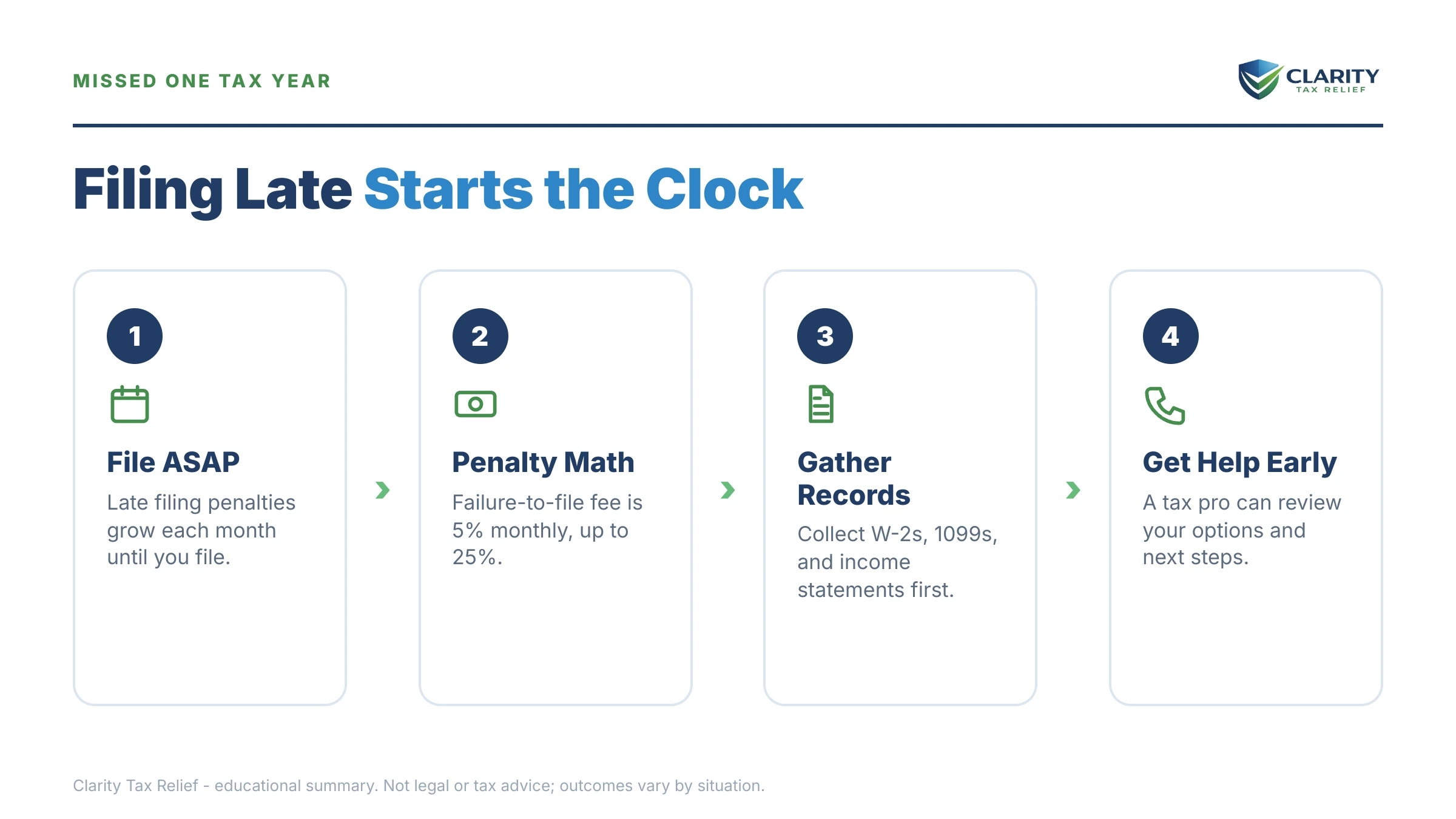
The short answer: if you haven't filed taxes in a year, file the missing return now — even if you can't pay. The failure-to-file penalty runs 5% per month, up to 25% — ten times the late-payment penalty. One unfiled year almost never has enforcement running yet, and filing stops the worst penalty instantly.
April came and went, and the return you meant to get to never got done — maybe the business swallowed every spare hour, maybe you already knew the number would hurt. Now another filing season has passed and the missing year sits in the back of your mind every time mail arrives. Here's the honest news: one skipped year is the smallest, cheapest version of this problem, and the fix is a defined project, not a crisis.
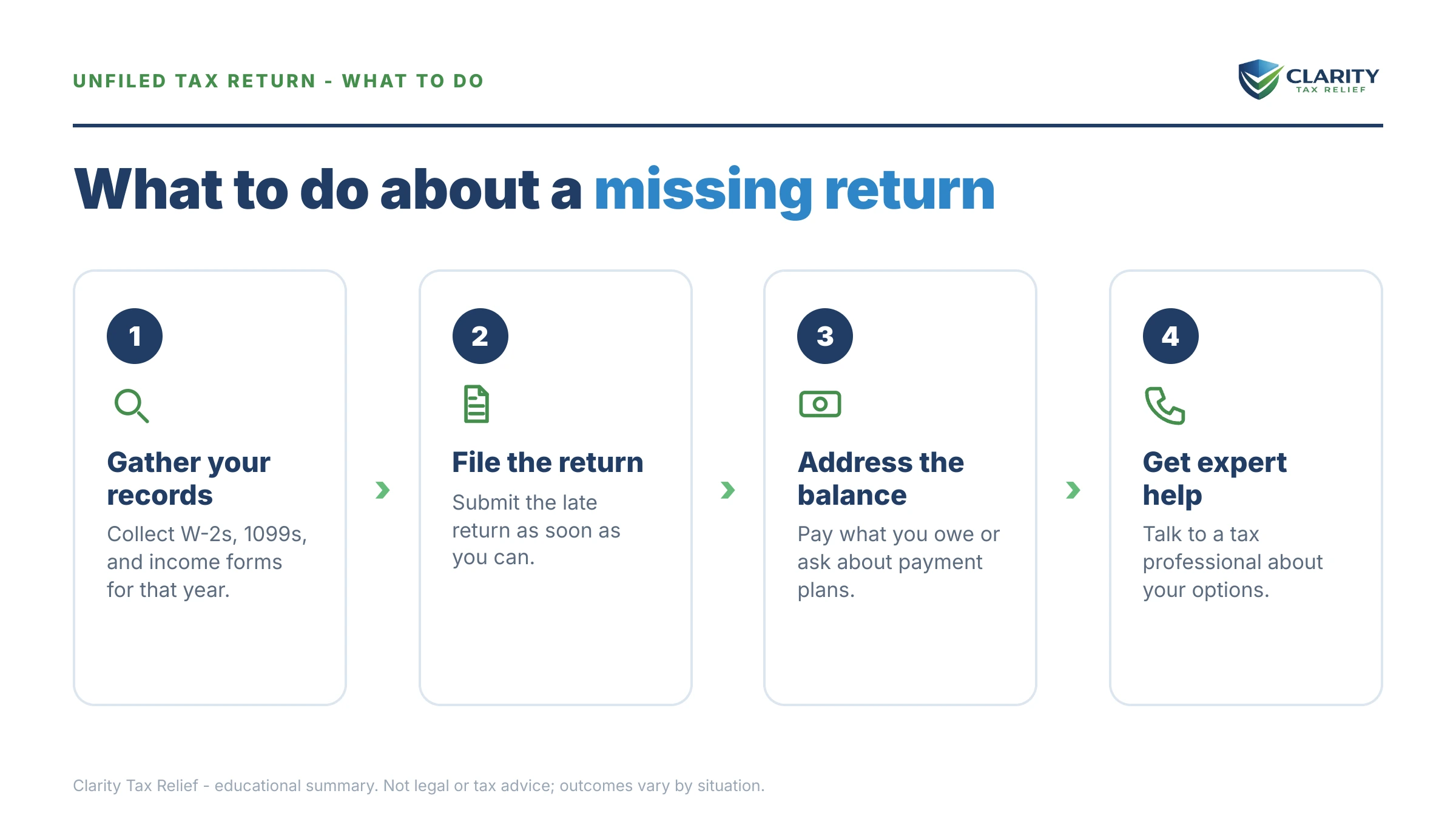
⏱ Your real clocks: the failure-to-file penalty grows 5% per month and maxes out at 25% after five months, if you're a full year late, it has already capped. But interest compounds daily and the 0.5% monthly late-payment penalty keeps running. And if the IRS owes you, you have 3 years from the original due date to claim that refund before it's gone for good.
Where you stand after one unfiled year
One unfiled tax year is the least expensive non-filing problem there is, because the biggest penalty stops growing at month five and enforcement for a single missing return has usually not started. What's happening behind the scenes right now is mostly passive: the IRS's computers have matched the W-2s, 1099s, and 1099-Ks filed under your Social Security number against… nothing, because no return came in.
That mismatch puts you in the non-filer inventory. At the one-year mark, you may have received a CP59 notice — the IRS's "we have no record of your return" letter — or you may have received nothing at all. Silence doesn't mean you slipped through; it means the automated sequence hasn't reached you yet.
Two facts unique to your position are worth absorbing before anything else. First, penalties are your main cost, and they're already mostly fixed — filing today doesn't erase what has accrued. But it caps the damage and unlocks every relief program. Second, an unfiled return means the IRS's clocks never started: the 10-year collection statute can't begin, and therefore can't ever expire, until a return is filed or the IRS assesses one for you. Waiting doesn't run out any clock in your favor.
“File all tax returns that are due, regardless of whether or not you can pay in full. File your past due return the same way and to the same location where you would file an on-time return.”
— Filing past due tax returns (IRS.gov)
What one year of not filing actually costs: the penalty math
The failure-to-file penalty is 5% of the unpaid tax per month, and it is ten times the size of the 0.5% failure-to-pay penalty. When both run in the same month, the file penalty drops to 4.5% so the pair totals 5% — which means a full-year non-filer who owes has already accrued 22.5% in file penalties (the 25% cap, net of the overlap) plus 6% in pay penalties, with interest compounding daily on all of it.
Here's what that looks like on a concrete balance. This is a hypothetical, not a client case. Say you're a small-business owner and the return you never filed would show $19,700 due in income and self-employment tax:
| Months past the deadline | Failure-to-file penalty | Failure-to-pay penalty | Balance owed |
|---|---|---|---|
| 1 month | $887 (4.5%) | $99 (0.5%) | $20,685 |
| 3 months | $2,660 (13.5%) | $296 (1.5%) | $22,655 |
| 5 months | $4,433 (22.5% — maxed) | $493 (2.5%) | $24,625 |
| 12 months | $4,433 (capped) | $1,182 (6%) | $25,315 |
So a year out, that $19,700 has become roughly $25,315 before interest, and interest, which the IRS resets quarterly and compounds daily, runs on the penalties too, not just the tax. Compare the counterfactual: had that return been filed on time with nothing paid, the only penalty after 12 months would be the $1,182 failure-to-pay amount. Filing, just filing, would have saved about $4,433. That same math is why filing today beats filing next month, every time. You can estimate your own penalty and interest with our calculator using your real numbers.
One more wrinkle for smaller balances: once a return is more than 60 days late, a minimum failure-to-file penalty applies — the lesser of an inflation-adjusted flat amount (several hundred dollars) or 100% of the unpaid tax. On a $19,700 balance the percentage penalty dwarfs it, but if you owe only a few hundred dollars, the minimum is what bites.
If you're owed a refund, there's no penalty, but there is a deadline
There is no failure-to-file penalty when the government owes you money, because the penalty is a percentage of unpaid tax, and yours is zero. Plenty of one-year non-filers are in exactly this spot: withholding covered the bill, and the "consequence" of not filing has been lending the IRS your refund interest-free.
The catch is the clock. You have 3 years from the return's original due date to file and claim that refund. Miss the window and the money is permanently forfeited. At one year out you have plenty of runway — the danger is letting one year quietly become three. The full rules are in our guide to claiming a refund from 3 years ago.
What happens if you keep not filing
The IRS non-filer process is a fixed, automated sequence. It doesn't skip steps, and 2025's roughly 27% workforce cut didn't slow it down, because notices and substitute returns are generated by systems, not people. From where you stand now, here is the order of what comes next:
- CP59 — "you didn't file." The opening inquiry, asking you to file or explain why you don't have to. You may be here already, or just before it.
- CP516 and CP518 — escalating reminders. The CP518 is the final "file now" notice. Still no enforcement, but you're near the end of the polite phase.
- Substitute for Return (SFR). The IRS files a return for you using only the income third parties reported — single or married-filing-separately status, zero business deductions, no credits. For a Schedule C owner, an SFR taxes your gross 1099 income and routinely doubles or triples the real liability. The proposal typically arrives as a CP2566.
- CP3219N — Notice of Deficiency. A 90-day letter. Do nothing for 90 days and the SFR's inflated number becomes a legally assessed debt.
- Collection begins. Once assessed, the debt enters the normal ladder — first bill, reminders, intent to levy, final notice — ending in lien filings, wage garnishment, and bank levies. Along the way, any current-year refund can be frozen (a CP63) until the missing return comes in.
Every stage of that sequence is worse than the one before it, and every stage is preventable by filing one return. That's the whole strategy for a one-year non-filer: get ahead of the machine while it's still only sending letters. If you're further behind than one year, the playbook changes — see haven't filed taxes in 3 years, and for the deep end, haven't filed taxes in 10 years.
One unfiled year, growing quietly every month?
An experienced tax professional can pull your IRS transcripts, tell you exactly what the missing return will show, and map the cheapest way to close it out, before the SFR sequence starts. Free, confidential, no pressure.
Your options if the late return shows a balance you can't pay
Filing the return is step one even when you can't pay a dime, because every IRS payment and relief program requires you to be filing-compliant first. Once the return is in, a roughly $19,700–$25,000 balance sits comfortably inside the IRS's self-service programs:
| Option | Who qualifies | Upfront cost | Timeline |
|---|---|---|---|
| Pay in full | Anyone | $0 | Immediate — stops penalties, interest, and all notices |
| Short-term payment plan | Can pay within 180 days | $0 setup fee | Set up online in minutes; accrual continues |
| Streamlined installment agreement | Balance ≤ $50,000, all returns filed | Setup fee (lower with direct debit; reduced for low income) | Up to 72 months; approvable online without financial disclosure |
| Currently Not Collectible | Documented hardship — paying would leave basics uncovered | $0 (financial statement required) | Collection paused; reviewed periodically; debt and interest remain |
| Offer in Compromise | Assets + future income genuinely below the balance | $205 fee + 20% down on lump-sum offers (both waived with low-income certification) | Months to over a year; roughly 1 in 5 offers accepted in FY2024 |
| Penalty abatement (FTA / AEP) | Clean compliance in the prior 3 years (FTA); AEP is automatic from summer 2026 | $0 | Can remove filing and payment penalties, and the interest charged on them |
On the hypothetical $19,700 balance (about $25,315 with penalties), a 72-month streamlined agreement works out to roughly $352 a month before continuing interest — call it $360–$400 realistically, shrinking as you pay down. Two features make the installment route cheaper than it looks: the failure-to-pay penalty drops to 0.25% per month while the agreement is active, and nothing stops you from paying it off early. Setup instructions are in our IRS payment plan online walkthrough.
Penalty relief deserves special attention for a one-year non-filer, because if the previous three years were clean, filed and paid, you're a textbook candidate for first-time penalty abatement, which on our example removes up to $5,615 in penalties plus their interest. And starting summer 2026, the IRS's new Automatic Exemption from Penalty (AEP) begins applying qualifying relief without a request. Eligibility is fact-specific, but a single slip after years of compliance is exactly what these programs exist for. For the broader self-help playbook on plans, offers, and hardship status, see how to settle tax debt yourself.
Business owner with payroll? The unfiled 1040 isn't the whole picture
For an owner with employees, an unfiled personal return is the mild problem — unfiled or unpaid Form 941s are the dangerous one. Payroll withholding is "trust fund" money in the IRS's eyes. The agency pursues it faster and harder than any personal income tax, including by assessing it against you personally even through an LLC or corporation.
So before you celebrate catching up the 1040, verify three things for the missing year: every quarterly 941 was filed, every deposit was actually made. The business return (1120-S, 1065, or Schedule C) that feeds your personal return is done. A late S-corp or partnership return also carries its own per-partner, per-month late-filing penalty — a separate bill many owners don't see coming. If any payroll quarter is open, read our guide to 941 back taxes before you talk to anyone at the IRS, because the sequencing of what you file and pay first genuinely changes personal exposure.
One planning note that cuts your balance rather than growing it: the year you reconstruct now is the year you can still do accurately. Mileage, home office, equipment, health insurance premiums — every legitimate deduction you document reduces the $19,700 before penalties are even calculated. An SFR would give you none of them.
How to file a year-late tax return, step by step
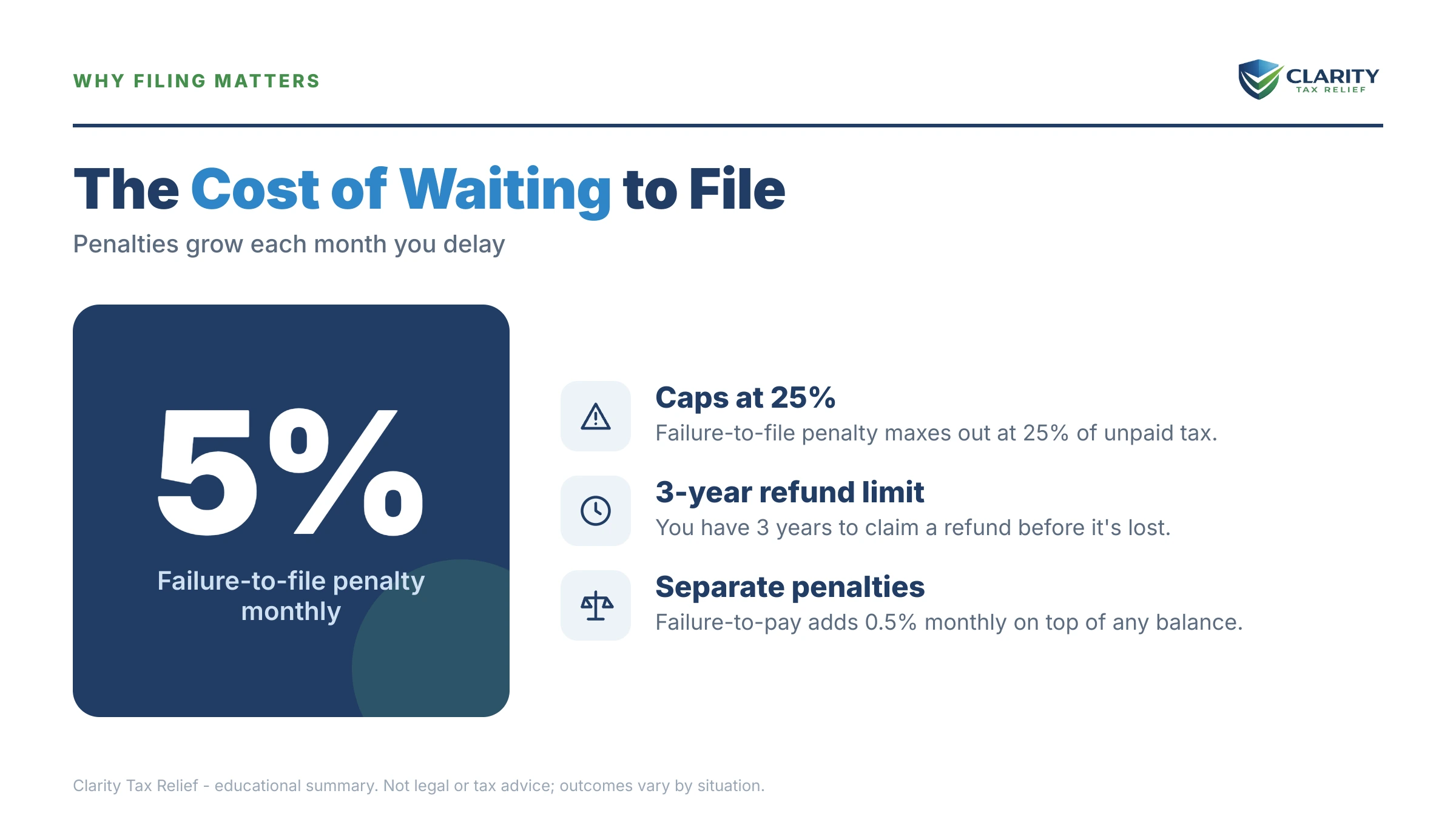
- Pull your income records for the missing year. Gather W-2s, 1099s, and business books, or request your wage and income transcript, which lists everything third parties reported under your Social Security number.
- Prepare and file the complete return. Claim every deduction and credit you're entitled to. This return, not a penalty request, is what sets your real balance. E-file if the prior-year window is still open; otherwise mail it.
- File any missing business returns too. If you have payroll or an entity, confirm your 941s and the business return for that year were filed — payroll gaps escalate faster than a late 1040.
- Pick your payment path before the first bill arrives. Pay in full at IRS.gov/payments, take the $0-setup 180-day short-term plan, or set up a streamlined installment agreement of up to 72 months for balances under $50,000 (details on the IRS payment plans page).
- Request penalty relief. Ask for first-time abatement if your prior three years are clean, and note the Automatic Exemption from Penalty (AEP) beginning summer 2026, which applies without a request.
- Fix withholding or estimates so it doesn't repeat. Adjust your W-4 or start quarterly estimated payments now, because a payment plan on top of a new balance next April is how one late year becomes three.
When you can handle this yourself, and when help changes the outcome
Plenty of one-year non-filers need no professional at all. If your missing year is a W-2 (or one or two clean 1099s), you have the documents. The result is a refund or a balance you can pay within 180 days, this is a weekend project: prepare the return, file it, pay or set up the plan online, done. If you get stuck and money is tight, the Taxpayer Advocate Service and Low Income Taxpayer Clinics offer free help.
Experienced help earns its cost in specific situations: a business year with payroll or entity returns in the mix, income records that are incomplete or contradictory, a balance you genuinely can't service even monthly (where CNC or offer math matters), an SFR or Notice of Deficiency already issued, or the discovery, common once transcripts get pulled, that it's actually more than one year missing. In those cases, the order you fix things in changes what you ultimately pay, and getting it wrong is expensive. One caution either way: if a return you didn't file already shows on your account, stop — that's an identity-theft problem, not a late-filing problem. It has its own process.
Also file even if you're certain you can't pay — the arithmetic behind that rule is laid out in file even if you can't pay, and it's the single decision that saves a one-year non-filer the most money.
Haven't-filed-in-a-year questions, answered
Is it bad if you haven't filed taxes in a year?
One unfiled year is the mildest version of a non-filing problem, but it is not free. If you owe, after five months the failure-to-file penalty has maxed out — 22.5% of the unpaid tax when the 0.5%/month failure-to-pay penalty also applies (that pay penalty keeps accruing up to another 25%, for a combined cap of 47.5%) — and interest compounds daily on top. Enforcement — levies, liens, a substitute return — almost never starts this early, which is exactly why filing now is so much cheaper than filing later.
Can you go to jail for not filing taxes for one year?
Jail is extremely unlikely for a single late return. Willful failure to file is technically a misdemeanor. But the IRS reserves criminal referrals for deliberate, multi-year evasion, usually with large dollar amounts and concealment. For one missed year, the realistic consequences are civil: penalties, interest, and eventually a substitute return, all of which filing voluntarily fixes.
Do I still get my refund if I file a year late?
Yes. There is no failure-to-file penalty when the IRS owes you money, because the penalty is a percentage of unpaid tax — which is zero. You have 3 years from the return's original due date to claim the refund. File after that window closes and the money is forfeited to the Treasury permanently.
Will the IRS file a return for me if I skip a year?
Eventually, yes — it's called a substitute for return (SFR). The IRS typically sends CP59 and follow-up notices first, and the SFR usually comes a year or more after the missed deadline. An SFR uses only the income reported to the IRS, files you as single or married filing separately, and skips every deduction and credit you're entitled to, so it almost always overstates what you owe.
Can I still e-file last year's tax return?
Often, yes. The IRS's e-file system generally accepts the most recent prior-year return through professional and commercial tax software, though not through every DIY product. If the e-file window for that year has closed, you file on paper — which works fine but takes longer to process. Either way, what matters is getting the return in; the method doesn't change the penalties.
Do penalties stop once I set up a payment plan?
They shrink but don't stop. On an approved installment agreement, the failure-to-pay penalty drops from 0.5% to 0.25% per month, and interest continues on the declining balance. Penalties already assessed stay unless you get them abated — through first-time abatement if your prior three years are clean, or automatically under the new Automatic Exemption from Penalty rolling out in summer 2026.
Can the IRS hold my current refund because of one unfiled year?
Yes. If the IRS's records show a missing return, it can freeze your current-year refund, typically announced with a CP63 notice, until the unfiled return comes in. The refund is released (or applied to any balance the late return creates) once you file. This is one of the most common ways a quietly skipped year surfaces.
Your next 24 hours
- Locate your income documents for the missing year — W-2s, 1099s, bank statements, and (if you run a business) that year's profit-and-loss. Anything you can't find, your IRS wage and income transcript will fill in.
- Gather your last filed return and a realistic monthly number — the prior return speeds up preparation, and knowing what you could pay per month lets you pick a payment path the same day you file.
- Book your free case review — the 2-minute form or (888) 825-7779. One unfiled year is a small project for an experienced tax professional, and interest and the late-payment penalty compound every month it stays open — the balance will never be smaller than it is today.
This guide is general information, not tax or legal advice for your specific situation. Eligibility for IRS programs depends on individual facts and circumstances; no outcome is guaranteed.