
Unfiled Returns
Haven't Filed Taxes in 10 Years? Here's Exactly What to Do in 2026
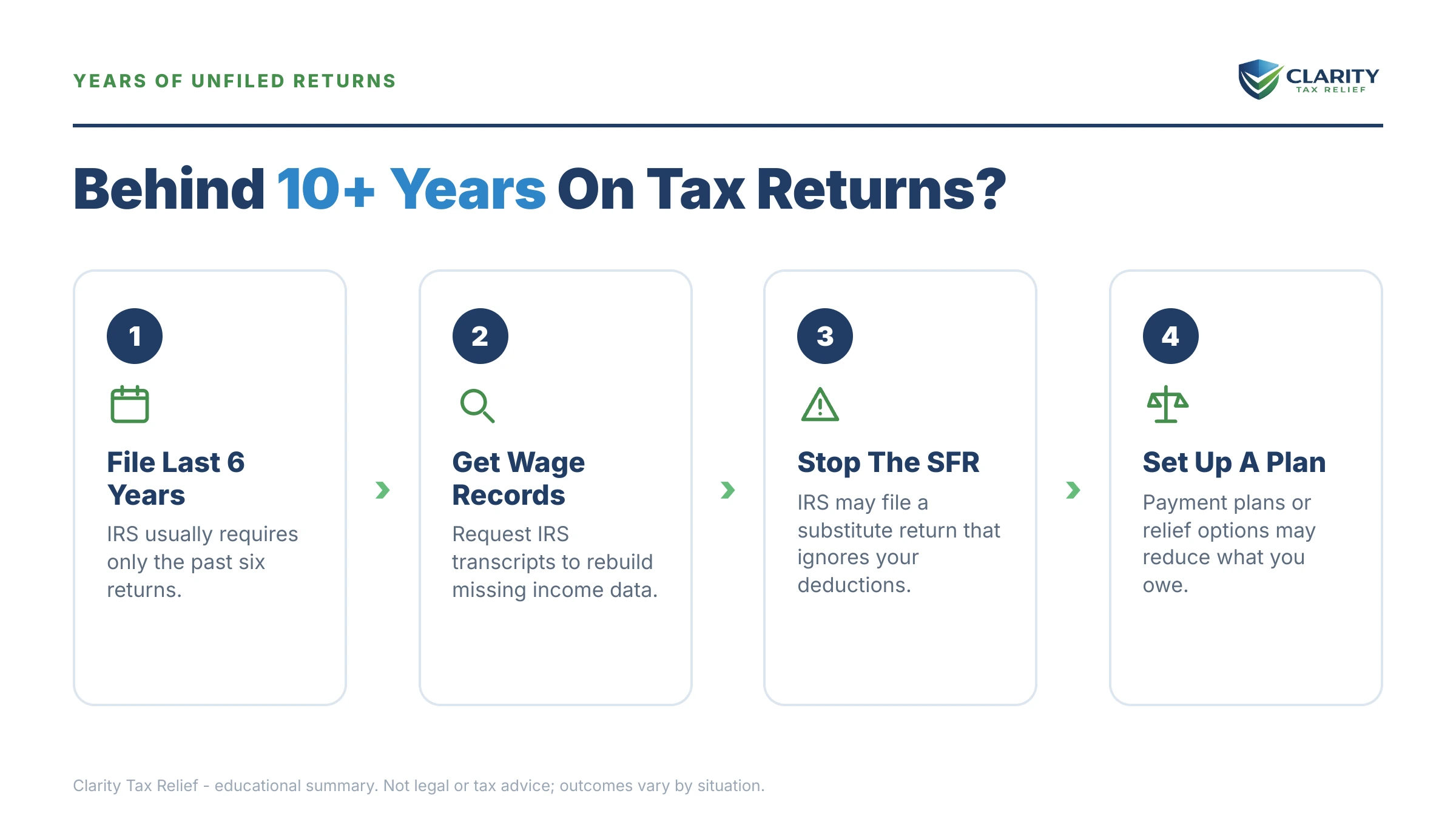
The short answer: if you haven't filed taxes in 10 years, you almost never have to file all ten returns. IRS policy generally requires only the last six years to get back into compliance. File those, fix any substitute returns the IRS filed for you, then set up a payment arrangement for what's left.
Ten tax seasons have come and gone, and each April made it feel harder to start than the one before. Maybe it began with one year you couldn't pay, and silence became the plan. Here's the part nobody told you: the way back is shorter than a decade, and people take it every day without handcuffs, without losing everything, and usually without filing anywhere near ten returns.
⏱ The clock that actually matters: there is no statute of limitations on an unfiled return — the IRS can assess tax for those years at any time, forever. Meanwhile, refunds expire three years after each return's due date, so every Tax Day that passes forfeits another year of withholding you can never get back.
The six-year rule: how many of the 10 years you actually file
IRS Policy Statement 5-133 generally limits delinquent-return enforcement to the last six years — meaning most people who haven't filed in a decade get compliant by filing six returns, not ten.
This is the single most important fact for a 10-year non-filer, and it's the one the fear misses. The IRS's own internal guidance tells its employees that requiring more than six years of returns usually takes manager approval. In practice, filing the most recent six years restores "filing compliance" — the status you need before any payment plan, hardship status, or settlement is even on the table.
There are three exceptions worth checking before you relax:
- Years the IRS already assessed. If the IRS filed a substitute return for a year outside the six-year window, that balance already exists and won't vanish just because you skip the return.
- Years the IRS specifically demanded. A written demand for a particular year, an LT26 or a revenue officer's request, overrides the general six-year practice.
- High-income years. The IRS has run targeted sweeps of high-income non-filers; big 1099 years can get pulled in individually.
The full rule, including when the window stretches, is covered in our guide to how many years of back taxes do i have to file. If your gap is shorter, the playbook shifts — see haven't filed taxes in 3 years, haven't filed taxes in 5 years, or haven't filed taxes in 7 years for those timelines.
“File all tax returns that are due, regardless of whether or not you can pay in full. File your past due return the same way and to the same location where you would file an on-time return.”
— Filing past due tax returns (IRS.gov)
What the IRS already knows about your 10 unfiled years
The IRS already holds roughly a decade of your W-2s and 1099s in a wage and income transcript — filed by every employer, gig platform, bank, and broker that ever paid you, whether or not you ever filed.
This cuts both ways. It's why hiding never worked: the automated non-filer program matches those third-party records against missing returns with no human involved. But it's also your reconstruction kit. You don't need a shoebox of 2017 paperwork. You can pull an irs wage and income transcript for each year and see exactly what the IRS sees, down to the payer and dollar amount.
Gig and 1099 workers should note one asymmetry: platforms report your gross income, but nobody reports your expenses. Your mileage, supplies, phone, and fees exist only on returns you file. That gap is precisely how the IRS's version of your decade ends up wildly overstated — which brings us to what happens if you keep waiting.
Haven't filed taxes in 10 years: what happens if you keep waiting
An unfiled year never closes: because no return exists, the assessment clock never starts. The IRS can build a bill for that year at any point — using its numbers, not yours.
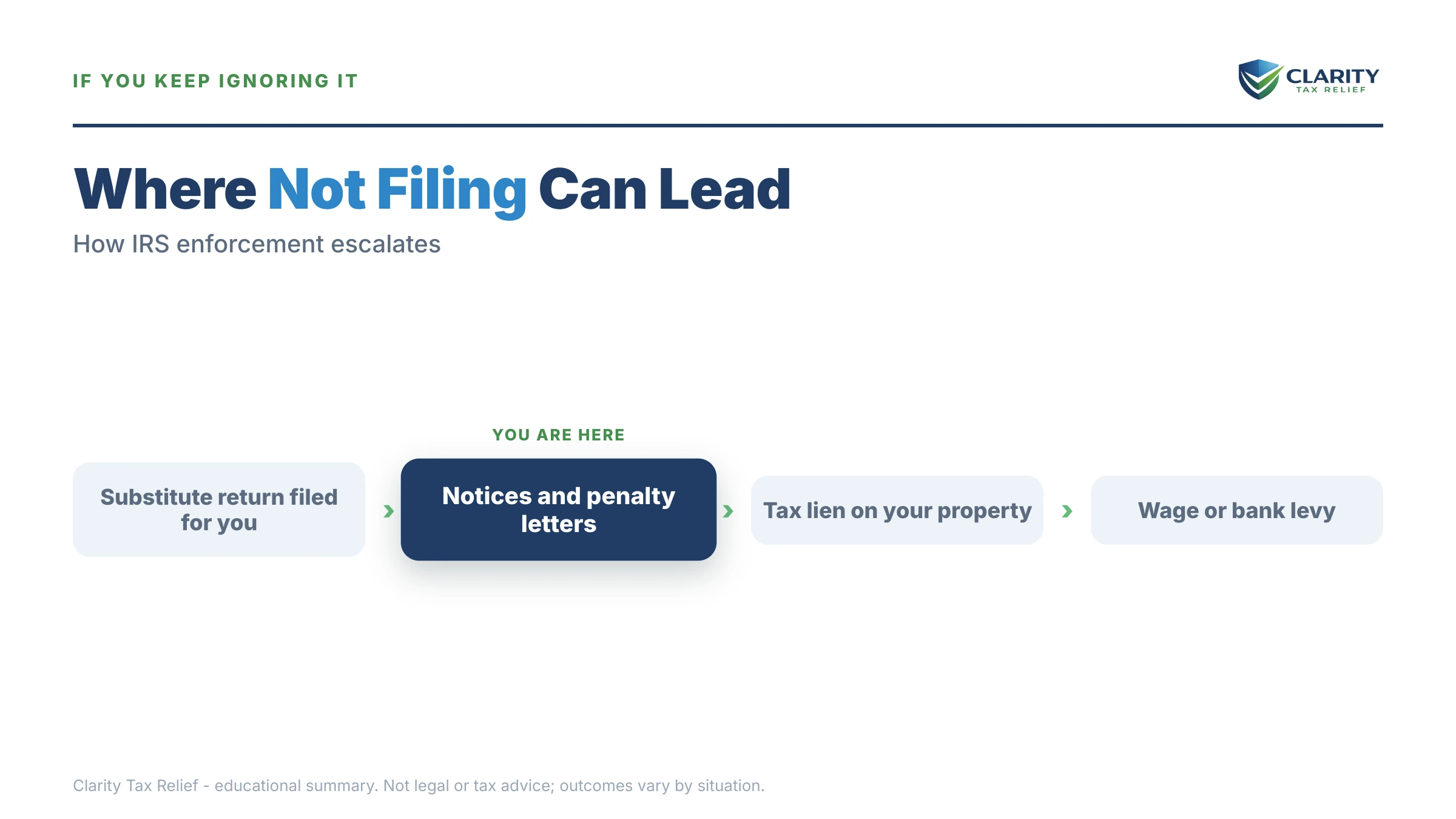
The sequence is automated, and in 2026 that matters more than ever. Per TIGTA reports, the IRS workforce shrank roughly 27% in 2025, so reaching a human is harder. But the non-filer notices, substitute returns, and levies are generated by systems that never got cut. Here's the ladder, stage by stage:
- CP59 → CP516 → CP518 — escalating "we have no record of your return" demands. Still just letters, but your file is now in the non-filer pipeline.
- Substitute for Return (SFR) — the IRS prepares a return for you: single filing status, zero deductions, zero business expenses, every 1099 dollar treated as pure profit. It proposes this via a notice such as the CP2566.
- CP3219N notice — a statutory Notice of Deficiency giving you 90 days to file your own return or petition Tax Court. Silence here means the inflated SFR number becomes a legal assessment.
- Collection stream — once assessed, the debt enters the same machine as any other balance: a CP14 bill (typically 21 days, or 10 business days if the balance is $100,000 or more), then reminders, then a CP504, then an LT11 final notice that opens a 30-day window before wage garnishment and bank levies. Refunds from any year you do file get held or seized, and once assessed debt passes $66,000 (the 2026 threshold), your passport can be certified for denial.
| Stage | What it means | Your window |
|---|---|---|
| CP59 / CP516 / CP518 | IRS demands the missing return; file is in the non-filer program | Respond promptly — filing now still counts as voluntary |
| SFR proposal (e.g., CP2566) | IRS computes your tax with no deductions or expenses | Reply by the date printed on the notice with your own return |
| CP3219N (deficiency) | Last stop before the SFR becomes a legal assessment | 90 days to file your return or petition Tax Court |
| CP14 bill | Assessed balance enters active collection | Typically 21 days before the next notice queues (10 business days if the balance is $100,000 or more) |
| CP504 → LT11 | Intent to levy, then final notice with appeal rights | 30 days after LT11 before wages and bank accounts are fair game |
Ten years of silence usually ends in an SFR bill: get ahead of it
A substitute return is built with none of your deductions, and every month adds penalties and interest to a number that isn't really yours. Send us what you have, even if it's nothing but your name. An experienced tax professional will pull your IRS records, map all 10 years, and tell you exactly which returns you owe. Free and confidential.
Your options once the returns are filed
Every IRS resolution program — payment plan, hardship status, Offer in Compromise — requires your delinquent returns to be filed first. Compliance is the ticket in, not the finish line.
That's why the order of operations matters: returns first, resolution second. Filing usually shrinks the debt (your deductions replace the IRS's zero-deduction math), and only then does it make sense to choose how to handle what remains. The full DIY comparison of these programs lives in our guide to how to settle tax debt yourself. Here's how they map to a post-catch-up balance:
| Option | Who qualifies | Cost / key catch |
|---|---|---|
| Short-term plan (≤180 days) | Any filing-compliant taxpayer who can pay in full within 180 days | $0 setup; interest and late-pay penalty keep accruing |
| Streamlined installment agreement | Balance ≤ $50,000, all required returns filed | Up to 72 months, set up online, no financial disclosure |
| Non-streamlined plan (over $50k) | Larger balances; financial disclosure on Form 433 required | IRS reviews income, assets, and allowable expenses; lien likely |
| Currently Not Collectible | Paying anything would leave you unable to cover basic living costs | Collection pauses; debt and interest remain; reviewed periodically |
| Offer in Compromise | Assets + future income genuinely can't cover the debt | $205 fee, 20% down on lump-sum offers (both waived if AGI ≤ 250% of poverty); roughly 1 in 5 offers accepted in FY2024, per IRS data |
| Penalty relief | Clean history before the gap, or reasonable cause (illness, disaster) | Can remove failure-to-file penalties year by year; interest on tax stays |
Two notes specific to a 10-year gap. First, penalty relief is worth more to you than to most people: the failure-to-file penalty runs 5% per month and caps at 25% of the tax per year, so a decade of unfiled returns can carry six figures of stacked penalties. First-Time Abatement can clear the earliest delinquent year if the three years before your gap were clean, and reasonable cause may reach the rest — the stacking strategy is covered in first time abatement multiple years. (Starting summer 2026, the new Automatic Exemption from Penalty applies some relief with no request at all — don't pay a penalty a pro could have removed.) You can rough out what penalties and interest have added to each year with our Penalty & Interest Calculator.
Second, check what's already expired. The 10-year collection statute runs from assessment, so if the IRS filed substitute returns early in your gap, part of that assessed debt may be near its expiration date. Never assume, some actions pause the clock, but never pay an expired year either. Your account transcripts show the assessment dates.
What 10 years of not filing actually costs: a worked example
Say you're a gig worker who stopped filing in 2016, grossing about $62,000 a year on 1099s from rideshare and delivery apps. The IRS filed substitute returns for three of those years, the ones with the biggest 1099 totals, and the assessments now total $92,700. Here's roughly how the IRS got there, per year:
- $62,000 gross treated as pure profit → self-employment tax around $8,800 plus income tax around $5,700 ≈ $14,500 in tax
- Failure-to-file penalty at the 25% cap ≈ $3,600, plus the failure-to-pay penalty and years of compounding interest
- Total per SFR year ≈ $30,900 — times three years ≈ $92,700
Now run the same three years with real returns. Suppose you reconstruct about 28,000 business miles a year plus phone, fees, and supplies — call it $19,000 in deductions annually. Net profit drops to roughly $43,000, tax falls to somewhere near $9,200 a year, and the penalties recalculate on that smaller tax. In this hypothetical, the three-year bill lands closer to $50,000 than $92,700 — the filing itself, before any relief program, does nearly half the work. And a balance in that range, once the other years show little or no tax due, puts a 72-month streamlined plan (roughly $700-plus a month, with interest still accruing) or an Offer analysis realistically on the table.
Every number above is illustrative. Your years, income, and expenses will produce different math. The point is the direction: the IRS's version of your decade is almost always the most expensive version, because it's built without a single deduction you're entitled to. The mechanics of replacing an IRS-prepared return are in our guide to the IRS filed a substitute return for me.
How to fix 10 years of unfiled taxes, step by step
Fixing a 10-year gap follows one sequence: transcripts first, returns second, resolution last — doing it out of order wastes months.
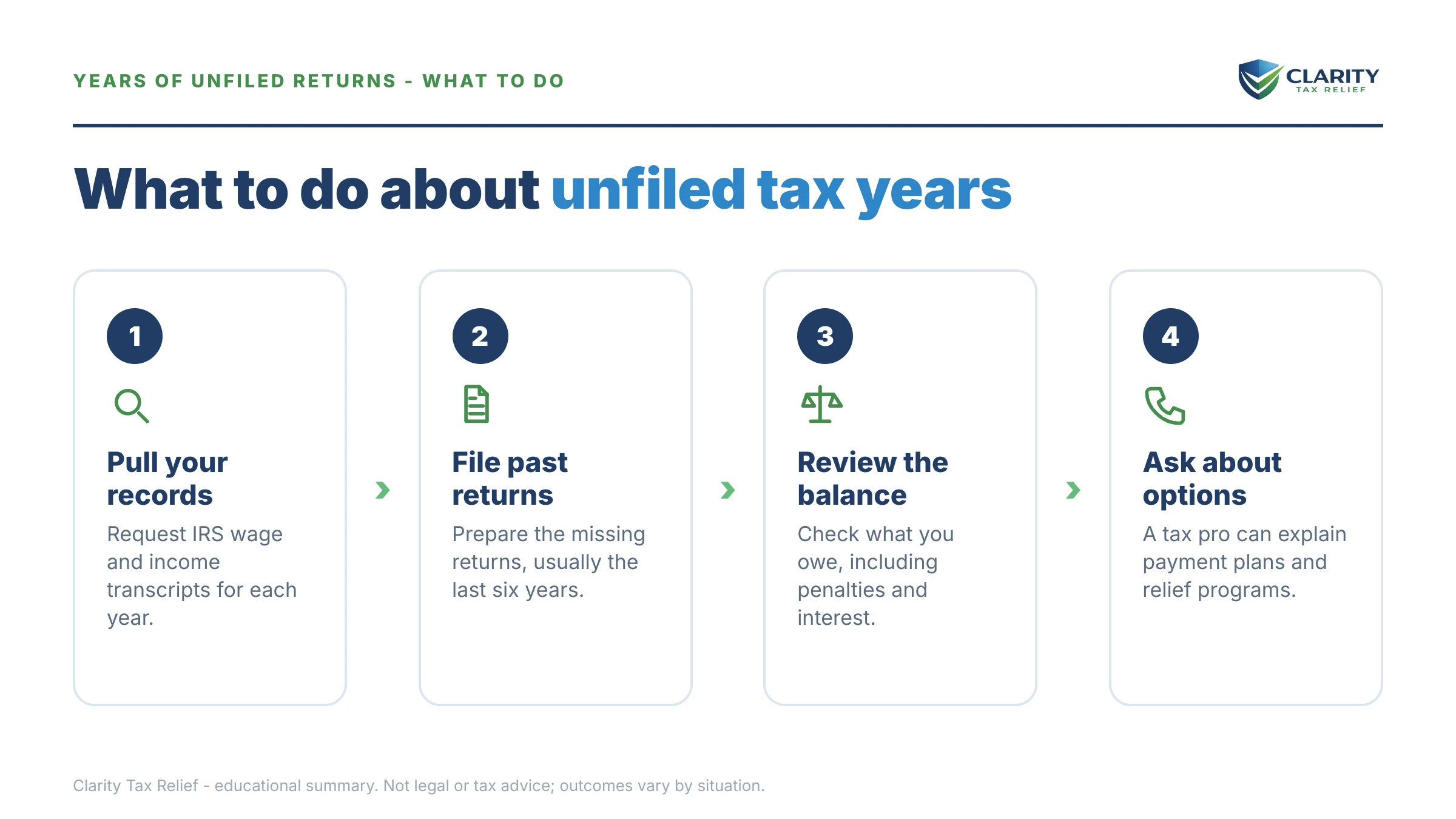
- Pull your IRS transcripts. Order wage and income transcripts for every available year plus account transcripts, so you can see what income the IRS has on file and whether any substitute returns were already assessed.
- Confirm which years you must file. Under Policy Statement 5-133 that's generally the last six years, plus any year with an SFR assessment or a specific written IRS demand.
- Rebuild your income and deductions. Match transcript income to bank deposits, pull platform earnings summaries, and reconstruct mileage and business expenses with honest, documented estimates.
- Prepare and file the delinquent returns. Old years must be paper-filed. If the IRS sent a notice or assigned your case, send the returns to the address on that notice so they reach the right unit.
- Set up a resolution for the balance. Once the returns process, choose the arrangement your finances support — a payment plan, hardship status, or an Offer in Compromise.
- Request penalty relief. Ask about abatement for the first delinquent year and reasonable-cause relief for the rest — penalty relief on a decade of failure-to-file penalties can be significant.
If your paperwork from the early years is simply gone, don't let that stall step three — file back taxes without records walks through reconstruction methods the IRS accepts.
When you can handle this yourself, and when help changes the outcome
A 10-year non-filer with straightforward W-2 income and no SFR assessments can often catch up without professional help.
Honestly: if your decade was salaried jobs with withholding, most of your six returns may show refunds (the recent three are still claimable — see can i still get a refund from 3 years ago) or small balances. Pull transcripts, prepare six returns with tax software or a preparer, mail them, and set up a payment plan online. You don't need to pay anyone thousands for that.
Experienced help earns its cost when any of these are true:
- The IRS already filed substitute returns — replacing an assessed SFR is an audit-reconsideration process with its own rules, and doing it wrong leaves the inflated balance standing.
- You're self-employed or gig-based — the entire savings lives in expense reconstruction, and defensible reconstruction is a craft.
- A CP3219N clock is running or a revenue officer is assigned — deadlines with legal consequences are attached now.
- The total will be large — above $50,000, financial disclosure, lien exposure, passport certification, and CSED analysis all come into play at once, and sequencing mistakes are expensive.
One more honest note: if you're only now realizing you should have filed and no IRS contact has happened, that's the strongest position you'll ever be in. Coming forward first — covered in voluntarily file old tax returns — is why non-filers who catch up on their own initiative are rarely treated as anything but taxpayers fixing a problem.
Terms you'll run into, decoded
- SFR (Substitute for Return): a return the IRS prepares for you from third-party records — always single status, never any deductions.
- Policy Statement 5-133: the internal IRS rule that generally limits delinquent-return enforcement to the last six years.
- Wage and income transcript: the IRS's year-by-year record of every W-2 and 1099 filed under your Social Security number.
- ASED (assessment statute): the deadline for the IRS to assess tax. It never starts running on a year you didn't file.
- CSED (collection statute): the 10-year deadline to collect an assessed debt, pausable by offers, appeals, and bankruptcy.
- Audit reconsideration: the process for replacing an SFR assessment with your own original return after the fact.
Unfiled-for-a-decade questions, answered
Can you go to jail for not filing taxes for 10 years?
Jail is extremely unlikely if you come forward before the IRS comes to you. Willful failure to file is technically a misdemeanor under IRC §7203. But the IRS reserves criminal referrals for fraud-heavy cases and pursues only a small number of prosecutions each year across all tax crimes. Voluntarily filing your delinquent returns is the strongest protection you have — waiting until the IRS contacts you first weakens it.
Do I have to file all 10 years of missing tax returns?
Usually not. IRS Policy Statement 5-133 directs that enforcement of delinquent returns generally covers the last six years, so most 10-year non-filers get back into compliance by filing six. The exceptions: any year where the IRS already filed a substitute return or sent a specific demand, and years with large income the IRS may pursue anyway. Confirm the scope before you start preparing returns.
Will I still get refunds from years I didn't file?
Only for the most recent three years. A refund expires three years after the return's original due date, so refunds from the seven older years in a 10-year gap are permanently gone. If any of your last three unfiled years show withholding or refundable credits, file those first — each Tax Day that passes forfeits another year's money for good.
What happens if the IRS already filed a return for me?
The IRS filed a substitute for return (SFR) — a return built from 1099s and W-2s that gives you no deductions, no business expenses. The least favorable filing status. The resulting assessment is fully collectible: it can trigger liens, levies, and passport certification. You can almost always reduce it by filing your own original return for that year, which the IRS processes as an audit reconsideration.
How does the IRS know I had income if I never filed?
Every W-2, 1099-NEC, 1099-K, 1099-INT, and similar form is filed with the IRS by the payer, not by you. Those records sit in your wage and income transcript whether or not you ever file. The IRS's automated non-filer program matches them against missing returns. That's why gig and contractor income is especially visible — the platforms report it even when no tax was withheld.
Can I get a payment plan on 10 years of tax debt?
Yes, but only after your required returns are filed; the IRS won't approve any agreement while you're non-compliant. Once you're current, balances of $50,000 or less generally qualify for a streamlined plan of up to 72 months set up online, and larger balances require financial disclosure on a Form 433. Interest and the late-payment penalty keep accruing during the plan.
Does the 10-year rule mean my old tax debt is already gone?
Not for unfiled years. The 10-year collection statute (CSED) starts only when tax is assessed, and no assessment exists until you file or the IRS files a substitute return. A year you never filed has no clock running at all. If the IRS filed SFRs years ago, those specific assessments may be close to expiring, which is exactly why you check your account transcripts before paying anything.
What if I have no records from 10 years ago?
You can rebuild almost everything. IRS wage and income transcripts show every W-2 and 1099 reported under your Social Security number for roughly the last decade, and old bank statements, platform earnings summaries, and reasonable mileage reconstructions fill in deductions. The IRS and the courts accept honest, well-documented estimates, the Cohan rule, when exact records no longer exist.
Your next 24 hours
- Check your mail pile and IRS account. Find any CP59, CP518, CP2566, or CP3219N notice and note the date printed on it. That date decides whether you're still ahead of the machine or already on a statutory clock. You can order transcripts at the IRS's Get Transcript page.
- Gather what exists. Any old W-2s or 1099s, bank statements, gig-platform login credentials. Your last filed return, however old — the reconstruction starts from these plus your transcripts.
- Get the free case review. Call (888) 825-7779 or use the 2-minute form — an experienced tax professional will map all 10 years, flag any SFR assessments and expired statutes, and give you the exact filing list. Interest and penalties are the only thing waiting adds.
Once you're filing-compliant, plan options and setup are on the IRS's payment plans page, and if the IRS process itself breaks down on you, the independent Taxpayer Advocate Service exists precisely for that.
This guide is general information, not tax or legal advice for your specific situation. Eligibility for IRS programs depends on individual facts and circumstances; no outcome is guaranteed.