
Unfiled Returns
Haven't Filed Taxes in 3 Years? Here's Exactly What to Do (2026)
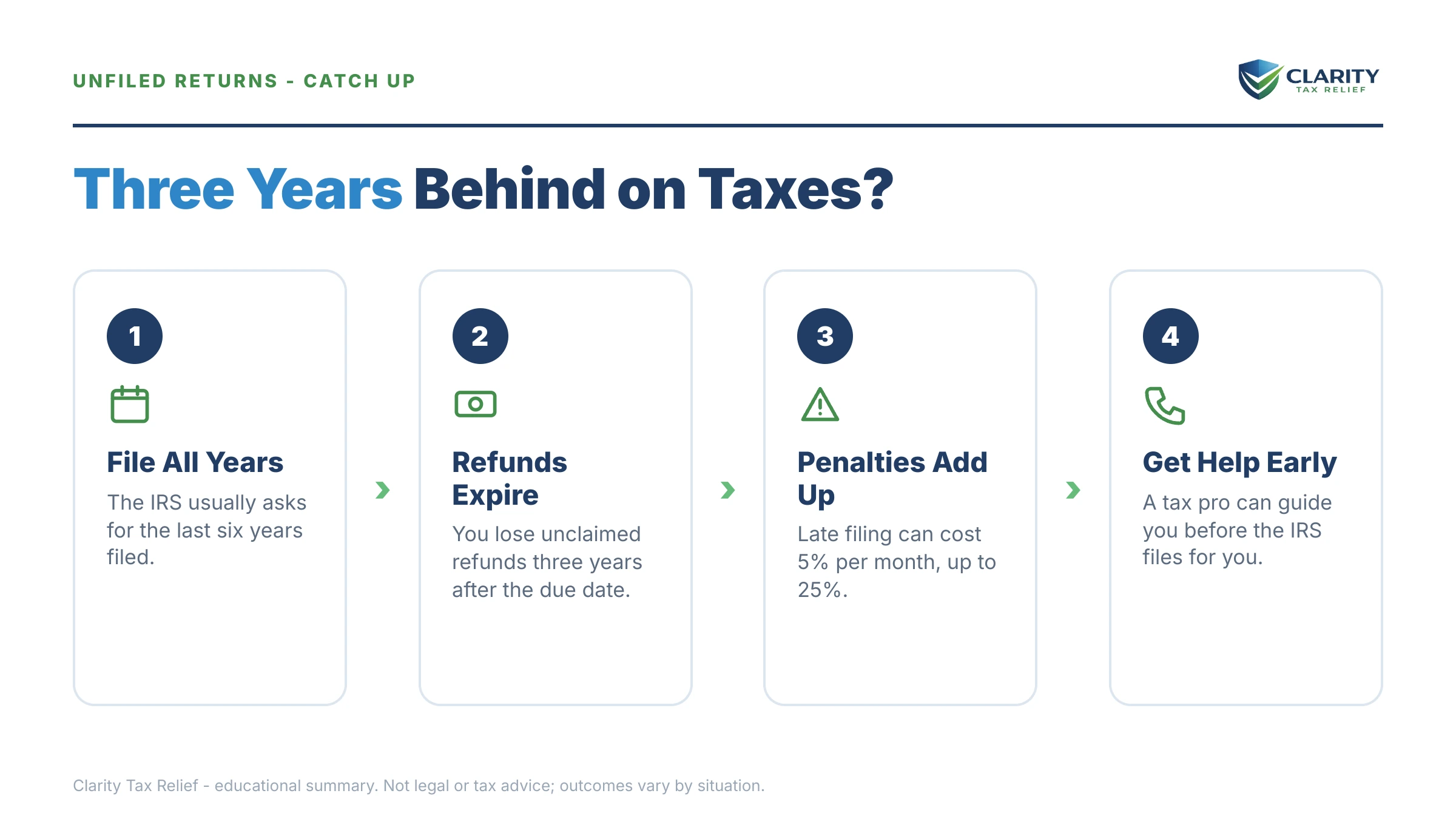
The short answer: if you haven't filed taxes in 3 years, file all three returns as soon as possible, before the IRS builds a substitute return that ignores every deduction you're entitled to. The failure-to-file penalty (5% per month, up to 25% per year) dwarfs the penalty for not paying, and your oldest year's refund window closes April 15, 2027.
Three tax seasons went by. The first April you told yourself you'd catch up over the summer; the second, you were afraid of what filing would trigger; by the third, not filing had become the routine. If you work on 1099s — no employer withholding, income scattered across clients and platforms — the fear compounds because you genuinely don't know the number.
Here's what matters: three unfiled years is still completely recoverable, and you're almost certainly still ahead of the IRS's substitute-return machinery. The map below covers what the IRS already knows, which of your three years can still pay you money, and the exact filing sequence that fixes this.
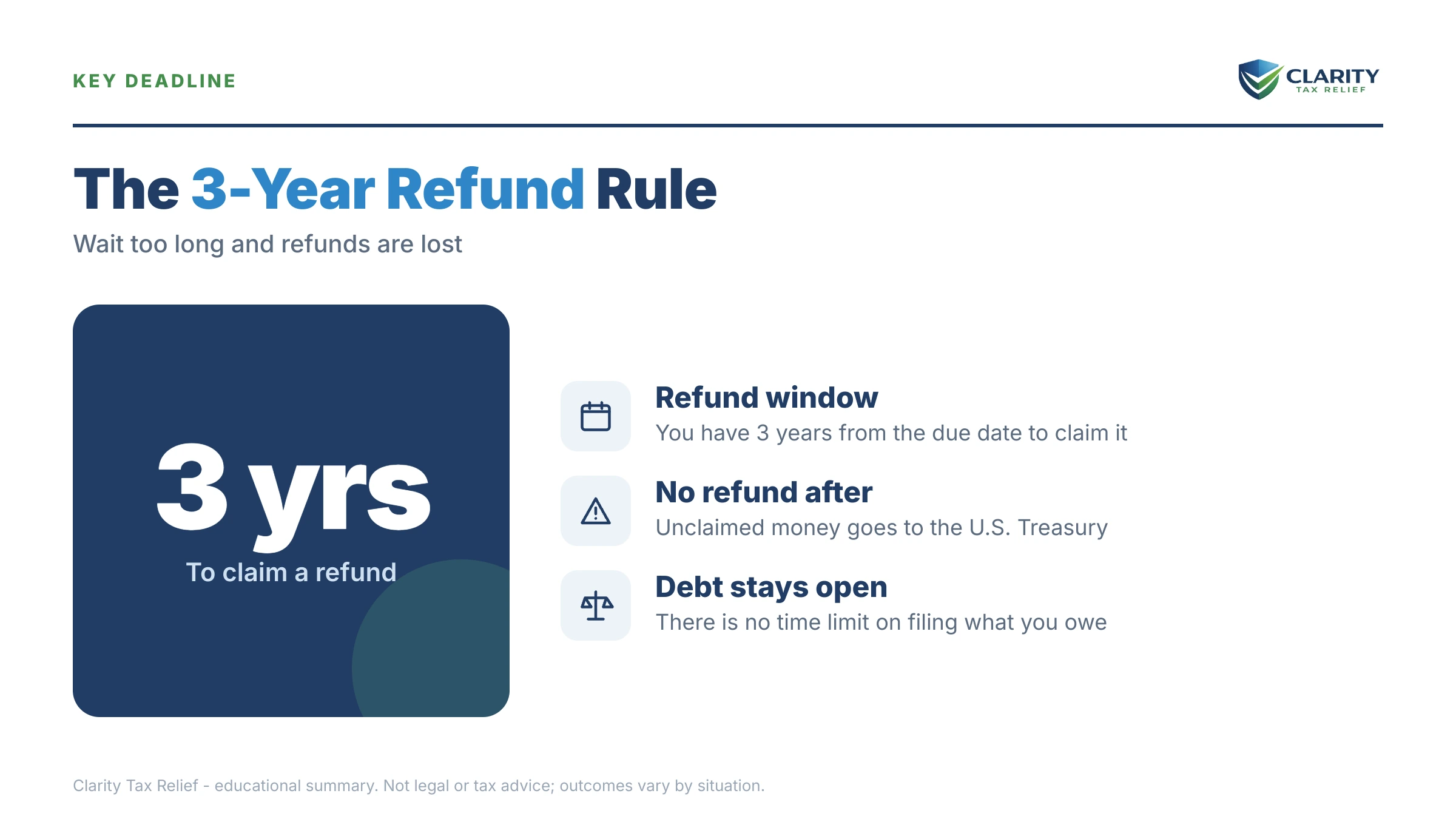
⏱ The clock that matters: a refund from an unfiled return expires 3 years after that return's original due date. For your oldest unfiled year, tax year 2023, that window closes April 15, 2027. After that date, any withholding or refundable credits from 2023 are forfeited permanently. Meanwhile, on any year where you owe, the failure-to-file penalty keeps accruing at 5% per month until you file.
Why 3 years of unfiled taxes snowballs faster than you think
The IRS already holds a copy of every W-2, 1099-NEC, 1099-K, and 1099-MISC issued under your Social Security number for all three unfiled years. Every client who paid you $600 or more sent the IRS the same form they sent you. Your income isn't hidden — it's sitting in the IRS's document-matching system waiting for a return that never arrived.
Three years is the point where that mismatch typically stops being dormant. The IRS's non-filer program works on a delay: it identifies missing returns from prior years, sends escalating notices, and, if you never respond, computes the tax for you. That computed version is the worst possible math for a contractor, because a substitute return taxes your gross 1099 income with zero business deductions — no mileage, no supplies, no home office, no health insurance. The least favorable filing status.
There's a second, quieter cost. Three years without filed returns means no proof of income for a mortgage, a business loan, an ACA subsidy, or Social Security self-employment credits. Every year you stay unfiled, the paperwork problem leaks into the rest of your life.
If your gap is different from three years, the playbook shifts — the guides for haven't filed taxes in 5 years and haven't filed taxes in 10 years cover the longer versions, where IRS lookback policy and substitute returns already in place change the strategy.
“File all tax returns that are due, regardless of whether or not you can pay in full. File your past due return the same way and to the same location where you would file an on-time return.”
— Filing past due tax returns (IRS.gov)
The refund clock: which of your 3 unfiled years can still pay you
All three of your unfiled years are still inside the refund window as of mid-2026 — a position the 5-year and 10-year non-filer no longer has. If you had any withholding (a W-2 job alongside your contracting, gambling withholding, backup withholding on a 1099) or qualify for refundable credits like the EITC, those refunds are still claimable. But only by filing, and only until each year's deadline passes.
| Tax year | Original due date | Refund claim deadline |
|---|---|---|
| 2023 | April 15, 2024 | April 15, 2027 |
| 2024 | April 15, 2025 | April 15, 2028 |
| 2025 | April 15, 2026 | April 15, 2029 |
If you filed an extension for any year, your deadline may differ slightly — check the date on your own records. And note the trap hidden in this table: an expired refund can't even be applied against a year where you owe. The full mechanics are in can I still get a refund from 3 years ago.
What happens if you haven't filed taxes in 3 years and keep waiting
The IRS handles non-filers with an automated sequence that ends in a tax bill it wrote for you. Nothing about 2026's reduced IRS workforce slows this down — the notices are generated by systems, not people. They escalate in a fixed order:
- CP59 — "we have no record of your return." The first non-filer notice. No enforcement yet; this is the cheapest moment to act.
- CP516 and CP518 — escalating demands to file. CP518 is the final request before the IRS stops asking and starts computing.
- Substitute for Return (SFR). The IRS files a substitute return for you from the 1099s and W-2s on file — gross income, no deductions, worst filing status — and proposes the resulting tax on a CP2566.
- CP3219N — Notice of Deficiency. This starts a 90-day clock to file your own return or petition Tax Court. Miss it, and the inflated SFR numbers become a legal assessment.
- Assessment, then collection. Once assessed, the balance enters the regular collection track — CP14 bill, reminders, CP504, then LT11, the final notice that opens a 30-day window before wage and bank levies.
| Stage / notice | What it means | Your window |
|---|---|---|
| CP59 | First notice that a required return is missing | Respond by the date printed on the notice |
| CP516 / CP518 | Escalating requests; CP518 is the final ask | Respond by the date printed on the notice |
| SFR / CP2566 | IRS computes your tax with no deductions | The response date printed on the notice |
| CP3219N | Notice of Deficiency on the SFR figures | 90 days to file or petition Tax Court |
| CP14 → CP504 → LT11 | Assessed balance moves into active collection | LT11 starts a 30-day clock before levies |
Filing your own accurate returns at any point before assessment short-circuits the entire sequence. That's the whole strategy: replace the IRS's version of your income with the real one before the IRS's version becomes law.
Three years behind and not sure where to start?
We'll pull your IRS transcripts, tell you exactly which years the IRS is tracking, and map the catch-up in one free call, before the substitute-return machinery does the math for you, and before your 2023 refund window closes on April 15, 2027. No pressure, no judgment.
Your options after filing 3 years of back taxes
Filing all three returns is step one; the IRS won't approve any payment arrangement, hardship status, or settlement while required returns are missing. Once you're filing-compliant, every resolution program opens up, and which one fits depends on your combined balance and your finances:
| Option | Who it fits | Key numbers |
|---|---|---|
| Pay in full | Balance you can clear with savings or cash flow | Stops all penalties and interest immediately; $0 fees |
| Short-term payment plan | Can pay everything within 180 days | $0 setup fee; interest and penalties continue |
| Guaranteed installment agreement | Total balance of $10,000 or less | Approval required by law if conditions are met |
| Online long-term installment agreement | Combined balance of $50,000 or less | Up to 72 months; no detailed financial disclosure |
| Non-streamlined agreement | Balance above $50,000 | Requires Form 433 financial disclosure |
| Currently Not Collectible | Paying anything would prevent basic living expenses | Collection pauses; debt and interest remain |
| Offer in Compromise | Assets + future income genuinely can't cover the debt | $205 fee, 20% down on lump-sum offers (both waived with low-income certification); roughly 1 in 5 offers accepted in FY2024 |
| Penalty abatement | Clean compliance history or reasonable cause | Can remove failure-to-file/failure-to-pay penalties for a qualifying year |
Two of these deserve special attention for a three-year catch-up. First, first-time penalty abatement: if the three years before your first missed year were clean, the oldest year's penalties may be removable with one request, and starting summer 2026, the IRS's new Automatic Exemption from Penalty (AEP) begins applying some of this relief automatically. Second, the $50,000 online-plan threshold counts penalties and interest, not just tax, so shrinking penalties can be the difference between a simple online plan and a full financial disclosure.
The step-by-step mechanics of negotiating each of these on your own — forms, phone scripts, and sequencing — live in our guide to how to settle tax debt yourself. And whatever you do, don't let a payment problem delay the filing: filing even when you can't pay is always the cheaper move, because filing stops the 5%-per-month penalty cold.
What 3 years of penalties looks like on $48,300: a worked example
Say you're a 1099 contractor and the three returns you finally prepare show $48,300 in combined tax: $15,200 for 2023, $16,400 for 2024, and $16,700 for 2025. Here's the honest math as of mid-2026:
- Failure-to-file penalty: 5% of the unpaid tax per month, capped at 25% per year. 2023 and 2024 hit the cap long ago — roughly $3,800 and $4,100. The 2025 return, about three months late, has accrued roughly 15% in combined late-filing and late-payment penalties (together they run about 5% per month — 4.5% + 0.5%), or about $2,505. Filing today freezes that last number instead of letting it climb to $4,175, and note that the 0.5%-per-month late-payment penalty keeps accruing even after the late-filing penalty caps at 25%.
- Failure-to-pay penalty: 0.5% per month on each year's unpaid tax, still running (in months where both penalties apply, the failure-to-file penalty is reduced by the failure-to-pay amount, so they partially offset).
- Interest: compounds daily on the tax and the penalties.
Realistically, the $48,300 has grown to somewhere north of $60,000 — which means the assessed balance would sit above the $50,000 line for a simple online 72-month plan. That's the hidden cost of year three: the penalties themselves changed which programs you qualify for. If abatement brings the balance back under $50,000, a 72-month plan runs roughly $695 per month before ongoing interest. You can rough out your own numbers with our Penalty & Interest Calculator — it estimates, it doesn't promise — but the direction of the math never changes: every month you wait, the 2025 penalty grows and the total drifts further from the simple-plan threshold.
How to file 3 years of back taxes, step by step
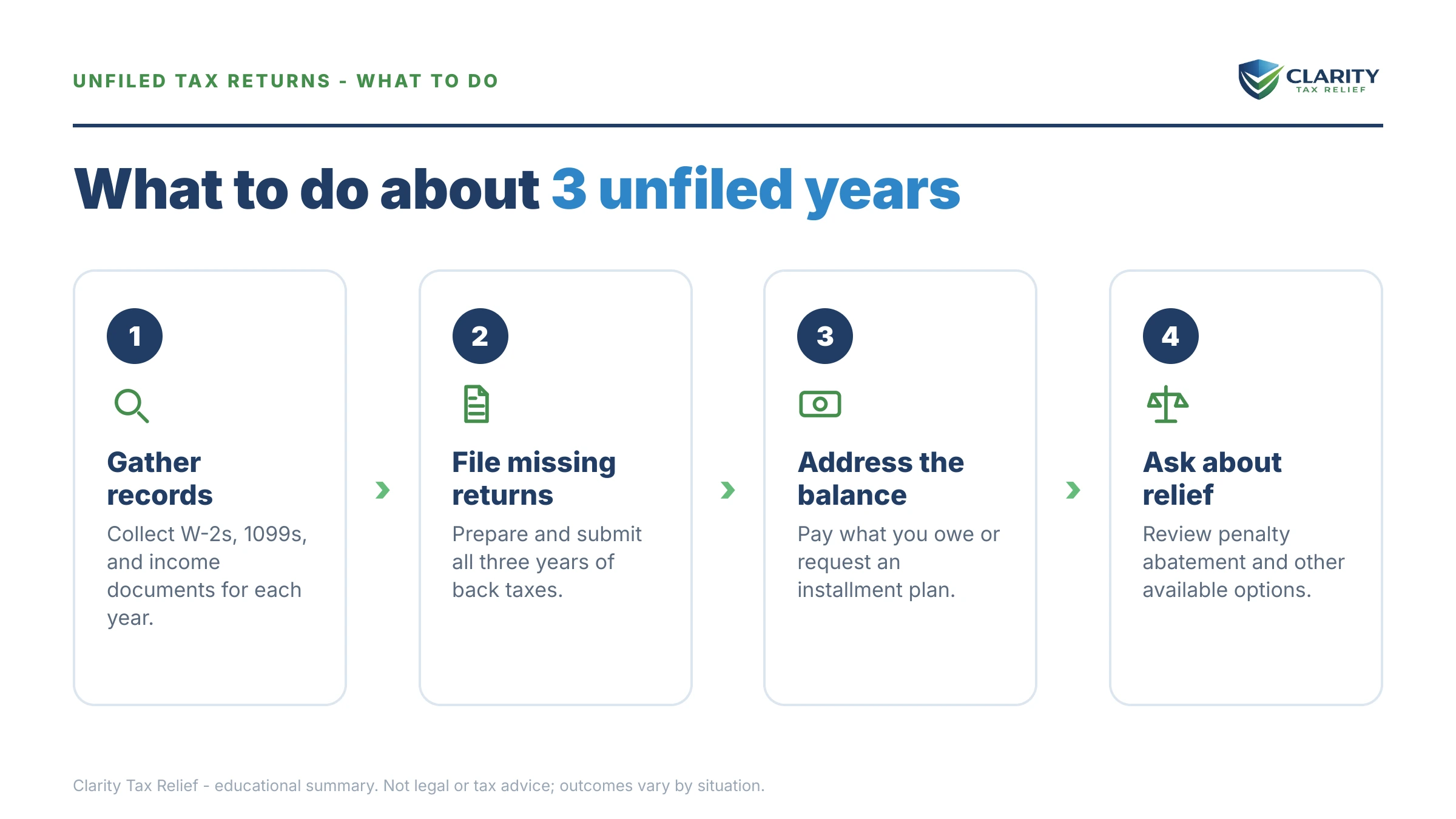
- Request your wage and income transcripts — pull the IRS's records for all three years so you know exactly what income was reported under your Social Security number before you prepare anything.
- Reconstruct your business expenses — gather bank statements, mileage records, and platform summaries for each year. The IRS accepts reasonable reconstruction when original receipts are gone.
- Prepare each return on that year's forms — use the tax rules and forms for 2023, 2024, and 2025 respectively, and mail prior-year returns on paper since old years generally can't be e-filed.
- Request penalty relief when you file — pursue first-time abatement or reasonable-cause relief for the oldest qualifying year to shrink the balance before setting up payment.
- Set up one payment arrangement for the combined balance — choose a payment plan, hardship status, or an offer before the IRS's automated collection sequence starts on the newly assessed years.
For step one, our walkthrough of the IRS wage and income transcript shows exactly how to pull each year's records online. For step two, filing back taxes with no records covers reconstruction methods the IRS actually accepts. Payment plan setup itself happens at the IRS's own payment plans and installment agreements page once your returns have posted.
When you can catch up yourself, and when help changes the outcome
Plenty of three-year non-filers can handle this without paying anyone. You're a good DIY candidate if your income was straightforward (a few 1099s or W-2s per year), you have or can reconstruct your expense records, you expect refunds or modest balances. Your combined balance will land under the $50,000 online-plan line. File the three returns, request abatement, set up the plan at IRS.gov/payments — done.
Experienced help earns its cost in specific situations: the IRS has already filed a substitute return or sent a CP3219N (replacing an SFR is a different, deadline-driven process). Your reconstructed balance will exceed $50,000. You had business payroll or multi-state income. You're weighing an Offer in Compromise, where the financial math decides everything. Or collection notices are already arriving on an assessed year. In those cases, the order you fix things — returns, then penalties, then the balance — materially changes what you end up paying, and it's easy to get the order wrong alone. If you'd rather come forward before the first notice ever lands, that's the strongest position of all, and it's exactly the posture the IRS's voluntary-compliance framework rewards. If you're stuck between the IRS and a hardship, the independent Taxpayer Advocate Service is a free escalation path.
Terms on your IRS mail, decoded
- Substitute for Return (SFR): a return the IRS prepares for you from third-party documents — gross income, no deductions, least favorable filing status.
- Wage and income transcript: the IRS's year-by-year list of every W-2 and 1099 reported under your SSN — the raw material for rebuilding old returns.
- Failure-to-file penalty: 5% of unpaid tax per month a return is late, capped at 25% per year — ten times the failure-to-pay rate.
- RSED (refund statute expiration date): the deadline, generally 3 years from a return's due date, after which an unclaimed refund is forfeited forever.
- CSED (collection statute expiration date): the 10-year limit on IRS collection. It starts at assessment — which means it hasn't started on any of your unfiled years.
Haven't filed in 3 years: your questions, answered
Will I go to jail for not filing taxes for 3 years?
Jail is extremely unlikely for an ordinary non-filer who comes forward voluntarily. Criminal charges are reserved for willful evasion — hiding income, faking documents, or refusing to file after repeated IRS contact. The practical consequences of three unfiled years are civil: a failure-to-file penalty of 5% per month (up to 25% per year), interest, and eventually a substitute return that overstates what you owe. Filing before the IRS contacts you is the strongest protection you have.
Can I still get refunds for 3 years of unfiled taxes?
Usually, yes — a refund can be claimed up to 3 years after the return's original due date. As of mid-2026, that window is still open for tax years 2023, 2024, and 2025. The oldest year, 2023, expires April 15, 2027. If you had withholding or refundable credits in any of those years, filing now is the only way to collect. After the deadline, the refund is permanently forfeited.
How do I file 3 years of back taxes at once?
Pull your wage and income transcripts from the IRS for each year, prepare each return using that year's tax forms and rules (not the current year's), and file all three — old returns generally must be mailed on paper. There's no penalty for submitting them together; in fact, the IRS expects non-filers to catch up in one batch. If your records are incomplete, transcripts show every W-2 and 1099 the IRS received under your Social Security number.
What happens if the IRS files a substitute return for me?
The IRS builds a return from the W-2s and 1099s it has on file — using single or married-filing-separately status, no dependents, and no business expenses or deductions. For a 1099 contractor, that means tax on gross receipts, which can double or triple the real liability. You can still file your own accurate return afterward to replace the SFR's numbers, but by then penalties have compounded and collection may already be underway.
How much are the penalties on 3 years of unfiled returns?
The failure-to-file penalty runs 5% of the unpaid tax per month, capping at 25% per year, and it applies separately to each unfiled year. On top of that, the failure-to-pay penalty adds 0.5% per month and interest compounds daily. Two or three years in, a balance can grow 30–45% beyond the original tax. Filing stops the largest penalty immediately, which is why filing always comes before worrying about payment.
Can I get one payment plan that covers all 3 years?
Yes — an installment agreement covers your total assessed balance across every year, not each year separately. If your combined balance is $50,000 or less including penalties and interest, you can typically set up a plan online for up to 72 months. Above $50,000, the IRS requires financial disclosure, which is one reason to request penalty abatement before the balance crosses that line.
Does the 10-year collection statute mean my old years will expire soon?
No — the 10-year collection clock (CSED) doesn't start until the tax is assessed, and unfiled years have never been assessed. Not filing doesn't run out the clock; it stops it from ever starting. The IRS can also assess an unfiled year at any time because the assessment statute of limitations only begins when a return is filed. Filing is what starts every protective deadline you have.
Do I need all my old records to file back taxes?
No. Your IRS wage and income transcript lists every W-2, 1099-NEC, 1099-K, and 1099-MISC reported under your SSN for each year — that's your income floor. For expenses, the IRS accepts reasonable reconstruction: bank statements, mileage estimates from calendars, and app records. A return built on transcripts plus reconstructed expenses is far better than not filing, and it's how experienced tax professionals prepare multi-year catch-ups every day.
Your next 24 hours
- Pull your IRS records. Create or log into your IRS online account and request wage and income transcripts for 2023, 2024, and 2025 — that's the exact income the IRS expects each return to explain.
- Gather what you have. Bank statements, any 1099s or W-2s in your files, mileage and expense records — imperfect is fine; reconstruction is normal.
- Get a free case review. Call (888) 825-7779 or use the 2-minute form and we'll map all three years, the penalty-relief angles. Your payment options, before the 5%-per-month penalty adds another month, and while your 2023 refund window is still open.
This guide is general information, not tax or legal advice for your specific situation. Eligibility for IRS programs depends on individual facts and circumstances; no outcome is guaranteed.