
IRS Notices
IRS CP2566 Notice: The IRS Calculated Your Tax for You, What to Do (2026)
The short answer: a CP2566 notice means the IRS has no tax return from you for the year shown, so it calculated the tax itself — using only income reported by employers, banks, and brokers, with no deductions, credits, or cost basis in your favor. Filing your actual return by the response date on the notice usually lowers the bill.
Somewhere in the back of your mind, you knew that year's return never got filed. Now the IRS has filed a version of it for you, and the total on this letter was built to be the worst-case reading of your income. That cuts one way in your favor: their numbers are a placeholder, and you're allowed to replace them with yours.
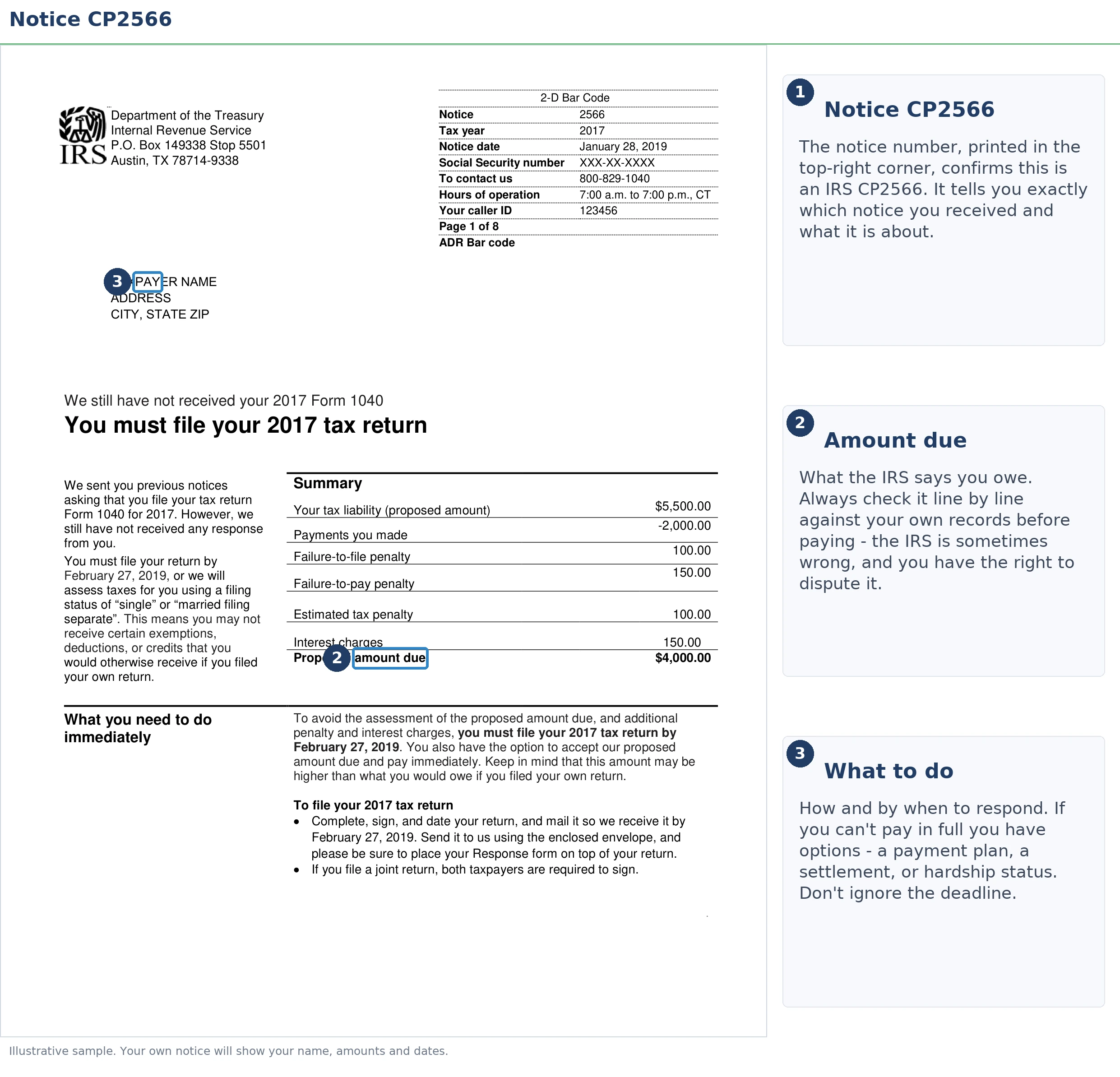
The image below shows you exactly what a CP2566 looks like and where to find the three things that matter most: the tax year, the proposed total, and the response date that controls your deadline.
⏱ Your deadline: the response date printed on your CP2566, usually near the top of the first page. Miss it, and the next letter is a CP3219N Notice of Deficiency — which starts a rigid 90-day countdown, after which the IRS's calculated amount becomes a legally collectible debt.
Why you got a CP2566 notice
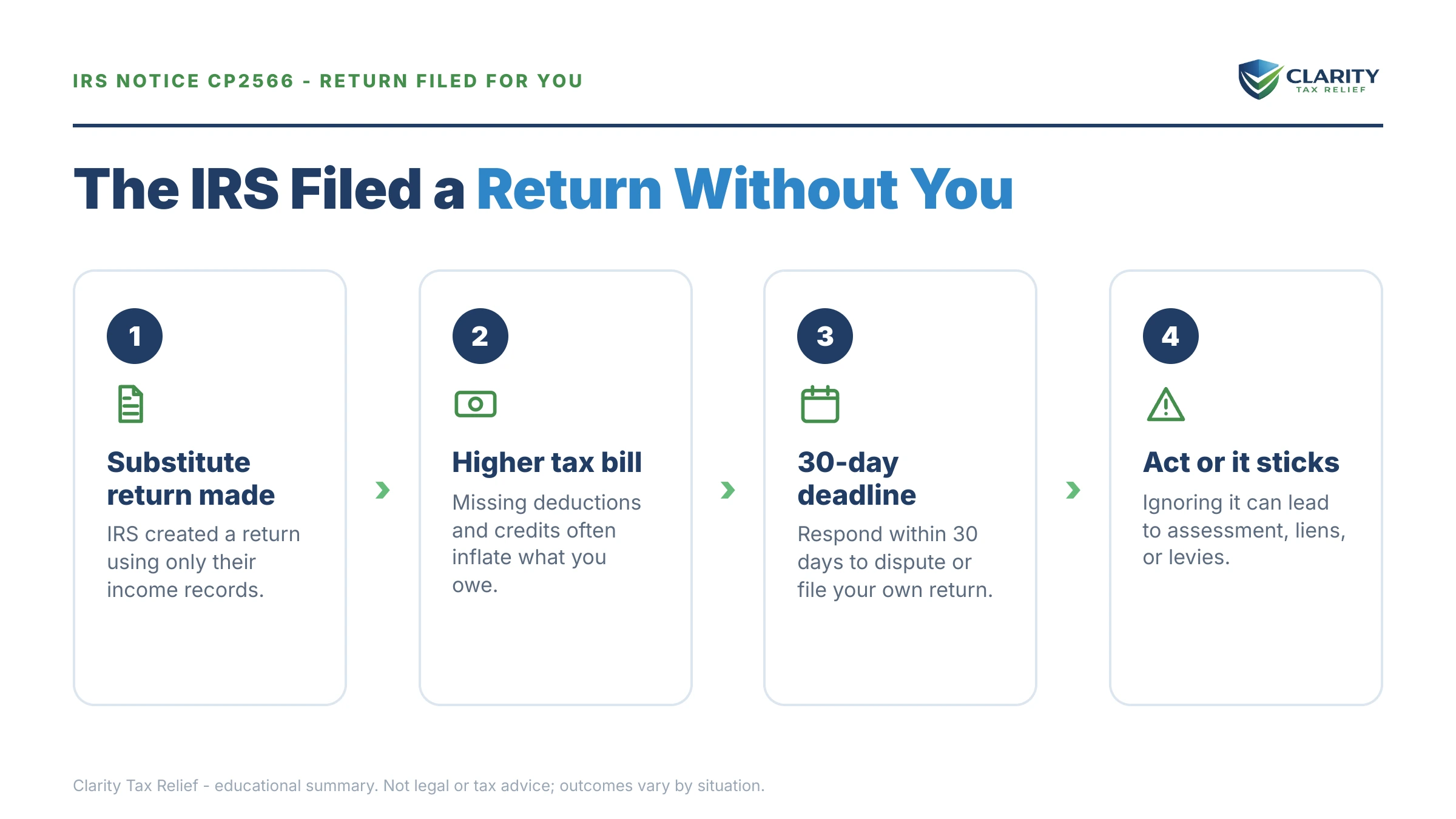
A CP2566 notice means the IRS found no tax return from you for the year shown, so it built one itself — called a substitute for return — using only the income that employers, banks, and brokers reported under your Social Security number. This comes from the Automated Substitute for Return (ASFR) program, a computer process that runs whether or not a human ever reviews your file.
Here's what makes the CP2566 number so inflated. The substitute return computes your tax as single or married filing separately, allows only the standard deduction, and includes no credits, no dependents, and zero cost basis on anything you sold. If a broker reported $80,000 in stock sale proceeds, the IRS taxed all $80,000 as gain — even if you paid $75,000 for the shares. Your W-2 withholding is credited, but nothing else you're entitled to appears anywhere.
You almost certainly received earlier letters first — a CP59 notice and possibly follow-up reminders asking you to file. The CP2566 is the stage where asking stops and proposing begins. If your letter says CP2566R, the IRS is also holding a refund from another year while it waits for your response.
One important distinction: if you did file for that year and the IRS changed your numbers, you'd be holding a CP11 notice (balance due after a correction) or a CP12 notice (correction with a refund) — different letters with different rules. Not sure why the IRS wrote to you at all? Start with our guide to why did I get a letter from the IRS.
“If the IRS files a substitute return, it is still in your best interest to file your own tax return to take advantage of any exemptions, credits and deductions you are entitled to receive.”
— Filing past due tax returns (IRS.gov)
What happens if you ignore a CP2566
If you ignore a CP2566, the IRS issues a CP3219N Notice of Deficiency, and 90 days after that it can legally assess and collect the substitute-return amount. The sequence is automated, and every stage removes an option you still have today:
- CP59 / CP516 / CP518 — the "you haven't filed" letters that usually arrived before this one. Asking stage; no proposed dollar amount yet.
- CP2566 — you are here. The IRS proposes a specific tax, penalty, and interest total and gives you a response date. Filing your own return still fully controls the outcome.
- CP3219N — the statutory Notice of Deficiency. From its date you have 90 days to file a Tax Court petition — the last way to dispute the amount without paying it first. See how the 90 day letter tax court petition process works.
- Default assessment — the 90 days pass, the substitute-return amount is assessed as a legal debt, and the 10-year collection statute starts running on it.
- The collection stream — a CP14 bill (roughly 21 days to pay), then CP501/CP503 reminders, then a CP504 that lets the IRS take your state refund, then an LT11 final notice that authorizes wage and bank levies 30 days later.
Two quieter consequences deserve attention. First, an unfiled year never times out: there's no assessment deadline on a year with no return, which is why ASFR can reach back several years. Second, a defaulted substitute return creates debt that generally can't be discharged in bankruptcy, because no return you filed exists — the details are in our guide to unfiled returns bankruptcy.
If you have several unfiled years, the assessments stack. Multiple substitute-return balances that together pass $66,000 put your passport at risk of certification in 2026. And while IRS staffing fell sharply in 2025, the ASFR program is exactly the kind of automation that kept running — the proposals, deficiency notices, and levies are generated by machine.
| Stage | What it means | Your window |
|---|---|---|
| CP59 / CP516 / CP518 | "You haven't filed" reminders | No fixed clock — file as soon as possible |
| CP2566 (you are here) | IRS proposes tax via a substitute for return | Response date printed on the notice |
| CP3219N | Statutory Notice of Deficiency | 90 days to petition Tax Court |
| Default assessment | Proposed amount becomes a legal debt; 10-year collection statute starts | Automatic once the 90 days pass |
| CP14 → CP501/CP503 → CP504 → LT11 | Collection stream ending in levy power | CP14 gives roughly 21 days; LT11 gives 30 days before levy |
Holding a CP2566 with a number you know isn't right?
Send us a photo of it before the response date on your notice passes. An experienced tax professional will pull your IRS records, tell you what the real number should be, and map the fastest way to replace the IRS's figures — free, confidential, no pressure.
Your three response options, and why filing usually wins
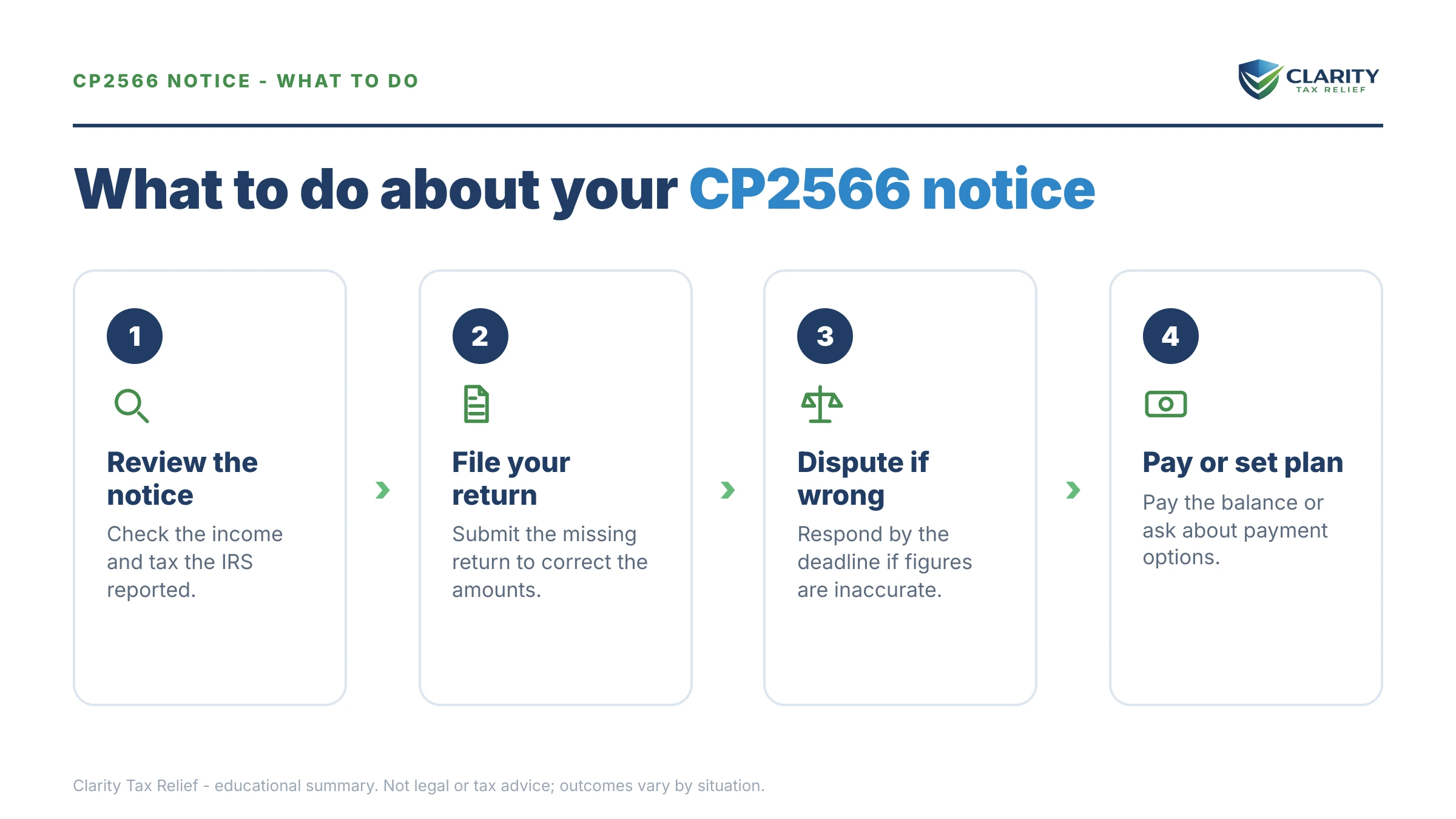
A CP2566 gives you three formal responses: file your actual return for the year shown, consent to the IRS's figures, or show you weren't required to file. The response form in your envelope has a checkbox for each.
- File your actual return. This is the right answer for nearly everyone, because your return restores everything the substitute left out. Your real filing status, deductions, credits, and cost basis. Start by pulling your IRS wage and income transcript so your return accounts for every document the IRS has. Missing paperwork isn't a dead end; here's how to file back taxes without records.
- Consent to the assessment. Signing the consent section tells the IRS to assess its figures immediately. This only makes sense in the rare case where the substitute return is actually accurate for you — a single W-2, standard deduction, no sales, no credits — and you'd rather skip preparing a return. Verify before you sign; consent ends the proposal stage.
- Show you weren't required to file. If your income was below the filing threshold for that year, say so on the response form and explain why. This is also the box to use when the income isn't yours — a W-2 or 1099 filed under your number by mistake, or identity theft — with documentation attached.
Here's exactly what changes when your return replaces the IRS's version:
| Tax item | IRS substitute return | The return you file |
|---|---|---|
| Filing status | Single or married filing separately | Your actual status |
| Deduction | Standard deduction only | Standard or itemized, whichever is larger |
| Dependents & credits | None | Every credit you're eligible for |
| Stock, crypto & property sales | Full proceeds taxed as gain (zero basis) | Only your actual gain, at the correct rate |
| Self-employment expenses | None — gross 1099 income taxed | Business expenses reduce income and SE tax |
| W-2 withholding | Credited | Credited |
A worked example: how a $48,300 proposal shrinks
Say your CP2566 proposes $48,300 for a year you didn't file. You're a single W-2 employee who earned $92,000 in wages, fully covered by withholding, and sold company stock through your brokerage for $110,000. The broker reported the $110,000 in proceeds, but not your basis. The substitute return taxed the entire $110,000 as gain:
- Additional tax on the phantom $110,000 gain: roughly $33,500
- Failure-to-file penalty (5% per month, capped at 25% of unpaid tax): about $8,400
- Failure-to-pay penalty and accrued interest: about $6,400
- Total proposed: $48,300
But you paid $101,000 for that stock, so your real gain was $9,000. File the actual return and the math resets: long-term tax on $9,000 at 15% is about $1,350, the failure-to-file penalty caps at 25% of that (about $340), and failure-to-pay penalty plus interest add roughly $260 — a total near $1,950 instead of $48,300. The numbers are hypothetical. But the mechanism isn't: penalties are percentages of the unpaid tax, so shrinking the tax shrinks everything stacked on top of it. You can estimate your own penalty and interest exposure with our IRS Penalty & Interest Calculator.
One more reason speed matters: if withholding actually covered your tax and you were due a refund, you only collect it by filing within three years of the original due date. Details in can I still get a refund from 3 years ago.
What about the balance that remains after you file?
Once your real return is processed, whatever genuinely remains is an ordinary tax debt with ordinary resolution paths:
| Balance after filing | Realistic options | What to know |
|---|---|---|
| $0 or a refund | Nothing to resolve — confirm the IRS processed your return | Refunds are only paid if you file within 3 years of the original due date |
| Under $10,000 | Pay within 180 days ($0 setup), or a guaranteed installment agreement | All required returns must be filed first — which your CP2566 response handles |
| $10,000–$50,000 | Streamlined installment agreement — up to 72 months, set up online | Direct debit is required at the top of this range; interest and penalties keep accruing on any plan |
| Over $50,000 | Payment plan with financial disclosure, Currently Not Collectible status, or an Offer in Compromise where the math supports it | The IRS accepted roughly 1 in 5 offers in FY2024 — eligibility is means-tested, never assumed |
How to respond to a CP2566, step by step
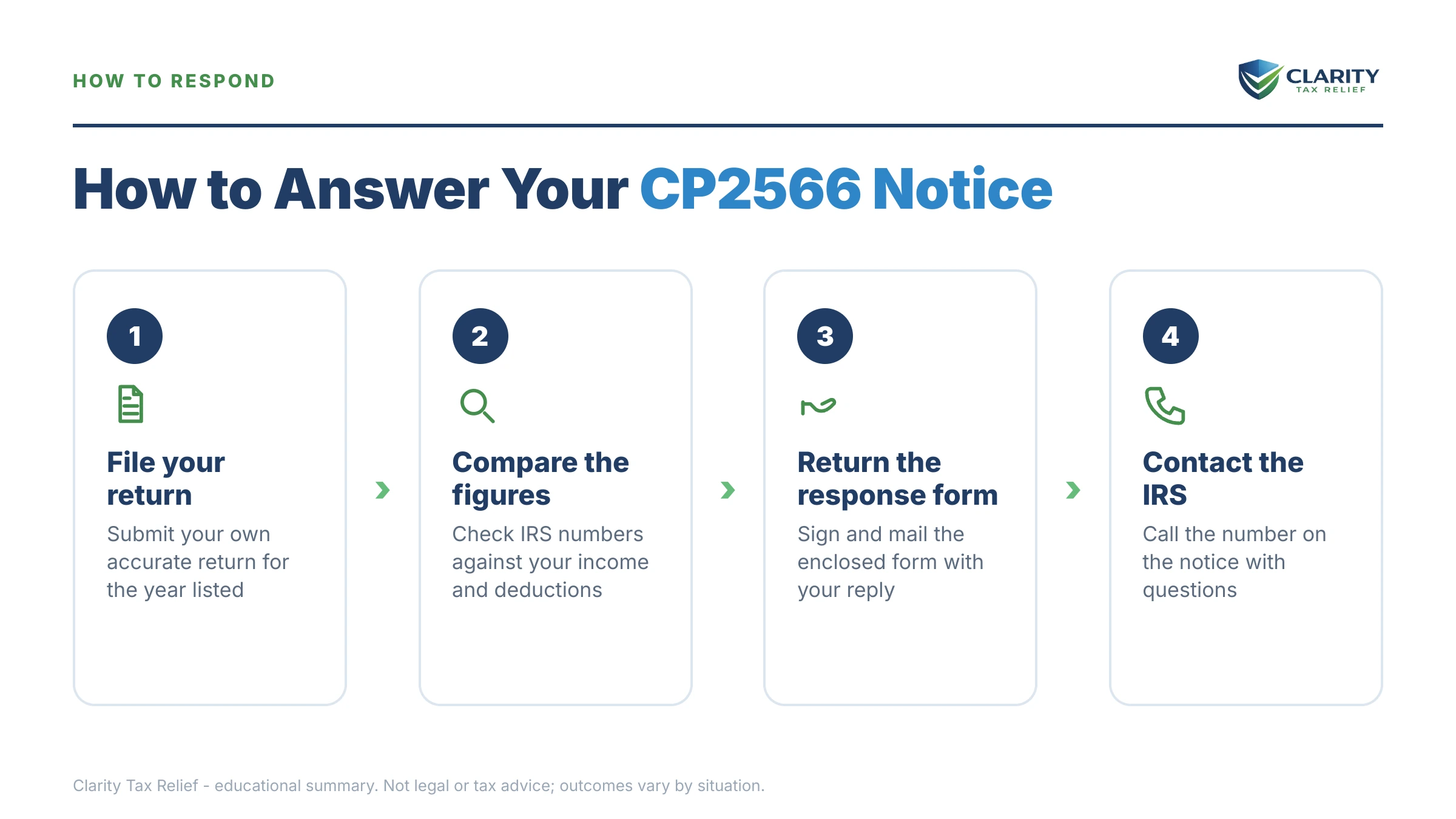
- Pull your wage and income transcript. See exactly which W-2s and 1099s the IRS used for the year on the notice. That list is the raw material of the substitute return.
- Compare the IRS's numbers to your records. Flag missing cost basis, deductions, credits, and any income document that isn't yours.
- Prepare your actual return for that year. Account for every document on the transcript so the IRS can match your return to its records without follow-up questions.
- Mail your response by the date on the notice. Send the return and the completed response form to the address printed on the CP2566, and keep proof of mailing.
- Arrange payment for the real balance. Pay in full if you can, or set up a payment plan before the corrected balance starts moving through collection notices.
- Confirm the IRS processed your return. Check your account transcript over the following weeks. If the substitute figures are still showing, follow up before the next notice arrives.
When you can handle a CP2566 yourself, and when help changes the outcome
Most W-2 employees with a single unfiled year can answer a CP2566 themselves by filing the missing return. If your income was one or two W-2s, your records are reachable. The resulting balance is something you can pay or put on a simple plan, you don't need to hire anyone — pull your transcript, prepare the return, mail it by the response date, and you're done.
Experienced help changes the outcome in a narrower set of situations: several unfiled years (where filing order and which years to file first affect the total), substantial 1099 or brokerage income that needs basis and expense reconstruction, a CP3219N that already arrived with its 90-day clock running, a balance large enough that resolution strategy matters, or income on the notice that isn't yours. In those cases the return itself is only half the job — the sequencing is the other half.
Terms on your CP2566, decoded
- Substitute for return (SFR): the return the IRS prepared for you, using only third-party income documents and none of your deductions.
- ASFR: the Automated Substitute for Return program — the computer process that generates CP2566 notices for non-filers.
- Notice of Deficiency: the formal letter (a CP3219N here) that starts a 90-day window to dispute the amount in Tax Court before it's assessed.
- Wage and income transcript: the IRS's list of every W-2 and 1099 filed under your Social Security number for a given year.
- Consent to assessment: the signature section of the response form telling the IRS to assess its proposed figures immediately, ending the proposal stage.
- Failure-to-file penalty: 5% of the unpaid tax per month, capped at 25% — ten times the rate of the failure-to-pay penalty, which is why filing matters even when you can't pay.
CP2566 questions, answered
What is an IRS CP2566 notice?
A CP2566 notice means the IRS has no tax return from you for the year shown, so it calculated the tax itself — using only income reported by employers, banks, and brokers, with no deductions, credits, or cost basis in your favor. Filing your actual return by the response date on the notice usually lowers the bill.
Is a CP2566 notice an audit?
No — a CP2566 comes from the IRS's Automated Substitute for Return program for people who didn't file, not from an examination of a return you submitted. No one is questioning your deductions, because the substitute return doesn't include any. Filing your actual return for the year shown is the normal response, and it does not by itself trigger an audit.
Do I have to pay the amount shown on my CP2566?
Not yet — the CP2566 total is a proposal, not an assessed debt. If you file your actual return by the response date, the IRS generally uses your figures instead, and most filers end up owing meaningfully less than the substitute-return amount. Only sign the consent portion of the response form if you've verified the IRS's numbers are genuinely right for you.
Can I still file my own tax return after getting a CP2566?
Yes, and it's almost always the best response. Mail the completed return for the year shown with the response form to the address on the notice. The IRS will generally process it in place of the substitute return. Even if the substitute amount has already been assessed, you can still file and request reconsideration. It just takes longer and collection may start in the meantime.
What happens if I ignore a CP2566 notice?
The IRS sends a CP3219N Notice of Deficiency, which gives you 90 days to petition Tax Court. If that window passes, the substitute-return amount is assessed as a legal debt and the collection sequence begins — bills, then a CP504, then a final notice that authorizes wage and bank levies. Interest and penalties grow the whole time, so every stage costs more than the one before it.
Will I get a refund if I was actually owed money that year?
Only if you file within three years of the return's original due date, after that, the refund is forfeited to the Treasury even though your filing obligation remains. Withholding on your W-2 sometimes covers the whole substitute-return balance and then some, so it's worth running the numbers quickly. If your three-year window is still open, filing fast protects money that is legally yours.
What is the difference between a CP2566 and a CP3219N?
The CP2566 is the informal proposal stage: you can respond by simply filing your return, consenting, or explaining that you weren't required to file. The CP3219N is the statutory Notice of Deficiency that follows if you don't respond. It starts a rigid 90-day clock, and after that your only dispute path without paying first is Tax Court. Everything is easier and cheaper at the CP2566 stage.
Can tax debt from a substitute return be wiped out in bankruptcy?
Generally no. Most courts hold that a substitute for return the IRS prepared doesn't count as a return you filed, which is a requirement for discharging income tax debt in bankruptcy. Filing your own return, even late, matters for this reason too, though the timing rules are strict and depend on your specific dates. This is one of the quieter long-term costs of letting a CP2566 default.
What if I wasn't required to file a return that year?
The response form has a section for exactly this — check it and explain why, for example because your income was below the filing threshold for your filing status and age. The same section is where you dispute income that isn't yours, such as a W-2 or 1099 filed under your Social Security number by mistake or through identity theft. Attach whatever documentation supports your explanation.
Your next 24 hours
- Find three things on your notice: the tax year, the proposed total, and the response date near the top of page one. Write that date somewhere you'll see it.
- Gather your records for that year: W-2s, 1099s, brokerage statements showing what you paid for anything you sold, and request your wage and income transcript so nothing the IRS has is missing from your return.
- Get a free case review before the response date passes: use the 2-minute form or call (888) 825-7779. We'll tell you what your real number looks like and the fastest way to put it in front of the IRS.
The IRS's own explainer for this notice is at Understanding your CP2566 notice. Payment options for whatever balance remains after you file are laid out on the IRS payment plans page, and if the IRS's processing of your response stalls and causes hardship, the Taxpayer Advocate Service is an independent avenue for help.
This guide is general information, not tax or legal advice for your specific situation. Eligibility for IRS programs depends on individual facts and circumstances; no outcome is guaranteed.