
IRS Notices · Employee Retention Credit
IRS Notice CP320B: Your Employee Retention Credit Claim Is Under Review (2026)
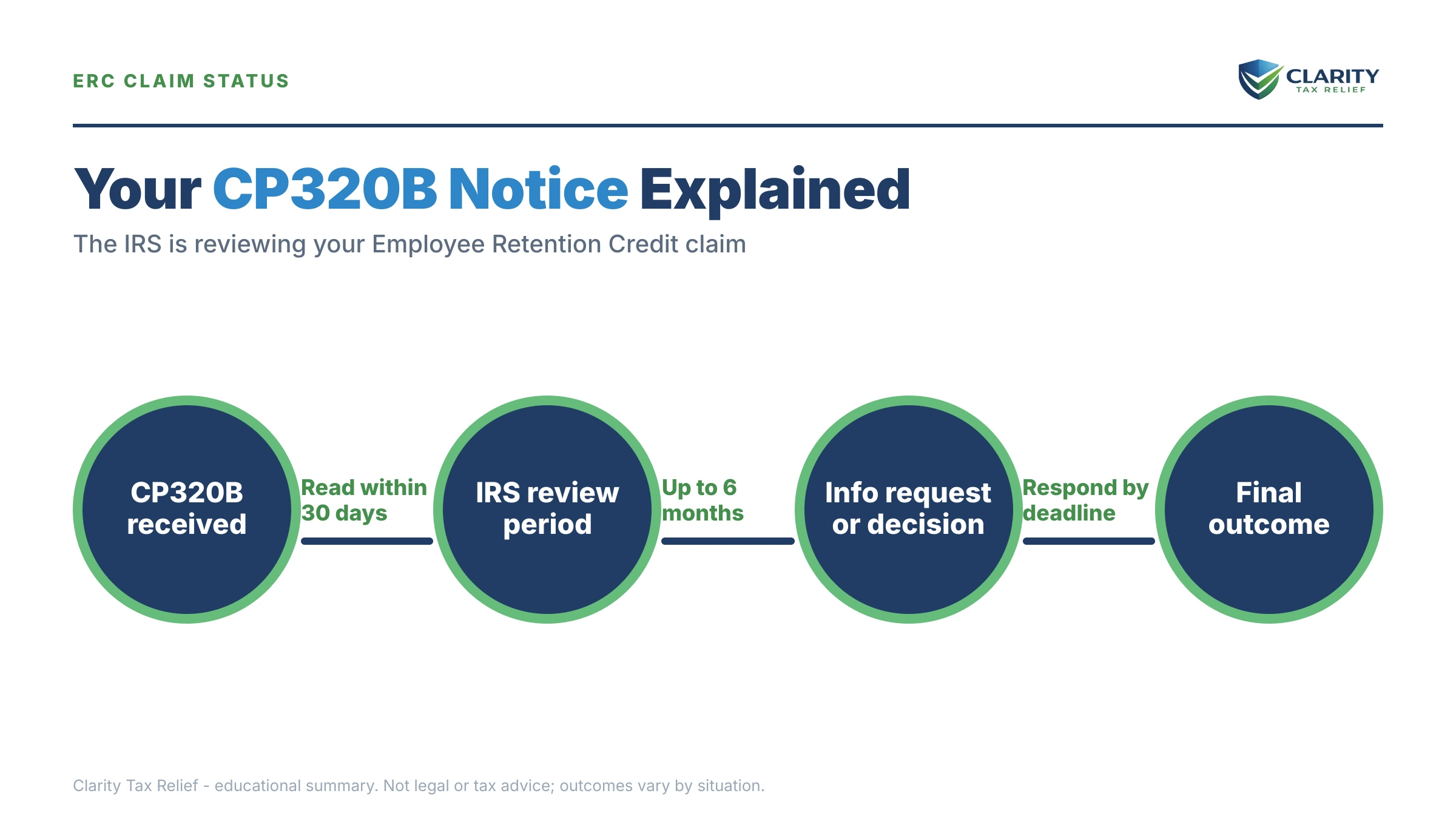
The short answer: a CP320B notice means the IRS is holding and reviewing your business's Employee Retention Credit claim before deciding whether to pay it, cut it, or deny it. It is not a bill and not an audit assessment yet, but it can end in a partial or full disallowance, so respond by the date on the notice with documentation.
You filed a Form 941-X to claim the Employee Retention Credit, waited months, and instead of a refund check the IRS sent a CP320B saying your claim is under review. Your stomach dropped, because this money is already spoken for in your cash-flow plan. Here is the part to hold onto: a CP320B is a review, not a verdict, and how you respond in the next few weeks shapes whether you keep the credit.
This guide walks through who gets a CP320B, what the IRS is actually looking for, the very real risk of a full or partial disallowance, and the 2026 enforcement landscape — the processing moratorium, the Withdrawal Program, and the Voluntary Disclosure Program. Below, the highlighted boxes on the annotated notice show exactly which line carries your response deadline — the box most business owners skim right past.
⏱ Your deadline: the response date printed on your CP320B — commonly about 30 days from the notice date. Missing it does not automatically disallow your claim, but it lets the IRS decide on the record it already has, which is the weakest possible position for a legitimate credit.

What a CP320B notice means
A CP320B is the IRS telling you it has pulled your Employee Retention Credit claim aside for a closer look before releasing any refund. It is one of a family of ERC review letters the IRS began sending as it worked through its backlog of amended payroll returns. The notice usually identifies the tax periods (payroll quarters) at issue and asks you to substantiate why your business qualified for the credit in those quarters.
The credit itself was large by design. For 2020, it was worth up to $5,000 per employee for the year. For the first three quarters of 2021, up to $7,000 per employee per quarter. A modest employer can easily have a six-figure claim across multiple quarters — which is exactly why the IRS is reviewing them one by one.
The CP320B by itself does not assess tax or demand payment. It is the gate your refund has to pass through. What comes out the other side is one of three things: the credit is paid, it is reduced, or it is denied.
“The IRS is concerned about a large number of improper ERC claims and is closely reviewing tax returns that claim the credit. The IRS urges taxpayers to review their claims and quickly resolve incorrect ones.”
— Employee Retention Credit (IRS.gov)
Who receives a CP320B
A CP320B goes to the business or organization whose name is on the Form 941-X that claimed the Employee Retention Credit. That means the entity, not the individual owner, is the taxpayer under review, even in a single-member LLC or a closely held S corporation.
You are most likely to see one if any of these describe your claim:
- You claimed the credit for 2021 quarters, where the per-employee dollars are largest and IRS scrutiny is heaviest.
- A third-party promoter or "ERC mill" prepared your claim, often on contingency, sometimes with aggressive eligibility theories the IRS is actively challenging.
- Your eligibility rested on a "partial suspension" from a government order rather than a clear gross-receipts decline, which is the fact pattern the IRS questions most.
- Your claim overlaps with PPP loan forgiveness on the same wages, which is not allowed and is easy for the IRS to flag.
- You are a tax-exempt organization, staffing firm, or other entity whose eligibility math is more complex than a typical small business.
Getting a CP320B does not mean the IRS believes your claim is fraudulent. Many legitimate claims are being reviewed simply because the whole program is under a microscope. The point is to prove your eligibility on paper, not to panic.
Why the IRS is reviewing ERC claims in 2026
The Employee Retention Credit became one of the most abused pandemic programs, and the IRS's response reshaped how every claim is now handled. Three developments define the 2026 landscape, and understanding them tells you which options are still on the table.
The processing moratorium. On September 14, 2023, the IRS stopped processing newly filed ERC claims because of a flood of questionable submissions pushed by promoters. Processing later resumed, but with intense screening — which is why claims filed before the pause are only now surfacing as CP320B reviews. If your refund has been stuck for a long time, this is why.
The ERC Withdrawal Program. The IRS created a path for businesses to pull back a claim they now doubt. If your claim has not been paid and is not already under a full exam, an eligible withdrawal is treated as though the claim was never filed — which can avoid penalties and interest on that claim. It is aimed at businesses that were talked into a credit they cannot actually support.
The Voluntary Disclosure Program (VDP). For businesses that already received an ERC refund they were not entitled to, the IRS ran limited-time voluntary disclosure windows that let eligible employers repay a reduced portion of the credit and avoid harsher penalties. The terms and availability of these windows have changed over time, so treat VDP as a "verify the current rules" option rather than an open door.
Layered on top of all of this: the IRS workforce shrank by roughly 27% during 2025. Human review is slower, but the automated review letters, including CP320B, never stopped going out. That combination is the real 2026 story: slow to pay, fast to scrutinize.
The risk: full or partial disallowance
The single biggest stake in a CP320B is that your claim can be reduced or denied. The money you counted on may never arrive, or may have to be paid back. There are two disallowance letters, and it matters which one you get.
- Full disallowance arrives as IRS Letter 105-C. The IRS is denying the entire claim for the periods listed.
- Partial disallowance arrives as IRS Letter 106-C. The IRS accepts part of the claim and cuts the rest — for example, allowing wages tied to a documented gross-receipts decline but denying wages you also used for PPP forgiveness.
If you have not been paid yet, a disallowance simply means no refund. If you were already paid and the claim is later disallowed on examination, the IRS can recapture the credit and add penalties and interest running from the date the refund was issued — turning a windfall into a balance due. That is the scenario that can leave a business owing the IRS $40,000, $60,000, or far more, depending on the size of the claim.
| Outcome | What you receive | What it means |
|---|---|---|
| Claim allowed | Refund + interest | The IRS accepts your documentation and pays the credit. |
| Partial disallowance | Letter 106-C | Part of the claim is paid; the rest is denied. You can appeal the denied portion. |
| Full disallowance | Letter 105-C | The entire claim is denied. Appeal or refund suit rights apply. |
| Recapture (already paid) | Exam adjustment + bill | A paid credit is clawed back with penalties and interest from the pay date. |
What happens if you ignore a CP320B
Ignoring a CP320B hands the decision to the IRS on the thinnest possible record, and the sequence that follows is largely automated. Here is the escalation path when a business does nothing:
- CP320B — review notice. You are here. The IRS is asking you to substantiate the claim.
- No response by the deadline — the IRS decides using only what it has, which typically means disallowance for lack of substantiation.
- Letter 106-C or 105-C — partial or full disallowance is issued, starting the clock on your appeal and refund-suit rights.
- Recapture and assessment — if you were already paid, the IRS moves to recover the credit, adding penalties and interest.
- Collection begins — an unpaid recapture balance enters the normal collection stream (bills, then liens and levies) like any other payroll tax debt.
The window narrows at every stage. Responding fully to the CP320B, while you still control the record, is the cheapest and strongest moment in this entire chain, exactly the way it is with any IRS notice.
Got a CP320B holding your ERC refund?
Send us the notice. An experienced tax professional will review which quarters are at issue and what your documentation actually supports, free and confidential, before your response deadline closes.
Your options after a CP320B, and what each one costs
Your best move depends on one honest question: can you actually substantiate the claim? The answer sorts you into one of four paths, each with different consequences for penalties and interest.
| Option | Best when | Consequence |
|---|---|---|
| Respond & substantiate | Your eligibility and records are solid | Claim paid in full or in part; preserves appeal rights. |
| Withdraw the claim | Refund unpaid, claim not on full exam, claim is weak | Treated as never filed; avoids penalties/interest on that claim. |
| Voluntary Disclosure | You were already paid but were not eligible | Repay a reduced amount under current VDP terms (verify availability). |
| Appeal a disallowance | You disagree with a 105-C or 106-C | Protest to IRS Appeals or file a refund suit within the deadlines. |
Respond and substantiate. If your eligibility is real, this is the path. You send the government-order analysis or gross-receipts numbers, payroll records, PPP-overlap worksheets, and the eligibility memo behind your credit. Cost here is mostly your time and any professional fee to organize the response. It is the only path that ends in getting paid.
Withdraw the claim. If a promoter computed a credit you cannot defend and the money has not been paid, the ERC Withdrawal Program can let you pull it back as though it was never filed. That avoids penalties and interest on the withdrawn claim — a clean exit when the claim is indefensible.
Voluntary Disclosure. If you already banked a refund you were not entitled to, VDP has been the way to repay a reduced portion and sidestep steeper penalties. Because the IRS opens and closes these windows on its own schedule, confirm the current terms before relying on them.
Appeal a disallowance. If the IRS denies a claim you believe is valid, you are not out of moves. You can protest to IRS Appeals and, if needed, file a refund suit in U.S. District Court or the Court of Federal Claims. Our full walkthrough of the ERC disallowance appeal process covers the deadlines and where each path leads.
A worked example: what a disallowance can cost
Numbers make the stakes concrete, so here is a clearly hypothetical scenario. Say your business claimed $180,000 in ERC across three 2021 quarters — roughly $60,000 per quarter for about a dozen employees — and a promoter built the eligibility on a "partial suspension" theory.
Scenario A — unpaid, then disallowed. The refund never arrived, and the IRS issues a Letter 105-C denying all $180,000. You are out the expected cash, but you owe nothing back. Your fight, if you have documentation, is to appeal and try to recover the credit.
Scenario B — already paid, then recaptured. You received the $180,000, spent it, and two years later an exam disallows it. The IRS recaptures the full $180,000 and adds interest from the date it paid you, plus a possible accuracy penalty of up to 20%. That alone could be $36,000. You could realistically be looking at a bill well over $220,000 once interest is layered on. You can estimate how penalties and interest stack on a recaptured balance with our IRS penalty and interest calculator.
Scenario C — partial disallowance. The IRS allows the two quarters tied to a documented gross-receipts decline ($120,000) and denies the third quarter's $60,000 that overlapped with PPP wages, sending a Letter 106-C. You keep most of the credit and appeal only the $60,000 you believe is defensible.
The difference between these outcomes is largely documentation and timing — which is exactly what a CP320B response lets you control.
How to respond to a CP320B, step by step
Respond in writing, on time, and answer every item the notice raises. Here is the sequence that protects your claim and your rights.
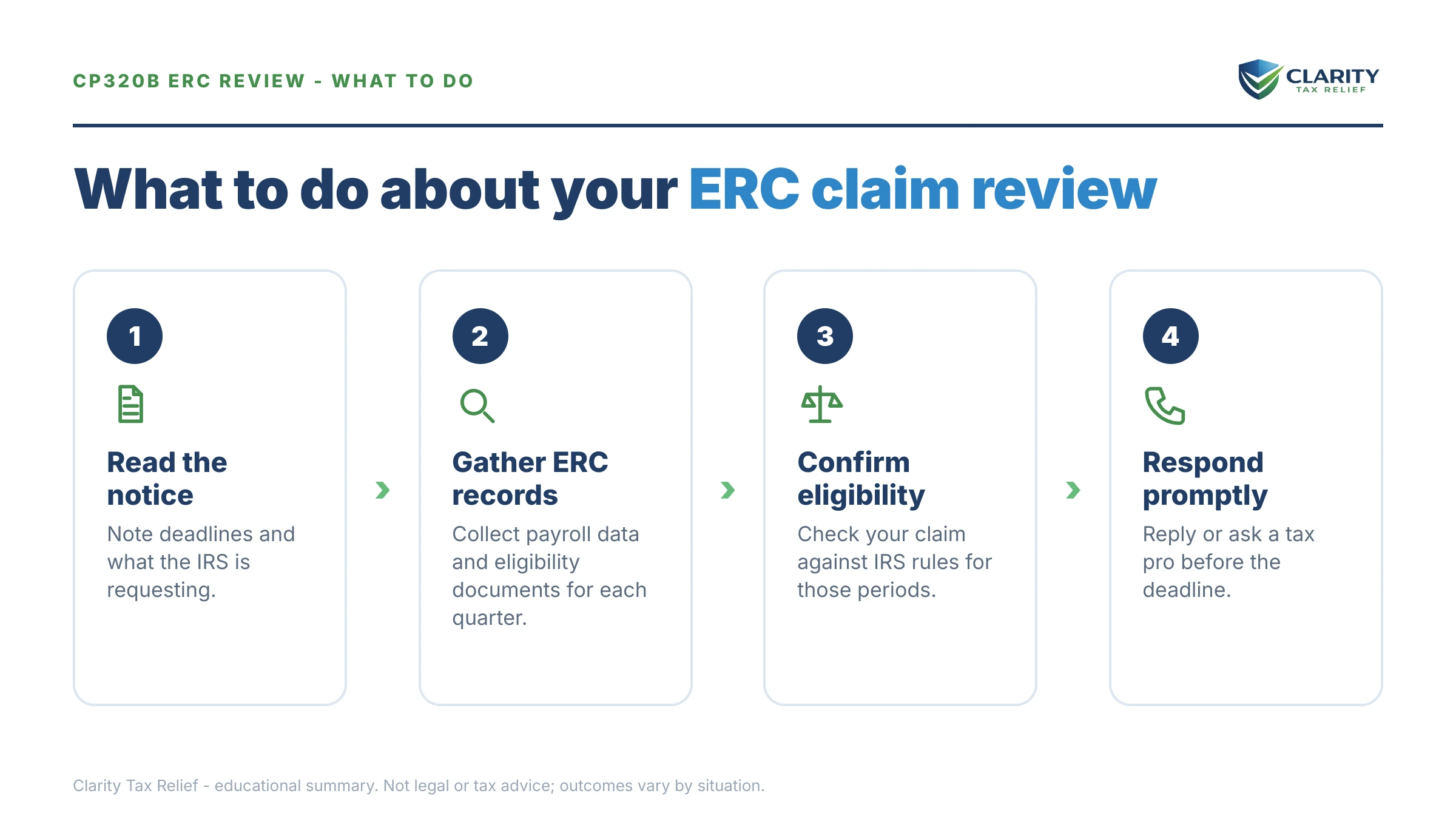
- Find the response deadline and the quarters at issue. Read the date on the notice and note exactly which payroll periods and Form 941-X filings the IRS is reviewing.
- Pull the file that supports your claim. Gather your government-order or gross-receipts analysis, payroll registers, PPP-overlap worksheets. The eligibility memo used to compute the credit.
- Decide whether the claim is defensible. Compare your documentation against the ERC rules. If it holds, respond. If it does not, weigh the Withdrawal Program or Voluntary Disclosure instead.
- Respond in writing before the deadline. Address every requested item, send documentation by trackable mail, and keep a complete copy of everything you submit.
- Protect your appeal and refund-suit rights. If a 105-C or 106-C follows, calendar the protest and refund-suit deadlines, and consider Form 907 to extend the two-year window to sue.
- Get representation if the dollars or the facts are complicated. Large claims, promoter-built credits, or multiple quarters are worth a professional review before you send anything.
If your response raises questions, the CP320B review can widen into a full examination — our guide to the ERC audit covers what that looks like and how to prepare.
When you can handle this yourself, and when you shouldn't
You can often respond to a CP320B on your own when the claim is small, the eligibility is clear. Your records are already organized. If your business had a clean, documented gross-receipts decline in the quarters at issue. You have the payroll numbers to match, sending an organized substantiation package is a reasonable DIY task.
Bring in an experienced tax professional when the stakes or the facts get harder to defend:
- A promoter or ERC mill computed your credit. Those are the claims the IRS challenges hardest, and you need to know whether yours holds up before you respond.
- The claim is large or spans multiple quarters, where a wrong move multiplies across periods.
- You already received the refund and now face possible recapture — the withdrawal-versus-voluntary-disclosure decision has major dollar consequences.
- Your eligibility rests on a partial-suspension argument, which requires a careful tie between a specific government order and a real effect on your operations.
- You have already been disallowed and need to appeal or sue within tight deadlines.
Honesty matters here: not every CP320B needs a professional. But when a six-figure claim or a possible recapture is on the line, the review is cheap insurance against a very expensive mistake.
Weighing withdrawal against a fight? Get a free CP320B review before you respond — the wrong choice can cost far more than the claim itself.
Terms on your notice, decoded
Employee Retention Credit (ERC): a refundable payroll tax credit for eligible employers who kept staff on during pandemic-era shutdowns or revenue declines.
Form 941-X: the amended quarterly payroll return most businesses used to claim the ERC after the fact.
Disallowance: the IRS's denial of a claim — full (Letter 105-C) or partial (Letter 106-C).
Recapture: the IRS recovering a credit it already paid you, with penalties and interest, when the claim is later found invalid.
Withdrawal Program: a path to pull back an unpaid, not-yet-examined claim so it is treated as never filed.
Voluntary Disclosure Program (VDP): a limited-window program to repay an improperly received credit at a reduced amount and avoid steeper penalties.
CP320B questions, answered
What does a CP320B notice mean?
A CP320B means the IRS is holding or examining your business's Employee Retention Credit claim before it decides whether to pay, partially pay, or deny the refund. It is not a bill and not an audit assessment yet. It is a review that can end in full payment, partial disallowance (Letter 106-C), or full disallowance (Letter 105-C).
Is a CP320B the same as an ERC audit?
Not exactly. A CP320B is a documentation review of your claim, usually before any refund is paid. A full ERC audit is a broader examination with an assigned examiner, an information document request, and interviews. A CP320B can turn into an audit if your response raises questions, so treat it as the first stage of scrutiny, not a formality.
How long do I have to respond to a CP320B?
Use the exact response date printed on your notice. It is commonly about 30 days from the notice date. Missing it does not automatically mean disallowance. But it lets the IRS decide on the record it already has, which is usually the weakest possible position for your claim. Respond on time, in writing, with documentation.
Can I still withdraw my ERC claim after a CP320B?
Often yes, if the refund has not been paid and the claim is not already under a full examination. The ERC Withdrawal Program treats an eligible withdrawn claim as if it was never filed, which can avoid penalties and interest on that claim. Whether you qualify depends on the status of your specific filing, so confirm before you rely on it.
What happens if the IRS disallows my ERC claim?
You receive Letter 105-C for a full disallowance or Letter 106-C for a partial disallowance. You can protest to IRS Appeals or file a refund suit in U.S. District Court or the Court of Federal Claims, generally within two years. If you already received the refund, a disallowance on exam can create a balance due with penalties and interest.
Do I have to repay ERC money I already received?
If a claim you were already paid is later disallowed, yes — the IRS can recapture the credit and add penalties and interest from the date it was paid. The Voluntary Disclosure Program was designed for exactly this situation, letting eligible businesses repay a reduced amount, though its availability changes, so verify the current terms before relying on it.
Why is my ERC claim taking so long?
The IRS paused processing new ERC claims in September 2023 and has been working through a large backlog with heightened scrutiny ever since. A CP320B is part of that scrutiny. Combined with a workforce reduced by roughly 27% in 2025, legitimate claims are moving slowly while questionable ones are being screened out.
Should I hire someone to handle a CP320B?
If your documentation is complete and your eligibility is clear-cut, you may be able to respond yourself. Get experienced help when the dollars are large, when a promoter computed your credit, when multiple quarters are at issue, or when you are weighing withdrawal versus voluntary disclosure. Those decisions change what you keep and what you owe.
Your next 24 hours
Turn the worry into three concrete moves before the day is out:
- Find your response deadline. Locate the date and response window on the CP320B, and note which payroll quarters are listed.
- Gather your ERC file. Pull the eligibility memo, the gross-receipts or government-order analysis, payroll records, and any PPP-overlap worksheets behind the claim.
- Get a free case review. Send us the notice at our 2-minute form or call (888) 825-7779 — an experienced tax professional will tell you what your documentation supports and whether to respond, withdraw, or disclose, before your deadline closes.
This guide is general information, not tax or legal advice for your specific situation. Eligibility for IRS programs depends on individual facts and circumstances; no outcome is guaranteed.
Primary sources: Employee Retention Credit