
IRS Notices
IRS IP PIN CP01A Notice: What It Means and What to Do With Your New PIN (2026)
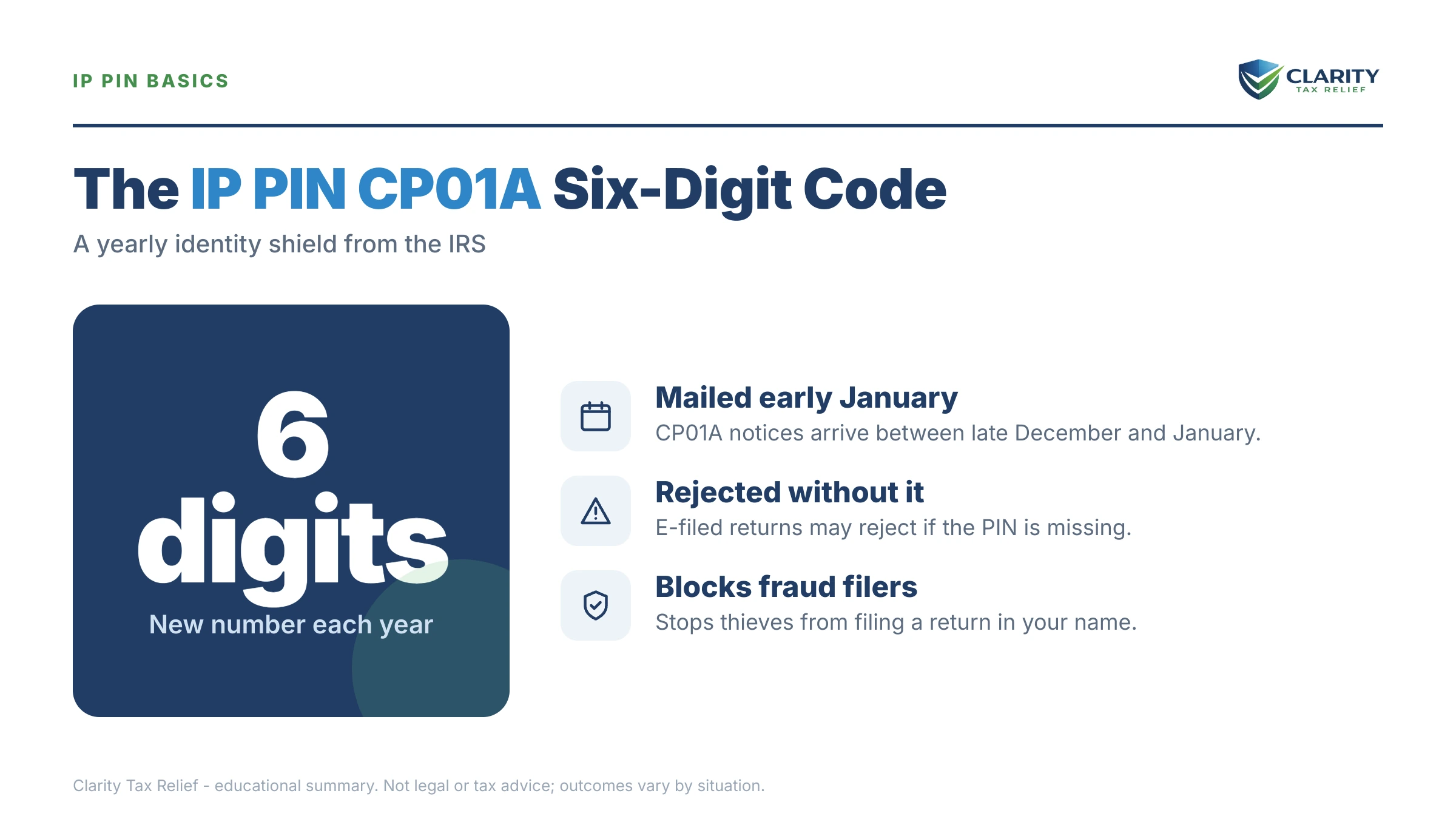
The short answer: a CP01A is the IRS notice that delivers your new six-digit Identity Protection PIN (IP PIN) for the coming filing season. It's not a bill and not an audit. The PIN is valid for one calendar year, and you must enter it on your federal return — e-filed returns without it are rejected.
You opened an IRS envelope braced for a dollar amount, and instead the IRS IP PIN CP01A notice handed you a six-digit number and no bill at all. That's genuinely good news. Those six digits are a lock the IRS put on your Social Security number. The only way this letter hurts you is if you lose it before you file.
The image below shows exactly what a CP01A looks like and where the six-digit PIN sits on the page — it's easy to skim past the one number that matters, so knowing where to look saves you a scramble in April.
⏱ The real clock: a CP01A has no reply deadline. You don't respond to it at all. But the six-digit IP PIN printed on it is required on every federal return you file this calendar year, and an e-filed return without it is rejected. Lose the letter in December and you'll feel it on April 15.
Why you got an IRS IP PIN CP01A notice
The IRS mails a CP01A every year, typically in late December or early January, to every taxpayer enrolled in the Identity Protection PIN program — each letter carries a brand-new six-digit PIN for that filing season. There are two paths into that mailing list, and which one you're on changes what the letter means.
Path one: you're a confirmed identity-theft victim. If someone filed a fraudulent return with your SSN and the IRS resolved the case — usually after you submitted a Form 14039 identity-theft affidavit — the IRS placed a permanent identity-theft marker on your account. From that point on, a new CP01A arrives automatically every year, and enrollment is permanent. You can't opt out, and that's the point: the PIN is what stops the thief from filing in your name again. If this is your situation and you're still untangling the original fraud, start with our guide to someone filed taxes in my name.
Path two: you opted in. The IP PIN program has been open to all taxpayers since 2021. If you enrolled voluntarily, your annual PIN may arrive by mail or, if you signed up through the online tool, you may be expected to retrieve it yourself each January with no letter at all. More on that difference below, because it's the number-one source of confusion.
Either way, a CP01A means protection is active. It does not mean a new fraud attempt just happened, and it has nothing to do with an audit or a balance due.
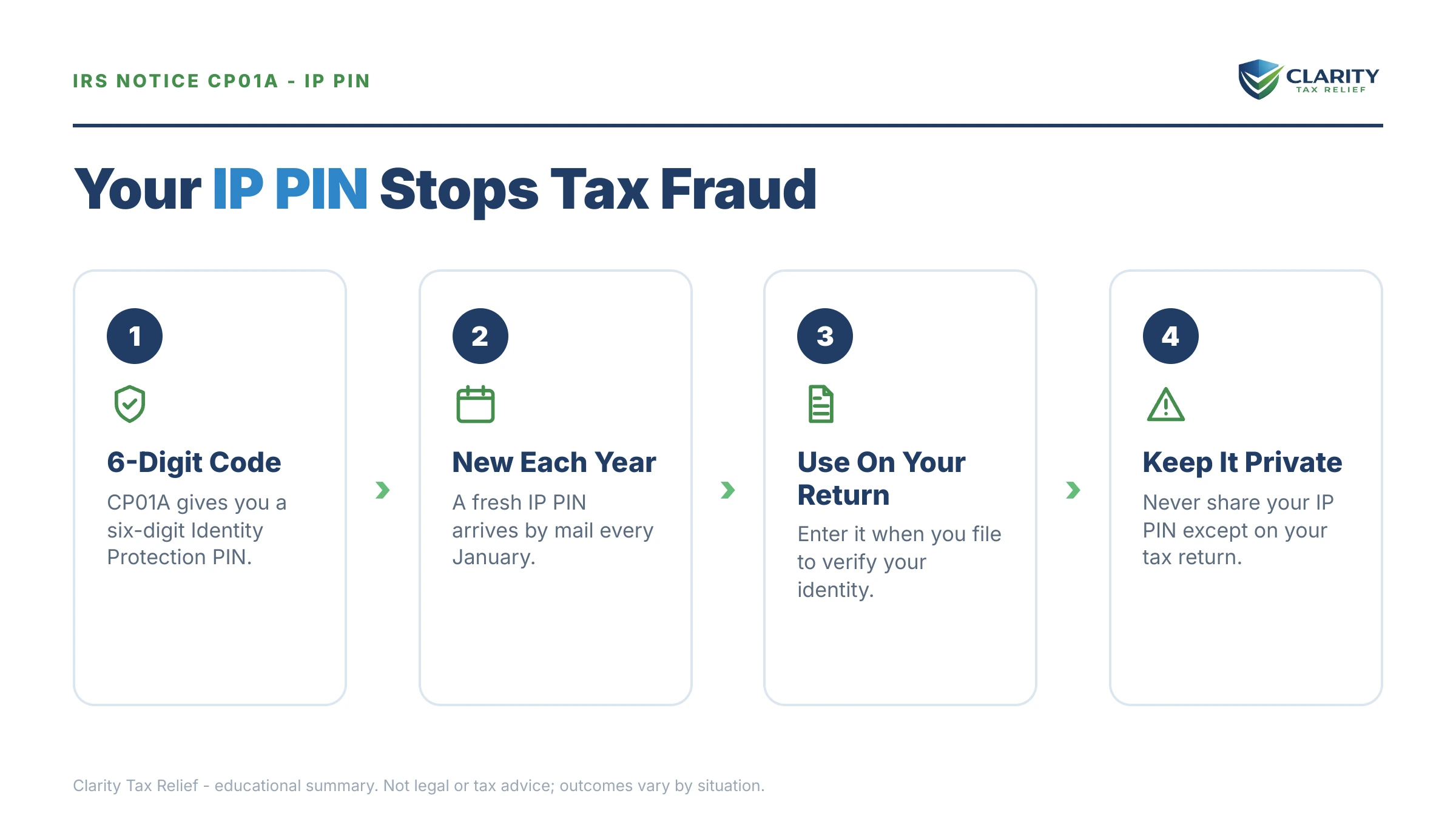
“If the IRS enrolled you into the IP PIN program due to being a confirmed victim of tax-related identity theft, we’ll mail you a CP01A Notice with your new IP PIN each year.”
— Get an identity protection PIN (IRS.gov)
What's actually printed on the CP01A
A CP01A contains exactly one piece of information you'll ever use: the six-digit IP PIN assigned to the person named on the letter. The notice also states which filing season the PIN covers and reminds you that it applies to every federal return you file during that calendar year — the current-year 1040, plus any prior-year or amended returns you file while the PIN is active.
Two details people miss. First, the PIN belongs to one SSN — if your spouse or dependent is also enrolled, they get their own CP01A with their own PIN. Second, last year's PIN is dead. The IRS generates a fresh number every year, so the CP01A you saved from last January will reject this year's return just as surely as no PIN at all.
What happens if you ignore or lose your CP01A
Nothing bad happens for ignoring a CP01A itself — the consequences all land at filing time, and they arrive in a predictable sequence:
- You e-file without the PIN — the return is rejected automatically, usually within hours, with an IP PIN error from the IRS e-file system. Your return has not been filed.
- You guess, or use last year's PIN — same result. A wrong PIN is treated exactly like a missing one, and repeated wrong attempts don't unlock anything.
- You mail a paper return without it — the IRS accepts the envelope but routes the return through extra identity screening. Expect a long processing delay, a held refund, or slow posting of a payment.
- The rejection collides with the deadline — this is where real money appears. A return that never gets successfully filed starts the failure-to-file penalty at 5% of the unpaid balance per month — ten times the 0.5% failure-to-pay rate. The full math is in our guide to the failure to file penalty vs failure to pay.
- Next December, another CP01A arrives anyway — losing or tossing the letter never cancels your enrollment. The protection stays on; only your copy of the key is gone.
The pattern to notice: the IP PIN never creates a debt by itself. It creates friction, and friction at the filing deadline turns into penalties for anyone who owes with their return.
Got a CP01A because someone filed in your name?
If the identity theft behind your CP01A left a mess — a frozen refund, a phantom balance, or a filing season you never got to finish — an experienced tax professional can review exactly where your account stands, free. Interest and penalties keep accruing on any real balance while the identity issues sort out, so it pays to know which part of your problem is fraud and which part is yours.
Lost the letter? Every way to retrieve your IP PIN
A lost CP01A is recoverable in minutes if you can verify your identity online, and in weeks if you can't. Here are the three realistic paths, fastest first:
| Method | What you need | How fast |
|---|---|---|
| "Get an IP PIN" tool in your IRS online account | An ID.me-verified login | Immediate — the current PIN displays on screen |
| IRS identity protection line, 800-908-4490 | Pass identity verification by phone | PIN is re-mailed to your address of record — allow several weeks |
| File on paper without the PIN | Nothing, but it's the last resort | Return accepted, then routed to identity screening; expect months of delay |
The online route runs through the IRS Get an IP PIN page. If you've never set up online access, our IRS online account setup walkthrough covers it, and if the identity-verification step keeps failing, see ID.me and idverify.irs.gov problems, solved. One timing trap: the online tool typically goes offline for maintenance from mid-November until early in the new year, so a PIN lost in December usually can't be retrieved online until January.
Who gets an IP PIN, and how each enrollment path delivers it
How your PIN arrives each year depends entirely on how you entered the program, and mismatched expectations here cause thousands of needless April rejections.
| How you enrolled | Who it's for | How each year's PIN arrives |
|---|---|---|
| Confirmed identity-theft victim | IRS resolved a fraud case on your SSN, often after Form 14039 | Automatic CP01A by mail every year — enrollment is permanent |
| Online opt-in ("Get an IP PIN" tool) | Anyone who passes ID.me verification | Retrieve the new PIN online each January, usually no letter is mailed |
| Form 15227 application | Taxpayers under the year's income threshold who can't verify online | Phone verification, then the PIN comes by mail |
| In-person at a Taxpayer Assistance Center | Anyone who can't verify online or by Form 15227 | Document check at the appointment, then the PIN comes by mail |
On opting out: only voluntary enrollees can leave the program, generally through their IRS online account. Confirmed victims stay enrolled for good. If you opted in on a whim and now find the annual PIN a hassle, weigh it honestly — for a self-employed filer whose SSN sits on dozens of client 1099s every year, the PIN is cheap insurance against someone else e-filing "your" refund in February.
How to respond to your CP01A, step by step
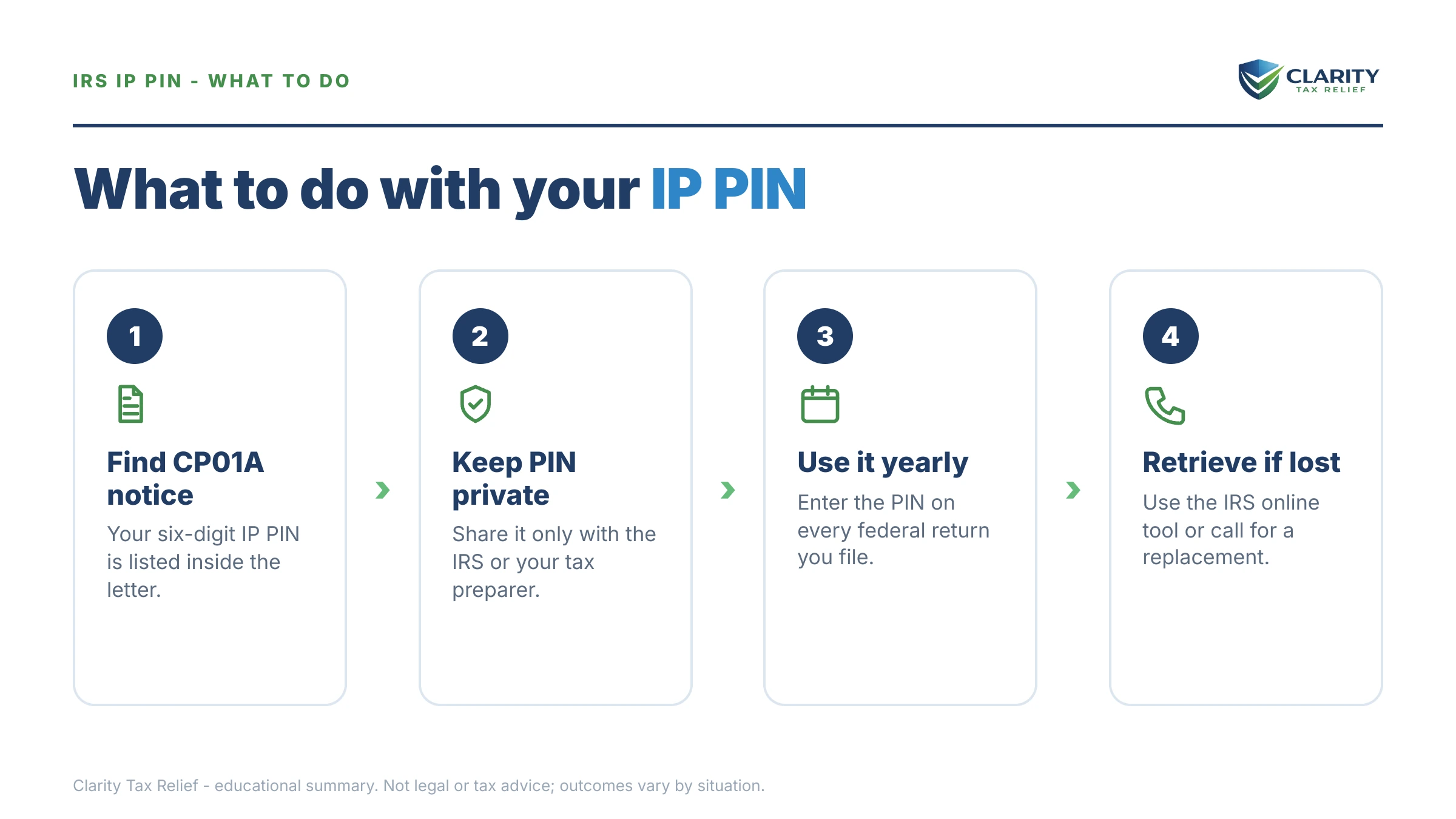
- Find the PIN — locate the six-digit IP PIN on the notice and confirm the tax year it covers — it's valid only for returns filed this calendar year.
- Store the notice — keep the CP01A with your tax documents. You'll need those six digits at filing time. The IRS won't email them to you.
- Enter the PIN when you file — type it into your tax software when prompted, or write it in the box next to the signature line on a paper Form 1040.
- Give it only to your preparer — if a tax professional files for you, hand them the PIN directly — and give it to no one else, ever.
- Retrieve a replacement if it's lost — use the Get an IP PIN tool in your IRS online account, or call 800-908-4490 to have it re-mailed to your address of record.
- Update your address before December — next year's CP01A goes to your address of record — file Form 8822 if you move so the new PIN doesn't land at an old address.
Say you owe $23,800 with your return: what a forgotten IP PIN can cost
The IP PIN costs balance-due filers real money when it's missing — refund filers mostly just lose time. Here's a clearly hypothetical example with the math shown.
Say you're a self-employed sole proprietor and your Schedule C year leaves you owing $23,800 with the return — no withholding, quarterlies came up short. You e-file on the evening of April 15. But the CP01A went out with the recycling in January and you skip the IP PIN field. The return rejects overnight. E-file rejections generally get a short grace window — you get 5 calendar days after rejection to resubmit electronically and still be treated as timely (or 10 days if you switch to a paper return) — but you don't discover the rejection email until May.
Now compare the two paths:
- Filed on time (PIN entered), still can't pay: the failure-to-pay penalty runs 0.5% per month — about $119 a month on $23,800, plus interest, while you set up a payment plan.
- Return never filed (PIN missing): the failure-to-file penalty runs 5% per month — about $1,190 a month. Refile in late May, two penalty months in, and you're roughly $2,380 deep in filing penalties alone — over entering six digits.
You can estimate your own numbers with our IRS Penalty & Interest Calculator. And note what relief does and doesn't exist after the fact: penalties can sometimes be abated, but interest almost never goes away on its own — see can IRS interest be waived. If the $23,800 itself is the bigger problem, the resolution options — payment plans, hardship status, settlement — are all mapped in our pillar on how to settle tax debt yourself.
CP01A vs 5071C, 4883C, and 5747C: which identity letter do you have?
The CP01A is the only letter in the IRS identity family that requires no response — every other one is the IRS holding your return hostage until you act. Match your letter before you panic:
| Letter | What it means | What you must do |
|---|---|---|
| CP01A | Delivers your new annual IP PIN — protection is active | Nothing now; enter the PIN when you file |
| 5071C letter | A return was filed and the IRS wants proof it was you | Verify online or by phone before the return processes |
| 4883C letter | Same suspicion, phone-verification route | Call the number on the letter with your returns in hand |
| 5747C letter | Verification must happen face to face | Book an in-person Taxpayer Assistance Center appointment |
| Letter 4310C | The IRS spotted possible identity-theft activity on your account | Read it carefully; respond only if it asks you to |
A useful rule of thumb: verification letters usually mean the system caught something this season. A CP01A means the system already knows you and is renewing the lock.
Spouses and dependents: whose PIN goes where
IP PINs are issued per person, not per return, so a married-filing-jointly household can have one, two, or several PINs in play. Each enrolled person gets their own CP01A, and each PIN must be entered in that person's spot on the return. Entering your PIN in your spouse's field rejects the return just like a wrong number.
Dependents can have IP PINs too, and for one specific problem they're the single best fix available: a child claimed by someone who shouldn't. Once a dependent has an IP PIN, no return claiming that child e-files without it. If you've been in a tug-of-war over a dependent, see both parents claimed the same child — an IP PIN for the child is how you keep next year from repeating this year.
When you can handle this yourself
Honestly: a CP01A is one of the few IRS letters that almost never needs professional help. If the letter arrived, the PIN is legible. Your only job is to type it into your software in April — do exactly that and keep your money. Retrieving a lost PIN online is also comfortably DIY. The FTC's identitytheft.gov covers the non-tax side of any identity theft for free.
Experienced help changes the outcome in a narrower set of situations: a fraudulent return already filed on your SSN that froze a refund or created a balance you don't recognize. Identity theft tangled with multiple unfiled years, where the order you fix things determines what you pay. Or a self-employed filer whose rejected return has now collided with a real balance due and growing penalties. In those cases the CP01A is a symptom, and the account behind it is the actual problem worth a professional read.
Terms on your notice, decoded
- IP PIN — a six-digit number that must accompany your SSN on a federal return. Without it, no e-filed return under your number goes through.
- CP01A — the annual IRS letter that delivers each year's new IP PIN to enrollees who receive theirs by mail.
- Identity-theft indicator — the permanent marker the IRS places on a confirmed victim's account; it's what triggers automatic annual CP01As.
- Form 14039 — the Identity Theft Affidavit that reports tax-related identity theft and, once the case resolves, usually leads to permanent IP PIN enrollment.
- Address of record — the address on your last filed return (or Form 8822). It's where every CP01A and re-mailed PIN goes, right or wrong.
- E-file rejection — an automatic refusal of your transmitted return. A missing or wrong IP PIN is one of the most common causes. A rejected return does not count as filed.
The IRS's own page on this notice is at Understanding your CP01A notice.
CP01A and IP PIN questions, answered
What is a CP01A notice from the IRS?
A CP01A is the annual letter the IRS mails to deliver your new six-digit Identity Protection PIN (IP PIN). It typically arrives in late December or early January, and the PIN inside is valid for returns filed during that calendar year. Getting one means your account is flagged for identity protection — either because you were a confirmed identity-theft victim or because you enrolled in the program.
Do I get a new IP PIN every year?
Yes — the IRS generates a new six-digit IP PIN every year, and last year's PIN will not work on this year's return. Confirmed identity-theft victims receive theirs by mail on a CP01A, typically in late December or early January. If you enrolled online through the Get an IP PIN tool, you usually will not get a letter. You log back into your IRS online account each January to retrieve the new number.
What do I do if I lost my CP01A or IP PIN?
Retrieve it online: log into your IRS online account and use the Get an IP PIN tool, which displays your current PIN immediately. If you can't verify your identity online, call the IRS identity protection line at 800-908-4490, after verification, the IRS mails the PIN to your address of record, which can take weeks. Never guess the PIN on your return; a wrong entry is rejected just like a missing one.
Where does the IP PIN go on my tax return?
On Form 1040, the IP PIN goes in the box next to the signature line. Tax software asks for it before e-filing, and if a preparer files for you, you have to give them the six digits. They cannot pull the number from the IRS. If your spouse or a dependent has their own IP PIN, each person's PIN gets entered for them on the same return.
Can I opt out of the IP PIN program?
Only if you volunteered in. Taxpayers who enrolled through the online opt-in program can generally opt out through their IRS online account. If the IRS enrolled you because you were a confirmed identity-theft victim, you cannot opt out — a new PIN issues every year to protect your SSN. Throwing the letter away does not remove you from the program; it just means you'll be filing blind in April.
Does a CP01A mean someone filed a tax return in my name?
Not by itself. A CP01A means your account is enrolled in the IP PIN program, usually because a past identity-theft incident was confirmed, often after you filed Form 14039, or because you opted in voluntarily. It is a protection, not a new alarm. If a suspicious return is actually filed, you'd typically see a different letter, such as a 5071C or 4883C asking you to verify your identity.
Will the IRS ever call or email me asking for my IP PIN?
No — the IRS never calls, emails, or texts to ask for your IP PIN, and neither does any legitimate company. The only people who should ever see it are you, your spouse, and the tax professional actually preparing your return. Anyone else asking for those six digits is attempting fraud, because the PIN is exactly what a thief needs to e-file in your name.
Do I need my IP PIN for my state tax return?
The IP PIN on your CP01A is a federal number for your federal return. States run their own separate identity programs. A few issue their own state-level PINs. Your state return will not reject for a missing federal IP PIN. That said, most states start from your federal filing, so a rejected federal e-file often stalls the state return too — one more reason to enter the PIN correctly the first time.
Your next 24 hours
- Find the six-digit PIN on the notice and confirm the tax year printed next to it — that's the only number on the page that matters.
- Put the CP01A with last year's tax return (or photograph it into a secure notes app), and if a preparer files for you, send them the PIN now instead of in April.
- If the identity theft behind this letter left a frozen refund, a balance you don't recognize, or unfiled years, get a free case review — the 2-minute form or (888) 825-7779. Interest and penalties keep accruing on any real balance while the identity side sorts out, so knowing where your account actually stands is the move.
This guide is general information, not tax or legal advice for your specific situation. Eligibility for IRS programs depends on individual facts and circumstances; no outcome is guaranteed.