
IRS Letters
IRS Letter 6174: What the Crypto Letter Means and What to Do (2026)
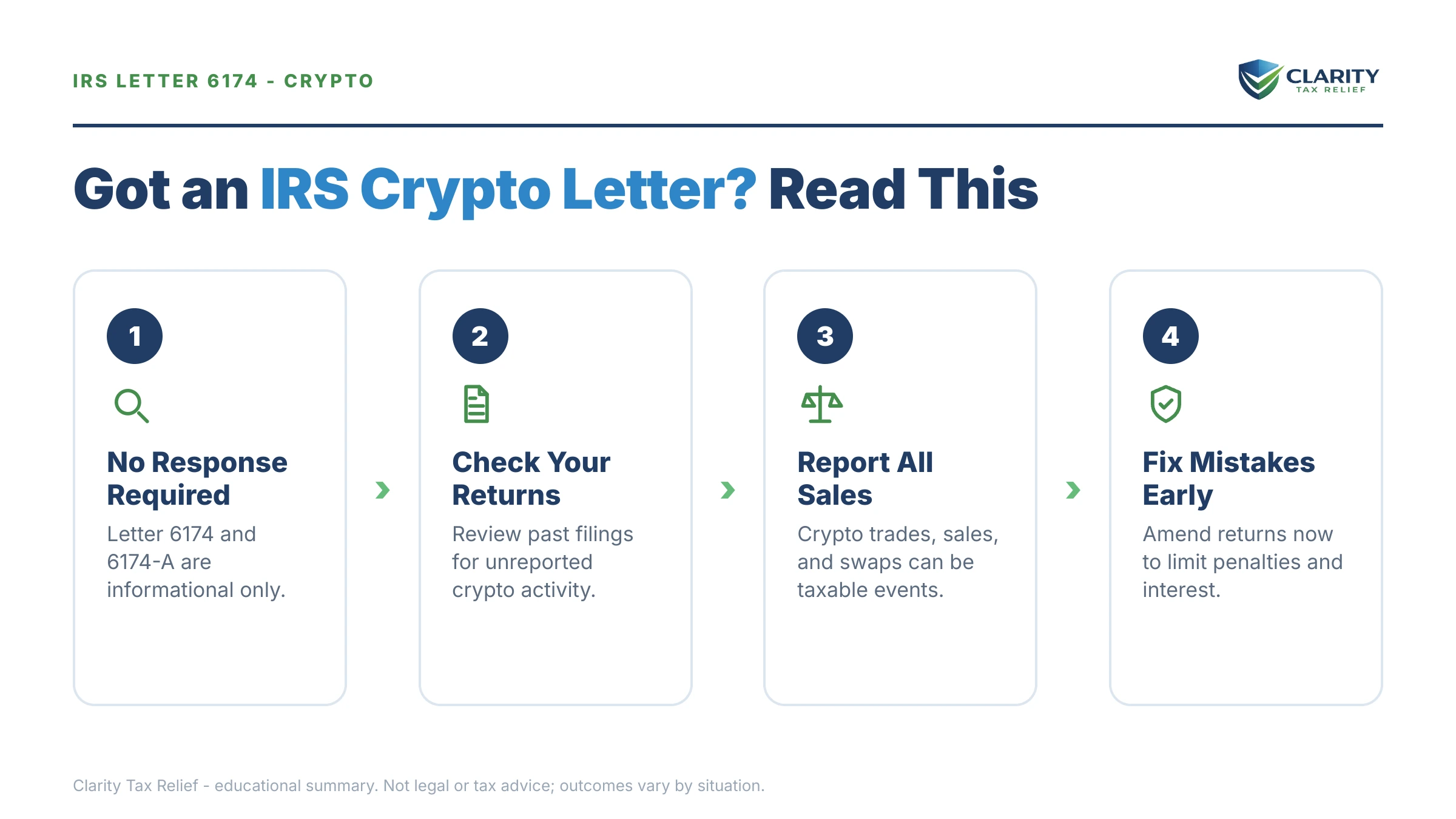
The short answer: IRS Letter 6174 is an educational "soft letter" sent to taxpayers the IRS has identified as holding cryptocurrency accounts. It requires no response, sets no deadline, and is not an audit. Your job is to confirm every crypto sale, trade, and payment was reported, and file an amended return if it wasn't.
You opened an official-looking envelope and found a letter about "virtual currency transactions" — maybe over the Coinbase account a grandchild helped you set up, or the Bitcoin you sold years ago to cover a repair. Here's the reassuring part: Letter 6174 is the mildest letter in the IRS's crypto playbook, and it's fully manageable from your kitchen table. This page shows you exactly what to check and when action is actually needed.
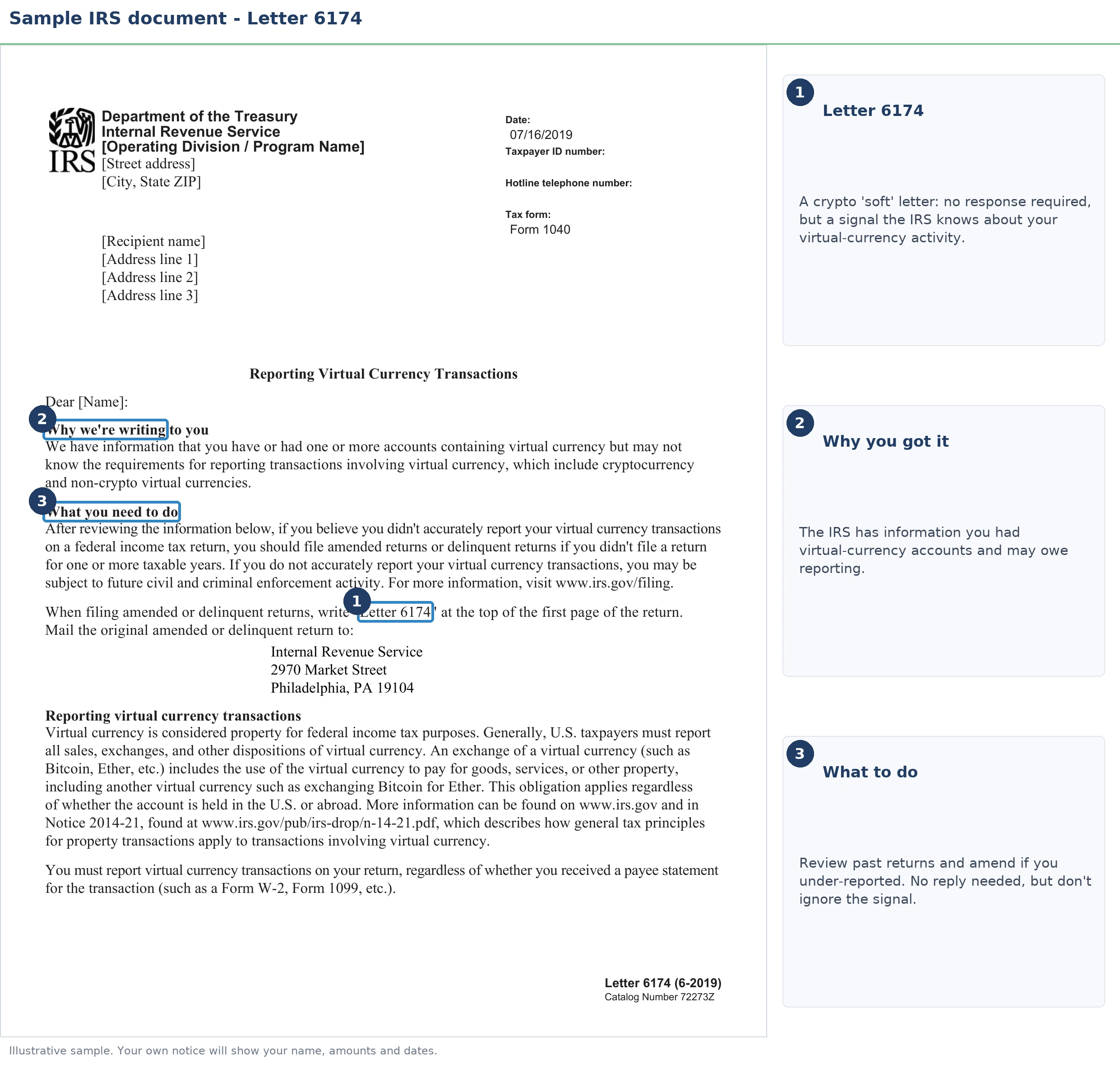
The image below shows exactly what Letter 6174 looks like and where to find the letter number and tax years it covers, so you can confirm which version of the crypto letter you're actually holding, because the three versions carry very different weight.
⏱ The real clock: Letter 6174 prints no deadline and requires no reply. But if a past return understated crypto income, interest and the monthly late-payment penalty are already accruing on that shortfall, and your chance to correct it voluntarily, on the best terms, lasts only until the IRS contacts you about the same income again.
Why you got IRS Letter 6174
Letter 6174 means the IRS has records showing you own or owned one or more cryptocurrency accounts. It does not mean the IRS found an error — the letter is mailed in bulk to account holders identified through exchange data, and many recipients reported everything correctly.
Where does that data come from? Federal courts approved "John Doe" summonses that compelled exchanges such as Coinbase and Kraken to turn over customer account records — names, addresses, and transaction histories — for users the IRS could not otherwise identify. Starting with 2025 transactions, brokers also report digital-asset sales directly to the IRS on Form 1099-DA, which means the matching that used to require a court order now happens automatically.
The letter lists the tax years the IRS is interested in and asks you to review whether those returns properly reported your virtual currency transactions. It is education by design: the IRS is telling you it can see the accounts, and inviting you to fix any problem before its computers do it for you.
Letter 6174 vs. 6174-A vs. 6173: which one are you holding?
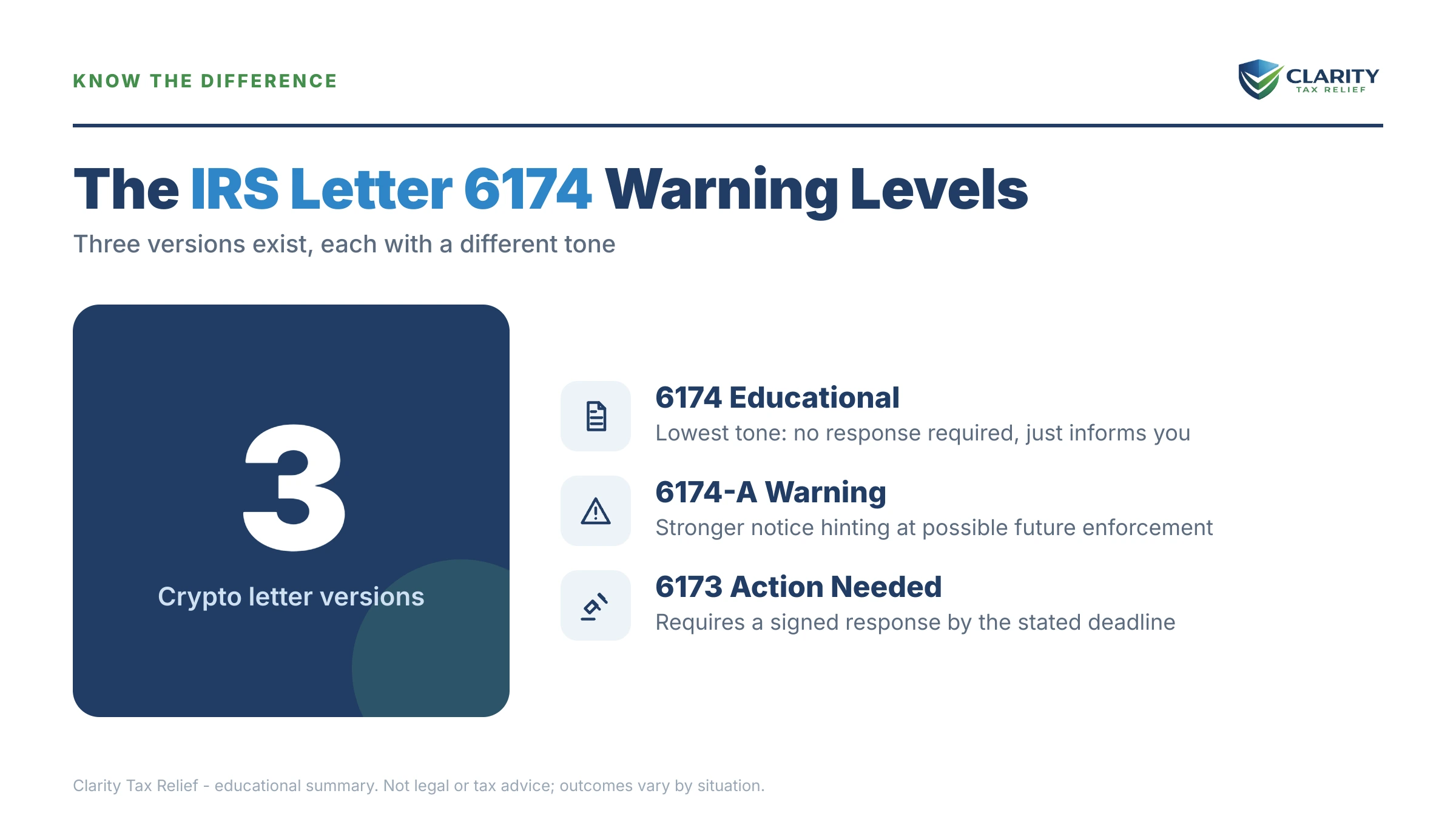
The IRS sends three crypto letters, and only one of them legally requires a response. Check the number in the top corner before you do anything else — a 6174 and a Letter 6173 look similar but demand completely different reactions.
| Letter | Response required? | What it signals | Your move |
|---|---|---|---|
| 6174 | No | Educational — the IRS knows you have or had crypto accounts and wants you to check your reporting | Verify your returns; amend only if something was missed |
| 6174-A | No, but the IRS says it may follow up | The IRS's data suggests you may not have properly reported transactions | Verify carefully against exchange records; amend promptly if anything is wrong |
| 6173 | Yes — signed under penalty of perjury, by the printed deadline | The IRS believes you failed to report crypto income or file required returns | Do not miss the deadline; get a professional review before responding |
The 6174-A variant matters more than its "no response required" language suggests. Its added sentence — that the IRS "may send other correspondence about potential enforcement" — is the difference between a general education mailing and a letter aimed at accounts whose data doesn't line up with a filed return. If yours says 6174-A, treat the review step below as mandatory, not optional.
What happens if you ignore Letter 6174
Ignoring Letter 6174 costs you nothing if your returns are accurate, and compounds every month if they aren't. There is no enforcement built into the letter itself. The risk comes from the exchange data behind it, which feeds the IRS's automated matching systems whether or not you ever reply. If unreported income exists, the sequence generally runs like this:
- The letter goes in a drawer. Nothing happens immediately — no lien, no levy, no follow-up call. This stage feels safe, which is exactly why people get hurt at the next one.
- Document matching flags the gap. Exchange records, 1099-B/1099-K forms, and (for 2025 forward) Form 1099-DA are compared against your return. A mismatch can post to your account as code 922 — underreporter review.
- A CP2000 arrives. The CP2000 notice proposes additional tax on the unreported gains, plus the 20% accuracy-related penalty and interest running back to the original due date of the return.
- No response leads to assessment. Ignore the CP2000 and the IRS issues a statutory notice of deficiency, then assesses the balance as a legal debt.
- Collection begins. The assessed balance enters the standard notice stream — bills, then intent-to-levy notices, then actual levy power over bank accounts and up to 15% of Social Security benefits through the Federal Payment Levy Program.
Note what changed between step 1 and step 5: nothing about the facts, only who controls them. At step 1, you decide what to fix, when, and on what terms. By step 3, the IRS has done the math its way — usually assuming zero cost basis, which inflates the gain — and you're responding to its numbers instead of filing your own.
Holding a Letter 6174 or 6174-A and not sure your old returns were right?
Send us a photo of the letter and tell us which exchanges you've used. An experienced tax professional will check what the IRS's data likely shows, whether anything needs amending, and what it would cost to fix now, while interest is the only thing accruing. Free and confidential.
Your options after Letter 6174, by situation
Most Letter 6174 recipients need one of six moves, and for many the correct move is nothing at all. Buying crypto with dollars and holding it is not a taxable event — the reportable events are selling, trading one coin for another, spending crypto, and earning rewards like staking or interest.
| Your situation | Right move | What it costs |
|---|---|---|
| Everything was reported correctly | Keep the letter with your tax records; no filing, no reply | $0 |
| Bought and held only — never sold, traded, or spent | Verify there were no coin-to-coin swaps or rewards, then file the letter away | $0 |
| One year with unreported sales or trades | File Form 1040-X with a corrected Form 8949 for that year | Tax on the gain + interest; amending first reduces penalty exposure |
| Multiple years unreported, or returns never filed | File or amend every affected year — unfiled years first, since the failure-to-file penalty (5%/month) is ten times the failure-to-pay penalty (0.5%/month) | Tax + interest + penalties; professional sequencing usually pays for itself |
| Used a foreign exchange or offshore wallet custodian | Check whether FBAR or Form 8938 reporting applied on top of income reporting | Varies — see offshore crypto reporting before filing anything |
| The corrected returns create a balance you can't pay | Short-term plan (up to 180 days, $0 setup) or a streamlined installment agreement up to 72 months for balances ≤ $50,000 | Interest + 0.5%/month late-payment penalty continue until paid |
Two situation-specific notes. First, if you're on a fixed income and even a modest amended balance would squeeze basic living expenses, Currently Not Collectible status exists for exactly that — our guide to IRS hardship while on Social Security walks through it. Second, if your crypto activity was heavy — hundreds of trades, missing basis records, DeFi — the reconstruction itself is the hard part. Start with didn't report crypto — what now and, for larger balances, crypto tax debt help.
Worked example: an $8,900 unreported crypto gain
Say you're retired, living mainly on Social Security, and in 2023 you sold Bitcoin for an $8,900 long-term gain that never made it onto your return. Here's the hypothetical math on fixing it now versus waiting:
- The tax itself: if your income puts the gain in the 15% long-term capital-gains bracket, the tax is roughly 0.15 × $8,900 = $1,335. (Some lower-income retirees land in the 0% bracket. But the gain can also pull more of your Social Security benefits into taxable income, so the real number needs a full recalculation, not napkin math.)
- Amend now: you file the 1040-X, pay the ~$1,335 plus interest and late-payment charges accrued since April 2024. The matter closes on your terms.
- Wait for the CP2000: the IRS proposes the same tax — often more, because without your records it may assume zero cost basis — plus the 20% accuracy-related penalty (about $267 on a $1,335 understatement), plus interest that kept compounding the whole time you waited. See how that 20% accuracy-related penalty works, and estimate your own numbers with our Penalty & Interest Calculator.
The gap between the two paths on an $8,900 gain is a few hundred dollars plus control of the timeline. On a $89,000 gain, the same gap is a few thousand dollars — the arithmetic scales, and it always favors moving first.
How to respond to Letter 6174, step by step
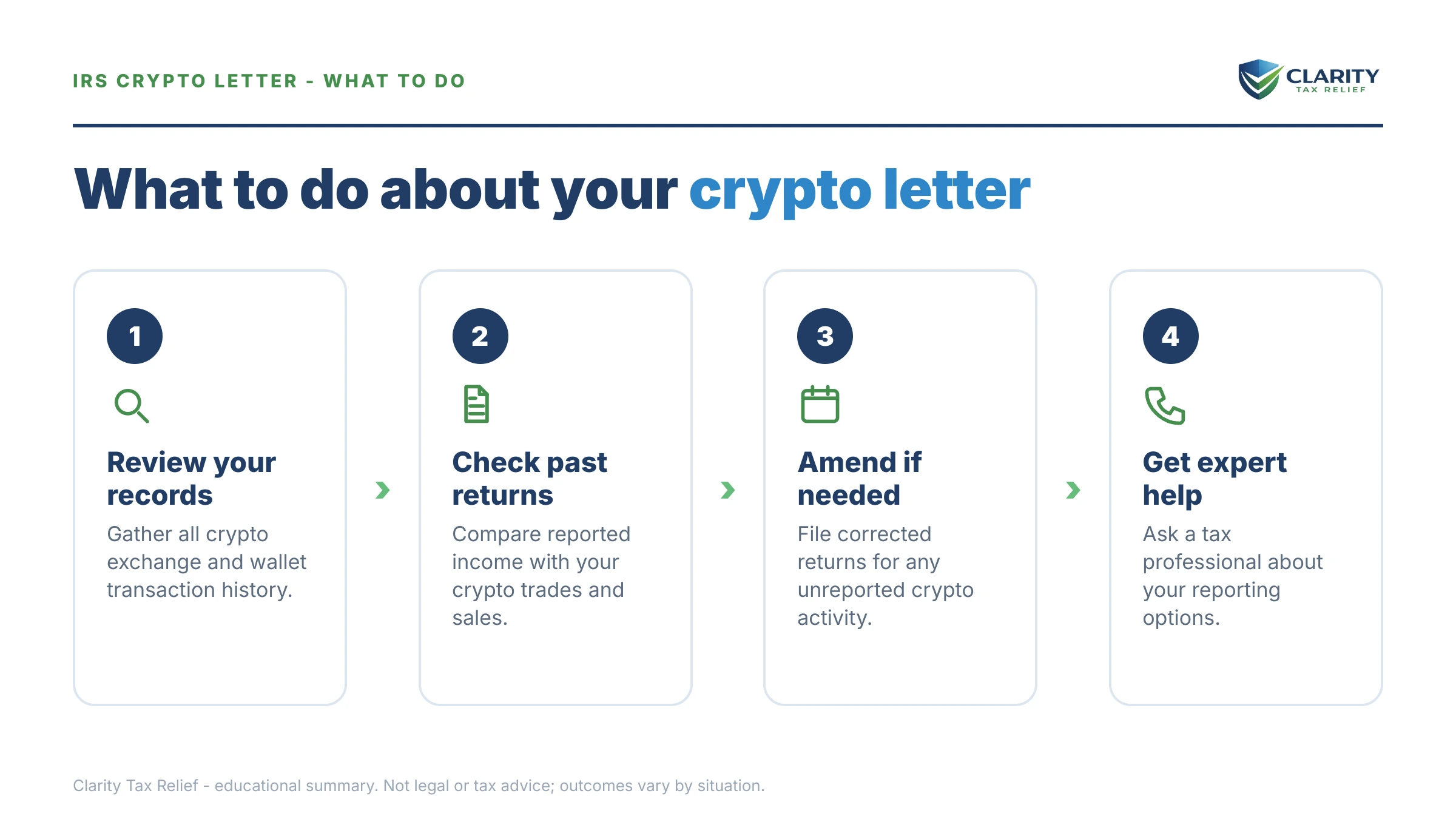
- Confirm the letter number — check the top right corner for 6174, 6174-A, or 6173 — only 6173 requires a signed response by a printed deadline.
- Pull your transaction history — download the complete transaction export (CSV) from every exchange and wallet you've used, covering every year the letter lists.
- Compare against your filed returns — confirm every sale, coin-to-coin trade, crypto purchase of goods, and staking or interest reward appears on Form 8949 and Schedule D for the right year.
- Amend anything that's wrong — file Form 1040-X with a corrected Form 8949 for each year with unreported transactions, and file any return you never filed at all.
- Handle any balance the fix creates — pay at IRS.gov/payments if you can, or set up a short-term plan or installment agreement before interest compounds further.
While you're verifying the letter itself, one caution: crypto scares are a favorite theme for scammers. A fake "IRS crypto notice" demanding payment by gift card or wallet transfer is not rare. A real Letter 6174 arrives by postal mail and asks for no payment at all — our guide to real vs. fake IRS letters covers the tells.
When you can handle this yourself
Most Letter 6174 situations are genuinely do-it-yourself. If you bought and held, if you already reported everything, or if you have one year with a handful of trades and clean exchange records, you can verify, amend, and pay without hiring anyone — Form 1040-X can be filed electronically for recent years, and setting up an IRS payment plan online takes minutes. Our pillar on how to settle tax debt yourself covers the payment side end to end.
Experienced help changes the outcome in a narrower set of cases: multiple years unreported or unfiled, high trade volume with missing cost-basis records, activity on foreign exchanges with possible FBAR exposure, income large enough that the corrected balance needs a negotiated resolution, or if the letter in your hand is actually a 6173, where a signed statement under penalty of perjury deserves professional eyes before it deserves your signature. If you can't afford representation, the Taxpayer Advocate Service and low-income taxpayer clinics are legitimate free resources.
Terms on your letter, decoded
- Soft letter — an IRS educational mailing generated from data analysis, sent to prompt voluntary compliance before any exam or collection action begins.
- John Doe summons — a court-approved order forcing a company, such as a crypto exchange, to identify unnamed customers and hand over their account records.
- Cost basis — what you paid for the asset, including fees. Your taxable gain is the sale proceeds minus this basis, which is why missing basis records inflate IRS estimates.
- Form 8949 / Schedule D — the forms where each crypto sale or trade is listed individually and then totaled into your return.
- Accuracy-related penalty — a 20% penalty on the underpaid tax when an understatement comes from negligence or is substantial.
- Digital-asset question — the yes/no question on page one of Form 1040 asking whether you received or disposed of digital assets, answered under penalty of perjury.
Letter 6174 questions, answered
Do I have to respond to IRS Letter 6174?
No. Letter 6174 states on its face that no response is required, and it prints no deadline and includes no reply form. Your obligation is substantive, not procedural: verify that the returns for the years listed reported all of your crypto income, and file Form 1040-X if they didn't. The exception is if you're actually holding Letter 6173, which does require a signed response by a printed deadline.
What is the difference between Letter 6174 and Letter 6174-A?
Both are no-response-required letters, but 6174-A carries a sharper warning. Letter 6174 says you may not know the reporting rules; Letter 6174-A says the IRS has information suggesting you may not have properly reported your transactions and that it may send future correspondence about potential enforcement. Treat a 6174-A as a stronger signal that the IRS's exchange data doesn't match your returns.
Is Letter 6174 an audit?
No. It's a mass-mailed educational notice, not an examination, and receiving one doesn't mean a human has reviewed your file. But the same exchange data that triggered the letter feeds the IRS's document-matching systems, so an unaddressed discrepancy can later surface as a CP2000 notice or a full exam. Fixing any errors now is what keeps the letter from turning into one.
How did the IRS know I own cryptocurrency?
Mostly from the exchanges themselves. Federal courts approved John Doe summonses that forced platforms such as Coinbase and Kraken to hand over customer account records, and starting with 2025 transactions, brokers report digital-asset sales directly to the IRS on Form 1099-DA. The digital-asset question on page one of Form 1040, which you answer under penalty of perjury, gives the IRS a second data point to match against.
Should I amend my return after getting Letter 6174?
Only if something was actually wrong. If every sale, trade, and crypto payment was reported, no action is needed — keep the letter with your records. If you find unreported gains, file Form 1040-X with a corrected Form 8949 for each affected year. Correcting the return before the IRS contacts you about the same income reduces your exposure to the 20% accuracy-related penalty and shows good faith.
I only bought bitcoin and never sold — why did I get this letter?
Because the letter is triggered by account ownership, not confirmed wrongdoing. Buying crypto with dollars and holding it isn't a taxable event, so if you truly never sold, you likely owe nothing. Double-check the edge cases first: swapping one coin for another, spending crypto on goods or services, and earning staking or interest rewards are all reportable events even if you never cashed out to dollars.
Can I go to jail over Letter 6174?
Almost certainly not. Letter 6174 is the IRS's civil, educational track, and honest mistakes corrected voluntarily are resolved with tax, interest, and sometimes penalties, not prosecution. Criminal cases target willful, large-scale evasion, usually involving concealment. What raises the stakes is knowingly leaving unreported income uncorrected after being put on notice, so the safe path is fixing any error now.
What if amending my return creates a tax bill I can't pay on Social Security?
File the amendment anyway — owing money you can't pay is a solvable problem, while unreported income is not. Balances under $50,000 generally qualify for a streamlined installment agreement of up to 72 months. A short-term plan gives you up to 180 days with no setup fee. If any payment would leave you unable to cover basic living expenses, Currently Not Collectible status can pause collection entirely.
Your next 24 hours
- Find the letter number and tax years. The number in the top right corner tells you whether you're holding a 6174, 6174-A, or 6173. The years listed tell you exactly which returns to check.
- Gather your records. Copies of the returns for those years, plus a full transaction export from every exchange and wallet you've used. Most exchanges let you download the complete history in one click.
- Get the letter reviewed free. If anything in your history looks unreported, or you're not sure it would be — send us a photo of the letter at the 2-minute form or call (888) 825-7779. Interest on any understated balance is accruing monthly either way; a review costs nothing and tells you whether there's anything to fix.
This guide is general information, not tax or legal advice for your specific situation. Eligibility for IRS programs depends on individual facts and circumstances; no outcome is guaranteed.