
IRS Letters
IRS Letter 12C: What It Means, What to Send, and Your Deadline (2026)
Read the transcript
Host: So you filed a return, maybe your first one in a while, and instead of a refund date you get an envelope from the IRS saying it can't finish processing. That's Letter 12C. And the refund's sitting there frozen.
Tax specialist: Right. And the first thing worth saying is what a 12C isn't. It's not a bill. It's not an audit. It's not the IRS changing your return.
Host: Not an audit at all?
Tax specialist: No. It comes out of the processing pipeline, not from an examiner. Your deductions aren't being questioned. The IRS is holding the whole return, refund included, because one piece is missing. They call that unit error resolution. Your return just sits there.
Host: Okay, so it's a paperwork gap.
Tax specialist: A paperwork gap. And here's the useful part — every single 12C prints three things on page one. What's missing. Your response deadline. And the fax number you send it to.
Host: Three things. Missing item, deadline, fax number.
Tax specialist: That's it. And the deadline printed on your letter is the only clock that matters. It's typically 20 days from the letter date, but don't take my word for the number — read yours.
Host: Twenty days is not a lot of runway if you're waiting on a document from somebody.
Tax specialist: It isn't. That's the hard part of this one, honestly. The mechanism is simple, the window is short.
Host: What's it usually asking for?
Tax specialist: Most common by a mile is a missing Form 8962. So — the Health Insurance Marketplace tells the IRS you had subsidized coverage. That's the Form 1095-A. If your return doesn't include the Form 8962 that reconciles the advance Premium Tax Credit payments against your actual income, the return can't post. Full stop.
Host: And the 1095-A, where does that come from?
Tax specialist: You download it from your HealthCare.gov account. You need it in hand before you can build the 8962, so that's the first errand.
Host: Okay. What else triggers it?
Tax specialist: Second one is withholding the IRS can't match. If the federal withholding you claimed doesn't line up with what employers reported, the letter asks you to prove it — copies of every W-2 and every 1099 that shows federal income tax withheld.
Host: Copies. Not the originals.
Tax specialist: Never originals. And the third trigger is the boring one. Your software or your preparer dropped a schedule the return references. You just complete that one form and send it.
Host: Wait, back up on the withholding thing. What if an employer never sent you a W-2?
Tax specialist: Then before you fax anything, pull your IRS wage and income transcript and see what was actually reported under your Social Security number. Because if you send numbers that don't match the IRS's own records, you just restart the loop. That's one of the situations where this stops being a ten-minute job.
Host: Hm. Okay.
Tax specialist: And one more thing on the 8962 — there's a wrinkle people don't expect. Reconciling the credit can change your refund by itself. If your actual income came in higher than the estimate you gave the Marketplace, the 8962 may show you got too much advance credit. Refund shrinks. Or a repayment balance shows up.
Host: So somebody hears that and thinks, great, I'll just not respond.
Tax specialist: And that's the trap. The IRS makes the same adjustment without you — except when they do it, they strip the credit, and you lose any part of it you were actually entitled to keep. You don't avoid the math by staying quiet. You just do it on worse terms.
Host: Walk me through the ignore-it path. What actually happens, step by step?
Tax specialist: It's automated and it runs in stages. Stage one, refund frozen — on your transcript that often shows up as a hold, code 570. Nothing posts, nothing pays out.
Host: Code 570.
Tax specialist: Code 570. Stage two, after the window closes, the IRS processes the return without the missing item. Unverified withholding comes off. An unreconciled Premium Tax Credit gets stripped. Stage three, you get an adjustment notice, something like a CP12, explaining the new math.
Host: And if the new math says I owe?
Tax specialist: Then the adjustment becomes a bill. A CP14 is the first bill, and that starts the standard collection sequence. Ignored long enough, that sequence escalates all the way to a final notice of intent to levy — Letter 1058.
Host: From a missing form.
Tax specialist: From a missing form. And undoing an adjustment after the fact is much harder than answering the letter now. That's really the whole argument.
Host: There's a case in the article I want you to explain, because I think a lot of people are in it. Somebody who filed several years at once.
Tax specialist: Yeah. So picture a gig worker who just filed three years together. The two older years land with balances totaling $23,800. The newest year had a part-time W-2 job with withholding and Marketplace coverage, so that one shows a $3,100 refund. And three weeks later, a 12C shows up on the newest year asking for Form 8962 and W-2 copies.
Host: So the refund's frozen.
Tax specialist: Frozen. Now, if they respond and that return processes, the $3,100 doesn't come to them. The IRS applies it to the older balances. $23,800 minus $3,100 is $20,700, and they haven't paid a dollar out of pocket.
Host: Which feels like losing the refund.
Tax specialist: It feels that way, but the alternative is worse. Stall, and the refund evaporates — the credit and the unverified withholding come off — and it may even flip to a small balance. Meanwhile the $23,800 keeps compounding. The failure-to-pay penalty alone is 0.5% per month, roughly $119 a month on that balance, and interest on top.
Host: Say that more simply for me.
Tax specialist: The refund you can't touch is still the cheapest payment you'll ever make against that debt. Letting it disappear costs you twice.
Host: Okay. So what does responding actually look like, mechanically?
Tax specialist: Four steps. Gather exactly what's listed — no more. Complete the missing form by itself. And I want to be loud about this one: do not file a Form 1040-X in response to a 12C.
Host: Why not? That's the instinct, right — fix the return.
Tax specialist: Because your original return hasn't finished processing. Stacking an amendment on a suspended return creates confusion and months of extra delay. Third step, fax it to the number printed on your letter, with a copy of the letter as the first page so it routes to your file. Keep the fax confirmation — that's your proof you replied on time.
Host: And step four is wait, I assume.
Tax specialist: Watch your account transcript, don't refile. The IRS says allow six to eight weeks after a complete response. In 2026, with the workforce down roughly 27%, real-world waits often run longer. Two things people panic about: the refund tracker may sit unchanged for weeks, and you may get a Letter 2645C, which just means the IRS got your reply and needs more time. Neither one needs action from you.
Host: Letter 2645C — that's not bad news.
Tax specialist: Not bad news. It's a receipt, basically.
Host: And when is this genuinely a do-it-yourself thing?
Tax specialist: Most of the time. If the letter names one clear item you can put your hands on — the W-2s are in a drawer, you can pull the 1095-A — gather it, fax it with the letter on top, done. There's nothing to negotiate. It's document delivery.
Host: And when isn't it?
Tax specialist: When the 12C is sitting on top of unfiled years or a balance you can't pay, because then the sequencing matters — returns first, then penalties, then the balance. When the 8962 reconciliation creates a repayment you can't cover. When you can't document withholding because an employer never issued forms. Or when the window already closed, the IRS adjusted the return, and you need to contest it. In those cases the 12C is a symptom, not the problem.
Host: So what do you do today?
Tax specialist: Page one. Find the response deadline and the fax number and circle both. Then pull three things together: the letter, a copy of the return you filed, and the requested items — your 1095-A from HealthCare.gov, or the W-2s and 1099s showing federal tax withheld.
Host: And if it's the bigger mess — unfiled years, a balance behind it?
Tax specialist: Then get a free case review before the window on your letter closes. Our Enrolled Agents can look at the letter, look at what else is on the account, and tell you whether this is a one-fax fix or the first move in a bigger cleanup. There's a two-minute form on the page, or call (888) 825-7779.
Host: Ten minutes now.
Tax specialist: Ten minutes now beats untangling an automated adjustment later. And read your own letter for the deadline, not the typical number, yours.
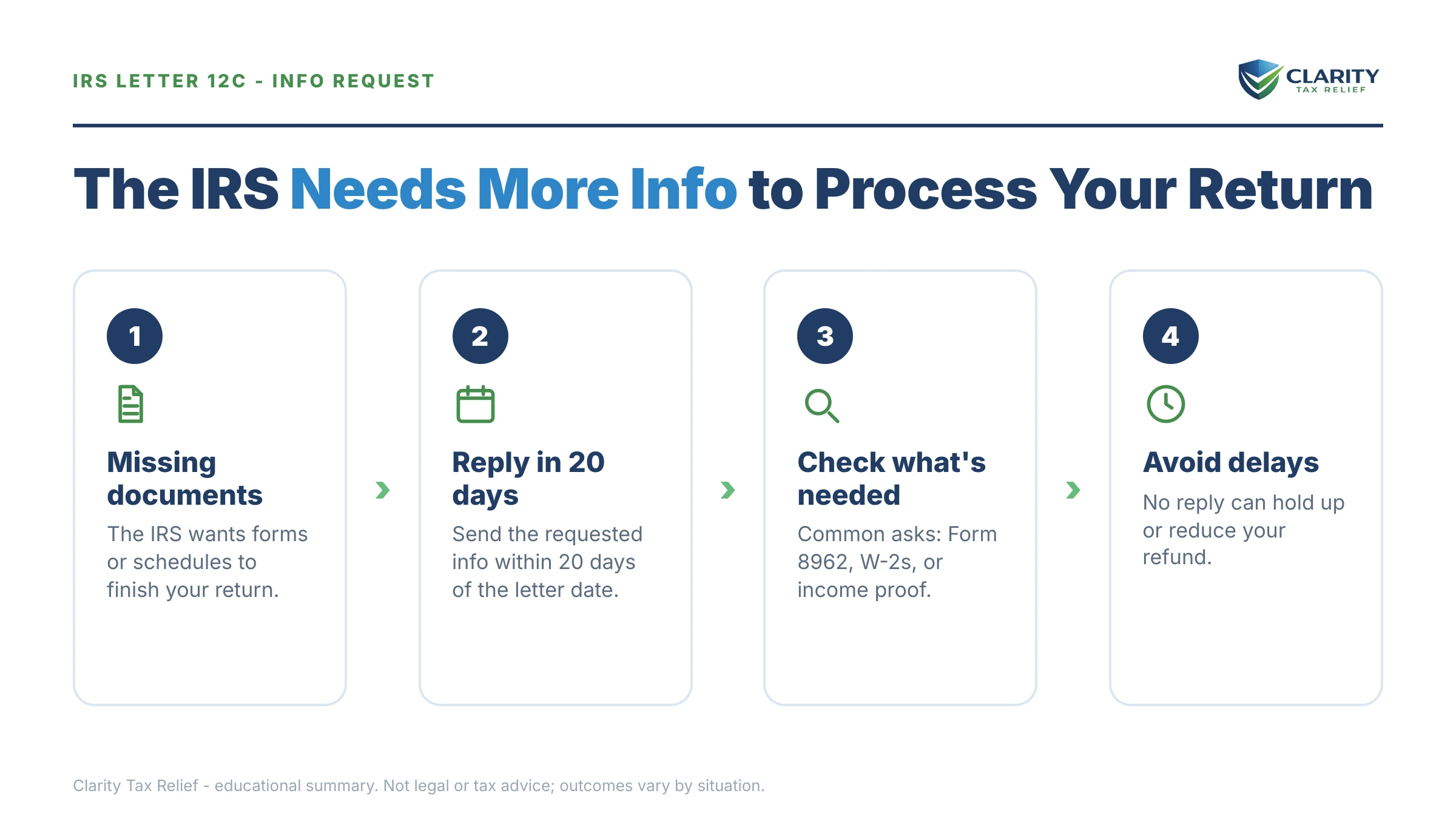
The short answer: IRS Letter 12C means the IRS has stopped processing your tax return because something is missing — most often Form 8962 for Marketplace health coverage, or proof of the withholding you claimed. Your refund is frozen until you reply. Send exactly what the letter lists, by fax, within the deadline it prints, typically 20 days.
You finally got a return in, maybe your first in a while, and instead of a refund date, the IRS mailed back a Letter 12C saying it can't finish processing without more information. That "what did I do wrong" jolt is understandable, but here the honest answer is usually: nothing serious. A 12C is a paperwork gap, and clearing it is often a single fax.
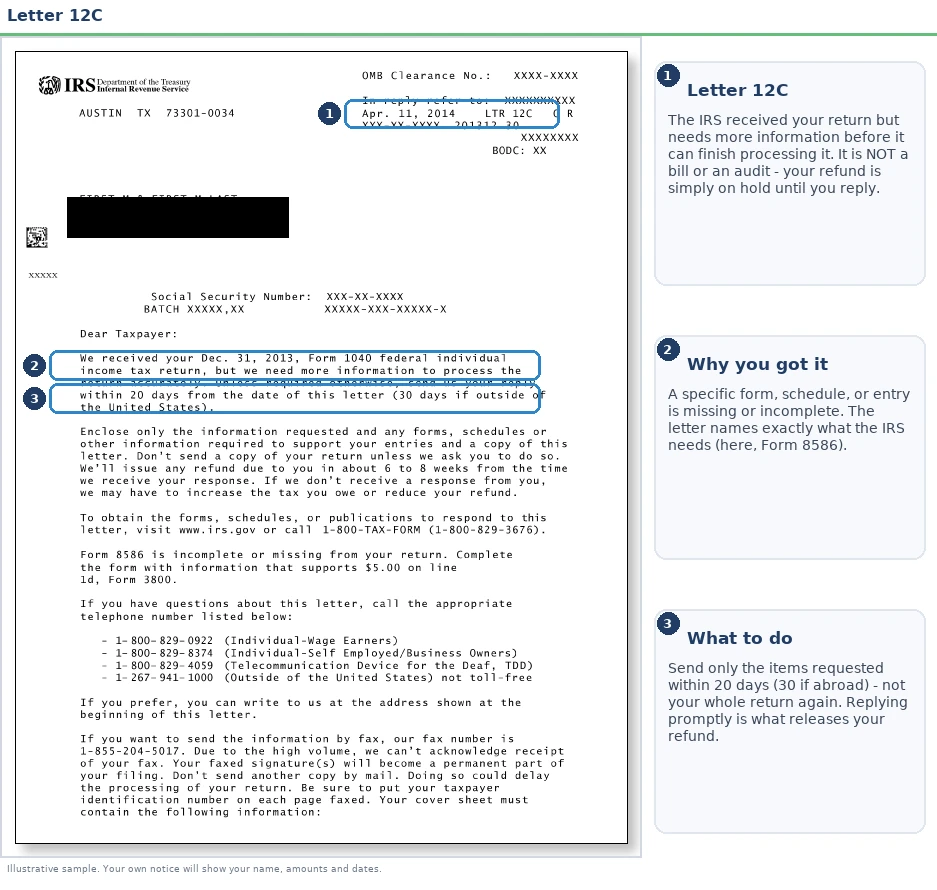
Unlike almost every other IRS letter, a 12C arrives before your return has been processed. It's not a bill, not an audit, and not a change to your return — it's the IRS holding the whole thing, refund included, until one missing piece shows up. Every 12C prints the three things you need to fix it: what's missing, your response deadline, and the fax number for your reply. The image below shows exactly what the letter looks like and where to find each of those on your copy.
This guide covers only the 12C — what triggers it, what to send back, and what it costs you to stall. For the bigger map of IRS mail in general, see why did I get a letter from the IRS.
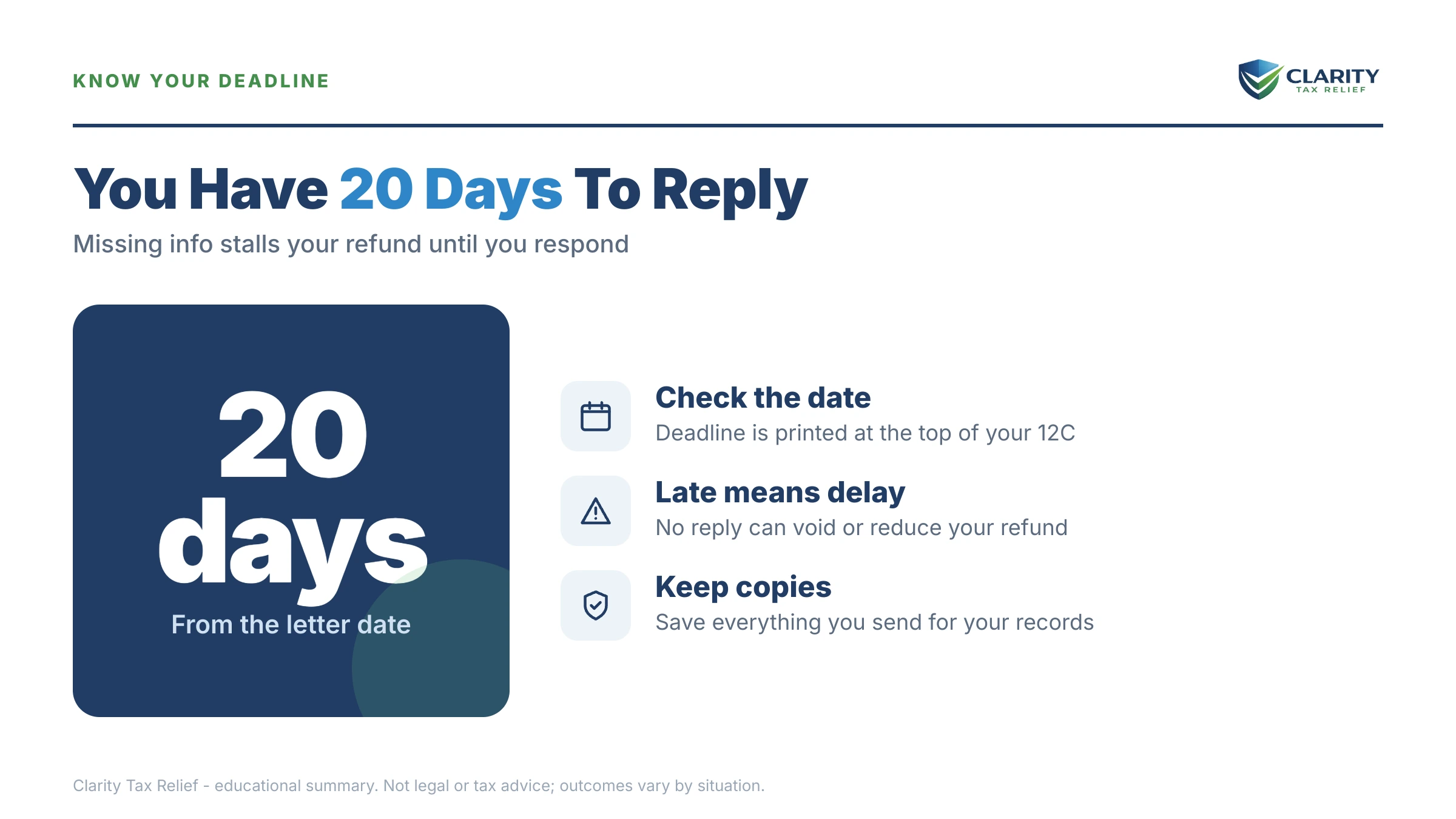
⏱ Your deadline: the response date printed on your Letter 12C — typically 20 days from the letter date. Your refund stays frozen until the IRS receives what it asked for. Let the window pass, and the IRS may process your return without the credit or withholding it couldn't verify.
Why the IRS sent you Letter 12C
Letter 12C means the IRS suspended your tax return during processing because a form, schedule, or piece of verification is missing. Your return sits in a holding pattern, the IRS calls it error resolution, and nothing moves, including your refund, until the gap is filled.
The single most common trigger is a missing Form 8962. The Health Insurance Marketplace tells the IRS (via Form 1095-A) that someone on your return had subsidized coverage. If your return doesn't include the Form 8962 that reconciles those advance Premium Tax Credit payments, the return can't post — full stop.
The second most common trigger is withholding the IRS can't match. If the federal withholding claimed on your return doesn't line up with the W-2s and 1099s employers reported, the 12C asks you to prove it with copies of the actual forms. The third is simpler still: your software or preparer dropped a schedule the return references.
One quick reality check before you respond: a real 12C arrives by postal mail. Your reply goes only to the IRS fax number or address printed on it. Nobody legitimate will call, text, or email about it, and no payment method involving gift cards or payment apps is ever the IRS.
What happens if you ignore IRS Letter 12C
If you never answer Letter 12C, the IRS eventually processes your return without the item it asked for. Your refund shrinks, disappears, or flips into a balance due. The sequence is automated and runs in stages:
- Refund frozen. Your return sits suspended in processing. On your transcript this often shows as a hold like code 570 on an IRS transcript — nothing posts, nothing pays out.
- The IRS processes without the missing item. Unverified withholding gets removed; an unreconciled Premium Tax Credit gets stripped. The refund you calculated is recalculated without you.
- An adjustment notice arrives. A letter like a CP12 notice explains the changed math. If the change swings the other way and you now owe, the adjustment becomes a bill.
- Collection begins on any balance. A first bill — the CP14 notice — starts the standard collection sequence, which, ignored long enough, escalates all the way to a final notice of intent to levy like Letter 1058.
There's one more clock that matters if you're filing old years: refunds die three years after the original due date. A suspended return that never completes can burn through that window — see the 3-year refund deadline for old returns. And in 2026, with the IRS workforce down roughly 27%, humans are slow but the automated adjustments are not — the system strips unverified items whether or not anyone ever reads your file.
| Stage | Timing | What's happening |
|---|---|---|
| Letter 12C arrives | Day 0 (the letter date) | Your return is suspended in processing; any refund is frozen. |
| Response window | Typically 20 days from the letter date | The IRS waits for the items listed; nothing moves until they arrive. |
| You respond | Allow 6–8 weeks after receipt (often longer in 2026) | Processing resumes; your refund releases or an adjusted figure posts. |
| No response | After the window closes | The IRS processes the return without the missing item — unverified withholding or credits are removed and an adjustment notice follows. |
| Adjustment creates a balance | Weeks after the adjustment | A first bill (CP14) starts the collection sequence if you now owe. |
Holding a Letter 12C right now?
Send us a photo of it before the response window printed on your letter closes. An experienced tax professional will confirm exactly what the IRS wants, spot anything else on your account, and map your fastest path to a released refund — free and confidential.
What to send back: decoding each Letter 12C request
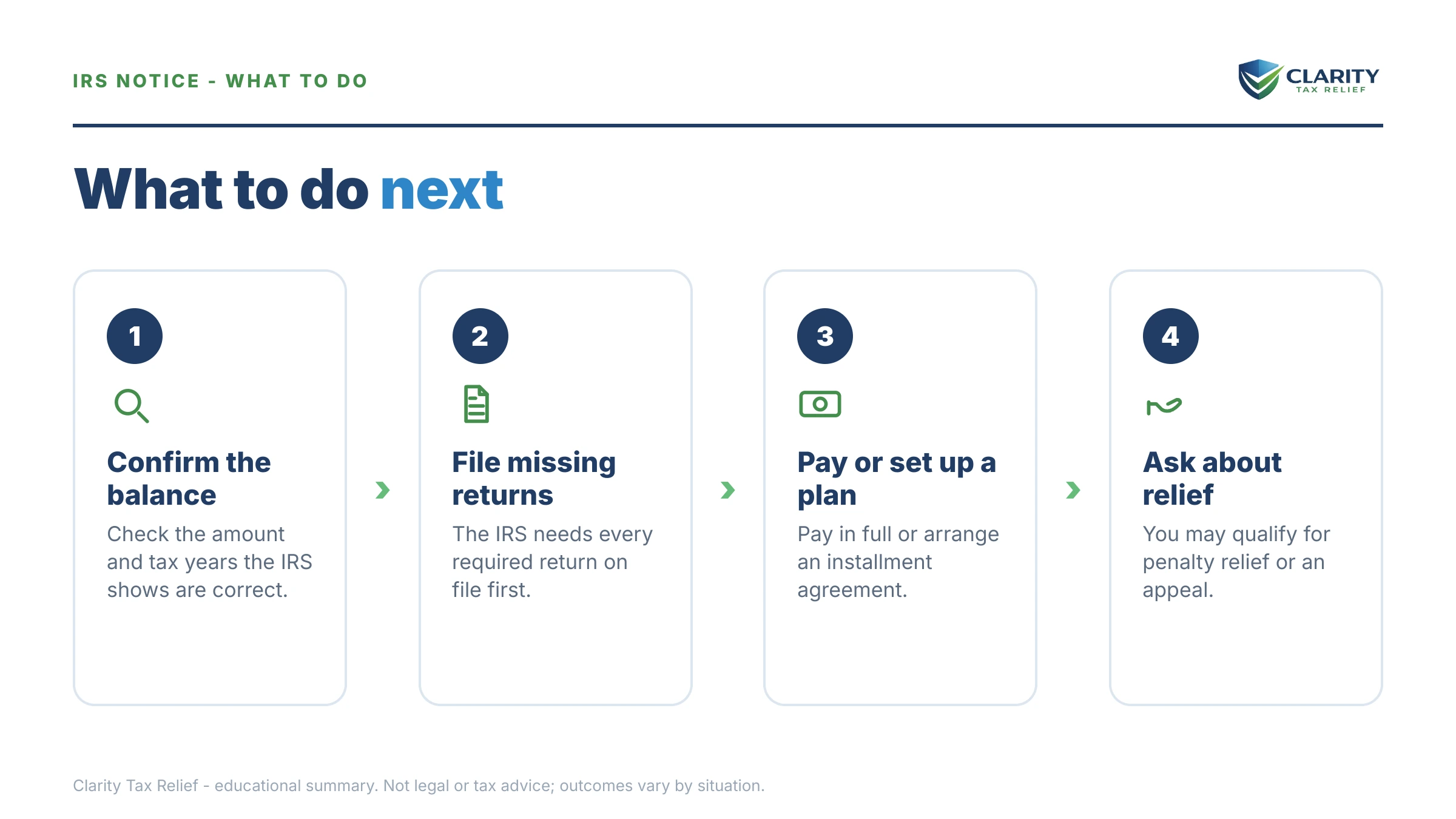
Almost every Letter 12C asks for one of four things, and each has one specific right answer. Send exactly what's listed — no more, no less, and never a brand-new return.
| What the letter asks for | Why the IRS wants it | What to send |
|---|---|---|
| Form 8962 and/or Form 1095-A | A Marketplace Form 1095-A is on file, but your return didn't reconcile the advance Premium Tax Credit | A completed Form 8962 plus a copy of your 1095-A (download it from your HealthCare.gov account) |
| Proof of federal withholding | The withholding claimed on your return doesn't match IRS wage records | Copies of every W-2 and 1099 showing federal income tax withheld |
| A missing form or schedule | Your return references income, credits, or deductions without the supporting form | The completed form or schedule only, not a whole new return |
| Support for a credit claimed | The IRS can't verify eligibility from the return alone | The specific documentation the letter names, exactly as listed |
The Form 8962 case has a hidden wrinkle: reconciling the credit can change your refund on its own. If your actual income came in higher than the estimate you gave the Marketplace, Form 8962 may show you received too much advance credit. Your refund shrinks, or a repayment balance appears. That's not a reason to stall. The IRS will make the same adjustment without you, minus any part of the credit you were entitled to keep.
The withholding case is a copy-and-fax job if you have your forms. Send every W-2 and 1099 that shows federal tax withheld. If an employer never sent one, pull your IRS wage and income transcript to see what was actually reported under your Social Security number before you respond — sending numbers that don't match the IRS's own records just restarts the loop.
The missing-schedule case is the easiest: complete the one form the letter names and send it alone. Resist the urge to "fix" other things at the same time — anything beyond what was requested slows the reply down and can route it to the wrong unit.
How to respond to IRS Letter 12C, step by step
- Read page one of your letter. Find the three things every 12C prints: exactly what's missing, your response deadline. The fax number for replies.
- Gather exactly what's listed — copies, never originals. If Form 8962 is requested, download your Form 1095-A from HealthCare.gov first. If it's withholding, pull the W-2s and 1099s that show federal tax withheld.
- Complete any missing form, but don't redo the return. Fill out Form 8962 (or the missing schedule) by itself — never file a Form 1040-X in response to a 12C.
- Fax your response with the letter on top. Use the fax number printed on your 12C, put a copy of the letter as the first page so it routes to your file, and keep the fax confirmation as proof.
- Track processing — don't refile. Allow several weeks (the IRS says most refunds follow within 6–8 weeks of a complete response). Watch your account transcript rather than submitting the return again.
Two things that commonly happen after you respond, neither of which means trouble: your refund tracker may sit unchanged for weeks — see "Where's My Refund" stuck on processing — and you may receive a Letter 2645C, which is just the IRS saying it received your reply and needs more time. Neither requires action from you.
Worked example: a $23,800 catch-up filer and a frozen refund
Say you're a gig worker who just filed three years at once after falling behind. The two older years land with balances totaling $23,800. The newest year is different: a part-time W-2 job withheld tax all year and you had Marketplace coverage, so that return shows a $3,100 refund. Three weeks later, a Letter 12C arrives on the newest year asking for Form 8962 and copies of your W-2.
Here's the math on responding versus stalling. Respond, and once the return processes, that $3,100 refund doesn't come to you — the IRS applies it to your older balances. $23,800 − $3,100 = $20,700 owed before you've paid a dollar out of pocket. That's the cheapest $3,100 payment you'll ever make.
Ignore the letter, and the IRS eventually processes the return without the credit and the unverified withholding. The $3,100 refund evaporates, and may flip to a small balance if the stripped credit exceeds what you'd verified. Meanwhile the $23,800 keeps compounding: the failure-to-pay penalty alone runs 0.5% per month, roughly $119 a month on that balance, with interest on top. You can estimate what your own balance is accruing with our IRS penalty and interest calculator.
The bigger lesson for anyone in this spot: the 12C is the small problem. The three unfiled years are the real project. The order you resolve things in — returns first, then penalties, then the balance — changes what you ultimately pay. Start with haven't filed in 3 years for that sequence.
When you can handle Letter 12C yourself
Most people can clear a 12C without any help. If the letter asks for one clear item — a Form 8962 you can build from your 1095-A, W-2 copies sitting in a drawer, a schedule your software dropped — gather it, fax it with the letter on top, and you're done. There's no negotiation here; it's document delivery.
Experienced help changes the outcome in a few specific situations: when the 12C sits on top of unfiled years or an existing balance (the refund it's holding may be your cheapest payment, and sequencing matters). When the Form 8962 reconciliation creates a repayment you can't pay. When you can't document the withholding you claimed because an employer never issued forms. Or when you didn't respond in time, the IRS already adjusted the return. You need to contest the change. In those cases the 12C is a symptom, and treating only the symptom leaves the expensive problem running.
If any of that describes you, a free case review with an experienced tax professional will tell you whether this is a one-fax fix or the first move in a bigger cleanup — start with the 2-minute form or call (888) 825-7779.
Terms on your Letter 12C, decoded
- Form 8962 — the form that reconciles the health-insurance subsidy you received in advance against what your actual income entitled you to.
- Form 1095-A — the Marketplace's statement of your coverage and advance credit payments; it's the source document for Form 8962.
- Advance Premium Tax Credit (APTC) — the subsidy paid directly to your insurer during the year, based on the income you estimated when you enrolled.
- Error resolution — the IRS processing unit where incomplete returns wait; your return sits there until your 12C response arrives.
- Transaction Code 570 — the transcript code that often marks the hold on your account while the return is suspended.
You can check your own account status for free — see how to get your IRS transcript online.
Letter 12C questions, answered
Why did I get a Letter 12C from the IRS?
The IRS stopped processing your tax return because something it needs is missing — the letter lists exactly what. The most common trigger is a missing Form 8962 when the IRS has a Form 1095-A showing Marketplace health coverage. Other common causes are withholding the IRS can't verify against its wage records or a form your software left off. It is a paperwork request, not an accusation.
How long do I have to respond to Letter 12C?
The letter itself states your deadline, typically 20 days from the date printed at the top. Your refund stays frozen until the IRS receives what it asked for, so faster is better. If you genuinely can't gather one document in time, send what you have with a short note explaining what's coming rather than sending nothing.
Is Letter 12C an audit?
No. Letter 12C comes from the IRS's processing pipeline, not from an examiner. Your deductions aren't being challenged. The IRS simply can't finish processing the return without the item it listed. Once you send it, processing resumes, and the letter by itself does not raise your audit risk.
Should I file an amended return instead of answering Letter 12C?
No — do not file Form 1040-X in response to a 12C. Your original return hasn't finished processing yet, and an amendment stacked on a suspended return creates confusion and months of extra delay. Send only the items the letter requests, with a copy of the letter on top, to the fax number or address it provides.
How long after I respond to Letter 12C will I get my refund?
The IRS generally says to allow six to eight weeks after it receives a complete response. In 2026, with the IRS workforce down roughly 27% after the 2025 cuts, real-world waits often run longer. Watch your account transcript for the refund to release instead of calling — the phone lines are the slowest path of all.
What happens if I don't respond to Letter 12C?
The IRS eventually processes your return without the missing item — which usually means removing the credit or withholding it couldn't verify. Your refund shrinks or becomes a balance due, and you'll get an adjustment notice explaining the change. Undoing that adjustment after the fact is far harder than answering the letter now.
Can I fax my response to Letter 12C?
Yes — fax is the fastest way to respond, and your letter prints the fax number to use. Include the letter (or at least its first page) on top of your documents so the response routes to your file. Keep the fax confirmation page; it's your proof of a timely response if anything gets misplaced.
Why is the IRS asking me for Form 8962?
Because its records show a Form 1095-A — meaning someone on your return had Marketplace health insurance with advance Premium Tax Credit payments — but your return didn't include the Form 8962 that reconciles those payments. Download your 1095-A from your HealthCare.gov account, complete Form 8962 from it, and send both back. The IRS won't release your refund until the credit is reconciled.
Your next 24 hours
- Find two things on page one of your letter: the response deadline and the fax number. Circle both — the deadline printed there is the only clock that matters.
- Gather what's listed: the letter itself, a copy of the return you filed. The requested items — your 1095-A from HealthCare.gov if it's a Form 8962 request, or your W-2s and 1099s if it's withholding.
- If the 12C sits on top of unfiled years or a balance you can't pay, get a free case review before the window on your letter closes — the 2-minute form or (888) 825-7779. Ten minutes now beats untangling an automated adjustment later.
Primary sources: the IRS's own explainer at Understanding your Letter 12C, your Form 1095-A download at HealthCare.gov, and — if your response has been ignored past normal processing times and the delay is causing hardship — the Taxpayer Advocate Service.
This guide is general information, not tax or legal advice for your specific situation. Eligibility for IRS programs depends on individual facts and circumstances; no outcome is guaranteed.