
IRS Letters
IRS Letter 3172 Notice of Federal Tax Lien Filing: What It Means and What to Do (2026)
The short answer: a Letter 3172 notice of federal tax lien means the IRS has already filed a Notice of Federal Tax Lien, a public claim against your property, at your county recorder's office. The letter starts one clock: you have 30 days to request a Collection Due Process hearing on Form 12153.
You filed jointly, the balance slipped down the priority list, and now a letter with both your names on it says a claim against everything you own together was recorded at the courthouse before you even opened the envelope. That's an ugly feeling, but a lien is a claim, not a seizure, and at balances like $7,400 it's one of the most reversible problems in the entire IRS collection playbook.
Two things on this letter matter more than everything else: the tax periods it lists, and the hearing-request deadline it prints. The image below shows exactly what a Letter 3172 looks like and where to find both.
⏱ Your deadline: you have 30 days to request a Collection Due Process hearing after Letter 3172, and the exact request-by date is printed on the letter itself. The lien is already filed; this deadline is about preserving your right to independent Appeals review with Tax Court backup. Miss it and that right is gone for these tax periods.
Why you got a Letter 3172 notice of federal tax lien in 2026
Letter 3172 must be sent within 5 business days after the IRS records a Notice of Federal Tax Lien (NFTL) against you. The law, Internal Revenue Code §6320, requires the IRS to tell you the lien was filed, tell you where, and explain your right to a hearing. So by the time you're reading it, the filing has already happened at your county recorder's office (or, for business property, often the secretary of state).
The lien itself arose quietly and automatically much earlier: the moment the IRS assessed the tax, sent a demand for payment. The balance went unpaid. Recording the NFTL is what changes things. It converts a silent statutory lien into a public record that other creditors, title companies, and lenders can see. It establishes the IRS's place in line against them.
Why a lien on your account specifically? Common triggers: a balance that crossed the IRS's usual filing threshold, a defaulted installment agreement, a string of unanswered collection notices, or an assessment from an audit or unfiled-return case. IRS policy generally points toward filing liens on balances over $10,000, but that's internal guidance, not a legal floor. A $7,400 balance gets liened too, particularly after a broken payment plan or ignored notices. If you're not sure how your account got here, start with why did I get a letter from the IRS. If you pull your account transcript, the filing shows up as code 582.
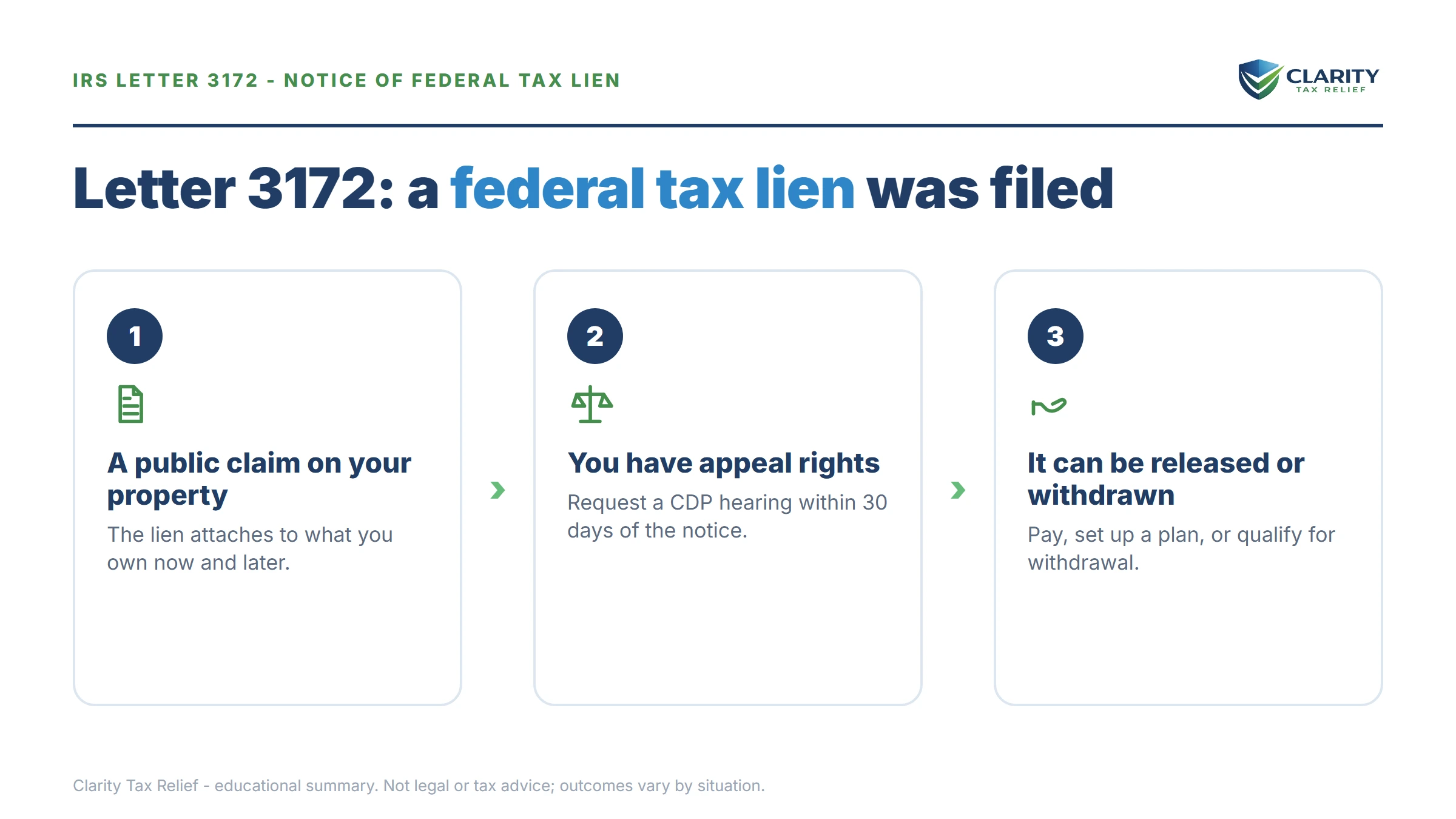
“Letter 3172 gives you 30 days to request a Collection Due Process (CDP) hearing to discuss the lien filing. You should request a CDP hearing using Form 12153 if you feel the lien is inappropriate.”
— Collection due process (CDP) FAQs (IRS.gov)
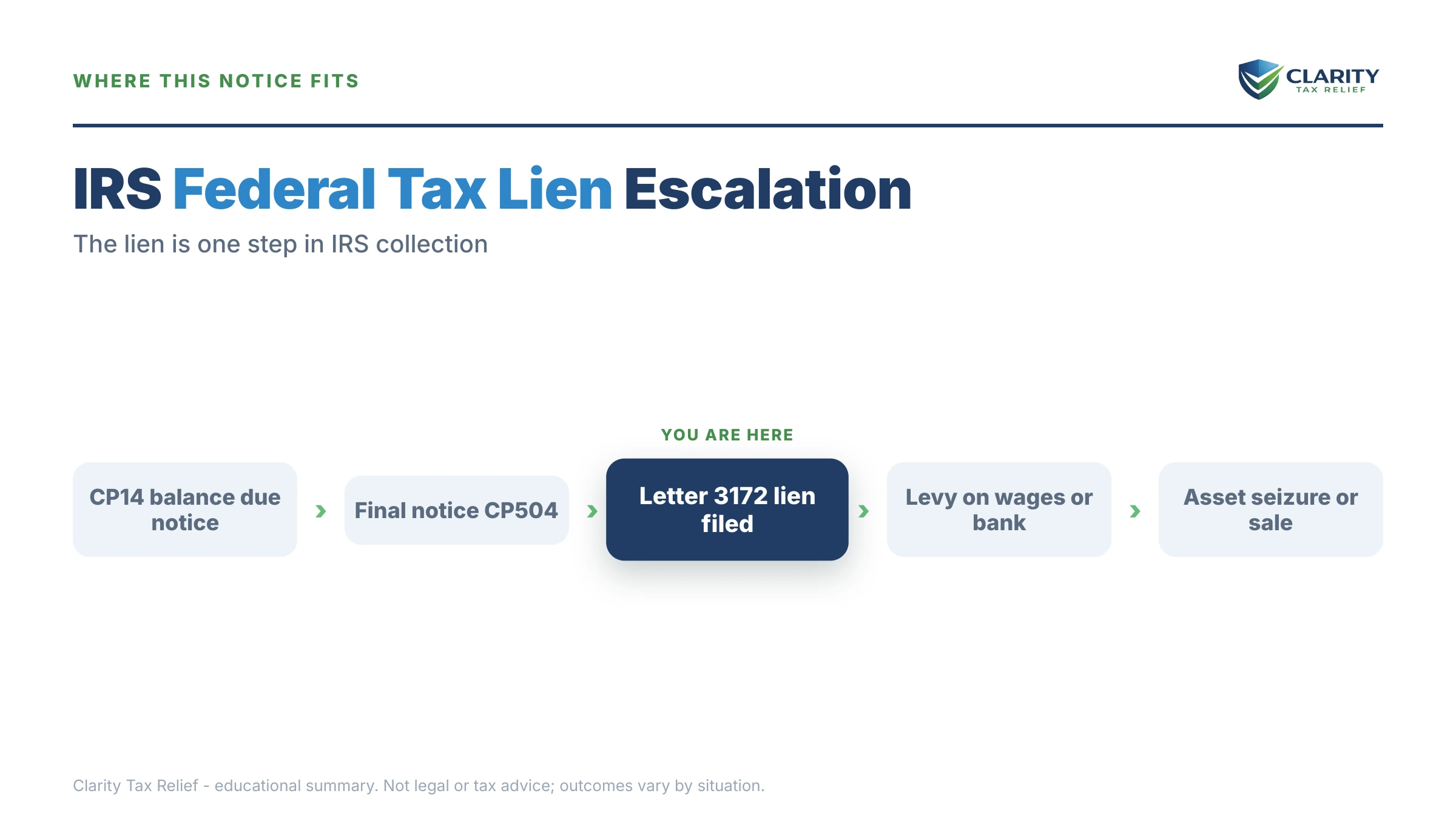
Where Letter 3172 falls in the IRS collection sequence
A lien filing typically follows at least three unanswered bills — Letter 3172 is a mid-to-late-stage event, not a first warning. Here's the sequence around it:
| Stage | What it means | What's at stake |
|---|---|---|
| CP14 | First bill for the balance due | Nothing enforced yet; roughly 21 days before escalation |
| CP501 / CP503 | Reminder notices | Balance growing monthly with penalties and interest |
| CP504 | Intent to levy your state tax refund (IRC §6331(d)) | State refund can be seized; lien filing becomes likely |
| NFTL filed + Letter 3172 | Lien recorded in public records. You are here | 30 days to request a CDP hearing (Form 12153) |
| LT11 / Letter 1058 | Final notice of intent to levy | 30 days before wages and bank accounts can be levied |
Note that the lien track and the levy track run in parallel. Receiving Letter 3172 doesn't mean a levy is off the table — many taxpayers get a Letter 1058 within weeks of the lien filing, and each letter carries its own separate 30-day hearing right.
What the lien actually does, and what it doesn't
A federal tax lien attaches to everything you own — your home, vehicles, business assets, accounts receivable, and even property you acquire later — until the debt is resolved. But it's important to be precise about what that means day to day, because the fear usually outruns the facts. A lien is a legal claim; a levy is a taking. The full distinction is covered in IRS lien vs levy, but here's the practical picture:
- Your paycheck and bank account are not touched by the lien. Only a levy reaches those. A levy requires its own final notice and its own 30-day window first.
- Your credit score doesn't take a direct hit. The three major bureaus removed tax liens from consumer credit reports in 2018 — details in tax lien on credit report. But the lien is a public record, and mortgage underwriters, landlords, and business lenders find it through public-records searches.
- Selling or refinancing your home gets complicated, not impossible. With enough equity, the IRS gets paid at closing. Without it, there are formal workarounds — a tax lien discharge to free a specific property for sale, or a tax lien subordination to let a refinance close. The mechanics of selling are in sell house with IRS lien.
- For a married couple who filed jointly, the lien names both spouses. A joint return means joint-and-several liability, so the NFTL attaches to jointly owned property — including a home titled in both names. If the debt had belonged to only one spouse (say, from a year filed separately), the lien would attach only to that spouse's property interest — though in community property states it can still reach community assets.
- If you're self-employed, the reach is wider. The lien attaches to business equipment and receivables. It can surface when a client, factor, or bank runs a lien search on your business name.
Your 30-day hearing right: Form 12153 and IRC §6320
Letter 3172 triggers a one-time right to a Collection Due Process (CDP) hearing before the IRS Independent Office of Appeals for the tax periods listed on the letter. You claim it by filing Form 12153 by the deadline the letter prints — the letter spells out where to send it, as the image in this guide shows.
A timely CDP request gets you three things you can't get any other way at this stage:
- An independent reviewer with real power. A settlement officer can order the lien withdrawn if the filing didn't follow procedure, or approve a collection alternative — installment agreement, Offer in Compromise, or hardship status — as part of resolving the case.
- Tax Court backup. If you disagree with Appeals' determination, you can petition the U.S. Tax Court. An equivalent hearing (the late version) has no court review.
- A chance to dispute the tax itself, but only if you never had a prior opportunity. If the balance came from an audit and you never received the Letter 531 notice of deficiency, the CDP hearing may be your first legitimate forum to challenge the underlying amount.
One trade-off to weigh honestly: a CDP hearing suspends the IRS's 10-year collection statute while it's pending. If your debt is old and close to expiring, pausing that clock can work against you. That's exactly the kind of judgment call worth running past an experienced tax professional before you file.
Miss the deadline? For up to one year you can still request an equivalent hearing on the same form. Appeals hears the same arguments. You just lose the Tax Court right and the case doesn't pause anything on your side or the IRS's.
What happens if you ignore Letter 3172
Ignoring Letter 3172 costs you your one guaranteed shot at independent review, and the lien only gets more expensive to live with from here. The stages, in order:
- The CDP deadline passes. Your right to a hearing with Tax Court review is gone for these tax periods. Only the weaker equivalent hearing remains, and only for a year.
- The lien sits on the public record and compounds the damage. Every month, penalties and interest grow the payoff figure, and every credit application, refinance attempt, or home sale during that time runs into the filing.
- The levy track keeps moving. The lien doesn't take anything, but the automated system behind it queues the final levy notice next. After that notice's own 30-day window, the IRS can seize bank funds (with a 21-day hold before they leave) and garnish wages continuously until released.
- Long-term consequences stack for bigger debts. Balances that grow past $66,000 (the 2026 threshold) can trigger passport certification. And the lien can be refiled to follow the debt if collection is extended.
In 2026, don't count on slipping through the cracks. The IRS workforce shrank roughly 27% in 2025, which makes humans harder to reach, but lien filings, refilings, and levy notices are generated by automated systems that never stopped running.
Holding a Letter 3172 right now?
The hearing-request deadline printed on your letter is a one-time right — once the 30-day window closes, it doesn't reopen. Send us a photo of your Letter 3172 and an experienced tax professional will map your fastest route to getting the lien withdrawn or released — free, confidential, no pressure.
Your options after a federal tax lien is filed
Five remedies for a lien already filed
Five separate remedies exist for a filed federal tax lien — release, withdrawal, discharge, subordination. A CDP appeal of the filing itself — and they do very different things:
| Remedy | Form | What it does | When it's realistic |
|---|---|---|---|
| CDP hearing | Form 12153 | Independent Appeals review of the filing; can order withdrawal or approve an alternative | Within 30 days of Letter 3172 (equivalent hearing up to 1 year) |
| Release | Automatic — Form 668(Z) issued | Ends the lien; record shows it as released | Within 30 days of full payment, bond, or the debt becoming unenforceable |
| Withdrawal | Form 12277 | Erases the public filing as if it hadn't happened | Balance ≤ $25,000 on a direct-debit plan after 3 payments; improper filing; or after full payment with clean compliance |
| Discharge | Form 14135 | Removes the lien from one specific property so it can sell | Selling property; IRS gets its interest from proceeds (or there's none to get) |
| Subordination | Form 14134 | Lets a new lender jump ahead of the IRS so a refinance can close | When the refinance helps you pay the tax debt |
A few distinctions worth internalizing before you pick a lane:
Release vs. withdrawal is the difference that matters most. A release (documented by the certificate of release of tax lien) says the debt is satisfied. But the original filing stays in county records, marked released. A lien withdrawal on Form 12277 pulls the filing itself, which is what you want if a lender or licensing board will be looking.
The lien also has a natural expiration. It rides on the collection statute, generally 10 years from assessment. The NFTL is written to self-release when that date passes unless the IRS refiles. The catch is tolling: appeals, offers, and bankruptcy pause the clock, so the real date is often later than the math suggests. See does IRS tax lien expire, or estimate your own collection deadline with our CSED Calculator.
Paying the debt is what powers every remedy. Whether by full payment, a payment plan, hardship status, or, where the math genuinely supports it, an Offer in Compromise, the lien problem resolves through the debt problem. The IRS accepted roughly 1 in 5 offers in FY2024, so treat OIC as a means-tested program, not a shortcut.
What resolving a $7,400 lien actually looks like (worked example)
A $7,400 lien is small by IRS standards, and small balances have the cleanest exit ramps. Say you and your spouse owe $7,400 from a jointly filed year, and the NFTL was just recorded. This is hypothetical math, but it shows the real shape of each path:
- Pay in full: $7,400 once. The IRS must release the lien within 30 days. File Form 12277 afterward to request the filing be withdrawn entirely.
- Short-term plan (up to 180 days, $0 setup): $7,400 ÷ 6 ≈ $1,233/month. Interest and the 0.5%/month late-payment penalty keep accruing until paid, then the release follows.
- 72-month direct-debit installment agreement: $7,400 ÷ 72 ≈ $103/month minimum, though because interest keeps running, stretching to the maximum term costs the most overall. The strategic move at this balance: a direct debit installment agreement under $25,000 makes you eligible to request lien withdrawal after just three consecutive payments. Roughly $310/month clears the debt in about two years and gets the public filing erased within months of starting.
- Hardship (Currently Not Collectible): $0/month if paying would leave you unable to cover basic living expenses. The lien stays filed, the balance grows, but levies stop and the 10-year clock keeps running.
One more lever: if the couple has a clean compliance history for the prior 3 years, first-time penalty abatement can strip the failure-to-pay penalties baked into that $7,400, and starting summer 2026, the IRS's new Automatic Exemption from Penalty (AEP) applies similar relief automatically, with no request needed. Here's the full costs-and-outcomes picture:
| Option | Approximate cost | Time to resolution | Lien outcome |
|---|---|---|---|
| Pay in full | $7,400 once | Immediate | Release within 30 days; withdrawal available on request |
| Short-term plan (180 days) | ≈ $1,233/mo × 6, $0 setup, interest accrues | Up to 6 months | Release after payoff |
| Direct-debit installment agreement | From ≈ $103/mo (72 mo) to ≈ $310/mo (24 mo), plus a modest setup fee | 2–6 years depending on payment | Withdrawal eligible after 3 consecutive payments (Form 12277) |
| Currently Not Collectible | $0/mo; balance grows | Until finances improve or statute expires | Lien stays filed; self-releases at the CSED |
| Offer in Compromise | $205 fee + 20% down on a lump-sum offer (both waived with low-income certification) | Often 6–24 months; auto-accepted if no decision in 2 years, with narrow exceptions - a returned or rejected offer stops the clock, and time during court disputes does not count | Release after offer terms are completed |
At $7,400 with two incomes in the household, an OIC rarely pencils out — the IRS looks at what it could collect from your income and assets over time, and most couples who can fund $103–$310 a month won't qualify. The direct-debit withdrawal path is usually the fastest route to both a resolved debt and a clean public record.
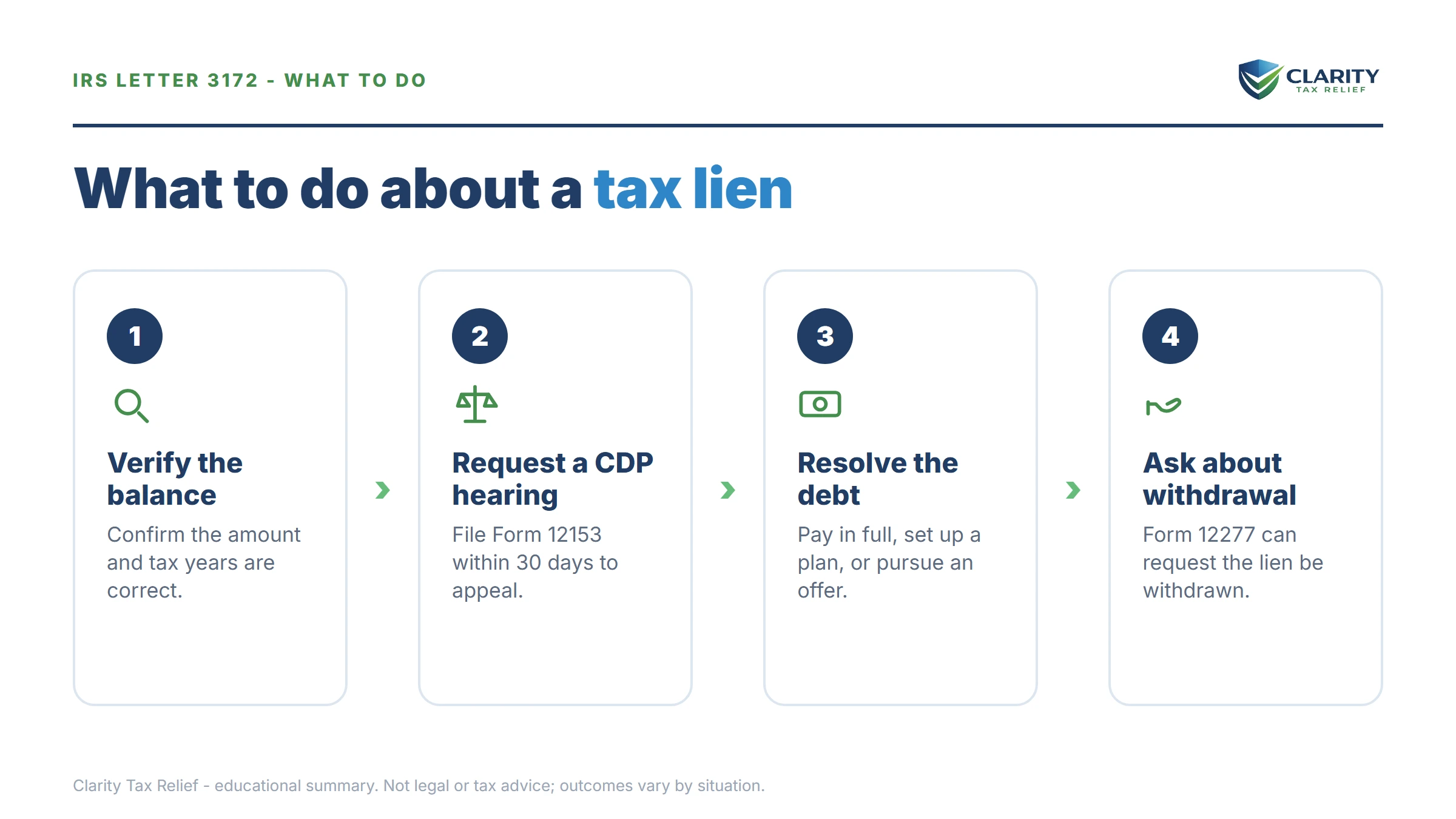
How to respond to Letter 3172, step by step
- Verify the lien filing details. Pull the tax periods and amounts listed on the letter, compare them against your IRS online account, and confirm the debt is yours and correct.
- Calendar the CDP deadline today. Find the request-by date printed on Letter 3172 and write it down. This deadline decides whether you keep Tax Court appeal rights.
- Decide whether to file Form 12153. Request a Collection Due Process hearing if the lien was filed in error, you never had a chance to dispute the tax, or you want Appeals to consider a collection alternative.
- Set up your resolution. Pay in full if you can, or open a direct-debit installment agreement — for a balance under $25,000, that is the route that leads to withdrawal.
- Request lien withdrawal or release. After full payment, confirm the release. After three consecutive direct-debit payments, file Form 12277 asking the IRS to withdraw the filing.
- Confirm the county record is clear. Check the recorder's office in every county where you own property to make sure the release or withdrawal was actually recorded.
When you can handle Letter 3172 yourself, and when help changes the outcome
When DIY works and when help matters
Plenty of Letter 3172 situations are genuinely DIY. If the balance is accurate, it's under $25,000. You can commit to a direct-debit plan, you can set up the agreement online, make three payments, and file Form 12277 yourself — no professional required. Same if you can simply pay in full: the release is automatic, and the withdrawal request afterward is a one-page form.
Experienced help changes outcomes in a narrower set of cases: when you believe the tax itself is wrong and the CDP hearing is your only forum to say so. When the lien is blocking a home sale or refinance on a clock and a discharge or subordination package has to be right the first time. When multiple years, some possibly unfiled, sit behind the lien. When the debt is business or payroll tax, where a lien on receivables can strangle cash flow. Or when the CSED question (how much clock is left, and whether a hearing pauses it) drives the whole strategy. In those cases, the sequencing decisions are worth more than the paperwork.
Terms on your Letter 3172, decoded
- Notice of Federal Tax Lien (NFTL): the document the IRS recorded publicly to stake its claim against your property — the lien itself arose earlier, automatically.
- Collection Due Process (CDP) hearing: your right to independent Appeals review of the lien filing, with Tax Court backup, if requested within 30 days.
- Equivalent hearing: the late version of a CDP hearing, available up to one year — same arguments, but no Tax Court review.
- Release vs. withdrawal: a release ends the lien but leaves the filing visible in records; a withdrawal erases the filing itself.
- Discharge: removal of the lien from one specific piece of property (usually so it can be sold) while the lien continues on everything else.
- CSED: the Collection Statute Expiration Date, generally 10 years from assessment, after which the lien self-releases unless refiled.
If your CDP window is still open and you're not sure whether a hearing request helps or hurts your timeline, have an experienced tax professional review your Letter 3172 free at the 2-minute form or (888) 825-7779, before the date printed on the letter passes.
Letter 3172 questions, answered
How long does the federal tax lien behind Letter 3172 last?
The lien generally lasts as long as the IRS can collect the debt — 10 years from the date the tax was assessed, called the CSED. The Notice of Federal Tax Lien is written to self-release when that date passes, unless the IRS refiles it. Be aware the 10-year clock pauses during bankruptcy, a pending Offer in Compromise, or a Collection Due Process hearing, so the real end date is often later than you'd guess.
Will the tax lien from Letter 3172 show up on my credit report?
No — Equifax, Experian, and TransUnion removed all tax liens from consumer credit reports in 2018, so the lien won't lower your credit score directly. But it is still a public record at your county recorder's office. Mortgage lenders, landlords, and business creditors routinely run public-records searches. A Notice of Federal Tax Lien will surface in those checks and can sink an approval.
Can the IRS really file a lien over $7,400?
Yes. IRS policy generally reserves lien filings for balances above $10,000. But that threshold is guidance, not law — the IRS can and does file liens on smaller debts, especially after a defaulted payment plan or repeated unanswered notices. If your balance is modest, that actually works in your favor: smaller debts qualify for the simplest resolution paths, including the direct-debit route to a full lien withdrawal.
What happens if I miss the 30-day deadline on Letter 3172?
You lose the right to a Collection Due Process hearing and the Tax Court review that comes with it. For up to one year after the deadline, you can still request an "equivalent hearing" using the same Form 12153, Appeals will hear the same arguments. But its decision can't be appealed to Tax Court. The request doesn't pause anything. Your payment and lien-removal options all remain available either way.
What's the difference between Letter 3172 and Letter 1058 or LT11?
Letter 3172 tells you a lien has already been filed — a claim against your property that's now public record. Letter 1058 and LT11 warn that a levy is coming, actual seizure of wages or bank funds, after 30 days. Both trigger Collection Due Process rights, but they're separate rights on separate clocks. Many taxpayers receive both letters within weeks of each other, and each deadline has to be tracked on its own.
Does paying in full make the lien disappear immediately?
Almost — the IRS must release the lien within 30 days of full payment by issuing Certificate of Release Form 668(Z). A release ends the lien, but the original filing stays visible in county records as a released lien. If you want the filing itself erased, you can request a withdrawal on Form 12277 after the release. The IRS grants post-payment withdrawals to taxpayers who have stayed compliant with filing and payment.
Can I get the lien withdrawn without paying the full balance?
Yes, if you fit the direct-debit path: owe $25,000 or less, set up a direct-debit installment agreement that pays the debt in full within 72 months (and before the collection deadline), make three consecutive direct-debit payments, and stay current on all filings. Then you file Form 12277 requesting withdrawal. This is the single most useful lien remedy for balances like $7,400, because it removes the public filing while you're still paying.
Does requesting a CDP hearing remove the lien?
Not by itself — the lien was filed before the letter went out, and it stays in place during the hearing. What the hearing does is put a settlement officer in front of you with the power to order withdrawal if the filing was improper, or approve a collection alternative like an installment agreement or Offer in Compromise. It also pauses new levy action on those periods while your case is heard.
Can we still sell or refinance our house with this lien on it?
Yes, but the lien must be dealt with in the transaction. On a sale with enough equity, the title company pays the IRS from the proceeds at closing. With little or no equity, you apply for a discharge on Form 14135 to remove the lien from that one property. For a refinance, Form 14134 asks the IRS to subordinate, step behind the new lender, which the IRS often grants when the refinance helps you pay.
Is Letter 3172 the same thing as the tax lien?
No. The lien itself arose automatically when you didn't pay after the first bill. The Notice of Federal Tax Lien is the document the IRS recorded at the courthouse to make it public. Letter 3172 is simply the required notification — the IRS must tell you within five business days of filing and explain your hearing rights. The letter creates your deadline; the recorded notice creates the public-record problem.
Your next 24 hours
- Find the request-by date on your Letter 3172. It's printed on the letter along with the tax periods covered. That date is your CDP deadline — write it somewhere you'll see it.
- Gather three things: the letter itself, your most recent tax return for the year(s) listed. A rough picture of household income and monthly bills. That's everything needed to pick between full pay, the direct-debit withdrawal path, and a hearing request.
- Get the free case review before the window closes. An experienced tax professional can tell you in one call whether a Form 12153 hearing helps or hurts your specific timeline — the 2-minute form or (888) 825-7779, ideally well before the date on your letter.
Primary sources for further reading: the IRS's own overview at Understanding a federal tax lien, the official IRS payment plans page, and — if the lien filing is causing hardship the normal channels won't fix — the Taxpayer Advocate Service.
This guide is general information, not tax or legal advice for your specific situation. Eligibility for IRS programs depends on individual facts and circumstances; no outcome is guaranteed.