
IRS Letters
IRS Letter 3164: The Trust Fund Penalty Investigation Contact Letter (2026)
The short answer: Letter 3164 is the IRS's third-party contact notice. It tells you the IRS — usually a revenue officer running a Trust Fund Recovery Penalty investigation — may contact your bank, employees, vendors, or bookkeeper about unpaid payroll taxes. It requires no reply, but it means a personal penalty case is being built.
The letter on your kitchen table doesn't demand money. It says something stranger: the IRS "may contact other persons" about the taxes your business owes. If your company is behind on 941 payroll deposits, that quiet sentence means an investigator is deciding whether the debt should become yours personally, and the decision is still open.
Letter 3164 is different from every collection notice before it because it isn't aimed at your wallet yet. It's aimed at evidence: who signed checks, who chose which bills got paid, who knew the payroll taxes weren't going in. The image below shows exactly what a Letter 3164 looks like and where to find the contact-period dates that control what happens next.
⏱ Your real clock: Letter 3164 has no response deadline, but the contact-start date printed on the letter is a genuine countdown. Under IRC §7602(c), the IRS must send this notice at least 45 days before it begins contacting third parties. The date on your copy tells you how long you have to get representation in place before your bank and employees hear from the IRS.
Why you got Letter 3164 (and what the IRS is investigating)
Letter 3164 is the notice IRC §7602(c) requires the IRS to send before it contacts anyone other than you about your tax liability. Congress built that warning into the law — the IRS cannot legally start interviewing the people around you without mailing this letter first.
The letter comes in several lettered versions (3164-A, 3164-B, 3164-E, and others) depending on which IRS function sent it — collection, examination, or unfiled-return inquiries. If yours arrived from a revenue officer while your business owes payroll taxes, you're on the Trust Fund Recovery Penalty track, and that's the version this guide covers. (For a general walkthrough of decoding any IRS mail, see why did I get a letter from the IRS.)
The TFRP, under IRC §6672, lets the IRS assess 100% of the "trust fund" portion of unpaid payroll taxes against individuals personally — the income tax withheld from employees' paychecks plus the employee share of Social Security and Medicare. That money was never the business's; it was held in trust for the government. When it doesn't arrive, the IRS looks for the people who decided where it went instead. The full liability framework is covered in our guide to the trust fund recovery penalty.
If your business also has quarters with no 941 filed at all, expect that thread to run in parallel — the IRS can propose returns for the business, a process that starts with Letter 1085. Unfiled quarters make the trust-fund math worse, because the IRS estimates high.
“You must deposit and report federal income tax and Additional Medicare Tax withheld and both the employer and employee social security and Medicare taxes.”
— Employment taxes (IRS.gov)
What the third-party contact notice lets the IRS do
Once the contact-start date on your Letter 3164 passes, the IRS can lawfully contact your bank, current and former employees, vendors, landlords, payroll company, and bookkeeper about the unpaid taxes. Each contact feeds one file: the case for assessing the penalty against specific people.
Two legal elements decide who pays. Responsibility — did you have the status, duty, and authority to direct payments? Willfulness — did you know the taxes were unpaid and pay other creditors anyway? Bank signature cards, canceled checks, and interview statements from the people around you are exactly how a revenue officer proves both. Our breakdown of who is personally liable for payroll taxes walks through how owners, officers, bookkeepers, and check-signers each get measured.
You have a matching right the letter mentions in fine print: you can request, in writing, a list of the third parties the IRS actually contacted during the period on your notice. Use it. Knowing whether the RO pulled your signature cards or interviewed your former office manager tells you which element of the penalty they think they can prove.
What happens if you ignore Letter 3164
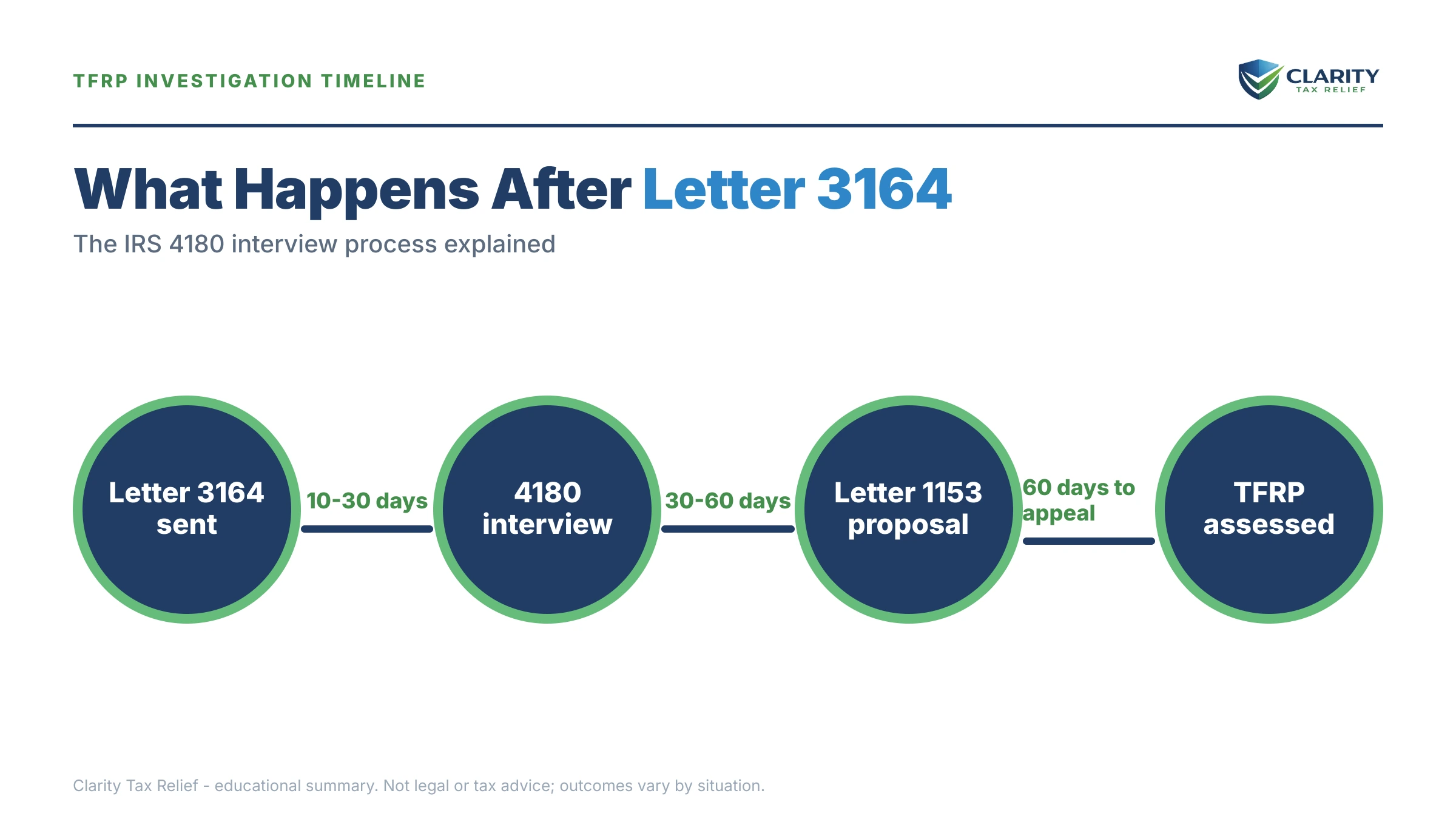
Ignoring Letter 3164 doesn't stop the investigation. It just means the file gets built entirely from other people's answers. The sequence from here runs in one direction:
- Letter 3164 arrives. The contact window opens on the date printed on your copy. You are here — no personal assessment exists yet.
- Third-party contacts begin. The revenue officer gathers bank signature cards, canceled checks, and statements from employees and vendors about who controlled the money.
- Form 4180 interviews. Each potential responsible person is asked to sit for the Form 4180 interview — a structured questionnaire aimed squarely at the responsibility and willfulness elements.
- Letter 1153 and Form 2751. The IRS proposes the penalty against you by name. Letter 1153 starts a 60-day window to protest to IRS Appeals. Your last stop before assessment.
- Assessment against your SSN. The business's trust-fund debt becomes your personal debt, alongside anyone else found responsible.
- Personal collection. Bills arrive in your name, followed by a final notice of intent to levy — Letter 1058 or LT11 — which starts a 30-day clock and your Collection Due Process rights before the IRS can reach personal wages, bank accounts, and property.
Here's the strategic point most people miss: your leverage is highest right now, at stage one, when nothing has been assessed and the record is still blank. Every stage that passes converts an open question into a documented conclusion.
| Stage | What happens | The clock that applies |
|---|---|---|
| Letter 3164 | IRS notifies you it may contact third parties | Contacts may begin on the start date printed on your letter (at least 45 days after issuance) |
| Third-party contacts | Bank records, signature cards, employee and vendor interviews | The contact period stated on your letter |
| Form 4180 interview | Structured responsible-person questioning, on the record | Scheduled by the revenue officer; you may arrange representation first |
| Letter 1153 + Form 2751 | TFRP formally proposed against you by name | 60 days to file a written protest with Appeals |
| Assessment | Trust-fund portion posts to your SSN as personal debt | Balance-due billing begins |
| Final notice of intent to levy | Letter 1058 / LT11 — personal levy authority next | 30 days to request a CDP hearing (Form 12153) |
Holding a Letter 3164 right now?
A revenue officer is building a personal penalty case, and the contact-start date on your letter is the window to get ahead of it. Get your Letter 3164 reviewed free before the IRS starts calling your bank and employees — an experienced tax professional will map your actual exposure, confidentially and without pressure.
Your options during a Letter 3164 TFRP investigation
Before Letter 1153 is ever issued, you have more ways to change the outcome than at any later stage. The realistic moves, roughly in order of impact:
- Get current on this quarter's deposits. A revenue officer's first demand is always compliance going forward. Continuing to miss deposits while under investigation reads as ongoing willfulness — the most damaging fact in the file. If the business is behind broadly, start with our guide to 941 back taxes.
- Have the business pay down the trust-fund portion. The personal penalty tracks the unpaid trust-fund balance. Voluntary business payments can be designated in writing to the trust-fund portion first, shrinking everyone's personal exposure dollar for dollar. (Involuntary payments, levies, get applied however the IRS chooses.)
- Set up a business payment plan. An in-business trust fund installment agreement — covered in our business payroll tax payment plan guide — can keep the company operating and paying while the investigation resolves. It doesn't erase TFRP exposure, but a business steadily paying changes the RO's calculus.
- Contest responsibility and willfulness. Titles don't decide this — facts do. A spouse listed as an officer who never touched the checkbook, a bookkeeper who followed orders, a check-signer who needed a second approval: these are winnable defenses. But they have to be documented before the record hardens.
- Protest after Letter 1153. If the penalty is proposed anyway, the 60-day Appeals protest is your pre-assessment fight. The playbook is in trust fund recovery penalty defense.
- Resolve it after assessment. If the penalty lands, it can go on an installment agreement, and in narrow hardship cases other relief may apply, but every post-assessment option is more expensive than winning earlier.
| Stage / document | Your window | The right at stake |
|---|---|---|
| Letter 3164 | Before the contact-start date printed on the letter | Getting representation (Form 2848) in place before your bank and employees are contacted |
| Contact-list request | During or after the contact period | A written list of the third parties the IRS actually contacted under §7602(c) |
| Form 4180 interview | When scheduled. You may ask to reschedule to obtain representation | Control over how your answers on responsibility and willfulness enter the record |
| Letter 1153 | 60 days from the letter date | An Appeals hearing before the penalty is ever assessed |
| Final notice of intent to levy | 30 days from the notice | A Collection Due Process hearing (Form 12153) before personal levy |
What the numbers look like: a hypothetical $83,100 payroll debt
The single most useful thing you can do with your 941 balance is split it into trust-fund and non-trust-fund dollars, because only the trust-fund slice can follow you home.
Say a married couple jointly runs an S-corp that fell behind across three quarters, and the business account shows $83,100 due. A realistic breakdown:
| Component | Amount | Personal TFRP exposure? |
|---|---|---|
| Federal income tax withheld from employees | $39,400 | Yes — trust fund |
| Employee share of Social Security & Medicare | $16,850 | Yes — trust fund |
| Employer matching share of Social Security & Medicare | $16,850 | No — stays with the business |
| Deposit penalties and interest on the business account | $10,000 | No — stays with the business |
| Total business balance | $83,100 | $56,250 assessable personally |
So the personal stakes here are $39,400 + $16,850 = $56,250, not $83,100. If both spouses are found responsible, each can be assessed the full $56,250. The liability is joint and several: the IRS collects the $56,250 only once. But it can pursue either spouse, or both at the same time, until it's paid.
Now run the leverage math. If the business designates $20,000 of voluntary payments to the trust-fund portion during the investigation, the maximum personal assessment drops to $36,250 — for both of them. That's why the payment strategy during the Letter 3164 window matters as much as the interview strategy.
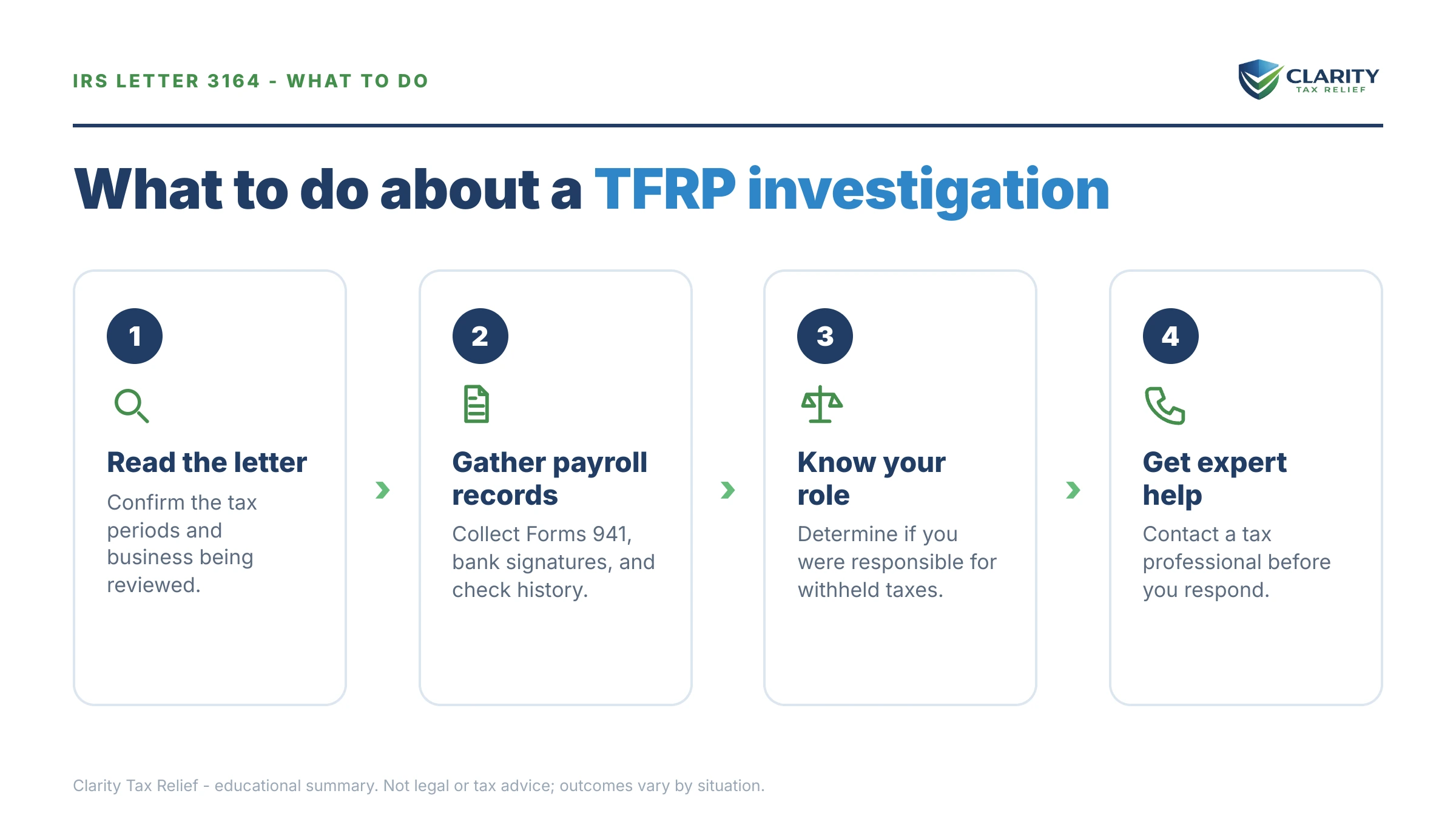
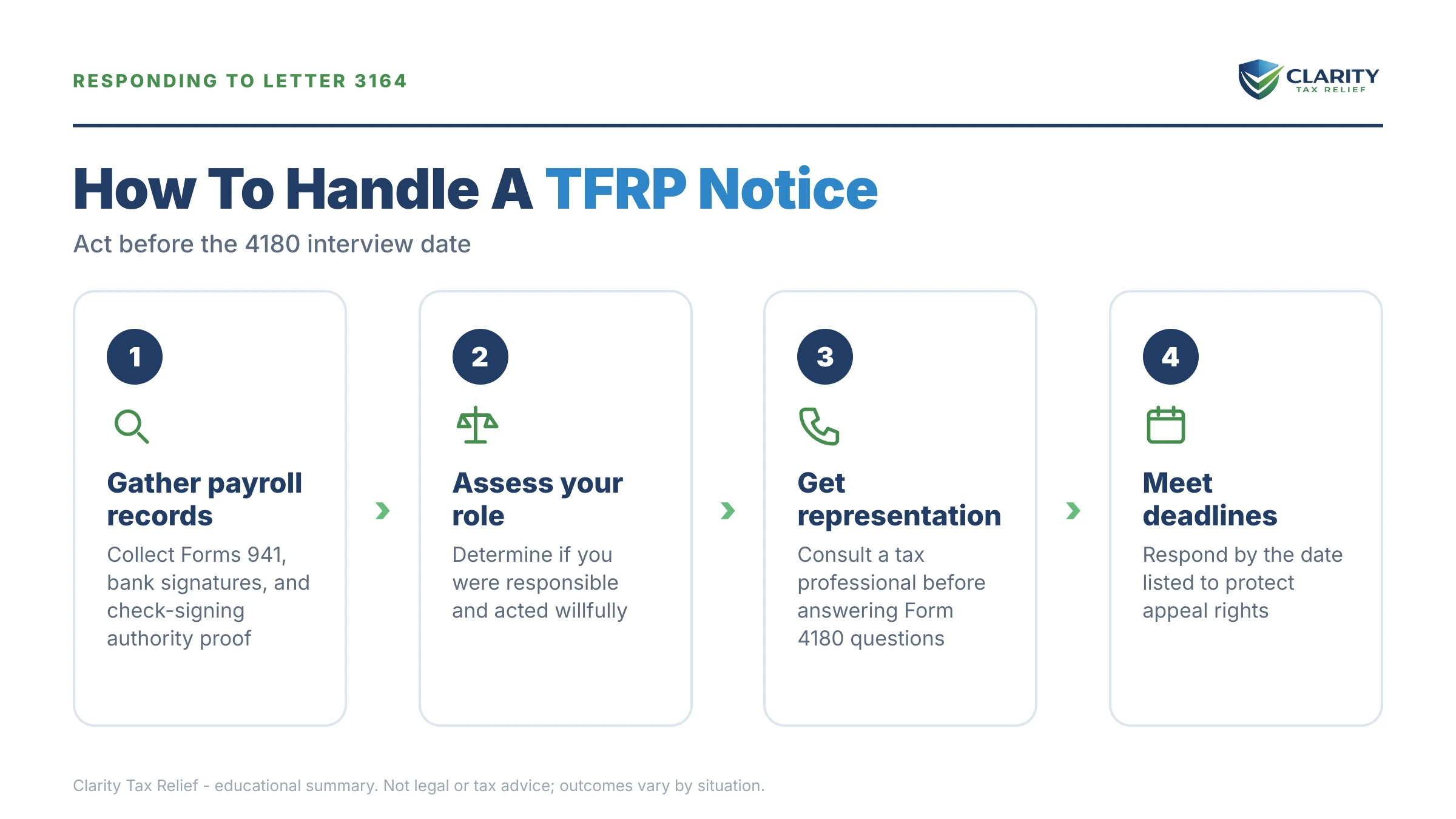
How to respond to Letter 3164, step by step
- Read the contact window: find the contact-start date and the contact period printed on your letter. They control everything else on this page.
- Get representation on file: submit Form 2848 so the revenue officer must work through your representative instead of around you.
- Assemble the records: filed and unfiled 941s, the deposit history, bank signature cards. A clear picture of who actually decided which creditors got paid.
- Get current on this quarter's deposits: nothing lowers the temperature of a payroll-tax case faster than showing the bleeding has stopped.
- Prepare for the Form 4180 interview: know the responsibility and willfulness elements before you answer a single question on the record.
- Calendar the next deadline: if Letter 1153 arrives, you have 60 days to protest — mark it the day the letter shows up.
Step two deserves emphasis. Filing a power of attorney doesn't make you look guilty — revenue officers work with representatives every day, and it's the normal posture for a TFRP case. Our Form 2848 instructions walk through getting it filed correctly the first time.
Married and both on the paperwork: who's actually exposed?
Filing a joint tax return does not make a spouse liable for the trust fund penalty — TFRP liability attaches to individuals based on what they did, not who they married. But couples who run a business together often both have the facts against them: both listed as officers, both on the bank signature card, both aware payroll was tight.
The distinctions that decide these cases are granular. Signing checks occasionally, at the other spouse's direction, is different from deciding which vendors got paid. Being an officer on paper for licensing reasons is different from reviewing the bank balance every Friday. A spouse who genuinely had no authority over payments has a real defense. But it needs to be established during the investigation, not asserted after assessment.
One more marriage-specific wrinkle: once either spouse is assessed, joint tax refunds become collection targets for that spouse's TFRP debt. A non-liable spouse can protect their share of a joint refund with an injured-spouse allocation. But the cleaner outcome is keeping the non-involved spouse out of the assessment entirely.
When you can handle this yourself, and when help changes the outcome
Be honest about which case you have. You can reasonably handle things yourself if the business balance is small, you're the only plausible responsible person, you agree you're liable. Your plan is simply to have the business full-pay quickly — in that scenario the investigation often resolves before it matures, and paying via IRS.gov/payments ends it.
Experienced help changes outcomes in the harder patterns: two or more potential responsible persons pointing at each other, a spouse or bookkeeper with a genuine non-responsibility defense, unfiled 941 quarters inflating the numbers, a business you need to keep operating through the investigation, or a Form 4180 interview already on the calendar. In those cases, what gets said, and designated, and documented — in the next 60 to 90 days typically determines who owes what for the next decade.
If you can't get traction with the IRS at all, or the process itself is causing hardship, the Taxpayer Advocate Service is an independent, free channel inside the IRS. And once any balance becomes personal, payment options run through the standard IRS payment plan programs.
Terms on your letter, decoded
- Trust fund taxes: the money withheld from employees' paychecks — federal income tax plus their share of Social Security and Medicare — held "in trust" for the government until deposited.
- Third-party contact: any IRS communication with someone other than you (bank, employee, vendor) to gather information about your liability — the activity Letter 3164 authorizes.
- Responsible person: anyone with the status, duty, and authority to decide which bills the business paid — a facts test, not a job-title test.
- Willfulness: knowing the payroll taxes were unpaid and choosing to pay other creditors anyway; it does not require bad intent.
- Form 4180: the IRS's structured interview questionnaire used to establish responsibility and willfulness for each candidate.
- Form 2751: the agreement form enclosed with Letter 1153 — signing it consents to the proposed penalty assessment.
Letter 3164 questions, answered
Is Letter 3164 an audit or a criminal investigation?
No — Letter 3164 is a civil notice that the IRS may contact third parties, most often during collection or a Trust Fund Recovery Penalty investigation. It is not an audit letter and not a criminal referral. That said, if a revenue officer sent it over unpaid payroll taxes, the IRS is gathering evidence to assess the trust-fund portion against individuals personally, so treat it as the start of a serious civil case.
Do I have to respond to Letter 3164?
No response is required — the letter is a notification, not a demand. But doing nothing has a cost: the revenue officer will build the responsibility and willfulness record from bank signature cards and interviews with the people around you, without your side of the story in the file. The smarter move is to get representation in place before the contact window printed on your letter opens.
Who can the IRS contact after sending Letter 3164?
Almost anyone with knowledge of the business's finances: banks (for signature cards and account records), current and former employees, vendors, landlords, your payroll company. Your bookkeeper or accountant. The IRS cannot begin those contacts before the start date printed on the letter. You have the right to request a list of the contacts it actually made during the period.
How much is the trust fund recovery penalty?
The TFRP equals 100% of the trust-fund portion of the unpaid payroll taxes — the federal income tax withheld from employees plus the employee share of Social Security and Medicare. It does not include the employer's matching share or the penalties and interest on the business account. On a typical Form 941 balance, the trust-fund portion runs roughly two-thirds of the total.
Can my spouse be liable for the trust fund penalty just because we file jointly?
No. TFRP liability is personal, based on each individual's responsibility and willfulness, not marital status or how you file. But if both spouses were officers or check signers, both can be assessed the full amount. And once one spouse is assessed, joint refunds can be offset. A non-liable spouse can file Form 8379 (injured spouse) to protect their share of a joint refund.
Can I find out who the IRS actually contacted?
Yes. Under IRC §7602(c) you can request, in writing, a list of the third parties the IRS contacted during the period shown on your notice. Some contacts are excluded — for example, ones you authorized, or situations where the IRS determines notifying you risks reprisal against the contact — but the list usually shows you exactly what evidence is being gathered and from whom.
Should I attend the Form 4180 interview alone?
Almost never. The Form 4180 interview exists to lock in your answers on responsibility and willfulness, the two elements of the penalty, and casual phrasing like "I handled the money" becomes assessment evidence. You have the right to representation. With Form 2848 on file, an experienced tax professional can prepare you, attend with you, or in some cases handle the contact for you.
Can the trust fund penalty be settled or paid over time?
Yes, after assessment it can go on an installment agreement like other IRS debt, and in narrow cases an Offer in Compromise, though OICs on trust-fund debt are strict and uncommon. The better economics usually come earlier: having the business pay down the trust-fund portion, winning at Appeals after Letter 1153, or proving you were never a responsible person at all.
Your next 24 hours
- Find the two dates on your Letter 3164 — the contact-start date and the end of the contact period. That window is how long you have before the IRS can start calling your bank and employees.
- Gather the payroll picture: filed and unfiled 941s, the deposit history, bank signature cards. A plain list of who could sign checks and who decided which bills got paid each week.
- Get a free case review before the contact window opens — call (888) 825-7779 or use the 2-minute form. An experienced tax professional can file Form 2848, take over IRS contact, and map exactly how much of the balance can actually reach you personally.
This guide is general information, not tax or legal advice for your specific situation. Eligibility for IRS programs depends on individual facts and circumstances; no outcome is guaranteed.