
IRS Refunds
Where's My Refund Stuck on "Still Processing": Why It Happens and How to Fix It (2026)
The short answer: if "Where's My Refund" is stuck on "still processing," the IRS has pulled your return out of the normal 21-day pipeline for a manual check — most often identity verification, a withholding match, or a credit review. Your account transcript shows which one: a hold code like 570 or 810 almost always explains the delay.
You filed in February, the refund was supposed to cover real plans, and every morning since, the same gray screen: "Your tax return is still being processed. A refund date will be provided when available." No letter, no explanation, no human to ask. If you're checking as a couple — one of you refreshing the app, the other refreshing the bank account — you're living the most common refund complaint of 2026.
Here's the part the tracker never tells you: "still processing" isn't a void. It maps to a specific hold sitting on your IRS account, and you can see that hold yourself, today, for free. The image below shows you exactly what a stuck tracker and the transcript behind it look like, and where on each to focus.
⏱ The only hard deadline is on paper, not on the screen: if the IRS mailed you a letter (5071C, CP05A, 12C), the response date printed on that letter controls, and an unanswered identity-verification letter means your return is never processed at all. If no letter has arrived, there's no clock on you; instead, the IRS generally starts owing you interest 45 days after the filing deadline.
Why "Where's My Refund" gets stuck on "still processing"
"Still being processed" means your return failed at least one automated filter and got routed to a manual queue. The IRS says most e-filed refunds arrive within 21 days; yours left that track. The tracker itself only has three stages — Return Received, Refund Approved, Refund Sent — and it updates just once a day, overnight. When a return gets flagged, the tool has nothing new to say, so it says nothing, sometimes for months.
The wording shift matters more than most people realize. "Your return is being processed" is generally the normal in-queue message. When it flips to "still being processed" — especially when the status bar and your refund amount vanish from the screen — a hold has usually posted to your account. If the generic Tax Topic 152 reference disappears, or is replaced by Tax Topic 151 or a reference number like 1242, the system is telling you (in its own coded way) that your refund has been routed somewhere specific: a review unit, an offset, or an exam.
2026 adds a hard truth: the IRS workforce shrank roughly 27% in 2025. The computers that flag returns never slowed down, but the humans who work the flagged queues did. Flags fire instantly. Releases take longer than they used to, which is why so many refunds are sitting longer this year (more on that in our guide to IRS layoffs 2026 processing delays). The practical effect: waiting passively is more expensive than ever, and reading your own account is more valuable than ever.
Your transcript tells you what the tracker won't
Your IRS account transcript names the exact hold behind a stuck refund, usually weeks before any letter arrives. Pull it free in about ten minutes — here's how to get your IRS transcript online — then read the last few three-digit codes on the account transcript for the stuck year:
- Code 570 — additional account action pending. The all-purpose freeze; something is being verified. See our full guide to code 570 on an IRS transcript.
- Code 971 — a notice was issued. Paired with 570, it means an explanation letter is on its way (or lost in the mail — the online account often shows it first).
- Code 810 — a refund freeze, the heavier hold. Often tied to identity verification or a questioned credit; start with our code 810 refund freeze guide.
- Code 846 — refund issued, with a date. This is the code you're waiting for; if it's already there, your money is in transit.
One warning for transcript-watchers: the tracker and the transcript update on different schedules, so a transcript can move days before the app does. Trust the transcript.
What happens if you ignore a stuck refund
A stuck refund doesn't escalate against you the way a tax bill does, but ignoring it can quietly turn a 60-day delay into a permanent one. The sequence usually runs like this:
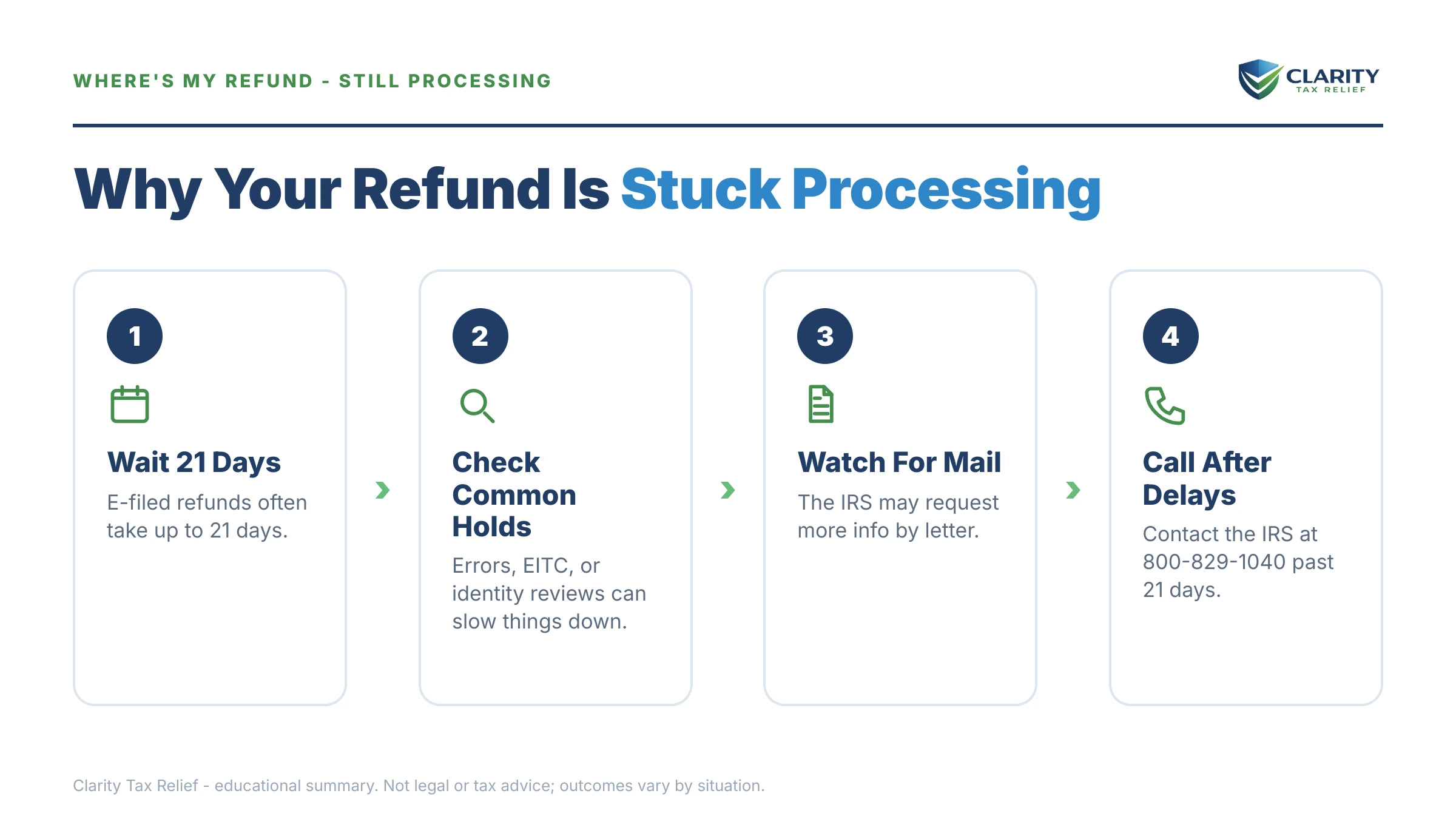
- The normal window passes. Most e-filed refunds arrive within 21 days. Yours doesn't, and the tracker language shifts to "still being processed."
- The hold posts. A 570 or 810 appears on your transcript. The status bar and refund amount often disappear from the tracker at this point.
- The fork: a letter issues (code 971), or nothing does. If a 5071C, CP05, 4464C, or 12C goes out and you answer it, the queue keeps moving. If an identity-verification letter goes unanswered, the return is treated as unfiled and the refund never issues. There is no timeout that releases it in your favor.
- The review resolves one of three ways. Released as filed (571 releasing the hold, then 846), adjusted (a CP12-style change to your refund, which you can dispute), or routed to examination (code 420 or a CP75 — the rare, serious branch).
- Or it simply sits. With review staff thinned in 2026, some flagged returns wait in queues for months with no code movement at all. Nothing forces the file forward except you: a response, a call, or a Taxpayer Advocate case.
The one consolation for waiting: if your refund issues more than 45 days after the filing deadline (or your filing date, if later), the IRS generally adds interest at its quarterly overpayment rate — automatically, though that interest is taxable next year.
Refund frozen for months with no explanation?
Send us your transcript, or let us pull it with you. An experienced tax professional will identify the exact hold code on your account, whether a letter is sitting unanswered. The fastest release path for your situation. Free, confidential, no pressure.
What's actually holding your refund, and what releases each hold
Nearly every "still processing" case falls into one of seven buckets, and each has a different release path. Match your transcript code or letter to the row below:
| What's holding it | How you'll know | What releases it |
|---|---|---|
| Identity verification | Letter 5071C, 4883C, or 5747C; often code 810 | You verify — online, by phone, or in person. The return is not processed until you do. |
| Withholding / income review | Code 570, then a CP05 or 4464C letter | Usually time — the IRS matches your W-2s and 1099s to employer filings. Respond only if a CP05A asks for documents. |
| Refund offset to a debt | Tax Topic 203 on the tracker; codes 826 or 898 | The refund pays the debt. If it was your spouse's debt alone, file Form 8379 to claim your share back. |
| PATH Act hold (EITC/ACTC) | Filed early claiming EITC or the Additional Child Tax Credit | Time only — the law bars these refunds from issuing before mid-February. |
| Error or missing form | Letter 12C or a math-error notice | Send exactly what the letter asks for, once, with the letter's stub attached. |
| Unfiled prior-year returns | CP63 refund-hold notice | File the missing years — the refund stays parked until you do. |
| Amended or duplicate return in the mix | Codes 971/977 for an amended return | Patience on a much slower track — amended returns process separately, over months. |
Three of these deserve a closer look, because they're where couples with large refunds most often land.
The withholding match. Big refunds get screened harder, because a big refund is exactly what a fraudulent return looks like to a computer. The IRS compares every dollar of withholding you claimed against what your employers actually reported. If one employer filed its W-2 copies late, or a payroll company reported under a different EIN than the one on your W-2 — the match fails and a 570 posts. Nothing is wrong with your return; the IRS is waiting on data. A CP05 notice is the usual letter here, and it typically asks you to do nothing while the review runs.
The identity check. If the flag is identity-based, you'll get a 5071C letter (or a 4883C/5747C variant). This is the one hold where doing nothing costs you everything, because the IRS will not process the return until you verify. After you verify, the IRS says to allow up to nine weeks for processing to resume.
The offset. If your refund was taken rather than delayed, the tracker often shows Tax Topic 203 and your transcript shows an 826 (applied to another tax year) or 898 (sent to another agency — child support, student loans, state debt). On a joint return, one spouse's old debt can swallow both spouses' refund. That's fixable with an injured-spouse claim on Form 8379, and if the debt was from before your marriage, start with our guide to an ex-spouse's tax debt taking your refund. And if the offset revealed a federal balance you didn't know about, the bigger question is the debt itself — our pillar on how to settle tax debt yourself walks through every resolution option in one place.
A worked example: the $27,500 joint refund that wouldn't move
Say you and your spouse filed jointly in mid-February claiming a $27,500 refund: $21,300 of combined W-2 withholding across three employers (one of you changed jobs mid-year), $4,200 of estimated payments on a side business, and $2,000 of child tax credit. A refund that size, built mostly on withholding, is a near-certain candidate for the withholding match.
Here's how it plays out. The mid-year job change means three W-2s to verify instead of two. The old employer's payroll filing posts late. The match fails. A 570 posts in early March. A CP05 arrives in late March saying "allow 60 days." The employer data finally posts in June, a 571 releases the hold, and an 846 dates the refund for early July.
The math on the wait: the refund issued well past 45 days after the April deadline, so the IRS owes interest from April 15 to the issue date. At a hypothetical 7% annual overpayment rate, roughly two and a half months of interest on $27,500 is about $27,500 × 7% × 2.5/12 ≈ $400 — added automatically, and taxable next year via a 1099-INT. The lesson inside the example: nothing this couple could have mailed would have sped up the employer match, but pulling the transcript in March would have told them exactly what they were waiting on. That no response was required.
When you can escalate, and who actually has power to move it
You earn a new escalation right at each milestone of a refund delay. Use this table as your calendar:
| Milestone | What it means | Your move |
|---|---|---|
| 21 days after e-file acceptance | The IRS's own benchmark for most refunds has passed | You may call 800-829-1040 — pull your transcript first so you know more than the hold music |
| A letter arrives | The printed response date is the only hard deadline in this process | Respond before that date — same week, ideally |
| 45 days after the filing deadline (or filing date, if later) | The IRS generally begins owing you interest | Nothing to file — it's added automatically to the refund |
| Up to 9 weeks after identity verification | The IRS's stated window for processing to resume post-verification | If it passes with no 846, call the verification line again or escalate |
| Delay causing financial hardship — any time | Eviction risk, utility shutoff, medical needs the refund would cover | File Form 911 with the Taxpayer Advocate |
| Months with no code, no letter, no answers | Manual-review queue limbo | A congressional caseworker inquiry, or an experienced tax professional with power of attorney |
Two escalation notes. The Taxpayer Advocate Service is a genuinely independent arm of the IRS and it is free. But it requires either hardship or a breakdown in normal IRS processes, so document both. And your U.S. representative's district office has caseworkers whose entire job is prying loose stuck federal files. A one-page inquiry from them often gets a status answer the phone line won't give you.
How to respond when your refund is stuck, step by step
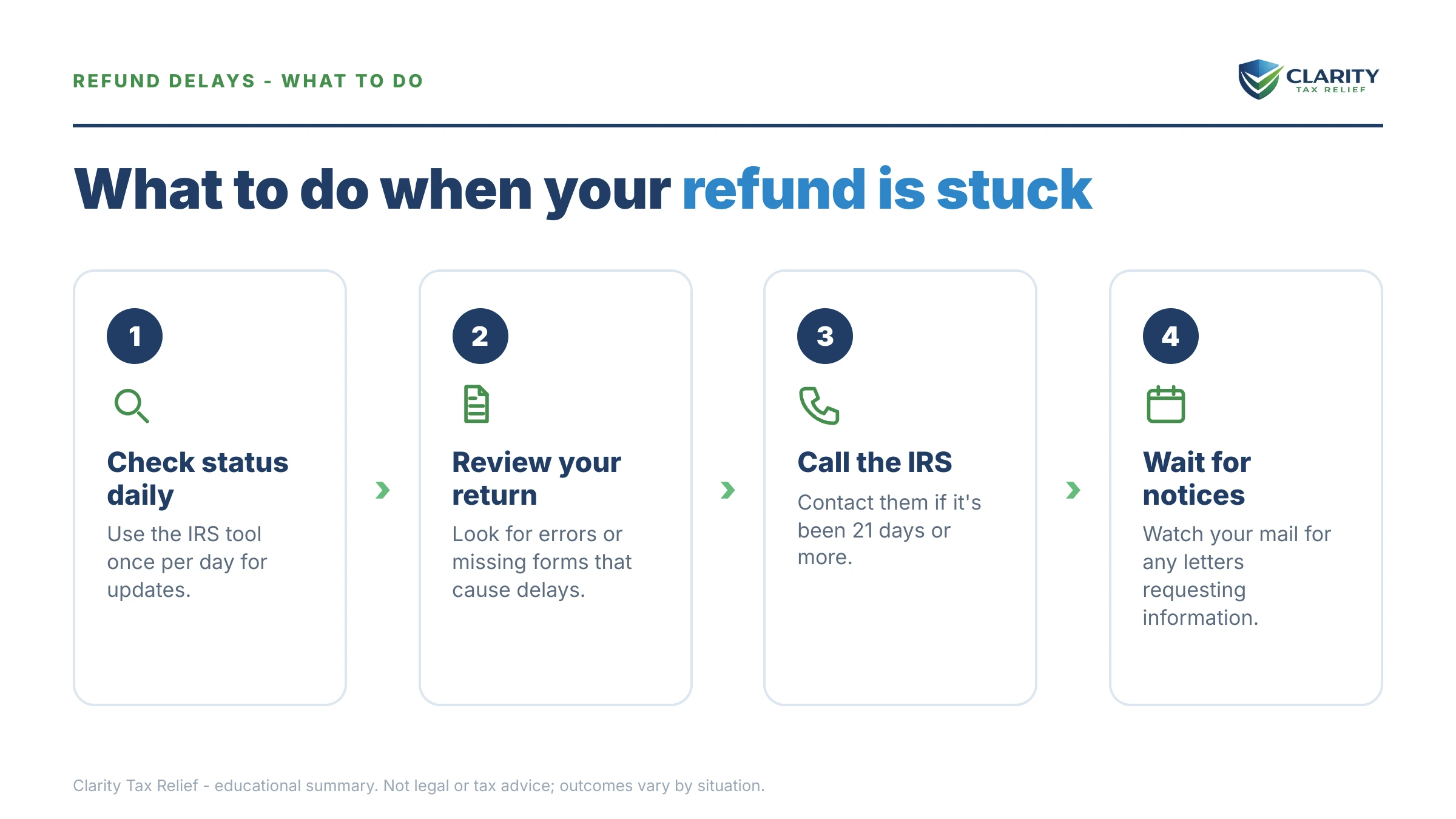
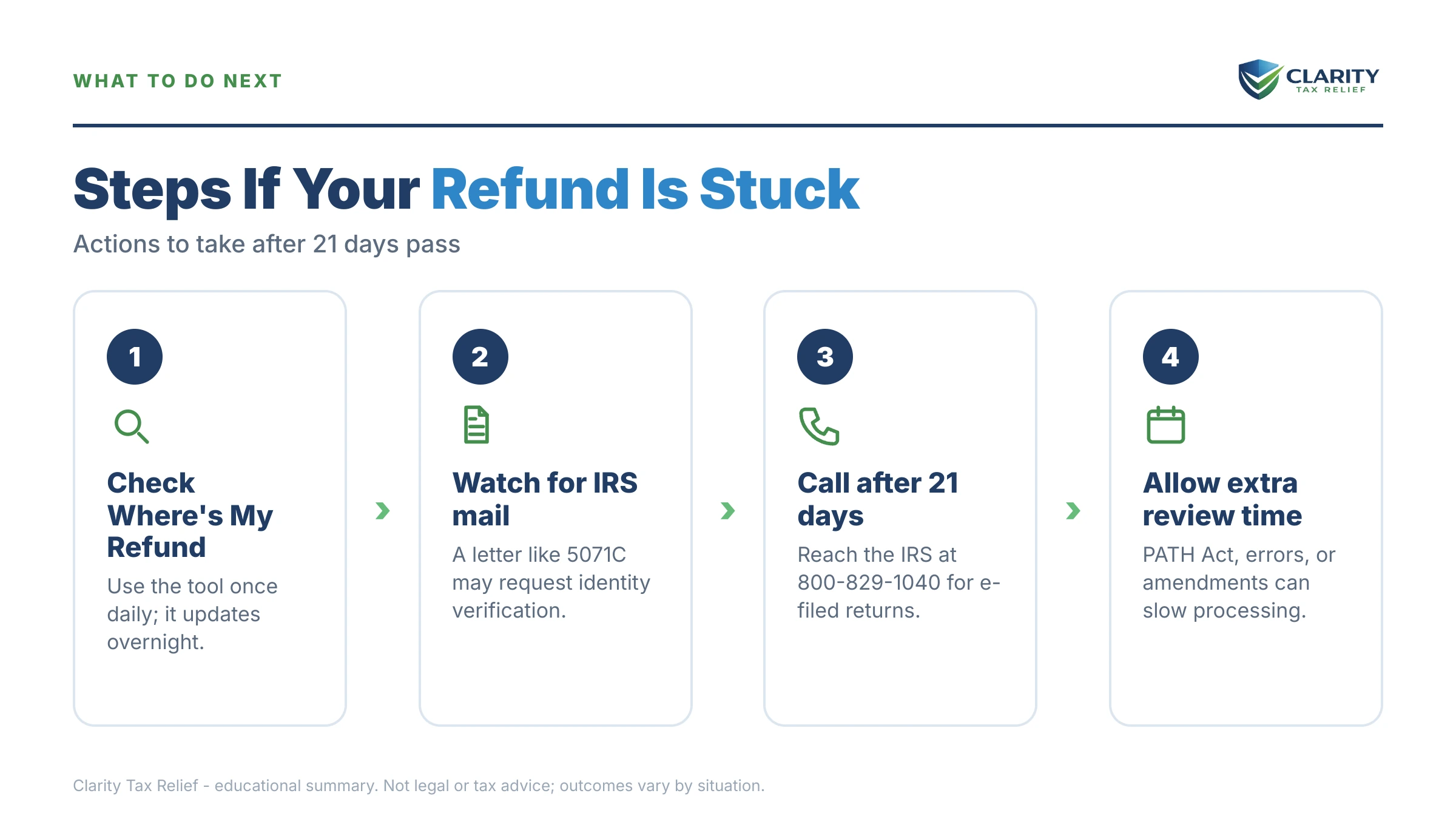
- Pull your account transcript. Log into IRS.gov and open the account transcript for the stuck year — the last code posted (570, 971, 810, or 846) tells you what kind of hold you have.
- Check your online account and your mail. Look for any IRS letter — 5071C, CP05, 4464C, 12C, or CP63 — and note the response date printed on it.
- Answer any letter before its printed date. Verify your identity or send the requested documents the same week. An unanswered verification letter means the return is never processed.
- Call the IRS if there is no code and no letter. After 21 days from e-file acceptance (about six weeks for paper), call 800-829-1040 with your return in hand and, on a joint return, both spouses available.
- Escalate if the delay is causing hardship. File Form 911 with the Taxpayer Advocate Service, or bring in an experienced tax professional if the hold connects to prior-year debt, unfiled returns, or an exam.
When you can handle this yourself, and when help changes the outcome
Most stuck refunds resolve without professional help, and it's worth saying so plainly. If your transcript shows a 570 with a CP05-style review, if your only task is verifying your identity, or if you're inside a PATH Act or employer-data wait, the honest answer is: respond to any letter, then wait — no firm on earth can process the IRS's queue for it.
Experienced help earns its cost in the tangled cases: an 810 freeze that won't release after verification. A refund held under a CP63 because of unfiled prior years (each unfiled year is its own project. The order you file them matters). An offset that pulled your refund into a spouse's or ex-spouse's old debt, where injured-spouse and innocent-spouse rules intersect. Or a review that turned into an exam of your credits. In those cases a professional with power of attorney can see your full account, talk to the units the public lines can't reach, and stop you from making the classic mistake — refiling or amending mid-review, which resets everything.
Terms on your tracker and transcript, decoded
- Tax Topic 152 — the generic "refunds take time" reference; its presence is normal, and its disappearance often coincides with a hold.
- Tax Topic 203 — your refund is being offset to another debt through the Treasury Offset Program.
- Code 570 — a temporary freeze while the IRS verifies something on your account; code 571 releases it.
- Code 810 — a full refund freeze, usually identity- or credit-related; code 811 releases it.
- Cycle code — the eight-digit number showing which weekly or daily batch your account updates in.
- "As of" date — an internal interest-computation date, not your refund date; don't read it as a promise.
Stuck-refund questions, answered
Why does Where's My Refund say 'still being processed'?
It means the IRS pulled your return out of the normal automated pipeline for a manual check. Most e-filed refunds arrive within 21 days. Yours left that track, usually for identity verification, a withholding match, a credit review, or an error correction. Your account transcript almost always shows which one, through a hold code like 570 or 810.
What is the difference between 'being processed' and 'still being processed'?
'Your return is being processed' is generally the normal in-queue message. When it changes to 'still being processed' — especially if the status bar and refund amount disappear — that usually signals a hold has posted to your account. The distinction is unofficial. But it tracks closely with what transcripts show: the 'still' version tends to appear alongside code 570 or an issued-letter code 971.
How long can the IRS hold my refund?
There is no statutory deadline forcing the IRS to issue a refund by a certain date, but two clocks work in your favor. Interest generally starts accruing to you 45 days after the filing deadline (or your filing date, if later). The Taxpayer Advocate Service can intervene at any point if the delay causes financial hardship. Identity-verification holds are the exception with no end at all. Those returns sit unprocessed until you verify.
Does 'still processing' mean I'm being audited?
Usually not. The large majority of stuck refunds are verification holds, identity checks or withholding matches, not examinations. An audit shows up differently: code 420 on your transcript, reference number 1242 on the tracker, or an exam letter like a CP75. If none of those appear, you are in review, not audit.
Should I call the IRS about a refund stuck on still processing?
Call once you are past 21 days from e-file acceptance (or about six weeks for a paper return) and only after pulling your transcript, because the phone assistor often reads you the same codes you can see yourself. With the IRS workforce down roughly 27% since 2025, hold times are long, so call with your return, the exact refund amount, and both spouses available if you filed jointly. If a letter triggered the hold, calling the number on that letter beats the general line.
Does the IRS pay interest on a delayed refund?
Generally yes. If your refund is issued more than 45 days after the filing deadline (or after your filing date, if you filed late), the IRS adds interest at its quarterly overpayment rate, automatically. You do not need to request it. The catch: that interest is taxable income, and the IRS will send you a 1099-INT to report it on next year's return.
Will filing my return again get my refund unstuck?
No — never file the same return twice. A duplicate return collides with the original, can trigger identity-theft screening, and typically adds months. Amending is just as risky while the original is in review: only amend if the IRS has finished processing and you found a genuine error. The productive moves are reading your transcript, answering any letter, and escalating through the Taxpayer Advocate Service if you have hardship.
Your next 24 hours
- Tonight: pull your account transcript for the stuck year at IRS.gov and write down the last transaction code and its date — that single line tells you which row of the table above you're in.
- Tomorrow morning: gather your file — the e-file acceptance confirmation, a copy of the return, every W-2 and 1099 for both spouses, and any IRS letter (check the online account's notices section, since mail gets lost).
- Then get a free review. If your refund has sat for eight-plus weeks with no code movement, no letter, or a hold you can't decode — especially an 810, an offset, or a CP63 — send us what you found at the 2-minute form or call (888) 825-7779. A hold tied to an unanswered letter or unfiled year will not resolve itself, no matter how long you wait.
For the IRS's own tools and stated timelines, start at IRS.gov/refunds. If the delay is creating genuine hardship, the Taxpayer Advocate Service is the independent, free escalation path.
This guide is general information, not tax or legal advice for your specific situation. Eligibility for IRS programs depends on individual facts and circumstances; no outcome is guaranteed.