
IRS Notices
IRS Letter June 2027: What That Notice Means, Your Deadline, and What to Do
The short answer: the most common IRS letter June 2027 will put in your mailbox is a CP14 balance-due bill — June is the IRS's heaviest billing month, because April returns finish processing in May. The notice code in the top-right corner of page one names your letter and sets your deadline, typically about 21 days for a CP14.
You've been carrying that envelope around since the mail came, and you already know the return address by heart. Maybe you filed in April and expected this; maybe you haven't filed in a while and this is the IRS finding you. Either way, the letter itself tells you exactly which situation you're in, and every version of it is fixable if you act inside its printed window.
Everything starts with one small piece of text: the notice code. The image below shows you exactly what a genuine IRS notice looks like and where that code sits on the page, so you can identify your letter before you read another word.
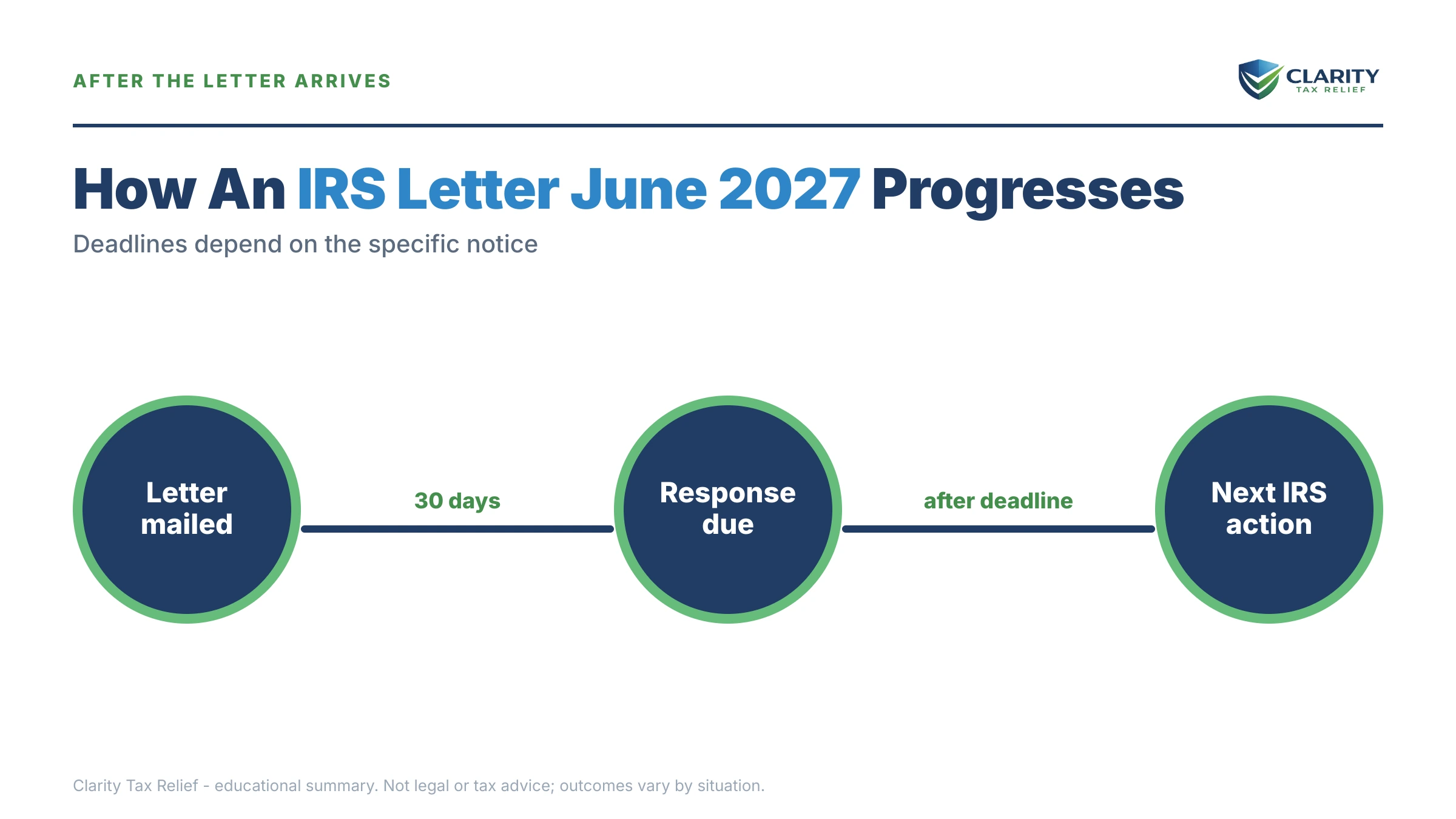
⏱ Your deadline: the response date printed on page one of your letter — every IRS notice sets its own clock, counted from the notice date, not the day it arrived. A CP14 typically gives you about 21 days; an LT11 gives you exactly 30 days from the date printed on the notice — not the day it lands in your mailbox — to request a Collection Due Process hearing before the IRS can levy.
Why you got an IRS letter in June 2027
June is the single biggest month of the year for IRS mail, because returns filed by the April 15 deadline finish processing in May and the bills go out in the weeks after. If you filed in spring 2027 and owed anything, or your payment didn't post the way you expected — a balance-due notice lands in June almost like clockwork.
But the June wave isn't just bills. It also carries CP2000 income-match notices (the IRS compared your return against the W-2s, 1099-NECs, and 1099-Ks employers and platforms filed, and found a gap), refund-review letters like the 4464C letter, identity-verification letters like the 4883C letter, and non-filer notices for people the IRS's matching systems flagged as missing returns entirely.
One more 2027 reality worth knowing: the IRS workforce was cut by roughly 27% in 2025, according to TIGTA reporting, so reaching a human is harder than it's ever been. But these letters are generated by automated systems that never slowed down. The notices, deadlines, and levies run on autopilot whether or not anyone at the IRS ever reads your file. That makes acting inside your letter's window matter more, not less.
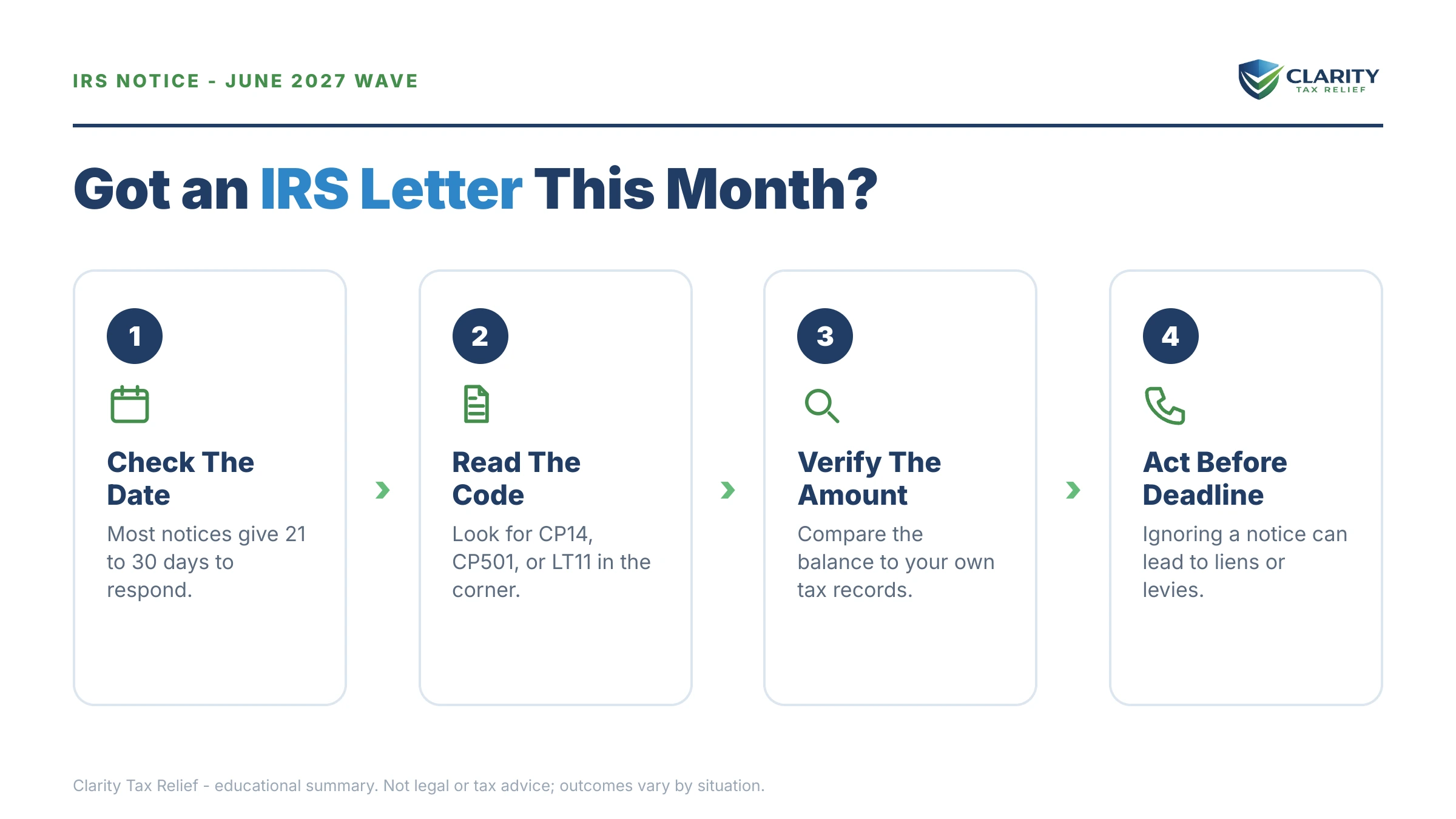
First: find the notice code, and make sure the letter is real
Every genuine IRS letter carries a notice code — CP or LT plus numbers, or "Letter" plus numbers — in the top-right corner of page one. That code is the whole story: it tells you whether you're holding a routine bill, a refund review, or a levy warning. It determines the deadline you're on.
Before you respond to anything, verify the letter is genuine. Scammers time fake "IRS" mail, texts, and calls to filing season precisely because they know real notices are hitting mailboxes. Three checks take ten minutes:
- Log into your IRS online account. A real notice and any real balance will appear there. If the account shows nothing, treat the letter with suspicion before paying a cent.
- Check the payment instructions. Real IRS payments go only to the United States Treasury or through IRS.gov — never gift cards, wire transfers, or payment apps. Anyone demanding those is a criminal.
- Compare it against known formats. Our guide on how to tell if an IRS letter is real walks through the exact markers of genuine notices, line by line.
The IRS also does not initiate contact by email, text, or social media. If your "June letter" arrived electronically, it isn't from the IRS.
IRS letter June 2027 decoder: which notice are you holding?
Seven notices account for the vast majority of June IRS mail, and each one carries a different deadline and a different level of urgency. Match your code:
| Notice code | What it means | Your response window |
|---|---|---|
| CP14 | First bill for a balance due on a filed return — see the full CP14 notice guide | Typically about 21 days from the notice date |
| CP2000 | Proposed change: income reported to the IRS doesn't match your return — see the CP2000 notice guide | The response date printed on the notice |
| CP59 | The IRS has no return on file for a prior year — see the CP59 notice guide | No enforcement clock yet, but the non-filer sequence escalates if you don't file |
| 4464C | Your refund is being reviewed before release | Usually none — wait, unless the IRS asks for documents |
| 4883C | Verify your identity before your return can process | Verify promptly — your refund stays frozen until you do |
| CP504 | Intent to levy your state tax refund under IRC §6331(d) — see the CP504 notice guide | The deadline printed on the notice — this is the last stop before the final notice |
| LT11 / Letter 1058 | Final notice of intent to levy wages and bank accounts — see the LT11 notice guide | Exactly 30 days from the date printed on the notice — not the day it lands in your mailbox to request a Collection Due Process hearing (Form 12153) |
Two June letters that deserve their own mention: if your notice is about virtual currency, the crypto-compliance series — IRS Letter 6173 and its softer siblings — follows different rules entirely, because the 6173 requires a signed response under penalty of perjury. Don't treat it like a bill.
Three years unfiled? Your June letter is on a different track
A June 2027 letter to a non-filer usually means the IRS's document-matching system finally connected your 1099s to a missing return. Gig platforms, payment apps, and clients file 1099-NECs and 1099-Ks with the IRS whether or not you file, and with the 1099-K threshold back at $20,000 / 200 transactions, the forms flowing in on working gig drivers, couriers, and freelancers are substantial.
The non-filer sequence runs CP59 → CP516 → CP518, and if you still don't file, the IRS files for you. That substitute return uses zero deductions, no mileage, no business expenses, and the least favorable filing status, then bills you the inflated result. Your real return, with your real expenses, is almost always dramatically cheaper than the IRS's version.
If that's your situation, the playbook in haven't filed taxes in 3 years covers the catch-up filing sequence in full. The short version: file the missing years first, before negotiating anything, because you can't get a payment plan, hardship status, or any settlement while returns are outstanding.
What happens if you ignore a June 2027 IRS letter
IRS notices escalate in a fixed sequence, and each stage removes options the previous one still offered. For a balance-due letter, the ladder looks like this:
- CP14 — first bill. No enforcement yet. This is the cheapest moment you will ever have to fix this debt.
- CP501 / CP503 — reminders. Still just bills, but the failure-to-pay penalty (0.5% per month) and daily-compounding interest keep stacking.
- CP504 — intent to levy. The IRS can now seize your state tax refund, and a federal tax lien becomes a live possibility.
- LT11 / Letter 1058 — final notice. A clock of exactly 30 days from the date printed on the notice, not the day it lands in your mailbox, starts. This is your window to file Form 12153 and lock in Collection Due Process rights — our guide to the IRS CDP hearing request letter shows exactly how.
- Levy. A bank levy freezes funds for a 21-day hold before the money leaves; a wage levy is continuous. It hits every paycheck until released.
The full ladder, with every rung explained, is in the order of IRS collection letters. Non-filers ride a parallel ladder — CP59 to CP518 to substitute return to a statutory deficiency notice with a 90-day Tax Court window — that ends in the same place: assessment and collection.
And if your balance grows past $66,000 (the 2026 inflation-adjusted threshold), the IRS can certify your debt to the State Department, which can deny or revoke your passport. Balances left to compound get there faster than people expect.
Holding a June 2027 IRS letter right now?
Whatever code is in that top-right corner, its deadline is printed on page one and the clock is already running. Send us a photo of the letter — an experienced tax professional will decode exactly where you stand and every option you have, free, before that printed date passes.
If your letter says you owe: your real options
The letter presents two choices, pay in full or face what comes next. But the IRS actually runs several resolution programs, each with its own eligibility line. Which one fits depends on your balance and your finances, not on what the notice advertises:
| Option | Who it fits | Cost & key numbers |
|---|---|---|
| Pay in full | Anyone who can, by the printed date | Stops penalties, interest, and the notice sequence immediately |
| Short-term plan | You can clear the balance within 180 days | $0 setup fee; interest and the 0.5%/month penalty continue |
| Long-term installment agreement | Balances of $50,000 or less qualify online for up to 72 months (direct debit required above $25,000 for streamlined terms) | Setup fee varies; interest and penalties keep accruing while you pay |
| Currently Not Collectible | Your allowable living expenses genuinely exceed your income | Free; collection pauses, but the debt and interest remain |
| Offer in Compromise | The IRS's own math shows your assets plus future income can't cover the debt | $205 fee plus 20% down on lump-sum offers (both waived with low-income certification); the IRS accepted roughly 1 in 5 offers in FY2024, per IRS data |
| Penalty relief | Clean compliance history for the prior 3 years, and starting summer 2026, Automatic Exemption from Penalty (AEP) applies some relief with no request at all | Free; removes penalties, not the tax or the interest on it |
How to work these programs on your own — the forms, the sequence. The traps — is covered in our full guide on how to settle tax debt yourself. Most plans start with Form 9465 or a fifteen-minute online application.
Worked example: a gig worker's $48,300 June letter
Say you drove and delivered on 1099s for three years without filing, caught up on all three returns in April 2027, and in June three CP14s arrive totaling $48,300. Here's a realistic (and entirely hypothetical) breakdown of how a balance like that assembles:
- $36,000 — combined income and self-employment tax across the three years
- $9,000 — failure-to-file penalties, which accrue at 5% per month and cap at 25% of each year's tax
- $3,300 — failure-to-pay penalties and interest accrued so far
Notice what already went right: filing stopped the failure-to-file penalty, which runs ten times hotter than the 0.5%-per-month failure-to-pay penalty. From here, $48,300 sits just under the $50,000 line — which means a 72-month online installment agreement is available without submitting full financials. The straight math is $48,300 ÷ 72 ≈ $671 a month, though interest and the ongoing late-payment penalty mean the real payoff runs higher (you can model your own accruals with our IRS Penalty & Interest Calculator).
Could this person do better than the payment plan? Possibly. If gig income is thin and there are no meaningful assets, the numbers might support hardship status or even an Offer in Compromise, but that's a means test the IRS runs on real financial data, not a program anyone can simply choose. And if this was the first compliance slip after clean prior years, penalty abatement on the oldest year could trim thousands off the top before any plan is set.
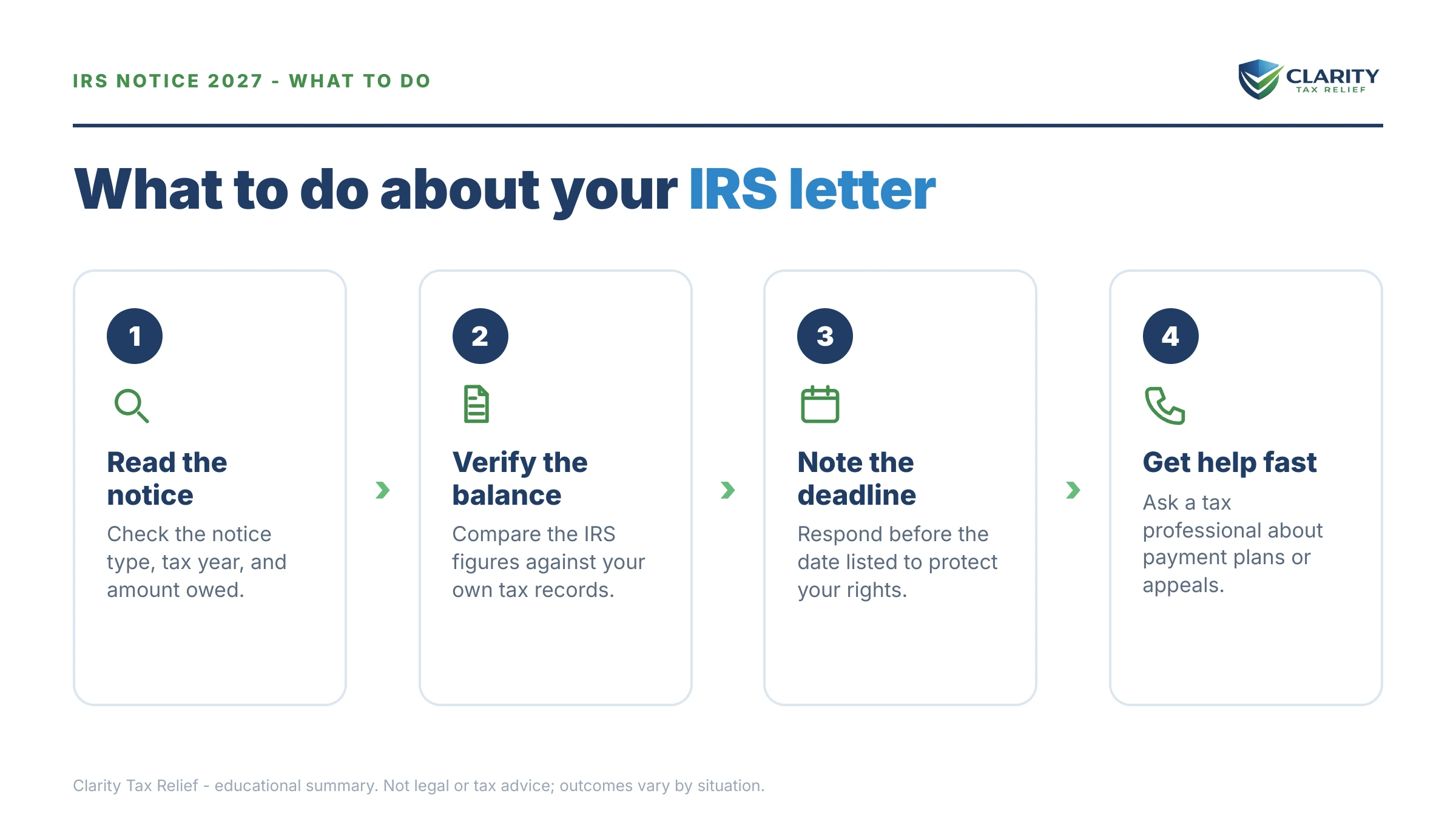
How to respond to a June 2027 IRS letter, step by step
- Find the notice code — it's in the top-right corner of page one (CP14, CP2000, LT11, and so on) and it determines everything that follows.
- Verify the letter is real — log into your IRS online account and confirm the notice and any balance appear there before you pay or call anyone.
- Circle the printed response date — every notice sets its own clock from the notice date, and that date controls your options.
- Respond before the deadline — pay at IRS.gov, set up a payment plan, or dispute the amount in writing with documentation.
- File any unfiled returns — filing stops the 5%-per-month failure-to-file penalty and blocks the IRS from assessing an inflated substitute return.
- Get a professional review for levy notices or multiple years — the order you fix things in (returns, penalties, then the balance) changes what you ultimately pay.
When you can handle this yourself
Plenty of June letters need no professional help at all. If your letter is a CP14 for an amount you agree with and can pay within 180 days, set up the short-term plan online and be done. If it's a 4464C, your job is mostly to wait. If it's a 4883C, verify your identity and your refund moves. A single-year CP2000 where the IRS is simply right about a 1099 you forgot is often a matter of signing the response and arranging payment.
Experienced help changes outcomes in four situations: a CP504 or LT11 is in play (levy machinery is moving and appeal windows are short), multiple years are unfiled (the filing order and penalty strategy materially change the final balance), the amount is disputed and you need to build a documented response, or your finances might support hardship status or an Offer in Compromise — math you want checked before you commit to a six-year payment plan you didn't need. Honest rule of thumb: the smaller and simpler the letter, the more likely you can handle it alone.
Terms on your letter, decoded
- Notice code — the CP, LT, or Letter number in the top-right corner that identifies which notice you received and what clock it starts.
- Notice date — the date printed on the letter; every deadline counts from this date, not the day the mail arrived.
- Levy vs. lien — a levy takes property (wages, bank funds); a lien is a legal claim against property that secures the debt without taking it.
- CDP rights — Collection Due Process: your right, after a final notice, to a hearing (requested on Form 12153) before the IRS levies.
- Substitute for return (SFR) — a return the IRS files for a non-filer using only reported income, with no deductions, producing the largest possible bill.
- CSED — the Collection Statute Expiration Date: the IRS generally has 10 years from assessment to collect, though appeals, offers, and bankruptcy pause that clock.
June 2027 IRS letter questions, answered
Why did I get an IRS letter in June 2027?
June is the IRS's heaviest billing month, because returns filed by the April deadline finish processing in May and balance-due bills mail in the weeks after. Most June letters are CP14 bills, but June also brings CP2000 income-match notices for 2025 returns and non-filer letters like the CP59. The notice code in the top-right corner tells you which one you're holding.
How do I know if my June 2027 IRS letter is real?
A genuine IRS letter arrives by postal mail with a notice code (CP or LT plus numbers) in the top corner. It never asks for gift cards, wire transfers, or payment-app transfers. You can verify it in minutes by logging into your IRS online account — a real balance or notice will appear there. If the letter demands immediate payment by phone, it's a scam.
What is the most common IRS letter sent in June?
The CP14 balance-due notice is the most common June letter by a wide margin. It's the first bill in the collection sequence and typically gives you about 21 days from the notice date to pay or set up a payment arrangement. It is not an audit. It means IRS records show unpaid tax, penalties, or interest for a year you filed.
Does a certified IRS letter in June mean I'm about to be levied?
Not necessarily, but certified mail signals a notice with legal significance — most often a CP504 intent-to-levy notice or an LT11 final notice. The LT11 starts a clock of exactly 30 days from the date printed on the notice, not the day it lands in your mailbox, to request a Collection Due Process hearing before the IRS can levy wages or bank accounts. Open it the day it arrives.
What if my June 2027 letter says I owe money I can't pay?
You have more options than the two the letter lists. A short-term plan gives up to 180 days with no setup fee, balances of $50,000 or less can go on a monthly plan of up to 72 months online, hardship status can pause collection. An Offer in Compromise may apply if the IRS's own math shows it can't collect in full. Interest keeps accruing under every option except full payment.
I haven't filed in three years — why is the IRS writing me now?
The IRS matches W-2s and 1099s to filed returns, and gig-platform 1099-Ks and 1099-NECs eventually flag missing years. Non-filer letters like the CP59 escalate to a CP518 and then a substitute-for-return, where the IRS files for you with no deductions and bills the inflated result. Filing your real returns first almost always produces a smaller balance than the IRS's version.
How long do I have to respond to an IRS letter?
Every IRS letter sets its own deadline, printed on page one. There is no universal window. A CP14 typically allows about 21 days, an LT11 allows exactly 30 days from the date printed on the notice, not the day it lands in your mailbox, to request a hearing, and review letters like the 4464C may require no response at all. Use the date printed on your specific notice, counted from the notice date, not the date it arrived.
Your next 24 hours
- Find the notice code and the printed response date on page one of your letter — top-right corner. Circle both. That code and that date define your entire situation.
- Gather three things: the letter itself, your most recent filed tax return. This year's income records (1099-NECs, 1099-Ks, bank statements if you're reconstructing gig income).
- Get the letter reviewed free — the 2-minute form or (888) 825-7779. Whatever the code says, penalties and interest are accruing every month it sits unresolved. Your best options all live on the near side of that printed date.
Primary sources: the IRS's own explainer for the most common June letter is at Understanding your CP14 notice. Payment plans and payoff options live at IRS.gov/payments. And if IRS delays or errors are causing you hardship, the independent Taxpayer Advocate Service can intervene at no cost.
This guide is general information, not tax or legal advice for your specific situation. Eligibility for IRS programs depends on individual facts and circumstances; no outcome is guaranteed.