
IRS Letters
IRS 4883C Letter: How to Verify Your Identity by Phone (2026)
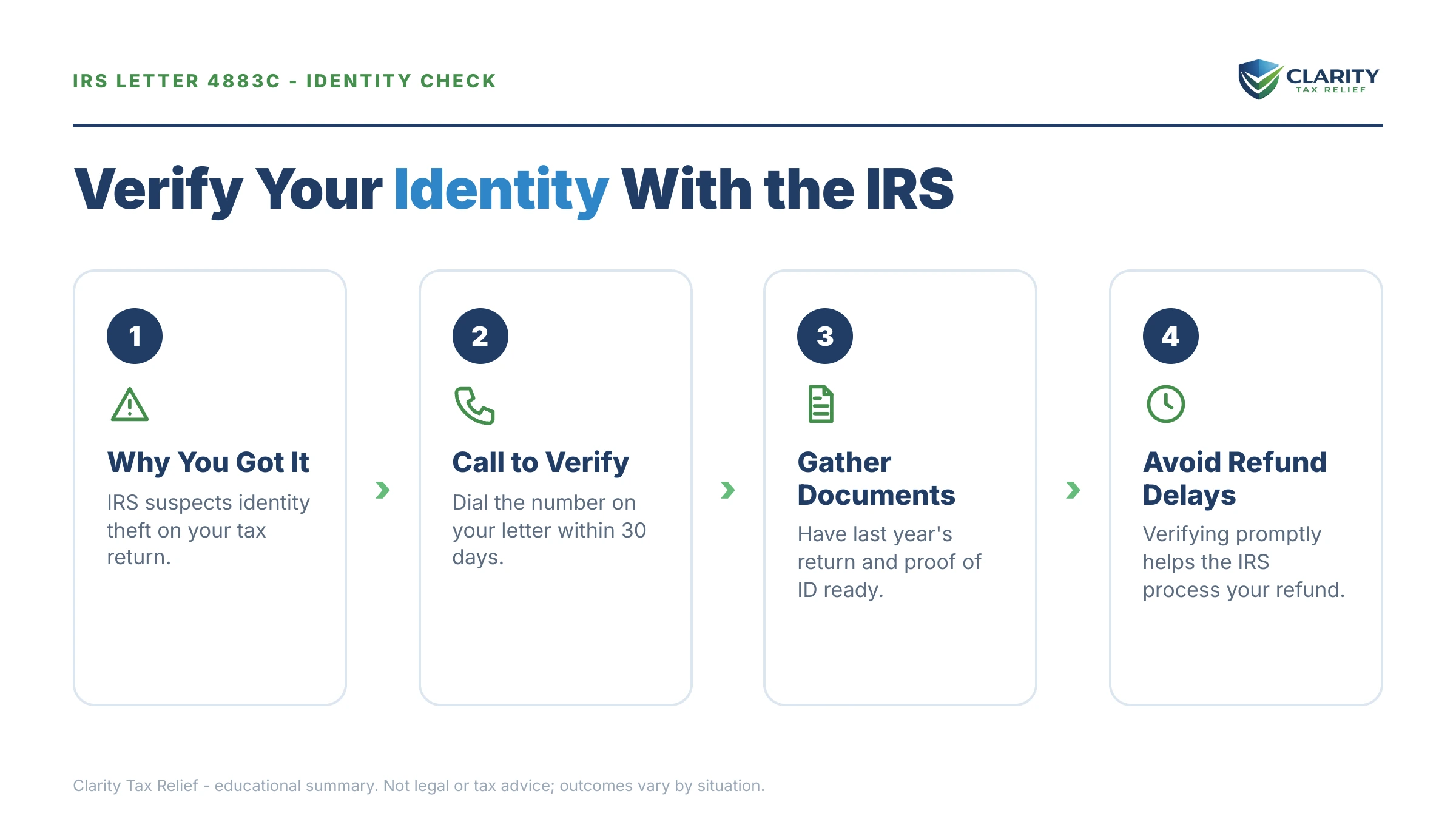
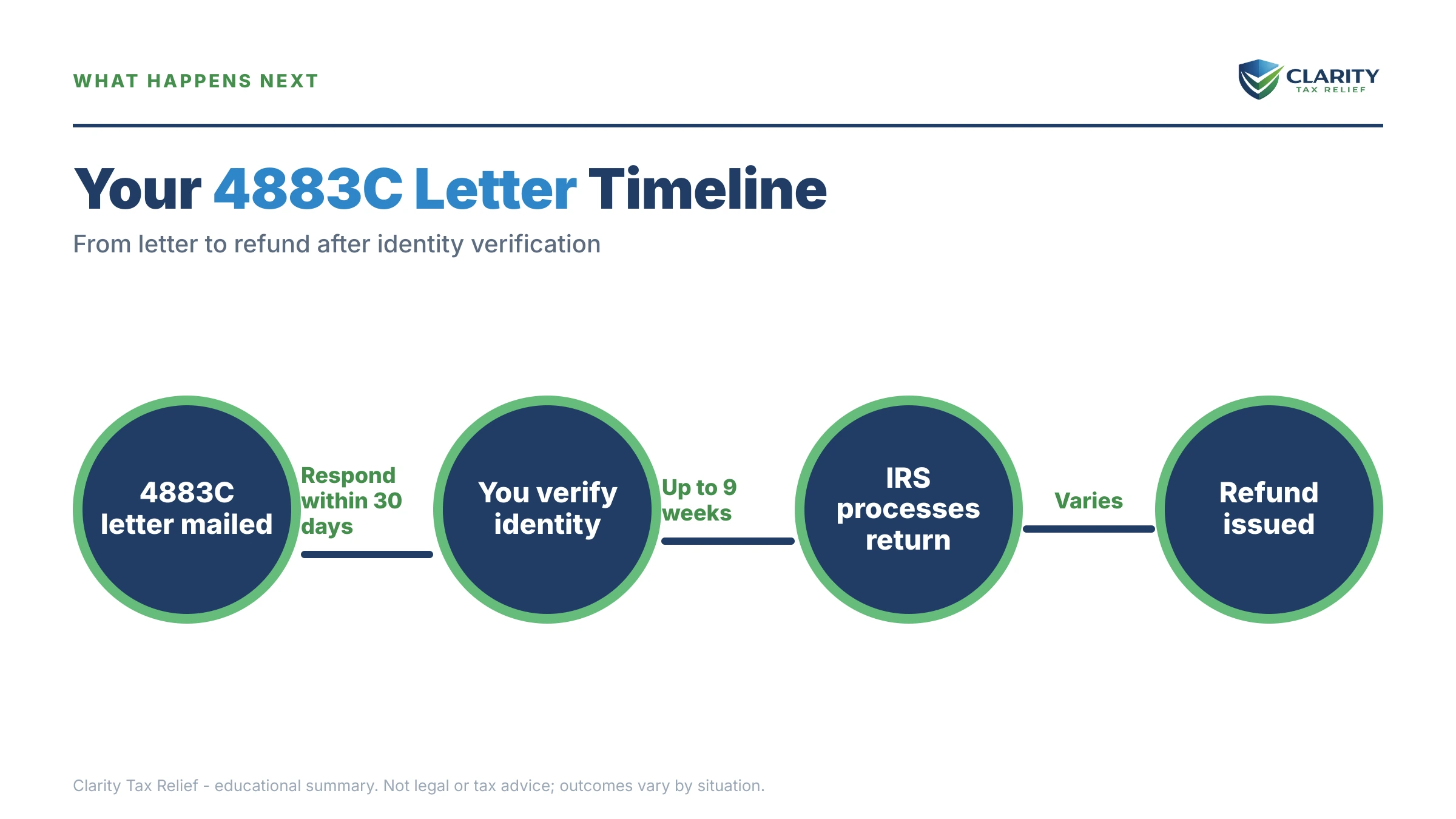
The short answer: a 4883C letter means the IRS stopped processing a return filed in your name until you verify your identity by phone. There is no online option for this letter. Call the Taxpayer Protection Program number printed on it, with this year's and last year's returns in hand, inside its 30-day window.
You filed months ago, "Where's My Refund" never moved past received, and now a one-page letter says the IRS won't touch your return, or your money, until you prove you're actually you, over the phone. The good news: a 4883C carries no penalty, no audit, and no enforcement. It's a locked door, and one successful call is the key.
The image below shows exactly what a real 4883C looks like and where to find the two things you need before you dial: the tax year being questioned and the phone number the IRS wants you to call.
⏱ Your deadline: the 4883C asks you to call within 30 days of the date printed on the letter. Missing that date doesn't trigger a levy, but your return stays frozen indefinitely, your refund never issues, and if a refund is due, the three-year window to claim it keeps running the whole time.
Why you got a 4883C letter
A 4883C letter means the IRS's identity-theft filters flagged a return filed under your Social Security number and froze it before processing. The Taxpayer Protection Program, the IRS unit that screens suspicious returns, wants a live human to confirm you filed it before anything moves.
The filters flag returns for reasons that are usually innocent: a new address or bank account, a refund much larger than prior years, wage figures that don't match what employers reported yet, your first return after a gap in filing, or a filing pattern that resembles known fraud batches. Getting a 4883C does not mean anyone stole your identity — most recipients did file the return. The call takes minutes once you're through.
Two things a 4883C is not. It's not an audit — nobody is questioning your deductions (a 4464C letter is the review letter, and it's a different process). And it's not optional — the freeze does not lift on its own, no matter how long you wait.
“Don’t reveal your IP PIN to anyone. It should be known only to your tax professional and only when you are ready to sign and submit your return. The IRS will never ask for your IP PIN. Phone calls, emails or texts asking for your IP PIN are scams.”
— Get an identity protection PIN (IRS.gov)
4883C vs 5071C vs 5747C: which identity letter did you get?
The IRS uses several different identity-verification letters, and each one dictates a different verification channel. The single most important fact about yours: a 4883C cannot be verified online — the ID.me tool that works for other letters will not clear this hold. Check the letter number in the top or bottom corner against this table:
| Letter | How you verify | Key difference |
|---|---|---|
| 4883C | Phone only | Call the Taxpayer Protection Program number printed on the letter — the online tool won't work |
| Letter 6330C | Phone only | A variant of the 4883C with the same phone process |
| 5071C letter | Online or phone | Start with the IRS online verification tool; phone is the backup |
| 5747C letter | In person | Requires an appointment at a Taxpayer Assistance Center with photo ID |
| Letter 5447C | Phone or mail | The version sent to filers living outside the United States |
If your letter number doesn't match any of these, run it through our guide on how to tell if an IRS letter is real before calling anything — identity-verification letters are a favorite template for scammers precisely because they arrive when people expect IRS mail.
What this letter is and is not saying
Receiving it does not mean the IRS has decided you are a victim of identity theft. It means a return for the tax year in question needs the filer verified before it goes further. That check happens whether the return was yours or not.
Have the supporting documents to hand before you make contact: the letter itself, the return it refers to, the prior year return, and identification. The verification is a single conversation when you have those, and several conversations when you do not.
What happens if you ignore a 4883C
Ignoring a 4883C doesn't trigger enforcement. It triggers permanent limbo. Unlike a balance-due notice, there's no escalating series of threats. There's just a return that never processes, in stages:
- Your return sits in suspense. It hasn't been accepted, rejected, or processed. No refund is scheduled, and your transcript for that year may show a freeze or nothing at all.
- The freeze protects nothing but that return. If you owe on older years, interest and penalties keep accruing there, and collection notices keep advancing — the 4883C doesn't pause any of it.
- Follow-up isn't guaranteed. You may get one more letter or none. Silence from the IRS doesn't mean the issue resolved itself; it means the return is still sitting.
- The return can eventually be treated as never filed. If it showed a refund, you generally have three years from the original deadline to claim it — our guide to the 3-year refund deadline covers how that money legally disappears.
- If a thief filed it, the trail goes cold. The longer a fraudulent return sits unreported, the harder every future filing season gets — e-file rejections, repeat flags, and frozen refunds year after year.
The 2026 wrinkle: the IRS cut roughly 27% of its workforce in 2025, so the verification phone lines are slower than ever. But the automated systems that freeze returns and pursue old balances never stopped. The freeze is instant and tireless; the fix requires reaching a human. That asymmetry is exactly why waiting costs you.
Refund frozen behind a 4883C, while an older balance keeps collecting?
Send us the letter. An experienced tax professional will map your whole IRS file — the frozen year, any back-tax balances, and any collection action in motion — before the 30-day call window printed on your letter passes. Free and confidential.
Your options: every way to clear a 4883C
Every 4883C is resolved through one primary channel — a live call to the Taxpayer Protection Program number printed on the letter — but there are backup paths when the phone route fails or your situation is more complicated:
| Path | When to use it | What you need |
|---|---|---|
| Call the TPP number on the letter | The default for every 4883C — start here | The letter, the return it names, a prior-year return, and your W-2s/1099s |
| In-person Taxpayer Assistance Center appointment | Phone verification failed, or you can't answer prior-year questions | Government photo ID, a second identity document, and the same returns |
| Representative on the line (Form 2848) | You want a professional managing the case and what comes after | Signed power of attorney, but you still answer the identity questions yourself |
| Taxpayer Advocate Service | The frozen refund is causing hardship (eviction risk, utility shutoff) and normal channels have stalled | Form 911 and documentation of the hardship |
| Report "that's not my return" | You never filed the return the letter names | The same call, then Form 14039 and an IP PIN request |
On the call itself, expect questions pulled from both tax returns: filing status, addresses, income figures, dependents, and bank details. Get an answer wrong and the representative may route you to in-person verification instead — which is why gathering documents before dialing matters more than dialing fast. If the line defeats you repeatedly, our guide on what to do when you can't reach the IRS on the phone covers timing tricks, and how to contact the Taxpayer Advocate Service covers the hardship escalation route.
What the freeze costs: an $8,900 example
Say you're expecting $8,900 back this year. You rent, so there's no home equity in play. But you still owe about $3,400 from a return two years ago. The collection notices on that balance are advancing toward a levy on your bank account.
Here's the math while the 4883C sits unanswered. The $8,900 is frozen and unreachable. The old $3,400 keeps growing — the 0.5%-per-month failure-to-pay penalty plus interest adds roughly $17–$30 every month, and after several months of drift the balance is closer to $3,600. Meanwhile the levy track continues: if the IRS levies your bank account, the bank holds the funds for 21 days and then sends them to the IRS — all while your own $8,900 sits locked one phone call away.
Now the verified version. You call, pass the questions, and the return processes — typically within nine weeks. Because you owe, the IRS applies your refund to the old balance first: $8,900 − $3,600 ≈ $5,300 to you, the old year paid off. The levy threat gone with it. One phone call converts two problems into one deposit. (For balances a refund can't cover, our hub on how to settle tax debt yourself walks through payment plans, hardship status, and settlement options.)
Before you call: what to have in front of you
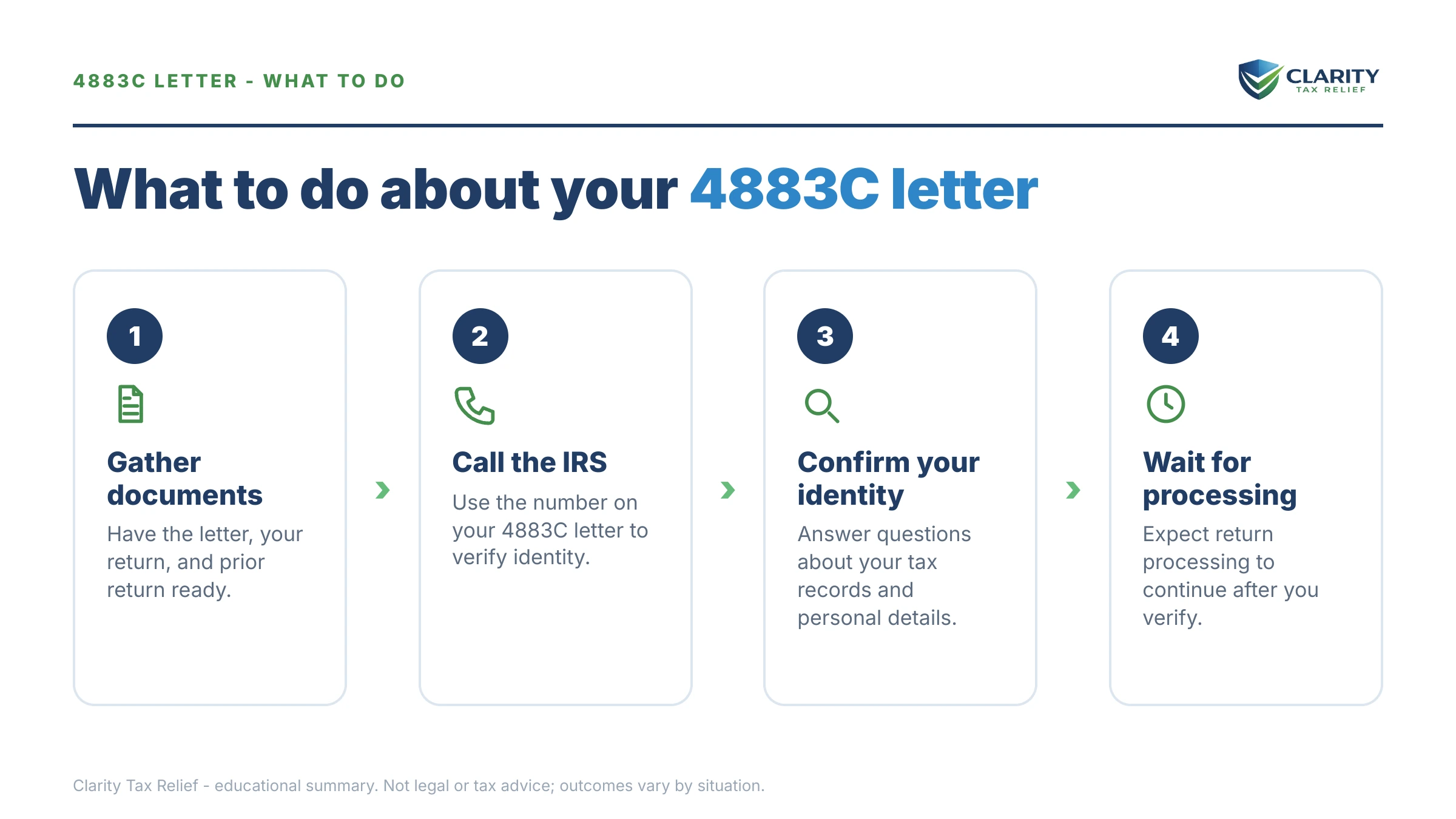
The verification call is an open-book test, but only if you bring the books. Have physical or on-screen copies of:
- The 4883C letter itself. It contains a control number the representative will ask for.
- The tax return for the year named on the letter, exactly as filed.
- A prior-year tax return — questions often come from it.
- Supporting income documents — W-2s, 1099s, and any schedules behind the flagged return.
If you used a preparer and don't have your copies, get them before calling. Failing the questions doesn't create a penalty, but it usually means starting over through the slower in-person route.
How to respond to a 4883C letter, step by step
- Confirm the letter is real. Compare the phone number on your 4883C with the one the IRS lists on its official 4883C page. A real verification call never asks for payment, gift cards, or bank logins.
- Gather both returns and your income documents. Pull the return for the year named on the letter, a prior-year return. The W-2s and 1099s behind them. The representative will quiz you from all of it.
- Call the Taxpayer Protection Program number on the letter. Call early in the day and early in the week. Expect a long hold, then a series of identity questions covering both returns.
- Say so immediately if you didn't file the return. The representative will stop the return from processing and route you to identity-theft protections: Form 14039 and an IP PIN.
- Track processing after you verify. Allow typically up to nine weeks for the return to finish. Watch your IRS online account or transcript; if nothing moves, call the same number again.
If step four applies to you, the return isn't yours, start with our guides to the Form 14039 identity-theft affidavit and what to do when someone filed taxes in your name. Then lock the door for good with an IRS IP PIN, which blocks anyone else from e-filing under your Social Security number in future years.
When you can handle a 4883C yourself
Most people can clear a 4883C without any professional help. If you filed the return, have copies of it and last year's return, and can spend the hold time on the phone, do it yourself — there's nothing to negotiate and nothing a professional can say on the identity questions for you.
Experienced help changes the outcome in a narrower set of situations: a levy already in motion on an older balance that the frozen refund was supposed to cover. Multiple years unfiled behind the flagged one. Confirmed identity theft with more than one fraudulent return to unwind. Or a hardship case that needs a Taxpayer Advocate escalation built and documented correctly. In those cases the 4883C call is the easy part — it's the sequencing of everything around it that determines what you end up paying and keeping.
Terms on your 4883C, decoded
- Taxpayer Protection Program (TPP): the IRS unit that screens returns for identity theft and staffs the 4883C verification line.
- Refund freeze (code 810): the transcript code that often appears while an identity hold sits on your account — the refund is blocked, not denied.
- IP PIN: a six-digit Identity Protection PIN that must accompany your e-filed return, blocking anyone else from filing as you.
- Form 14039: the Identity Theft Affidavit you file when the return the letter names isn't yours.
- Taxpayer Assistance Center (TAC): a local IRS office where you verify in person, by appointment, if phone verification fails.
- Refund offset: the IRS applying your refund to a balance you owe, federal or certain other debts, before paying out what's left.
4883C letter questions, answered
What is IRS Letter 4883C?
A 4883C letter means the IRS stopped processing a return filed in your name until you verify your identity by phone. There is no online option for this letter. Call the Taxpayer Protection Program number printed on it, with this year's and last year's returns in hand, inside its 30-day window.
Can I verify a 4883C letter online?
No. The 4883C is a phone-only verification — the IRS's online identity tool is reserved for letters like the 5071C. Your two paths are the Taxpayer Protection Program number printed on your letter or, if phone verification fails, an in-person appointment at a Taxpayer Assistance Center. Trying the online tool with a 4883C wastes time; it will not clear the hold on your return.
How long after verifying a 4883C will I get my refund?
The IRS says to allow up to nine weeks after successful verification for the return to finish processing, though many refunds arrive sooner. If you owe back taxes, the refund is applied to that balance first and you receive only what's left. If nothing has moved after nine weeks, check your account transcript or call the number on your letter again.
What happens if I never respond to a 4883C letter?
Your return simply never processes. No refund is issued, no reminder is guaranteed, and the IRS can eventually treat the return as never filed. If the return showed a refund, you generally have three years from the original deadline to claim it — let the freeze sit long enough and the money is legally gone. Verification takes one phone call; there is no upside to waiting.
What phone number do I call for a 4883C letter?
Call the Taxpayer Protection Program number printed in the top corner of your letter, and before you dial, confirm it matches the number the IRS lists on its official 4883C page. Never call a number from an email, text, or voicemail claiming to be the IRS. The real verification call never asks for a payment, a gift card, or your bank login.
What if I can't get through on the 4883C phone line?
Keep trying early in the day, right when the lines open, and early in the week. The IRS cut roughly 27% of its workforce in 2025, so holds are long. But the automated freeze on your return doesn't care about hold times. If you repeatedly can't get through, schedule an in-person appointment at a Taxpayer Assistance Center, or contact the Taxpayer Advocate Service if the frozen refund is creating genuine financial hardship.
What if I didn't file the return my 4883C mentions?
Tell the representative immediately — someone likely filed a return using your Social Security number. The IRS will keep that fraudulent return from processing. You should file Form 14039 (Identity Theft Affidavit) and request an IP PIN so it can't happen next year. Your own legitimate return can still be filed on paper if the fraudulent one blocked e-filing.
Is a 4883C letter an audit or a sign I'm in trouble?
No. A 4883C is a fraud filter, not an examination — the IRS isn't questioning your income or deductions, it's questioning whether you're the one who filed. Verifying doesn't raise your audit odds, and there's no penalty attached to the letter itself. The only cost of a 4883C is the delay it puts on your refund.
Can my spouse or tax preparer verify a 4883C for me?
The IRS needs to speak to the taxpayer named on the letter. You must be on the call and answer the identity questions yourself. On a joint return, the spouse named on the letter is the one who verifies. An authorized representative with a Form 2848 power of attorney can be on the line with you and handle the rest of the case. But they can't replace you for the identity questions.
Your next 24 hours
- Find three things on your letter: the tax year in question, the date printed at the top (your 30-day call window runs from it). The Taxpayer Protection Program phone number. Confirm that number against the IRS's official page — Understanding your Letter 4883C — before dialing.
- Gather your call kit: the flagged return, last year's return, every W-2 and 1099 behind them, and photo ID in case you're routed to in-person verification. The IRS's Identity Theft Central covers what to do if the return turns out not to be yours, and the Taxpayer Advocate Service is the escalation path if the frozen refund becomes a hardship.
- If the frozen refund is only half your problem — an older balance is collecting interest or a levy is in motion — get a free case review before you call the IRS, so the whole file gets fixed in the right order. Use the 2-minute form or call (888) 825-7779.
This guide is general information, not tax or legal advice for your specific situation. Eligibility for IRS programs depends on individual facts and circumstances; no outcome is guaranteed.