
IRS Transcript Codes
Code 420 on Your IRS Transcript: What the Audit Indicator Means (2026)
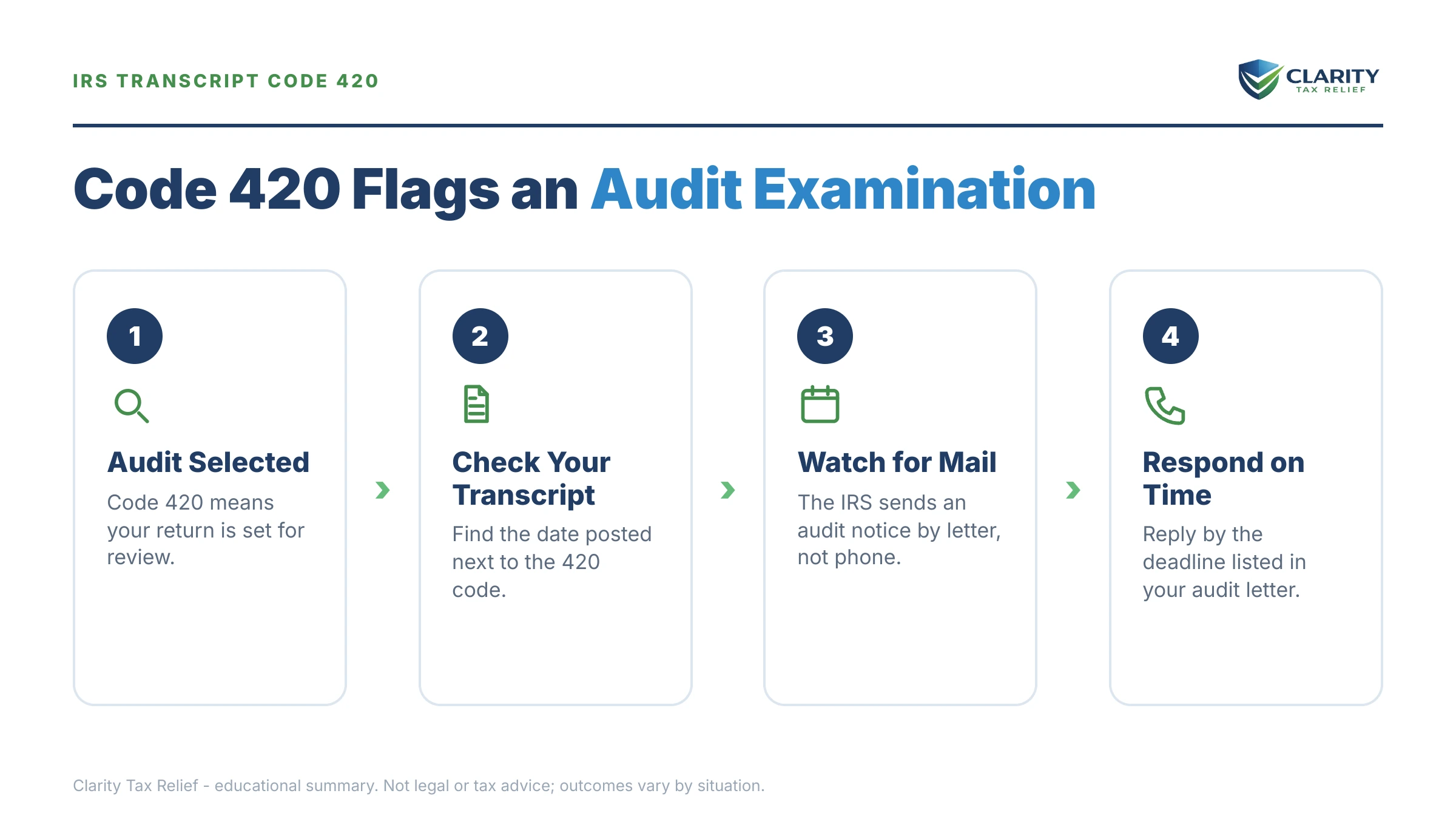
The short answer: code 420 on an IRS transcript means the IRS has selected that return for examination — an audit. The code itself is not a bill and sets no deadline. The audit letter that follows (Letter 566, CP75, or Letter 2205-A) tells you exactly what's being examined and when you must respond.
You pulled your account transcript to check on a refund or a balance, and there it is near the bottom: 420 — Examination of tax return, with a date and $0.00 beside it. If you run a business with employees, that one line lands harder than any notice, because you know an exam can reach past one deduction and into the whole operation. Take a breath — a 420 is the earliest possible warning, which means you found out at the best possible moment to prepare.
The $0.00 next to code 420 confuses almost everyone: it doesn't mean you owe nothing. It means the code is a status marker, not an assessment. The image below shows exactly what this line looks like on a real account transcript and how to read the date posted next to it.
⏱ The real clock: code 420 sets no deadline by itself. Your response date is printed on the audit letter that follows it. Miss that letter's date and the examiner can disallow items without your input, adding tax, a possible 20% accuracy-related penalty, and interest that accrues until paid.
What code 420 means on an IRS transcript
Transaction code 420 means the IRS has formally referred your return for examination. It is the transcript's audit indicator. It posts when an exam file opens, before any letter reaches your mailbox, which is why transcript-watchers often see it days or weeks ahead of official word.
Three things to read off the line itself. First, the date beside 420 is roughly when the exam file opened — it is not your response deadline. Second, the tax year in the transcript's header tells you which return is under exam. Third, if a refund is pending for that year, the 420 usually holds it until the exam closes. For where this line sits among everything else on the document, see how to read an IRS account transcript.
Code 420 also can't tell you what kind of audit is coming. Most exams are correspondence audits — a letter asking you to mail documentation for one or two items. A smaller share are office audits (an appointment at an IRS office) or field audits (an agent at your business). The letter that follows reveals which one you drew.
| Code | What it means | What to do |
|---|---|---|
| 424 | Examination request — a candidate file, not yet a full audit | Wait and watch; many 424s close without an exam ever opening |
| 420 | Examination of tax return — an audit file is open | Start gathering records now; watch the mail for the exam letter |
| 971 | Notice issued — a letter is on its way to you | Match its date to the letter that arrives; that letter carries your deadline |
| 570 | Hold on the account — refund or credit frozen | Common alongside 420 while the exam runs; it releases when the exam resolves |
| 421 | Examination closed | Check what posts with it — nothing new means a no-change audit |
| 300 | Additional tax assessed by examination | The audit's result; appeal or reconsideration rights may still apply |
“Selection for an audit does not always suggest there's a problem. The IRS uses several different selection methods:”
— IRS audits (IRS.gov)
Code 420 vs. code 424 vs. code 570
Code 424 is an exam request; code 420 is an exam opened — the difference decides whether you're actually being audited. A code 424 on your IRS transcript means your return was pulled as a candidate. A meaningful share of those files close without a real exam. Once 420 posts, an examination is underway.
A code 570 on your IRS transcript is different again: a general account hold that can come from identity checks, income-matching, or routine review — most 570s resolve without any audit. You can see 570 and 420 together when a refund is frozen while the examination runs. In that pairing, the 420 is the one driving events.
Why code 420 appeared on your account
Returns land in examination through scoring and matching, not because someone at the IRS is watching you personally. The most common triggers: a statistical score (the DIF system) flagging deductions or losses that sit far outside norms for your income and industry. A mismatch between your return and the 1099s, W-2s, or K-1s filed under your number. Refundable credits like the EITC (those exams arrive as a CP75 notice). Or a related exam — a partner, S-corp, or contractor already under audit whose paperwork points to you.
Business owners with payroll carry extra surface area: large Schedule C or S-corp losses, low officer salary against high distributions, heavy vehicle or meals deductions, and cash-heavy receipts all raise selection odds. If that sounds like your return, the specific triggers are covered in small business audit red flags — knowing which item likely drew the exam tells you which records to assemble first.
What happens if you ignore the exam behind code 420
An ignored code 420 exam ends with the IRS calculating your tax bill without you. That number posts to your transcript as a TC 300 assessment. The sequence is procedural and runs whether or not you participate:
- TC 420 posts. The exam file is open. No letter yet, no deadline yet — this is your preparation window.
- The audit letter arrives — Letter 566, CP75, or Letter 2205-A — naming the items under exam and your response date. Ignore it, and the examiner decides each item using only IRS records, which almost always means disallowance.
- The examination report follows (with Letter 525 or 915 — the "30-day letter"), showing proposed tax, penalties, and interest. You get 30 days to protest to the IRS Independent Office of Appeals. Silence counts as no objection.
- The Notice of Deficiency arrives (CP3219A or Letter 531 — the 90-day letter). This is your last stop before assessment: 90 days to petition Tax Court without paying first.
- Assessment posts. TC 300 adds the exam's tax, usually with the 20% accuracy-related penalty, and interest computed back to the return's original due date. Collection notices begin, and an unpaid balance moves toward the lien and levy track.
Notice what each stage removes: first your chance to document, then your free appeal, then your prepayment day in court. Nothing on this ladder requires an IRS employee to think about your file — in 2026, with the workforce down roughly 27%, the automated side of this process is the part still running at full speed.
Seeing code 420 on your transcript right now?
Get your transcript and audit letter reviewed free before the letter's response date passes. An experienced tax professional will identify what triggered the exam, what the examiner is likely to ask for, and how to answer without expanding the audit.
Your options at every stage of a code 420 audit
Every stage of a code 420 examination comes with a specific right, and each right expires on a specific clock. This is the map most exam letters never spell out:
| What arrives | Your window | The right you lose if it passes |
|---|---|---|
| Audit letter (Letter 566, CP75, or Letter 2205-A) | The response date printed on the letter | Your chance to resolve items directly with the examiner using your own records |
| Examination report with Letter 525 or 915 (the "30-day letter") | 30 days | A free appeal to the IRS Independent Office of Appeals — no court required |
| CP3219A / Letter 531 — Notice of Deficiency (the "90-day letter") | 90 days (150 if you're outside the U.S.) | Your right to contest the tax in U.S. Tax Court before paying it |
| Assessment posts (TC 300) and collection notices begin | Ongoing — interest and the 0.5%/month late-payment penalty accrue | Prepayment court review is gone; audit reconsideration and payment options remain |
Within that framework, your realistic paths:
- Substantiate and close. If you have the records, a correspondence exam can end in a no-change letter. Send copies keyed to each questioned item — organized responses close exams; document dumps prolong them.
- Partially agree. You can concede the items you can't support and document the ones you can. The tax, and the 20% penalty that rides on it — shrinks with every dollar you substantiate.
- Appeal. Disagree with the exam report? The 30-day letter is your ticket to Appeals, which settles cases based on hazards of litigation, often on better terms than the examiner offered.
- Petition Tax Court. After a Notice of Deficiency, filing within 90 days lets you contest everything without paying first. Most petitioned cases still settle with Appeals before trial.
- After assessment: audit reconsideration can reopen an exam decided without your input if you bring new documentation, and payment plans or hardship status handle a balance you genuinely can't dispute. One penalty note: the accuracy-related penalty isn't covered by first-time abatement — contesting it takes a reasonable-cause argument, ideally raised during the exam or appeal, not after.
What a code 420 exam can cost: a worked example
Say you own an S-corp with four employees. The exam behind your code 420 proposes disallowing enough vehicle, meals, and "supplies" deductions to add $36,900 in tax. If you never respond, the report adds the 20% accuracy-related penalty — $36,900 × 20% = $7,380 — bringing the assessment to $44,280 before interest. And interest on an exam assessment runs back to the return's original due date, not the audit date, so a 2023 return assessed in 2026 arrives with roughly two-plus years of interest already attached. Left unpaid, the 0.5%-per-month failure-to-pay penalty starts stacking on top. You can estimate how fast those additions grow with our IRS Penalty & Interest Calculator.
Now run the engaged version. Suppose your bank statements, payroll reports, and a reconstructed mileage log substantiate two-thirds of the disallowed items. The proposed tax drops to roughly $12,300, the 20% penalty falls to about $2,460 (and becomes worth contesting on reasonable cause), and interest is computed on the smaller number. Same transcript code, same exam — a five-figure difference decided entirely by whether you answered the letter. Thin records don't end the analysis either: exams are won on reconstruction more often than people think, as covered in audited with no receipts.
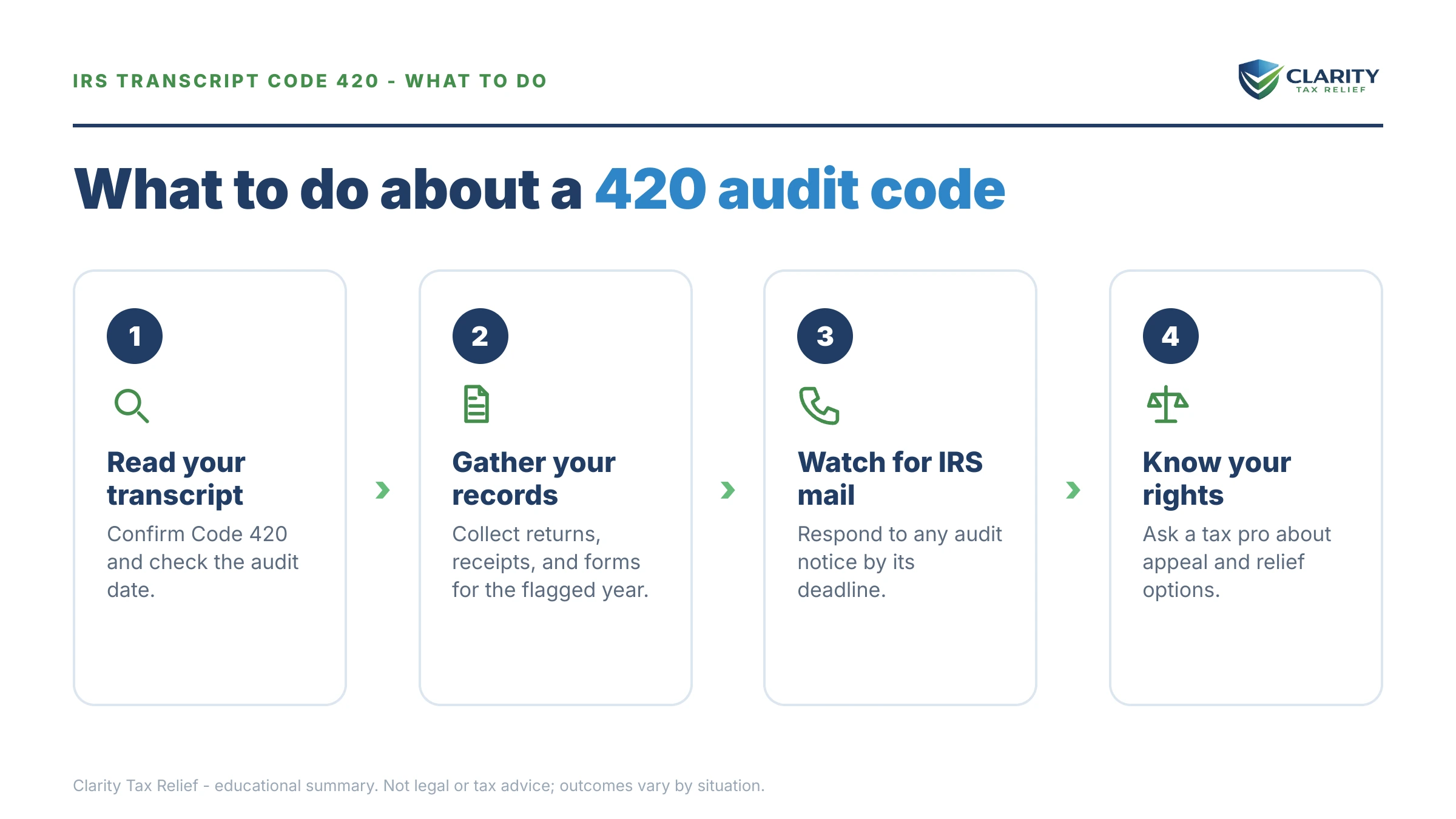
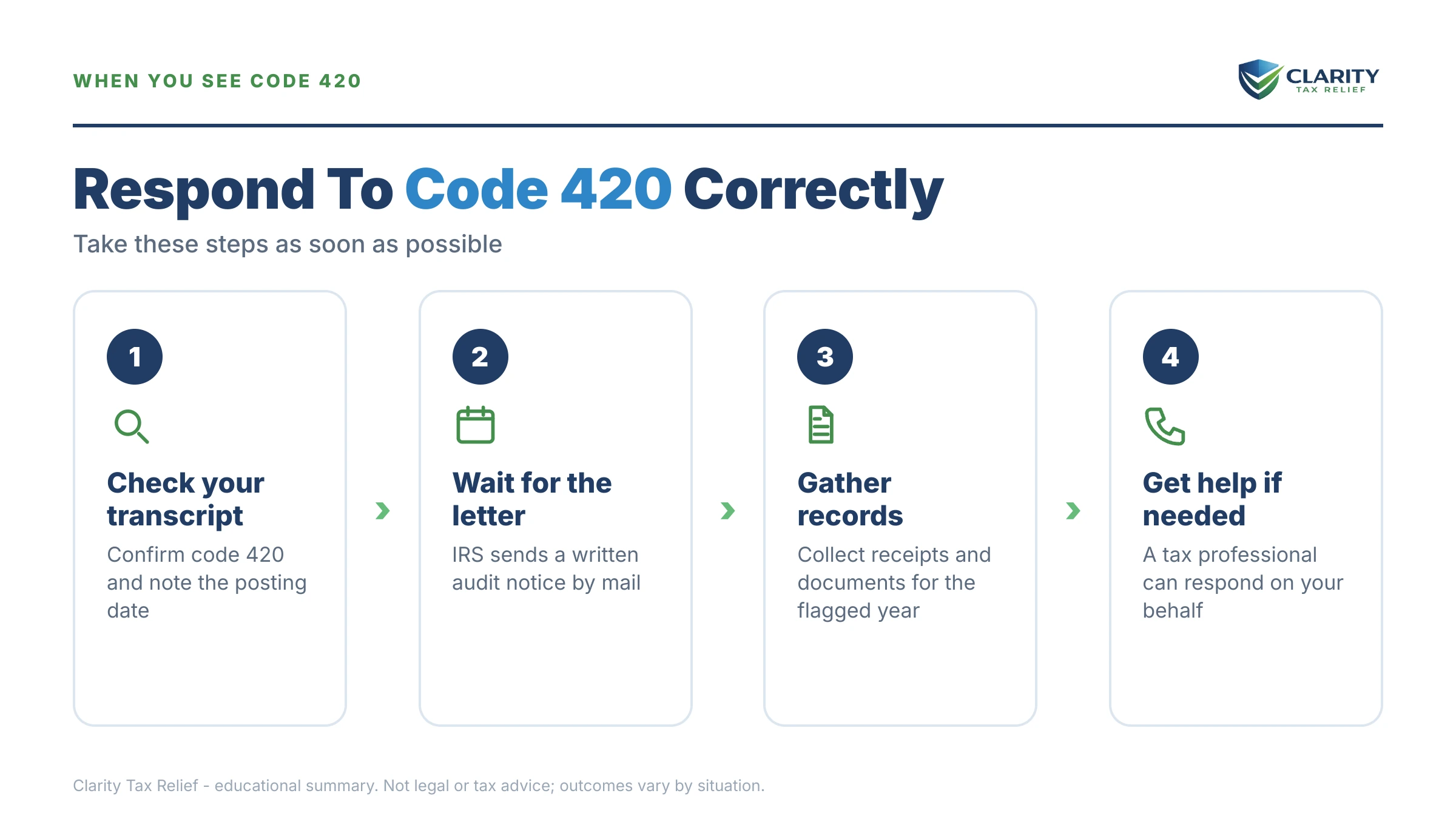
How to respond to code 420, step by step
- Pull your full account transcript — note the date beside TC 420 and check for a TC 971 showing a letter has been issued.
- Identify the audit letter when it arrives — Letter 566, CP75, or Letter 2205-A tells you the tax year, the exact items under exam. Your response date.
- Gather records for the flagged items — pull bank statements, receipts, mileage logs, and payroll reports before you contact anyone at the IRS.
- Respond by the date printed on the letter — send copies (never originals) with a short cover letter tying each document to each questioned item.
- Escalate on time if you disagree — 30 days to protest the exam report to Appeals, then 90 days to petition Tax Court after a Notice of Deficiency.
- Get a professional review before your first response if the exam touches payroll or multiple years. Your first answer shapes the whole exam, and a representative with Form 2848 can handle every examiner contact for you.
When you can handle a code 420 audit yourself
Plenty of code 420 exams are safely handled without professional help. If it's a correspondence audit over one documented issue — a 1099 you can match to your books, a dependent-credit exam where school and medical records prove residency, a charitable deduction with receipts in a folder — respond yourself, on time, with organized copies. Paying for representation on a one-item mail audit you can prove is usually money wasted.
Experienced help changes outcomes in a narrower set of situations: a field exam at your business, an exam that could reach worker classification or payroll deposits, multiple open years, records that need reconstruction, or a report proposing accuracy or fraud penalties. In those cases the risk isn't the flagged item — it's scope. A representative under a Form 2848 power of attorney answers exactly what's asked and nothing more. You never sit across from the examiner improvising. Since the IRS generally has three years to assess — six if income was understated by more than 25% — controlling scope is often worth more than winning any single deduction. The full rules are in how far back the IRS can audit.
Terms on your transcript, decoded
- Examination of tax return — the IRS's formal word for an audit; code 420's literal transcript description.
- TC 421 — examination closed; paired with a TC 300 if the audit added tax, or nothing if it ended in no change.
- No-change letter — the exam's best outcome: the IRS reviewed the flagged items and accepted your return as filed.
- 30-day letter — the exam report cover letter (525 or 915) giving you 30 days to protest the findings to Appeals.
- Notice of Deficiency — the statutory "90-day letter" (CP3219A/531); your last chance to contest the tax in court before it's assessed. See code 290 on an IRS transcript for how non-exam assessments post by comparison.
- Accuracy-related penalty — a 20% addition on the underpayment an exam finds, contestable on reasonable-cause grounds.
Code 420 questions, answered
What does code 420 mean on an IRS transcript?
Code 420 on an IRS transcript means the IRS has selected that return for examination — an audit. The code itself is not a bill and sets no deadline. The audit letter that follows (Letter 566, CP75, or Letter 2205-A) tells you exactly what's being examined and when you must respond.
Does code 420 on my transcript always mean an audit?
Yes — transaction code 420 means your return was formally referred for examination, which is what the IRS calls an audit. What varies is the scope: most exams are correspondence audits handled entirely by mail over one or two items. A code 424 without a 420 is only an exam request, and some of those close before a real audit ever opens.
How long after code 420 will I get an audit letter?
Usually within a few weeks of the 420 posting, though there's no fixed schedule and 2026 staffing cuts have stretched some timelines. Watch your transcript for a TC 971 ("notice issued"), which means a letter is on its way. If months pass with no letter, call the IRS or check your online account rather than assuming the exam disappeared.
Will code 420 hold my refund?
If a refund is pending for the year under exam, code 420 typically freezes it until the examination closes. The hold releases when TC 421 posts — either with no changes or after any additional tax is resolved. Refunds for other years generally aren't affected unless the IRS applies them to a balance the exam creates.
What does code 421 mean after code 420?
TC 421 means the examination closed. Look at what posts with it: nothing new means a no-change exam, while a TC 300 shows additional tax assessed from the audit, usually followed by penalty and interest codes. If tax was added and you disagree, audit reconsideration or an appeal may still be available.
Is code 420 the same as code 570?
No. Code 570 is a general hold on the account. It can come from identity checks, income-matching, or dozens of routine reviews, and most 570s resolve without an audit. Code 420 is specific: an examination file has been opened on that return. You can have both at once when a refund is frozen while the exam runs.
How far back can the audit go once code 420 posts?
The exam usually covers the single year shown on the transcript, and the IRS generally has three years from filing to assess. That window stretches to six years if you understated income by more than 25%, and there's no limit for fraud or unfiled returns. Examiners can open earlier or later years if they find the same issue repeating.
Can the audit expand into my payroll taxes?
It can. An income tax exam of a business owner regularly looks at worker classification, officer salary, and payroll deposits, and examiners can refer or open an employment tax exam if something looks off. If you have payroll, have your 941s and payroll reports reconciled before your first response — inconsistencies invite expansion.
Can code 420 be a mistake or go away on its own?
Rarely. Once 420 posts, an examination file exists — unlike code 424, which is only a request and sometimes reverses without an audit. Some exams do close quickly with a no-change letter when the flagged item checks out. But that happens because you responded with documentation, not because the code expired.
Your next 24 hours
- Pull the account transcript for the year showing code 420, note the date beside it, and check whether a TC 971 (notice issued) has posted yet.
- Gather that year's return and the records behind its largest deductions — bank statements, receipts, mileage records, and payroll reports if you have employees — so you're ready the day the letter lands.
- Get a free case review at the 2-minute form or (888) 825-7779 — an experienced tax professional can read your transcript, anticipate what the examiner will ask, and plan your response before the letter's clock even starts.
For background straight from the source, see the IRS's own overview of how IRS audits work, its options at IRS.gov/payments if an assessment does result, and the Taxpayer Advocate Service if the exam process itself breaks down.
This guide is general information, not tax or legal advice for your specific situation. Eligibility for IRS programs depends on individual facts and circumstances; no outcome is guaranteed.