
IRS Transcript Codes
Is Code 570 an Audit? What the Hold on Your IRS Transcript Really Means (2026)
What this episode covers
- Does IRS code 570 mean I am being audited?
- What triggers IRS code 570 on a tax transcript?
- Is the date next to IRS code 570 on a transcript a deadline?
- Which transcript codes show an IRS code 570 hold has been released?
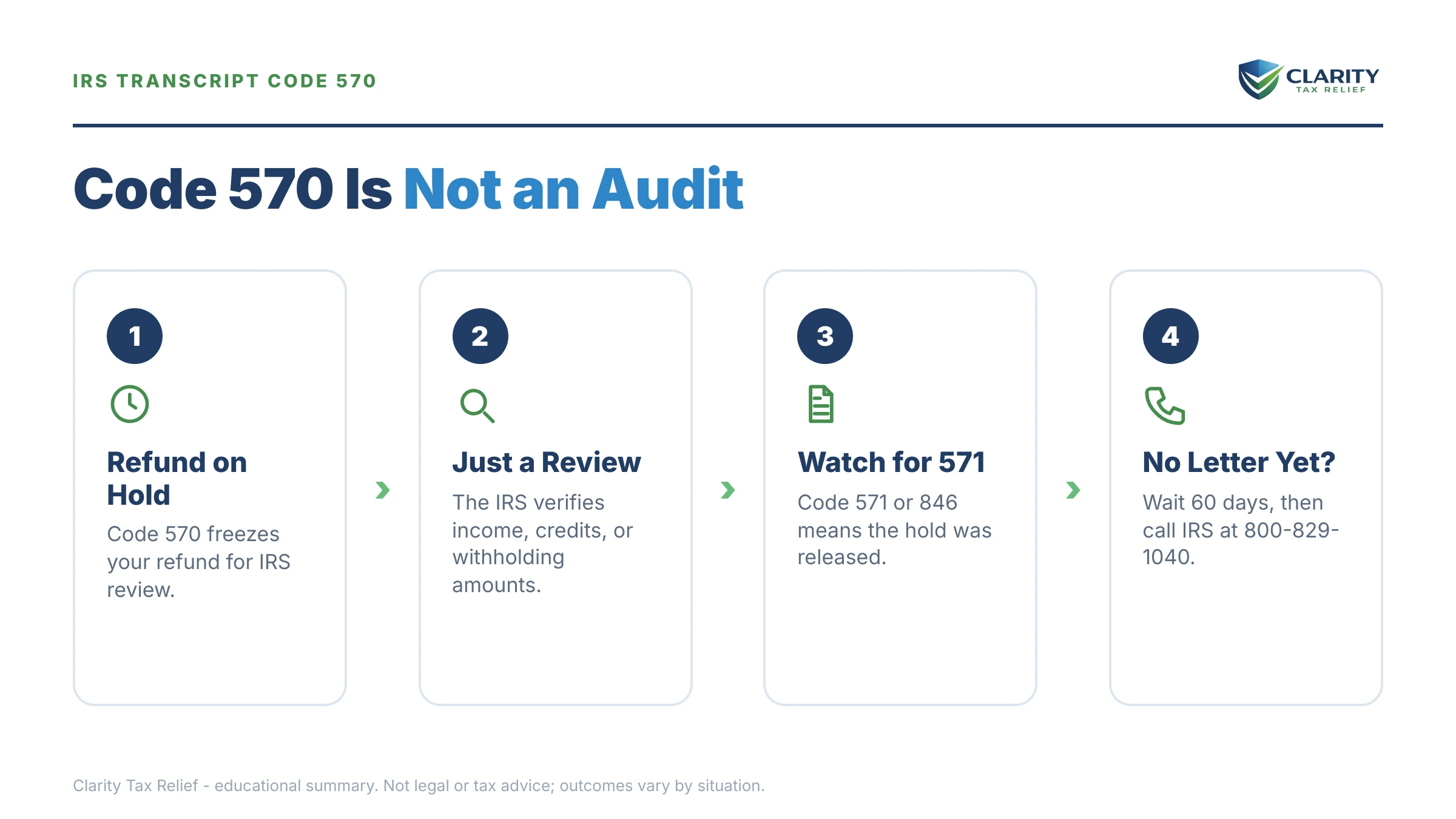
Is code 570 an audit? No. Code 570 means "additional account action pending" — a temporary hold that stops your refund from releasing while the IRS verifies something on your account. Audits show up on a transcript as codes 420 or 424. If those codes aren't there, no examination has been opened.
You've been refreshing your transcript for days, the refund tracker still says "processing," and now there's a line reading 570, Additional account action pending, $0.00 with no explanation attached. Your mind jumps straight to audit. The transcript itself can tell you whether that fear is real, and for the vast majority of people, it isn't.
This guide shows you how to read the lines around your 570, which codes actually mean an exam, and what to do when the hold is tied to something bigger — like income the IRS knows about from years you never filed. The image below shows you exactly where a 570 sits on a real account transcript and which nearby lines to check first.
⏱ The clock that matters: a code 570 sets no response deadline by itself. The only real deadline is the date printed on any letter that follows (watch for code 971 on your transcript). But two clocks run in the background: your refund stays frozen until the hold resolves, and if you have unfiled years, the failure-to-file penalty grows at 5% per month, up to 25%, until you file.
Is code 570 an audit, or just a hold?
Code 570 is a hold, not an audit. It stops a refund or credit from releasing while the IRS checks something on your account. On the transcript's ledger, your return posts as code 150, your withholding posts as code 806, and the 570 sits below them like a hand pressed on the "pay out" button.
An audit leaves a completely different fingerprint. Codes 420 and 424 are the transcript's actual audit codes — code 424 means your return was pulled for possible examination, and code 420 means an exam is open or opening. Neither posts automatically with a 570.
The confusion is understandable: both a 570 and an audit involve the IRS "looking at" your return. The difference is scope. A 570 is usually a system-level verification — matching your numbers against payer records, checking a credit, or confirming identity. An audit is a formal examination with legal procedures, document requests, and appeal rights. One is a speed bump; the other is a process.
Can a 570 become audit territory? Occasionally, yes, if the review finds something the system can't reconcile, the account can be referred to exam or the underreporter unit. You'd see that referral as a 424, a 420, or a code 922 posting later. Until one of those appears, you're dealing with a hold, not an investigation.
Why code 570 posted to your transcript
A code 570 posts when an IRS system needs to verify something before releasing money, and the trigger list is long. The single most common trigger is a mismatch between what you reported and what employers, banks, and payment platforms reported about you.
The usual causes, roughly in order of frequency:
- Withholding or income mismatch. The withholding on your return (code 806) or the income you reported doesn't line up with the W-2s, 1099-NECs, and 1099-Ks in the IRS's files. Even a payer's late or corrected form can trip this.
- Refundable credit verification. Returns claiming the Earned Income Tax Credit, Additional Child Tax Credit, or premium tax credit get extra screening before the money goes out. A CP05 notice or 4464C letter often accompanies this kind of hold.
- Identity or return-integrity screening. If filters flag the return as possibly not yours, the hold sits until identity is confirmed, sometimes escalating to a hard freeze (more on code 810 refund freeze below).
- Unfiled prior years. The IRS will hold a current-year refund while it looks at years you never filed, often paired with a CP63 notice. It won't pay you with your left hand while its right hand shows potential balances due.
- Account housekeeping. A duplicate filing, a pending amended return, an injured-spouse allocation, or a payment posted to the wrong year can all park a 570 on the module while a human sorts it out.
Gig workers get hit disproportionately by the first and fourth causes. Platforms report your gross receipts on 1099-Ks and 1099-NECs — before mileage, fees, or any expense — so the IRS's picture of your income is always bigger than your actual profit. And if some years never got filed at all, the system sees exactly the combination it's built to hold: a refund request sitting on top of unexplained income. For the full line-by-line anatomy of the code, see our guide to code 570 on your IRS transcript. For how the whole document fits together, start with how to read an IRS account transcript.
Code 570 vs. the real audit codes: 420, 424, and 1242
Three transcript markers actually signal examination activity, and code 570 isn't one of them. A 570 can coexist with an audit, but it does not create one. Here's the side-by-side most transcript watchers are really looking for:
| Code | What it means | Is it an audit? | What to do |
|---|---|---|---|
| 570 | Additional account action pending — refund/credit held for review | No | Verify your income and withholding match your forms; watch for a 971 |
| 971 | Notice issued — a letter is coming that explains the hold | No, but the letter says what's happening | Respond by the date printed on the letter |
| 810 | Hard refund freeze from a specialized unit | No, but more serious than a 570 | Usually requires identity verification or unit contact; won't self-resolve |
| 424 | Examination request — return pulled for possible exam | Pre-audit | Gather records now; it may close without an exam or convert to 420 |
| 420 | Examination indicator — an audit is open or opening | Yes | Expect an exam letter; consider representation before responding |
| 1242 (reference no.) | Refund frozen and routed for review, shown with Tax Topic 151 | Often — the return is in the exam pipeline | Wait for the letter identifying the issue; respond with documentation |
| 922 | Underreporter review — reported income vs. payer records | Not a formal audit — this is CP2000 territory | Reconcile your 1099s/W-2s against your return before the notice arrives |
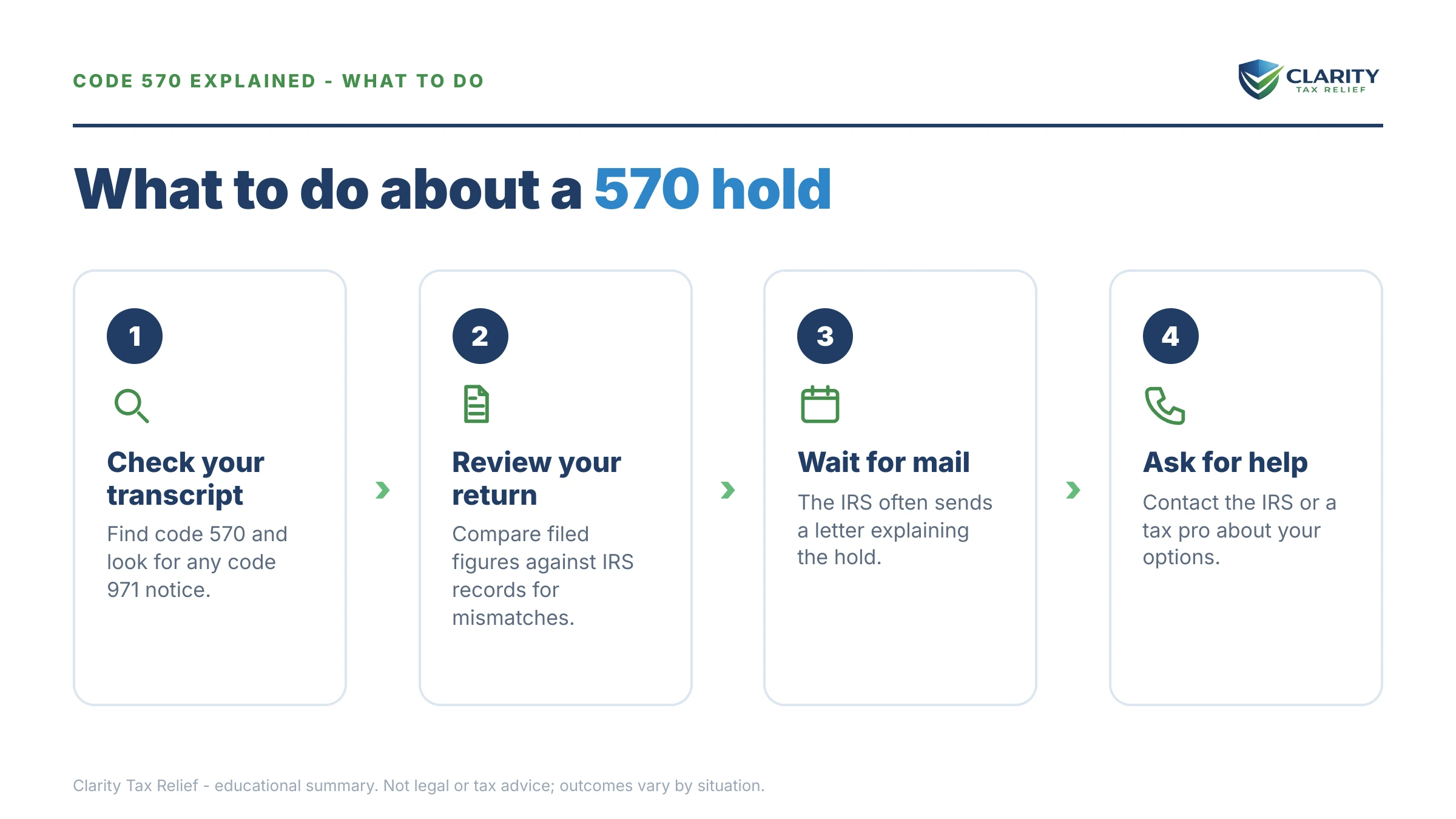
One important pairing: a 570 followed by a 971 on the next line is the most common combination on held accounts. It means a specific letter is about to tell you what the IRS wants. We cover that pattern — including which order the codes appear in and why it matters — in 570 and 971 codes on transcript.
What happens if you ignore a code 570 hold
A code 570 never escalates to garnishment or levy by itself, but ignoring what's underneath it can cost you the refund and much more. The sequence when you do nothing runs in stages, not on a fixed calendar:
- The hold sits. Your refund stays frozen. Nothing is collected from you, but nothing releases either, and the IRS is under no obligation to hurry.
- A 971 posts and a letter goes out. That letter (CP05, 4464C, CP63, or similar) carries the only real deadline in this process. Miss it, and the review resolves without your input, usually against you.
- The review deepens. If the IRS can't verify what it needs, the 570 can be joined by an 810 freeze, referred to exam (424, then 420), or routed to the underreporter unit (922). This is the exact point where "not an audit" can become one.
- Unfiled years catch up. With missing returns on file, the IRS can build substitute-for-return assessments on your gross 1099 income — zero deductions, zero mileage — then issue a CP3219N notice of deficiency, assess the tax, and start collection. Our guide to what happens when the IRS filed a substitute return covers that path in full.
- Adjustments replace the refund. If the review changes your return, a code 290 posts additional tax, your refund shrinks or disappears. A balance-due notice may follow.
- Old refunds expire. You generally have three years from a return's due date to claim its refund. Sit on unfiled years long enough and any money the IRS owed you is gone permanently — see the 3-year refund deadline for old returns.
One 2026 reality worth naming: the IRS workforce is down roughly 27% after the 2025 cuts, so the humans who resolve holds are scarcer. But the automated systems that place holds, build substitute returns, and send notices never slowed down. Waiting doesn't run out the clock; it just leaves the machine unopposed.
Staring at a 570 on top of unfiled years?
Send us your transcript. An experienced tax professional will decode every code on it, tell you whether an exam is actually opening, and map the fastest path to releasing the hold — free and confidential. While the hold sits, late-filing penalties on unfiled years keep growing every month.
What posts after a 570: release or escalation
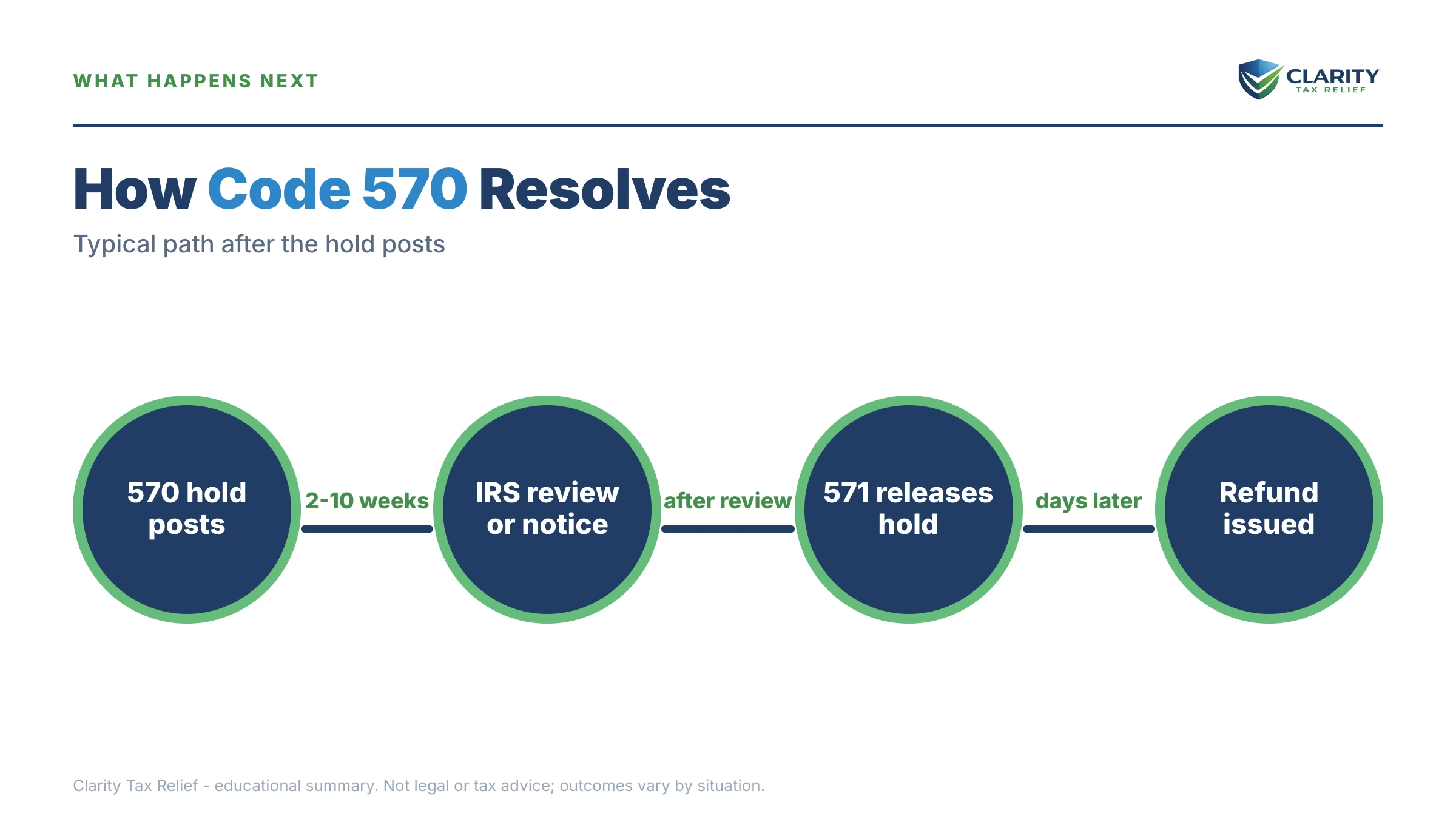
Every code 570 eventually resolves one of two ways — a release code frees the refund, or a follow-on code deepens the review. Since you're likely checking your transcript weekly anyway, here's what each possible next line means:
| What posts next | What it means | What happens to your refund |
|---|---|---|
| 571 or 572 | Additional action resolved or reversed — the hold is lifted | Releases; watch for an 846 on the next update |
| 846 | Refund issued — the review confirmed your numbers | Money is on the way; the 846 refund issued date is the send date |
| 971 | Notice issued — the IRS needs something from you | Frozen until you respond by the letter's printed date |
| 810 | Refund freeze — a specialized unit took over the account | Frozen indefinitely; requires action from you and an 811 to release |
| 424 → 420 | Exam referral, then an open examination | Frozen; the audit process now controls the outcome |
| 290 | Additional tax assessed — the review changed your return | Reduced or eliminated; a balance-due notice may follow |
Your options, while the hold sits, and if it ends with a balance
What you can do about a code 570 depends on which trigger caused it, and whether the review ends with a refund or a bill. While the hold is active, your levers are limited but real:
- Answer any letter immediately and completely. A documented response by the printed date is the single fastest release path for holds that need input from you.
- Verify identity the moment you're asked. Identity holds cannot resolve without you, and every week of delay is a week of frozen refund.
- File anything missing. A hold tied to unfiled years typically will not release until the returns are in, and accurate returns almost always beat the IRS's deduction-free estimates.
- Escalate genuine hardship. If the frozen refund means you can't cover rent, utilities, or medication, the Taxpayer Advocate Service can intervene in hardship cases the normal queue won't prioritize.
If the review ends with a balance instead of a refund — common when unfiled years or underreported 1099 income sit underneath the hold — the resolution menu depends mostly on how much you owe. The $50,000 line matters most: below it, you can usually set up a payment plan online without handing over full financials.
| Option | Who it fits | Cost and terms |
|---|---|---|
| Pay in full / short-term plan | You can clear the balance within 180 days | $0 setup; interest and the 0.5%/month late-payment penalty run until paid |
| Guaranteed installment agreement | You owe $10,000 or less in tax and are filing-compliant | The IRS must generally accept it if you can pay within three years |
| Streamlined installment agreement | Combined balance of $50,000 or less | Up to 72 months, set up online with no detailed financials; setup fee applies (lower with direct debit) |
| Currently Not Collectible | Paying anything would leave you unable to cover basic living expenses (shown on Form 433-F) | $0; collection pauses, but the debt, penalties, and interest remain |
| Offer in Compromise | Your assets plus future income genuinely can't cover the debt | $205 fee plus 20% down on lump-sum offers — both waived with low-income certification; the IRS accepted roughly 1 in 5 offers in FY2024 |
A worked example: three unfiled years, a frozen refund, and $48,300
Say you've driven and delivered on 1099s since 2022 and never filed, then filed your 2025 return in February expecting a $4,100 refund. Your transcript shows a 150, an 806, and a 570 that won't budge. The IRS's wage-and-income files show your gross platform receipts for 2022–2024. Its math on that gross income — no mileage, no fees, no expenses — pencils out to $48,300 in unpaid tax across the three years.
Here's what that number does if you keep waiting. The failure-to-file penalty runs 5% per month and caps at 25% — up to roughly $12,075 on a $48,300 base — plus the 0.5%-per-month failure-to-pay penalty and daily-compounding interest on top. You can estimate your own exposure with our IRS penalty and interest calculator.
Here's what it does if you act. Filing real Schedule C returns with mileage and expenses usually cuts the tax itself well below the IRS's deduction-free estimate. Even if the final balance landed near $48,300, that's under the $50,000 streamlined line — roughly $671 a month over 72 months ($48,300 ÷ 72), set up online, while interest continues to accrue. Expect the frozen $4,100 refund to be applied against the oldest balance rather than paid out — annoying, but it's $4,100 you no longer owe. The step-by-step catch-up playbook is in haven't filed taxes in 3 years.
How to respond to code 570, step by step
The right response to a code 570 is the same in every scenario: read the whole transcript first, then act on what it actually shows. The notice date, not any date on the transcript, is the only deadline in this process.
- Pull every transcript. Download the account transcript for the frozen year and wage-and-income transcripts for every year you haven't filed — the hold rarely makes sense from one document alone.
- Scan for the codes that change the answer. A 420, 424, or 810 near your 570 moves you from "routine hold" to "act now," and a 971 means a letter is on its way.
- Match the hold to a cause. Compare the withholding and income on your return against your actual W-2s and 1099s — a mismatch is the most common 570 trigger.
- Respond to any letter by its printed date. The notice date, not any date on the transcript, is the only deadline in this process.
- File every missing return. A hold tied to unfiled years will not release until the IRS has your returns, and filing stops the 5%-per-month late-filing penalty from growing.
- Get a transcript review if the stack is complicated. A 570 sitting on unfiled years, an 810, or exam codes is worth an experienced tax professional's eyes before you spend hours on hold with the IRS.
When you can handle a code 570 yourself, and when help changes the outcome
Most standalone code 570 holds resolve without professional help, and you shouldn't pay anyone to wait alongside you. Handle it yourself when:
- The 570 stands alone — no 971, no 810, no exam codes — and your return's numbers match your actual forms. Check weekly and let it clear to a 571.
- A letter arrives asking for simple documentation (pay stubs, a W-2, proof of a dependent). Send exactly what it asks for, by the date, and keep copies.
- The hold is an identity check. Verify online or by the method the letter specifies — no one can do that step for you anyway.
Experienced help changes outcomes in a different set of situations: a 570 paired with an 810, a 424, or a 420. Multiple unfiled years with large gross 1099 income behind the hold. A substitute return the IRS has already built or assessed. Or a review heading toward a five-figure balance where the order of moves — file accurate returns first, address penalties second, then structure the balance — changes what you ultimately pay. In those cases the transcript is the map, and reading it wrong is expensive.
Terms on your transcript, decoded
The vocabulary around a code 570 confuses more people than the code itself. The five terms you're most likely staring at:
- Additional account action pending — the official description of code 570: something must be verified or processed before your refund releases.
- TC 571 / TC 572 — the release codes; 571 means the pending action resolved, 572 means it was reversed. Either one unfreezes the account.
- "As of" date — the date the IRS uses to compute interest and penalties on the account. It is not a deadline and not your refund date.
- Refund freeze (810) — a harder stop than a 570, placed by a specialized unit, that requires action from you and a code 811 to lift.
- Substitute for return (SFR) — a return the IRS constructs for a year you didn't file, using gross reported income and no deductions, which becomes a legal assessment if unchallenged.
If your transcript stack looks like the worked example above, a 570 sitting on years that were never filed, a free review with an experienced tax professional at (888) 825-7779 can tell you in one conversation which returns to file first and how to get the hold released.
Code 570 questions, answered
Is code 570 an audit?
No. Code 570 is a hold, "additional account action pending", that freezes your refund while the IRS verifies something, most often income, withholding, or a credit you claimed. An audit appears on your transcript as code 420, or code 424 while an exam is being considered. A 570 can eventually be routed to exam, but by itself it is not one.
What does "additional account action pending" mean on an IRS transcript?
It means an IRS system flagged your account for a manual or automated check before releasing money, and nothing will move until that check finishes. The phrase is deliberately generic — the same code covers income mismatches, credit verification, identity screening, and unfiled-year holds. Watch for a code 971 beneath it; the letter it triggers tells you which one you're dealing with.
How long does a code 570 hold last?
There's no fixed timeline. Simple mismatches often clear in a few weeks with a code 571 release, while holds that need documents or missing returns can run months. In 2026, with the IRS workforce down roughly 27% from the 2025 cuts, manual reviews move slower than the automated systems that create them. The fastest way to shorten a hold is to answer any letter immediately and file anything missing.
Does code 570 always come with a notice?
No. Many 570 holds resolve internally and never generate a letter — the code simply flips to 571 and the refund releases. When the IRS does need something from you, a code 971 (notice issued) posts and a letter follows in the mail. If a 971 appears, the letter, not the transcript, tells you what to send and by when.
What's the difference between code 570 and code 810?
A 570 is a pending-action hold on a specific return. An 810 is a hard refund freeze placed by a specialized unit, most often for identity verification or suspected frivolous or fraudulent claims. A 570 frequently resolves on its own; an 810 almost never releases without action from you and requires a code 811 to lift. Seeing both together means the account needs attention now.
Will I still get my refund if my transcript shows code 570?
Usually, yes, if the review confirms your numbers, a code 571 releases the hold and code 846 posts with your refund date. Two exceptions: if the review changes your return, the refund shrinks by the adjustment, and if you owe on other years, the IRS applies the refund to those balances first. A frozen refund is delayed money, not necessarily lost money.
Can unfiled prior-year returns cause a code 570?
Yes. The IRS routinely holds a current-year refund while it looks at years you never filed, often alongside a CP63 notice, because it won't pay out with potential balances outstanding. The hold typically won't release until the missing returns are in. Filing them also stops the failure-to-file penalty, which grows at 5% per month up to 25%.
What does the date next to code 570 mean?
It's a processing date generated by the IRS's weekly posting cycle, not a deadline and not the day your hold resolves. A future date next to a 570 is normal and doesn't mean anything is scheduled to happen that day. The only date that ever demands action from you is the one printed on a mailed notice.
Should I call the IRS about a code 570?
Not immediately. In the first few weeks a phone rep will usually just confirm the account is under review, and 2026 hold times are long. Call when a 971 posted but no letter arrived within a few weeks, when the hold has sat for months with no movement, or when the frozen refund is causing genuine financial hardship — in that last case, the Taxpayer Advocate Service can also intervene.
Your next 24 hours
A code 570 rewards the people who act while everyone else refreshes. Three moves today put you ahead of the hold:
- Check the three lines that matter. Pull your account transcript at IRS.gov's Get Transcript tool and look for a 971 under your 570, an 810 anywhere on the page, and any 420 or 424. Those three checks answer the audit question in two minutes.
- Gather your paper. Any IRS letter you've received, every W-2 and 1099 for the frozen year. A simple list of the years you haven't filed. If a balance ever results, payments and plans run through IRS.gov/payments, but the paperwork comes first.
- Get your transcript reviewed free. If your 570 sits on unfiled years or is keeping company with freeze or exam codes, call (888) 825-7779 or use the 2-minute form at the free consultation page. Your refund stays frozen and late-filing penalties keep compounding while the stack goes unread — an experienced tax professional can read it in one sitting.
This guide is general information, not tax or legal advice for your specific situation. Eligibility for IRS programs depends on individual facts and circumstances; no outcome is guaranteed.