
IRS Transcript Codes
Code 424 IRS Transcript Meaning: What the Exam Request Is, and Isn't (2026)
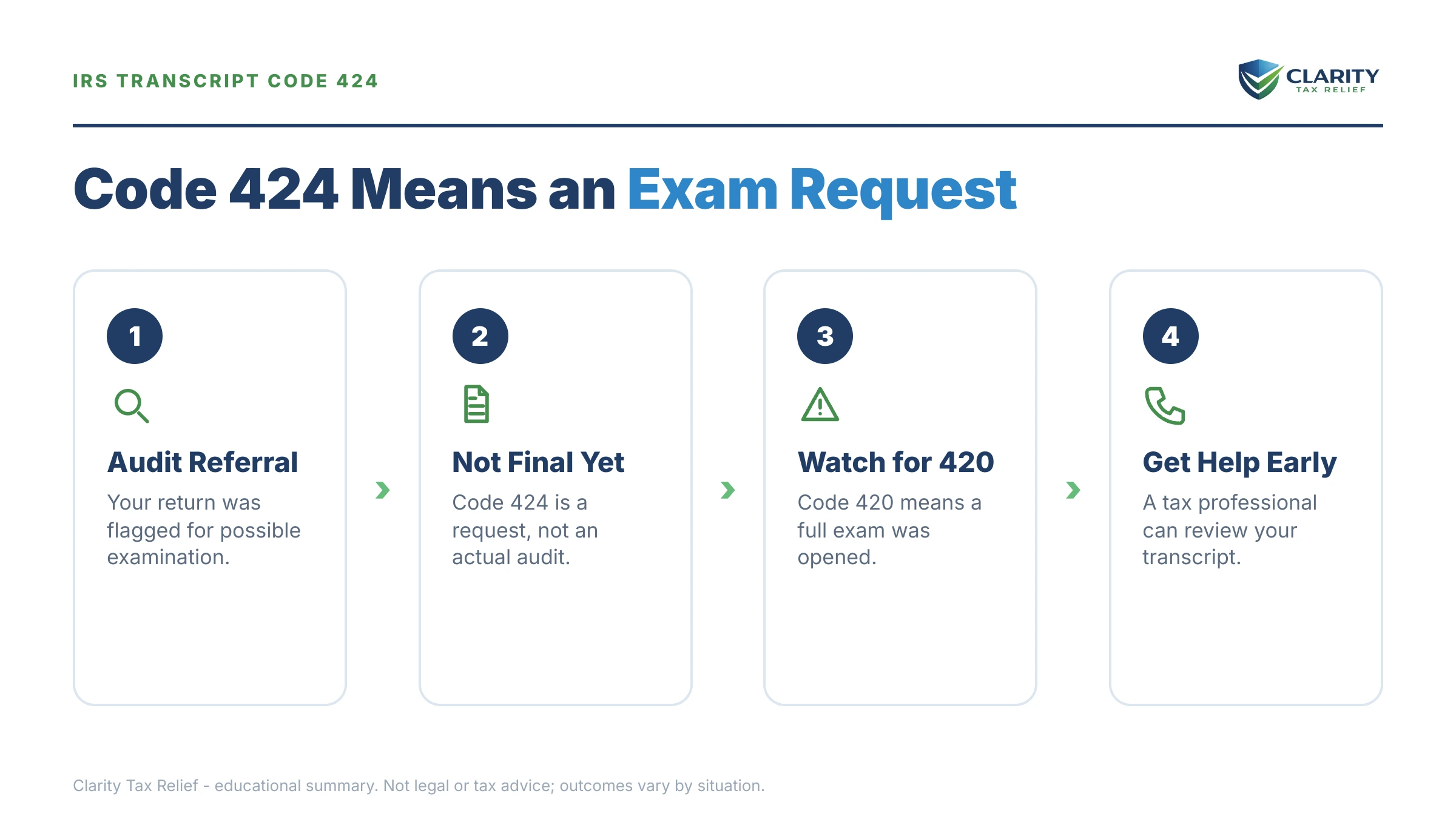
The short answer: code 424 on an IRS transcript means your return was flagged with an examination request — the IRS is considering an audit, but no audit is open yet. Many 424 requests are screened out and vanish. If the exam actually opens, code 420 posts and a letter follows by mail.
You went looking for a refund date, scrolled the transactions on your transcript, and hit a line that says "424 Examination request." No letter, no explanation — just a code that sounds like the word every taxpayer dreads. Here's the part the transcript doesn't tell you: a 424 is a question the IRS is asking itself, not a decision it has made about you, and a real share of these requests die quietly in screening. This page walks you through exactly what happens next, stage by stage.
If you're not even sure you're reading the right line, the image below shows exactly where a 424 entry sits in the transactions section of an account transcript and how to read the date and amount columns around it. (For the full column-by-column walkthrough, see our guide on how to read IRS account transcript entries.)
⏱ Your deadline: there isn't one — yet. Code 424 by itself requires nothing from you and sets no response date. A clock starts only if an audit letter (usually Letter 566 or CP75) arrives in the mail, and the response date printed on that letter is the one that controls. Use the quiet period now to get organized.
Why code 424 appeared on your IRS transcript
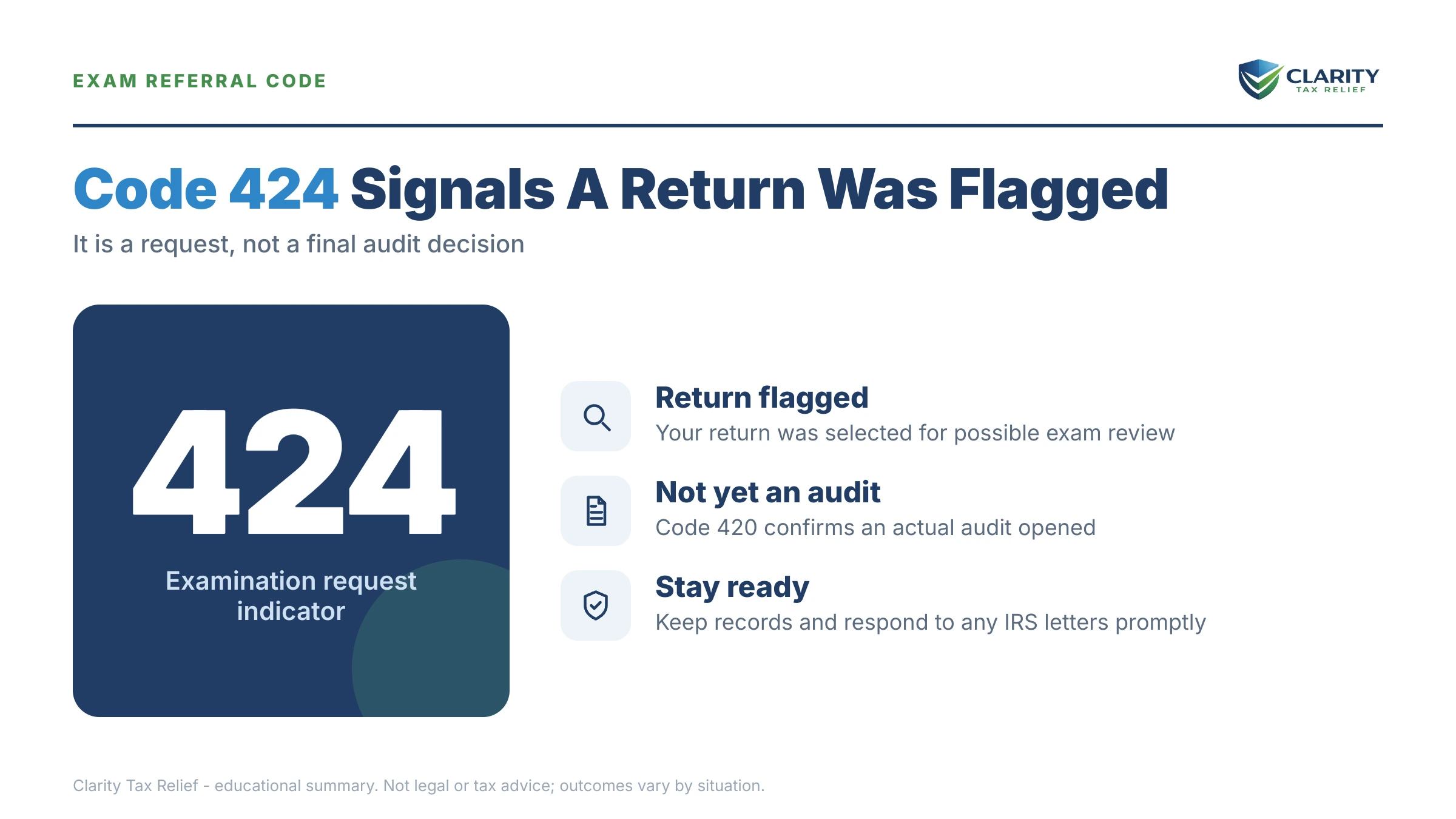
Code 424 means a person or computer program asked the IRS examination function to look at your return. It is a referral for possible audit, not an open audit. In IRS terms it's an "examination request indicator." The line usually shows a date and $0.00 in the amount column, because nothing has been assessed. Nothing on your account has changed except the flag itself.
Where the request comes from varies. The most common sources:
- Computer scoring. The IRS scores every return for audit potential (the DIF score). Deductions or credits that are unusually large relative to your income raise the score.
- A document mismatch. A 1099, W-2G, or SSA-1099 the IRS received that your return didn't fully reflect.
- A related exam. Your spouse, business partner, or a preparer under review can pull your return in with theirs.
- A refundable-credit screen. Earned Income Credit and similar claims get their own pre-refund review track. Those often surface as a CP75 notice if the exam opens.
After the 424 posts, your return sits with a unit called classification. A classifier decides whether the issue is worth an examiner's time. Two outcomes are possible: the request is rejected and reversed — the 424 may disappear from a freshly pulled transcript, or a code 421 posts — or it's accepted and code 420 irs transcript posts, meaning the audit is genuinely open. That single distinction, request versus open exam, is the whole meaning of 424.
One practical side effect: if your refund hadn't been issued when the 424 posted, it will usually stay on hold while the return is screened, often alongside a code 570 on irs transcript hold or, less commonly, a code 810 refund freeze.
| Code | What it means | What to do |
|---|---|---|
| 424 | Examination request — return referred for possible audit | Nothing required yet; monitor your transcript and mail |
| 420 | Examination opened — classification accepted the request | Expect an audit letter; start gathering documents now |
| 421 | Examination closed or request screened out | Check for changes; if no code 300 follows, it's over |
| 570 | Additional account action pending — refund on hold | Wait; this hold often accompanies exam screening |
| 810 | Refund freeze — a harder stop than 570 | Watch for a verification or review letter and follow it |
| 300 | Additional tax assessed by examination | The audit produced a balance; appeal or payment options apply |
“Should your account be selected for audit, we will notify you by mail. We won't initiate an audit by telephone.”
— IRS audits (IRS.gov)
What happens after code 424: the full sequence if you do nothing
A code 424 has exactly two possible endings: the request is screened out and disappears, or it converts to code 420 and an audit letter follows. If it converts and you ignore the mail, the process runs to a bill without you. Here is the stage order:
- 424 posts — screening. A classifier reviews the flagged issue. No contact, no deadline. Any unpaid refund typically waits here.
- Screened out. The request is reversed or a 421 posts. No letter ever comes; a held refund is released. This is a common outcome, and you'll never be told why.
- Accepted — 420 posts. The audit is now open and assigned. Mail follows.
- The audit letter arrives. Usually Letter 566 for a correspondence exam, CP75 for a credit-focused exam, or an appointment letter for an office exam. It names the items under review and prints your response date.
- No response → exam report. The examiner disallows the unverified items and issues a report (Letter 525, the "30-day letter") proposing additional tax, typically with about 30 days to protest to the IRS Independent Office of Appeals.
- Still no response → Notice of Deficiency. A CP3219A gives you 90 days to petition Tax Court — the last chance to contest the tax before it's assessed (see the 90 day letter Tax Court petition guide).
- Assessment and collection. Code 300 posts the audit tax, penalties and interest attach, and the balance flows into the normal collection notice stream.
A 2026 reality check: the IRS workforce shrank roughly 27% in 2025, so screening and exam pipelines move slower and phone answers are harder to get. But the flags, holds, and downstream notices are generated by automated systems that never took a day off. Slow does not mean forgotten.
Staring at a 424 on your transcript?
The screening stage is the cheapest moment in the entire exam process to get ahead of it, before an examiner proposes changes. Send us your transcript and an experienced tax professional will read every code on it and map your realistic options, free and confidential.
Your options at each stage, and the right at stake
Every stage after a code 424 comes with a specific right, and each right expires when the stage passes. The table below is the map; the notes after it tell you which move fits where.
| Stage | Your deadline | The right at stake |
|---|---|---|
| Code 424 posts (screening) | None — nothing is due | Nothing yet; time to prepare is the only asset |
| Code 420 + audit letter (Letter 566 / CP75) | The response date printed on the letter (typically about 30 days) | Having your documents considered before changes are proposed |
| Exam report — Letter 525 ("30-day letter") | Typically 30 days from the letter date | A free appeal to the IRS Independent Office of Appeals |
| CP3219A Notice of Deficiency | 90 days to petition Tax Court | Contesting the tax before you have to pay it |
| Tax assessed (code 300) | Collection notices begin their own clocks | Audit reconsideration is still possible, but you're now disputing an assessed debt |
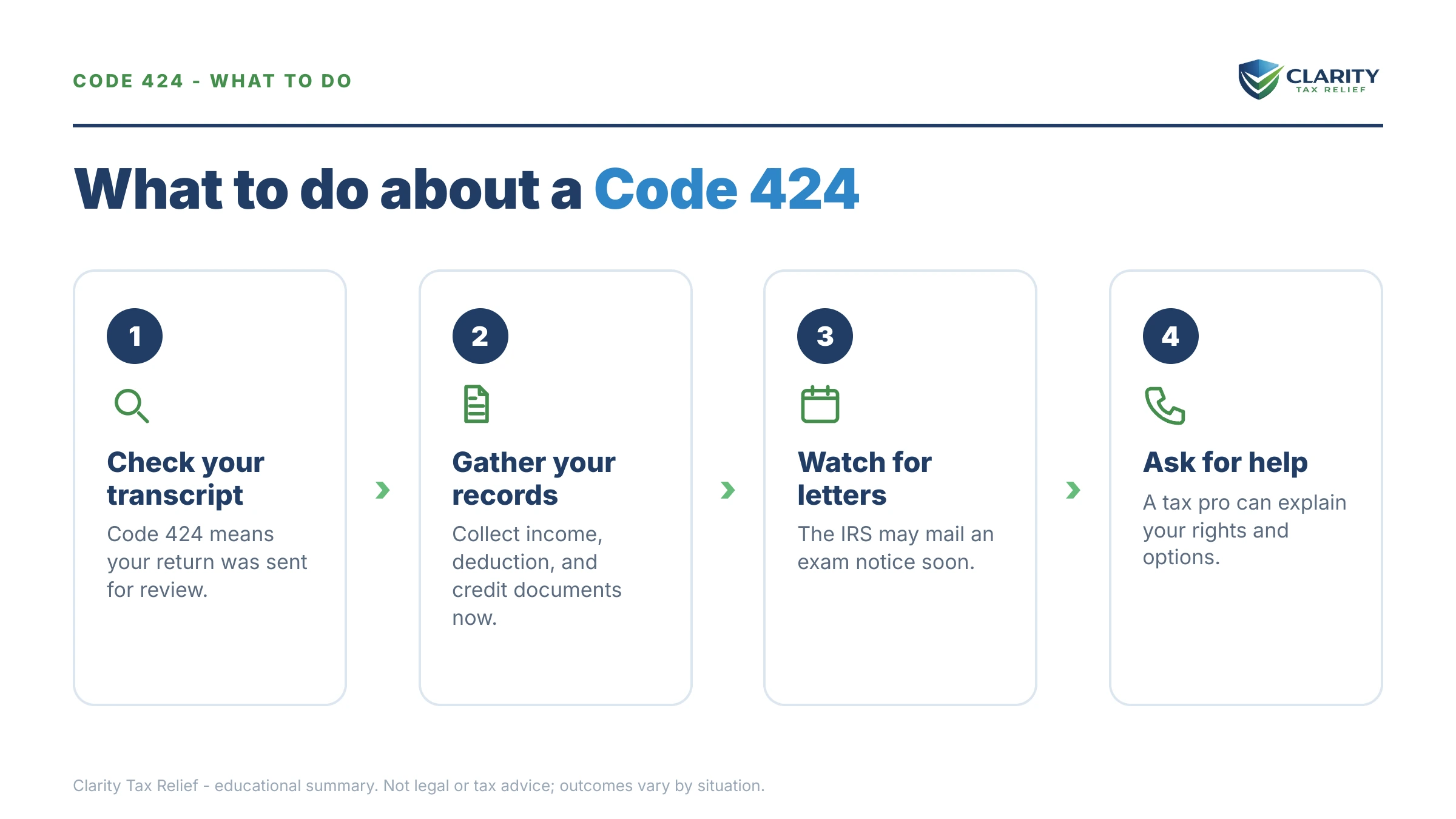
If 424 is the only unusual code: your move is preparation, not contact. Confirm your address is current with the IRS, pull the documents behind your return's biggest numbers, and re-check your transcript every week or two for a 420 or 421.
If a 420 posts or a letter arrives: the exam is real and narrow — the letter lists the exact items in question, and nothing else is on the table unless you put it there. Answer only what's asked, with organized copies. Our guides on irs mail audit what to expect and being audited with no receipts cover the mechanics, including how reconstructed records can substitute for missing originals.
If you missed the letters and tax was assessed: you haven't lost — you've lost leverage. Audit reconsideration lets you submit the documentation the examiner never saw and ask for the assessment to be reduced, but you're now working uphill while collection notices run in parallel.
What an exam could cost: a $6,200 worked example
Numbers make the stakes concrete. Say you're retired, living on Social Security and a pension, and a 424 posted because your itemized medical and charitable deductions look large next to your income — a classic retiree profile. A common scoring trigger, not a sign of wrongdoing.
Suppose the request becomes an audit, you never respond, and the examiner disallows the unverified deductions, producing $6,200 in additional tax. If the 20% accuracy related penalty irs applies, that adds $6,200 × 20% = $1,240 — a $7,440 balance before interest, which compounds daily from the return's original due date. You can rough out the accrual on our Penalty & Interest Calculator; it estimates, it doesn't promise.
Left unpaid into collection, that balance can reach fixed income: under the Federal Payment Levy Program the IRS can take up to 15% of a Social Security benefit — on a $1,900 monthly check, that's $285 a month (details in can the irs garnish social security).
Now run the same facts the other way. You spend the screening period pulling pharmacy printouts, insurance statements, and charity acknowledgment letters. When the letter comes, you document, say, three-quarters of the deductions. The additional tax drops to roughly $1,550, a good-faith documentation showing undercuts the accuracy penalty, and the case closes at the first stage. Same return, same 424 — the difference is entirely what you did during the quiet weeks.
How to respond to code 424, step by step
- Pull your full account transcript. Download your account transcript for the year in question and note every code near the 424 — a 420 means the audit opened, a 421 means it closed, and a 570 or 810 explains a held refund.
- Confirm your mailing address with the IRS. Audit letters go to your last known address. If you've moved since filing, submit Form 8822 or update your address so Letter 566 or CP75 doesn't go somewhere you'll never see it.
- Gather documentation for the return's biggest numbers. Collect the records behind your income and largest deductions or credits now — 1099s, SSA-1099, receipts, medical and mileage logs — while they're still easy to find.
- Don't file reactive amendments or duplicate returns. Once a return is flagged for exam, an amended return is typically routed to the examiner instead of being processed normally. Get advice before changing anything.
- Respond to any letter by its printed date. If Letter 566, CP75, or an exam report arrives, calendar the response date printed on it and send organized copies, never originals, or get a professional review first.
When you can handle a code 424 yourself
Most people watching a lone 424 need patience, not representation. You can handle this yourself if:
- The 424 stands alone — no 420, no letter — and your return is simple with records in hand. Monitor and wait.
- A single-issue correspondence audit opens and you have clean documentation for exactly what's asked (a charity letter, a 1099 you can explain). Copy, label, mail by the printed date.
- The 424 reversed or a 421 posted with no assessment. It's over; keep the records for three years and move on.
Experienced help genuinely changes outcomes when the exam touches dependents or Earned Income Credit claims (documentation rules are unforgiving), when records are missing or reconstructed, when the flagged year connects to other unfiled or disputed years, when the case has already reached the 30-day or 90-day letter, or when you're on a fixed income and an assessment would collide with hardship rules. In those cases, what gets said, and not said — in the first response shapes everything after it.
Terms on your transcript, decoded
- Examination request: the official meaning of code 424 — a referral asking the audit function to consider your return.
- Classification: the IRS screening unit that decides whether a flagged return actually gets audited.
- DIF score: the computer score every return receives that estimates how likely an audit is to change it.
- Correspondence audit: an audit conducted entirely by mail — the most common kind that follows a 424.
- Notice of Deficiency: the "90-day letter" (CP3219A) — your final window to dispute proposed exam tax in Tax Court before it's assessed.
- Audit reconsideration: the process for reopening an audit assessment with documentation the examiner never reviewed.
Code 424 questions, answered
What does code 424 mean on an IRS transcript?
Code 424 on an IRS transcript means your return was flagged with an examination request — the IRS is considering an audit, but no audit is open yet. Many 424 requests are screened out and vanish. If the exam actually opens, code 420 posts and a letter follows by mail.
Does code 424 mean I'm being audited?
Not yet. Code 424 means your return was requested for examination — a screener still has to decide whether an audit is worth opening. If it opens, code 420 posts to your transcript and a letter such as Letter 566 or CP75 arrives by mail. A meaningful share of 424 requests are screened out and never become audits.
Can code 424 go away on its own?
Yes. If the classification reviewer decides not to pursue the exam, the request is reversed — the 424 line may disappear from a freshly pulled transcript, or a code 421 (closed examination) may post. When that happens, no letter ever arrives and any held refund is released for normal processing. You don't need to do anything to make this happen.
Will code 424 delay my refund?
Often, yes. If your refund hadn't been issued when the exam request posted, the IRS typically holds it while the return is screened, sometimes alongside code 570 (additional account action pending) or 810 (refund freeze). If the request is screened out, the hold lifts; if an audit opens, the refund generally stays held until the exam closes.
What is the difference between code 420 and code 424?
Code 424 is the request; code 420 is the open audit. A 424 means someone asked the examination function to look at your return, while a 420 means classification accepted the request and assigned it for exam — mail follows a 420. If your transcript shows 424 with no 420, you are still in the screening stage.
How long after code 424 will I hear something?
There is no fixed timeline — screening can take anywhere from a few weeks to several months, and with IRS staffing down roughly 27% since 2025, exam pipelines are slower than usual. Watch your transcript for a 420 or 421 and watch your mail. If a year passes with no change, the request very likely died in screening.
Should I call the IRS about code 424?
Usually not — general phone representatives can't open, close, or speed up an exam request. They typically won't share why a return was selected. There is nothing to respond to until a letter arrives with a name, number, and response date on it. Your time is better spent confirming your mailing address and organizing records.
Does code 424 mean the IRS thinks I committed fraud?
No. Most exam requests come from computer scoring or a document mismatch — a 1099 or W-2G the return didn't include, deductions that are large relative to income, or a related exam of a spouse or business partner. Fraud referrals are a different, rare process. Treat a 424 as a records check, not an accusation.
Your next 24 hours
- Re-pull your transcript and read around the 424. Note its date and check for a 420, 421, 570, or 810. Those four codes tell you which stage you're actually in.
- Build one folder. Your filed return for that year, every income document (SSA-1099, 1099-Rs, W-2s). The receipts or statements behind your largest deductions and credits.
- Get a free case review. If you'd struggle to document what's on the return, or a letter has already arrived — call (888) 825-7779 or use the 2-minute form. No exam deadline exists yet. But the screening window is when preparation is still cheap. Once an examiner proposes changes, penalties and interest ride along with any assessment.
Sources: you can pull your own transcripts free at the IRS's Get Transcript page, and if an exam drags on or a held refund is causing hardship, the independent Taxpayer Advocate Service can intervene at no cost.
This guide is general information, not tax or legal advice for your specific situation. Eligibility for IRS programs depends on individual facts and circumstances; no outcome is guaranteed.