
IRS Transcript Codes
Code 811 IRS Transcript: The Refund Freeze on Your Account Was Removed (2026)
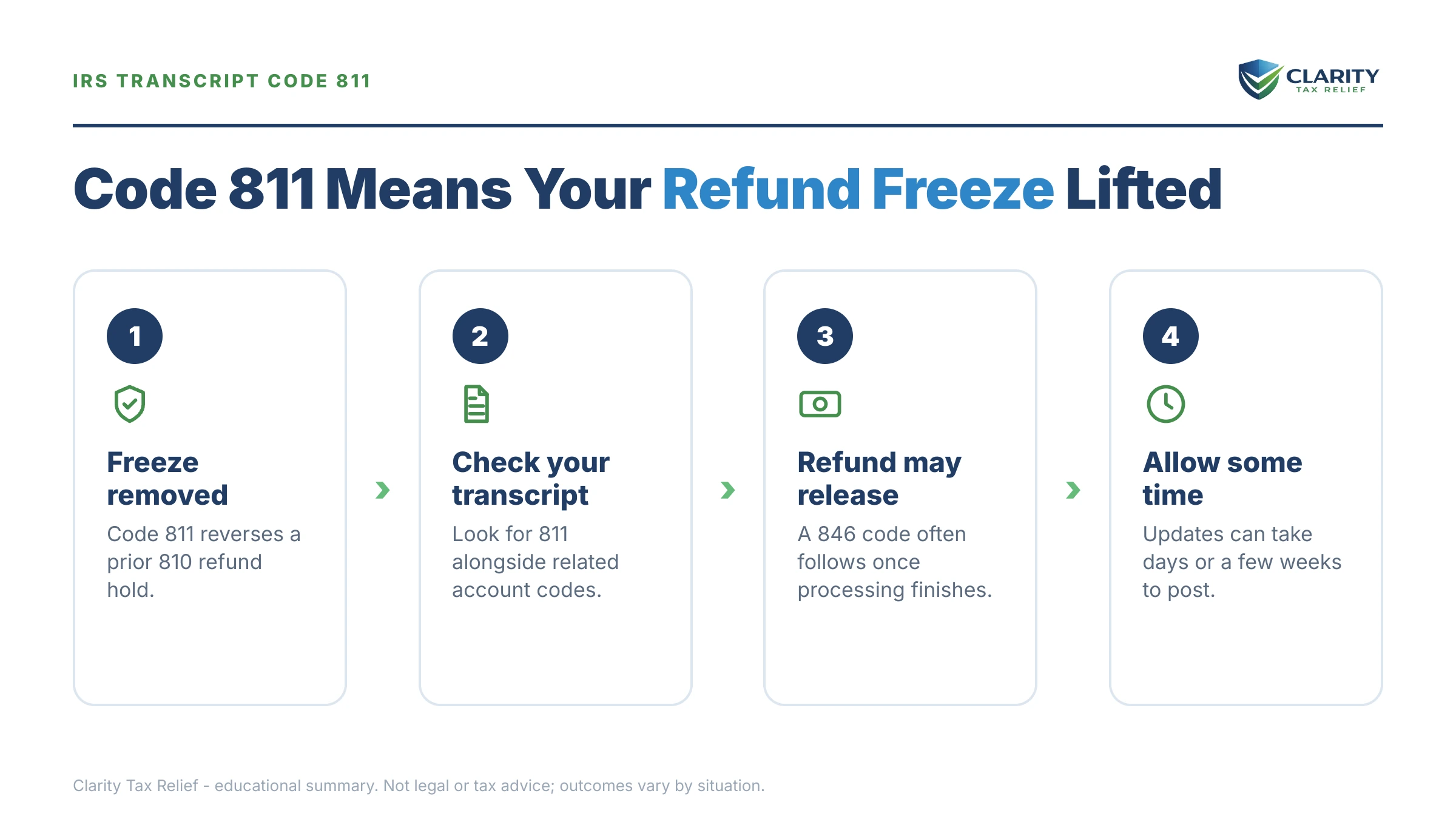
The short answer: code 811 on an IRS transcript means the IRS removed the refund freeze that code 810 placed on your account. An 811 showing $0.00 releases the entire freeze, but your refund isn't scheduled until code 846 posts. Any other holds on the account must clear before the money moves.
You've been refreshing your transcript since the 810 froze everything, and this morning a new line finally appeared: 811, "removed refund freeze," $0.00. No letter came with it, no explanation — just three digits and a zero. That line means the review trapping your refund is over, and from here there's exactly one code left to watch.
The image below shows exactly where an 811 sits on a real account transcript and which nearby lines tell you whether your money is actually moving. If transcripts are new territory for you, our walkthrough on how to read an IRS account transcript covers the layout; this page covers only what 811 itself is telling you.
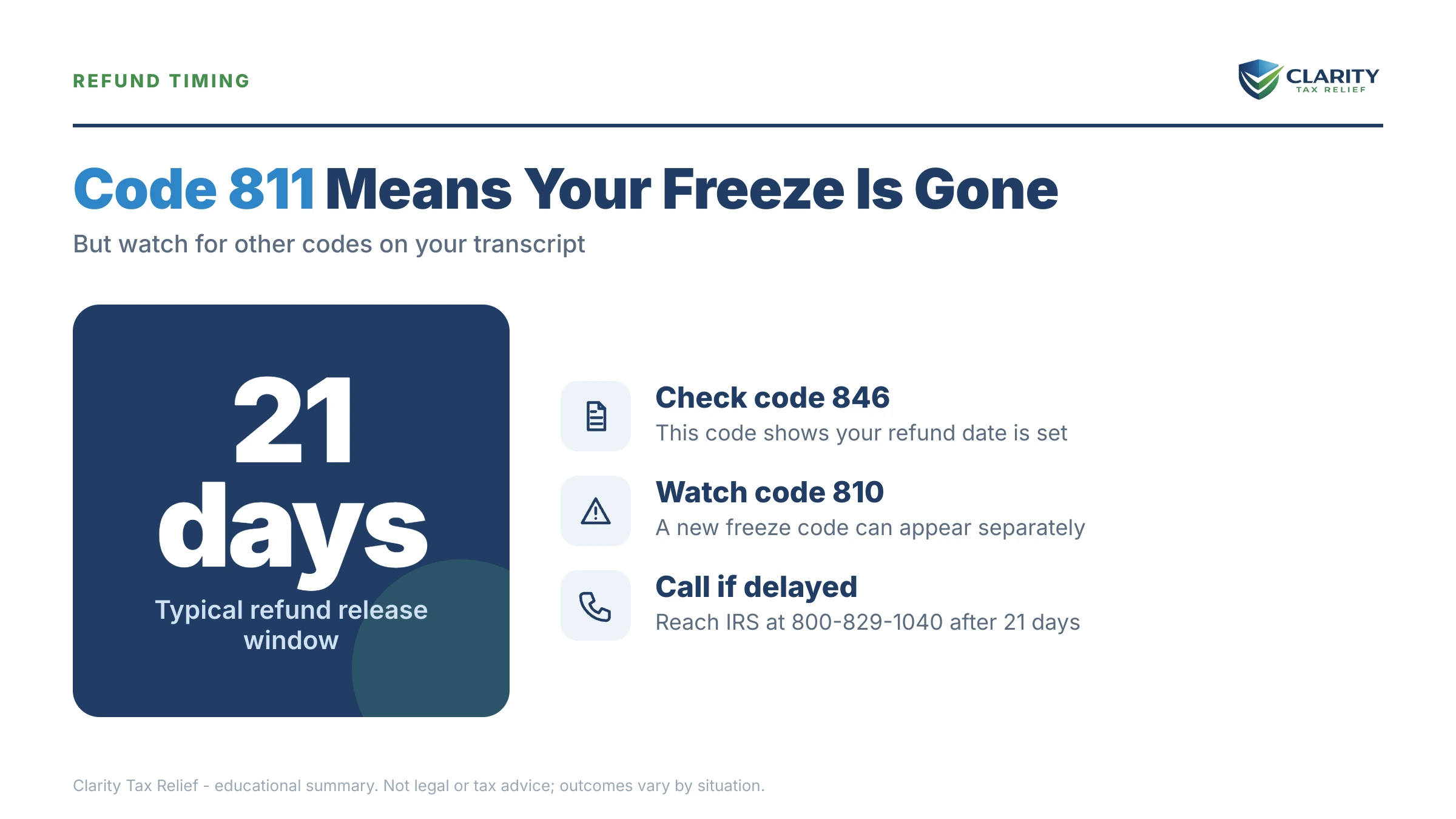
⏱ No deadline, but one marker to watch: code 811 sets no clock for you. The line that matters next is code 846 (refund issued) — when no other holds remain, it often posts within the next few weekly transcript updates. If an unanswered IRS letter is what's keeping part of the account held, the date printed on that letter is the only real deadline in play.
Why code 811 posted to your IRS transcript
Code 811 posts when the IRS unit that froze your refund with code 810 signs off and releases the hold. The 810 freeze is a hard stop — no refund leaves the Treasury while it's on the account — and only the unit that set it can reverse it. The 811 is that reversal, recorded on the master file.
Which unit released it depends on why the freeze existed in the first place. The four common triggers behind a code 810 refund freeze are:
- Identity verification. The return was flagged as possibly not yours. Once you verify — the path we map in 810 freeze verify identity — the Taxpayer Protection Program releases the freeze and 811 posts.
- Refundable-credit review. Returns claiming heavily screened credits (fuel tax credits, sick-and-family-leave credits, unusual withholding claims) get held until a reviewer confirms the numbers.
- Frivolous-return screening. The IRS's frivolous-return program in Ogden freezes returns matching known bad-claim patterns; the 811 posts when yours is cleared as legitimate.
- Exam referral closed. If the freeze fed into an examination — you'd typically see a code 424 exam request or code 420 audit indicator nearby — the 811 posts when exam releases its hold on the refund.
Two details on the 811 line itself matter. An 811 posted with $0.00 releases the entire freeze — the zero describes the freeze action, not your refund amount. An 811 carrying a dollar figure can mean only part of the frozen overpayment was released, with the rest still under review. And note what usually doesn't arrive with an 811: a letter. The IRS frequently lifts freezes silently, so the transcript is often the only place you'll ever see it happen.
| Code | What it means | What to do |
|---|---|---|
| 810 | Refund freeze — a specific IRS unit blocked your refund before payout | Identify the trigger: identity letter, credit review, or exam referral |
| 811 | Freeze removed — the flagging unit released the 810 hold | Check the amount ($0.00 = full release), then scan for remaining holds |
| 570 | Additional account hold — separate from the 810 freeze | Wait for a 571 release, or a 971 notice explaining what's needed |
| 571 | The 570 hold was resolved | Nothing. This clears the path to 846 if no other holds remain |
| 971 | A notice was issued to you | Read and answer the letter; unanswered notices keep refunds parked |
| 846 | Refund issued — the only line that schedules your money | Note the date; direct deposit usually lands on or near it |
“The typical time to receive your refund depends on how you filed your taxes: E-filed return - 3 weeks from the date you e-filed Mailed return - 6 or more weeks from the date we received your mailed return Refund delays can happen when a tax return needs corrections or further review.”
— Refunds (IRS.gov)
What happens after code 811 posts: the release sequence
After code 811 posts, your refund still has to clear every remaining hold on the account before a payment is scheduled. Code 846 is the only transcript line that actually moves money — the 811 opens the gate; it doesn't push the refund through it. The full sequence, from freeze to deposit, runs in this order:
- 810 posts — the refund is frozen before payout. Nothing leaves the Treasury while this hold is open.
- The flagging unit reviews — identity verification, credit review, frivolous-return screening, or an exam referral runs its course. This is usually the longest stage, and it only moves if any letter sent to you gets answered.
- 811 posts — the freeze is removed. You are here.
- Remaining holds clear — a 571 releases any open code 570 account hold, and offsets apply: code 826 peels money off for another tax year you owe, and code 898 sends it to another agency (child support, state debts, federal student loans) before anything reaches you.
- 846 posts — the refund is scheduled, with a real date on the line. See 846 refund issued date for how to read it.
Where doing nothing backfires: no penalties accrue against you while a refund sits held, but the IRS isn't chasing you, either. If the 810 came from an identity letter you never answered, no 811 ever posts. If the 811 posted but a code 971 notice below it sits unanswered, the refund parks indefinitely. A stalled refund stays stalled until someone acts, and with the IRS workforce down roughly 27% since 2025, nobody at the agency is going to volunteer.
Refund frozen, or released but still not moving?
Send us your transcript. An experienced tax professional will read every code on it, tell you exactly what's still holding your money, and map the fastest path to your 846 — free, confidential, no pressure.
Code 811 but no code 846: your options when the refund still hasn't moved
When code 811 posts without an 846 behind it, one of a handful of things is holding the refund, and each has its own fix. Code 811 removes only the 810 freeze. Every other hold on the account survives it. Match your transcript to the table, then act on the row that fits:
| What you see | What it means | What to watch for next |
|---|---|---|
| 811 with $0.00 and no other open codes | Full freeze release; nothing else is holding the refund | Code 846, often within the next few weekly updates |
| 811 followed by 846 | Refund scheduled — the freeze story is over | The date on the 846 line; deposit usually lands on or near it |
| 811 with a dollar amount | Only part of the frozen overpayment may have been released | A further 811 or adjustment code, plus a notice explaining the split |
| 811, but a 570 with no 571 | The freeze is gone, but a separate account hold remains | A 571 releasing the hold, or a 971 notice telling you what's needed |
| 811, then 826 or 898 | The refund is being offset to another tax year or another agency | A smaller 846 for whatever remains after the offset |
| 811, then a new 810 | A different unit re-froze the return | The letter that usually follows; each freeze resolves separately |
If your row says "wait," know what waiting means: most accounts update on a weekly cycle, so checking daily accomplishes nothing — our guide on what day IRS transcripts update shows when your cycle refreshes. If your row says a hold or notice remains, that item, not the 811, is now the whole ballgame. And if the delay is causing genuine financial hardship (an eviction notice, a utility shutoff, medicine you can't buy), you don't have to wait in line: the Taxpayer Advocate Service can force movement through Form 911.
A worked example: the $92,700 W-2 filer with a frozen refund
Say you're a W-2 employee filing single who earned $92,700 last year. Your account transcript tells the whole refund story in four lines. Code 150 shows the tax your return assessed — say $12,880. Code 806 shows your federal withholding as a negative (credit) figure — say −$14,530. The math is the refund: $14,530 − $12,880 = $1,650 overpaid.
But instead of an 846 scheduling that $1,650, an 810 posted — your return tripped an identity screen, and a 5071C letter followed (here's what a 5071C letter is). You verify online, and a few weekly cycles later the 811 posts with $0.00: full release. If nothing else is open on the account, the next update or two brings the 846 for $1,650, with a deposit date on the line.
Two twists worth knowing. If you also owed, say, $400 on a prior year, an 826 would transfer that first and your 846 would post at $1,250 — the refund shrinks. But the transcript shows you exactly where the difference went. And if the IRS releases a refund more than 45 days after the filing deadline (or your filing date, if later), it generally adds overpayment interest on top — a small consolation that becomes taxable income on next year's return.
How to respond to code 811, step by step
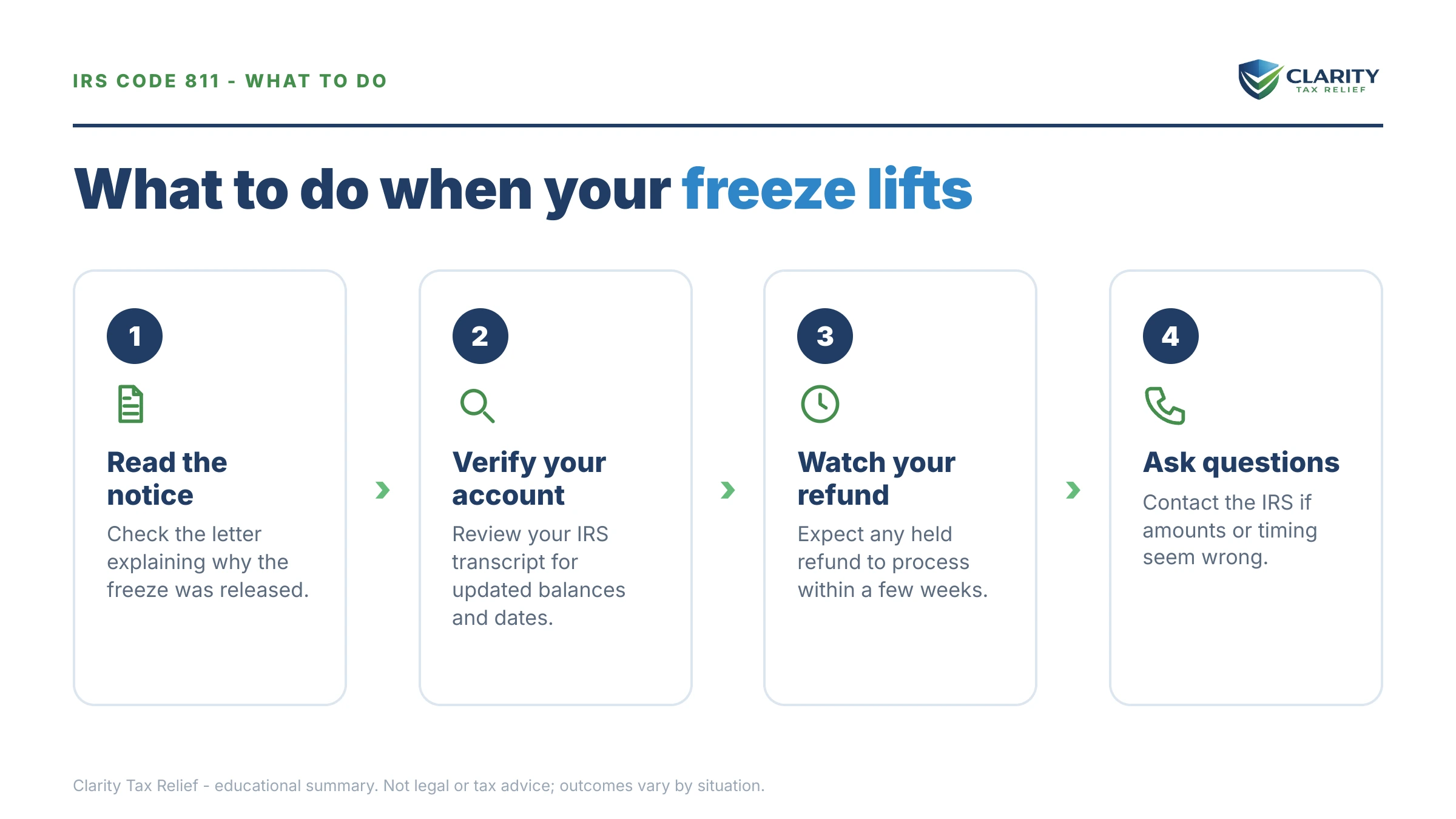
- Pull your newest account transcript. Log in at IRS.gov and download the account transcript for the frozen year — the return transcript won't show freeze codes.
- Find the 811 line. Confirm the amount reads $0.00 for a full release, and note the date it posted.
- Scan the lines below it. A 570 without a matching 571, an unanswered 971, or a fresh 810 means the refund is still parked.
- Answer anything open. Respond to any outstanding IRS letter, or finish identity verification if you never completed it.
- Escalate if nothing moves. After several weekly updates with no 846, call the IRS, and file Form 911 with the Taxpayer Advocate Service if the delay is causing financial hardship.
When you can handle code 811 yourself, and when help changes the outcome
Most people who see an 811 need patience, not professional help. If your 811 shows $0.00, no other codes are open below it. This is a single, ordinary tax year, the right move is to track your weekly cycle and watch for the 846. You can pull transcripts free at the IRS's Get Transcript page and check payout status at IRS.gov/refunds. The same goes if your 846 already posted: the freeze chapter is closed.
Experienced help earns its keep in the messier versions of this story: multiple years frozen at once, where each 810 has a different trigger and a different unit to satisfy. An 811 followed by exam codes (420/424), where what you send the examiner determines whether the refund survives. A freeze tied to credits the IRS is actively disputing, where a wrong response converts a held refund into an assessed debt with penalties. Or a partial 811 where the IRS kept part of your money and never explained why. In those cases, the order and content of your responses change the dollar outcome. A professional reads the transcript the way the IRS wrote it. If hardship is the issue, the Taxpayer Advocate Service is a free, independent escalation path worth using in parallel.
Terms on your transcript, decoded
- Transaction code (TC): the three-digit codes the IRS master file uses to record every action ever taken on your account.
- Refund freeze (TC 810): a hard hold that stops your refund from being paid until the specific unit that set it releases it.
- Freeze release (TC 811): the reversal of an 810. It removes the freeze but does not schedule payment; don't confuse it with 571, which releases a 570 hold instead.
- Cycle code: the eight-digit number showing which weekly processing cycle a transaction posted in — it tells you when your transcript refreshes.
- "As of" date: the date the IRS uses to compute interest and balances on the account — it is not your refund date.
- Master file: the IRS's central account database, where all of these codes live.
Code 811 questions, answered
What does code 811 mean on an IRS transcript?
Code 811 means the IRS removed a refund freeze from your account. It directly reverses a code 810 that was blocking your refund from being paid out. It usually posts after you complete identity verification or after the review that triggered the freeze closes. On its own, 811 releases the hold; it does not schedule the payment.
Does code 811 mean I will get my refund?
It means the freeze that was blocking your refund is gone, which is the biggest hurdle. But the refund isn't scheduled until code 846 posts with a date. If your account has no other holds, 846 often appears within the next few weekly updates. If a code 570 without a matching 571 remains, that separate hold must clear first.
How long after code 811 does the refund come?
The IRS doesn't publish a fixed timeline, but when no other holds remain, code 846 often posts within a few weekly transcript updates after the 811, and the 846 line carries your actual refund date. Direct deposits usually arrive on or near that date. If several weeks pass with no 846, something else on the account is still holding the money.
Why does my code 811 show $0.00?
An 811 with $0.00 is good news: it means the entire refund freeze was released, not that your refund is zero. The dollar amount on a freeze-release line describes the freeze action, not your refund. Your refund amount appears on the code 846 line when it posts, or you can estimate it as your withholding and credits minus the tax on your code 150 line.
Can my refund still be held after code 811?
Yes. Code 811 removes only the 810 freeze — other holds survive it. A code 570 without a 571, an unanswered notice shown by code 971, or an offset (code 898 for other-agency debts, code 826 for another tax year you owe) can each stop or shrink the refund even after the freeze is gone. Check the lines below your 811 before assuming you're clear.
What if code 811 posted weeks ago and there's still no 846?
Pull a fresh account transcript and look for what's still open: a 570 with no 571, a 971 notice you haven't answered, or a new 810 that re-froze the account. If nothing is visibly open and it has been more than a few weekly updates, call the IRS, and if the delay is causing genuine financial hardship, the Taxpayer Advocate Service can take the case through Form 911.
Does code 811 mean my identity verification worked?
When your 810 freeze came from an identity-verification letter like a 5071C or 5747C, an 811 posting afterward is the transcript's way of confirming the verification succeeded and the freeze was lifted. If you verified but no 811 has posted yet, give it a few weekly cycles — verification results don't hit the transcript instantly.
Can the IRS freeze my refund again after code 811?
Yes — an 811 releases the existing freeze. But a new code 810 can post afterward if a different unit flags the return, and each freeze has to be resolved on its own. This is uncommon but happens most often on returns claiming credits the IRS screens heavily. A repeat 810 usually comes with, or is followed by, a letter explaining what to do.
Your next 24 hours
- Find the 811 line on your account transcript and check two things: the amount ($0.00 means full release) and whether any 570, 971, or new 810 sits below it.
- Gather three items: your latest account transcript, every IRS letter you've received about this return. A copy of the return itself — whoever helps you (including the IRS on the phone) will need all three.
- If your refund is stuck behind an open hold or an unexplained partial release, get a free transcript review — the 2-minute form or (888) 825-7779. A frozen refund doesn't fix itself; the account only moves when the open item gets answered.
This guide is general information, not tax or legal advice for your specific situation. Eligibility for IRS programs depends on individual facts and circumstances; no outcome is guaranteed.