
IRS Transcript Codes
Code 898 IRS Transcript: Your Refund Went to Another Agency (2026)
The short answer: the code 898 IRS transcript entry means the Treasury Offset Program took some or all of your refund to pay a non-IRS debt — most often past-due child support, defaulted federal student loans, or state taxes. The IRS didn't keep the money; another agency did. Call 800-304-3107 to learn which one.
You checked "Where's My Refund," it said approved, then the deposit never landed, or landed short. So you pulled your transcript and found code 898 sitting right under your refund line, with a dollar amount that looks painfully familiar. If your divorce just finalized, there's a real chance the debt behind this code isn't even yours.
This is fixable, and it's usually a two-phone-call problem, not a two-year one. The image below shows exactly what this entry looks like on a real account transcript and where to find the amounts that matter. First, here's what actually happened to your money.
⏱ The clocks that matter: code 898 has no printed deadline — the offset already happened. But two clocks are running: if the debt belongs to your spouse or ex-spouse, the window to claim your share with Form 8379 is limited — generally you must file Form 8379 within 3 years from the original return's due date (including extensions) or 2 years from the date the tax was paid and offset, whichever is later — and unless the underlying debt gets fixed, next year's refund is exposed the moment you file.
Why the code 898 IRS transcript entry posted to your account
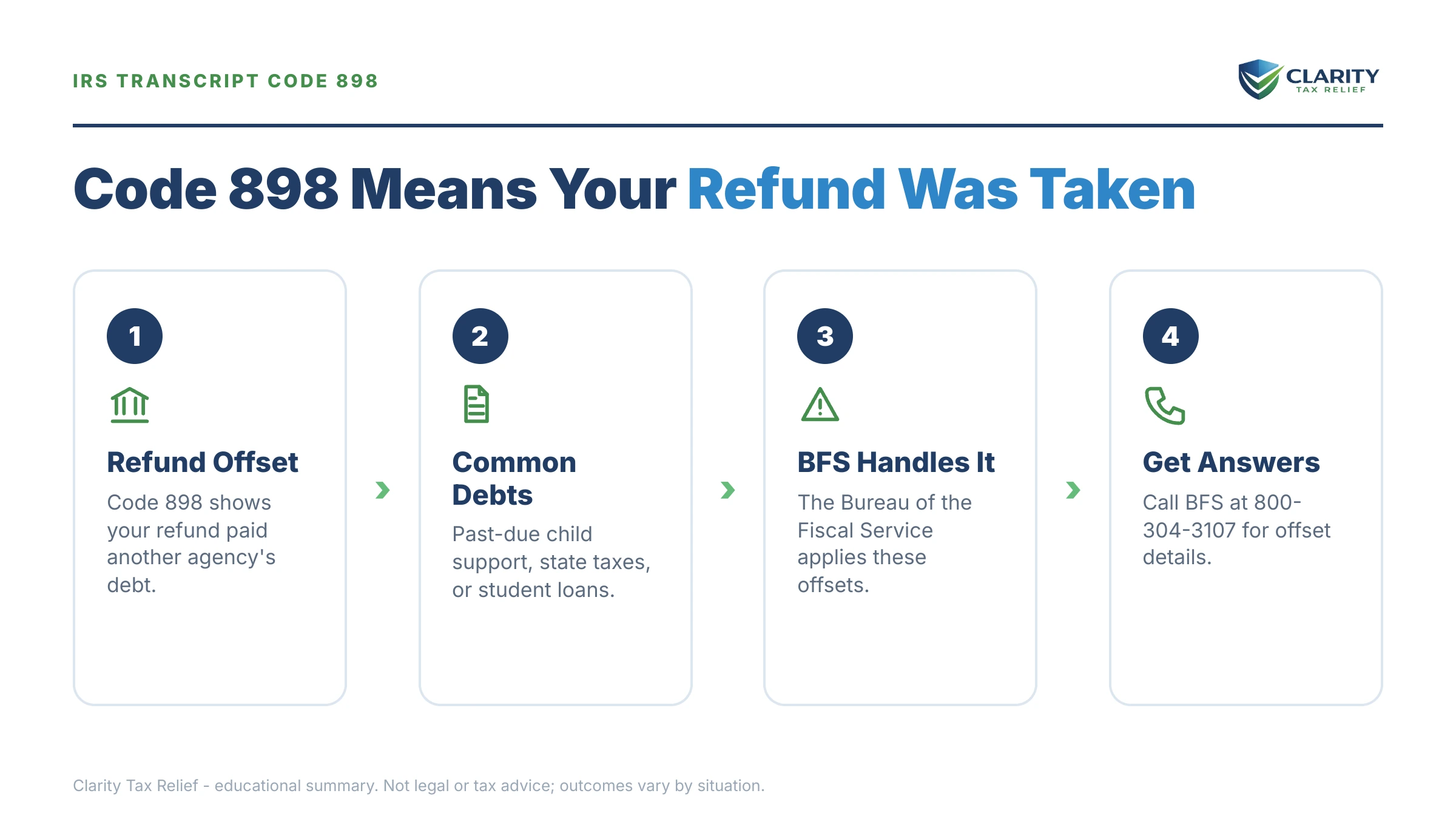
Code 898 means the Treasury Offset Program, not the IRS, redirected your refund to a non-IRS debt such as child support, defaulted federal student loans, or a state tax balance. The technical label is "refund applied to non-IRS debt," and it's the one transcript code where the IRS is genuinely just the messenger.
Here's the mechanics. Agencies with a delinquent debt in your name — a state child-support unit, the Department of Education, a state tax department — "certify" that debt to the Treasury Offset Program (TOP), a database run by the Bureau of the Fiscal Service. When the IRS approves your refund, the Fiscal Service checks your Social Security number against that database before the money goes out. A match means the refund gets rerouted, and TC 898 posts to your account to record it.
That's why the sequence on your transcript usually looks normal right up to the end: a code 150 showing your return posted, your withholding credits, then a code 846 refund issued for the full amount — followed by the 898 clawing some or all of it toward the certified debt. Each 898 carries an Offset Trace Number (OTN), the reference the Treasury uses to track that specific offset.
Two things code 898 is not. It is not an IRS collection action, if you owed the IRS back taxes, your refund would be absorbed under code 826 and a CP49 notice, a completely different path. And it is not a processing problem — a code 570 hold delays a refund for review. An 898 means the refund was released and intercepted on the way out. (If transcript layout in general is the confusing part, start with our guide to how to read an IRS account transcript.)
How to tell how much was taken, and whether any refund survives
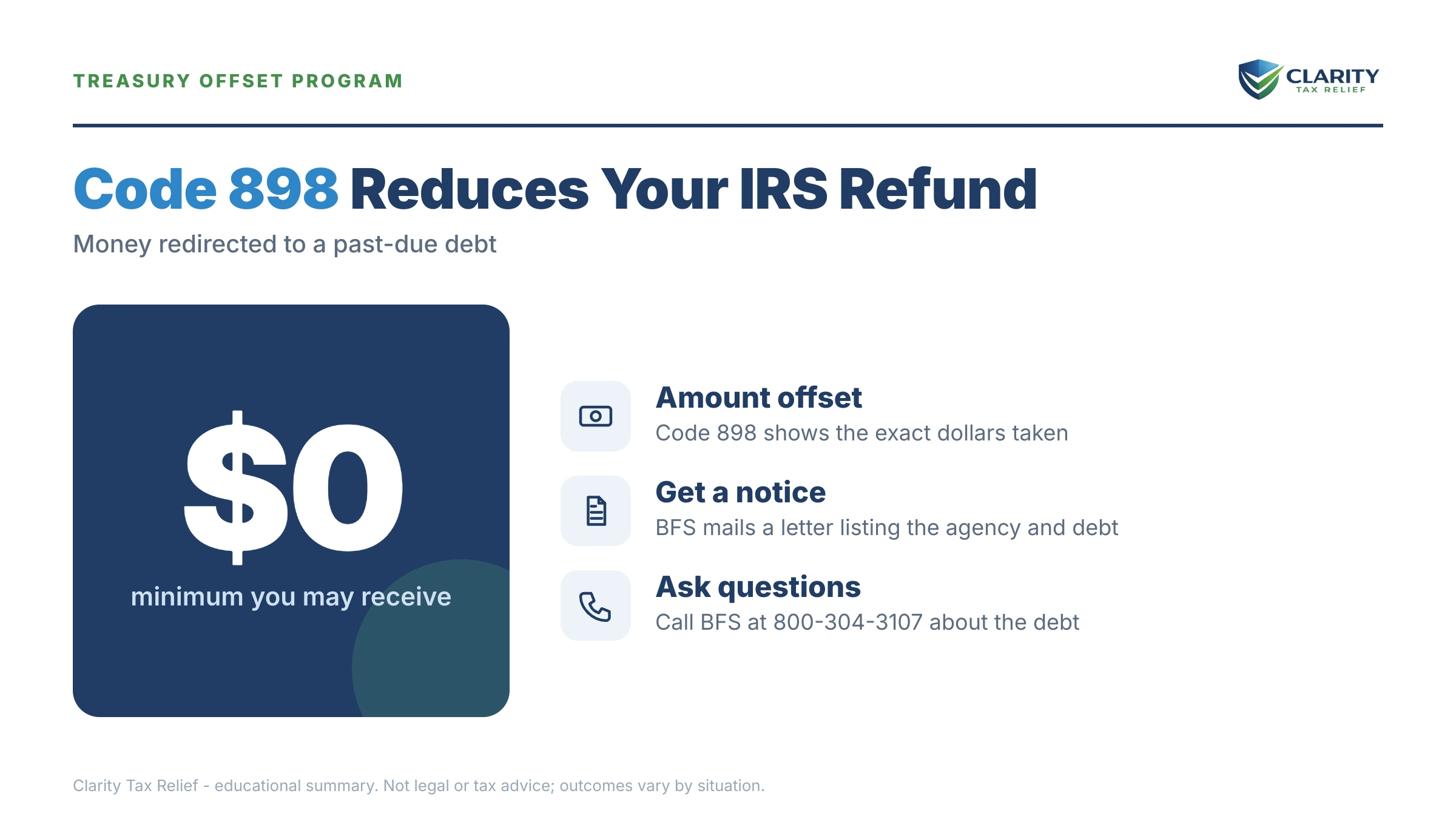
The math is one subtraction: your code 846 amount minus your code 898 amount is what's still coming to you. If the 898 equals the 846, the whole refund went to the debt. If you see two 898 lines, two different agencies had certified debts, and each line shows what each one took.
Don't rely on "Where's My Refund" here. It often shows the refund as approved and sent, because from the IRS's perspective it was. The transcript is the honest record. The mailed offset notice from the Bureau of the Fiscal Service is the paper confirmation: it names the agency, the amount taken. A contact number. If that letter hasn't arrived yet, the automated TOP hotline at 800-304-3107 tells you the same thing in about two minutes.
What happens if you do nothing about the debt behind the 898
An unaddressed code 898 repeats every filing season until the certified debt reaches zero. The offset itself is done — the real question is what the debt does next. Left alone, the sequence runs like this:
- The offset notice arrives. The Bureau of the Fiscal Service mails a letter confirming which agency took your refund and how much of the debt remains.
- The balance keeps growing. Defaulted federal student loans accrue interest and can add collection costs; child-support arrears accrue interest in many states. The refund you lost may not have even covered the growth.
- The agency's own enforcement continues. Refund offset is the passive tool. Defaulted federal loans can also trigger administrative wage garnishment — up to 15% of disposable pay, no court order required — and child-support agencies can suspend licenses, report arrears to credit bureaus, and intercept state refunds too.
- Next filing season, another 898 posts. Every federal refund you claim is exposed until the debt is paid off, resolved, or de-certified from the TOP database.
Refund gone to a code 898 offset, and not sure the debt was even yours?
Send us your transcript and the offset notice. An experienced tax professional will confirm who took the money, whether an injured spouse claim can recover your share, and how to keep it from happening again — free and confidential.
Code 898 vs. the codes around it on your transcript
Code 898 almost never appears alone — reading it correctly means reading its neighbors. This table decodes the refund-side codes that show up together:
| Code | What it means | What to do |
|---|---|---|
| 846 | Refund approved and issued — the full amount before any offset | Note the amount; it's your baseline for the subtraction |
| 898 | Refund applied to a non-IRS debt through the Treasury Offset Program | Call 800-304-3107, then contact the agency named |
| 826 | Refund kept by the IRS for your own back federal taxes (comes with a CP49) | Deal with the IRS balance directly — different playbook |
| 766 | Credit to your account — with a matching offset trace number, it's an 898 reversal | Match its OTN to the 898 to confirm money coming back |
| 570 | Hold on the account — the refund hasn't been released at all yet | Different problem: the refund is delayed, not intercepted |
Your options after a code 898 offset
Which move fits depends on one question: whose debt is it, and is it real? There are four distinct paths.
The debt is yours and valid. The offset stands — the leverage now is preventing the next one. Fix the source (rehabilitate the loans, get current on support, put the state balance on a plan) and adjust your W-4 so you stop building a big refund that gets intercepted every spring.
The debt is your ex-spouse's. If the offset hit a joint refund — common when the last joint return processes after the divorce — Form 8379, the injured spouse allocation, asks the IRS to compute and return your share based on your own income, withholding, and credits. A divorce decree assigning the debt to your ex doesn't stop the offset by itself. The Treasury only sees the two names on the return. Our guide to an ex-spouse's tax debt taking your refund walks through that exact scenario.
The debt is wrong, paid, or not yours at all. Dispute it with the certifying agency in writing, with proof. When the agency corrects its records and returns the money, the reversal typically posts to your transcript as a code 766 credit tied to the same offset trace number. The IRS cannot short-circuit this — the agency has to release the funds.
The offset was actually for federal taxes. Then you're looking at code 826, not 898. The answer runs through the IRS's own collection playbook. The broader system behind all of this is covered in our guide to the Treasury Offset Program.
Here's who is actually behind the most common 898 offsets, and where the fix lives:
| Debt behind the 898 | Who actually holds it | Your move |
|---|---|---|
| Past-due child support | Your state's child support enforcement agency | Verify arrears; if the return was joint and the arrears are your ex's, file Form 8379 |
| Defaulted federal student loans | U.S. Department of Education / its default servicer | Confirm the balance; ask about rehabilitation or consolidation to exit default |
| State income tax debt | Your state's tax agency | Request a payment plan or dispute the assessment with the state directly |
| Unemployment overpayment | The state workforce/unemployment agency | Ask about a waiver if the overpayment wasn't your fault; otherwise arrange repayment |
| Other federal agency debt | The originating agency (VA, SBA, HUD, USDA, etc.) | Request a debt validation and repayment terms from that agency |
A worked example: $41,800 in defaulted loans and a $5,900 refund
Say you came out of a divorce with $41,800 in federal student loans in your name, and during the chaos of the separation, they slid into default and got certified to the Treasury Offset Program. You over-withheld all year (nobody adjusts a W-4 mid-divorce), so your first single-filer return shows a $5,900 refund.
Your transcript shows code 846 for $5,900, then code 898 for $5,900 the same week. Nothing hits your bank. The loan balance drops to $41,800 − $5,900 = $35,900, and at $5,900 per year, refund offsets alone would take roughly six to seven more filing seasons, while interest and collection costs push the finish line further out the whole time.
The better play costs nothing extra. Loan rehabilitation — typically nine agreed monthly payments made within ten months — pulls the loans out of default, which removes them from the offset database and stops wage garnishment risk. And a corrected W-4 keeps that ~$490 a month ($5,900 ÷ 12) in your paycheck instead of parking it where the Treasury can seize it next April. Same debt, but you choose where every dollar goes. (This is a hypothetical illustration, not a prediction for your case.)
How to respond to code 898, step by step
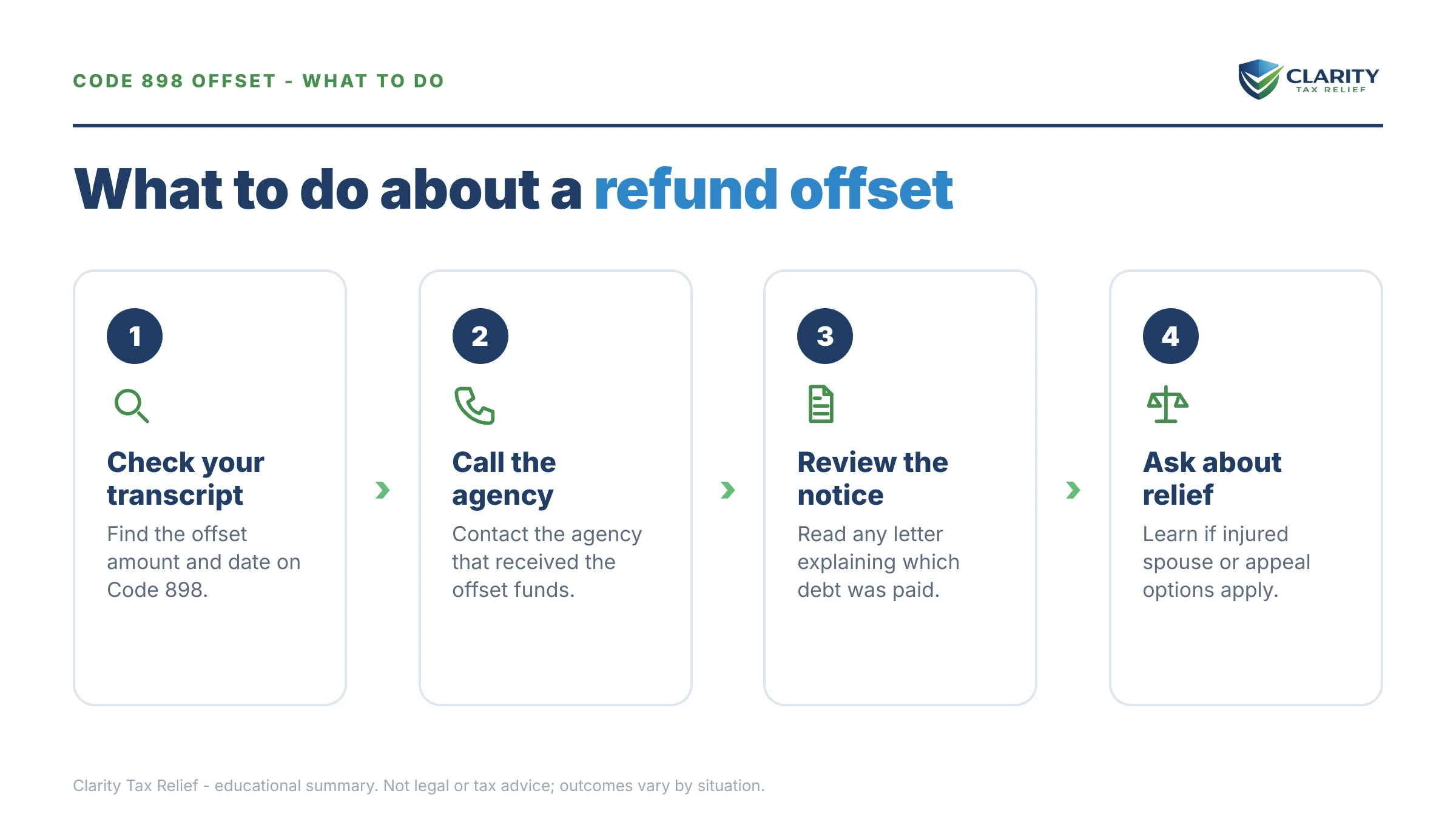
- Call the Treasury Offset Program hotline. Dial 800-304-3107, enter your Social Security number, and note which agency received your refund and its contact number.
- Compare your 846 and 898 amounts. Pull your account transcript and subtract the code 898 amount from the code 846 amount — whatever is left is still coming to you.
- Contact the agency that took the money. Ask for the balance, the certification date, and proof of the debt — then dispute in writing if it's paid, wrong, or not yours.
- File Form 8379 if the debt belongs to your ex-spouse. Send the injured spouse allocation to recover your share of a joint refund taken for a debt that is only your ex's.
- Resolve the underlying debt before next filing season. Rehabilitate defaulted loans, get current on support, or set up a state payment plan so the offset doesn't repeat, and adjust your W-4 so less refund is exposed.
When you can handle a code 898 yourself
Most code 898 situations are genuinely do-it-yourself. If the debt is yours, you knew about it. You filed single, the entire fix is the hotline call, one call to the agency. A repayment or rehabilitation arrangement you can set up without help. Nobody needs to pay a professional to confirm a valid child-support or student-loan offset.
Experienced help changes the outcome in narrower situations: a joint-return offset where the Form 8379 allocation math is contested or you live in a community-property state. An offset against a debt you already paid and the agency won't correct. Multiple years of offsets tangled with IRS collection codes on the same transcript. Or student-loan offsets like refund offsets for student loans stacked on top of an IRS balance, where the order you resolve things determines how much you recover.
Terms on your transcript, decoded
- Treasury Offset Program (TOP): the federal database that matches refunds against certified non-IRS debts before the money leaves the Treasury.
- Bureau of the Fiscal Service: the Treasury bureau that actually disburses refunds and executes offsets — it, not the IRS, sends the offset letter.
- Offset Trace Number (OTN): the reference number attached to each TC 898 that ties the offset, and any later reversal — to a specific agency claim.
- Certified debt: a delinquent debt an agency has formally submitted to TOP, making every federal refund in your name interceptable.
- Injured spouse: a filer whose share of a joint refund was taken for the other spouse's debt — recovered with Form 8379. (Different from innocent spouse relief, which contests the tax itself.)
- TC 766 reversal: a credit posting that returns offset money to you, matched to the original 898 by its OTN.
The primary sources are worth bookmarking: the IRS explains reduced refunds at Tax Topic 203, Reduced Refund, the Treasury documents the program at the Bureau of the Fiscal Service's Treasury Offset Program page. The injured spouse claim lives at About Form 8379 on IRS.gov.
Code 898 questions, answered
What does code 898 mean on an IRS transcript?
Code 898 means the Treasury Offset Program applied some or all of your refund to a non-IRS debt — most commonly past-due child support, defaulted federal student loans, or a state tax balance. The IRS approved and issued your refund; the Bureau of the Fiscal Service intercepted it on the way out. The dollar amount next to the code is exactly how much was redirected.
How do I find out who took my refund with code 898?
Call the Treasury Offset Program call center at 800-304-3107 — it's automated and will tell you which agency received your money and how to contact it. The Bureau of the Fiscal Service also mails an offset notice listing the agency, the amount, and a contact number. The IRS can't answer this question, because the debt isn't theirs.
Can a code 898 offset be reversed?
Yes, in three situations: the agency certified a debt you don't actually owe or already paid, the debt belonged only to your spouse or ex-spouse (file Form 8379), or the agency offset more than the remaining balance. When money comes back, it typically posts as a code 766 credit carrying the same offset trace number as the 898. Reversals start with the agency that took the money, not the IRS.
Will I still get part of my refund after code 898?
Compare the code 846 amount to the code 898 amount. If the 898 is smaller than the 846, the difference is still coming to you by direct deposit or check. If the two amounts match, the entire refund went to the debt and nothing is on the way. A second, smaller 898 can appear if two different agencies had certified debts against you.
Does code 898 mean I owe the IRS money?
No. Code 898 specifically marks an offset to a non-IRS debt, if you owed the IRS itself, your refund would be absorbed with code 826 and you'd get a CP49 notice instead. In fact, a code 898 only appears because the IRS's side of your account was clean enough to approve a refund in the first place. Your fight is with the certifying agency, not the IRS.
Will the offset happen again next year?
Yes — as long as the debt stays certified with the Treasury Offset Program, every federal refund you claim is exposed until the balance hits zero. The fix is to resolve the underlying debt (for example, rehabilitating defaulted student loans or getting current on support) or to stop over-withholding so there's little refund left to take. Adjusting your W-4 is the fastest self-defense.
My refund was taken for my ex-spouse's debt — can I get my share back?
Often, yes. If the offset hit a joint refund but the certified debt belongs only to your ex, Form 8379 (injured spouse allocation) asks the IRS to calculate and return your portion based on your income, withholding, and credits. Your divorce decree doesn't stop the offset by itself — the Treasury only sees the names on the return. Community-property states use different allocation math, so the recovered share may be smaller there.
Is code 898 the same as code 826?
No — they're opposite directions of the same idea. Code 826 means the IRS kept your refund for your own back federal taxes. Code 898 means the Treasury sent it outside the IRS to another agency's debt. The distinction decides who you call: the IRS for an 826, the Treasury Offset Program hotline (800-304-3107) and the certifying agency for an 898.
Your next 24 hours
- Find two numbers on your transcript: the code 846 amount and the code 898 amount. Subtract them — that's how much survived the offset.
- Make one call and gather three documents: dial 800-304-3107 to identify the agency, then pull the offset notice (or watch for it), your last filed return, and, if the debt might be your ex's, your divorce decree.
- Get a free case review. If the debt wasn't yours, the amount looks wrong, or a joint refund was swallowed whole, have an experienced tax professional map the recovery before the debt takes next year's refund too — start at the 2-minute form or call (888) 825-7779.
This guide is general information, not tax or legal advice for your specific situation. Eligibility for IRS programs depends on individual facts and circumstances; no outcome is guaranteed.