
IRS Notices
IRS CP14 Notice in 2027: What the New Wave Means and How to Respond
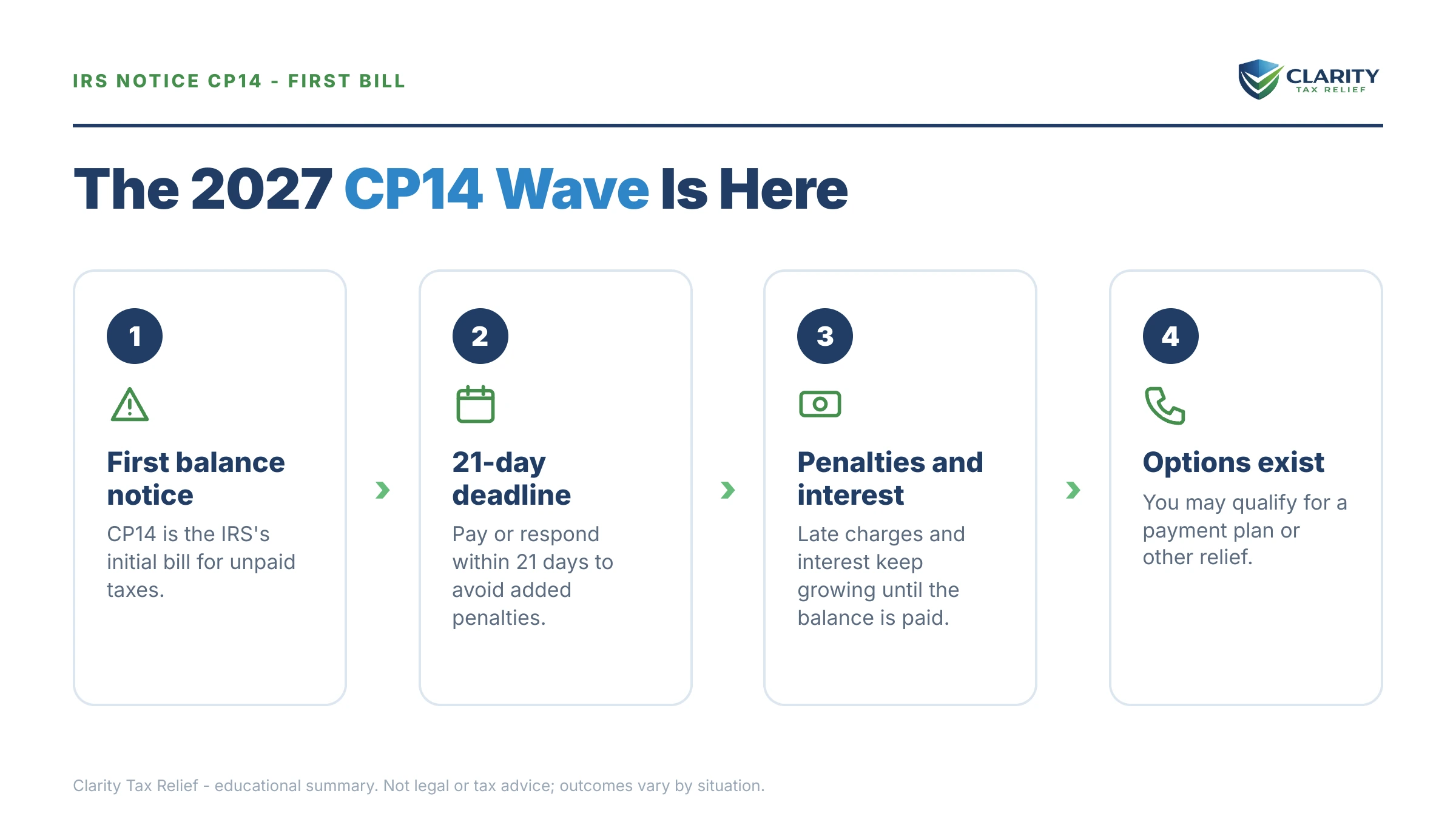
The short answer: a CP14 notice in 2027 is the IRS's first bill for an unpaid tax balance — most in this wave cover tax year 2026 returns. You typically have 21 days from the notice date to pay or start a payment arrangement before the automated collection sequence moves toward liens and levies.
Maybe you filed your first return as a single filer in years, expected things to come out roughly even, and instead an envelope from the IRS says you owe thousands you don't have sitting in an account that's now only yours. That's the most common story behind the 2027 CP14 wave, and it's fixable, at every balance level, if you act inside the window this notice opens.
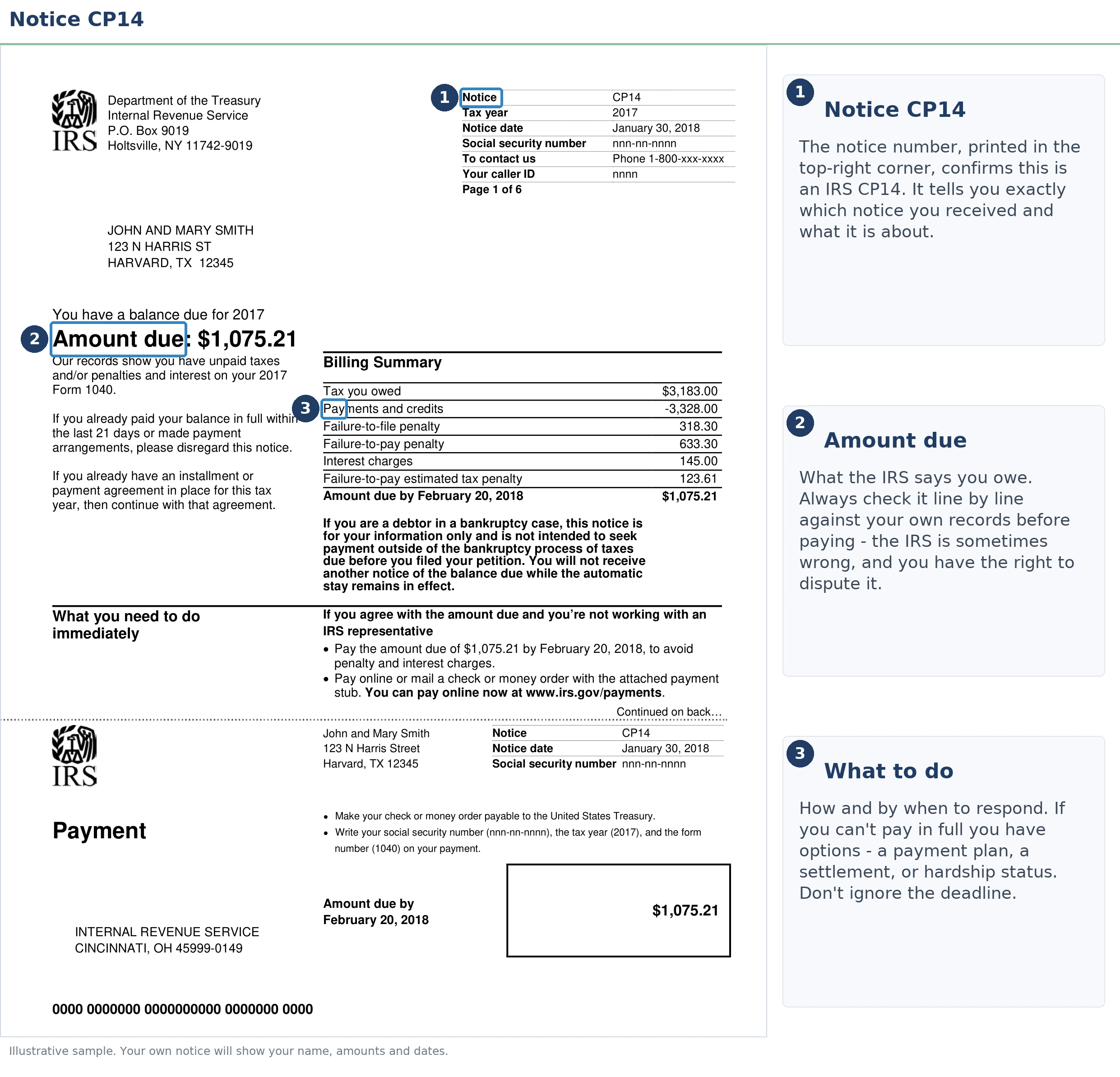
Two pieces of information on the notice control everything that follows: the notice date in the header block and the amount due. The image below shows exactly what a 2027 CP14 looks like and where to look for both, so you can stop guessing and start working the actual numbers.
⏱ Your deadline: the "pay by" date printed on your CP14, typically 21 days from the notice date, or 10 business days if you owe $100,000 or more. After that date, interest and the 0.5% monthly failure-to-pay penalty keep compounding, and the IRS's automated system queues the next notice in the sequence.
Why you got a CP14 notice in 2027
A CP14 means the IRS processed a return under your Social Security number and its records show an unpaid balance — in 2027, that's most often a tax year 2026 return filed by the April deadline. The notice states the tax year, the total due, and the split between tax, penalties, and interest.
The usual triggers in this wave:
- Underwithholding after a life change. Divorce is the classic one: a W-4 still set at married rates for part or all of 2026 produces a balance due the first time you file single or head of household.
- You filed but couldn't pay in full. Filing on time was the right move — the failure-to-file penalty runs 5% per month, ten times the 0.5% failure-to-pay penalty. The CP14 is simply the bill for the unpaid part.
- A payment posted to the wrong place. Estimated payments made from a formerly joint account sometimes post under the ex-spouse's SSN, the primary filer on your old joint returns, leaving your account showing unpaid.
- Penalties or interest posted after the fact to a year you thought was closed.
What a CP14 is not: an audit, a levy, or a criminal matter. It's a bill, and this is the cheapest moment in the entire collection process to deal with it. If you're not even sure this is the letter you're holding, start with our decoder on why you got a letter from the IRS. For the evergreen fundamentals of this notice, the core CP14 notice guide covers them. This page covers what's specific to the 2027 cycle.
“Read your notice carefully. It will explain how much you owe and how to pay it. Pay the amount you owe by the due date on the notice. Make a payment plan if you can't pay the full amount you owe.”
— Understanding your CP14 notice (IRS.gov)
What's different about the 2027 CP14 wave
The 2027 CP14 cycle is running with roughly 27% fewer IRS employees than before the 2025 workforce cuts, but every notice in the sequence is generated by automated systems that were never cut. Three things make this year's wave genuinely different from the guides written for earlier years:
1. The humans are harder to reach. The machine is not slower. Phone hold times and correspondence backlogs have grown, which means a mailed dispute can sit for months while the notice stream keeps advancing on schedule. In 2027, the safe assumption is that no human will pause your account for you — only a posted payment, an active plan, or a processed response stops the sequence.
2. Penalty relief went automatic for many filers. Starting in summer 2026, the Automatic Exemption from Penalty (AEP) began replacing the request-based first-time abatement process. If your prior three years are clean, qualifying penalties may come off without your asking, but "may" is doing real work there. Check your transcript rather than assuming, and know that the request-based path via first-time penalty abatement still matters where AEP hasn't applied.
3. Fewer gig-economy surprises, same old balances. The 1099-K reporting threshold reverted to $20,000 and 200 transactions, so casual sellers saw fewer surprise forms for 2026. But if your CP14 stems from an earlier year's platform income, that debt didn't revert with the threshold.
First: verify the CP14 is actually right
Ten minutes in your IRS online account tells you whether a CP14 is accurate before you send a dollar. In the 2027 environment — thin staffing, heavy notice volume — notices that cross in the mail with recent payments are common, and post-divorce accounts are especially prone to misapplied credits.
- Compare the online balance to the notice. If they differ, the online figure is more current.
- Check where your payments landed. If you made 2026 estimated payments from a joint account, confirm they posted to your SSN and to tax year 2026, not to your ex's account or a prior year. Misapplied payments are fixable, but only if you catch them.
- Match the tax year. A CP14 for a year you filed jointly is a different problem than one for your first solo return — more on that below.
If a payment you already made explains the balance, follow the playbook in CP14 notice but I already paid. If the IRS's math itself looks off, see CP14 wrong amount — don't pay a balance you don't owe on the theory the IRS will refund it later.
Your account transcript shows the machinery behind the notice. These are the codes that typically sit under a 2027 CP14:
| Code | What it means | What to do |
|---|---|---|
| 150 | Your return posted and tax was assessed — the amount the CP14 starts from | Confirm it matches the tax on your filed return |
| 806 | Withholding credited from your W-2s/1099s | Check it against your actual withholding — a mismatch may mean a missing form |
| 276 | Failure-to-pay penalty posted (0.5% per month) | Check AEP/first-time abatement eligibility before paying it |
| 196 | Interest assessed on the unpaid balance | Rarely removable — reducing the balance fast is the only real fix |
| 971 | Notice issued — the CP14 itself (and each notice after it) | Track new 971s to see where you are in the sequence |
What happens if you ignore a 2027 CP14
An ignored CP14 doesn't stall. It advances through four more notices, ending in the IRS's legal authority to garnish wages and levy bank accounts. The stages arrive in a fixed order, each typically several weeks after the last, and each with more enforcement power than the one before:
- CP14 — first bill. You are here. No enforcement power yet; the balance grows monthly.
- CP501 and CP503 — reminder notices. Still just bills, but each one means another month of penalty and interest stacked on.
- CP504 — Notice of Intent to Levy under IRC §6331(d). The IRS can now seize your state tax refund, and a federal tax lien becomes a live possibility.
- LT11 / Letter 1058 — Final Notice of Intent to Levy. This starts a 30-day clock and your Collection Due Process rights (requested on Form 12153). After it runs, wage garnishment and bank levies are on the table.
- Levy and lien enforcement — a bank levy freezes funds for 21 days before they're sent to the IRS. A wage levy is continuous until released. If the balance later grows past the passport-certification threshold — $66,000 in 2026, adjusted annually — passport denial or revocation enters the picture too.
In 2027 this sequence deserves extra respect: budget cuts didn't slow the notice machine, they only removed the people who might have flexibly worked with you once things escalated. Answering at the CP14 stage means dealing with a website. Answering at the LT11 stage means dealing with deadlines that decide whether your paycheck is intact.
| Notice | What it allows the IRS to do | Your window |
|---|---|---|
| CP14 | Bill you; penalties and interest accrue | Typically 21 days from the notice date (10 business days if $100k+) |
| CP501 / CP503 | Continue billing; balance compounds monthly | The "pay by" date printed on each notice |
| CP504 | Seize your state tax refund; lien filing becomes likely | 30 days per the notice, but this is not yet the final notice |
| LT11 / Letter 1058 | Levy wages, bank accounts, and other property after the clock runs | 30 days to pay, arrange, or request a CDP hearing (Form 12153) |
| Active levy | Bank funds held 21 days then sent; wage levy continuous until released | Release requires an agreement, hardship showing, or appeal |
Holding a 2027 CP14 right now?
Get it reviewed free before the 21-day window on your notice closes. An experienced tax professional will verify the balance, check whether automatic penalty relief applies, and map your cheapest way out — no pressure, no obligation.
Your options if you can't pay the CP14 in full
The IRS offers five real alternatives to paying a CP14 in full, and most 2027 balances qualify for at least two of them without any financial disclosure. The notice presents "pay now" as the only path; here is the actual menu (details on the IRS payment plans page):
| Option | Who it fits | Cost & trade-offs |
|---|---|---|
| Pay in full | Anyone with the funds or short-term access to them | Stops penalties and the notice sequence immediately; cheapest total cost |
| Short-term plan | Can pay everything within 180 days | $0 setup fee; interest and 0.5%/mo penalty continue until paid |
| Guaranteed installment agreement | Balances of $10,000 or less, filed and paid on time historically | IRS must accept if criteria are met; up to 36 months |
| Streamlined installment agreement | Combined balances up to $50,000 — up to 72 months, set up online | Setup fee applies (lower with direct debit); no financial statement needed |
| Currently Not Collectible | Paying anything would leave you unable to cover basic living expenses | Collection pauses; the debt and interest remain, refunds get kept |
| Offer in Compromise | Assets and future income genuinely can't cover the debt before the collection statute runs | $205 fee and 20% down (both waived with low-income certification); the IRS accepted roughly 1 in 5 offers in FY2024 |
| Penalty relief (AEP / abatement) | Clean compliance for the prior 3 years, or reasonable cause (illness, disaster) | Free; removes penalties, not the tax or interest on the tax |
A few notes the table can't hold. A streamlined installment agreement is the workhorse for most CP14 balances: online setup through your IRS account (or Form 9465 by mail), no Form 433 financials at these levels, enforcement off the table while it's active. Currently Not Collectible status is for genuine hardship, not inconvenience — the IRS applies its own living-expense standards. The balance keeps accruing interest while collection is paused. And an offer in compromise is real but math-driven: the IRS computes what it could collect from your assets and income, and only offers below a debt that math can't reach get accepted. Anyone promising a settlement before seeing your finances is selling, not advising.
Say you owe $19,700: the real math
Here's a clearly hypothetical example built on a common 2027 profile. Say you divorced in 2026, your W-4 stayed at married rates most of the year. Your first single-filer return produced a CP14 for $19,700.
- The cost of waiting: the failure-to-pay penalty runs 0.5% per month — about $98.50 a month on this balance, capping at 25% ($4,925) — plus interest at the federal short-term rate + 3%, set quarterly and compounding daily. Every month of "I'll deal with it later" costs real money before enforcement even starts. You can estimate your own penalty and interest growth with our Penalty & Interest Calculator.
- Short-term plan: paying $19,700 inside 180 days means finding roughly $3,285 a month for six months. No setup fee, but that's a steep monthly hit for one income where there used to be two.
- Streamlined installment agreement: at $19,700 you're comfortably under the $50,000 online ceiling. Spread over the full 72 months, principal alone is about $274 a month ($19,700 ÷ 72). With interest and the reduced 0.25% in-agreement penalty continuing, budget somewhat more, or pay extra when you can to cut the total interest.
- Guaranteed installment agreement: not available here — that program caps at $10,000.
- Penalty relief: if 2023–2025 were clean, the failure-to-pay penalties already posted may be removed — automatically under AEP, or by request. If the account has run a year, that's roughly $1,182 (6% of $19,700) back off the balance.
- Offer in Compromise: with steady wages and, say, home equity from the divorce settlement, the IRS's collection math will usually exceed $19,700 — meaning an offer likely isn't the right tool for this profile. It's worth checking honestly, not assuming.
The pattern to notice: at this balance, the realistic decision is usually which payment plan, plus whether penalty relief applies, not whether the debt can be made to vanish.
How to respond to a CP14, step by step
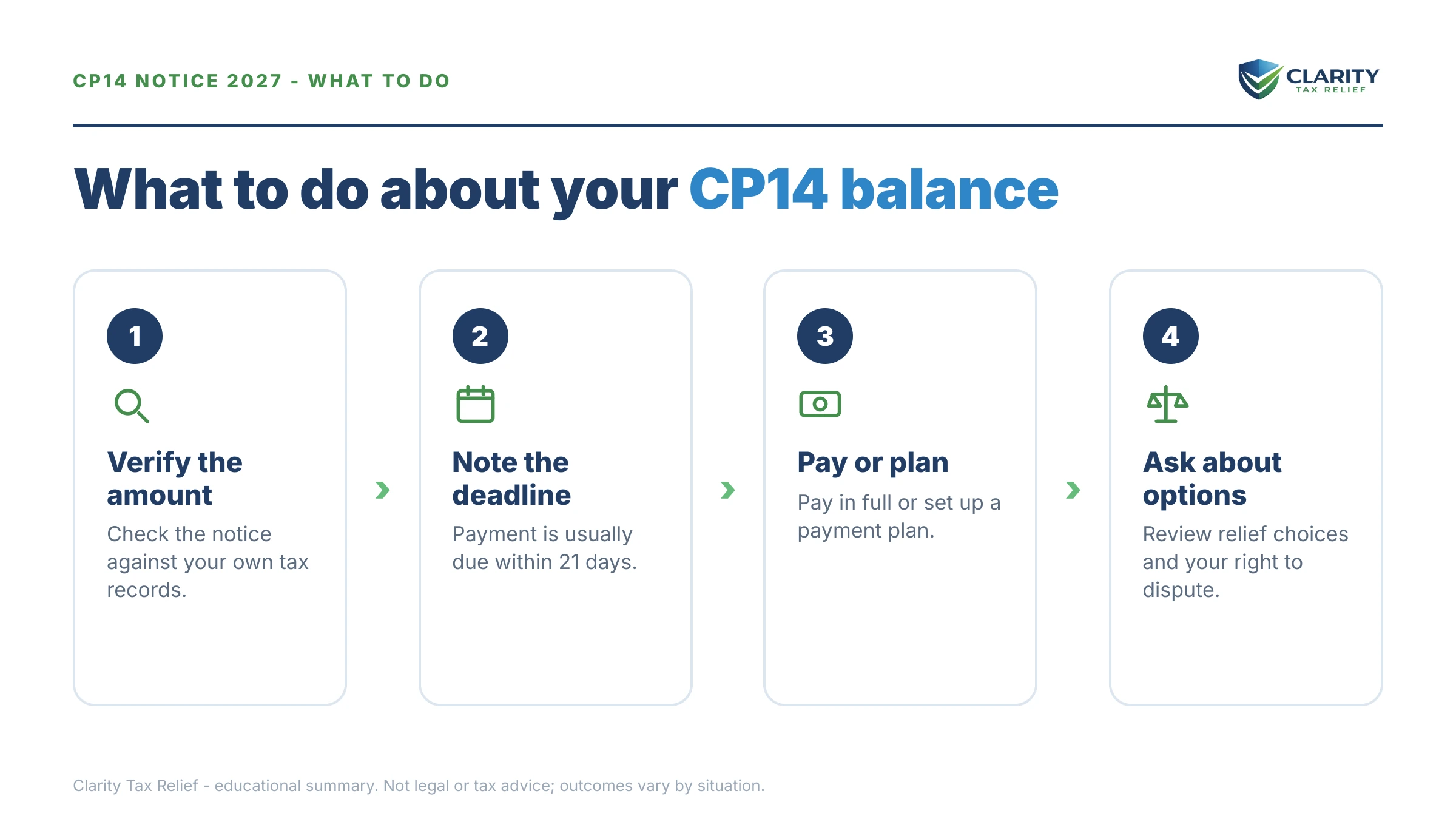
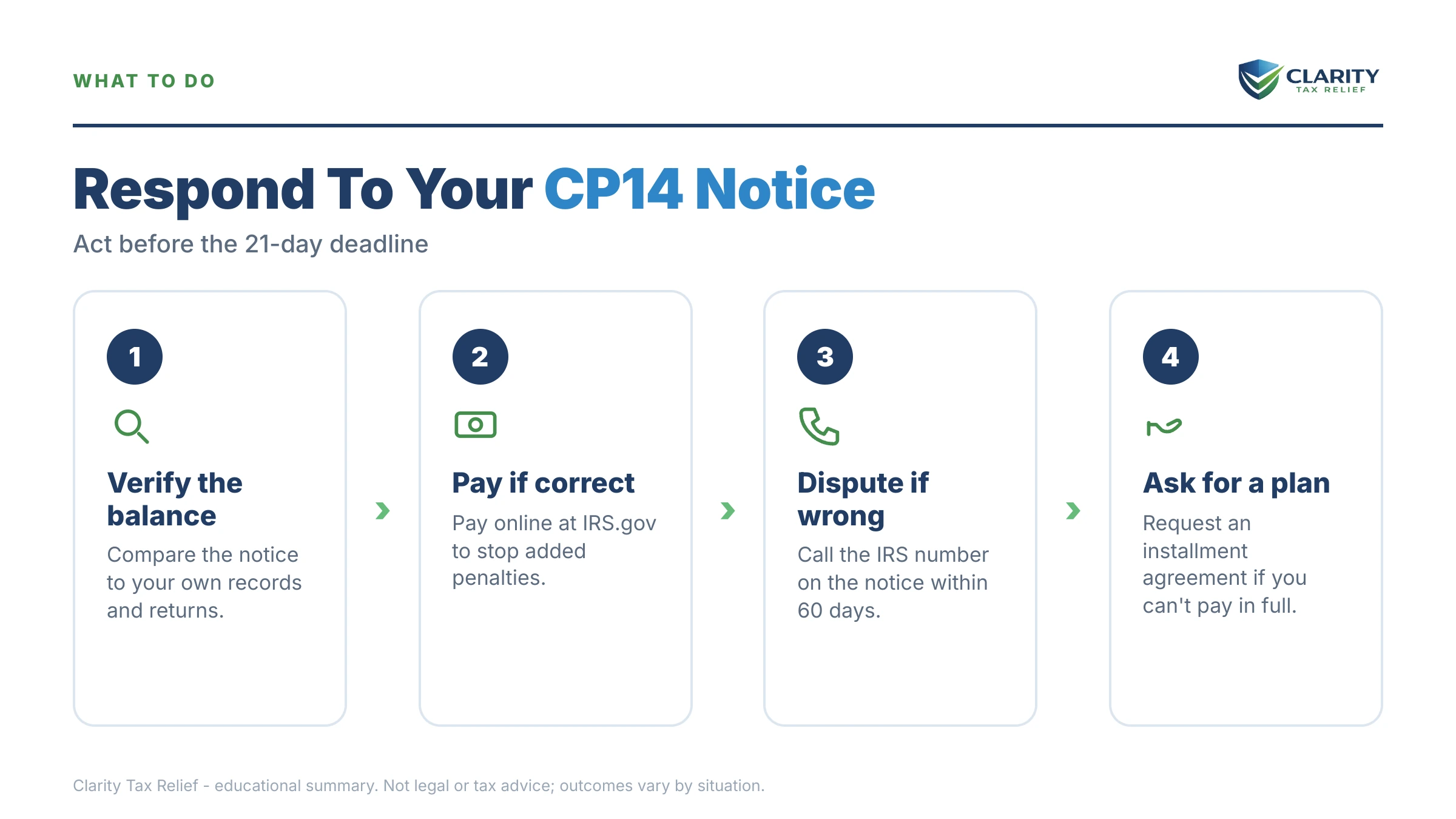
Responding to a CP14 takes five moves, and most people finish the first three in a single evening:
- Verify the balance — Log into your IRS online account and compare the balance there against the notice and your 2026 return before sending a dollar.
- Pay in full if you can — Pay by the date printed on the notice at IRS.gov/payments — that stops the failure-to-pay penalty from growing and ends the notice sequence.
- Set up a plan if you can't — Apply online for a short-term plan (up to 180 days) or an installment agreement before the notice date passes — an active plan stops escalation.
- Dispute it in writing if it's wrong — Respond to the address on the notice with proof of payment or corrected figures, and keep copies of everything you send.
- Get a professional review for complications — Joint-year balances after a divorce, multiple years owed, or unfiled returns change the right order of moves — have an experienced tax professional map it before you commit.
Divorced in 2026? Three CP14 traps specific to you
The IRS is not bound by your divorce decree — for any year you filed jointly, both ex-spouses owe 100% of the balance, no matter which of you the judge assigned it to. That single fact drives the three traps that catch newly divorced CP14 recipients:
Trap 1: assuming the decree settled it. If your CP14 covers a joint year and your decree says your ex pays, the IRS can still collect the full amount from you. Your remedy against your ex is in family court, not with the IRS. The mechanics are covered in divorce decree IRS debt, and if the underlying debt traces to income your ex hid or misreported, innocent spouse relief may shift liability — see divorce and IRS debt: who pays before you agree to a payment plan on a balance that may not be fully yours.
Trap 2: credits that went to the wrong account. On old joint returns, one spouse was "primary." Estimated payments and prior-year overpayments sometimes follow that primary SSN after the split. Before treating the CP14 amount as real, confirm every 2026 payment you made actually posted to your account and year.
Trap 3: fixing 2026 but not 2027. If underwithholding caused this bill, the same W-4 is quietly building next year's CP14 right now. Update your withholding to your actual filing status — it's the one move that reliably solves this once instead of annually.
When you can handle a CP14 yourself
Most people with a single-year CP14 they agree with, a balance under $25,000, and no other IRS problems can resolve it themselves online in under an hour. Honestly: if that's you, you don't need to hire anyone. Verify the balance, pick a plan, set it on direct debit, and confirm penalty relief posted. If you can't afford anything and can't reach the IRS to say so, the Taxpayer Advocate Service exists for exactly the cases the system is failing.
Experienced help changes outcomes in specific situations: the CP14 covers a joint year and an innocent spouse claim is possible. You owe for multiple years or have unfiled returns (the sequencing — returns first, then penalties, then the balance — changes what you ultimately pay). The balance is disputed and a paper fight with a short-staffed IRS needs to be run without the collection clock winning. Or later notices are already arriving and levy exposure is real. In those cases, the fee for a professional is usually small against what the wrong first move costs.
Not sure which side of that line you're on? A free review of your 2027 CP14 and its tax year takes minutes and tells you whether this is a do-it-yourself afternoon or a case worth staffing.
Terms on your CP14, decoded
- Notice date — the date printed in the header block. Every deadline on the notice runs from this date, not from when you opened the envelope.
- Assessment — the formal recording of your tax debt on the IRS's books. It's what makes the balance legally collectible and starts the 10-year clock.
- Failure-to-pay penalty — 0.5% of the unpaid tax per month (capped at 25%), reduced to 0.25% while an installment agreement is active.
- Interest — the federal short-term rate plus 3%, set quarterly, compounding daily; unlike penalties, it's almost never waived.
- CSED — the Collection Statute Expiration Date: the IRS generally has 10 years from assessment to collect, though appeals, offers, and bankruptcy pause the clock.
- Joint and several liability — on a jointly filed return, each spouse owes the entire balance individually. The IRS can collect all of it from either person.
CP14 notice 2027: your questions, answered
When do 2027 CP14 notices start arriving?
Most CP14 notices for tax year 2026 returns mail in the weeks after the April 2027 filing deadline, typically late spring through summer. The IRS generates them automatically once a return posts with an unpaid balance, so people who e-filed and owed usually see theirs first. A CP14 can also arrive any time of year if a payment was misapplied or a penalty posted to an older year.
How long do I have to pay a CP14 notice?
Typically 21 days from the date printed on the notice — 10 business days if the balance is $100,000 or more. That printed date controls when the next notice queues, not the day the letter reached your mailbox. If you can't pay by then, setting up a payment plan before the date passes keeps the sequence from escalating.
Will the IRS remove my CP14 penalties automatically in 2027?
Possibly. Starting in summer 2026, the Automatic Exemption from Penalty (AEP) began replacing the old first-time abatement request for taxpayers with a clean compliance history over the prior three years — relief applies automatically, with no request needed. Check your account transcript to confirm it posted; if it didn't and you qualify, you can still request abatement. Interest on the tax itself keeps accruing and is rarely waived.
I got divorced in 2026 — is my ex responsible for my 2027 CP14?
It depends on the tax year printed on the notice. If the CP14 covers your 2026 return filed as single or head of household, the balance is yours alone. If it covers an earlier year you filed jointly, you are both fully liable no matter what the divorce decree says — the IRS wasn't a party to your divorce and can collect the entire amount from either of you. Innocent spouse relief may apply if the debt traces to your ex's income or errors.
Can I set up a payment plan online for a CP14 balance?
Yes. Combined balances up to $50,000 (tax, penalties, and interest) generally qualify for an online long-term installment agreement of up to 72 months. A short-term plan gives you up to 180 days with a $0 setup fee. You apply through your IRS online account without submitting financial statements at these levels. Interest and the 0.5% monthly failure-to-pay penalty continue until the balance is paid, but enforcement stops while the plan is active.
Does a CP14 notice affect my credit score?
No. The IRS does not report balances to credit bureaus, and the three major bureaus stopped including tax liens on credit reports in 2018. The indirect risk comes later: if the debt escalates to a filed federal tax lien, it becomes a public record that mortgage lenders and some employers can find, even though it won't appear as a score-lowering item on your report.
What happens if I pay a CP14 a few days after the deadline?
Nothing dramatic happens on day 22 — interest and the monthly failure-to-pay penalty simply keep running, so your payoff figure will be slightly higher than the notice shows. Pay the current balance from your IRS online account rather than the printed amount to avoid a small leftover balance that keeps generating notices. If a reminder notice crosses in the mail with your payment, verify online that the account shows zero before assuming it's handled.
How do I know my 2027 CP14 is real and not a scam?
A genuine CP14 arrives by postal mail — never by email, text, or social media message. Any payment goes only to the United States Treasury or through IRS.gov. Anyone demanding gift cards, wire transfers, or payment-app transfers is a criminal, not the IRS. The safest check takes five minutes: log into your account at IRS.gov and see whether the same balance appears there before paying anything.
What's the difference between a CP14 and a CP501?
A CP14 is the first bill after your return posts with a balance due. A CP501 is the reminder that follows, typically several weeks later, if the CP14 goes unanswered. Neither notice carries levy power by itself, but each one means more accrued penalty and interest and one step closer to the CP504 and LT11 notices that do authorize seizures. The cheapest moment to act is at the CP14.
Your next 24 hours
- Find two things on the notice: the notice date in the header block and the "amount due" figure. Count 21 days from that date — that's your real runway, and it's probably longer than the panic suggests.
- Gather three documents: your 2026 return, the CP14 itself, and — if any part of the balance touches a joint year — the pages of your divorce decree that address taxes. Add a recent pay stub so plan payments can be sized realistically.
- Get the free case review before your window closes: send us the notice through the 2-minute form or call (888) 825-7779. We'll verify the balance, check for automatic penalty relief, and give you the exact next move, whether or not that move involves us.
For the IRS's own description of this notice, see Understanding your CP14 notice at IRS.gov.
This guide is general information, not tax or legal advice for your specific situation. Eligibility for IRS programs depends on individual facts and circumstances; no outcome is guaranteed.