
IRS Notices
IRS CP14 Wrong Amount: How to Dispute an Incorrect IRS Bill in 2026
What this episode covers
- Why might the amount on an IRS CP14 notice be wrong?
- Should I pay an IRS CP14 notice if the amount is wrong?
- What do IRS transcript codes 150, 806, 276, and 196 mean?
- What happens if I ignore an IRS CP14 notice?
The short answer: if your CP14 shows the wrong amount, don't pay it yet. Compare the notice to your IRS account transcript first: most incorrect CP14 balances trace to a payment posted to the wrong tax year, a missing credit, or penalties you can dispute. Pay only the part you agree with, then dispute the rest in writing.
Your tax return says one number. The CP14 in your other hand says a different one — higher, or blind to a payment you know you made. So you typed "CP14 wrong amount" into your phone. Your instinct is correct: a CP14 is a computer's summary of your IRS account, not a human's review, and posting errors are routine, provable, and fixable.
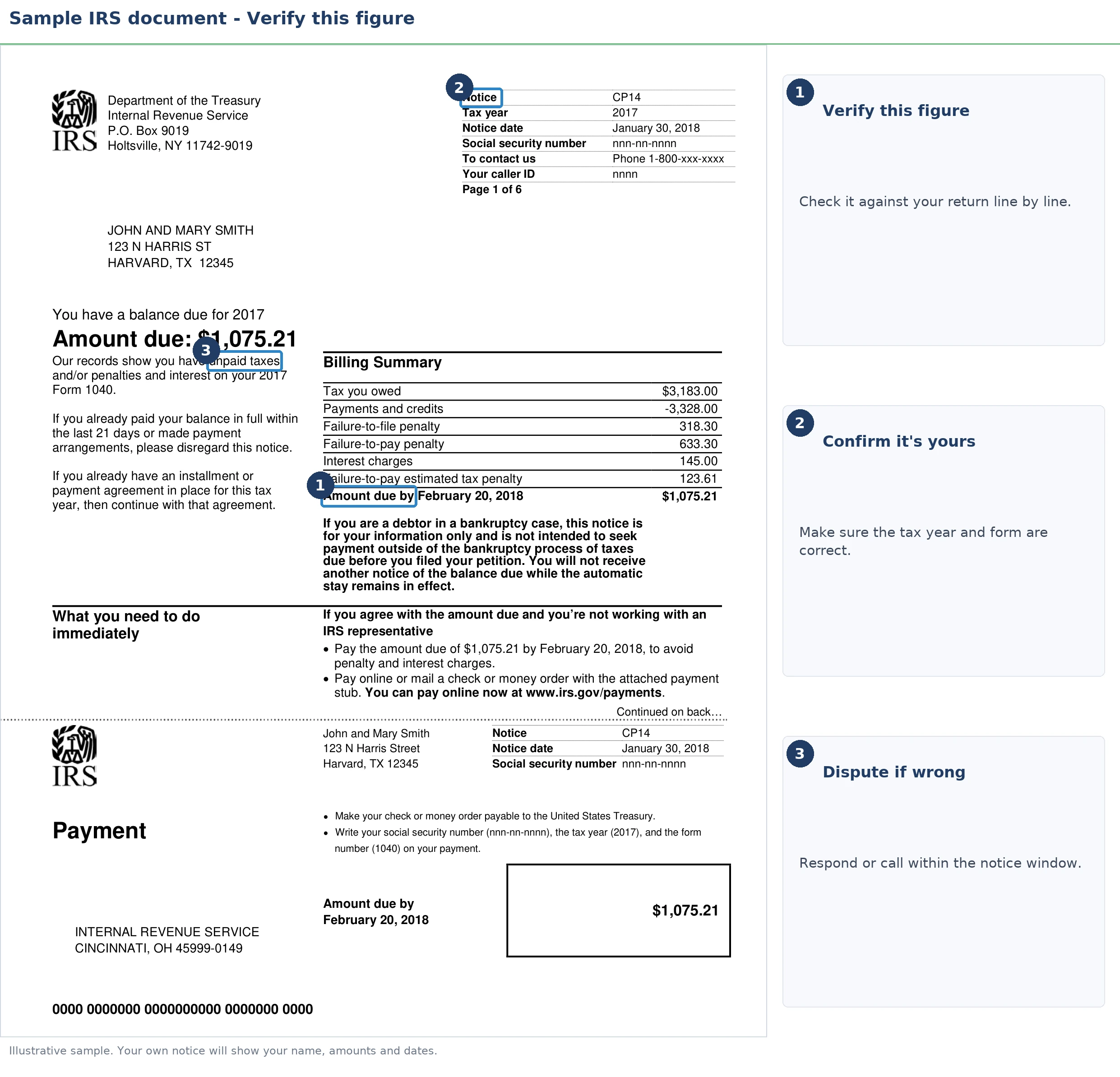
This guide shows you how to find where the IRS's number came from, prove the real balance, and get the wrong part removed — before the automated notice sequence escalates. The image below shows exactly what a CP14 looks like and where the billing summary splits the total into tax, penalties, and interest — the first place to look when the number doesn't match yours.
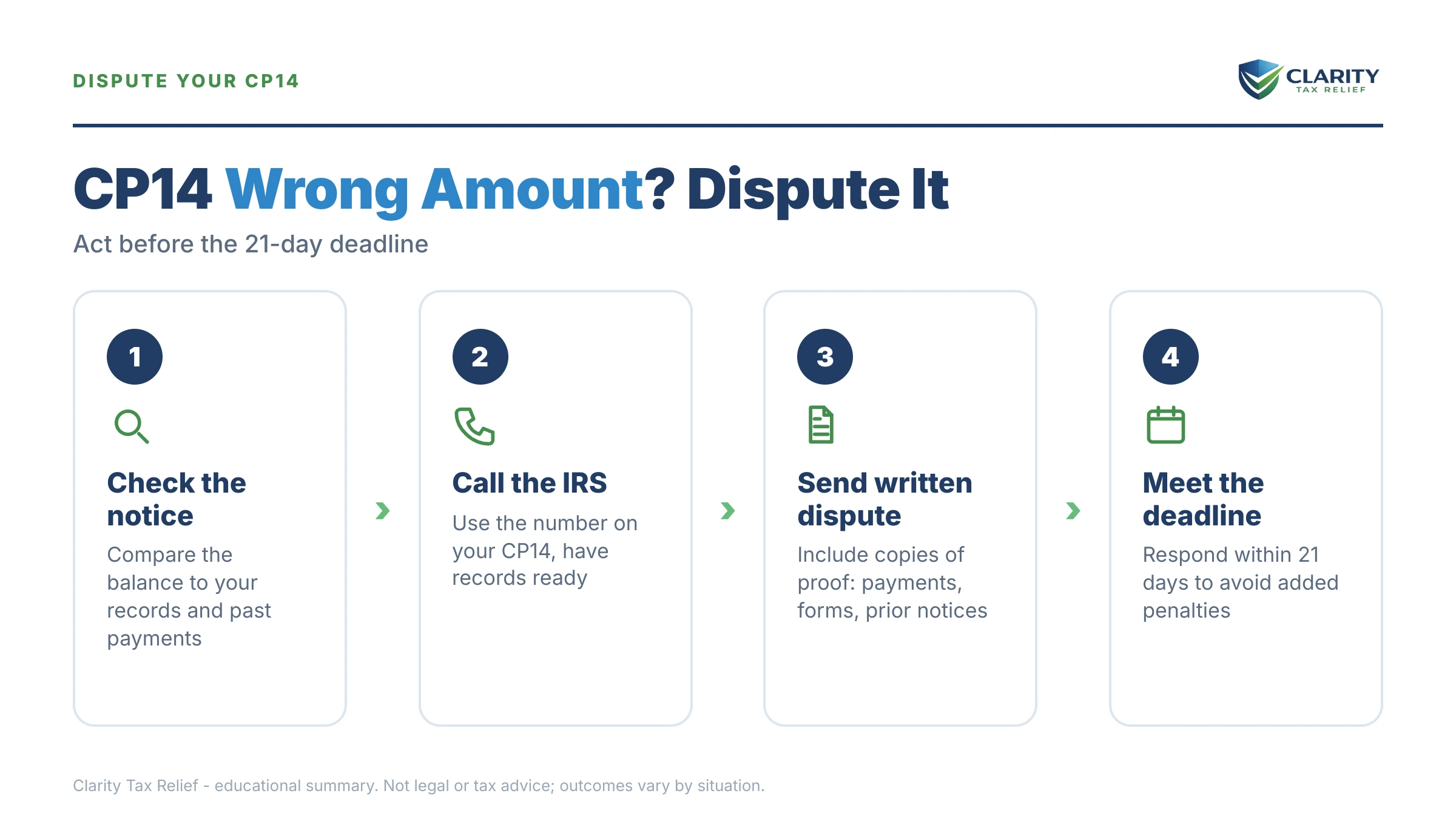
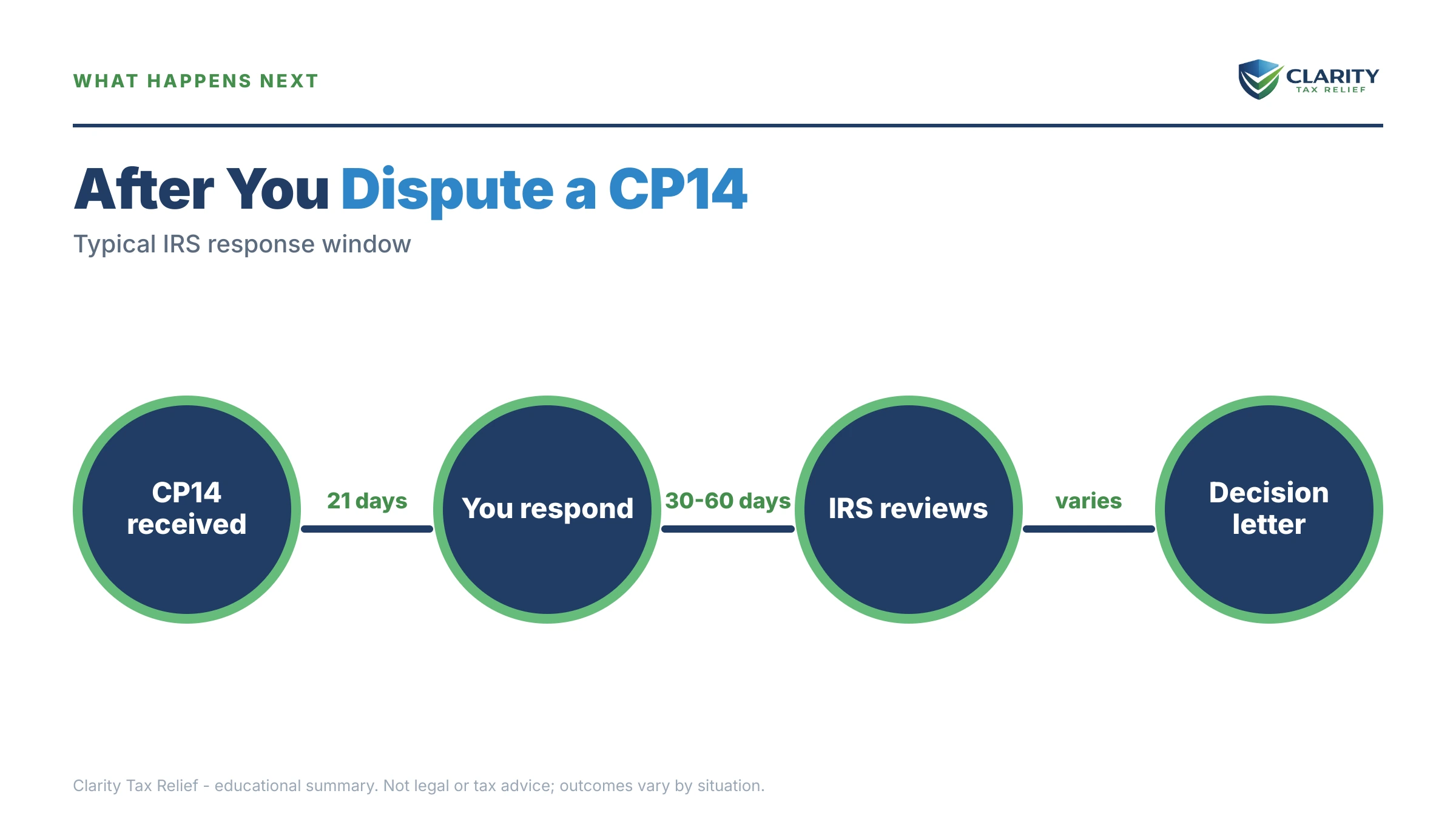
⏱ Your deadline: the pay-by date printed on your CP14 — typically 21 days from the notice date (10 business days if the balance is $100,000 or more). Disputing the amount does not pause this clock: interest and the late-payment penalty keep accruing on whatever you genuinely owe until the account is corrected or paid.
CP14 wrong amount: the 7 reasons the IRS number doesn't match yours
Seven common reasons the balance is wrong
Most incorrect CP14 balances trace to one of seven causes, and five of them are posting errors you can prove with a bank statement or a confirmation number. (For the bigger picture on why the IRS sends letters at all, see why did I get a letter from the IRS. This page stays on the specific problem of a CP14 whose number is wrong.)
1. Your payment crossed in the mail. CP14s print automatically on a schedule. A payment you made in the last two to three weeks may simply not be reflected yet. If you already paid the full balance, that's a different (and simpler) problem — the CP14 notice but I already paid guide covers that playbook in full.
2. Your payment posted to the wrong tax year or wrong payment type. This is the single most common cause we see for self-employed and gig filers. IRS Direct Pay asks you to pick a reason ("Balance Due," "Estimated Tax," "Extension") and a tax year from a dropdown. Choose "1040-ES 2026" when you meant "Balance Due 2025," and your money sits as a stranded credit on a different year while the CP14 bills you as if you never paid.
3. Estimated payments or withholding never got credited. Quarterly payments made under one spouse's Social Security number and claimed on the other spouse's separate return, backup withholding on a 1099 that the payer reported late, or a prior-year overpayment you elected to roll forward that never rolled — all of these leave the CP14 showing more than you owe. Married couples who made joint estimated payments and then filed separately hit this constantly: the IRS credits the payments to one account. The other spouse's return comes up short.
4. Penalties and interest you didn't expect. This is the honest one: sometimes the amount is technically correct — just bigger than your return said. If you filed late, the failure-to-file penalty runs 5% of the unpaid tax per month, up to 25% — ten times the 0.5% monthly failure-to-pay penalty (though in months where both penalties apply, the failure-to-file portion drops to 4.5%, for 5% combined) — and interest compounds daily on top of both. The CP14 billing summary breaks the total into tax, penalties, and interest. If the tax line matches your return, the gap is statutory additions, and your fight is a penalty-relief fight (more on that below). You can estimate how much of your balance is penalties and interest with our IRS penalty and interest calculator.
5. The IRS changed your return. Under its math-error authority, the IRS can adjust a return during processing — a miskeyed SSN on a dependent, a credit it recalculated, a number that didn't match its records. When a change creates a balance, you should normally receive a CP11 notice explaining it. But the bill and the explanation don't always arrive together. If your CP14 total exceeds your return and no payment is missing, look for an adjustment on your transcript — you may need to challenge the adjustment itself, not just the bill it produced.
6. A payment was reversed or moved. If the IRS took a payment off your account — because it bounced, was traced to someone else, or was reapplied to an older debt or a spouse's balance — you'd typically see a CP60 notice first. But the CP14 is where the fallout lands. A refund from another year that you expected to cover this balance can also get intercepted for a different debt before it ever arrives.
7. You don't recognize the year or the return at all. A CP14 for a year you never filed can follow an identity-theft return or a substitute return the IRS prepared for you. Don't pay anything on a year you don't recognize until you've confirmed what was actually filed under your SSN.
One scope note: CP14s go to individuals. If the bill is for your business's 1120 or other business return, you're looking at the CP161 series, which follows different fix paths.
| Cause | How to spot it | The fix |
|---|---|---|
| Payment crossed in the mail | You paid within ~3 weeks of the notice date | Check your online account; if posted, keep the confirmation and disregard after verifying |
| Payment on wrong year/type | Confirmation says a different year than the notice; a stray credit sits on another year's transcript | Request a payment transfer with the date, amount, and confirmation number |
| Missing estimated payments or withholding | Transcript payment lines don't match your records; joint estimates + separate returns | Written dispute with bank records; spouses document how joint estimates were divided |
| Penalties and interest added | Billing summary's tax line matches your return; the rest is additions | First-time abatement, AEP (from summer 2026), or Form 843 reasonable cause |
| IRS adjusted your return | Transcript shows an adjustment; a CP11 may have arrived separately | Respond to the adjustment with documentation within its own window |
| Payment reversed or reapplied | A CP60 preceded the bill, or a payment vanished from the account | Trace the payment; dispute the reversal with proof it was yours and cleared |
| Unknown year or return | CP14 for a year you never filed | Verify what was filed under your SSN before paying anything; report identity theft if it wasn't you |
Disputing and paying are not mutually exclusive
People delay one waiting on the other, and the delay costs more than either. Balance due notices keep escalating while a dispute is open, so if part of the unpaid balance is clearly yours, deal with that part now.
You can set up a payment plan on the undisputed portion, or raise financial hardship on it, while still contesting the rest. Splitting the balance that way stops the sequence advancing on the piece nobody disagrees about.
Prove the real balance: pull your transcript before you pay
Where to look on your account transcript
Your IRS account transcript, not the CP14, is the authoritative record of what the IRS believes you owe and what it credited. The notice is a snapshot. The transcript shows every transaction with a date and a code, which is exactly what you need to find the error.
Look for these lines: code 150 is the tax your return assessed, code 806 is withholding credited, the 600-series codes (610, 660, 670) are payments posted, code 276 is the failure-to-pay penalty, and code 196 is interest. Add the credits, subtract from the assessments, and you have the IRS's math. Our guide to how to read an IRS account transcript walks through every line.
Then run the cross-year check: pull transcripts for the year before and after the notice year. A payment missing from the CP14's year usually isn't lost — it's sitting as a credit on the adjacent year, waiting for a transfer request. That ten-minute check resolves more "wrong amount" cases than any phone call.
What happens if you ignore a CP14, even one that's wrong
The IRS collection sequence is automated, and a dispute that exists only in your head does not pause it. Believing the bill is wrong, even correctly, protects nothing until the account is actually fixed. If you set the notice aside, the machine escalates:
- CP14 — first bill. You are here. No enforcement power yet; this is the cheapest and easiest stage to correct an error.
- CP501 and CP503 — reminder bills, typically arriving about five weeks apart. Same wrong number, now with more penalties and interest stacked on top of it.
- CP504 — Notice of Intent to Levy under IRC §6331(d). The IRS can seize your state tax refund. A federal tax lien becomes a live risk — over a balance that may still be partly fictional.
- LT11 / Letter 1058 — final notice of intent to levy. A 30-day clock starts on your Collection Due Process rights; after it runs, wages and bank accounts are fair game. You can still raise the error here, but you're now litigating it under pressure instead of fixing it with a letter.
The 2026 backdrop makes early action matter more, not less: the IRS workforce was cut roughly 27% in 2025, so reaching a human to fix a posting error takes longer, while the automated notices, liens, and levies never slowed down. The correction queue is slow; the escalation queue is not. Start the paper trail now.
| Notice | Response window | What's at stake |
|---|---|---|
| CP14 | Pay-by date, typically 21 days (10 business days if $100,000+) | Nothing enforced yet; errors are cheapest to fix here |
| CP501 / CP503 | Date printed on each notice | Balance keeps growing monthly; the error compounds |
| CP504 | Date printed on the notice | State tax refund can be seized; lien filing becomes likely |
| LT11 / Letter 1058 | 30 days | Last chance to request a Collection Due Process hearing (Form 12153) before wage and bank levies |
Is your CP14 wrong, or just bigger than you expected?
Send us a photo of the notice and your payment records. An experienced tax professional will trace where the IRS's number came from and tell you exactly what's disputable — free, before the pay-by date on your notice passes. Call (888) 825-7779 or use the 2-minute form.
Your options when the CP14 amount is wrong (or only partly wrong)
Every fix for an incorrect CP14 is free — the IRS never charges a fee to correct its own posting error, and penalty-relief requests cost nothing to file. Which path fits depends on which part of the number is wrong:
- Written dispute with proof. For any documented posting error — missing payments, uncredited withholding, a reversal that wasn't yours — send a letter to the address on the notice with copies (never originals) of confirmations and bank statements, stating the balance you believe is correct.
- Payment transfer request. For money sitting on the wrong year or wrong type, call or write with the payment date, amount, and confirmation number and ask that it be moved. This is routine; the IRS does it constantly.
- Penalty abatement. If penalties inflate the bill: first-time penalty abatement removes failure-to-file and failure-to-pay penalties if your prior three years were clean — filed and paid on time. Starting summer 2026, the new Automatic Exemption from Penalty (AEP) applies similar relief automatically, with no request needed. Outside those, Form 843 is the vehicle for reasonable-cause relief — illness, disaster, circumstances genuinely beyond your control.
- Amend the return. If the CP14 is faithfully billing a return that was itself wrong — you forgot deductible expenses, overstated income, missed a credit — the fix is a 1040-X, not a dispute letter. The bill is only as right as the return underneath it.
- Taxpayer Advocate Service. If your documented dispute has stalled through multiple notices and the growing balance is causing real harm, the Taxpayer Advocate Service can force movement. If your income is modest, a Low Income Taxpayer Clinic can represent you at no charge.
- Pay the corrected balance, or arrange it. Once the number is right, a short-term plan gives up to 180 days with $0 setup. Balances of $50,000 or less can go on a streamlined installment agreement of up to 72 months online (a setup fee applies, lowest with direct debit). Balances of $10,000 or less generally fit the guaranteed installment agreement. If even the corrected amount is out of reach, the got a CP14 and can't pay guide covers hardship status and settlement paths in depth.
| Option | When it fits | Cost |
|---|---|---|
| Written dispute with proof | Any documented posting error | $0 |
| Payment transfer request | Payment sitting on the wrong year or type | $0 |
| First-time abatement / AEP | Penalties on the bill; clean prior 3 years (AEP automatic from summer 2026) | $0 |
| Form 843 (reasonable cause) | Penalties, but prior years not clean | $0 |
| Amended return (1040-X) | The underlying return was wrong | $0 IRS fee |
| Short-term payment plan | Corrected balance payable within 180 days | $0 setup; interest continues |
| Streamlined installment agreement | Corrected balance ≤ $50,000; up to 72 months | Setup fee (lowest online with direct debit); interest continues |
| Taxpayer Advocate Service | Dispute stalled and causing hardship | $0 |
Worked example: the $8,900 CP14 that was $1,575 too high
A worked example: misdirected payment, late return
Say you're a gig driver with three years unfiled — 2022, 2023, and 2024 — and you start catching up by filing your 2024 return in February 2026, about ten months late. The return shows $6,800 in tax due, mostly self-employment tax. A CP14 arrives billing $8,900:
- $6,800 tax, plus
- $1,530 failure-to-file penalty (capped at 22.5% of the unpaid tax when the failure-to-pay penalty runs alongside it), plus
- $340 failure-to-pay penalty (0.5% × 10 months = 5%), plus
- roughly $230 in interest.
But you made a $1,200 Direct Pay payment in January 2025 intended for 2024. The confirmation email shows you accidentally selected "1040-ES, tax year 2025." That $1,200 is sitting as a credit on 2025, invisible to the 2024 bill. Because the payment landed before the April 2025 due date, transferring it recomputes everything: unpaid tax drops to $5,600, the failure-to-file penalty falls to $1,260, the failure-to-pay penalty to $280, and interest to roughly $185. New balance: about $7,325 — roughly $1,575 less than the notice, from one phone call with a confirmation number.
Here's the persona-specific trap: first-time abatement can't rescue the remaining penalties, because FTA requires a clean prior three years — including filed returns — and 2022 and 2023 are still open. Filing those years isn't just overdue housekeeping; it's the gateway to penalty relief on this bill. The haven't filed taxes in 3 years guide covers the catch-up sequence. This example is hypothetical. But the mechanics — misdirected payment, recomputed penalties, FTA blocked by unfiled years — are exactly what a transcript review uncovers.
How to respond to a CP14 with the wrong amount, step by step
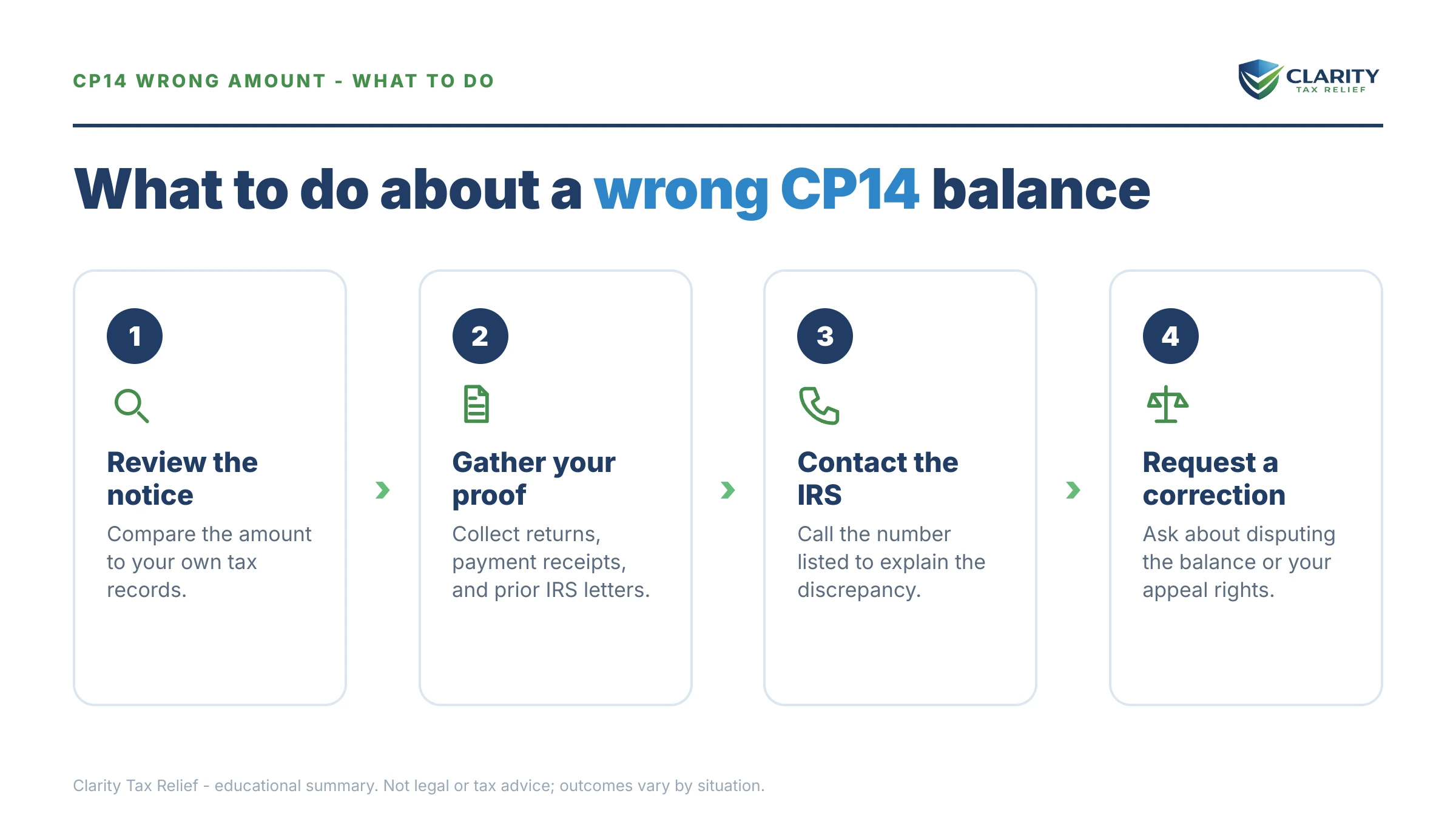
- Pull your account transcript. Compare the notice line by line against the transcript's entries for tax, payments, penalties, and interest — the transcript is the authoritative record.
- Match every payment you made. Gather Direct Pay confirmations, bank statements, and canceled checks, and confirm each payment posted to the right tax year and the right type.
- Pay the undisputed portion. Pay whatever you agree you owe by the date on the notice at IRS.gov/payments, so penalties and interest stop growing on that part.
- Dispute the rest in writing. Send copies of your proof to the address on the notice, state the corrected balance you believe is right, and keep copies of everything you send.
- Request penalty relief separately. File Form 843 or ask for first-time abatement if penalties inflate the total — penalty relief is a separate request from a balance dispute.
- Follow up before the next notice. If a CP501 arrives and the account still shows the wrong number, call the number on the notice or bring in an experienced tax professional.
For the mechanics of making the undisputed payment — which options post fastest and how to make sure it lands on the right year — see the CP14 pay online walkthrough.
When you can handle this yourself, and when help changes the outcome
Many wrong-amount CP14s are genuinely do-it-yourself fixes. Handle it on your own when:
- One payment is misapplied and you have the confirmation number. A payment transfer request is a routine call — patience with hold times is the only real cost.
- The only "wrong" part is penalties and your prior three years are clean. First-time abatement is frequently granted on a single phone call, and AEP will handle many of these automatically starting summer 2026.
- The corrected balance is small and payable within 180 days. Verify, fix, pay through a $0-setup short-term plan, done.
Experienced help changes the outcome when the picture is layered: multiple unfiled years with payments stranded across different tax modules, disputes that have already outlasted two notices while the sequence kept escalating, identity-theft returns, business and personal balances tangled together, or a wrong amount plus a genuine can't-pay problem, because the order you fix things in (returns first, then penalties, then the balance) changes what you ultimately pay. In the worked example above, transferring the payment before requesting abatement, and filing the old years before either, is the difference between relief granted and relief denied.
If your situation looks like the second list, a free review of your notice and transcripts will tell you the right sequence before anything escalates — start with the 2-minute form.
Terms on your CP14, decoded
- Assessed balance — the amount officially recorded on your IRS account, which is what the CP14 bills. It can differ from your return if payments or adjustments posted differently than you expected.
- Notice date — the printed date in the top corner that starts your pay-by window. The clock runs from this date, not the day the letter reached your mailbox.
- Failure-to-pay penalty — 0.5% of the unpaid tax per month, added automatically until you pay or arrange payment.
- Statutory interest — interest the law requires on unpaid tax, compounding daily at a rate the IRS adjusts quarterly. It can rarely be waived, even when penalties are.
- Credit elect — a prior-year overpayment you chose to apply forward instead of refunding; when it doesn't roll as expected, a CP14 often results.
- Tax period — the specific year the notice covers; always confirm it, because payments meant for one period routinely land on another.
The IRS's own explainer for this notice is at Understanding your CP14 notice, payments and plan setup live at IRS.gov/payments, and stalled disputes causing hardship can go to the Taxpayer Advocate Service.
CP14 wrong amount questions, answered
Can the IRS send a CP14 with the wrong amount?
Yes. CP14s are generated automatically, and errors happen — payments that crossed in the mail, payments posted to the wrong tax year, and estimated payments that never got credited are the most common. The notice is a computer's summary of your account, not a human's review. Always compare it to your account transcript before paying, because the IRS will not catch a posting error on its own.
Why is my CP14 higher than what my tax return says I owe?
Usually because of penalties and interest added after you filed. The failure-to-pay penalty runs 0.5% of the unpaid tax per month, the failure-to-file penalty runs 5% per month (up to 25%) if you filed late, and interest compounds daily on top. The CP14 billing summary breaks the total into tax, penalties, and interest, if the tax line matches your return, the extra is statutory additions, not an IRS error.
Should I pay a CP14 I disagree with?
Pay the portion you agree you owe, and dispute the rest in writing with proof. Paying the undisputed part stops penalties and interest from growing on that amount, and it shows good faith if the case escalates. Never pay a balance you can prove you don't owe just to make the notice go away — recovering an overpayment from the IRS can take months.
How do I dispute a CP14 notice amount?
Call the number on the notice or send a written dispute to the address printed on it, with copies (never originals) of your proof — payment confirmations, bank statements, or your return. Written disputes create a paper trail, which matters because the automated notice sequence keeps running while your case sits in a queue. If penalties are the problem, request abatement separately with Form 843 or a first-time abatement request.
What if the IRS applied my payment to the wrong tax year?
Ask the IRS to transfer the payment to the correct year. This is a routine fix. You'll need the payment date, amount, and confirmation number, or a bank statement showing the debit. Misdirected Direct Pay payments are one of the most common CP14 errors, especially for self-employed filers juggling estimated payments across multiple years. Until the transfer posts, the CP14 balance will keep showing the wrong number.
Does disputing a CP14 stop penalties and interest?
No. Interest and the failure-to-pay penalty keep accruing on whatever you genuinely owe while your dispute is reviewed. That is why the smart move is to pay the undisputed portion immediately and fight only the part that is wrong. If your dispute succeeds, the penalties and interest attributable to the erroneous portion come off along with it.
What's the difference between a CP14 and a CP11?
A CP14 bills you for a balance the IRS says already exists on your account. A CP11 tells you the IRS changed something on your return and the change created a balance. If your CP14 total doesn't match your return and no payment is missing, check your transcript for an adjustment. You may need to challenge the adjustment itself, not just the bill it produced.
How long do I have to respond to a CP14?
Until the pay-by date printed on the notice, typically 21 days from the notice date, or 10 business days if you owe $100,000 or more. Missing that date does not trigger a levy. But it keeps the automated notice sequence moving toward CP501, CP503, CP504, and eventually a final notice of intent to levy. Disputing the amount does not pause the sequence unless the IRS actually corrects the account.
Can the penalties on my CP14 be removed?
Often, yes. If you filed and paid on time for the prior three years, first-time abatement can remove failure-to-file and failure-to-pay penalties, and starting summer 2026, the IRS's Automatic Exemption from Penalty (AEP) applies similar relief automatically, with no request needed. If you don't qualify, reasonable cause (illness, disaster, circumstances beyond your control) is a second path. Interest on the tax itself is rarely removed unless it stems from an IRS error or delay.
Your next 24 hours
- Find two things on the notice: the pay-by date in the top section. The billing summary that splits the total into tax, penalties, and interest. Circle whichever line doesn't match your records — that's your dispute.
- Gather your evidence: the filed return for that year, every payment confirmation and bank statement, and your account transcript from your IRS online account.
- Get the notice reviewed free before the pay-by date passes: use the 2-minute form or call (888) 825-7779. An experienced tax professional will trace the IRS's number against your records and map the exact dispute, or the exact relief. That fits.
This guide is general information, not tax or legal advice for your specific situation. Eligibility for IRS programs depends on individual facts and circumstances; no outcome is guaranteed.