
Paying the IRS
How to Get Your Exact IRS Payoff Amount in 2026
The short answer: your IRS payoff amount is your full balance projected to a specific future date, including every day of interest and penalty up to that date — which is why it is always higher than the balance printed on your notice. Get it free from your IRS online account, or request a formal payoff letter for a lien or a home sale.
You want to pay the IRS in full and be done — maybe to release a lien, close on a house, or just stop the bleeding. The number on your last notice will not do it, because interest kept running the day after that notice printed. The image below shows where the balance and the projected payoff figure appear in your account, and why the two are never quite the same.
⏱ The clock that matters here: a payoff figure is only good through the date it names. Interest compounds daily and the failure-to-pay penalty adds up monthly, so a quote from last week already understates today's number. Always ask for a payoff good through a date past when your payment will actually clear.
Why the payoff number is never the number on your notice
Your payoff amount equals tax + accrued interest + accrued penalties, calculated to the exact day you plan to pay. A CP14, CP501, or CP503 shows a snapshot from the day it was generated, and by law, interest on unpaid tax compounds daily while it sits.
That gap is the single most common reason people underpay. They mail the exact figure from a two-month-old notice, then get a fresh bill weeks later for the interest that ran in between. Understanding how IRS interest actually compounds is what turns "I paid it" into "the account is actually closed."
The balance is built from three moving parts. Only the first is fixed; the other two grow every day you wait:
| Component | How it behaves | Does it grow daily? |
|---|---|---|
| Assessed tax | The original amount you owed for the year | No — fixed once assessed |
| Failure-to-pay penalty | 0.5% of unpaid tax per month, up to 25% | Monthly, until the tax is paid or the cap is hit |
| Interest | Charged on tax and on penalties; compounds daily at a rate set quarterly | Yes — every single day |
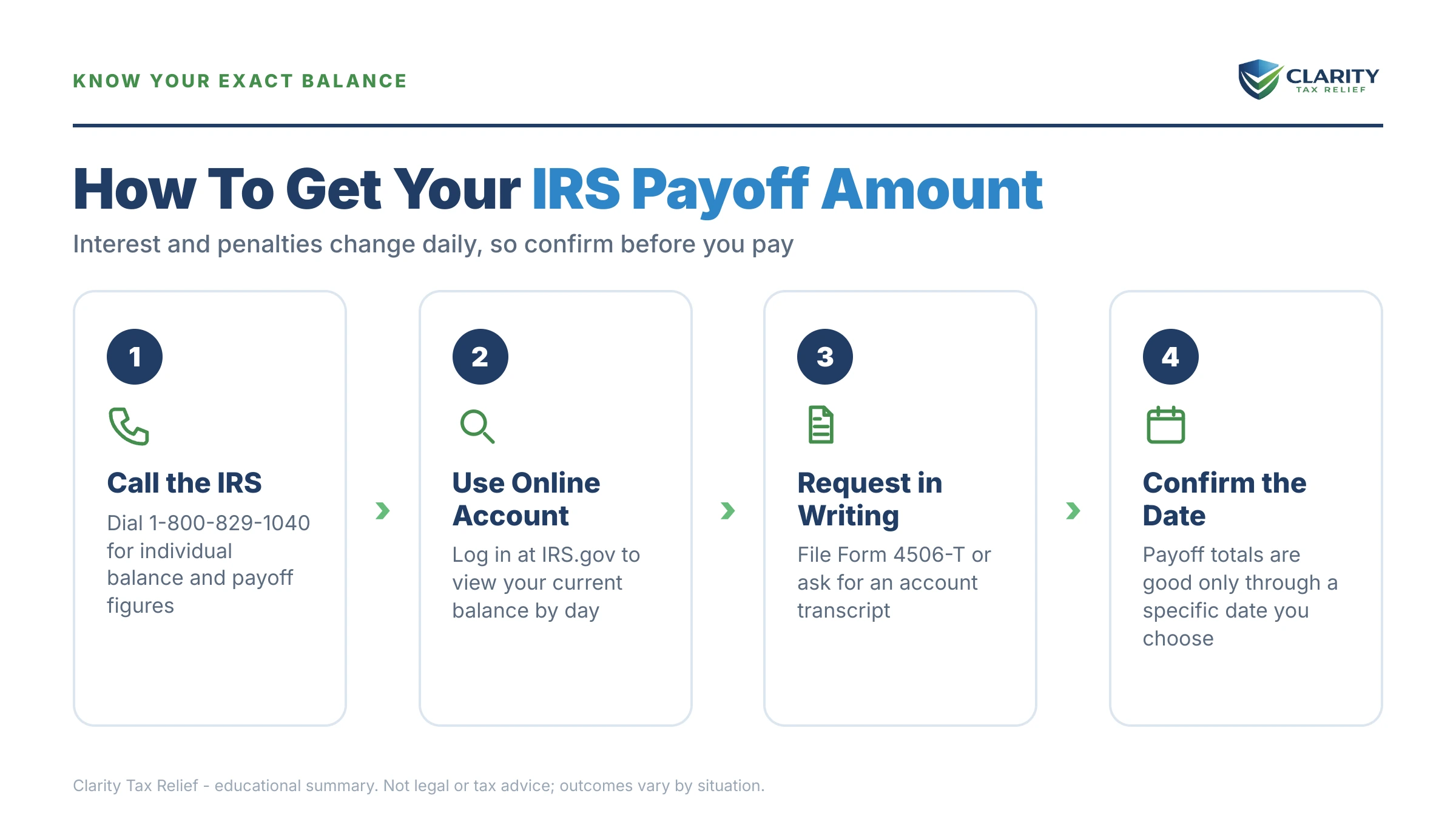
Where to get your exact IRS payoff amount
Your IRS online account is the fastest source, and it's free. It displays your current balance and lets you view a payoff figure good through a date you choose — the number you actually pay to close the account.
Which method you use depends on why you need the number. Paying it yourself is simple; satisfying a lien for a closing is a formal request with its own paperwork.
| Source | What you get | How fast |
|---|---|---|
| IRS online account (IRS.gov) | Current balance + payoff good through a chosen date, all years | Same day, free |
| Account transcript | Line-by-line history; balance as of the transcript date (interest not projected forward) | Same day online |
| Phone (1-800-829-1040) | An agent quotes a payoff good through a date you name | Same call, if you get through |
| Lien payoff letter (Centralized Lien Operation) | Written amount to satisfy a recorded federal tax lien | Typically a few weeks by mail |
A word on the account transcript: it's excellent for seeing every penalty and interest posting, but the balance it shows is only current to the transcript date. It won't project interest forward to your pay date the way the online account payoff tool does. Learn to pull one at getting your transcripts online.
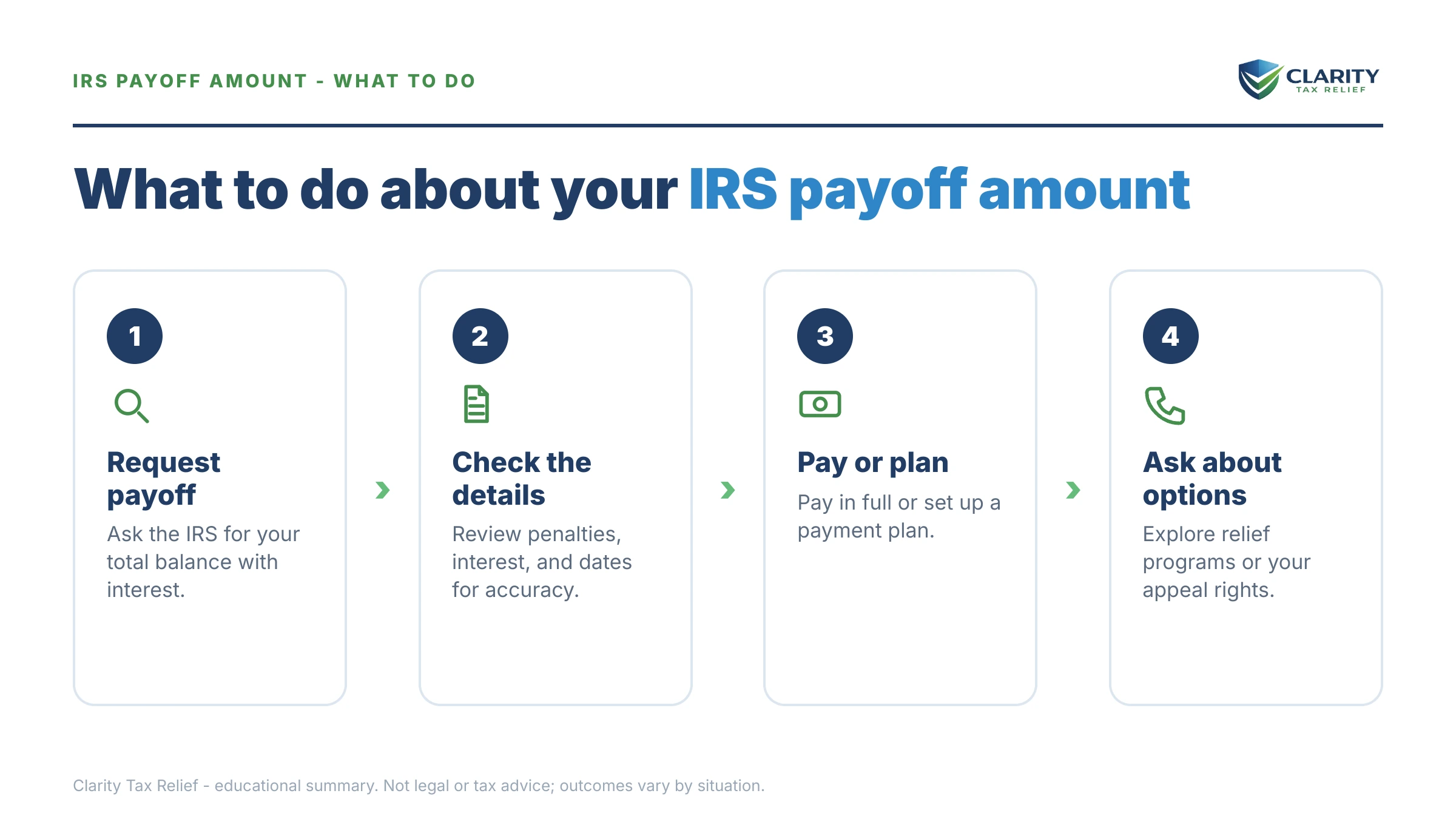
What happens if you pay the wrong (stale) number
Paying a figure that's even a few days old leaves a residual balance that quietly keeps the account open. Here's the sequence that follows a short payment:
- You pay the notice balance — thinking the account is settled.
- A small residual remains — the interest that accrued between the notice date and your payment date.
- That residual keeps growing — daily interest and the monthly penalty continue on whatever is left, no matter how small.
- A fresh notice arrives — for a balance you thought was gone, restarting the collection sequence.
- Any lien stays put — the IRS won't issue a Certificate of Release of Federal Tax Lien until the balance hits zero, which can blow up a closing or refinance.
This is why the payoff date matters as much as the payoff dollars. In 2026, with IRS staffing cut sharply, a mis-timed payment can sit unreconciled for weeks, but the automated interest and lien systems never paused. Get the number right the first time.
Need an exact payoff before a closing or lien release?
Interest is running every day this stays open. An experienced tax professional can pull your exact payoff, request a lien payoff letter, and time it to your closing date so nothing is left behind — free, confidential, no pressure.
Getting a payoff for a tax lien, a home sale, or a refinance
When a federal tax lien is recorded, you need a lien payoff letter, not just an account balance, because a title company or lender needs the exact amount, good through a date, that clears the lien. You (or your closing agent, with authorization) request it from the IRS Centralized Lien Operation.
Timing is everything here. Ask for a payoff that runs a week or two past your closing date so daily interest doesn't leave a dollar behind. If you're selling a house with an IRS lien, the proceeds at closing usually satisfy it. If you're refinancing and there isn't enough equity, a lien may not need full payoff — see refinancing with a tax lien for the subordination path.
Once the IRS receives full payment, it issues the release. Expect the lien to be released after payment generally within 30 days.
A worked example: why the notice number leaves you short
Say you're selling your home and the title company needs an exact IRS lien payoff. Your most recent notice showed $18,400, but that notice printed two months ago.
Assume, for this hypothetical, an 8% annual interest rate (the rate is set quarterly and changes, so treat this as illustration only). Daily interest on $18,400 is roughly $18,400 × 0.08 ÷ 365 ≈ $4.03 a day. Over the ~60 days since the notice, that's about $242 in interest. Add the failure-to-pay penalty at 0.5% per month — roughly $92 per month, about $184 over two months.
So the real payoff is closer to $18,400 + $242 + $184 ≈ $18,826. It keeps climbing about $4 every day until it's paid. If you wire the old $18,400 to closing, you'd leave roughly $426 unpaid, the lien wouldn't release, and the sale could stall. Want to sanity-check the interest and penalty on your own balance? Estimate it with our IRS penalty & interest calculator, then confirm against your online account before you pay.
How to get your IRS payoff amount, step by step
- Set the date you'll actually pay — the day funds will clear, not the day you request the number.
- Log into your IRS online account and view the payoff figure good through that date, for every year you owe.
- If a lien is recorded, request a payoff letter from the Centralized Lien Operation, dated past your closing.
- Pay through the best method for your situation — direct pay or EFTPS clears fast and posts to the right year.
- Confirm the balance hit zero in your account, and for a lien, watch for the Certificate of Release within 30 days.
When you can handle this yourself, and when help pays off
You can absolutely do this alone if the situation is simple: one tax year, no lien, and you're paying in full this week. Pull the payoff from your online account, pay it, confirm zero. Done. If you're paying off a payment plan early, the online payoff figure is all you need — there's no prepayment penalty.
Experienced help changes the outcome when a recorded lien has to release for a closing on a specific date, when you owe across several years and payments must be applied in a particular order, or when you're weighing whether paying in full even makes sense versus a settlement. If your finances mean you genuinely can't pay the payoff at all, the smarter move may be a payment plan or an offer — see payment plan vs. offer in compromise before you drain savings.
Terms on your payoff, decoded
Payoff amount: the full balance projected to a specific date, including interest and penalty through that date — the number that closes the account.
"Good through" date: the last day the quoted payoff is valid; after it, more interest is due.
Accrued interest: interest that has built up but isn't yet in a printed balance; it compounds daily.
Statutory additions: the IRS term for the penalties and interest added to your assessed tax by law.
Lien payoff letter: a written IRS statement of the exact amount needed to satisfy a recorded federal tax lien.
Certificate of Release of Federal Tax Lien: the document the IRS issues once the balance is paid, clearing the lien from the public record.
IRS payoff amount questions, answered
How do I get my exact IRS payoff amount?
The fastest way is your IRS online account at IRS.gov, which shows your current balance updated with interest and penalties, plus a payoff figure good through a chosen date. For a formal lien payoff letter, call the IRS or the Centralized Lien Operation and request one in writing. The online account is free and available the same day; a mailed payoff letter can take a few weeks.
Why is my IRS payoff amount higher than my notice balance?
Because interest compounds daily and the failure-to-pay penalty accrues monthly, so the balance on a notice is already out of date by the time you read it. Your payoff amount is the balance projected forward to a specific date, including every day of interest between now and then. On a five-figure debt that can add several dollars a day, so a notice from two months ago will always understate what it takes to close the account.
How long is an IRS payoff quote good for?
Only through the specific "good through" date printed on it. After that date, more interest is due and the quote is stale. When you request a payoff figure for a house closing or refinance, ask for one that runs a week or two past your closing date so daily interest does not leave a small unpaid balance that keeps a lien from releasing.
Does the IRS charge to give me a payoff amount?
No. Viewing your balance and payoff figure in your IRS online account is free, and requesting a payoff letter costs nothing. Be wary of anyone who charges just to "pull your payoff". That number is yours to get directly from IRS.gov. You only pay fees when you use certain programs, such as the $205 Offer in Compromise application fee.
How do I get a payoff amount to release a tax lien or sell my house?
Request a lien payoff letter from the IRS Centralized Lien Operation; a title company or closing agent can also request it with your authorization. The letter states the exact amount, good through a date, needed to satisfy the lien. Once the IRS receives full payment, it issues a Certificate of Release of Federal Tax Lien, generally within 30 days.
Can I get a payoff amount if I'm on a payment plan?
Yes. An installment agreement does not stop interest or penalties, so your payoff amount keeps shrinking as you pay but keeps accruing daily interest at the same time. Your IRS online account shows the current payoff figure. There is no prepayment penalty — paying the account off early stops the interest clock for good.
Is my IRS online account balance the same as my payoff amount?
Close, but not identical. The balance shown is accurate as of the date it was last updated. The payoff amount adds interest for every day between that update and the date you plan to pay. For a payment you're making today they'll be nearly the same, but for a future closing date always use the projected payoff, not the displayed balance.
What if I pay the payoff amount and a small balance is still left?
That usually means interest accrued between the quote date and the day your payment posted. A leftover balance of even a few dollars keeps the account open and, if there's a lien, can delay its release. Ask for a payoff good through a date past when your payment will clear, or pay a small cushion and request a refund of the overpayment.
Your next 24 hours
- Find the exact date your payment will actually clear (or your closing date) — that's the "good through" date your payoff must run to.
- Gather your login and the latest notice so you can compare the notice balance against the projected payoff in your IRS online account.
- Get a free case review, if a lien has to release for a closing, or you owe across several years, use the 2-minute form or call (888) 825-7779 before interest adds another day.
This guide is general information, not tax or legal advice for your specific situation. Eligibility for IRS programs depends on individual facts and circumstances; no outcome is guaranteed.
Primary sources: IRS online account for individuals, IRS.gov/payments, and IRS Get Transcript.