
IRS Liens
How Long for the IRS to Release a Tax Lien? 2026 Timelines and How to Speed It Up
How long for the IRS to release a tax lien? Federal law, IRC §6325(a), gives the IRS 30 days to issue a Certificate of Release after your balance is paid in full, becomes legally unenforceable, or is secured by an accepted bond. Recording the release with your county typically adds a few more weeks.
You made the final payment weeks ago, pulled up the county recorder's website this morning, and the federal tax lien is still sitting there under your name and your business name. When you work for yourself, that public record isn't abstract — it's what a lender, a landlord, or a big client sees when they search you. The fix is real and the law is on your side: the release clock runs on the IRS, and there are specific levers to pull when it stalls.
Two documents control this whole process — the lien notice that was filed and the certificate that kills it. The image below shows exactly what the release document looks like and where to look on it, so you'll recognize the real thing when it arrives.
⏱ The real clock: under IRC §6325(a), the IRS must release a federal tax lien within 30 days after your liability is fully paid, becomes legally unenforceable, or is covered by an accepted bond. The 30 days start when the debt is satisfied on IRS records, not when you mail the payment.
Why your lien is still on the record after you paid
A federal tax lien does not vanish the moment you pay — the IRS must issue a Certificate of Release (Form 668(Z)) and your county recorder must record it before the public record clears. Three separate lags hide inside that sentence, and any one of them can make a paid-off lien look active for weeks.
Lag one: when the debt counts as "satisfied." If you paid with guaranteed funds — IRS Direct Pay, a wire, a cashier's check — the payment posts and the clock starts. If you paid by personal check, the IRS can wait until the check clears before treating the liability as satisfied. That alone can push the start of the 30-day window back several weeks.
Lag two: the 30-day issuance window. The IRS Centralized Lien Operation generates the Certificate of Release of Federal Tax Lien and sends it to the same recording office where the original Notice of Federal Tax Lien — the Form 668(Y) that came with your Letter 3172 — was filed. The agency is allowed the full 30 days, and in 2026, with the IRS workforce down roughly 27% after the 2025 cuts, it frequently uses all of them.
Lag three: county recording. The recorder's office indexes the release on its own schedule. Until that happens, a title search still shows an active lien, even though legally the release exists. If a lien was filed in more than one county — common for a sole proprietor with a home in one county and business property in another — each county clears separately.
There's one silent killer worth checking before you blame the paperwork: trailing accruals. Interest and the failure-to-pay penalty compound daily, so a "payoff" figure you calculated yourself last month may be a few dollars short today. A balance of $4.17 keeps the account open and blocks the release entirely. Always request an official lien payoff letter from the IRS before making the final payment, and confirm on your transcript that the module actually shows zero.
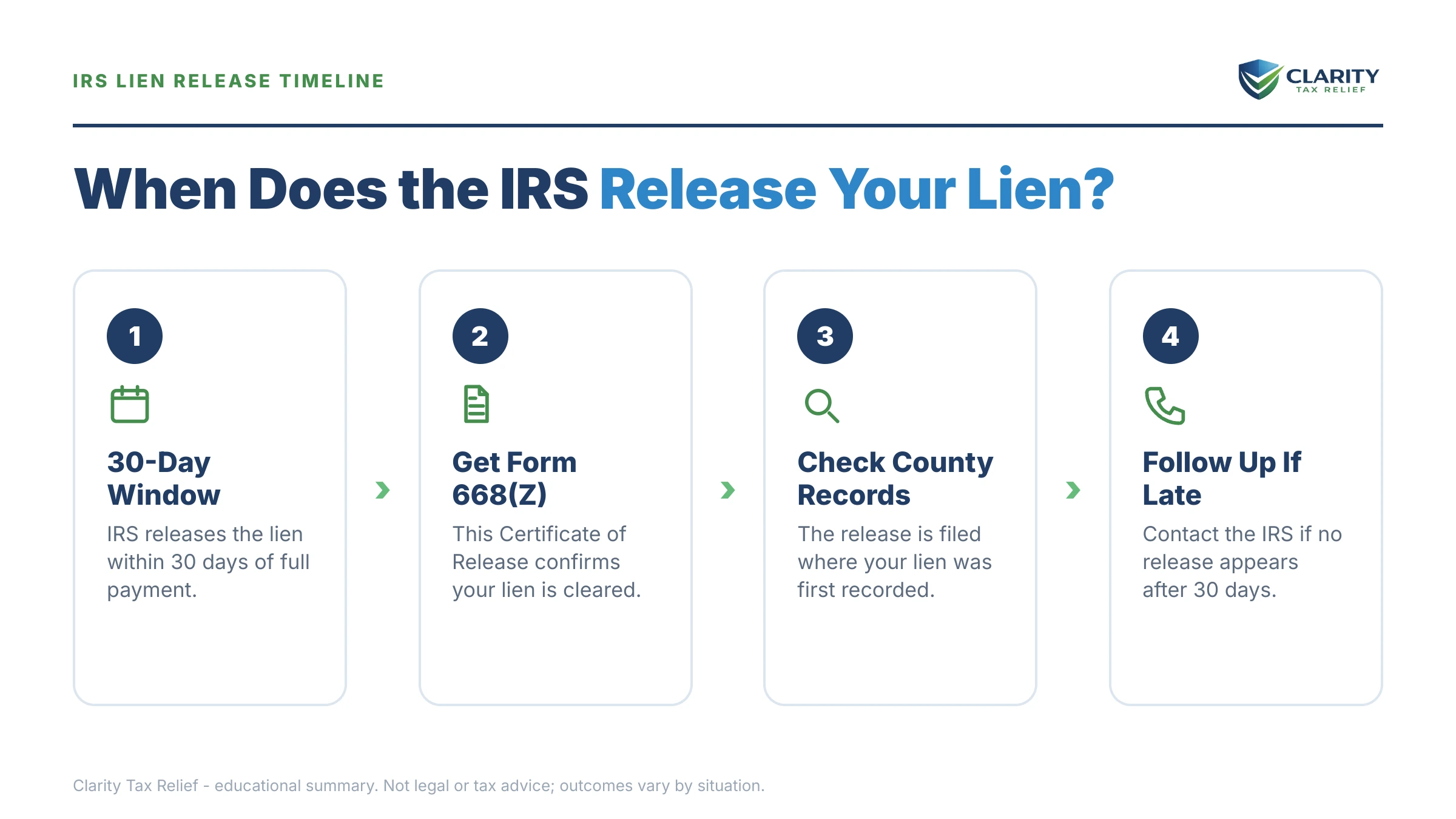
How long for the IRS to release a tax lien: the timeline by scenario
Every path to a lien release runs through the same 30-day statute, but the day the clock starts depends on how the debt gets satisfied. Here's how the scenarios compare:
| How the debt is satisfied | When the 30-day release clock starts | What to watch |
|---|---|---|
| Paid in full with guaranteed funds (Direct Pay, wire, cashier's check) | When the payment posts to your account | Fastest path — save the payment confirmation |
| Paid in full by personal check | Can be delayed until the check clears | Use guaranteed funds when a closing depends on timing |
| Final installment-agreement payment | When the last payment posts and accruals are zeroed | Trailing interest of a few dollars is the #1 stall — get a payoff letter |
| Offer in Compromise completed | When the full offer amount and terms are satisfied | The lien stays in place during periodic offer payments |
| Collection statute (CSED) expires | The filed notice self-releases by its own terms on the "Last Day for Refiling" | Tolling events can extend the date; the IRS can refile before it lapses |
| Bond accepted for the liability | When the IRS accepts the bond | Rare in practice; used mainly in business and estate situations |
End to end, a clean full-payment case usually looks like this: payment posts, the certificate issues sometime inside the 30-day window, and the county records it in the weeks that follow. If you're planning around a loan application or a contract that requires a clean record, build in the statutory 30 days plus your county's recording turnaround, and verify each stage yourself rather than waiting for mail.
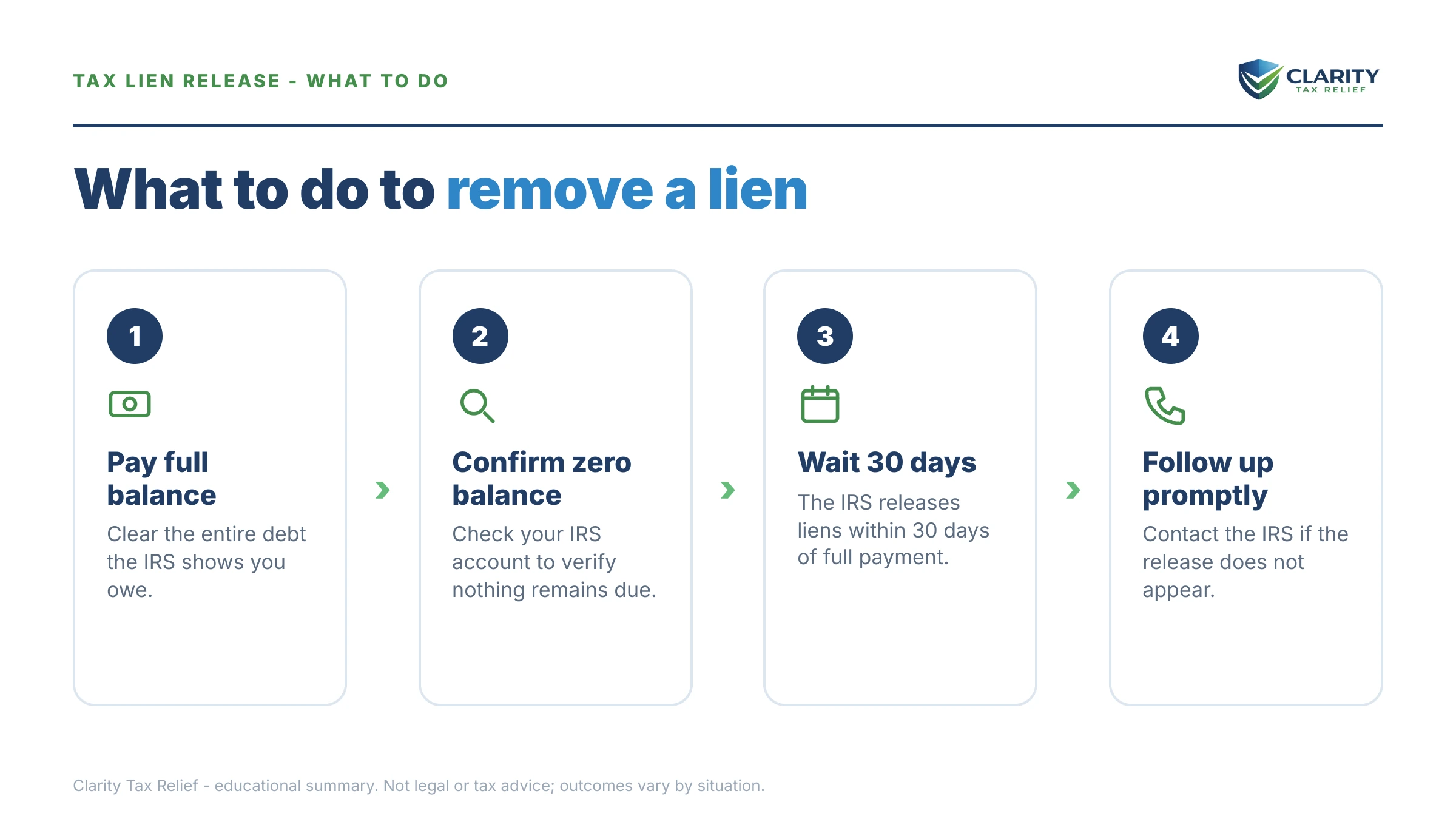
“The IRS releases your lien within 30 days after you have paid your tax debt.”
— Understanding a federal tax lien (IRS.gov)
What happens if you assume the release "just happens"
A lien release that never gets confirmed protects no one — title searches keep flagging the lien until the county record actually clears. Here's the sequence that plays out when a paid-off lien is left on autopilot:
- The certificate issues, but nobody verifies it recorded. The IRS's side is done; the public record still shows an active federal tax lien against you.
- A loan or sale hits underwriting. The title search flags the lien and the deal freezes while you scramble for proof — the exact squeeze covered in our guide to whether you can refinance with an IRS lien.
- Trailing accruals surface. If a few dollars of interest posted after your "final" payment, the account was never satisfied, no certificate ever issued. The lien remains fully valid — still attached to everything you own, including your home (see federal tax lien on your house).
- Proof gets harder to retrieve. Months later you're chasing a certificate through IRS phone lines that, in 2026, are thinner-staffed than they've been in decades, while your closing date doesn't move.
- The lien keeps reaching forward. An unsatisfied federal tax lien attaches to after-acquired property: the truck you buy next year, new business equipment, receivables. It doesn't fade with time; it compounds with your life.
None of this is the IRS being vindictive. It's an automated filing system talking to thousands of county recorders, with no human assigned to make sure your record cleared. That job is yours, or your representative's.
Paid off the debt but the lien is still on the books?
The 30-day release clock may already have run. Send us your payoff confirmation and lien notice — an experienced tax professional will confirm where your release actually stands and, if it's stalled, start the written demand the same day. Free and confidential.
Release, withdrawal, discharge, subordination: which one do you actually need?
"Release" is only one of four ways to get a federal tax lien out of your way, and it's not always the fastest one. If you still owe the balance and need broader strategy on paying it down, that lives in our guide to how to settle tax debt yourself. This table is about the lien itself:
| Option | What it does | Who may qualify |
|---|---|---|
| Release — Form 668(Z) | Declares the lien satisfied; the original filing stays in county records as history | Automatic (within 30 days) once the debt is fully paid, unenforceable, or bonded |
| Withdrawal (Form 12277) | Removes the public notice as if it had never been filed — the strongest cleanup | You may qualify with an assessed balance of $25,000 or less on a direct-debit installment agreement after three consecutive payments, or after full payment and release, with clean compliance |
| Discharge (Form 14135) | Removes the lien from one specific property so a sale can close; the lien survives on everything else | Sellers, typically where the IRS gets its share of the proceeds or the property has no equity |
| Subordination (Form 14134) | Lets a new or refinanced loan jump ahead of the lien in priority; the lien stays filed | Refinancers, where the new loan helps the IRS collect (lower payment, cash to the IRS) |
Two clarifications that trip people up. First, a payment plan alone does not release the lien — the lien stays filed while you pay, unless you qualify for the withdrawal route above. Second, hardship status doesn't touch it either: Currently Not Collectible pauses levies, not liens, as we cover in does CNC stop a tax lien. If your goal is a clean public record while you still owe, withdrawal is the play. If your goal is closing one transaction, discharge or subordination beats waiting for a release.
A worked example: clearing a lien on a $31,200 balance
Say you're a self-employed sole proprietor with a lien filed over $31,200 in unpaid self-employment tax across two years. Here's how the two realistic paths run — the numbers are hypothetical, the mechanics are exact.
Path A — you can pay it off. You request an official lien payoff letter (so trailing interest is included), then pay the full figure through IRS Direct Pay on, say, March 2. The payment posts within days; the IRS's statutory deadline to issue Form 668(Z) is 30 days later, in early April. Add your county's recording turnaround, and a clean record by late April to mid-May is a realistic expectation. If you'd mailed a personal check instead, the clock might not start until the check cleared — potentially adding weeks for no benefit.
Path B — you can't pay it off. But you need the public record clean. $31,200 is above the $25,000 withdrawal ceiling, so the sequence is: pay the balance down by $6,300 to $24,900, set up a direct-debit installment agreement — $24,900 over 72 months is roughly $346/month ($24,900 ÷ 72 = $345.83), before the interest and penalties that keep accruing — make three consecutive direct-debit payments, then file Form 12277 requesting withdrawal. If granted, the notice comes off the record as though never filed, while you keep paying the remaining balance quietly. Total elapsed time is driven mostly by those three monthly payments plus IRS processing of the withdrawal request.
Path B costs a $6,300 lump sum up front. What it buys is a public record that stops answering "yes" when clients, lenders, and licensing boards search your name — years before Path A's payoff would be possible on the same cash flow.
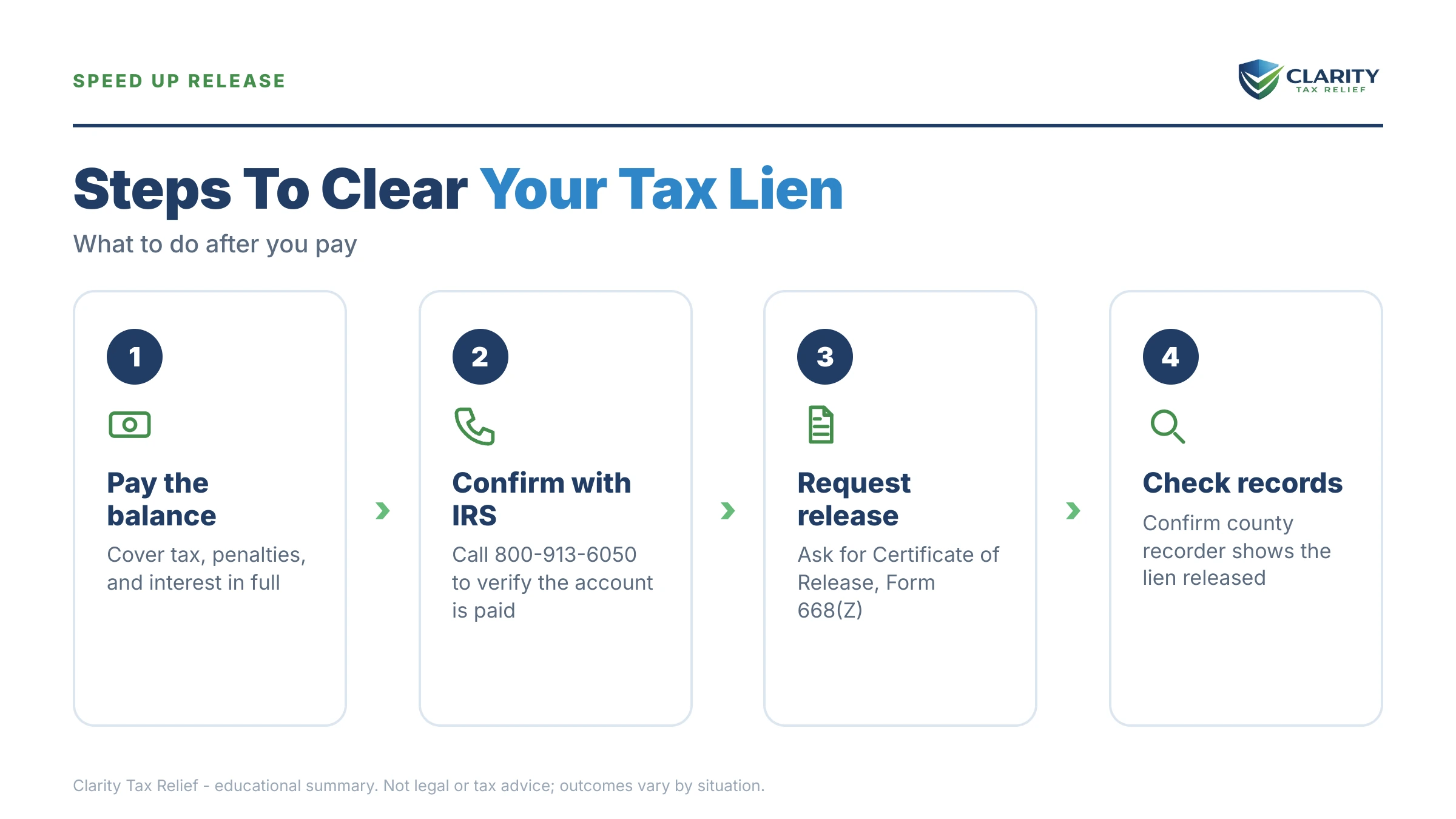
How to get your IRS lien release confirmed, step by step
- Confirm the balance is truly zero. Pull your IRS account transcript and check that the balance shows zero with no trailing penalty or interest accruals — a few leftover dollars is the most common reason a release never issues.
- Mark the 30-day window. Count 30 days from the date your final payment posted (or cleared, if you paid by check). That is the IRS's statutory deadline to issue Form 668(Z).
- Check the county record. Search the recorder's office in every county where a Notice of Federal Tax Lien was filed to confirm the release was actually recorded.
- Request the release in writing if the window passes. Follow Publication 1450: send proof of payment and a copy of the lien notice to the IRS Centralized Lien Operation at 800-913-6050.
- Escalate a stalled release. Contact the IRS Collection Advisory group for your area. The Taxpayer Advocate Service if the delay is causing measurable harm, like a collapsing closing.
- Save certified copies. Order a certified copy of the recorded release from the county and keep it permanently. Lenders may ask for it years from now.
On your transcript, the confirmation you're looking for is code 583 — the release/withdrawal marker that mirrors the code 582 posted when the lien was filed. The transcript updates faster than the mail, so it's your early-warning system that the certificate is in motion.
Need it faster? Expedited release for a closing or refinance
The IRS can expedite a lien release when a specific transaction is on the line. You don't have to lose a sale waiting out the standard cycle. If you have an imminent closing, contact the Centralized Lien Operation or your area's Collection Advisory group with proof of payment (or the closing documents showing the IRS gets paid from escrow) and ask for expedited handling. Title companies do this routinely: the IRS's share is paid directly out of proceeds at the table, and the release or discharge paperwork follows.
If the debt won't be fully paid by the transaction, an expedited release isn't the tool — a discharge or subordination is. Start that application well before your closing date, because those certificates take their own processing time, and read our walkthrough on selling a house with an IRS lien before you sign a purchase agreement. The worst position is discovering the lien at the closing table; the best is walking in with the certificate already in the file.
No payment at all? The lien has its own expiration date
A federal tax lien becomes unenforceable when the 10-year collection statute expires. The filed notice is built to self-release on the "Last Day for Refiling" date printed right on Form 668(Y). That means a lien can die of old age without you paying a dollar, a scenario we cover in depth in does an IRS tax lien expire.
Two big caveats keep this from being a strategy you can nap through. First, the 10-year collection statute (CSED) pauses during events like a pending offer in compromise, bankruptcy, or a collection due process appeal, so the date printed on your lien notice may understate the real expiration. You can estimate when your own statute actually ends with our CSED Calculator. Second, the IRS can refile the notice before the refiling deadline passes if the statute has been extended, which resets the public record. If your lien is within a year or two of its printed date, get the CSED math verified before assuming the finish line, and never let anyone tell you the debt simply "disappears at 10 years" without checking for tolling.
When you can handle the lien release yourself
Most straightforward releases don't need professional help. If you paid in full with guaranteed funds, your transcript shows a zero balance. You have no deadline pressure, the process is genuinely DIY: wait out the 30 days, check the county record, and send the Publication 1450 request if it slips. The same goes for ordering copies of a release that already recorded — that's a phone call and a county records fee, not an engagement.
Experienced help changes the outcome in four situations. A transaction is on a clock — a closing or refinance where a stalled release, discharge, or subordination has to be pushed through Collection Advisory before a date that won't move. The balance isn't actually zero — trailing accruals, a payment applied to the wrong year, or multiple lien filings across counties that each need chasing. You're engineering a withdrawal — the paydown-to-$25,000, direct-debit, Form 12277 sequence has ordering rules where one misstep restarts the clock. And the lien touches a business — liens over receivables and equipment raise priority questions with your other creditors that are worth getting right the first time.
If a closing date is bearing down and the release still hasn't recorded, have an experienced tax professional chase it in parallel while you prep the deal — call (888) 825-7779 or use the 2-minute form for a free look at where your release is stuck.
The paperwork that proves your lien is gone
When a lender or title company asks for proof, "the IRS said so on the phone" carries no weight. These documents do:
| Document | What it proves | Where to get it |
|---|---|---|
| Form 668(Z), Certificate of Release | The IRS formally released the lien | Mailed by the IRS; copies from the Centralized Lien Operation |
| Certified county recording of the release | The public record is cleared — what title companies want | The recorder's office where the lien was filed |
| Account transcript showing code 583 | The release/withdrawal processed on IRS systems | Your IRS online account or transcript request |
| Lien payoff letter (before final payment) | The exact figure that satisfies the lien on a given date | Request from the IRS before paying — prevents trailing accruals |
One thing you will not find anywhere: the lien on your credit report. The bureaus dropped tax liens in 2018, so the damage today runs through public records and title searches instead — full details in tax lien on credit report.
Terms on your lien paperwork, decoded
- Notice of Federal Tax Lien (Form 668(Y)): the public document the IRS filed with your county recorder telling the world the lien exists.
- Certificate of Release (Form 668(Z)): the document that formally extinguishes the filed lien once the debt is satisfied.
- Self-releasing lien: language built into Form 668(Y) that automatically releases the lien on the "Last Day for Refiling" if the IRS doesn't refile first.
- Last Day for Refiling: the date printed on your lien notice by which the IRS must refile to keep the lien alive past the original statute.
- CSED: the Collection Statute Expiration Date — 10 years from assessment, extendable by tolling events like an OIC, bankruptcy, or appeals.
- Centralized Lien Operation: the IRS unit that files, releases, and provides copies of federal tax lien documents.
For the IRS's own overview of how liens arise and end, see Understanding a Federal Tax Lien. To make the final payment that starts your release clock, use IRS.gov/payments. If a stalled release is causing real financial harm, the Taxpayer Advocate Service exists for exactly that.
Tax lien release questions, answered
How long after paying the IRS in full is a tax lien released?
By law, the IRS has 30 days from the date your balance is fully satisfied to issue a Certificate of Release of Federal Tax Lien (Form 668(Z)). Recording that certificate with your county can add several more weeks. If you paid by personal check, the clock may not start until the check clears, so use guaranteed funds when timing matters.
What if it's been more than 30 days and my lien still isn't released?
Request the release in writing using the procedure in IRS Publication 1450: send proof of payment and a copy of the lien notice to the IRS Centralized Lien Operation (800-913-6050). If that stalls, escalate to the IRS Collection Advisory group for your area, and to the Taxpayer Advocate Service if the delayed release is causing financial harm, such as a collapsing closing.
Does an IRS tax lien release itself after 10 years?
Generally yes — the Notice of Federal Tax Lien contains self-release language that takes effect on the "Last Day for Refiling" printed on the form, which tracks the 10-year collection statute. But events like an offer in compromise, bankruptcy, or a collection due process appeal pause that clock. The IRS can refile the notice before it lapses. Never assume expiration without checking your dates.
How do I get a copy of my Certificate of Release?
The IRS sends Form 668(Z) to the recording office where the lien was filed. You can request your own copy from the Centralized Lien Operation. For lenders and title companies, a certified copy from the county recorder where the release was recorded usually carries the most weight. Keep at least one copy permanently. You may need it years later.
Does a released tax lien still show on my credit report?
No. The three major credit bureaus stopped reporting tax liens entirely in 2018, so neither the lien nor its release appears on your credit report today. The lien remains visible in county public records, however, and the recorded release is what shows searchers the matter is closed.
What's the difference between a lien release and a lien withdrawal?
A release says the debt is satisfied but leaves the original filing in the public record as history. A withdrawal (requested on Form 12277) removes the notice as if it had never been filed. You may qualify for withdrawal if your assessed balance is $25,000 or less and you're making direct-debit installment payments, or after full payment if you've stayed compliant.
Can I sell or refinance my house before the lien release records?
Yes. You don't have to wait. For a sale, a certificate of discharge (Form 14135) removes the lien from that specific property, and title companies routinely pay the IRS directly out of closing proceeds. For a refinance, subordination (Form 14134) lets the new loan move ahead of the lien. Both take processing time, so apply well before your closing date.
Does finishing an Offer in Compromise release the tax lien?
Yes — once you pay the full offer amount and meet the offer's terms, the lien must be released within 30 days, the same statutory window as full payment. The lien stays in place while you're still making periodic offer payments, though, and defaulting on the offer's five-year compliance terms can reinstate the original debt.
How does my IRS transcript show a lien was released?
Your account transcript posts code 583 when a lien release or withdrawal is processed, mirroring the code 582 that posted when the lien was filed. Transcript codes are internal markers, not legal proof — a lender or title company will still want the recorded Form 668(Z) from your county, so use the transcript to track progress, not to close a loan.
Your Next 24 Hours
- Find your lien notice. On the Form 668(Y) that came with Letter 3172, locate two things: the recording office where the lien was filed (that's the county record you need to check) and the "Last Day for Refiling" date.
- Gather your proof. Pull your final payment confirmation, your most recent IRS account transcript, and a copy of the lien notice. Those three documents are everything a written release demand requires.
- Get a free lien review. If the 30-day window has passed, the county record hasn't cleared, or a closing depends on this — call (888) 825-7779 or use the free case review form. Every week the record stays uncleared is a week the lien keeps blocking financing you may need.
This guide is general information, not tax or legal advice for your specific situation. Eligibility for IRS programs depends on individual facts and circumstances; no outcome is guaranteed.