
IRS Hardship Programs
Does CNC Stop a Tax Lien? What Currently Not Collectible Pauses, and What It Doesn't (2026)
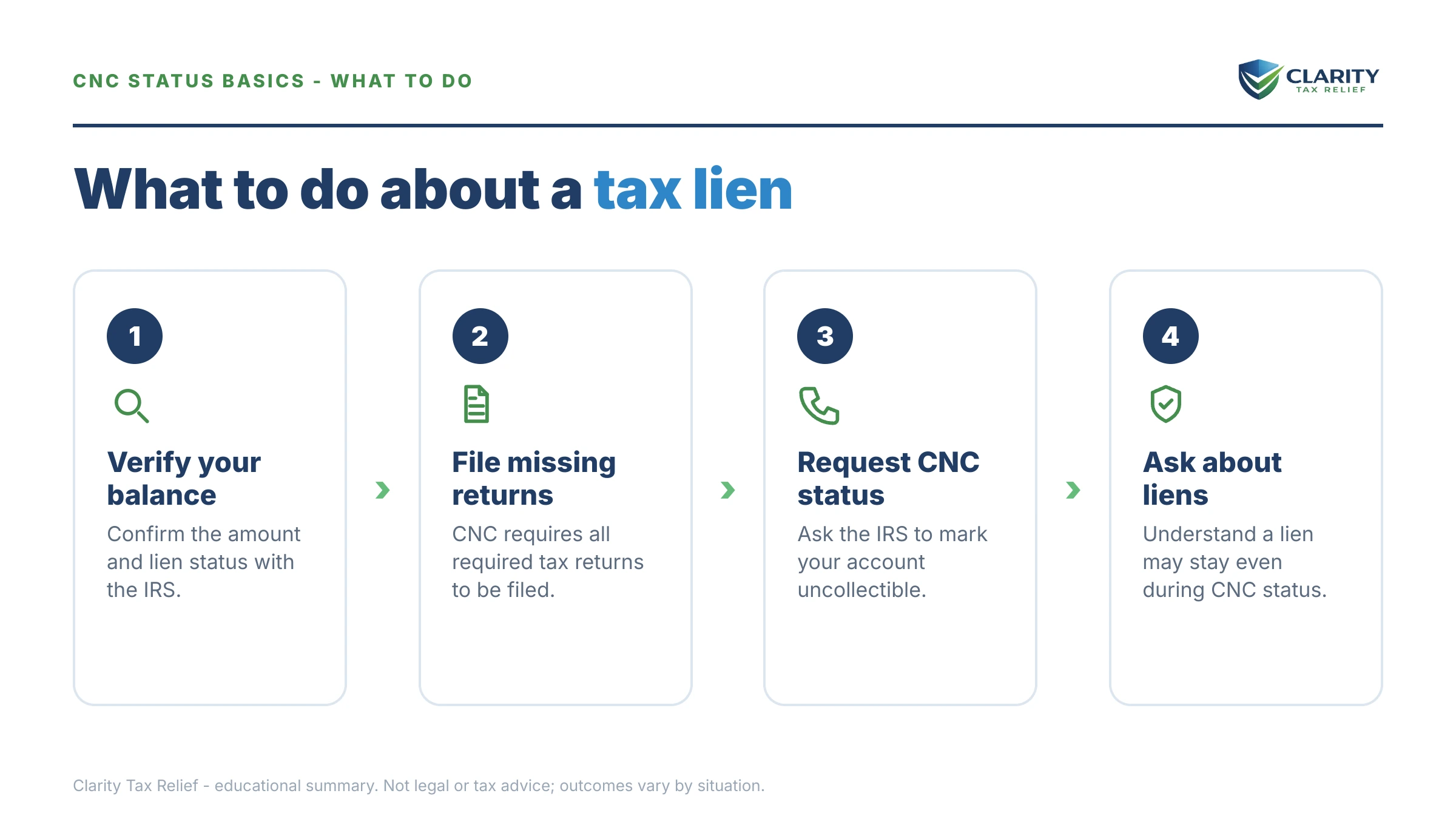
Does CNC stop a tax lien? No. Currently Not Collectible status pauses levies and garnishments. It does not stop, prevent, or release a federal tax lien. In fact, the IRS often files a Notice of Federal Tax Lien at the same time it approves CNC, typically when the balance is $10,000 or more.
You did the hard part. You proved to the IRS that after rent, gas, and quarterly estimates there's nothing left to take, and your account went into hardship status. Then a lien notice showed up anyway, or you're reading the fine print before applying and wondering if it will. That's not a mistake on the IRS's end; it's how CNC is designed, and once you understand the split between a lien and a levy, the whole thing gets manageable.
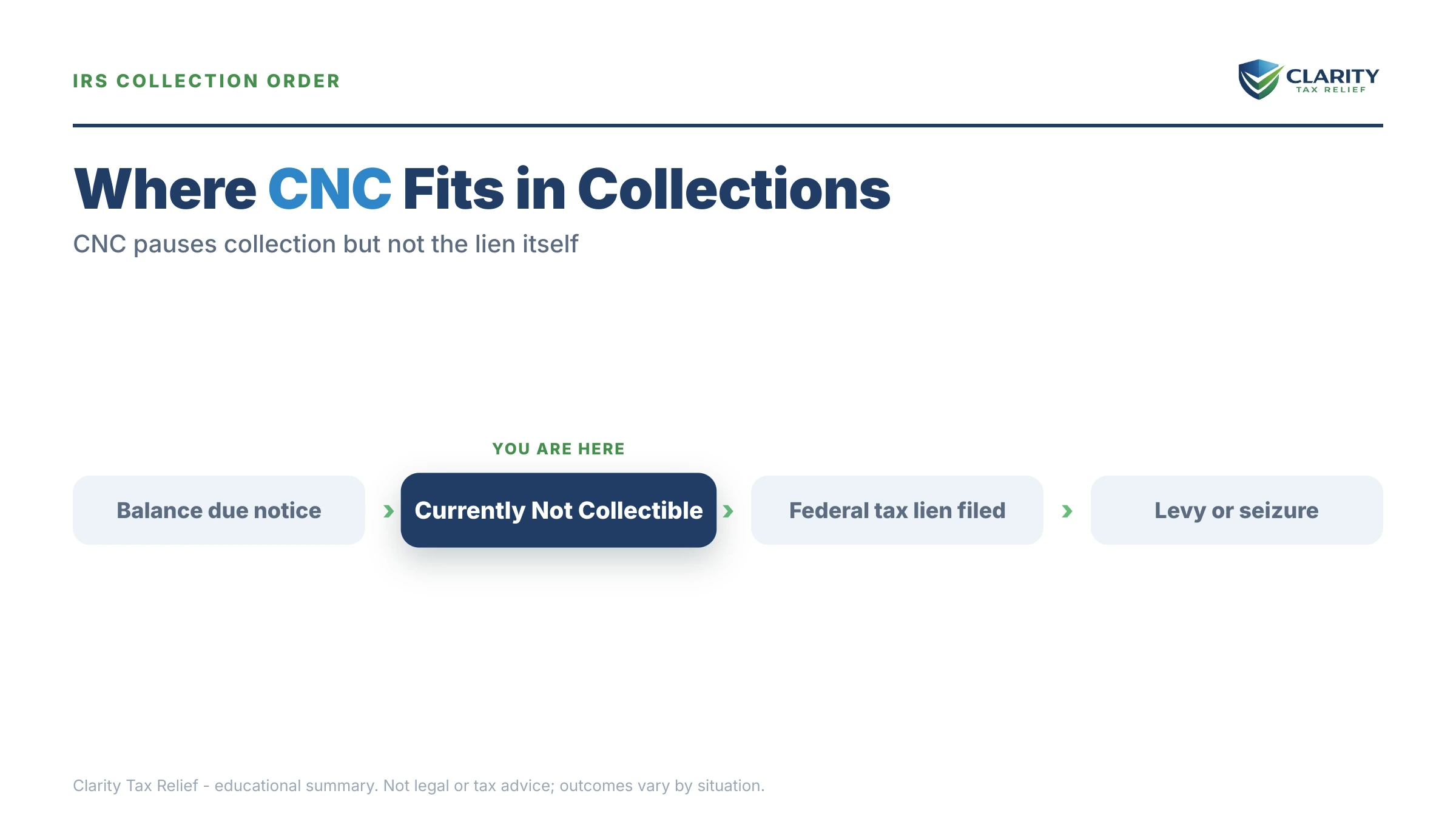
The confusion comes down to one distinction the approval letter never explains clearly. The image below shows exactly where hardship status and a lien filing each appear on your IRS account, and how to tell at a glance which one you're actually dealing with.
⏱ The only hard clock here: if the IRS files a lien, Letter 3172 starts a roughly 30-day window to request a Collection Due Process hearing (Form 12153) — the exact deadline is printed on the letter. If no lien has been filed, CNC itself has no deadline, but penalties and interest keep accruing every month you're in it.
Lien vs. levy: the one distinction that answers "does CNC stop a tax lien"
CNC suspends levies, the IRS taking money, while a lien is a legal claim that CNC never touches. A levy is action: a bank account swept, a paycheck garnished, a client's payment to you intercepted. A lien is a position: the government's recorded claim against everything you own, sitting quietly until you try to sell, refinance, or borrow.
Here's the part most CNC articles skip: the lien itself already exists before anyone files anything. Under IRC §6321, a statutory lien arises automatically once the IRS assesses the tax, sends a demand, and you don't pay. What the IRS decides to file, or not file — is the Notice of Federal Tax Lien (NFTL), the public county-record document that tells lenders, title companies, and anyone who searches that the claim exists.
CNC is a decision about collection activity. Filing an NFTL isn't collection activity in the IRS's eyes — it's protecting the government's place in line while collection sleeps. That's why the two coexist so easily, and why hardship status can't be used to make a lien go away.
| Collection action | Paused by CNC? | What actually happens |
|---|---|---|
| Bank levy / wage garnishment | Yes | Suspended while the account carries hardship status |
| Levy on 1099 receivables or client payments | Yes | No levies issued to your payers while CNC holds |
| New Notice of Federal Tax Lien | No | Often filed as part of the CNC approval when the balance tops $10,000 |
| Existing federal tax lien | No | Stays on the public record until released, withdrawn, or expired |
| Refund offset | No | Any refund is automatically applied to the old balance |
| Penalties and interest | No | 0.5%/month failure-to-pay penalty plus daily-compounding interest keep accruing |
| 10-year collection clock (CSED) | Keeps running | Works in your favor — CNC does not pause the statute |
| Passport certification ($66,000 in 2026) | Generally paused | Hardship-CNC debts are typically excluded from certification |
“A lien is not a levy. A lien secures the government’s interest in your property when you don’t pay your tax debt. A levy actually takes the property to pay the tax debt.”
— Understanding a federal tax lien (IRS.gov)
Why the IRS files a tax lien when it grants CNC
IRS procedures generally require a lien-filing determination before an account over $10,000 is reported currently not collectible. That's the mechanism behind the pattern that surprises so many people: the hardship approval and the lien notice arriving in the same season. Before the IRS shelves your account, possibly for years, it decides whether to stake its public claim first, and above $10,000 the default answer is yes.
The logic is coverage, not punishment. CNC can last until your finances recover or until the 10-year statute expires. If you inherit money, land a big contract, or sell property during that stretch, the lien makes sure the IRS gets paid from it. Without an NFTL on file, a mortgage lender or a buyer would take priority; with one, the government's claim is recorded first.
For a 1099 contractor there's an extra reason: you have no employer paycheck to garnish later, so the lien is often the only security the IRS holds on a self-employed hardship account. If your income is business income, expect the lien determination to be taken seriously. (The hardship math itself works differently when you're self-employed — see currently not collectible self employed for how the IRS treats business income and expenses in the 433 analysis.)
Below $10,000, a lien filing during CNC is uncommon — no determination is generally required. The IRS rarely spends the filing effort on small balances. That single threshold changes the strategy completely depending on what you owe:
| Balance when CNC is approved | Lien filing during CNC | What that means for you |
|---|---|---|
| Under $10,000 | Uncommon — no lien determination generally required | CNC without a public lien is realistic; watch that accruals don't push you over the line |
| $10,000 – $25,000 | Expected — a determination typically precedes CNC | Plan for Letter 3172; weigh a streamlined installment agreement if avoiding the lien matters more than a $0 payment |
| $25,000 – $66,000 | Near-standard | The lien secures the debt while collection sleeps; discharge and subordination become your tools for any property moves |
| Over $66,000 (2026 passport threshold) | Near-certain | Lien filed, but hardship CNC generally blocks passport certification; expect periodic financial reviews |
What a lien during CNC actually costs a 1099 contractor
What the lien touches while CNC holds
A Notice of Federal Tax Lien attaches to everything you own and everything you acquire later — including business assets. For a contractor that means equipment, vehicles, accounts receivable, and the rights to payments clients owe you. The IRS isn't taking any of it while CNC holds; the claim just sits recorded against all of it.
Where it bites in practice:
- Client and vendor checks. General contractors, property managers, and larger companies sometimes run public-records searches before onboarding a sub. A recorded lien can show up in that search even though it never appears on your credit report — see where liens are recorded and how the lookup works in tax lien public record.
- Credit and financing. Since 2018 the three credit bureaus no longer report tax liens, so your score doesn't drop. But mortgage underwriters and equipment lenders search public records directly, and a lien usually has to be dealt with before a home loan closes.
- Selling or refinancing property. The lien clouds title. Sales and refinances can still happen from inside CNC — through discharge or subordination, covered below — but they take paperwork and lead time.
What the lien does not do during CNC: it doesn't take money from your bank account, doesn't touch your clients' payments to you, and doesn't force a sale of anything. Those are levy powers, and levy powers are exactly what your hardship status suspends.
Does currently not collectible remove an existing tax lien? No: here are the real exits
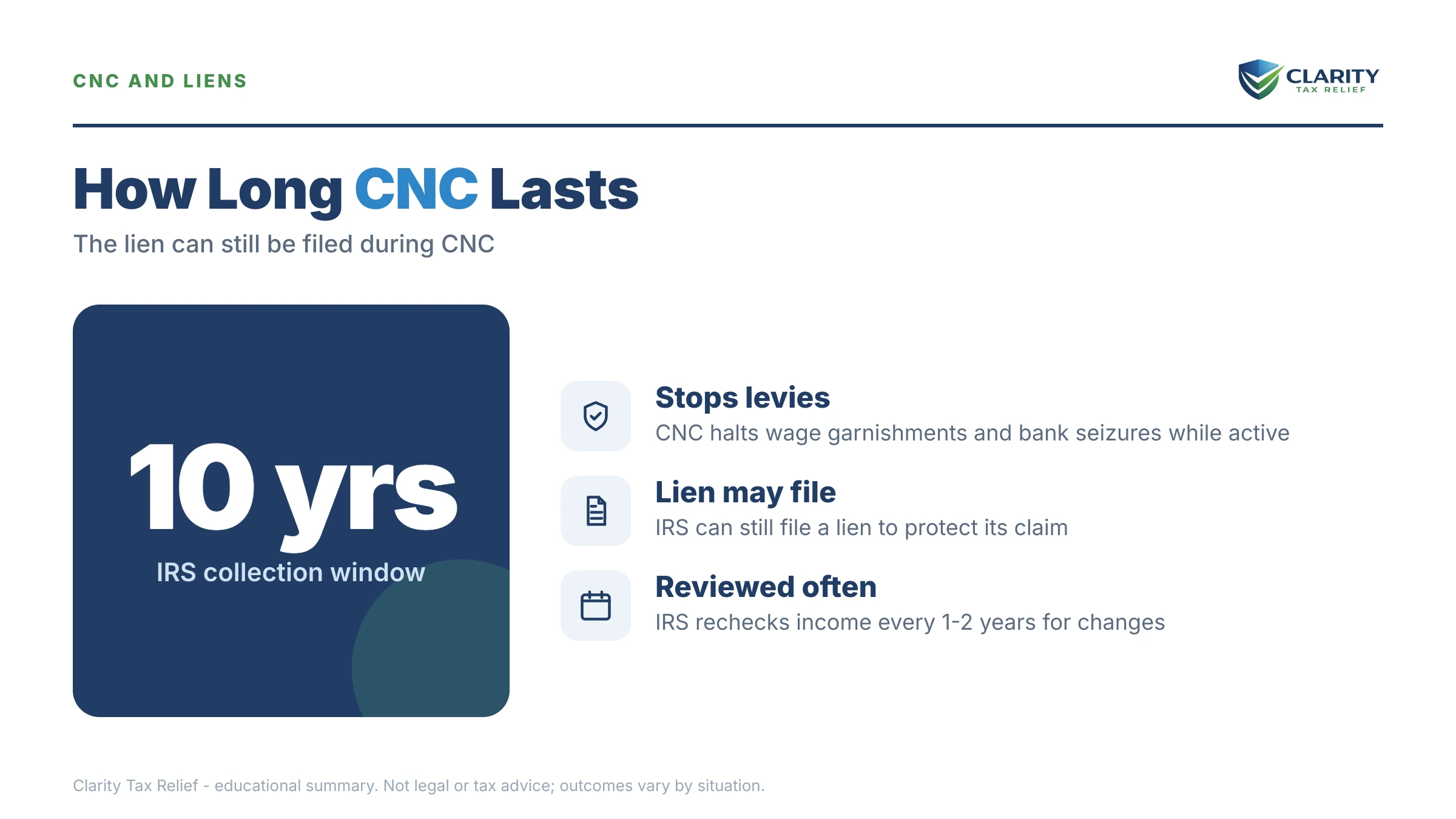
No IRS status makes a filed lien disappear; only release, withdrawal, discharge, subordination, or expiration do. If an NFTL was already on record before your hardship approval, CNC leaves it exactly where it was. The general mechanics of getting a lien off your record, and how long the IRS takes once you've earned it — are covered in our guide to how long for irs to release a tax lien. Here's how each path interacts with CNC specifically:
- Release happens automatically within 30 days after the debt is fully paid or the collection statute expires. From inside CNC, full payment is by definition off the table — expiration is the release path most hardship accounts actually reach. Proof comes as a certificate of release of tax lien.
- Self-release at the CSED is built into the lien document itself: an NFTL that isn't refiled becomes unenforceable when the 10-year statute runs out. The mechanics, and the refile exception — are in does irs tax lien expire.
- Withdrawal (Form 12277) erases the public notice. But its main routes — full payment, or a direct-debit installment agreement on $25,000 or less — conflict with hardship status. During CNC it's realistic only for liens filed in error or prematurely.
- Settlement paths exist too: if your finances are bad enough for CNC, they may be bad enough for an Offer in Compromise, which ends in a lien release when the offer is paid. How liens are handled during and after an offer is its own topic — see does oic remove tax lien.
Say you owe $4,800: the CNC-and-lien math for a 1099 contractor
Here's a clearly hypothetical example with the arithmetic shown. Say you're a contractor who owes $4,800 from a rough year. You filed, couldn't pay, and a slow winter means your Form 433-F shows income barely covering allowable living expenses. The IRS approves CNC.
- Lien risk: low. At $4,800 you're under the $10,000 line where a lien determination is generally required, so hardship status without a public lien is the likely outcome.
- The balance still grows. The failure-to-pay penalty runs 0.5% per month — $24 a month on $4,800 — until it caps at 25% of the tax ($1,200). Interest compounds daily on top at the federal short-term rate plus 3%. Call it roughly $600 added in the first year, tapering as the penalty caps.
- The threshold watch. Even after several years of accrual, a $4,800 debt is unlikely to cross $10,000, unless you add a new unpaid year. Stack a second $6,000 balance on top and you're over the line, back in lien-determination territory, and likely out of CNC entirely for defaulting on current-year compliance.
- The alternative worth pricing. Because the balance is under $10,000, a guaranteed installment agreement is available if you can pay within 36 months: $4,800 ÷ 36 ≈ $134 a month, a bit more with accruals. A streamlined 72-month plan runs about $67 a month before interest. Either retires the debt, keeps refund offsets short-lived, and takes the lien question off the table, if your cash flow can absorb it.
Now flip one number: if that same contractor owed $14,800, the CNC approval would almost certainly come with a lien determination, and Letter 3172 would be part of the package. Same hardship, same status — completely different lien outcome. The balance band, not the hardship, drives the lien.
What happens to the lien if you stay in CNC and do nothing
A CNC account with a lien doesn't sit frozen. It moves through a slow, automated sequence. Nothing dramatic happens next week, but each stage below changes your position:
- Accrual continues. Interest compounds daily and the 0.5%/month failure-to-pay penalty runs until it caps at 25% — the balance on your annual reminder notice goes up every year, not down.
- Annual reminders arrive. The IRS sends a yearly balance-due reminder (the CP71 series). It's informational, not enforcement, but it's also how many people discover their $8,000 debt is now $10,500.
- The balance crosses $10,000. If accruals or a new tax year push you over the line, a lien determination becomes standard even if none was made at approval.
- A review reopens the account. The IRS screens CNC accounts against new returns. Income above the threshold set at approval, or an unfiled return — closes the hardship status and sends you back to active collections. What that looks like is covered in cnc status removed.
- Out of CNC, the notice ladder resumes. Reminder notices restart, escalating toward a final notice of intent to levy, with the lien already on file, the IRS's position is fully secured when levies become available again.
- At the CSED, everything ends. If you reach the 10-year Collection Statute Expiration Date still in hardship, the debt becomes uncollectible and the lien self-releases, unless the IRS refiles it in the rare case it believes assets are worth chasing. You can estimate your own expiration date with our CSED Calculator.
One 2026 reality check: the IRS workforce shrank roughly 27% in 2025, and human reviews are slower. But the lien filings, annual reminders, and CNC income screens are automated. Understaffing delays the people, not the machine.
In CNC with a lien on your record, or worried one's coming?
Get your transcript and lien situation reviewed free before interest quietly pushes your balance across the next threshold. An experienced tax professional will tell you whether the lien can be challenged, worked around, or simply outlasted, and whether CNC is even your best option at your balance.
Your options for a tax lien while in CNC status
You can't erase a lien from inside CNC. But you can appeal it, work around it, or outlast it, and each tool has a specific trigger. The right one depends entirely on what the lien is blocking:
| Path | Form / trigger | When it works during CNC |
|---|---|---|
| Appeal the new lien filing | Form 12153, within ~30 days of Letter 3172 | Contest the filing or propose alternatives at a Collection Due Process hearing — the one chance to challenge the lien with full appeal rights |
| Lien withdrawal | Form 12277 | Rare in CNC — realistic only for premature or improper filings, or where withdrawal would demonstrably help the IRS collect |
| Discharge of specific property | Form 14135 | Selling a home or asset; the lien is removed from that property and the IRS is paid from your equity at closing — apply about 45 days ahead |
| Subordination | Form 14134 | Refinancing; the lender moves ahead of the lien so the loan can close, usually because the refi improves your ability to pay |
| Full payment → release | Automatic within 30 days of payoff | Ends the lien entirely, usually via family help, a windfall, or leaving CNC for a payment plan |
| CSED expiration → self-release | Automatic at the 10-year mark | The default endgame for long-term hardship accounts, unless the IRS refiles |
Two of these deserve a closer look before you need them. If you own a home and think you might sell during CNC, read up on tax lien discharge before you list — title companies flag the lien immediately. The discharge application is the difference between a delayed closing and a dead one. If a refinance is the goal, tax lien subordination is the parallel tool. Neither requires giving up your hardship status.
And if you just received the lien notice, don't skip the appeal window: Letter 3172 is the only point in the process where you get an independent hearing on the filing itself, requested with Form 12153 (CDP hearing). A hearing rarely erases a properly filed lien. But it can catch procedural errors and lock in your right to go to Tax Court if Appeals gets it wrong.
How to respond, step by step
- Pull your IRS account transcript. Look for code 530 (currently not collectible) to confirm your hardship status, and code 582 (lien filed) to see whether a Notice of Federal Tax Lien is already on your account.
- Check the date on any Letter 3172. The lien-filing notice starts a roughly 30-day window to request a Collection Due Process hearing with Form 12153 — the exact deadline is printed on the letter itself.
- Answer every financial-review letter. An ignored request for an updated Form 433-F is the fastest way to lose hardship status and put levies back on the table — the lien question becomes secondary if CNC collapses.
- Match the lien tool to your goal. Discharge (Form 14135) to sell property, subordination (Form 14134) to refinance, a CDP hearing to contest the filing, or simply let the 10-year clock run if the lien isn't blocking anything.
- Get experienced eyes on anything with a closing date. If the lien is holding up a sale, refinance, or business contract, get a free review before the deal timeline forces a bad decision — (888) 825-7779.
When you can handle this yourself, and when help changes the outcome
Plenty of CNC-and-lien situations need no professional at all. You can confidently handle it yourself when:
- Your balance is under $10,000 and no lien has been filed. Requesting CNC with a straightforward Form 433-F, or choosing a small monthly plan instead — is genuinely DIY territory. Start with how to qualify for cnc.
- A lien exists but isn't blocking anything. If you rent, aren't seeking credit. Your clients don't run public-records checks, the cheapest move is often to keep CNC current and let the CSED run.
- You just need to confirm status. Reading your own transcript for codes 530 and 582 takes ten minutes with an IRS online account.
Experienced help earns its cost in a narrower set of situations: a Letter 3172 with the 30-day CDP clock already running, a sale or refinance on a deadline that needs a discharge or subordination package done right the first time, multiple unfiled years that have to be cleaned up before any hardship request survives review, business or payroll tax mixed into the balance, or a balance sitting near the $10,000 or $66,000 thresholds where the filing-or-not decision is still live. In those cases the question isn't whether you could do the paperwork — it's whether a first-attempt mistake costs you the closing, the appeal right, or the status itself. The Taxpayer Advocate Service (taxpayeradvocate.irs.gov) is also a free option when an IRS delay is causing you measurable harm.
If a lien filed during hardship status is holding up a closing, a contract, or a loan, have an experienced tax professional review it free, or call (888) 825-7779, before the deal's timeline makes the decision for you.
Terms on your transcript and lien notice, decoded
- Statutory lien vs. NFTL: the lien itself arises automatically by law when you don't pay after assessment. The Notice of Federal Tax Lien is the public filing that tells everyone else it exists.
- Levy: the actual taking of money or property — the thing CNC suspends.
- Code 530: the transcript code showing your account was reported currently not collectible.
- Code 582: the transcript indicator that a lien has been filed against your account.
- CSED: the Collection Statute Expiration Date — 10 years from assessment, still ticking while you're in CNC.
- CDP rights: your Collection Due Process right to an independent Appeals hearing after a lien filing (Letter 3172) or before most levies.
- Self-releasing lien: language built into every NFTL making it release automatically at the statute date unless the IRS refiles.
For the IRS's own overview of how liens arise, attach, and end, see Understanding a Federal Tax Lien. And if your situation improves enough to end CNC by paying, every payment method is at IRS.gov/payments.
CNC and tax lien questions, answered
Does CNC remove a tax lien that was already filed?
No. CNC changes how the IRS collects going forward. It does not undo anything already on file. A Notice of Federal Tax Lien filed before your hardship approval stays on the public record until the debt is paid, the 10-year collection statute expires, or you win a withdrawal, discharge, or subordination. Hardship status and the lien simply coexist, often for years.
Will the IRS file a new tax lien when it approves CNC?
Often, yes, and it can be part of the approval itself. IRS procedures generally require a lien-filing determination before an account over $10,000 is reported currently not collectible, so many taxpayers receive Letter 3172 within weeks of their hardship approval. Below $10,000, a filing is possible but much less common.
Does CNC stop levies and wage garnishments?
Yes. That is exactly what CNC stops. While your account carries hardship status, the IRS suspends bank levies, wage garnishments, and levies on 1099 receivables. The protection lasts only as long as the status does: if a review finds your income has recovered, or you skip a required filing, active collection resumes.
Does the 10-year collection statute keep running during CNC?
Yes, and that works in your favor. Unlike an Offer in Compromise or bankruptcy, CNC does not pause the Collection Statute Expiration Date. Every month in hardship status is a month closer to the debt, and the lien securing it — expiring. Some taxpayers ride CNC all the way to the CSED and never pay the balance, though the IRS reviews the account along the way.
Can I get a lien withdrawn while I'm in CNC?
Rarely. The main withdrawal routes require either full payment or a direct-debit installment agreement on a balance of $25,000 or less — both incompatible with hardship status. Withdrawal during CNC is realistic only if the lien was filed in error or prematurely, or if you can show that withdrawal would actually help the IRS collect. Form 12277 is the request.
Can I sell or refinance my house while in CNC with a tax lien?
Yes, with the right paperwork. A discharge (Form 14135) removes the lien from the specific property you're selling so the sale can close, with the IRS paid from your equity at closing. A subordination (Form 14134) lets a refinance lender move ahead of the lien. Neither requires leaving CNC, but both take weeks — start at least 45 days before closing.
Does a tax lien filed during CNC hurt my credit score?
Not directly. The three major credit bureaus stopped reporting tax liens in 2018, so a Notice of Federal Tax Lien no longer appears on your credit report or lowers your score. It is still a public record, though — mortgage underwriters, commercial clients, and lenders who run public-records searches will find it, which is where the real damage usually shows up for a contractor.
Can the IRS take my passport while I'm in CNC?
Generally, no. Debts in currently-not-collectible hardship status are typically excluded from 'seriously delinquent tax debt' passport certification, even above the 2026 threshold of $66,000. If your passport was certified before CNC was approved, the hardship determination is grounds for the IRS to reverse the certification, but confirm the reversal actually posts rather than assuming it.
Will the IRS keep my tax refund while I'm in CNC?
Yes. CNC pauses levies, not offsets — any refund you're owed is automatically applied to the old balance until it's gone. For a 1099 contractor this often matters less, since no withholding usually means no refund. But if you overpay a quarterly estimate or claim a refundable credit, expect the IRS to keep that money.
Your next 24 hours
- Check your account for codes 530 and 582. Pull your account transcript (or dig out any Letter 3172) and confirm two things: is your CNC status actually posted, and has a lien been filed? If a 3172 exists, note the response deadline printed on it — that 30-day CDP window is the only clock in this situation.
- Gather three documents. Your most recent tax return, your CNC approval letter or last Form 433-F, and any lien notice or annual reminder showing your current balance. Those three tell a professional everything needed to map your options in one conversation.
- Get the free case review. Call (888) 825-7779 or use the 2-minute form. Whether the right move is appealing the lien, packaging a discharge for a sale, or simply keeping CNC intact while the statute runs, the balance grows a little every month you wait to find out.
This guide is general information, not tax or legal advice for your specific situation. Eligibility for IRS programs depends on individual facts and circumstances; no outcome is guaranteed.