
IRS Collections
How Much Can the IRS Garnish From My Paycheck? (2026)
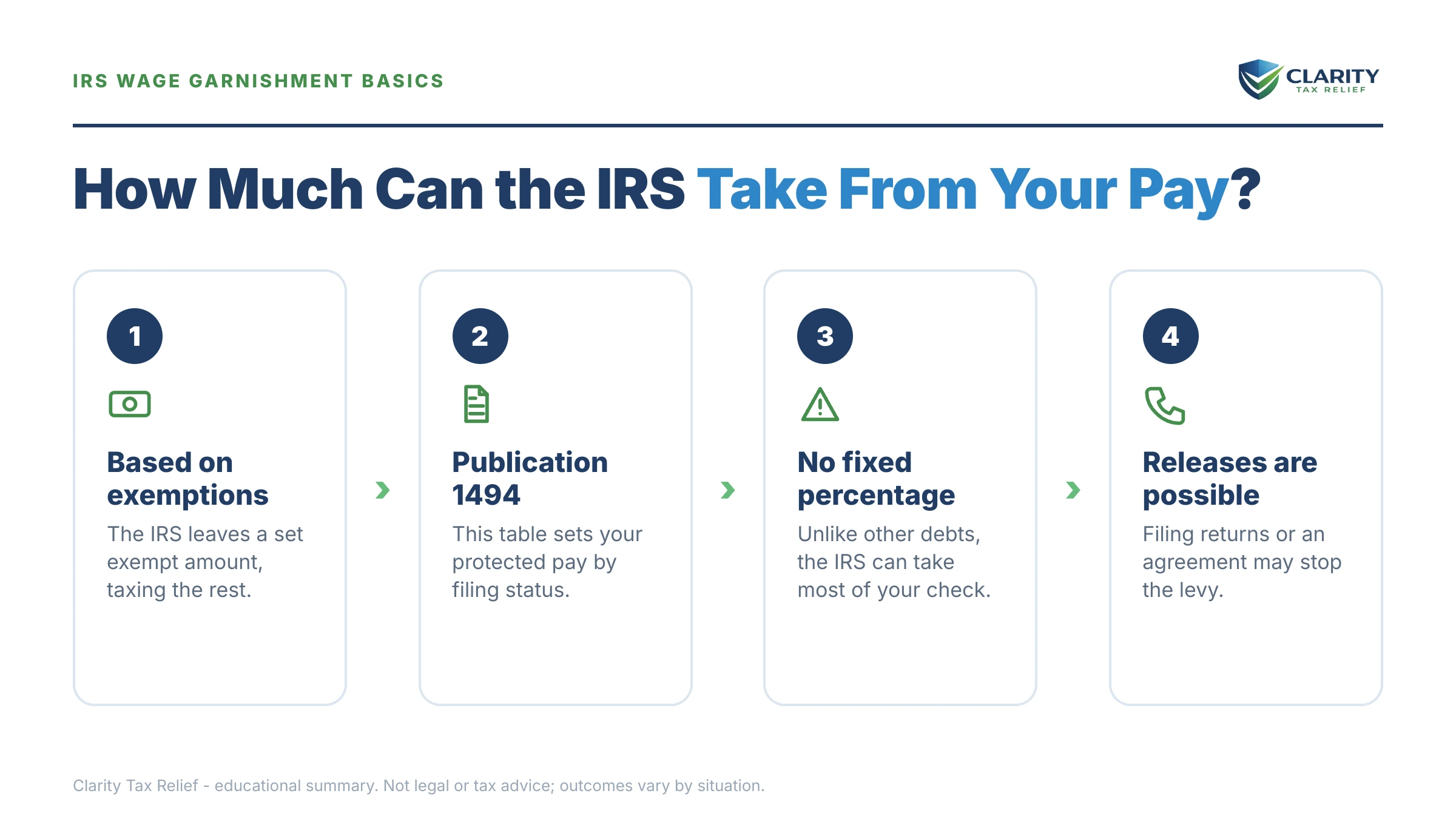
The short answer: how much can the IRS garnish from my paycheck? The IRS doesn't take a fixed percentage. It takes everything above a protected "exempt amount" set by Publication 1494, based on your filing status, dependents, and pay frequency, often half or more of your take-home pay, far beyond the 25% cap ordinary creditors face.
Payroll just told you a levy notice arrived, and now you're doing grim arithmetic: what actually lands in the account on Friday, and can it cover the mortgage? The number is probably worse than you're guessing, but the levy is also one of the most fixable enforcement actions the IRS takes, and the fix can be in motion before your next pay date.
⏱ Your clock: if the garnishment is already running, every payday is a deadline — an IRS wage levy is continuous and repeats each pay period until released. If your employer just handed you the levy paperwork, you typically have only a few days (the window is printed on the form) to return the Statement of Dependents that sets how much of each check you keep.
Further down, the image shows exactly what the levy paperwork your employer received looks like and where to find the parts that control your protected amount — knowing which page to grab matters, because one of those pages is due back almost immediately.
How much can the IRS garnish from my paycheck? There is no 25% cap
The IRS can garnish everything in your paycheck above an exempt amount published in IRS Publication 1494. It is not bound by the 25% cap that limits ordinary creditors. A credit card company or private judgment creditor is generally restricted to a slice of your disposable earnings under federal consumer protection law. The IRS operates under a different statute, and its math runs in reverse.
Instead of capping what the IRS takes, the law fixes what you keep. Your protected amount works out to roughly your standard deduction — plus an additional amount for each dependent you claim — divided across your pay periods for the year. Everything above that exempt amount goes to the IRS, every payday, until the levy is released.
Here's how the amount gets set. The IRS sends your employer Form 668-W, Notice of Levy on Wages, Salary, and Other Income. Your employer gives you Parts 3 and 4, the Statement of Dependents and Filing Status, and you declare your filing status and dependents. Payroll then looks up your protected amount in the Publication 1494 table for your pay frequency.
If you don't return that statement within the short window printed on the form (typically just a few days), your employer must compute your exempt amount as if you were married filing separately with no dependents — the smallest protection the table allows. A married parent of two who skips this one piece of paper can lose hundreds of extra dollars per check for no reason.
Want a ballpark for your own pay stub before you call anyone? You can estimate the split with our IRS Wage Garnishment Calculator. It estimates what the levy leaves you, not what the IRS will agree to.
“Part of your wages may be exempt from the levy and the exempt amount will be paid to you. The exempt amount is based on the standard deduction and an “amount determined” calculated in part based on the number of dependents you are allowed for the year the levy is served.”
— Information about wage levies (IRS.gov)
How much can the IRS take from bonuses, 1099s, and other income?
The exempt amount protects one thing: a slice of each regular pay period — every other income stream follows different rules. If you're comparing what the IRS can reach beyond your W-2 wages (or you searched the closely related question how much can the IRS take from my paycheck), here is the full map:
| Income type | How the levy works | How much the IRS can take |
|---|---|---|
| W-2 paycheck | Continuous — repeats every payday until released | Everything above your Publication 1494 exempt amount |
| Bonus or commission in the same pay period | Covered by the same continuous levy | Usually all of it — the exempt amount applies once per pay period |
| 1099 / contractor pay | One-time levy on amounts owed to you when the levy lands | Up to 100% of that payment — see can the IRS garnish 1099 income |
| Social Security benefits | Federal Payment Levy Program, automated | Up to 15% of each payment — see can the IRS garnish Social Security |
| Bank account | One-time snapshot with a 21-day hold before funds leave | Up to the full balance that day, capped at what you owe — see IRS bank levy 21 days |
One more comparison worth knowing: state garnishments run on entirely different rules. California's Franchise Tax Board, for example, uses a percentage-based order rather than an exempt-amount table — the details are in how much can FTB garnish.
Why your wages are being garnished, and the warnings you were sent
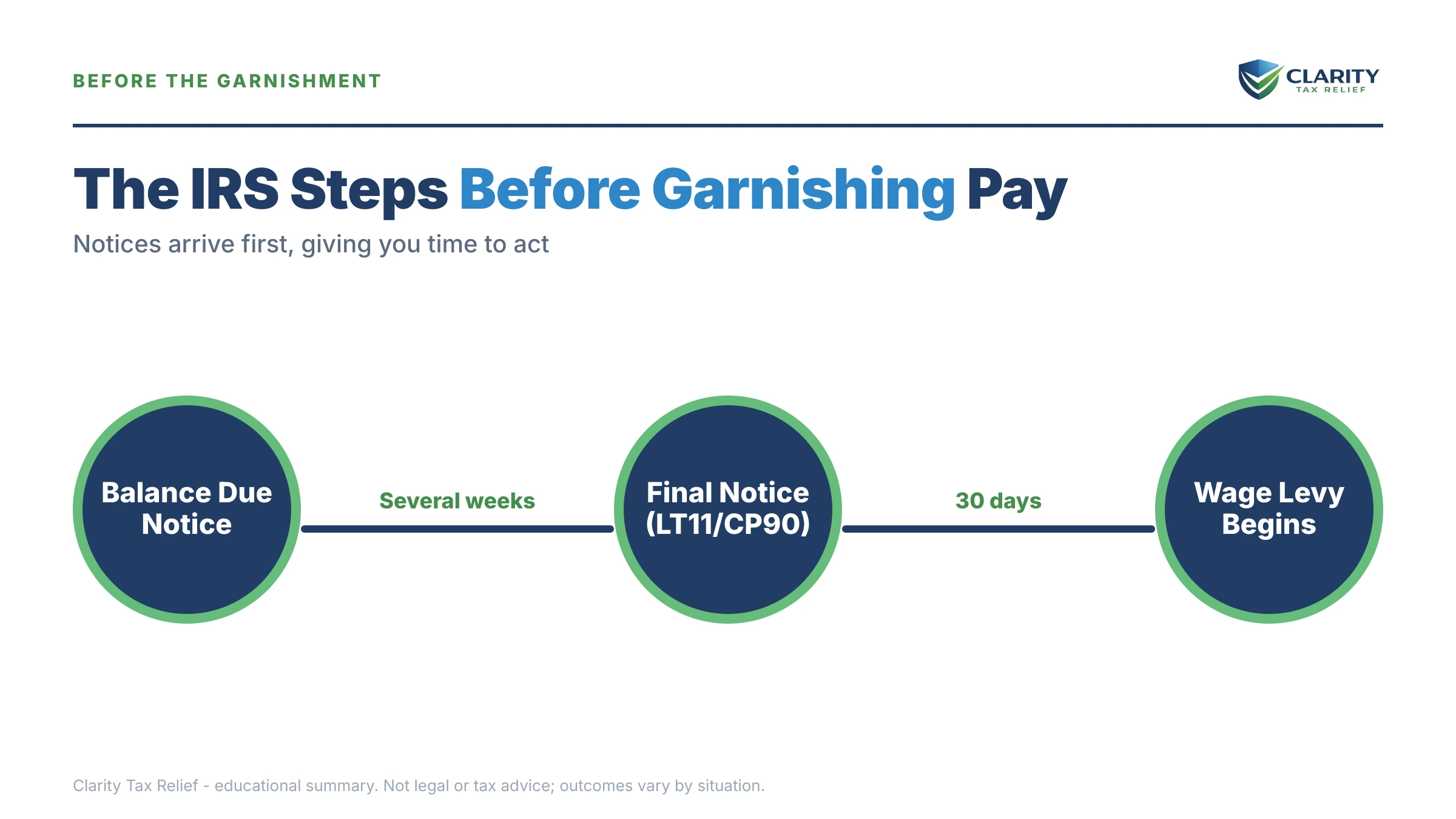
The IRS cannot garnish wages until it sends a final notice, LT11 or Letter 1058, and gives you 30 days to respond. A wage levy is never the first letter. Before Form 668-W reached your employer, the IRS mailed a series of bills to your last known address, ending with that final notice and its offer of a Collection Due Process hearing under Form 12153.
If those letters went to an old address, you may genuinely be hearing about this for the first time from HR. That doesn't invalidate the levy. But it does mean your account has probably been accruing penalties and interest for a year or more. The balance on the levy paperwork is bigger than the tax you originally owed.
The image below shows you exactly what this levy notice looks like and where to look — in particular, which parts belong to your employer and which parts are yours to fill out and return.
| Stage / document | Your window | What's at stake if it passes |
|---|---|---|
| LT11 / Letter 1058 (before any levy) | 30 days from the notice date | Your Collection Due Process hearing — the appeal that blocks the levy while it's heard |
| Form 668-W Parts 3–4 (Statement of Dependents) | Typically a few days — printed on the form | Your correct exempt amount; miss it and payroll must use the smallest protection (married filing separately, no dependents) |
| Levy already active | No fixed window — every pay date is a deadline | Everything above the exempt amount on each check |
| After the 30-day CDP window closes | You can still request a release at any time | The formal appeal path is gone — the release now runs through IRS collections instead |
The math on an $8,900 balance: a married couple's paychecks
A worked example shows why the exempt-amount rule stings, and why a balance under $10,000 has an unusually clean exit. Say you and your spouse filed jointly and owe $8,900. One of you takes home $2,780 every two weeks, and the employer just received Form 668-W. (This is a hypothetical, not a client case.)
Using the Publication 1494 approach for a joint filer with no dependents paid biweekly, the protected amount comes to roughly $1,240 per check — approximately the annual joint standard deduction spread over 26 pay periods (check the current-year table for your exact figure). The math on each payday:
$2,780 take-home − $1,240 exempt = about $1,540 to the IRS per check — roughly 55% of take-home pay. At that pace, the $8,900 balance clears in about six checks, or three months — though interest and penalties keep accruing until the balance hits zero, so the levy often runs an extra check or two beyond that estimate — all while you're living on $1,240 per pay period.
Now the exit. Because the balance is $10,000 or less and this is a first-time compliance problem for a couple with all returns filed, they likely meet the criteria for a guaranteed installment agreement — the one payment plan the IRS must accept when the statutory conditions are met: individuals only, an income-tax balance of $10,000 or less excluding penalties and interest, all returns filed, timely filing and payment for the past 5 years with no installment agreement in that period, and full payment within 3 years. Spread over 36 months, $8,900 runs about $247 a month plus accruing interest and the 0.5% monthly late-payment penalty. Compare $247 a month against $3,080 a month leaving one spouse's paychecks, and the value of acting before the next payroll run is obvious.
Two married-couple wrinkles worth knowing. First, on a joint liability the IRS can levy either spouse's wages. It typically hits one income source at a time, but the untouched paycheck isn't legally protected. Second, if the couple has dependents, returning the Statement of Dependents raises the exempt amount for each one. Skipping that form is the single most expensive mistake levied employees make.
What happens if you let the garnishment run
An IRS wage levy never expires on its own. It repeats every pay period until the debt is paid, the IRS releases it, or the collection statute runs out. Left alone, here's the sequence:
- The first split check. Payroll withholds everything above your exempt amount and sends it to the IRS. No court order was needed; the final notice window already closed.
- Every payday after. The levy is continuous. If you never returned the Statement of Dependents, each check keeps only the minimum married-filing-separately protection.
- Bonuses and extra pay absorbed. The exempt amount applies once per pay period — a year-end bonus or commission check in the same period can go to the IRS in full.
- Stacked enforcement. A wage levy doesn't preclude other action. The IRS can still levy your bank account (with its 21-day hold), seize your state refund, and take up to 15% of Social Security benefits through the Federal Payment Levy Program.
- Years, not weeks. On larger balances the levy can run until the 10-year collection statute expires, and certain events pause that clock, stretching it further.
In 2026, don't count on the levy quietly falling through the cracks. IRS staffing is down sharply after the 2025 workforce cuts, but wage levies are issued and sustained by automated systems — the humans got harder to reach, the garnishment didn't.
Your paycheck is being garnished right now
Every payday the levy stays in place, another check gets split with the IRS. Get your levy paperwork reviewed free before your next pay date — an experienced tax professional will run your exempt-amount math and map the fastest release path for your numbers.
Your options to shrink or release the garnishment
The IRS releases most wage levies once you're back in a compliant arrangement — the levy is leverage, not the endgame. The full playbook for each path lives in our guide on how to stop IRS wage garnishment. Here's what each option requires and what it does to the garnishment itself:
| Option | What it requires | Effect on the garnishment |
|---|---|---|
| Pay in full | The complete balance, including penalties and interest | Levy released; collection ends for that debt |
| Guaranteed or streamlined installment agreement | Guaranteed: individuals only, income-tax balance ≤ $10,000 excluding penalties and interest, timely filing and payment for the past 5 years with no installment agreement in that period, full payment within 3 years. Streamlined: balance ≤ $50,000, up to 72 months. Both: all returns filed | IRS typically releases the levy once the agreement is in place; interest and penalties continue on the balance |
| Economic hardship / Currently Not Collectible | Financials on Form 433-F showing the levy prevents basic living expenses | Levy must be released for documented hardship; the debt remains and interest accrues |
| Offer in Compromise | Full financial disclosure; the IRS's own math must show it can't collect the full amount | Collection generally pauses while a processable offer is under review; approval is means-tested, never assured |
| CDP hearing (Form 12153) | Filed within 30 days of the LT11 / Letter 1058 | Blocks levy action while the appeal is pending — only available before that window closes |
| Correct the exempt amount | Return the Form 668-W statement with your true filing status and dependents | Doesn't release the levy, but shrinks the bite out of every check immediately |
One disqualifier cuts across every row: unfiled returns block a release. The IRS will not approve a payment plan, hardship status, or offer while required returns are missing, if you have open years, filing them is step zero.
How to respond to an IRS wage garnishment, step by step
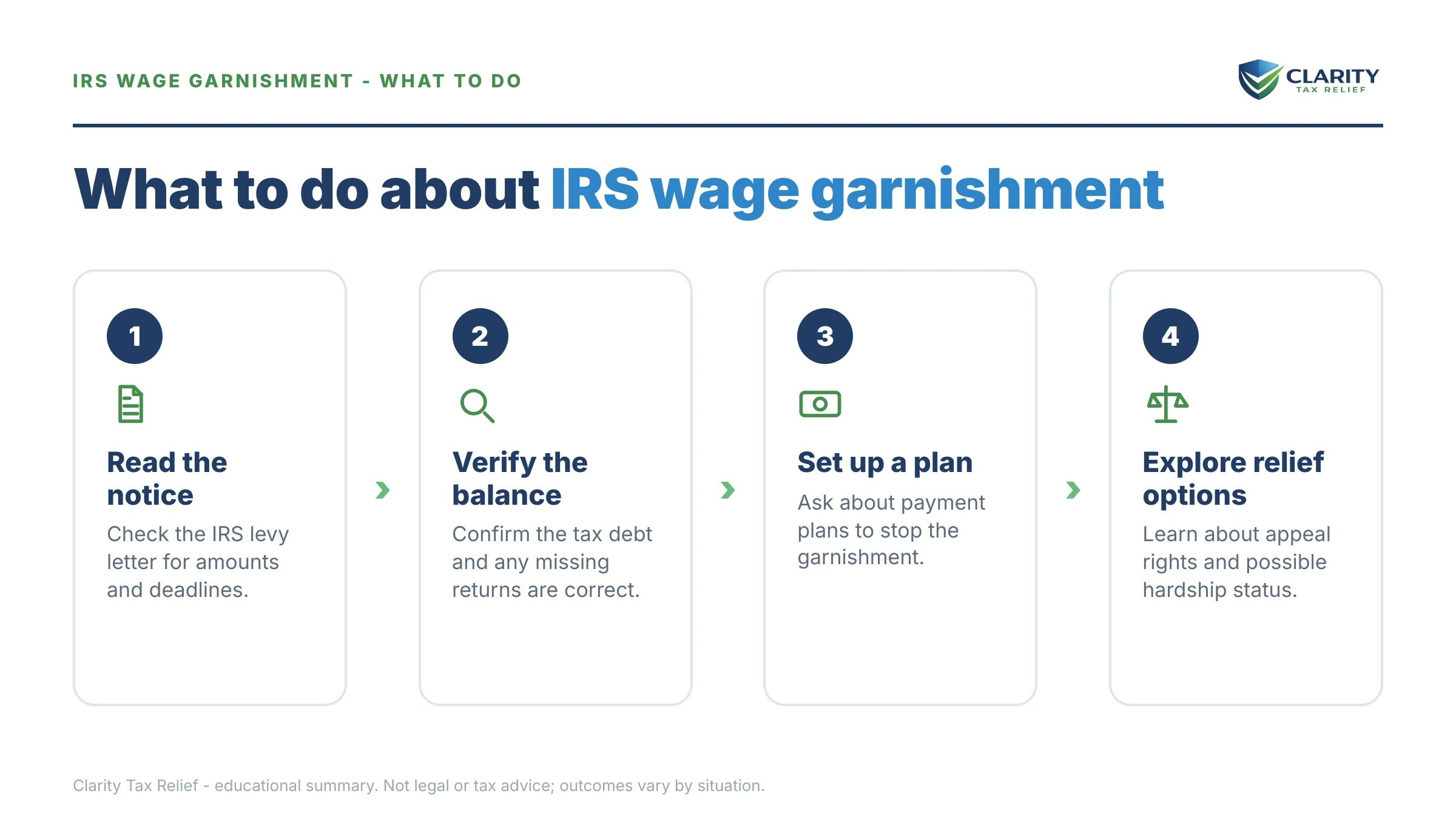
- Return the Statement of Dependents. Fill out Parts 3 and 4 of Form 668-W and get them back to your employer within the window printed on the form. This locks in your filing status and every dependent you're entitled to claim, which sets how much of each check is protected.
- Confirm your balance and filings. Log into your IRS online account, verify the amount the levy is collecting, and make sure every required return is filed — the IRS won't release a levy while returns are missing.
- Pick your release path. Match your finances to one option before anyone calls: pay in full, a payment plan, hardship status, or an offer. For individuals, an income-tax balance of $10,000 or less (excluding penalties and interest) may fit a guaranteed installment agreement if you've filed and paid on time for the past 5 years with no installment agreement in that period and can pay in full within 3 years.
- Call the number on the levy notice. Negotiate the agreement or hardship release yourself, or have an experienced tax professional make the call with a power of attorney on file. Ask the IRS to send the release directly to your employer's payroll contact.
- Confirm Form 668-D reached payroll. The garnishment stays in force until your employer's payroll department has the release in hand — follow up before your next pay date so the next check isn't split.
Payment-plan terms and setup details are on the IRS's own payment plans and installment agreements page.
When you can handle this yourself
Many wage levies can be resolved without paying anyone for help. If your income-tax balance is $10,000 or less (excluding penalties and interest), all your returns are filed, you've filed and paid on time for the past 5 years with no installment agreement in that period, you can pay in full within 3 years. You agree with the amount, you can likely set up the installment agreement yourself in one phone call and have the levy released — that's exactly the situation the guaranteed agreement (available to individuals only) exists for. Under $50,000 with the ability to make monthly payments, the streamlined path is still very manageable solo.
Experienced help changes outcomes in a narrower set of situations: the levy is causing genuine hardship and you need a documented §6343 release built from your real budget. You have multiple unfiled years standing between you and any release. The debt is business or payroll tax. The balance is large enough that offer-in-compromise math is worth running. Or you dispute that you owe the amount at all. In those cases, the order you fix things in — returns first, exempt amount second, release third — determines how many more paychecks get split. If cost is the barrier, the Taxpayer Advocate Service can intervene in hardship cases at no charge.
Terms on your levy paperwork, decoded
- Levy vs. garnishment: the IRS's legal term is "levy" — a wage garnishment is simply a continuous levy on your paycheck (full comparison: levy vs garnishment).
- Form 668-W: the Notice of Levy on Wages, Salary, and Other Income your employer received — Parts 3 and 4 are yours to complete and return.
- Exempt amount: the slice of each check the law protects, looked up in IRS Publication 1494 by filing status, dependents, and pay frequency.
- Form 668-D: the Release of Levy the IRS sends your employer — payroll cannot stop withholding until it arrives.
- CDP rights: your Collection Due Process appeal, available for 30 days after the final notice, requested on Form 12153.
- CSED: the Collection Statute Expiration Date — the end of the IRS's 10-year window to collect, though certain events pause the clock.
IRS paycheck garnishment questions, answered
Is there a limit on how much the IRS can garnish from your paycheck?
Yes, but it works backward from every other garnishment. Instead of capping what the IRS takes, the law caps what you keep — an exempt amount from IRS Publication 1494 based on your filing status, dependents, and pay frequency. Everything above that protected amount goes to the IRS, which often means half or more of your take-home pay.
How long does an IRS wage garnishment last?
An IRS wage levy is continuous. It repeats every payday until the balance is paid, the IRS releases the levy, or the 10-year collection statute (CSED) expires. It does not lapse on its own after a set number of checks. Setting up a payment plan or documenting economic hardship are the two fastest ways to get it released.
Can the IRS take 100% of my paycheck?
Effectively yes, in two situations. If you never return the Statement of Dependents, your employer must use the smallest possible exempt amount. And a bonus or extra check in the same pay period gets no additional protection — the exempt amount applies once per period, so the extra pay can go entirely to the IRS. A regular paycheck always keeps at least the Publication 1494 exempt amount.
Can my employer refuse to garnish my wages for the IRS?
No. Once your employer receives Form 668-W, it is legally required to comply — an employer that ignores the levy becomes liable for the amounts it should have withheld, plus a possible penalty. The good news: federal law generally protects you from being fired over a single garnishment, so working with HR on the paperwork won't cost you your job.
Can the IRS garnish my spouse's paycheck too?
If the debt comes from a jointly filed return, yes — both spouses are fully liable. The IRS can levy either paycheck, though it usually levies one income source at a time. If the debt is from one spouse's separate return or a year before the marriage, the other spouse's wages are generally outside the levy's reach, especially in non-community-property states.
Does an IRS wage garnishment affect my credit score?
Not directly. The IRS doesn't report levies to credit bureaus, and federal tax liens were removed from consumer credit reports years ago. The indirect effects are real, though: a garnished paycheck can cause missed payments on other bills, and lenders reviewing bank statements or asking about tax debt on an application will see the levy.
How fast can I stop an IRS wage garnishment?
Often within one or two pay cycles once you act. The IRS typically releases the levy after you set up an installment agreement or document economic hardship, then sends Form 668-D to your employer. The variable is payroll timing, if the release arrives after payroll runs, that check is already split, so start before your next pay date.
Your next 24 hours
- Find the Statement of Dependents. Pull out Form 668-W Parts 3 and 4 from the paperwork your employer gave you and check whether it's been returned, if not, complete it today so your next check keeps the full exempt amount for your filing status and dependents.
- Gather three things: your most recent tax return, your last two pay stubs. A quick list of monthly essentials (rent or mortgage, utilities, food, insurance). These drive both the exempt-amount math and any hardship or payment-plan request.
- Get the free case review before your next payday. Call (888) 825-7779 or use the 2-minute form — the levy repeats every pay period until it's released. A release that reaches payroll before the next run is the difference between a whole check and a split one.
This guide is general information, not tax or legal advice for your specific situation. Eligibility for IRS programs depends on individual facts and circumstances; no outcome is guaranteed.