
Business Tax Debt
IRS Shut Down My Business: What the IRS Can Really Do and How to Stop It (2026)
The short answer: the IRS almost never shuts down a business by padlocking the doors. What actually closes businesses is a bank levy, a levy on customer payments, or a seizure of assets, and every one of those requires a final notice first, which opens a 30-day window that can stop the whole thing.
Maybe your bank app showed a frozen balance this morning, or a final levy notice landed in the mail, or a revenue officer's card is sitting on your counter. Whatever put "IRS shut down my business" into your search bar, here's the part that matters: in almost every case, the shutdown isn't finished — it's a sequence, and there are still points where you can interrupt it.
This guide maps that sequence exactly: what the IRS can legally do to a business, the paperwork it must send first, and which lever stops it at each stage. Further down, the image shows you exactly what the final levy notice looks like and where to find the date that starts, or has already started — your 30-day window.
⏱ The clock that matters: you have 30 days from the date on an LT11 or Letter 1058 to request a Collection Due Process hearing before the IRS can levy your accounts. Filing that request (Form 12153) pauses levy action on those tax periods while Appeals hears your case — it's the single strongest brake in the entire sequence.
What "IRS shut down my business" actually means in 2026
The IRS closes businesses with levies on money, not padlocks on doors. When owners say the IRS shut them down, one of three things almost always happened first:
- A bank levy. The IRS serves your bank, the bank freezes whatever is in the account that day, and after a 21-day hold the money goes to the Treasury. Payroll bounces, rent bounces, and the business stops functioning, without an agent ever setting foot on your property.
- A receivables levy. For any business that invoices, the IRS can send levy notices directly to your customers, ordering them to pay the IRS instead of you. An IRS levy on accounts receivable cuts off cash flow at the source, and tells every client you have a tax problem.
- A federal tax lien. A recorded lien attaches to your equipment, inventory, and receivables. It doesn't take anything by itself, but it can kill your business credit, spook lenders, and put vendors on cash-only terms.
Actual physical seizure — agents inventorying equipment, changing locks, auctioning assets — sits at the very top of the ladder and requires senior IRS approval. To enter business premises that aren't open to the public, the IRS also needs a writ of entry signed by a federal judge. Our guide to whether the IRS can take your business breaks down the legal mechanics. If assets have already been taken, start with IRS seized business assets instead.
One 2026 reality check: the IRS workforce shrank roughly 27% in 2025, so reaching a human is harder than ever, but bank levies, receivables levies, and lien filings are generated by automated systems that never stopped running. Fewer staff means fewer chances to catch a problem before the machine acts.
“An IRS levy permits the legal seizure of your property to satisfy a tax debt. It can garnish wages, take money in your bank or other financial account, seize and sell your vehicle(s), real estate and other personal property.”
— Levy (IRS.gov)
Why the IRS is moving against your business
Three things put a business on the enforcement track: payroll tax debt, unfiled returns, and ignored notices. Which one applies to you determines how fast this moves.
Payroll (941) debt is the accelerant. Part of every payroll deposit is money withheld from employees' paychecks — the IRS treats keeping it as holding the government's money, and 941 back taxes get routed to human revenue officers faster than any other debt. Payroll cases also open a second front: the Trust Fund Recovery Penalty, which moves the withheld portion onto owners, officers, and even bookkeepers personally.
Unfiled returns block every exit. If you haven't filed, the IRS may have built substitute returns for you — with no deductions, no mileage, no cost of goods — and assessed an inflated balance. Worse, the IRS won't approve any payment arrangement while returns are missing. If you're behind, the playbook in haven't filed taxes in 3 years is where compliance starts.
Your entity decides whose problem this is. A sole proprietor or gig worker has no wall between business and personal — levies hit your personal checking account and your 1099 pay. A corporation or multi-member LLC shields owners from the entity's income tax debt, but not from the trust-fund portion of payroll debt, and not if the state suspends the entity for non-compliance.
The shutdown sequence: what happens if you do nothing
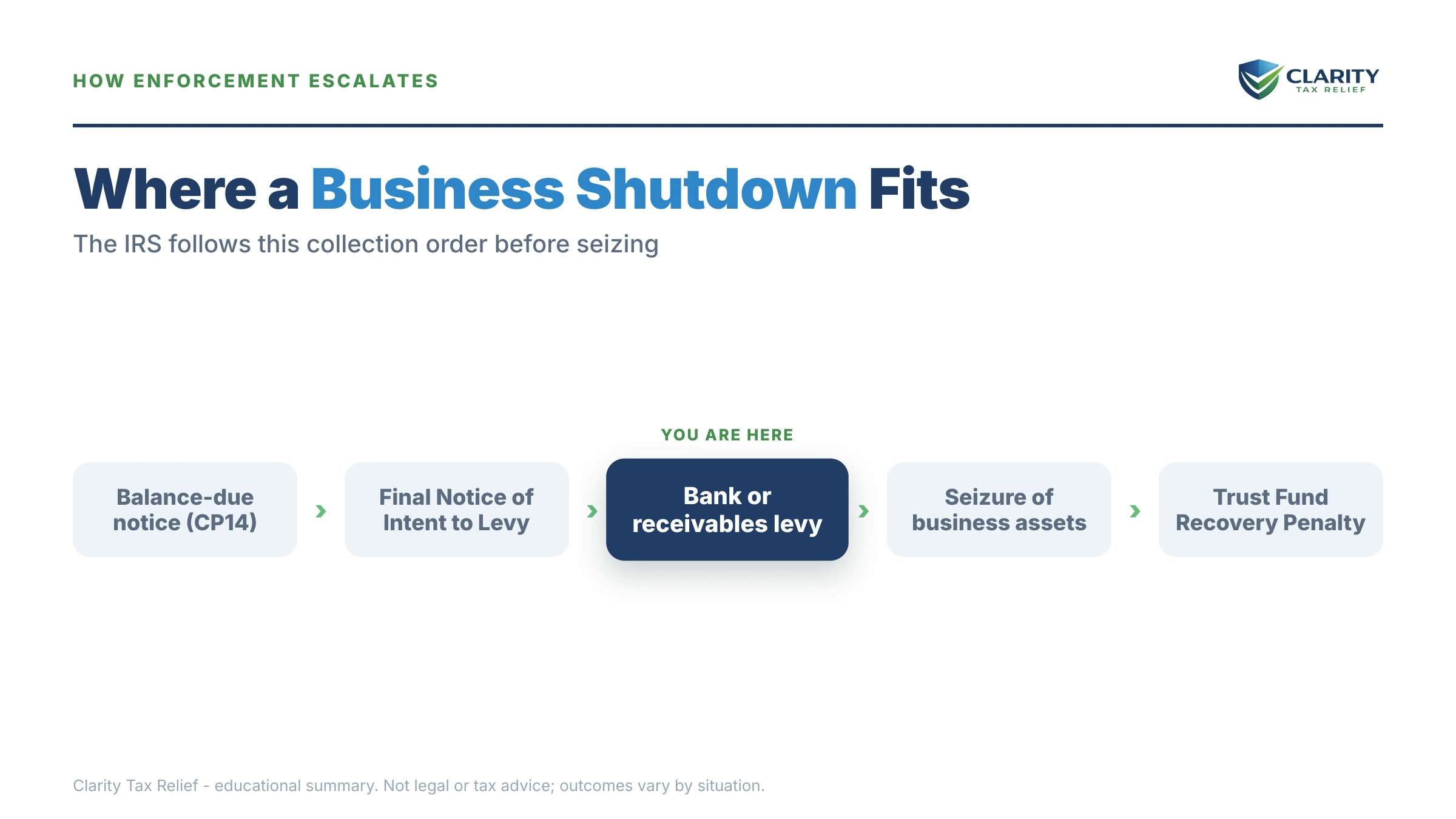
A business shutdown is the last rung of an automated ladder, and every rung below it sends you paper first. Here is the order it runs in:
- First bill (CP161 for businesses, CP14 for individuals). A statement of the balance. No enforcement power, and the cheapest moment to fix everything.
- Escalating reminders, then CP504 or CP504B. The "intent to levy" notice. At this stage the IRS can seize your state tax refund. A lien filing becomes likely. But it cannot yet levy your bank account or receivables.
- LT11, Letter 1058, or CP297 — the final notice. This one carries the 30-day Collection Due Process clock. Once it expires with no response, the IRS has legal authority to levy.
- Levies begin. Bank accounts (with the 21-day hold), accounts receivable, payment processors, and contractor pay. If you also hold a W-2 job, a wage levy is continuous until released.
- A revenue officer takes the case. Payroll debt and larger balances get assigned to a human collector, often announced by Letter 725-B. What to do in the first 24 hours after a revenue officer visits your business is its own playbook, and on payroll cases the officer will pursue the Trust Fund Recovery Penalty against individuals in parallel, starting with a Form 4180 interview and a Letter 1153 proposal.
- Asset seizure. Equipment, vehicles, inventory — sold at auction. This is the true "shut down" step, and it requires the approval chain and, for private premises, the court-issued writ of entry described above. It is rare precisely because every earlier rung gives you an exit.
| Enforcement action | What it does to your business | How to stop or undo it |
|---|---|---|
| CP504 / CP504B | State tax refund can be seized; lien filing likely | Set up a resolution now. This notice does not yet authorize bank or receivables levies |
| LT11 / Letter 1058 / CP297 | After 30 days, the IRS can levy accounts, receivables, and pay | File Form 12153 within 30 days — levy action pauses while Appeals reviews the case |
| Bank levy | Freezes that day's balance; funds leave after a 21-day hold | Use the 21 days: prove economic hardship or enter an agreement to get it released |
| Receivables / 1099 levy | Customers must send your payments to the IRS; cash flow stops | Each levy grabs only what's owed that day; a resolution stops new ones and can release pending ones |
| Wage levy (owner's W-2 job) | Continuous — takes most of every paycheck until released | Hardship release or installment agreement |
| Physical seizure / padlock | Assets auctioned; the business closes | Requires senior approval and usually a writ of entry — appeal rights plus a resolution stop it earlier |
Two nuances the table can't capture. First, a levy on 1099 pay generally reaches only what a customer owes you the day it's served — the details are in can the IRS garnish 1099 income. Second, if any of your income comes through a W-2 job, you can estimate what a continuous wage levy would leave you per paycheck with our IRS Wage Garnishment Calculator. It estimates, not promises, but it makes the stakes concrete.
Notices piling up against your business?
Send us your most recent one. An experienced tax professional will pinpoint exactly where you sit on the enforcement ladder and what stops it, and if an LT11 or Letter 1058 is in hand, the 30-day hearing window is already counting. Free, confidential, no pressure.
Your options to stop an IRS business shutdown
Every enforcement action on the ladder stops advancing once you're inside an IRS resolution. The general mechanics of each program are covered in our guide to how to settle tax debt yourself. Here's how they line up for a business under enforcement:
| Option | Who qualifies | What it does |
|---|---|---|
| Pay in full / short-term plan | Anyone; short-term plans run up to 180 days with a $0 setup fee | Ends the ladder immediately; interest accrues until paid |
| Streamlined installment agreement | Individuals and sole proprietors owing ≤ $50,000, all returns filed | Up to 72 months online, no full financial disclosure; enforcement stops while you pay |
| In-business payroll tax plan | Operating businesses behind on 941s that can stay current on new deposits | Monthly payments on the payroll balance while the doors stay open; stricter terms than personal plans |
| Currently Not Collectible | Paying anything would leave you unable to cover basic living or operating costs | Pauses levies; the debt and interest remain, and the IRS reviews periodically |
| Offer in Compromise | Assets plus future income genuinely can't cover the debt; $205 fee (waived with low-income certification) | Settles for what the IRS could realistically collect. It accepted roughly 1 in 5 offers in FY2024, so candidacy math matters before applying |
| Penalty relief (FTA / AEP) | Clean compliance for the prior 3 years; starting summer 2026, the new Automatic Exemption from Penalty applies without a request | Removes penalties, not the tax or interest, and can shrink the balance meaningfully |
| CDP hearing (Form 12153) | Anyone within 30 days of an LT11, Letter 1058, or CP297 | Freezes levy action on those periods while Appeals considers alternatives; see our Form 12153 CDP hearing guide |
One warning about the exit that isn't one: closing the business does not close the debt. Sole-proprietor debt is personal debt, and payroll trust-fund debt follows the responsible people out the door. If winding down is genuinely on the table, the sequence in dissolve business owe IRS matters more than the decision itself.
A worked example: $19,700, three years unfiled
Say you've driven delivery and done app-based work as a sole proprietor since 2023, never filed. The IRS built substitute returns totaling $19,700 across the three years. A CP504 just arrived, and you're afraid your "business" — which is really you, your car. Your bank account — is about to be shut down. Here's the hypothetical math:
- Do nothing: the failure-to-pay penalty alone runs 0.5% per month — about $98.50 a month on $19,700 — plus compounding interest, while the next notice up the ladder queues automatically. A levy would hit your personal checking account, and app platforms and customers can be served for your 1099 pay.
- File the real returns first: substitute returns give a gig driver zero mileage deduction, usually the single biggest write-off in the business. If your actual Schedule Cs bring the true liability down to, say, $13,900, you've cut the problem by nearly 30% before paying a dollar.
- Then set up the plan: at $13,900, you're well under the $50,000 streamlined ceiling. Spread over the maximum 72 months, that's roughly $194 a month ($13,900 ÷ 72), though paying more shortens the term and cuts the interest that keeps accruing. Every levy threat stops while the agreement is in good standing.
- If the numbers genuinely don't work: a driver whose income barely covers rent, gas, and insurance may qualify for Currently Not Collectible status instead, and if AGI falls at or below 250% of the federal poverty level, an Offer in Compromise application would carry no $205 fee, no 20% down payment, and no payments during review.
Notice the order: file, then resolve. Reversing it doesn't work, because the IRS won't grant the plan, and you'd be paying down an inflated number.
How to stop the IRS from shutting down your business, step by step
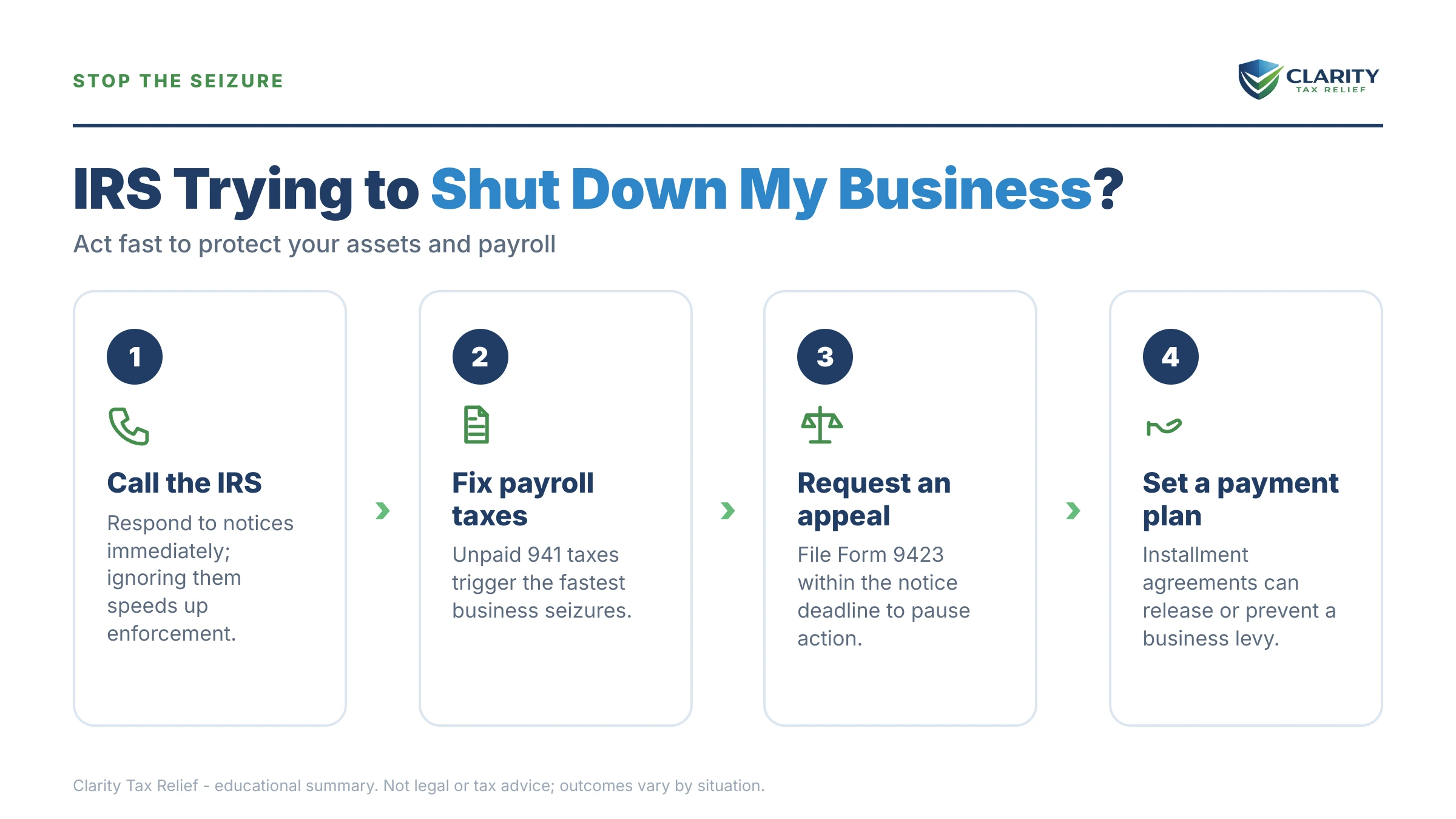
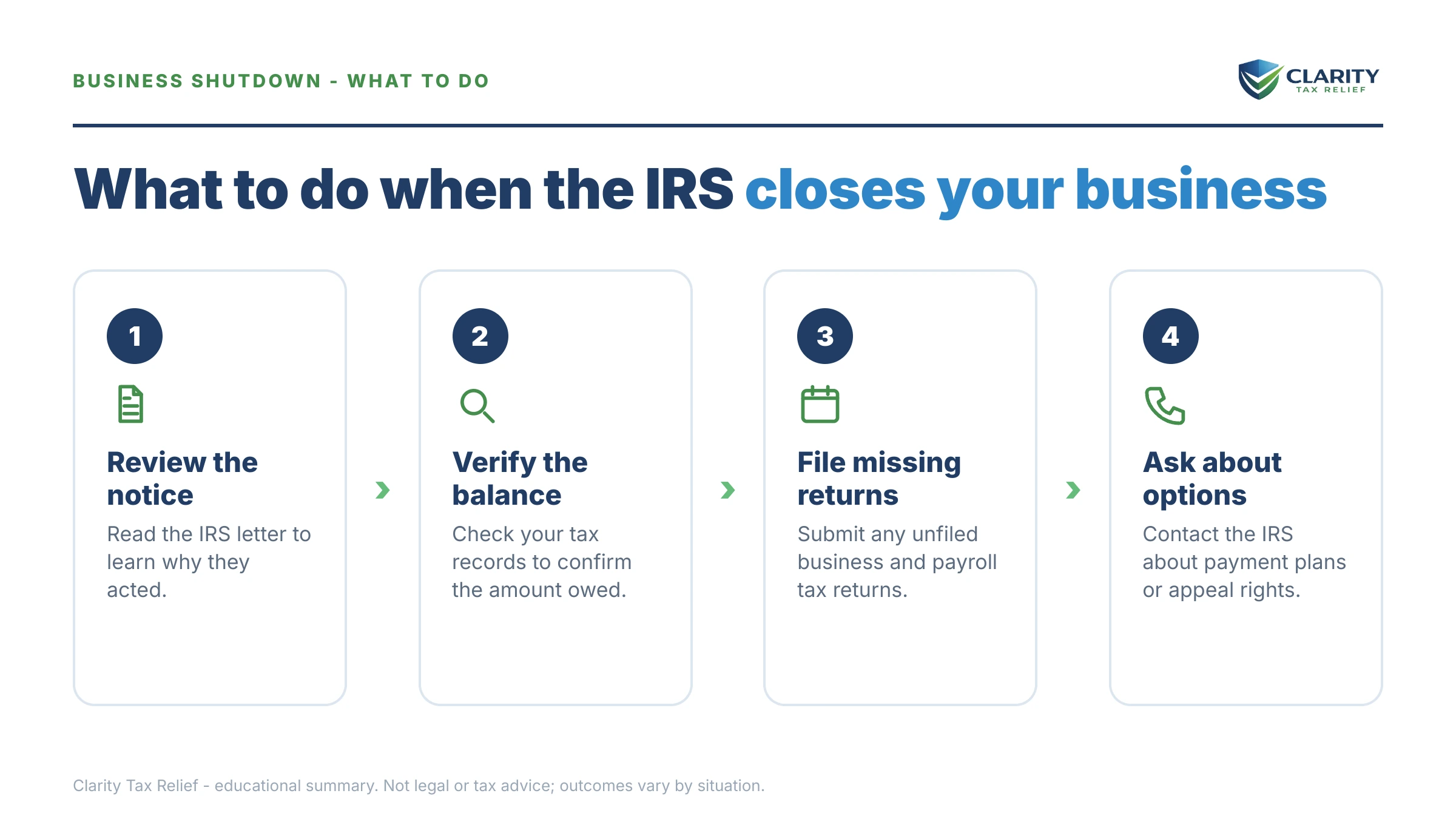
- Pull your latest notice and check the date. A CP504B means bank and receivables levies haven't been authorized yet. An LT11 or Letter 1058 means the 30-day clock is already running.
- File every missing return. The IRS won't approve any payment arrangement while returns are unfiled, and filing real returns often shrinks a balance the IRS estimated for you.
- Request a CDP hearing if the window is open. Mail Form 12153 within 30 days of a final notice to freeze levy action on those tax periods while Appeals reviews your case.
- Set up the resolution that fits your numbers. A payment plan through the IRS payment plans page, hardship status, or an Offer in Compromise — choose from the options table above, not from a sales pitch.
- Stay current from today forward. One missed federal tax deposit or quarterly estimated payment defaults a new agreement and restarts the entire enforcement ladder.
When you can handle this yourself, and when help changes the outcome
If your debt is income tax only, under $50,000, and no final notice has arrived, you can usually fix this without paying anyone. File the missing returns, set up the plan online at IRS.gov/payments, and keep current — that's the whole job. The DIY hub linked above walks through it.
Experienced help genuinely changes outcomes in four situations. A levy has already been served — the 21-day bank-levy window is short, and hardship releases require documentation assembled fast. A revenue officer is assigned — deadlines become personal and negotiable, and missed ones get memorialized in your file. The debt is payroll debt — everything you say in a Form 4180 interview shapes who gets hit personally with the Trust Fund Recovery Penalty. And you're weighing whether to close — the wind-down order determines how much debt follows you personally.
If a levy is causing immediate economic harm and you can't get traction with IRS collections directly, the Taxpayer Advocate Service is a free, independent channel inside the IRS built for exactly that.
Terms on your notice, decoded
- Levy vs. lien: a lien is a legal claim recorded against your property; a levy is the actual taking of money or assets.
- Going concern: IRS-speak for a business that's still operating — seizing one requires extra approvals precisely because it destroys the income that could repay the debt.
- Trust fund taxes: the portion of payroll taxes withheld from employees' paychecks, which the IRS treats as government money you were holding.
- Collection Due Process (CDP): your statutory right, after a final notice, to a 30-day window to request an independent Appeals hearing before levy.
- Writ of entry: the federal court order the IRS needs before physically entering business premises that aren't open to the public.
- CSED: the collection statute expiration date — the IRS generally has 10 years from assessment to collect, though appeals, offers, and bankruptcy pause the clock.
IRS business shutdown questions, answered
Can the IRS actually shut down my business?
Yes, but almost never by padlocking the doors. The IRS closes businesses indirectly — a bank levy, a levy on customer payments, or a lien that dries up your credit — and each of those requires a final notice with a 30-day appeal window first. Physically seizing an operating business needs senior IRS approval, and entering private business premises requires a court order called a writ of entry, which is why padlock seizures are rare.
How much do you have to owe before the IRS shuts down a business?
There is no dollar threshold — the IRS escalates based on the type of debt and whether you respond, not the amount alone. Unpaid payroll taxes draw the fastest, hardest enforcement because part of that money was withheld from employees. A cooperative sole proprietor owing under $50,000 in income tax will almost always be offered a payment plan. A business piling new payroll debt on top of old can face seizure at much smaller balances.
Can the IRS padlock my business without warning?
No — outside of a rare jeopardy levy, the IRS must send a final notice of intent to levy and give you 30 days to request a hearing before seizing anything. To physically enter business premises that aren't open to the public, the IRS also needs a writ of entry signed by a federal judge. If someone claiming to be the IRS threatens to chain your doors tomorrow without any of that paperwork, treat it as a scam.
Can the IRS shut down a sole proprietorship or gig business?
There's no separate business for the IRS to shut down — as a sole proprietor or gig worker, you and the business are the same taxpayer. Enforcement hits your personal bank account, your 1099 pay, and any wages from a side W-2 job. One quirk works in your favor: a levy on contractor pay usually grabs only what a customer owes you on the day it's served, unlike a continuous wage levy on an employee's paycheck.
What happens when the IRS levies my business bank account?
The bank freezes whatever is in the account that day and holds it for 21 days before sending it to the IRS. That 21-day window is your chance to get the levy released — by proving economic hardship or getting into a payment arrangement. The levy is one-time: deposits made after the levy date aren't taken, though the IRS can serve a new levy later if the debt still isn't resolved.
If I just close the business, does the tax debt go away?
No. Sole-proprietor and single-member LLC tax debt is your personal debt, and it follows you after the business closes. For corporations and LLCs with payroll debt, the trust-fund portion transfers to owners and other responsible people personally through the Trust Fund Recovery Penalty, even after dissolution. Closing can still be the right move in some situations. But the order you wind things down in determines how much of the debt follows you.
How do I stop the IRS from shutting down my business?
Get into a resolution before levies start: file every missing return, then set up a payment plan, hardship status, or an Offer in Compromise if your finances qualify. If you're within 30 days of an LT11 or Letter 1058, request a Collection Due Process hearing. That freezes levy action on those tax periods while Appeals reviews your case. If a levy has already hit, a release is still possible, but the paths narrow the longer you wait.
Your next 24 hours
- Find your most recent IRS notice and the date printed at the top right. The notice name tells you which rung of the ladder you're on; the date tells you whether the 30-day hearing window is still open.
- Gather three things: your last filed return, income records for every unfiled year (1099s, platform summaries, bank statements), and the notice itself.
- Get a free case review — call (888) 825-7779 or use the 2-minute form. If a final notice is in hand, the 30-day clock is already counting. And even if it isn't, interest and penalties are accruing every month you wait.
This guide is general information, not tax or legal advice for your specific situation. Eligibility for IRS programs depends on individual facts and circumstances; no outcome is guaranteed.