
IRS Levies & Garnishment
Can the IRS Garnish 1099 Income? How Contractor Levies Work in 2026
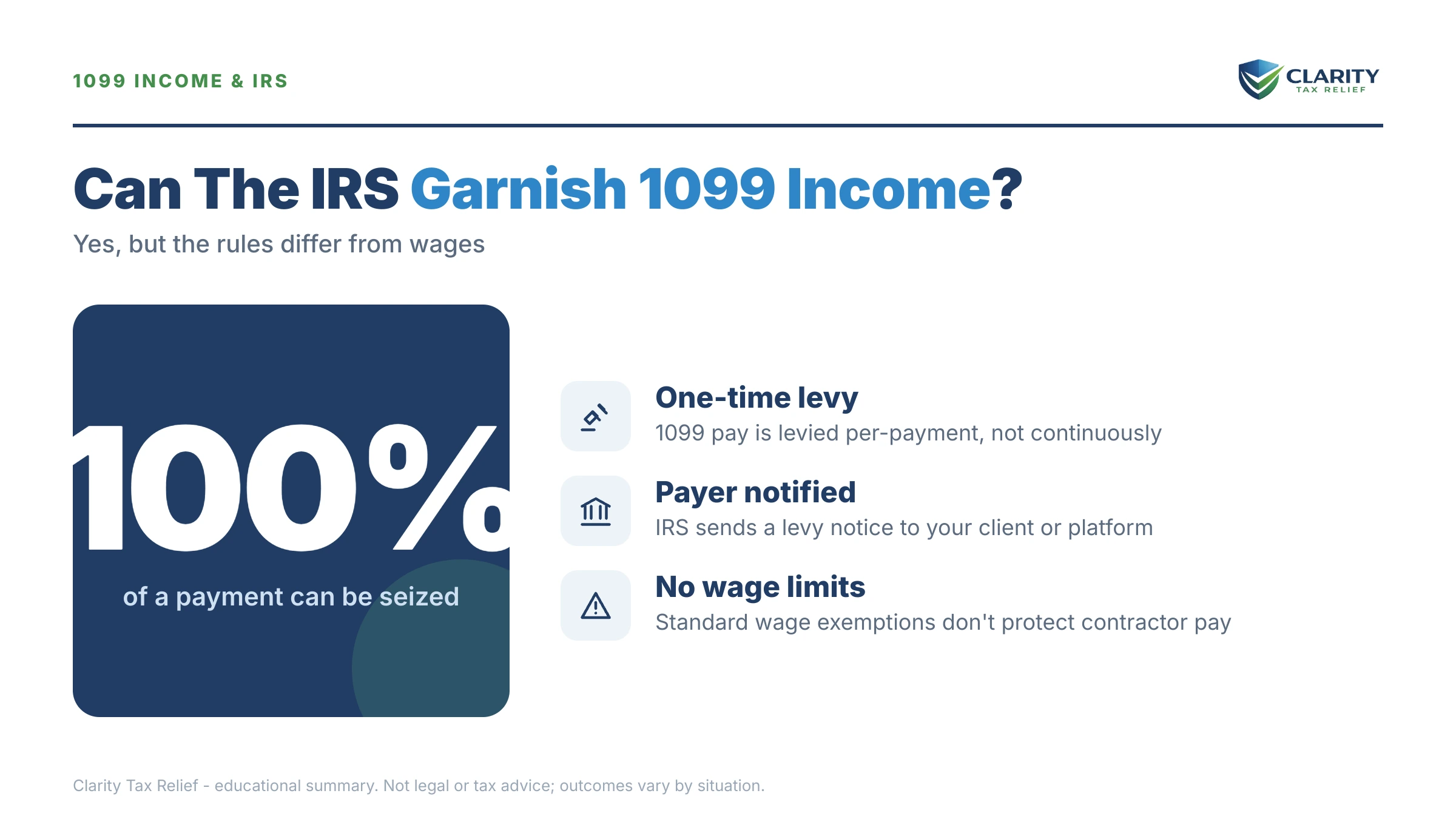
The short answer: yes — the IRS can garnish 1099 income, but not through a standard paycheck garnishment. It serves a levy (Form 668-A) directly on your clients, and because the wage-exemption table doesn't apply to contractor pay, a single levy can take 100% of whatever a client owes you that day.
You're self-employed, the rent comes out of whatever your clients pay this month, and now an IRS letter is threatening a levy. So the question "can the IRS garnish 1099 income" isn't academic — it's whether your next invoice actually reaches your bank account. It can be stopped, and the rules that decide when and how much are laid out below.
Two forms decide everything here: Form 668-W (the employee garnishment) and Form 668-A (the one the IRS uses on contractors). The image below shows you exactly what the IRS's levy paperwork looks like and where to look for the amounts and dates that control your rights.
⏱ Your deadline: You have 30 days from the date on an LT11 or Letter 1058 to request a Collection Due Process hearing before the IRS can levy your clients. If you haven't received that final notice yet, the levy can't legally start, but interest and the monthly failure-to-pay penalty are accruing on your balance right now.
Why the IRS is coming after your 1099 income
Every 1099-NEC and 1099-K your clients and platforms file gives the IRS a ready-made list of exactly who pays you, and each name on that list can be served a levy. Employees have one employer to garnish. You may have five clients, a payment app. A business checking account, and collections can reach all of them.
The trigger is almost always the same chain: self-employment income with no withholding, a balance you couldn't pay in full. A string of notices that went unanswered. The IRS pulls your levy targets straight from your own wage and income transcript — the file where every 1099 filed under your Social Security number lands each January.
One thing worth knowing: the IRS does not need to sue you or get a court judgment to levy 1099 income. Administrative levy power under IRC §6331 lets it act on its own once the required notices have gone out.
“An IRS levy permits the legal seizure of your property to satisfy a tax debt. It can garnish wages, take money in your bank or other financial account, seize and sell your vehicle(s), real estate and other personal property.”
— Levy (IRS.gov)
How the IRS garnishes 1099 income: Form 668-A, not a paycheck garnishment
The IRS levies contractor pay with Form 668-A, a one-time levy that captures whatever a client owes you on the day it's served, with no exempt amount held back. That single sentence contains both the good news and the bad news for 1099 workers.
The bad news first. When an employee's wages are garnished on Form 668-W, a portion of every paycheck is protected by an exemption table — the employee always takes something home. You can see how that math works on the W-2 side with our IRS Wage Garnishment Calculator, which estimates what a wage levy would leave an employee. As a contractor, none of those exemptions apply to a 668-A. If your client owes you $6,200 when the levy lands, the client must send the IRS all $6,200.
The good news: a 668-A is not continuous. It reaches only money the client owes you at that moment, not work you haven't invoiced yet. A wage garnishment runs paycheck after paycheck until released; a contractor levy is a snapshot. The catch is that the IRS can take a new snapshot whenever it likes, serving fresh levies on the same client or several clients at once. And where your contract creates fixed and determinable future payments — a retainer, a structured commission agreement — one levy can attach to those future payments too. That gray zone is covered in depth in our guide to an IRS levy on a 1099 contractor and, for variable pay, the IRS levy on commission income.
| How it works | 1099 contractor levy (Form 668-A) | W-2 wage garnishment (Form 668-W) |
|---|---|---|
| Who receives it | Each client, platform, or bank — one form per payer | Your single employer's payroll department |
| How much is taken | Up to 100% of what that payer owes you that day | Everything above a small exempt amount per paycheck |
| How long it lasts | One-time snapshot, but repeatable, and future payments if "fixed and determinable" | Continuous, every paycheck until released |
| What's protected | Nothing — no exemption table applies | An exempt amount based on filing status and dependents |
| How it ends | Funds remitted; IRS must serve a new levy to take more | Only by IRS release — agreement, hardship, or full payment |
So a contractor is both better and worse off than an employee facing how much the IRS can garnish from a paycheck: each levy can hurt more. But there are gaps between levies — gaps you can use to get an agreement in place before the next one.
Can the IRS garnish 1099 income without warning?
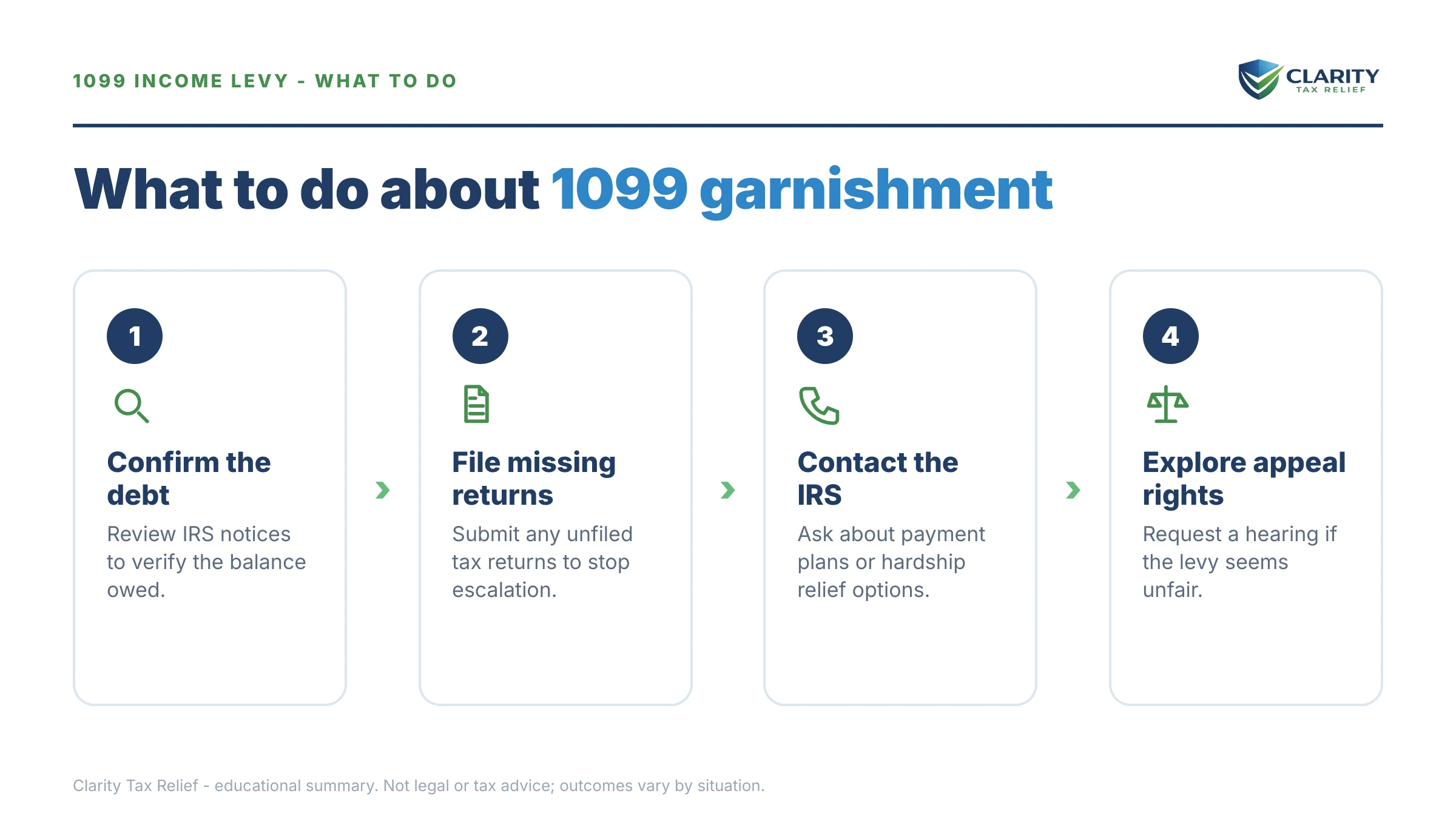
No, before levying your clients, the IRS must send a final notice of intent to levy and give you 30 days to respond. That final notice is the LT11 notice or Letter 1058, and it comes at the end of an automated sequence, not the beginning:
- CP14 — the first bill, giving you until the due date printed on the notice before the next notice queues up. No enforcement yet; this is the cheapest moment to act.
- CP501 / CP503 — reminder notices. Still just bills, but the balance grows every month they sit unanswered.
- CP504 — Notice of Intent to Levy under IRC §6331(d). The IRS can now seize your state tax refund. Despite the scary name, it is not the notice that authorizes levying your clients.
- LT11 / Letter 1058 — the final notice. A 30-day clock starts, along with your Collection Due Process rights. After day 30, levies on your clients, bank, and payment apps become legal.
- Levies land — Form 668-A goes to the clients on your 1099 record and to your bank. A bank or payment-app levy comes with a 21-day hold before funds leave (see the IRS bank levy and the 21-day rule). A levy on a client has no such hold — the client simply pays the IRS instead of you.
In 2026 this sequence runs on autopilot. The IRS workforce shrank roughly 27% in 2025. But these notices and levies are issued by automated systems that never got laid off — hard to reach a human, easy to get levied. The stage that matters most is the LT11, because the right that expires with it is real: a timely Form 12153 filing generally blocks levies while your case is heard. Our walkthrough of the Form 12153 CDP hearing covers exactly how to file it.
| Notice or action | Your window | The right at stake |
|---|---|---|
| CP14 (first bill) | Typically about 21 days from the notice date | Resolve now and no levy process ever starts |
| CP501 / CP503 (reminders) | The date printed on each notice | Set up a plan by phone or online with no financial disclosure at most balances |
| CP504 (intent to levy) | The date printed on the notice | Your state tax refund — seizable after this notice |
| LT11 / Letter 1058 (final notice) | 30 days from the notice date | Collection Due Process hearing (Form 12153) — the right that pauses levies |
| Form 668-A served on a client | Immediate — client must remit what it owes you | Release by agreement or hardship before the next levy round |
| Form 668-A served on your bank or payment app | 21-day hold before funds are sent | Your one window to negotiate release of that money |
Facing a levy on your contractor income?
If you're holding an LT11 or Letter 1058, the 30-day window to protect your clients from levies is already running. Send us the notice — an experienced tax professional will map exactly where you are in the sequence and which option fits your numbers. Free, confidential, no pressure.
Your options when you owe on 1099 income
Every option below stops new levies once it's in place — the differences are cost, paperwork, and who qualifies. One rule applies to all of them: the IRS expects you to be current on this year's estimated tax payments before it approves an agreement, and staying current keeps the agreement alive.
| Balance owed | Realistic options | What it takes |
|---|---|---|
| Under $10,000 | Guaranteed installment agreement; 180-day short-term plan ($0 setup) | File all returns, pay within 3 years (guaranteed IA) or 180 days; no financial disclosure |
| $10,000 – $25,000 | Streamlined installment agreement, up to 72 months, set up online | No detailed financials; stay current on quarterly estimates |
| $25,001 – $50,000 | Streamlined agreement with direct debit; up to 72 months online | Direct debit required above $25,000 to skip financial disclosure |
| Over $50,000 | Non-streamlined agreement, partial-pay agreement, Offer in Compromise, or CNC | Full financials on Form 433-F/433-A; the IRS reviews income, expenses, and assets |
Beyond a payment plan, three paths matter most for self-employed people:
- Currently Not Collectible, if allowable living expenses genuinely eat your income, collection pauses (levies stop) while the debt sits. Business income makes the math trickier; see currently not collectible while self-employed.
- Offer in Compromise — settling for less than the balance when your assets and future income can't cover the debt. It carries a $205 fee and 20% down on lump-sum offers (both waived with low-income certification if your AGI is at or below 250% of the poverty line). The IRS accepted roughly 1 in 5 offers in FY2024 — real, but never easy or guaranteed.
- Penalty relief — first-time abatement can strip penalties if your prior three years are clean, and starting summer 2026 the IRS's new Automatic Exemption from Penalty (AEP) begins applying similar relief automatically, no request needed.
The full playbook for getting an active levy lifted — the same release rules apply whether the levy hit a paycheck or a client — is in our hub guide on how to stop an IRS wage garnishment.
A worked example: $19,700 owed, rent due, levy threatened
Say you owe $19,700 in self-employment tax across two years, you rent your apartment, and an LT11 just arrived. Here's the math on your three realistic moves — hypothetical numbers, shown so you can run your own:
- Do nothing: after day 30, the IRS levies your biggest client the week your $6,200 invoice comes due. The client must send the IRS the full $6,200, your rent money included, and your balance still sits near $13,500 with interest running. The next levy round can follow whenever collections chooses.
- Streamlined plan: $19,700 is under the $25,000 streamlined line, so you can set up a plan online with no financial disclosure. $19,700 ÷ 72 months = about $274/month minimum — in practice set it a bit higher, because interest and the 0.5%-per-month failure-to-pay penalty keep accruing until paid. Once approved, no client ever sees a levy.
- Hardship route: if $274/month truly isn't there after rent, utilities, food, and transportation, CNC status or a partial-pay agreement may fit — the IRS tests your numbers against its allowable-expense standards, not your actual lifestyle.
The gap between "do nothing" and "streamlined plan" in this example is stark: $6,200 gone in one levy versus roughly $274 a month. The plan is the cheaper option on day one.
How to respond, step by step
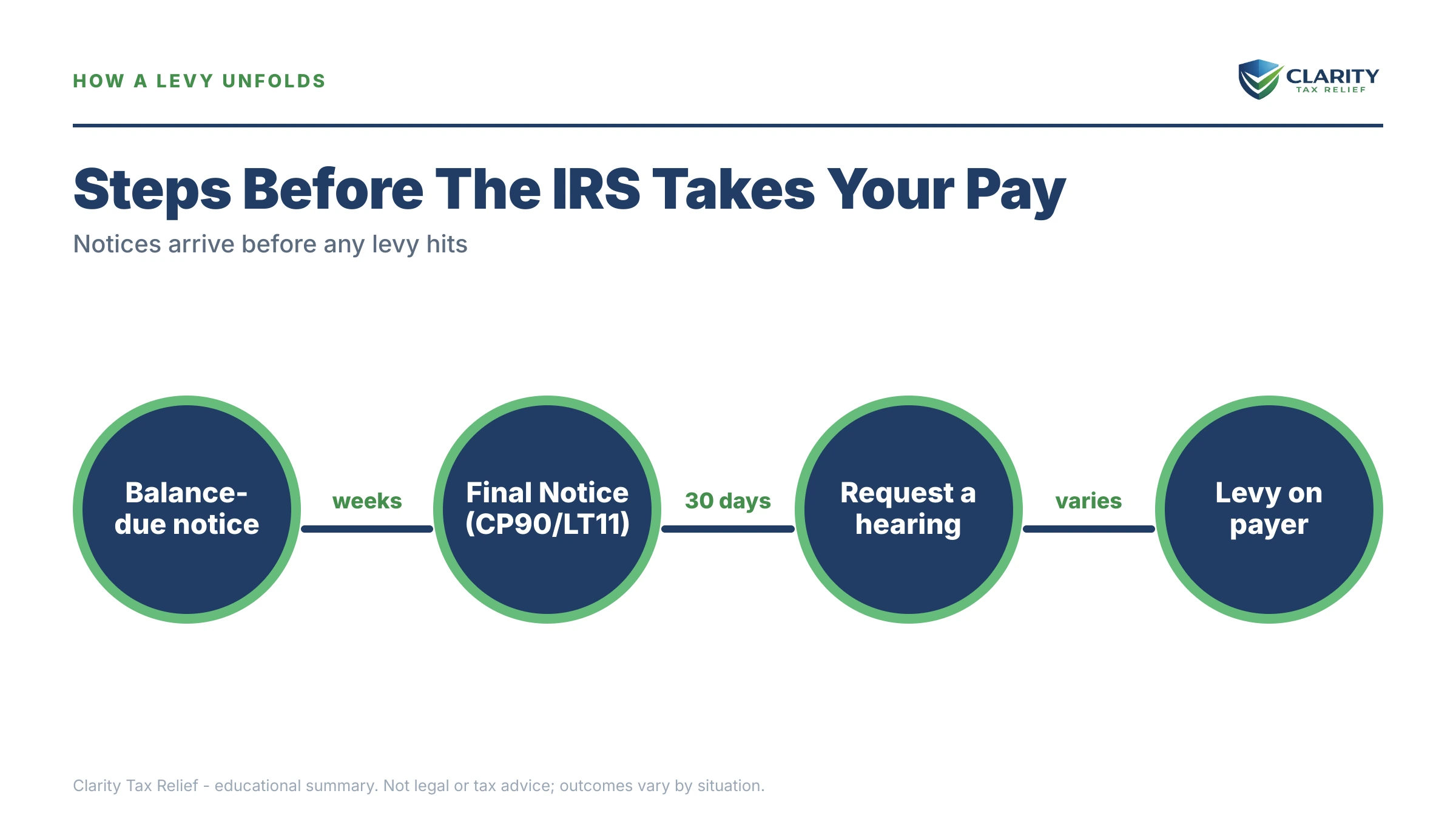
- Identify the notice you're holding. Find the code in the corner — CP14, CP504, LT11, or Letter 1058 — and the date. The code tells you how close the IRS is to levying your clients; the date starts your clock.
- Pull your wage and income transcript. It lists every client and platform that filed a 1099 on you — which is exactly the list the IRS will levy from. Knowing who's exposed tells you how urgent this is.
- File Form 12153 if you're inside the LT11 window. A Collection Due Process request filed within 30 days of an LT11 or Letter 1058 generally blocks levies on your clients while your case is heard.
- Set up a resolution before the next invoice cycle. A streamlined installment agreement, Currently Not Collectible status, or an Offer in Compromise each stops new levies once in place. Get current on this year's estimated taxes — the IRS requires it to approve and keep an agreement.
- Request a release if a client was already levied. Call the number on the levy and ask for release based on an approved agreement or economic hardship — a levy that leaves you unable to pay rent and basic bills must be released under IRC section 6343.
When you can handle this yourself, and when help changes the outcome
Plenty of 1099 levy threats don't need professional help. If you owe under $25,000, agree with the balance, and can afford the streamlined payment, setting up a plan online before the LT11 clock runs out is a 30-minute job. You can do it at the IRS's payment plans page today. Same if a single small levy already hit and you can pay the rest quickly.
Experienced help earns its cost in different situations: a levy already in motion against clients you can't afford to lose, multiple unfiled years (the IRS won't approve any agreement until returns are in), hardship math on Form 433 where one wrong line inflates what the IRS thinks you can pay, or an Offer in Compromise, where the calculation of what the IRS could collect from you decides everything. If a levy release is being stonewalled, the Taxpayer Advocate Service is a free escalation path when the levy is causing genuine hardship — see also our guide to an emergency levy release for hardship. And if your balance sits with a client who's dragging their feet mid-levy, don't wait it out — that's exactly when a professional review clarifies your fastest release path: start with a free case review or call (888) 825-7779.
Terms on your levy notice, decoded
- Levy vs. garnishment: legally the IRS "levies" (seizes) property; "garnishment" is the everyday word for a levy on income — same power, different vocabulary.
- Form 668-A: the one-time levy served on clients, banks, and payment apps — it captures what's owed to you the day it arrives.
- Form 668-W: the continuous wage levy used on W-2 employers; it does not apply to true contractor relationships.
- Fixed and determinable: future payments you already have a set right to receive (a retainer, a structured payout) — the exception that lets one levy reach future contractor payments.
- Accounts receivable: money clients currently owe you — the exact asset a 668-A intercepts.
- CDP (Collection Due Process): your 30-day right after an LT11/Letter 1058 to a hearing that generally pauses levies while it's pending.
1099 garnishment questions, answered
Can the IRS garnish 1099 income if I'm self-employed?
Yes. The IRS can't send your clients the continuous wage garnishment it uses on employees. But it can serve each client a Form 668-A levy that seizes whatever that client owes you when the levy arrives. It can also levy your business bank account and, through repeated levies, keep intercepting your receivables until the debt is resolved.
How much of my 1099 income can the IRS take?
Up to 100 percent of any single payment. The exempt-amount table that protects part of an employee's paycheck applies only to wage garnishments under Form 668-W. It does not apply to a one-time levy on contractor pay. If a client owes you $5,000 when the levy lands, the client must send the IRS the full $5,000.
How does the IRS know who my clients are?
From the 1099-NEC and 1099-K forms your clients and payment platforms file every January. Those filings sit in your IRS wage and income transcript, which gives collections a ready-made list of who pays you. Clients who paid you in past years can still be levied, as long as they currently owe you money when the levy is served.
Can the IRS levy my 1099 income more than once?
Yes. A Form 668-A levy is one-time — it only captures what the client owes you the day it's served — but nothing stops the IRS from serving a fresh levy on the same client next month, or on several clients at once. And if your contract creates fixed and determinable future payments, a single levy can attach to those future payments too.
Can the IRS take money from my PayPal or Venmo business account?
Yes. Payment-app balances can be levied like bank accounts. The platforms report your business income on Form 1099-K once you pass $20,000 and 200 transactions. A levy on a bank or app account comes with a 21-day hold before the money is sent to the IRS, which is your window to negotiate a release.
Does the IRS have to warn me before garnishing 1099 income?
Yes, in almost all cases. Before levying, the IRS must send a final notice of intent to levy, usually LT11 or Letter 1058, and give you 30 days to request a Collection Due Process hearing on Form 12153. The main exceptions are jeopardy levies, state refund levies, and certain federal payment levies, which can happen with less warning.
What if a levy leaves me unable to pay rent?
You can ask for an economic-hardship release under IRC section 6343. If the levy prevents you from meeting basic living expenses — rent, utilities, food, transportation — the IRS is required to release it, though you'll need to document your income and expenses. A release stops that levy, but the debt remains, so pair it with a payment plan or hardship status.
Will a levy on my client end the working relationship?
It's uncomfortable. But your client has no choice: a payer who ignores an IRS levy becomes personally liable for the amount they should have turned over, and can face an additional penalty. Most clients comply immediately and keep working with you. The faster you get the levy released or an agreement in place, the less your clients ever see.
Your next 24 hours
- Find your notice's code and date. Look at the top-right corner of the most recent IRS letter, if it says LT11 or Letter 1058, count 30 days from the printed date. That's your levy-protection deadline.
- Gather three things: your last filed return, the notice itself. A list of the clients and platforms that filed 1099s on you this year. That's the exposure map for any levy. You can verify your balance anytime at IRS.gov/payments.
- Get a free case review. Before your next invoice cycle puts client money at risk, have an experienced tax professional check which option fits your numbers. The 2-minute form or (888) 825-7779. If your LT11 clock is running, sooner genuinely beats later.
This guide is general information, not tax or legal advice for your specific situation. Eligibility for IRS programs depends on individual facts and circumstances; no outcome is guaranteed.