
IRS Collections & Levies
IRS Seized Business Assets: What to Do Now and How to Get Them Back (2026)
The short answer: if the IRS seized business assets, you still have a recovery window. Bank-levy funds sit on hold for 21 days before your bank sends them, and physically seized equipment or inventory can be returned any time before the auction if you pay or negotiate a resolution. Speed decides what you keep.
Maybe the business checking account read zero this morning. Maybe a revenue officer handed you an inventory list of every tagged machine in your shop, or a customer called to say their payment now goes to the U.S. Treasury. However it happened, the IRS seized business assets you need to operate, and the single most important fact right now is that seizure is not the same as sale. Until the sale happens, most of this is reversible.
What you do in the next few days depends entirely on which form the IRS used and which dates are printed on it. The image below shows exactly what the IRS's levy and seizure paperwork looks like and where to find the dates that control your recovery window.
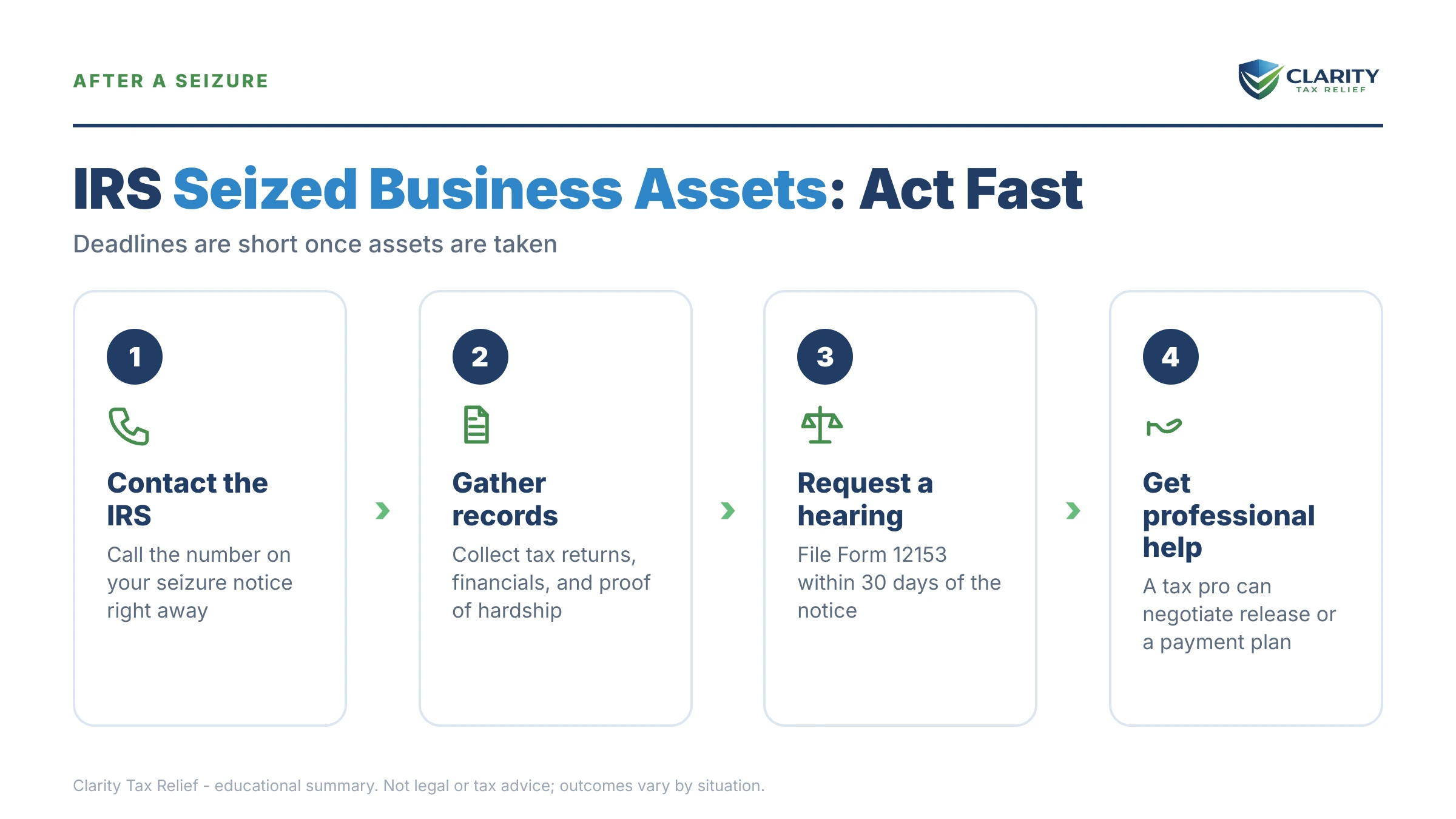
⏱ Your deadline: if the levy hit your business bank account, the bank holds the funds for 21 days before sending them to the IRS. That hold is your negotiation window. If physical property was seized, the sale date printed on your Notice of Sale controls; your options collapse once it passes.
Why the IRS seized your business assets
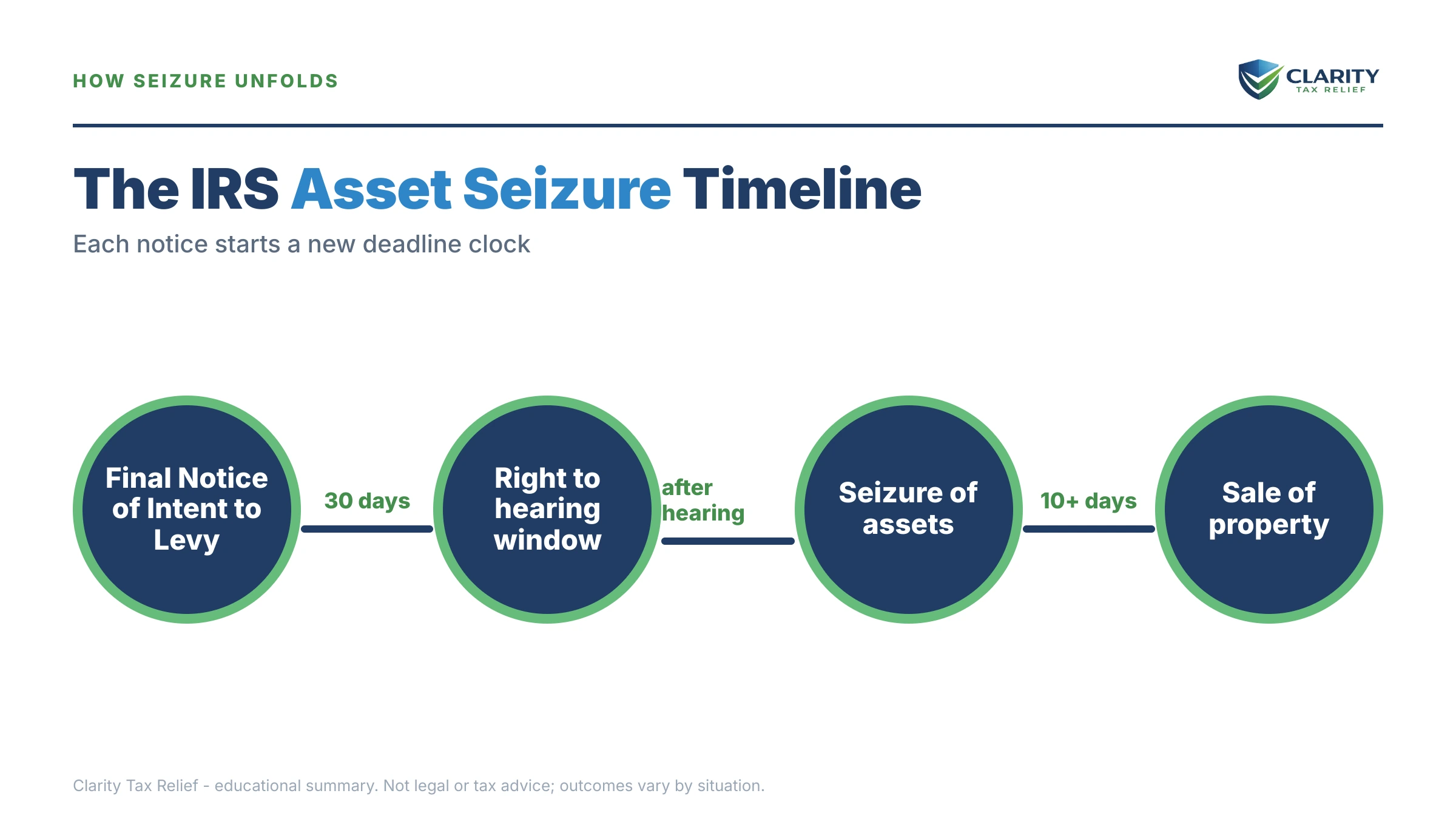
The IRS seizes business assets only after its written warnings ran out — by law, it must send a final notice of intent to levy and wait 30 days before taking anything. That final notice is Letter LT11 or Letter 1058, and it carries Collection Due Process appeal rights, requested with Form 12153. If those 30 days passed without a response, the levy authority switched on.
Behind the seizure sits an assessed balance: an unpaid business return, an audit adjustment, or, the most common driver of business seizures, unpaid payroll deposits. If your debt comes from Form 941, read our guide to 941 back taxes, because payroll debt escalates faster and carries personal exposure income-tax debt doesn't.
Who did it matters, too. Bank and receivable levies are usually fired automatically by the IRS's collection system. A physical seizure — trucks towed, doors padlocked, equipment tagged — requires a human: an assigned revenue officer and multiple layers of management approval. If someone left a card at your door, our guide to a revenue officer visit over payroll taxes covers the first 24 hours. And despite 2025's roughly 27% cut to the IRS workforce, the automated levy systems never stopped running — accounts escalate whether or not a human ever reviews the file.
“An IRS levy permits the legal seizure of your property to satisfy a tax debt. It can garnish wages, take money in your bank or other financial account, seize and sell your vehicle(s), real estate and other personal property.”
— Levy (IRS.gov)
What kind of seizure hit you, and why it matters
Every type of IRS business asset seizure has a different mechanism and a different recovery window. Identify yours from the paperwork before you make a single call — the strategy for a frozen bank account is nothing like the strategy for tagged equipment. (For the full picture of what the IRS can and can't reach in an operating company, see can the IRS take my business.)
| What the IRS took | How the levy works | Your recovery window |
|---|---|---|
| Business bank account | Form 668-A snapshot levy — freezes what's in the account that day; deposits made afterward aren't touched | 21-day hold before the bank transmits the funds |
| Accounts receivable | Levy served directly on your customers — money they owe you goes to the IRS instead | Until each customer pays; a release stops further diversions |
| Equipment, inventory, vehicles | Form 668-B physical seizure — property is tagged, removed or padlocked, then appraised for auction | Any time before the date on your Notice of Sale |
| Owner's wages or draws (sole proprietor) | Continuous levy on W-2 wages; typically a one-time levy on 1099 payments owed to you | Until formally released — a wage levy never expires on its own |
| Business real estate | Seizure and sale of land or buildings; a principal residence requires federal court approval first | Before the sale; real property also carries post-sale redemption rights |
Two of these deserve their own deep dives: the IRS bank levy and the 21-day rule, and IRS seizure of real property, which follows stricter court-supervised rules than personal property.
What happens next if you do nothing
A seizure is not the end of IRS collection — it's the middle: whatever the auction doesn't cover stays collectible for the rest of the 10-year collection statute (the CSED). Left alone, the sequence runs like this:
- Bank funds transmit. When the 21-day hold ends, your bank sends the frozen money to the IRS and it's applied to the balance. Recovering transmitted funds is rare.
- Seized property is appraised. The IRS values equipment, vehicles, and inventory at forced-sale prices and sets a minimum bid, usually far below what the assets are worth inside a running business.
- The Notice of Sale issues. The auction is publicly advertised with a fixed date. That printed date becomes the wall your remaining options run into.
- The auction happens. Property sells to the highest bidder at or above the minimum bid. The expenses of seizure and sale come out of the proceeds before a dollar touches your tax debt.
- The leftover balance survives. The IRS returns to the well: new bank levies, receivable levies, and, for payroll debt, Trust Fund Recovery Penalty assessments against owners and check-signers personally.
- The federal tax lien keeps working. A filed Notice of Federal Tax Lien attaches to everything the business still owns and everything it acquires, clouding credit, financing, and any sale of the company.
If the seizure has reached the point where you can't operate — doors locked, cash flow cut off — see IRS shut down my business for the going-concern playbook, including when the IRS itself is required to back off because a dead business can't pay anything.
Assets seized and a sale date looming?
Send us the levy paperwork. An experienced tax professional will decode which form hit you, what your real recovery window is. The fastest release path — free, before the 21-day bank hold ends or the Notice of Sale date arrives.
Your options to get seized business assets back
Federal law, IRC §6343, requires the IRS to release a levy in specific situations, and seized property can be recovered before the sale by paying the balance plus seizure and sale costs. Between those poles sits a menu of negotiated outcomes. The general playbook for resolving the underlying balance lives in our guide to how to settle tax debt yourself. Here's how each option behaves when a seizure is already in motion:
| Option | Who it fits | What it does |
|---|---|---|
| Pay in full before the sale | Anyone who can raise the balance plus seizure and sale expenses | The property must be returned and the levy ends |
| Installment agreement | Individuals: up to 72 months online on balances ≤ $50,000; a guaranteed installment agreement applies at ≤ $10,000 (income tax) paid within 3 years. Operating businesses use a business IRS installment agreement with its own thresholds | Typically supports a levy release and stops further seizure while you pay; interest and penalties keep accruing |
| Release because the levy blocks collection (IRC §6343) | Businesses that can show the seizure prevents them from earning the money to pay, or individuals in economic hardship | Levy released so the business keeps operating; the debt itself remains |
| Collection Due Process hearing | Anyone still inside the 30-day window after LT11/Letter 1058, or who never received it; request via Form 12153 | Appeals reviews the seizure and your alternatives; levy action is generally on hold during a timely hearing |
| Wrongful levy claim | Third parties — lessors, secured lenders, co-owners — whose property was taken for your debt | Returns property that never belonged to the taxpayer; a strict time limit applies |
| Offer in Compromise | Businesses or owners whose assets and income genuinely can't cover the debt; $205 application fee, and the IRS accepted roughly 1 in 5 offers in FY2024 | Can settle for less than owed, but it's a months-long, means-tested process — not a fast levy fix |
One option many owners don't know exists: the leased forklift, the floor-planned trucks, the consignment inventory — property with someone else's name on the title can come back through a wrongful levy claim, filed by the true owner, not you. Call your lessors and lenders the same day the seizure happens.
Worked example: a $7,400 debt, a levy, and a refinance on the line
Say you owe $7,400 in income tax from your sole proprietorship's best year, the IRS just levied your business checking account and froze $3,100, and you're planning to refinance your house this fall. This is hypothetical, but the math is real.
Because the balance is under $10,000, you fit the guaranteed installment agreement if you can pay within three years: $7,400 ÷ 36 ≈ $206 a month. Stretch it to 72 months under a streamlined agreement and it's roughly $103 a month, but interest plus the 0.5%-per-month failure-to-pay penalty keep accruing, so the longer plan costs more in total.
The refinance angle is why speed matters here. A resolved $7,400 balance on an active agreement typically gives the IRS no reason to file a Notice of Federal Tax Lien, and no lien means nothing surfaces on your title search. Let it drift into liens and repeated levies, and your underwriter will see it. If a lien has already been recorded, refinancing is still workable — see refinancing with an IRS lien for the subordination route.
And the $3,100? Set up the agreement and request a release inside the 21-day hold, and there's a real chance that money goes back to covering payroll instead of leaving for the Treasury. Wait until day 22 and it's applied to the balance — legally gone.
How to respond to an IRS business asset seizure, step by step
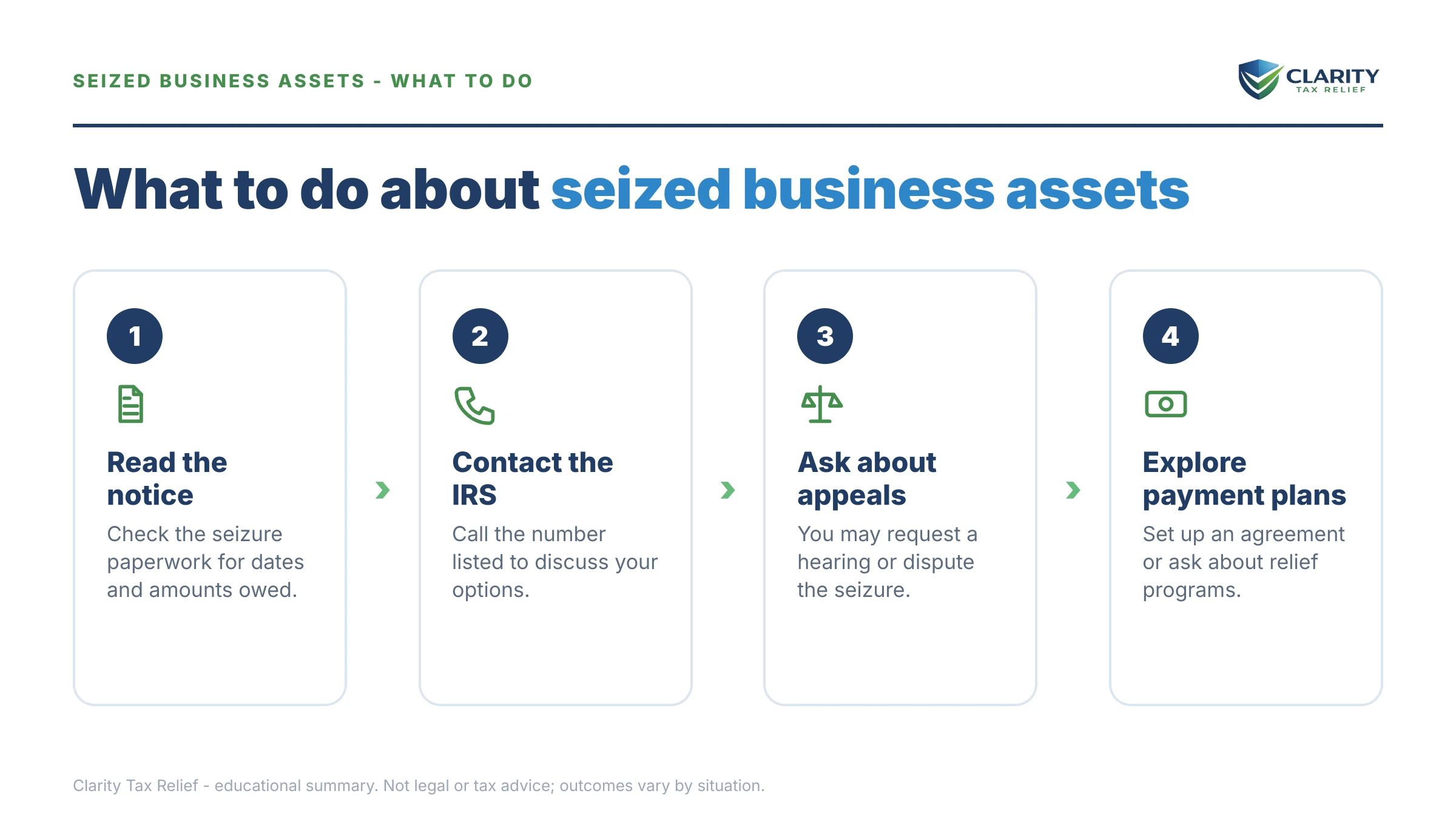
- Identify the paperwork. Find the form number and dates: Form 668-A means a bank levy with a 21-day hold; Form 668-B means a physical seizure. A Notice of Sale shows the auction date that controls everything.
- Call the number on the notice today. Ask for the assigned revenue officer, confirm the exact balance and every deadline, and say plainly that you intend to resolve the account — engagement is what keeps a sale from moving forward on autopilot.
- Gather your financials. Pull three months of business and personal bank statements, a current profit-and-loss, your most recent filed returns. A written list of everything seized with its realistic value.
- Propose a resolution before the deadline. Full payment, an installment agreement, or a release because the levy blocks the business from earning — pick the option your numbers support and put it in front of the IRS in writing.
- Assert your rights if they were skipped. If you never received a final notice of intent to levy, file Form 12153 for a Collection Due Process hearing. If seized property belongs to someone else, start a wrongful levy claim immediately.
Can the IRS take your personal assets for the business debt?
For a sole proprietor, there is no legal wall — business and personal assets are equally exposed for the same tax debt. That includes your personal bank accounts, your wages from any day job, and, in extreme cases, real estate — though the IRS must obtain federal court approval before seizing a principal residence, a bar it rarely clears. If your own paycheck is in play, you can estimate the exposure with our IRS Wage Garnishment Calculator.
If the business is an LLC or corporation, its own income-tax debt generally stays at the entity level. The exception that catches owners off guard is payroll: the withheld portion of employee paychecks is "trust fund" money, and the Trust Fund Recovery Penalty lets the IRS assess it personally against anyone who was responsible for paying it and willfully didn't — owners, officers, and sometimes bookkeepers and check-signers.
A small amount of property is also off the table by statute: certain tools of the trade and books are exempt from levy up to an inflation-adjusted dollar cap. The exemption is claimed, not automatic — one more reason to answer the paperwork instead of ignoring it.
When you can handle this yourself, and when help changes the outcome
You don't need professional representation for every levy. If this is a single bank levy on a balance you agree with, the total is modest — like the $7,400 example above — and your returns are filed, you can set up a payment plan yourself on the IRS payment plans page, then call the number on the levy to request a release before the 21-day hold ends. Balances you can clear within 180 days qualify for a short-term plan with $0 setup fee.
Experienced help changes outcomes in four situations: a physical seizure with a sale date already set, an assigned revenue officer working the case in person, payroll debt with Trust Fund Recovery Penalty interviews looming, and any going-concern fight where the release argument is that the levy destroys the IRS's own source of repayment. Those cases turn on financial presentation and timing, and a misstep is measured in auctioned equipment. Our tax relief for small business guide covers how to evaluate that help honestly. If the IRS itself is unresponsive while a sale date approaches, the Taxpayer Advocate Service can intervene when you face imminent economic harm.
Terms on your seizure paperwork, decoded
- Levy — the IRS actually taking money or property, as opposed to a lien, which is only a legal claim against it.
- Seizure — a levy on physical property: the IRS takes possession of equipment, vehicles, inventory, or real estate to sell at auction.
- Form 668-B — the levy form a revenue officer uses to seize physical business property (Form 668-A is the bank-account version).
- Notice of Sale — the document announcing the public auction of seized property; its printed date is the deadline that governs your remaining options.
- Minimum bid — the floor price the IRS sets before auction. You're entitled to see it and can challenge a figure that undervalues your property.
- Trust Fund Recovery Penalty (TFRP) — the rule that makes responsible individuals personally liable for the withheld-from-employees portion of unpaid payroll taxes.
IRS seized business assets: your questions, answered
Can I get my business assets back after the IRS seizes them?
Often, yes — the window is before the sale. Bank-levy funds sit on hold for 21 days before your bank sends them, and physically seized equipment or inventory can be returned any time before the auction if you pay the balance plus seizure costs or the IRS agrees a release helps it collect. After the sale, personal property is generally gone for good.
Can the IRS seize business assets without warning?
Not legally, outside of rare jeopardy situations. Before levying, the IRS must send a final notice of intent to levy, Letter LT11 or Letter 1058, and wait 30 days, during which you can demand a Collection Due Process hearing with Form 12153. If you never received that notice at your last known address, the seizure itself may be defective — raise it immediately.
What is the difference between a levy, a seizure, and a lien?
A lien is a legal claim that attaches to everything the business owns; it takes nothing by itself. A levy is the actual taking — money from a bank account or payments from your customers. A seizure is a levy on physical property: the IRS takes possession of equipment, vehicles, or inventory and sells them at public auction.
Can the IRS take my personal assets for my business's tax debt?
It depends on your entity and the tax type. Sole proprietors have no separation — business and personal assets are equally exposed. A corporation's or LLC's own income-tax debt generally stays with the entity, but unpaid payroll withholding crosses over: the Trust Fund Recovery Penalty makes responsible individuals personally liable for the trust-fund portion.
How long does the IRS wait before selling seized business assets?
There is no single fixed timeline. After seizure, the IRS appraises the property, sets a minimum bid, and issues a Notice of Sale showing the exact auction date, typically a matter of weeks, not months. The date printed on your Notice of Sale controls, and every recovery option gets harder once it passes.
What if the IRS seized property that isn't actually mine?
Leased equipment, consignment inventory, or a co-owner's property taken for your debt can be recovered through a wrongful levy claim. The true owner, not you, files the claim, and a strict time limit applies, so lessors and secured lenders should act fast. Notify any equipment lessor or lender with an interest in the property the same day the seizure happens.
Will the auction of my seized assets pay off what I owe?
Usually not. Seized business property sells at forced-sale prices — often far below what you paid or what it is worth inside a running business — and the expenses of seizure and sale come out of the proceeds first. Whatever balance remains is still fully collectible, which is why negotiating before the sale almost always beats letting it happen.
Does filing bankruptcy stop an IRS seizure?
The automatic stay generally halts IRS collection, including a scheduled sale, the moment a bankruptcy petition is filed. It is not a cure-all: many recent taxes survive the case, and property already sold is not recovered. Bankruptcy is a serious step that deserves advice from an experienced tax professional or bankruptcy attorney before a sale date forces the decision.
Your next 24 hours
- Find the controlling date on your paperwork. Form 668-A: count 21 days from the levy date — that's when the bank transmits. Form 668-B or a Notice of Sale: the printed sale date is your wall.
- Gather your file. The levy forms, your last filed business and personal returns, three months of bank statements. A list of what was seized with its realistic value, plus contact info for any lessor or lender whose property was taken.
- Get the seizure reviewed free. Use the 2-minute form or call (888) 825-7779. An experienced tax professional can tell you before the hold ends or the sale date arrives which release path your numbers actually support. You can make any payment directly at IRS.gov/payments.
This guide is general information, not tax or legal advice for your specific situation. Eligibility for IRS programs depends on individual facts and circumstances; no outcome is guaranteed.