
Back Taxes & Balances
How Much Do I Owe the IRS? Four Ways to Find Out in 2026
The short answer: to find out how much you owe the IRS, use one of four free methods — your IRS Online Account at IRS.gov (fastest, updated to today), your account transcript (shows tax vs. penalties vs. interest), a phone call to 1-800-829-1040, or the balance on your latest IRS notice. The online account is the most current figure.
You have a nagging sense you owe the IRS, but you don't know the number — maybe you tossed the last letter, maybe you have a few unfiled years, maybe you just want to know before it grows any bigger. Here's the good news: the exact figure is a few minutes away, it's free, and knowing it is the first move toward fixing it.
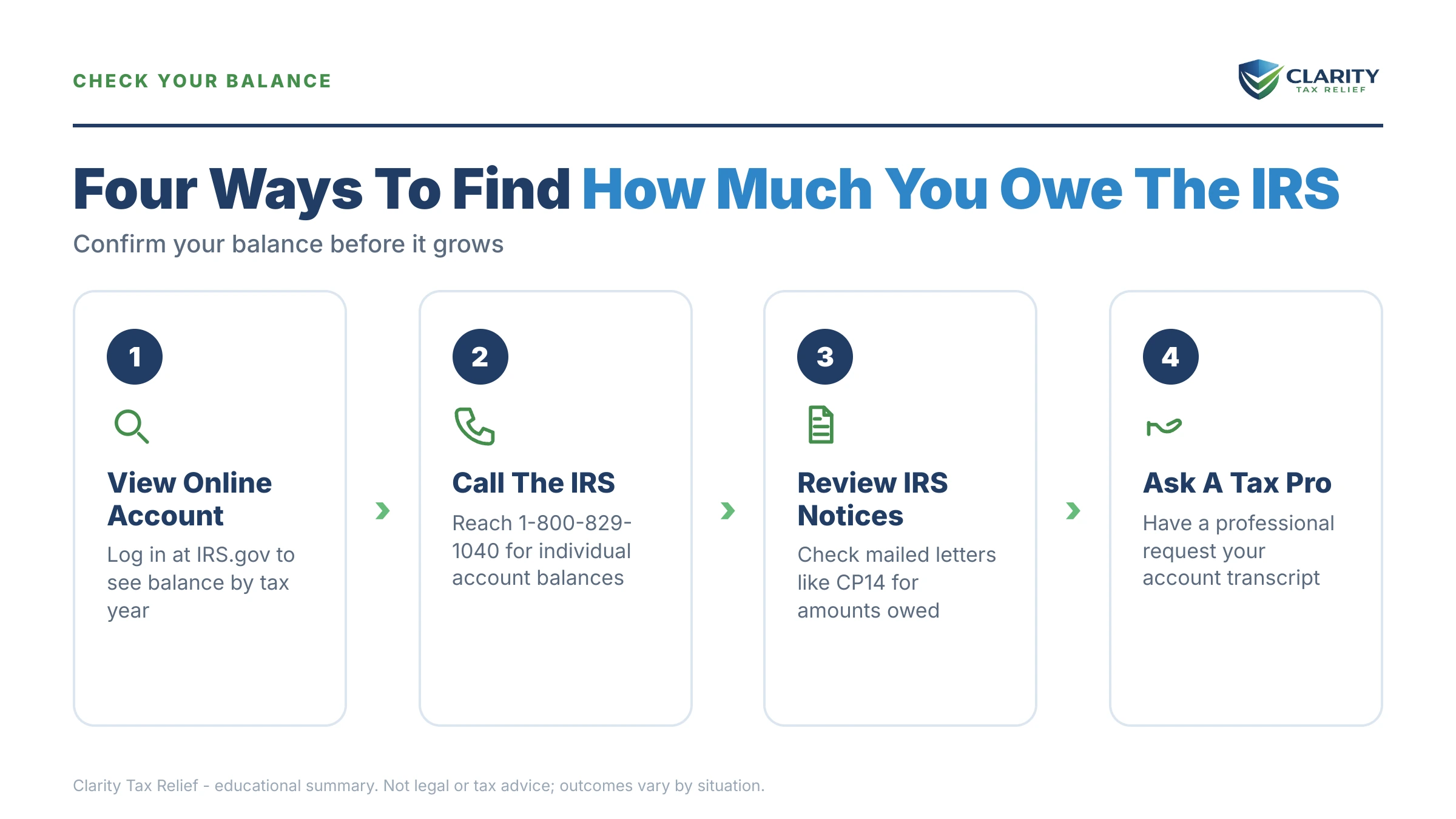
The four ways below don't all show the same number, and that trips people up. The image below shows where the IRS actually displays your balance and what to look for so you don't overpay or panic at the wrong figure.
⏱ The clock that matters here: there's no deadline to look up your balance, but every day you wait, it grows. The failure-to-pay penalty adds 0.5% of the unpaid tax each month and interest compounds daily, so the number you find today is the smallest it will ever be.
Why you're not sure how much you owe the IRS
Most people asking "how much do I owe the IRS" fall into one of a few situations, and each one has a slightly different answer path.
You may have filed but not paid. You know a balance exists but not what it's grown to with penalties and interest. You may have lost or ignored the notices and want the current total without digging through mail. You may have unfiled years, where the IRS might not have a final number yet, or might have filed a substitute return that overstates it. Or you may be checking on someone else's behalf — a spouse, a parent, an estate — which requires written authorization.
The reason the number feels slippery is simple: your balance changes every single day. A letter from three months ago is already out of date. That's why the source you check matters as much as the checking itself.
What happens if you don't find out
Not knowing your balance doesn't pause it — the IRS keeps assessing, mailing, and eventually enforcing on its own automated schedule. Avoiding the number just means you find out later, when it's bigger and the options are fewer.
- The balance keeps compounding. Penalties and interest post monthly whether or not you've looked; a balance you never check quietly climbs.
- CP14, then reminder notices. The first bill (CP14 notice) is followed by CP501 and CP503 reminders, each with more added on.
- CP504 — Intent to Levy. The IRS can seize your state tax refund and a federal lien becomes a real possibility.
- LT11 / Letter 1058 — Final Notice. After a 30-day window with appeal rights, the IRS can garnish wages and levy bank accounts.
In 2026 this runs almost entirely on autopilot. IRS staffing was cut sharply in 2025, but the systems that assess penalties and issue levies never stopped. The machine escalates on schedule even when no human is looking at your file — which is exactly why pulling your own number now, before a levy, is the move.
Not sure what your real IRS balance means?
Send us a photo of your latest notice or your online-account screen. An experienced tax professional will confirm your true payoff figure and lay out your options — free, confidential, and while penalties are at their smallest.
Four ways to find out how much you owe the IRS
All four methods are free and legitimate — the IRS never charges to tell you your balance. They differ in speed and in what they reveal. Start at the top; drop down only if a step is blocked.
| Method | How fast | What it shows | Best for |
|---|---|---|---|
| IRS Online Account | Minutes (after ID.me setup) | Current total + balance per year | Fastest, most up-to-date figure |
| Account transcript | Instant online; 5–10 days by mail | Tax vs. penalties vs. interest, by code | Seeing what the balance is made of |
| Phone (1-800-829-1040) | Same call, if you get through | Balance and years, read by an agent | Can't verify identity online |
| Your latest IRS notice | Already in hand | Balance as of the notice date only | A quick starting number (not current) |
1. Your IRS Online Account (fastest)
Your IRS Online Account shows your total balance updated to today plus a year-by-year breakdown — it's the single most current figure available. Set it up at IRS.gov; the first-time identity check through ID.me takes about 15 minutes and needs a photo ID and a selfie. Our IRS online account setup walkthrough covers every screen. The balance here already includes accrued penalties and interest, so treat it as your payoff amount.
2. Your account transcript (shows the breakdown)
An account transcript is the only free source that splits your balance into tax, penalties, and interest line by line. Pull it instantly inside your Online Account, or order it separately — see getting your transcripts online. Once you have it, our guide to reading an account transcript decodes the transaction codes, so you can tell which charges are penalties (potentially reducible) versus interest (rarely reducible).
3. Call the IRS (no online account needed)
If you can't clear ID.me, call the IRS at 1-800-829-1040, verify your identity. An agent will read you the balance and the years involved. Reaching a human is the hard part in 2026 — see the best time to call the IRS and what to say when calling the IRS about back taxes. If you keep getting disconnected, this fix for when you can't reach the IRS on the phone lays out the alternatives.
4. Read your latest IRS notice
The quickest starting number is already in your mailbox: the balance printed on your most recent CP14, CP501, or CP503. Just remember it's a snapshot from the day it printed — penalties and interest have run since, so the notice figure is a floor, not your current payoff. Confirm the up-to-date number in your Online Account before you pay.
How to check what you owe the IRS, step by step
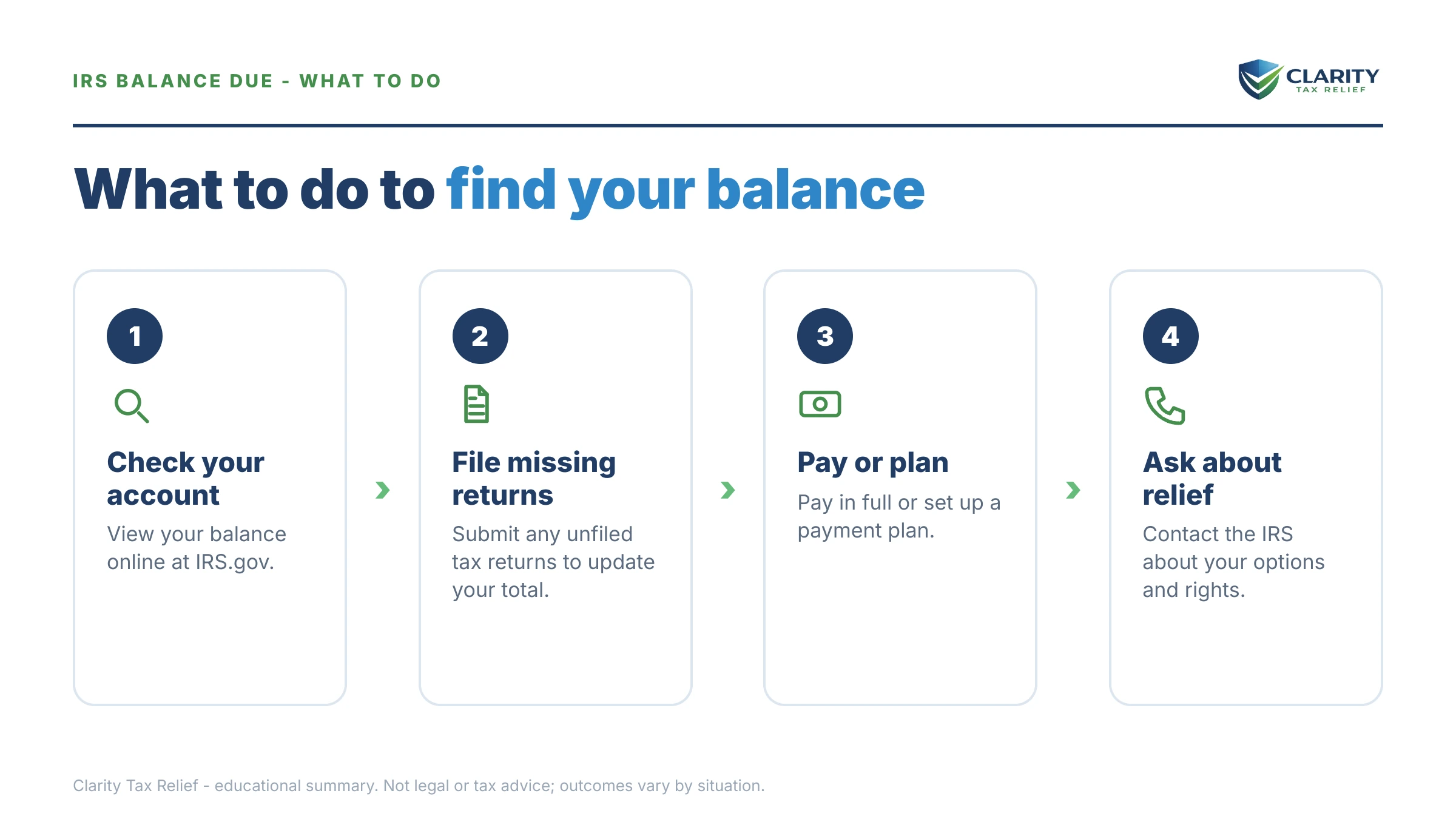
- Check your IRS Online Account at IRS.gov for the fastest, most current total. It shows your balance updated to today and a year-by-year breakdown.
- Pull your account transcript for each year you owe to see how the balance splits between tax, penalties, and interest by transaction code.
- Call the IRS if you can't get online — dial 1-800-829-1040, verify your identity. An agent will read you the current balance and the years involved.
- Compare against your notices and returns to catch a payment that didn't post or a year that looks wrong.
- Decide your next move by the amount — pay in full, a payment plan, hardship status, penalty relief, or a professional review for larger or multi-year balances.
What your balance is actually made of
The number you find is rarely just tax — it's tax plus a failure-to-file penalty, a failure-to-pay penalty, and daily interest layered on top. Knowing the split matters, because penalties can sometimes be removed while the underlying tax usually can't. You can estimate the additions yourself with our IRS penalty & interest calculator, then confirm against your transcript.
The failure-to-file penalty is the expensive one at 5% of the unpaid tax per month (capped at 25%) — ten times the 0.5%-per-month failure-to-pay penalty. That's why filing always beats not filing, even when you can't pay. Our breakdown of failure-to-file vs. failure-to-pay penalties and how big IRS penalties actually get show the math in detail, and how IRS interest compounds explains the daily piece.
Say your 2023 return showed $18,400 of tax and you paid nothing. Here's how one balance can look like three different numbers depending on where you check:
| Where you look | What it shows | Why |
|---|---|---|
| Original return | $18,400 tax | Tax only — no additions yet |
| Old CP14 (months ago) | ~$19,100 | Early penalties + interest as of print date |
| Online Account today | ~$23,800 | Failure-to-file penalty maxed at 25% ($4,600) + failure-to-pay + accrued interest |
The figures above are illustrative, not a quote. Your real additions depend on your dates and the current interest rate. The takeaway holds, though: the Online Account total is your true payoff. The gap between it and the old notice is pure penalties and interest that keep growing.
How much you owe changes what you should do next
Once you know the exact number, it points you to a resolution path — the IRS treats small balances very differently from large ones. Here's the map by amount.
| Amount you owe | Typical best path | Details |
|---|---|---|
| Can pay within 180 days | Short-term plan ($0 setup) | No fee; interest/penalties still run |
| Up to $10,000 | Guaranteed installment agreement | Near-automatic if you're compliant |
| $10,000–$50,000 | Streamlined installment agreement | Up to 72 months, no full financials |
| Over $50,000 | Financials required (433-F/433-A) | Plan, hardship, or an offer — case by case |
| Genuine hardship | Currently Not Collectible / offer | Collection paused; offer if you qualify |
Want the deep-dive for your exact number? See I owe the IRS $10,000, I owe the IRS $25,000, or I owe the IRS $50,000 — each walks through the plan math for that band. And if the balance is affordable, setting up a payment plan online takes about 15 minutes.
Checking a balance for someone else (spouse, parent, estate)
You can't pull another adult's IRS balance just by asking. You need written authorization, even for a family member. Two forms do it: Form 8821 (Tax Information Authorization) lets you see the account and transcripts, while Form 2848 (Power of Attorney) also lets you act — set up plans, call on their behalf, respond to notices. For a parent who's overwhelmed or an estate you're administering, Form 2848 is usually the right one because you'll need to do more than look.
When you can handle this yourself, and when help changes the outcome
If you owe one year, agree with the number, and can pay it or set up a plan online, you don't need anyone. Log in, confirm the balance, and pay or arrange it in minutes — that's the whole job. A first CP14 you agree with is squarely a do-it-yourself situation, and paying it or starting a short-term plan stops the escalation cold.
Experienced help earns its keep when the number is a surprise or a mess: multiple unfiled years, a substitute return the IRS filed for you, a balance over $50,000, a levy or garnishment already in motion, or penalties large enough that abatement is worth pursuing. In those cases the order you fix things — file returns, request penalty relief, then resolve the balance — changes what you ultimately pay. If you have several open years, our guides on the six-year lookback and the 10-year collection statute explain why sequence matters before you send the IRS a dime.
Terms on your account, decoded
- Account transcript: a free IRS record showing every posting to a tax year — tax, payments, penalties, and interest — each with a transaction code.
- Failure-to-pay penalty: 0.5% of unpaid tax per month, added until the balance is paid or capped at 25%.
- Failure-to-file penalty: 5% of unpaid tax per month (max 25%) — ten times harsher, which is why filing beats not filing.
- Payoff amount: the total to fully clear a year as of a specific date, including all accrued penalties and interest — what your Online Account shows.
- CSED (Collection Statute Expiration Date): the roughly 10-year deadline the IRS has to collect, which certain actions can pause (toll) and extend.
- Substitute for return (SFR): a return the IRS files for you when you don't. It excludes your deductions, so the balance is usually too high.
How much do I owe the IRS: questions, answered
Can I check how much I owe the IRS online?
Yes. The fastest way is your IRS Online Account at IRS.gov, which shows your total balance updated to today, plus a year-by-year breakdown. You'll verify your identity through ID.me the first time, which takes about 15 minutes. The online balance already includes accrued penalties and interest, so it is usually higher than any older notice you're holding.
How do I find out how much I owe the IRS for free?
Every legitimate method is free — the IRS never charges to tell you your balance. Your Online Account, your account transcript, and calling 1-800-829-1040 all cost nothing. Be careful with third-party sites that promise your balance for a fee. The real number lives only at IRS.gov and on the notices the IRS mails you.
Why is the amount on my IRS notice different from my online account?
Because a notice is a snapshot from the day it printed, and penalties and interest have run since. The failure-to-pay penalty adds 0.5% a month and interest compounds daily, so your Online Account balance is almost always higher than an older CP14 or CP501. Trust the Online Account figure as the current payoff amount.
How do I find out if I owe the IRS from previous years?
Your IRS Online Account lists a balance for each tax year separately, so you can see every year with an open balance in one place. If a year is missing entirely, pull the account transcript for that year — a blank transcript can mean the IRS has no return on file, which is a different problem than owing. Multiple open years usually means you should get professional eyes on the sequence.
Can I find out how much I owe the IRS without creating an account?
Yes, two ways. You can call the IRS at 1-800-829-1040 and, after verifying your identity, an agent will read you the balance. Or you can request an account transcript by mail using the Get Transcript by Mail tool or Form 4506-T, which arrives in 5 to 10 calendar days. Both avoid the ID.me setup, but neither is as fast as the online account.
How much do I owe the IRS if I never filed a return?
If you never filed, the IRS may not have a balance calculated yet, or it may have filed a substitute return for you that overstates the tax because it excludes your deductions. Your account transcript will show whether a substitute return posted. Filing your own accurate return almost always lowers a substitute-return balance, so don't assume the IRS figure is final.
Will checking how much I owe the IRS start collections?
No. Logging into your account, pulling a transcript, or calling to ask your balance does not trigger anything — collection is driven by the returns you filed and the automated notice cycle, not by you looking. In fact, knowing your exact number is the first step to stopping escalation, because you can't set up a payment plan or request relief until you know what you owe.
Does the IRS online account show penalties and interest?
Yes. The Online Account total is your payoff amount as of that day, with penalties and interest already added in. To see how the balance splits between tax, penalties, and interest for a given year, open that year's account transcript, which lists each addition by its own transaction code. That breakdown matters because penalties, but rarely interest — can sometimes be reduced or removed.
Your next 24 hours
- Find your number. Log into your IRS Online Account and write down the total balance and the balance for each year — that's your true starting figure.
- Gather the context. Pull the account transcript for each open year and set your last filed return and most recent notice beside it, so you can spot a missing payment or a substitute return.
- Get a free case review. If the number is bigger than you expected, spans multiple years, or a levy is already moving, call (888) 825-7779 or use the 2-minute form — the sooner you act, the less penalties and interest add on.
This guide is general information, not tax or legal advice for your specific situation. Eligibility for IRS programs depends on individual facts and circumstances; no outcome is guaranteed.