
Unfiled Returns
How Much Do I Owe the IRS If I Never Filed Taxes? A 2026 Guide
The short answer: if you never filed, no one can hand you an exact number yet — how much you owe depends on your income, filing status, and how many years you skipped. Until you file, the IRS may estimate it against you with a Substitute for Return, which almost always overstates what you actually owe.
You've been avoiding the question for a while, and now you need the number: how much do I owe if I never filed taxes? The honest truth is that the scariest version of that number, the one the IRS would assign you, is usually not your real number. There's a gap between what the IRS can estimate and what you actually owe, and closing that gap is entirely in your control.
Here's what changes the answer, in plain terms. If a year is still blank on your IRS record, no balance exists yet. If the IRS has already built a Substitute for Return, a balance exists, but it was calculated with zero deductions and the worst filing status, so it's inflated on purpose.
The image below shows you what these documents look like and where to look for the numbers that actually determine what you owe — the wage and income data the IRS holds, and any balance already assessed against you.
⏱ Two clocks are running: penalties and interest accrue every month a return sits unfiled, and any refund from a return older than three years is lost forever once that window closes. There is no single "respond by" date, but every month of delay makes the number bigger and can cost you refunds you're still owed.
Why you can't get a straight number until you file
The amount you owe on an unfiled year does not exist as a fixed figure sitting in an IRS computer waiting for you. Tax is assessed, formally posted to your account, only when a return is filed or when the IRS completes its own estimate for you. Until one of those happens, the year is essentially open and unresolved.
That's why "how much do I owe if I never filed" has three possible answers depending on where your account stands:
| Your account status | What the IRS shows | What it means for you |
|---|---|---|
| Year is blank / no return on file | No assessed balance yet | No number exists. Filing your own return sets the real figure, and starts the collection clock. |
| IRS built a Substitute for Return (SFR) | A balance with penalties and interest | The number is inflated — no deductions, credits, or dependents. Filing a real return usually lowers it. |
| Notice of Deficiency issued and time expired | SFR figure assessed as final | You can still file a real return to correct it, but it's now in active collection. Act fast. |
So the first job isn't to guess the number — it's to learn which of these three buckets each unfiled year sits in. That's a 20-minute transcript check, and it's covered step by step below.
How the IRS estimates what you owe: the Substitute for Return
When you don't file, the IRS can file a version for you called a Substitute for Return (SFR), and it is designed to protect the government, not to be accurate. Employers, banks, brokerages, and gig platforms all report your income to the IRS under your Social Security number, so it can reconstruct your gross income even without your return.
What the SFR leaves out is exactly what would lower your bill. It uses the standard deduction only, no itemized deductions, no business expenses, no dependents, and it typically files you as single or married filing separately — the highest-tax status. For a self-employed person this is brutal: the IRS taxes every dollar of a 1099 as if you had no expenses at all.
That's why the SFR number is almost always higher than your real number. Filing your own accurate return for that year, even years later, replaces the SFR figure with what you genuinely owe. Our full walkthrough of what happens when the IRS filed a substitute return for you explains how to overturn it.
The penalties and interest that inflate the number
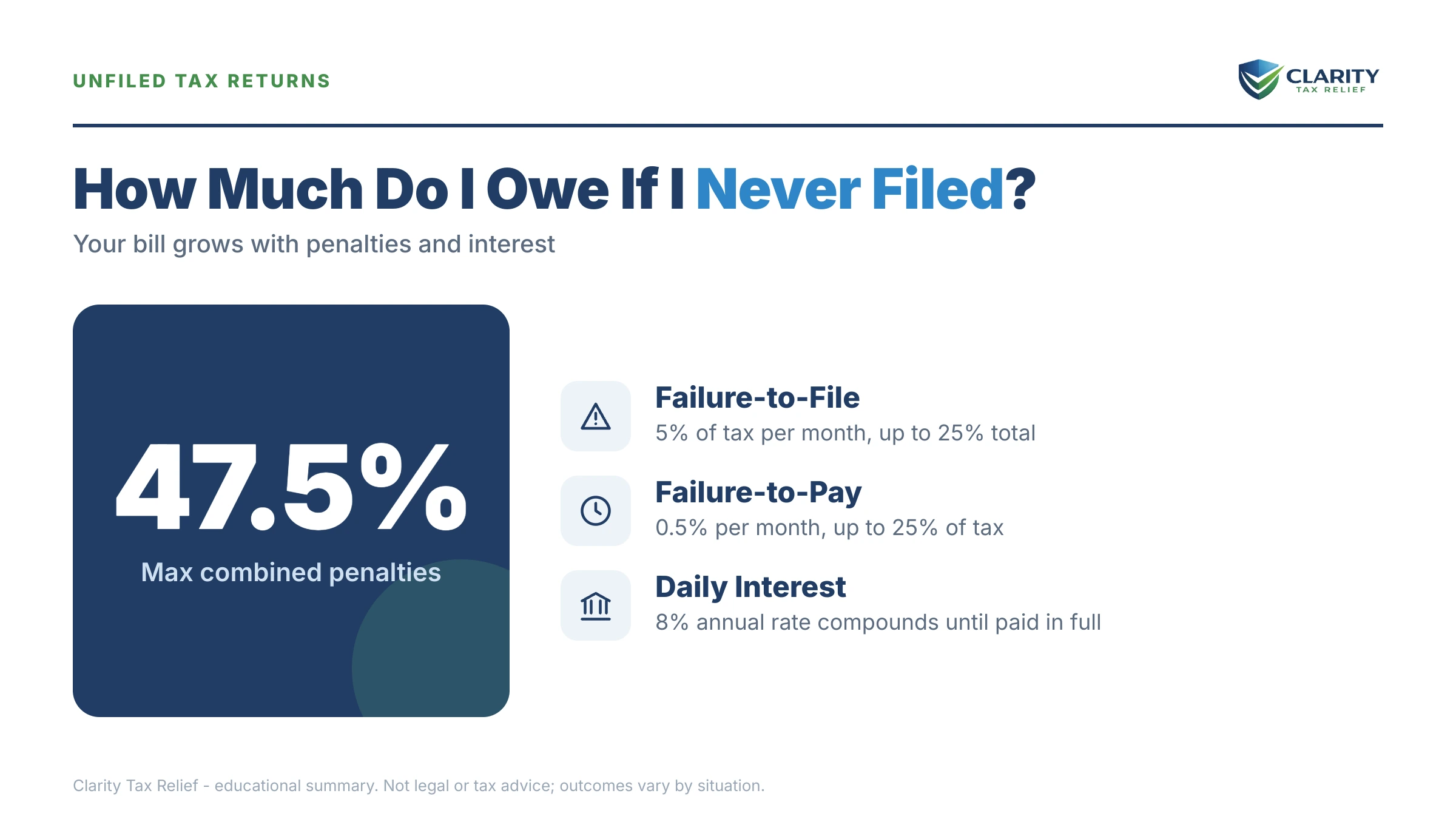
The failure-to-file penalty is 5% of the unpaid tax per month — ten times the 0.5% failure-to-pay penalty. That single fact is the most important thing to understand about never filing: the penalty for not filing dwarfs the penalty for not paying. Filing, even without paying, immediately stops the larger of the two.
Here's how the pieces stack on a single unfiled year:
- Failure-to-file penalty: 5% of unpaid tax per month, capped at 25%.
- Failure-to-pay penalty: 0.5% per month, also capped at 25%.
- Overlap rule: in any month both apply, the file penalty drops to 4.5% so the combined monthly hit is 5%, but together they can still reach 47.5% of the tax over time.
- Interest: charged on the tax and the penalties, compounding daily. Our breakdown of how big IRS penalties get shows the math year by year.
Want to estimate the additions on your own numbers before you talk to anyone? Run them through our IRS penalty and interest calculator. It estimates the failure-to-file and failure-to-pay penalties on a balance and year, though your final figure depends on the return you actually file.
A worked example: what an unfiled year can grow into
Say you never filed for 2022, and you were a 1099 contractor who owed $12,000 in tax that year after self-employment tax. You did nothing for roughly three years. Here's how the number climbs — clearly hypothetical, but the arithmetic is real:
| Component | How it's figured | Amount |
|---|---|---|
| Tax owed | Assessed on the return | $12,000 |
| Failure-to-file penalty | Maxes at 25% of tax | $3,000 |
| Failure-to-pay penalty | Up to 25% of tax over ~50 months | ~$3,000 |
| Interest | Compounds daily on tax + penalties | ~$2,500 |
| Balance after ~3 years | ~$20,500 |
Now the flip side. If that contractor had $18,000 of legitimate business expenses the SFR ignored, the real tax might be closer to $5,000. The penalties and interest shrink proportionally. That's the entire reason filing your own return beats accepting the IRS estimate: the base number the penalties are built on drops.
What happens if you keep not filing
Not filing doesn't make the problem quiet. It triggers its own automated notice sequence, separate from the collection notices that come after a balance is assessed. Ignore each stage and the next one carries more weight:
- CP59 / CP516 — "We have no record that you filed." First contact about a missing return.
- CP518 — Final reminder that a return is still missing.
- CP2566 — The IRS proposes a Substitute for Return with a balance it calculated for you.
- CP3219N (Notice of Deficiency) — The 90-day letter. Ignore it and the SFR balance becomes final and assessed.
- Collection begins — Once assessed, you enter the standard bill-and-levy track: CP14, then CP501/CP503, then CP504, then LT11 before liens and levies.
In 2026 this runs largely on autopilot. IRS staffing was cut sharply in 2025, but the systems that generate SFRs, deficiency notices, and levies never stopped. The machine keeps advancing whether or not a human ever reviews your file — which is exactly why coming forward on your own terms beats waiting to be found.
Not sure how many blank years the IRS is tracking?
Send us the notices you have, or none, if you've heard nothing yet. An experienced tax professional will pull the picture, tell you which years actually need filing, and estimate the real number before penalties keep climbing. Free, confidential, no pressure.
How to find out how much you owe when you never filed
You don't have to guess. Everything you need to build the real number is available to you directly. Here's the sequence:
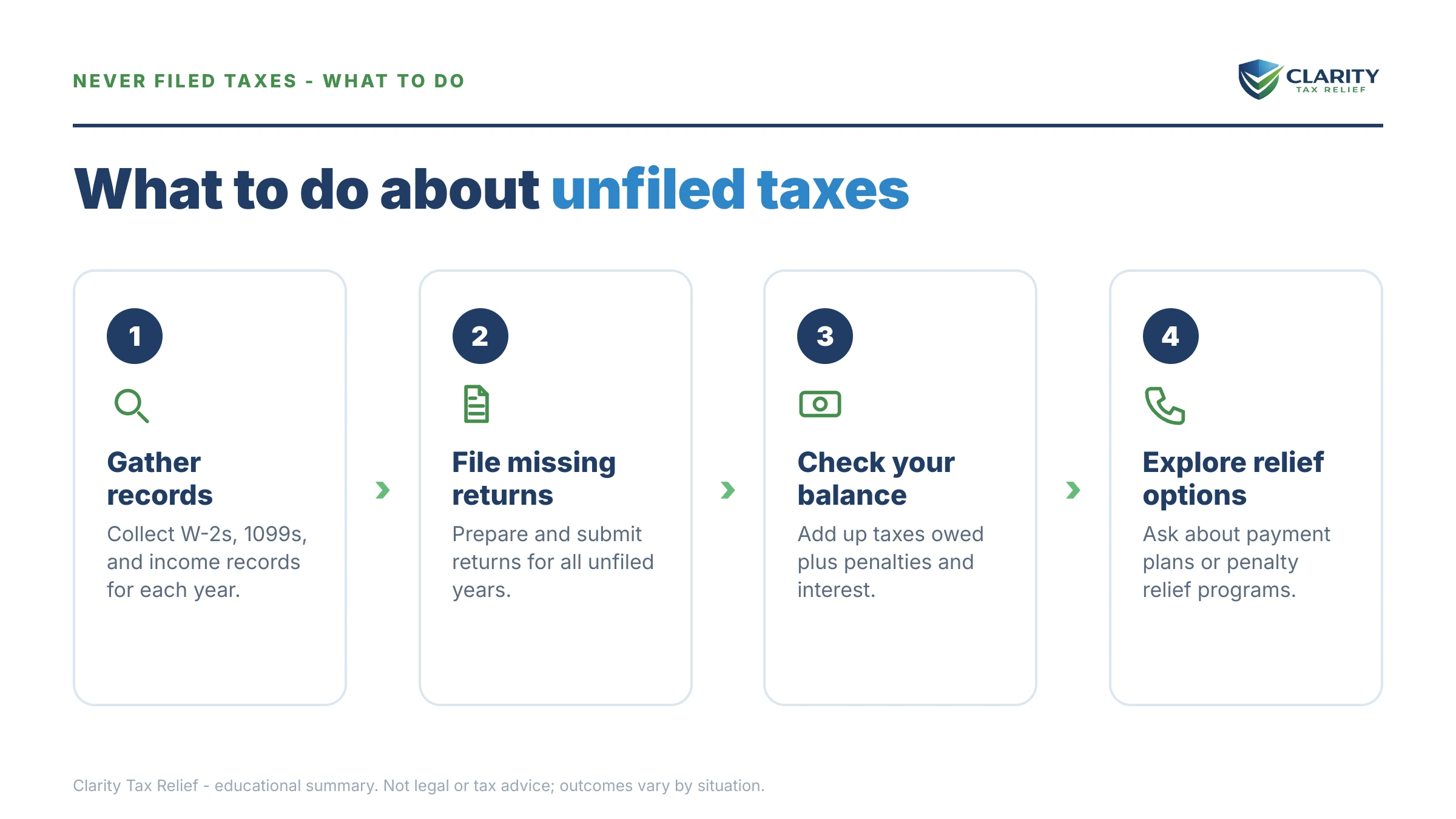
- Pull your wage and income transcripts. Log into your IRS online account and download a Wage and Income Transcript for every skipped year. It lists the W-2s and 1099s the IRS already has.
- Check your account transcript for each year. This shows whether an SFR balance has already been assessed or whether the year is still blank. Reading an account transcript tells you which bucket you're in.
- Reconstruct income the IRS can't see. Cash income, missing 1099s, and deductible expenses won't be on transcripts. Filing back taxes with no records shows how to rebuild them from bank statements.
- Prepare the actual returns. File a real return for each required year, usually the last six, claiming the deductions, credits, and correct filing status the SFR never gave you.
- Read the assessed balance and choose a resolution. Once returns post, your true balance appears. Then pick a payment plan, hardship status, penalty relief, or an Offer in Compromise based on that number.
How many years do you actually have to file?
IRS policy generally asks for the last six years of returns to bring you into good standing, even if you skipped more than that. There's no statute that erases old unfiled years, but the six-year lookback is the practical benchmark most agents apply. Our guide to how many years of back taxes you have to file walks through the exceptions.
Two timing rules cut in opposite directions, and both matter for your number:
- Refunds expire. You have only three years from the original due date to claim a refund. If an old year would have refunded you, filing late enough forfeits it — see whether you can still get a refund from three years ago.
- The collection clock hasn't started. The 10-year collection statute runs from assessment. Because nothing is assessed on an unfiled year, not filing keeps the debt open indefinitely. It does not run out the clock in your favor.
| Option | Best when | Cost / catch |
|---|---|---|
| Pay in full | Balance is small and affordable | Stops penalties and interest immediately. |
| Streamlined installment agreement | Balance under $50,000 | Up to 72 months, minimal disclosure; interest keeps accruing. |
| Currently Not Collectible | Paying anything causes hardship | Collection pauses; debt and interest remain. |
| Offer in Compromise | Assets + income truly can't cover the debt | $205 fee (waived if low-income); ~1 in 5 accepted in FY2024. |
| Penalty abatement | Clean prior 3 years or reasonable cause | Removes penalties, not the underlying tax or interest. |
A note on penalty relief in 2026: first-time abatement is being replaced by an Automatic Exemption from Penalty (AEP) rolling out summer 2026 — automatic, with no request needed for those who qualify. Don't assume the old request form is the only path.
When you can handle this yourself, and when you shouldn't
If you skipped just one or two years, your income was all on W-2s. You can afford whatever the return shows, you can likely handle this on your own. Pull the transcripts, file the returns, and set up a plan at IRS.gov. Our guide to coming clean on unfiled returns voluntarily covers the DIY path, and never filed and scared to start helps if the fear is the biggest obstacle.
Experienced help changes the outcome when the picture is bigger. Get a professional review if you have multiple unfiled years, self-employment or cash income to reconstruct, an SFR already assessed against you, or a balance you can't pay. The order you fix things in — returns first, then penalty relief, then the balance — determines what you ultimately pay, and getting that order wrong can cost you thousands. If a revenue officer or a Notice of Deficiency is already in play, don't go it alone.
Behind on several years? Start with the guide closest to your situation: haven't filed in 3 years, 5 years, or 10 or more years. Or get a free review — an experienced tax professional can map every year before penalties keep climbing.
Terms on your notices, decoded
Substitute for Return (SFR): a return the IRS files for you from reported income, with no deductions or credits — almost always higher than a real return.
Notice of Deficiency (CP3219N): the 90-day letter proposing an SFR balance; if you don't file or petition Tax Court, the amount becomes final.
Assessment: the moment tax is formally posted to your account. Nothing is collectible, and no collection clock runs, until assessment.
Wage and Income Transcript: the IRS record of every W-2 and 1099 filed under your SSN — your fastest way to see what income the IRS already has.
CSED (Collection Statute Expiration Date): the 10-year deadline for the IRS to collect, starting from assessment — which never begins on an unfiled year.
How much do I owe if I never filed taxes: quick answers
How does the IRS know how much I owe if I never filed?
The IRS knows your income because employers, banks, brokerages, and platforms send it copies of your W-2s and 1099s every year. When you don't file, it can build a Substitute for Return from those documents. That estimate uses no deductions or credits and the worst filing status, so it usually shows a higher balance than a real return would.
Can I find out how much I owe before I file?
You can find out what the IRS already has on record, but not your true balance until returns are filed. Pull your Wage and Income Transcript to see the income reported under your Social Security number. Your Account Transcript to see whether a Substitute for Return balance has been assessed. If a year is blank, no number exists yet.
How many years of unfiled returns do I have to file?
IRS policy generally asks for the last six years to be considered in good standing, even if you skipped more. A revenue officer can require more in some cases. File the oldest refund years too. But you only have three years from the original due date to claim a refund before it is lost forever.
Why is the amount the IRS says I owe so high?
Because a Substitute for Return is built to protect the government, not you. It taxes your gross income with no business expenses, mortgage interest, dependents, or credits, and often files you as single with one exemption. Filing your own accurate return for that year almost always lowers the balance, sometimes dramatically.
How much are the penalties for not filing?
The failure-to-file penalty is 5% of the unpaid tax per month, capping at 25%. The failure-to-pay penalty is 0.5% per month, also capping at 25%. When both apply in the same month the file penalty is reduced, but combined they can still reach 47.5% of the tax, plus daily-compounding interest.
Does the 10-year collection clock start if I never filed?
No. The 10-year collection statute runs from the date tax is assessed, and nothing is assessed until a return is filed or the IRS finishes a Substitute for Return. Skipping filing does not run out the clock. It keeps the debt open indefinitely until something posts to your account.
Can I go to jail for never filing my taxes?
For the vast majority of non-filers, no — failing to file is usually handled as a civil matter with penalties and interest, not prosecution. Criminal charges are reserved for willful evasion, hidden income, or fraud. Coming forward and filing voluntarily before the IRS contacts you is the strongest protection against that risk.
What if I can't pay the balance once I file?
Filing and paying are two separate steps — file first, because the file penalty is ten times the pay penalty. Once the balance posts you can set up an installment agreement, request Currently Not Collectible status if paying would create hardship, or apply for an Offer in Compromise if your finances genuinely qualify.
Your next 24 hours
- Check for a number that already exists. Log into your IRS online account and open the Account Transcript for each skipped year — a blank year means no balance yet. An assessed figure means an SFR is in play.
- Gather your income picture. Download the Wage and Income Transcript for every year, and pull bank statements for any cash or unreported income the IRS can't see.
- Get the real number set. Use the form or call (888) 825-7779 for a free review — an experienced tax professional will tell you which years to file and estimate your true balance before penalties and interest keep compounding.
This guide is general information, not tax or legal advice for your specific situation. Eligibility for IRS programs depends on individual facts and circumstances; no outcome is guaranteed.
Primary sources: the IRS explains the process for filing past-due returns, penalty rules on its penalties page, and free transcript access through your IRS Get Transcript tool.