
Back Taxes by Profession
Dentist Owes the IRS: How to Resolve Dentist Tax Debt in 2026
The short answer: dentist tax debt almost always starts with income the IRS never saw withholding on — S-corp distributions, associate 1099 pay, or skipped quarterly estimates. The debt is fixable through a payment plan, hardship status, penalty relief, or occasionally an Offer in Compromise. But once you cross $66,000, your passport is at risk, so act before the notices escalate.
You built a practice, you see a full schedule, and yet the IRS says you owe more than you can write a check for. Maybe it was a heavy equipment year, a jump in associate income, or three years of quarterly estimates you kept meaning to catch up on. It feels backward for someone who earns well, but high income and high tax debt go together more often than people admit.
The good news: nothing about your case is unusual to a tax professional, and every stage of it has a defined fix. The image below shows you exactly what an IRS balance-due notice looks like and where to check the numbers that set your clock.
⏱ The clock that's already running: interest plus a 0.5%-per-month failure-to-pay penalty keep compounding on your balance every month until it's paid or under an agreement. If you're already holding a CP504 or an LT11 / Letter 1058, that adds a hard 30-day deadline before the IRS can levy — check the date printed on your notice.
Why dentists owe the IRS
Dentist tax debt is usually an income-timing problem, not a spending problem. Unlike a W-2 employee, no one withholds tax from your practice profit or your distributions. You have to fund it yourself through quarterly estimates, and a busy year makes it easy to fall behind.
The most common triggers we see cluster around how dental income actually flows. Here is where the money hides from your withholding.
| Income source | Why it creates a surprise balance | Where it lands |
|---|---|---|
| S-corp distributions | Taken as cash all year with no tax withheld; profit flows to your 1040 via K-1 | Personal income tax |
| Associate / locum 1099 pay | No employer withholding; adds 15.3% self-employment tax on top of income tax | Income + SE tax |
| Skipped quarterly estimates | A full year's tax comes due at once, plus an underpayment penalty | Balance due + penalty |
| Big equipment year reversing | A Section 179 write-off masks income one year; the next year's profit spikes | Larger-than-expected bill |
| Practice payroll (Form 941) | Deposits skipped to cover cash flow; trust-fund tax owed personally | Practice + personal liability |
If your debt is mostly personal — income and self-employment tax from distributions and 1099 work — you're in the more flexible category. If your practice is behind on payroll deposits, that's a different and more urgent animal, covered in our guide to dentist practice payroll and equipment debt and the deeper 941 payroll back taxes playbook.
A note if your practice is an S corporation: paying yourself too little salary to dodge payroll tax is a classic audit trigger. See how the S-corp reasonable salary rules can turn into their own back-tax problem. And if you never set up quarterlies at all, start with how quarterly estimated taxes work so this year doesn't repeat the cycle.
What happens if you ignore it
The IRS collection sequence is automated, and in 2026 it runs on autopilot even though staffing is down sharply — the machine that mails notices and files levies didn't get laid off. Ignore each stage and the next arrives, with more interest and more power:
- CP14 — first bill for the balance. No enforcement yet, but the clock starts.
- CP501 / CP503 — reminder notices. Penalties and interest keep stacking monthly.
- CP504 — Notice of Intent to Levy. The IRS can now take your state tax refund and a federal tax lien becomes likely — a public record that hits practice financing.
- LT11 / Letter 1058 — Final Notice of Intent to Levy. After 30 days the IRS can levy practice and personal bank accounts, garnish other income, and reach your accounts receivable. You have Collection Due Process appeal rights here.
- Revenue officer assignment — larger dentist balances (especially with payroll tax) get pulled from the automated stream and assigned to a person who can visit your practice.
Two consequences hit dentists harder than most. First, a lien filed against practice assets can freeze your ability to refinance equipment or sell the practice. Second, once your assessed debt clears $66,000, the IRS can certify you for passport revocation for tax debt — a real problem if you attend continuing-education conferences abroad or do mission dentistry.
Behind on taxes and running a practice?
Send us your latest IRS notice. An experienced tax professional will map exactly where you stand, whether payroll tax is in play, and which option protects your practice and your passport — free, confidential, no pressure. Interest is compounding every month you wait.
Your options to resolve dentist tax debt
The notice offers two choices, pay or else. But the IRS actually runs several programs, and for a high-earning dentist the right one turns on your assets, your net practice income, and whether you have payroll tax mixed in.
| Option | Best fit for a dentist | Cost / catch |
|---|---|---|
| Short-term plan (≤180 days) | A one-time cash crunch you'll clear after receivables come in | $0 setup; interest + penalty still accrue |
| Streamlined installment agreement | Balances ≤ $50,000, paid over up to 72 months, no financials | Setup fee; auto-approved if you stay current |
| Non-streamlined / over-$50k IA | Most established practices — larger balances | Requires Form 433-A financials; must full-pay within the statute |
| Partial-pay installment agreement | When even the full monthly math is beyond your allowable budget | Full financial disclosure; periodic reviews |
| Offer in Compromise | Rare for high earners — only when assets + income truly can't cover it | $205 fee + 20% down; ~1 in 5 accepted |
| First-Time Penalty Abatement | A clean prior 3 years — removes the failure-to-pay penalty | Free; one-time; doesn't touch the tax itself |
Because most practicing dentists carry balances above $50,000, the realistic path is usually a payment plan over $50,000 backed by Form 433-A, not an Offer in Compromise. An OIC is scored on Reasonable Collection Potential — your equity in assets plus your expected future income — and a healthy practice with strong collections tends to show the IRS it could collect the full amount over time. You can estimate your own offer with our Offer in Compromise Calculator before spending anything chasing one. For the full mechanics, see how an offer in compromise actually works, and if your balance is large, our guide to owing the IRS $100,000.
If this is your first time behind after years of clean filing, don't skip first-time penalty abatement — on a big balance the removed penalty alone can be worth thousands.
A worked example: what a dentist's payment plan really costs
Hypothetical — your numbers will differ. Say you're a solo-practice dentist and you owe $185,000 across two tax years: roughly $150,000 in income tax on distributions and associate 1099 work, plus about $35,000 in self-employment tax and penalties.
Because the balance is over $50,000, the IRS generally wants it paid within the remaining collection statute. On a 72-month plan, $185,000 ÷ 72 ≈ $2,569 per month before interest. Add interest (currently accruing) and the real number lands closer to $3,200 a month.
If that's impossible on your actual budget, Form 433-A financials, using IRS allowable living expenses, might support a partial-pay agreement of, say, $1,400 a month, with the balance that isn't collected before your CSED expiring at the statute. Meanwhile, first-time abatement could strip the failure-to-pay penalty off one year, and getting the total into an accepted plan reverses any passport certification. Notice what an OIC would require here: proving that $185,000 is genuinely more than the IRS could ever collect from a working practice — a hard case for a high earner, which is exactly why the plan usually wins.
How to respond, step by step
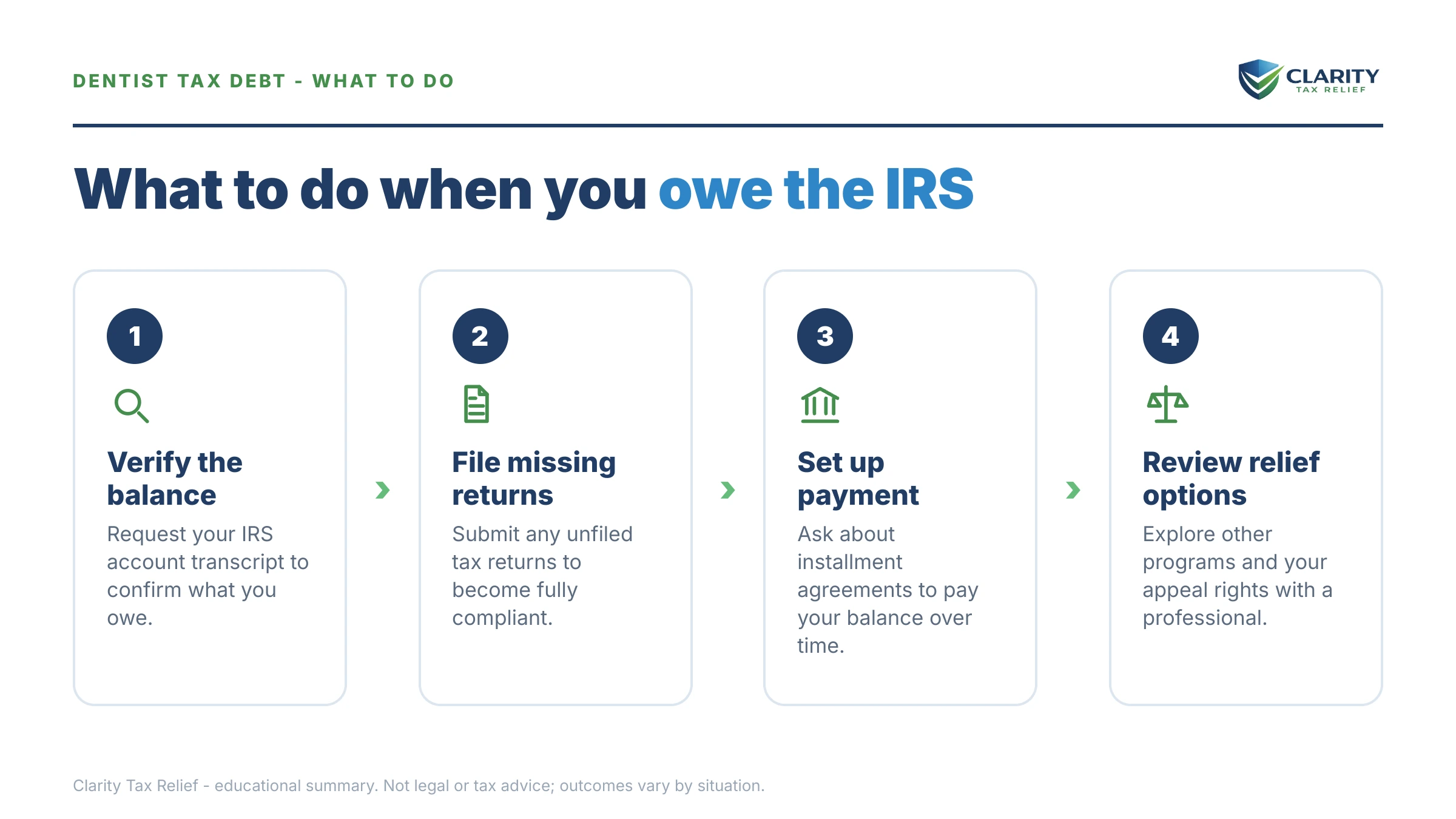
- Confirm what you actually owe — log into your IRS online account and match every year and amount against your returns before you agree to anything.
- Separate payroll from personal — if your practice skipped 941 deposits, flag that as the emergency; trust-fund tax follows you personally.
- File any missing returns first — you cannot get into a plan or abatement with unfiled years. The failure-to-file penalty is ten times worse than failure-to-pay.
- Get current on this year's estimates — the IRS won't approve an agreement if you're already falling behind again.
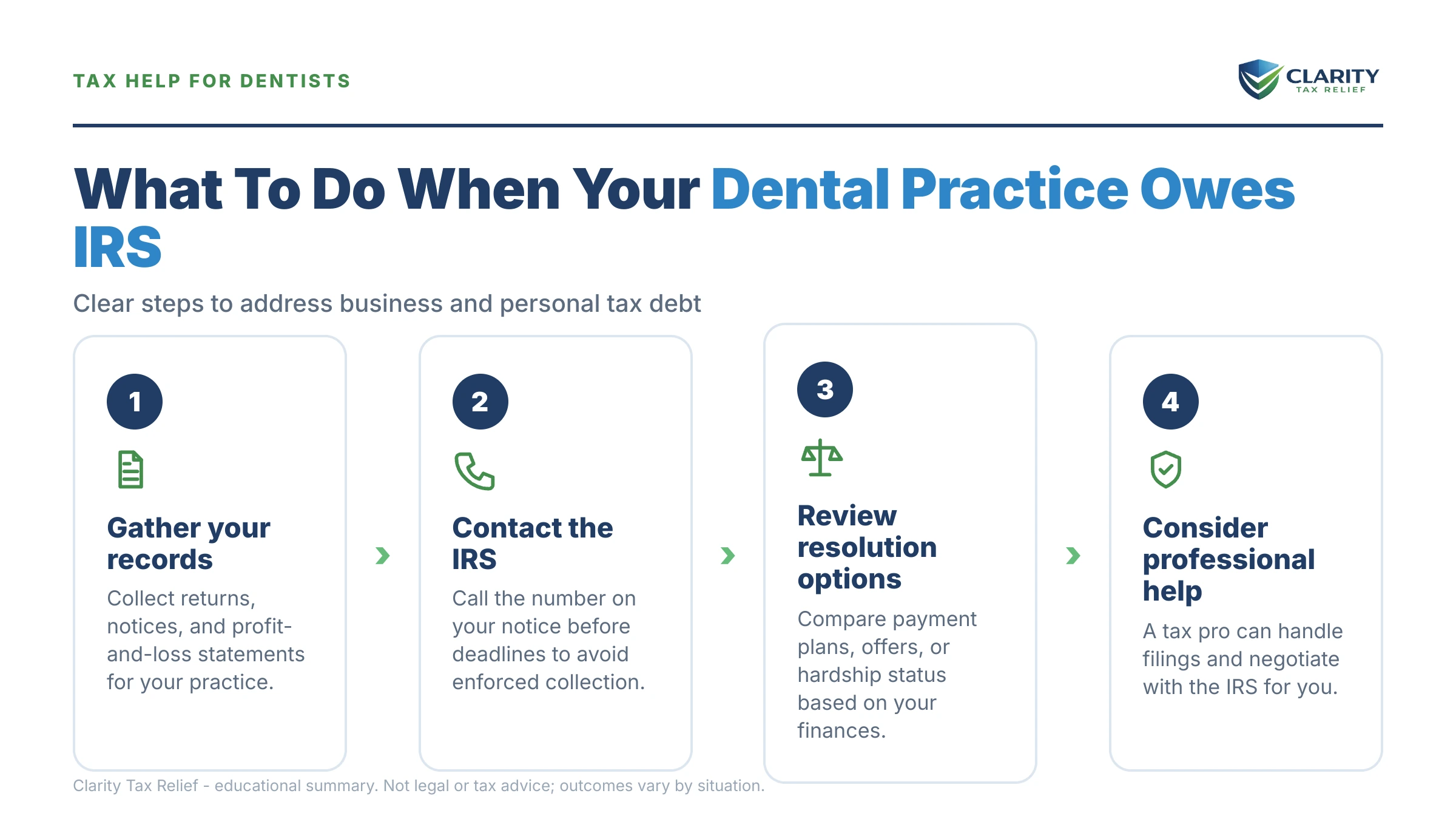
- Choose and set up the right option — a plan, partial-pay agreement, or abatement — before the notice deadline, which stops the escalation immediately.
- Get a professional review if payroll, multiple years, or $100k+ is involved — the order you fix things in changes what you ultimately pay.
When you can handle this yourself, and when you shouldn't
You can absolutely do this alone when the picture is simple. If you owe under $50,000 in personal income tax only, all your returns are filed. You can afford the streamlined monthly payment, set up the agreement yourself online in an afternoon — no firm needed. A first notice you agree with and can pay is just a bill; pay it and move on.
Experienced help changes the outcome when the facts get heavier: a levy or lien already in motion, multiple unfiled years, a balance over $100,000, or, most importantly, any unpaid practice payroll tax. Payroll debt exposes you to the Trust Fund Recovery Penalty, which the IRS assesses against owners personally and pursues harder than almost anything else. That's the line where the cost of getting it wrong dwarfs the cost of a professional. Dentists in that spot often look at the same options a physician with tax debt faces, and the sequencing matters. Start with the broader IRS collection process roadmap if you want the full map first.
Terms on your notice, decoded
- Self-employment tax: the 15.3% Social Security and Medicare tax on your net practice and 1099 income — the piece employees split with an employer. But you pay in full.
- Reasonable Collection Potential (RCP): the IRS's formula for an Offer in Compromise — your asset equity plus future income. A strong practice usually makes this high.
- Trust Fund Recovery Penalty (TFRP): the withheld payroll tax the IRS can assess against you personally if your practice didn't remit it.
- Lien vs. levy: a lien is a public claim against your property and practice assets; a levy is the actual seizure of accounts, receivables, or income.
- CSED: the Collection Statute Expiration Date — generally 10 years from assessment, though appeals, an OIC, or bankruptcy can pause the clock.
- Passport certification: the IRS flag sent to the State Department once assessed debt tops $66,000, which can block a passport renewal.
Dentist tax debt questions, answered
Why do dentists end up owing the IRS?
Most dentist tax debt comes from income the IRS never saw withholding on. When you take S-corp distributions or associate 1099 pay and skip or underpay quarterly estimates, the bill lands all at once in April. A big equipment write-off in one year can also mask how much you actually owe the next. There is no employer setting money aside for you — the shortfall is on you.
Can the IRS take my dental practice?
The IRS can levy practice bank accounts, seize accounts receivable, and file a lien that attaches to practice assets and equipment, but seizing and padlocking an operating practice is rare and requires supervisory approval. It usually only happens after final notices are ignored. Setting up an agreement before the LT11 clock runs almost always keeps the doors open.
Can I lose my dental license for owing the IRS?
The IRS itself cannot suspend your dental license. That authority belongs to your state dental board. Some states, however, can suspend or refuse to renew professional and driver's licenses for unpaid state tax debt. Federal IRS debt does not touch your license directly, but the related passport and lien consequences can still disrupt your career.
Will owing the IRS affect my passport?
Yes, once your assessed federal tax debt passes $66,000 in 2026 (including penalties and interest), the IRS can certify you to the State Department, which can deny or revoke your passport. Most established dentists clear that threshold easily. An accepted payment plan or Offer in Compromise reverses the certification, so getting into an agreement protects your ability to travel.
I owe both income tax and practice payroll tax — which comes first?
Payroll (941) tax comes first, because unpaid trust-fund payroll tax can be assessed against you personally through the Trust Fund Recovery Penalty and the IRS pursues it aggressively. Your personal 1040 income-tax balance is serious but more flexible. If your practice is behind on payroll deposits, treat that as the emergency and get help before a revenue officer opens a case.
Can a dentist qualify for an Offer in Compromise?
It's possible but harder for a high earner. An Offer in Compromise is based on Reasonable Collection Potential. Your equity in assets plus your future income. A busy practice with strong collections usually shows the IRS it could collect the full amount over time, so a payment plan or partial-pay agreement often fits better. The IRS accepted roughly 1 in 5 offers in FY2024, so it is never guaranteed.
How much will I pay per month on an IRS payment plan?
For balances over $50,000 the IRS generally wants the debt paid within the remaining collection statute, so the payment is the balance divided by the months left, plus accruing interest. On $185,000 over 72 months that's roughly $2,570 a month before interest — closer to $3,200 with it. If that number is impossible, financials on Form 433-A can support a lower partial-pay amount.
What if my associate income came on a 1099 and I never paid estimates?
Then you likely owe income tax plus 15.3% self-employment tax on that pay, and an underpayment penalty for skipping quarterlies. The fix is to file every year correctly, get current on this year's estimates, and then resolve the back balance with a plan or abatement. Filing is non-negotiable — the failure-to-file penalty is ten times the failure-to-pay penalty.
Your next 24 hours
- Find the numbers. Pull your most recent IRS notice and read the tax year, the total balance, and the "pay by" or 30-day date if there is one.
- Gather three things. Your last filed return, a list of any unfiled years. A rough figure for your practice's monthly net income — that's everything a pro needs to see your options.
- Get a free case review. Call (888) 825-7779 or use the 2-minute form today. Every month you wait, the failure-to-pay penalty and interest keep compounding, and if you're near $66,000, your passport is on the line.
For primary-source detail, see the IRS pages on payment plans and installment agreements, estimated taxes for the self-employed, and passport revocation for unpaid taxes.
This guide is general information, not tax or legal advice for your specific situation. Eligibility for IRS programs depends on individual facts and circumstances; no outcome is guaranteed.