
Back Taxes by Profession
Mortgage Broker Tax Debt: How to Handle Back Taxes on Commission Income (2026)
The short answer: mortgage broker tax debt almost always comes from 1099 commission income with no withholding plus the 15.3% self-employment tax. It's fixable — file every year, fix your current estimates, then choose a payment plan, hardship status, penalty relief, or an Offer in Compromise based on your real income. A recorded tax lien can also touch your NMLS license and your own ability to refinance.
You close loans for other people all day, and now the IRS says you're behind on your own. That's a specific kind of frustration, and you're not alone in it — commission income that swings with interest rates is one of the fastest ways a tax balance builds. Here's the good news: this is a solvable problem, and the sooner you move, the more options stay open.
Two things about broker debt make it different from a regular W-2 balance: the self-employment tax that doubles what you'd expect, and the license and lien exposure that can follow a loan originator into a background check. The worked example and tables below show exactly how the balance builds and what each fix costs.
⏱ Your clock: there's no single deadline unless you're holding a collection notice, but interest and the failure-to-pay penalty accrue every month the balance sits. If you already received a CP504 notice or an LT11, the printed date controls: act before it to keep your appeal rights and stop a levy on your commission checks.
Why mortgage brokers fall behind on taxes
Mortgage broker tax debt usually starts with a 1099-NEC and no tax withheld from a single commission check. When you're a W-2 employee, taxes come out before you ever see the money. As an independent loan originator, the full check lands in your account, and the tax on it is your job to set aside and pay in quarterly installments.
Then the self-employment tax lands on top. On 1099 commissions you pay both halves of Social Security and Medicare — 15.3% of net earnings — before a dollar of income tax. Many brokers budget for income tax and get blindsided by this second layer. Our guide to the self-employment-tax shock breaks down the math in full.
The rate cycle makes it worse. A high-volume year fills your account and pushes you into a higher bracket, so you owe more than a flat set-aside covers. When rates spike and volume dries up the next year, the cash to pay last year's bill is gone. That boom-then-drought pattern is the single most common cause of broker back taxes — the same trap that hits real estate agents behind on taxes and commission-paid financial advisors.
If you never set up quarterly payments at all, add the underpayment penalty. See how quarterly estimated taxes work to stop that penalty from repeating next year.
How much a mortgage broker should set aside for taxes
For most 1099 loan originators, 25% to 35% of every commission check covers federal income tax plus self-employment tax. The right rate rises with your total volume for the year, which is why a flat set-aside fails in a boom. The table shows realistic reserve targets by commission level.
| Annual 1099 commissions | Suggested set-aside rate | Roughly what to reserve |
|---|---|---|
| $60,000 | ~25% | ~$15,000 |
| $120,000 | ~28% | ~$33,600 |
| $180,000 | ~31% | ~$55,800 |
| $250,000+ | ~33–35% | ~$82,500+ |
These are planning estimates, not your exact bill. Your state tax, business deductions (mileage, licensing, home office, marketing), and filing status all move the number. Track your deductible expenses closely; loan-origination costs and vehicle miles can meaningfully cut what you owe.
What happens if you ignore mortgage broker tax debt
The IRS collection sequence is automated, and it escalates on its own timeline whether or not a human ever reviews your file. Each stage carries more enforcement power than the last:
- CP14 — the first bill for a balance due. No enforcement yet, and the cheapest moment to act.
- CP501 / CP503 — reminder notices. Still just bills, but penalties and interest keep stacking monthly.
- CP504 — Notice of Intent to Levy. The IRS can seize your state tax refund. A federal tax lien becomes a real possibility — the piece that can surface at license renewal.
- LT11 / Letter 1058 — Final Notice of Intent to Levy. After 30 days, the IRS can levy your bank account and serve a levy on the brokerage or lender that pays your commissions. You get formal Collection Due Process appeal rights here, via Form 12153, but fewer good options than you have now.
For a broker, the lien is the sharpest edge. A recorded Notice of Federal Tax Lien is public record. It can complicate financing you arrange for yourself and show up in the financial-responsibility review at NMLS renewal. And because commissions can be levied, an IRS levy on commission income can hit your next closing's pay if you let it reach the final-notice stage. In 2026, with IRS staffing cut roughly 27%, the humans are harder to reach, but the automated levies and liens never slowed down.
Holding a CP504 or LT11 over commission debt?
Send us the notice. An experienced tax professional will decode exactly where you stand, protect your commission checks from a levy, and map your options — free, confidential, and worded for a loan originator's income.
Your options to resolve mortgage broker back taxes
There are more paths than "pay it all now," and the right one depends on your finances and how many years are involved. Here's what each option costs and who it fits.
| Option | Best when | Cost & key threshold |
|---|---|---|
| Short-term plan (≤180 days) | A strong pipeline is closing soon | $0 setup; interest & penalty still accrue |
| Streamlined installment agreement | Balance ≤ $50,000, want a fixed monthly | Low setup fee; up to 72 months, no financials |
| Partial-pay installment agreement | Income too low to cover a full-pay plan | Requires Form 433 financials; IRS reviews periodically |
| Currently Not Collectible | A drought year — paying anything is hardship | Pauses collection; debt & interest remain |
| Offer in Compromise | Assets + income genuinely can't cover the debt | $205 fee + 20% down (waived if low-income); ~1 in 5 accepted |
| First-Time Penalty Abatement | Clean prior 3 years, penalties are large | Free request; removes the failure-to-pay penalty |
A note on penalty relief: First-Time Abatement is being replaced by an Automatic Exemption from Penalty (AEP) starting in summer 2026, which applies without a request for eligible taxpayers. For older years, reasonable-cause relief may still apply if illness, a family crisis, or disaster kept you from paying. You can estimate what penalties and interest are adding to your balance with our IRS penalty and interest calculator before you decide which route to take.
Because a single boom year can average your income high, many brokers fit a payment plan or hardship status better than an offer — see payment plan vs. offer in compromise to compare honestly.
A worked example: how a $38,000 balance builds
Here's a clearly hypothetical case to show the math. Say you're a 1099 mortgage broker who earned $145,000 in net commissions in a strong year and set almost nothing aside.
- Self-employment tax: 15.3% on 92.35% of $145,000 ≈ $20,500.
- Federal income tax: after the SE-tax deduction and the standard deduction, taxable income is roughly $120,000, producing about $21,900 in income tax (single filer).
- Total tax ≈ $42,400. Subtract a couple of small quarterly payments you did make (~$4,400), and you're left owing about $38,000.
On a 72-month streamlined installment agreement, $38,000 runs roughly $625–$660 a month while interest and a reduced failure-to-pay penalty keep accruing. If the next year is a rate-driven drought, Currently Not Collectible could pause that entirely — or, if your assets and future income genuinely can't cover the debt, an Offer in Compromise would ask the IRS to accept the most it could realistically collect. The numbers are illustrative; your actual bracket, state tax, and deductions change them. If you're near this range, our page on when you owe the IRS $30,000 walks through the same decision.
How to respond, step by step
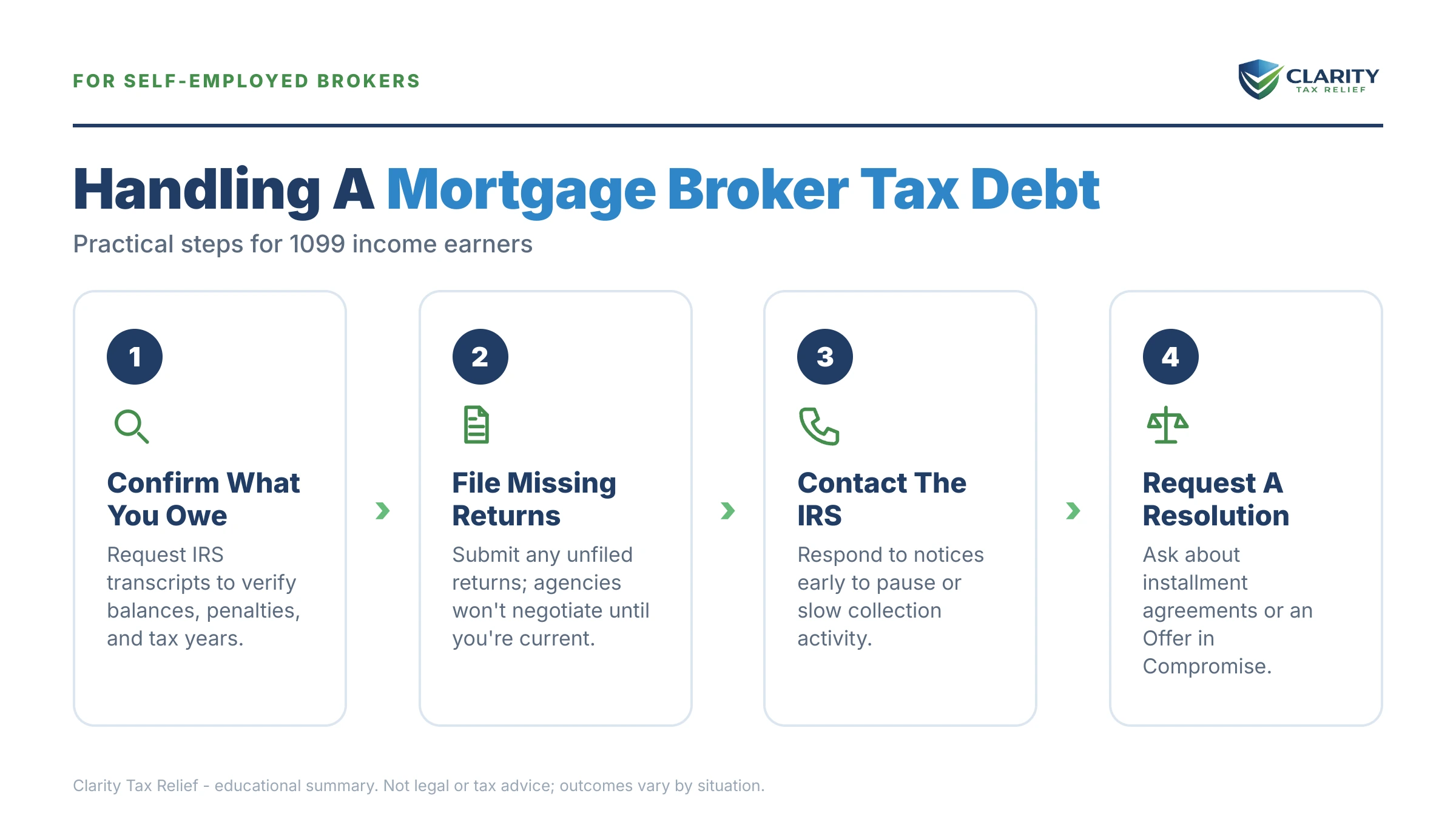
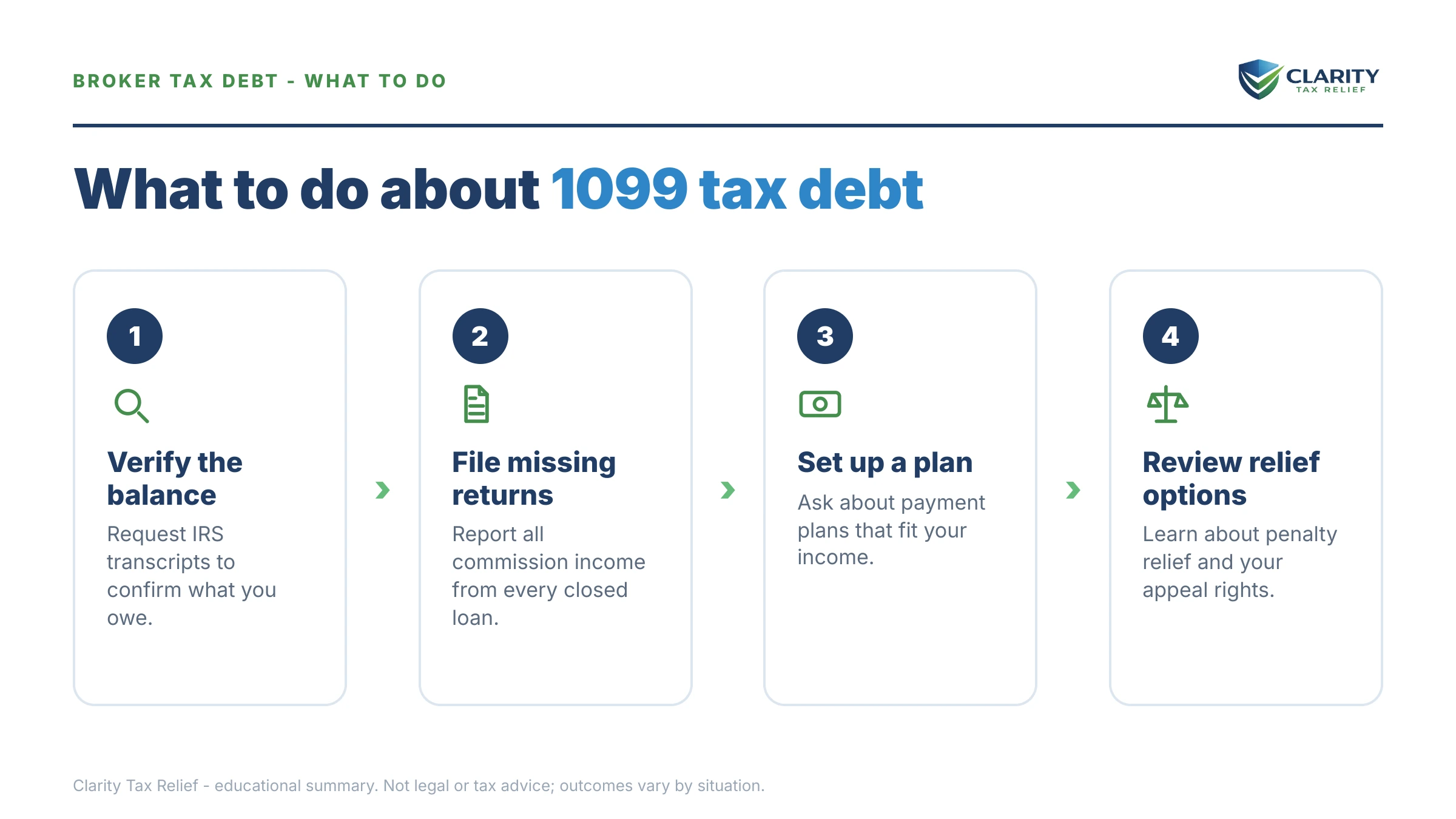
- Pull your transcripts and confirm every year — log into your IRS online account and pull account and wage-and-income transcripts so you know which years are filed, which are missing. The real total owed.
- File any missing returns first — the IRS won't approve a plan or offer while returns are missing. Its substitute return ignores your origination expenses and mileage.
- Fix your current-year estimated payments — set up quarterly Form 1040-ES payments now so you stop adding a new balance on top of the old one.
- Choose the resolution that fits your income — match a payment plan, hardship status, penalty abatement, or an offer to your actual finances. Swinging commission income changes which one makes sense.
- Respond to any collection notice before its deadline, if you already have a CP504 or LT11, act before the printed date to keep your appeal rights and stop a commission or bank levy.
- Get a professional review for larger or multi-year debt — for balances over $50,000, several unfiled years, or a lien affecting your license, have an experienced tax professional sequence the returns, penalties, and negotiation.
When you can handle this yourself, and when help changes the outcome
If you filed on time, agree with the balance, and it's under about $50,000, you can often set up a payment plan online yourself in one sitting — no professional needed. A single missed quarter with a clean prior record is squarely a do-it-yourself fix, and requesting first-time penalty abatement is a phone call.
Experienced help changes outcomes when the stakes climb: a levy already served on your commission checks, several unfiled years, a balance near the $66,000 passport-certification threshold, a lien threatening your NMLS renewal, or an Offer in Compromise where the reasonable-collection math decides everything. If your debt is that size, see how it works when you risk passport revocation over tax debt — the certification is automatic once you cross the line. In those cases, the order you fix things in — returns, then penalties, then the balance — directly changes what you end up paying.
Terms on your notice, decoded
- Self-employment tax — the 15.3% Social Security and Medicare tax you pay on 1099 net earnings, on top of income tax.
- Levy vs. lien — a levy takes money (a bank account or commission check). A lien is a public claim against your property that secures the debt. See lien vs. levy.
- Streamlined installment agreement — a monthly payment plan for balances up to $50,000, up to 72 months, with no detailed financial disclosure.
- Reasonable Collection Potential — the IRS's calculation of the most it could collect from your income and assets. It drives whether an Offer in Compromise gets accepted.
- CSED — the Collection Statute Expiration Date. The IRS generally has 10 years from assessment to collect, though appeals, offers, and bankruptcy can pause the clock.
Mortgage broker tax debt questions, answered
Are mortgage brokers paid on a 1099 or a W-2?
Most independent loan originators are paid on a 1099 as self-employed contractors, so no tax is withheld from commission checks. Some brokers are W-2 employees of a brokerage, in which case tax is withheld like any job. If you get a 1099-NEC, you owe both income tax and the full 15.3% self-employment tax. You are expected to pay it in quarterly estimates rather than at year end.
Can owing back taxes affect my NMLS mortgage license?
It can. State licensing agencies under the SAFE Act review financial responsibility. A recorded federal tax lien is public record that surfaces in NMLS background and credit reviews at renewal. A lien alone does not automatically revoke a license. But an active plan or resolution in progress is far easier to explain to a regulator than an unaddressed balance. Check your state's specific renewal standards through the NMLS Resource Center.
How much should a mortgage broker set aside for taxes?
For most 1099 loan originators, setting aside 25% to 35% of each commission check covers federal income tax plus self-employment tax. The exact rate depends on your bracket and state. In a strong-volume year your effective rate climbs, so brokers who set aside a flat 25% during a boom often come up short — bumping the reserve toward 30–35% on higher-earning years prevents the April surprise.
Can the IRS levy my commission checks?
Yes. If you are paid on a 1099, the IRS can serve a levy on the brokerage or lender that pays you, and how much it captures depends on whether the payment is treated as wages or contractor pay. A one-time levy grabs commissions already owed to you at that moment; a continuous wage levy applies if you're a W-2 employee. Either way this only happens after the final notice (LT11 or Letter 1058) and its 30-day window pass without action.
Can I get an IRS payment plan when my income swings every month?
Yes, and swinging income is exactly why you should plan around your slow months. A streamlined installment agreement for balances up to $50,000 sets a fixed monthly payment over up to 72 months without financial disclosure. If your income is genuinely unpredictable, a partial-pay agreement or a lower payment based on your average income may fit better — the key is setting a payment you can make in a slow month, not a booming one.
Can I still buy or refinance a house if I owe the IRS?
Often yes, which is a common frustration for brokers who help clients close but struggle with their own file. A tax balance under an active payment plan is usually acceptable to underwriters. But a recorded federal tax lien complicates or blocks financing until it is addressed. You may be able to request a lien subordination or discharge to let a specific transaction close.
What if I haven't filed returns for several years?
File the missing years before anything else — the IRS will not approve a payment plan or Offer in Compromise while returns are unfiled. In most cases you need the last six years filed to be considered compliant. If the IRS already filed a substitute return for you, it left out your loan-origination expenses and mileage, so filing your own accurate return usually lowers the balance.
Can I settle mortgage broker tax debt for less than I owe?
Sometimes, through an Offer in Compromise, but only when the IRS's own math shows it can't collect the full amount from your income and assets. The IRS accepted roughly 1 in 5 offers in FY2024, so it is neither automatic nor a promise that you will pay only a small fraction of what you owe. Because commission income averages high over good years, many brokers qualify better for a payment plan or hardship status than for an offer.
Your next 24 hours
- Find the balance and the year. Pull your IRS online account or the notice in hand — write down the exact amount owed and every tax year listed.
- Gather three things: your last filed return, your 1099-NECs, and a rough total of this year's business expenses (mileage, licensing, marketing, home office).
- Get a free case review. Call (888) 825-7779 or use the 2-minute form. Interest and penalties accrue every month you wait, and if you're holding a CP504 or LT11, do this before its printed date to protect your commission checks from a levy.
This guide is general information, not tax or legal advice for your specific situation. Eligibility for IRS programs depends on individual facts and circumstances; no outcome is guaranteed.