
Back Taxes by Profession
Nurse Owes the IRS? Back Taxes Help for Nurses in 2026
The short answer: when a nurse owes the IRS, it usually traces to under-withheld overtime, shift differentials, bonuses, or 1099 agency pay, not a mistake you made on purpose. Your license is not at risk from the IRS, and you have real options: a payment plan up to 72 months, penalty relief, or hardship status. Acting early costs the least.
You picked up the extra shifts, worked the holiday differentials, and took the sign-on bonus, and now the IRS says you owe. It feels backwards: you earned more and ended up in a hole. It is fixable, and the reasons a nurse owes the IRS are so predictable that the fix is predictable too.
What you do next depends on how the debt happened — a staff W-2 that under-withheld, several W-2s from picking up shifts at different facilities, or 1099 per-diem work with no withholding at all. The image below breaks down where nurse tax debt actually comes from and which fix matches each source.
⏱ The clock that's running: there's no single deadline on "owing back taxes," but the meter never stops. The failure-to-pay penalty adds 0.5% of the unpaid tax every month, and interest compounds daily. If a specific notice arrived — a CP14, CP504, or LT11 — the date printed on it sets a hard response window, so check the top-right corner.
Why a nurse owes the IRS more often than most workers
Most nurse tax bills come from pay that was taxed too lightly during the year, not from anything you did wrong. Your base wage is withheld correctly; the trouble sits in the extra earnings that make nursing pay well.
Overtime, shift differentials, charge-nurse pay, and bonuses are treated as supplemental wages, and employers often withhold a flat 22% on bonuses. If your real marginal bracket is higher, that 22% leaves a gap that lands on your April return. Working at two hospitals or a hospital plus an agency makes it worse — each employer withholds as if its paycheck is your only income, so combined you cross into a higher bracket that neither W-4 accounted for. If that is you, the withholding fix in our guide on two jobs and owing taxes every year stops the repeat.
Then there is 1099 work. Per-diem, PRN, and agency nurses paid on a 1099 have zero withholding and owe self-employment tax of 15.3% on their net earnings, on top of income tax — the shock explained in our self-employment tax guide. Travel nurses face a separate trap: untaxed stipends and multiple state returns, covered in our travel nurse multi-state tax debt guide.
One 2026 note: recent law (the OBBBA package) added a temporary deduction for certain overtime and tip income, outlined in our OBBBA tax changes guide, but it does not erase a balance you already owe from prior years.
| Income source | Why a balance builds | The fix |
|---|---|---|
| Overtime & differentials (W-2) | Taxed as supplemental wages; withholding lags your real bracket | Add extra withholding on Form W-4, line 4(c) |
| Sign-on / retention bonus | Flat 22% withheld — too low if you're in a higher bracket | Set aside the shortfall; adjust W-4 for the year |
| Two or more W-2 jobs | Each employer withholds as if it's your only income | Use the IRS estimator; bump withholding at the higher-paying job |
| Per-diem / agency (1099) | No withholding + 15.3% self-employment tax | Pay quarterly estimated taxes going forward |
| Travel-nurse stipends | Taxable if no real tax home; multi-state returns | Establish a tax home; file each state |
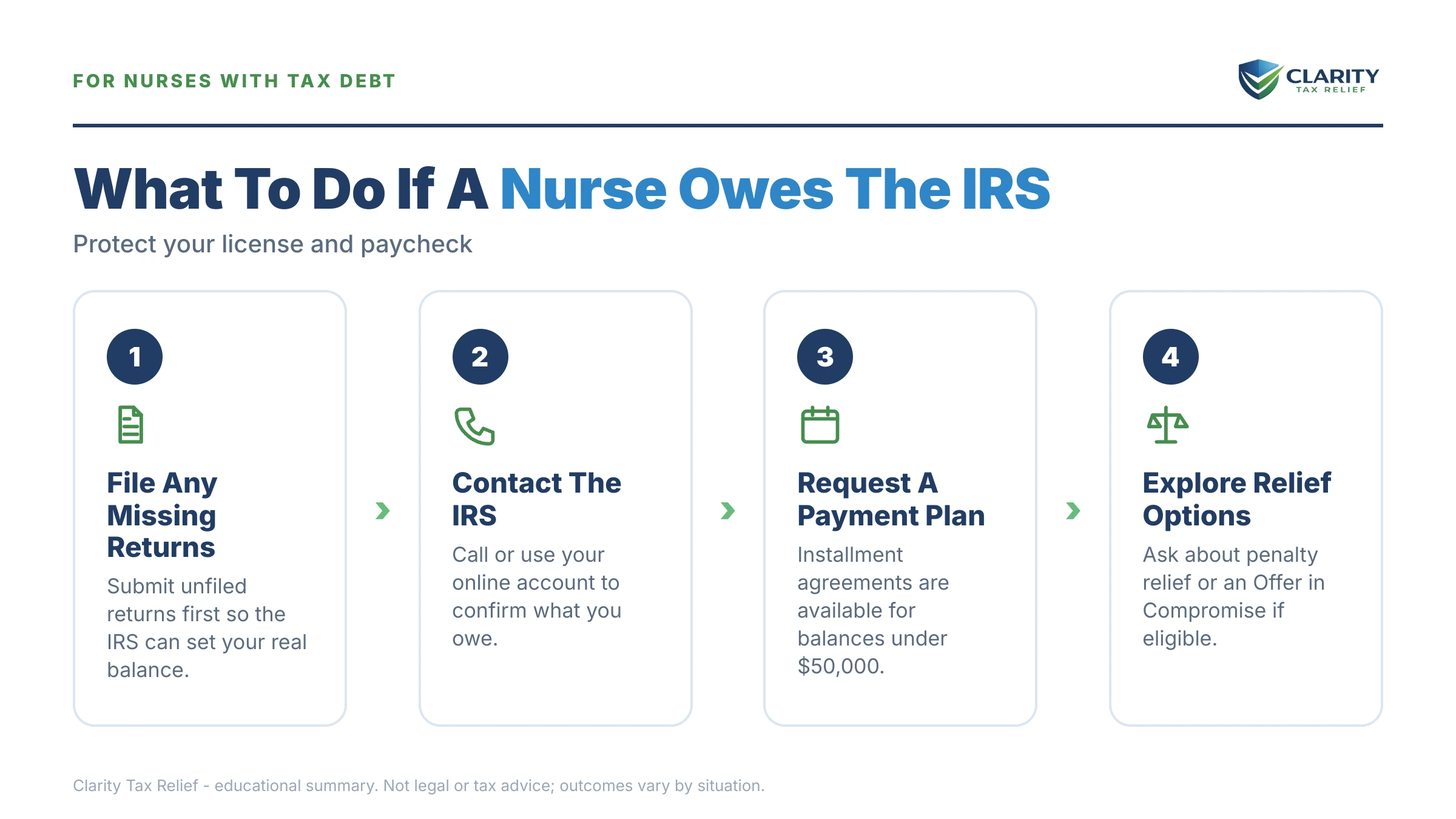
What happens if a nurse ignores the IRS
An unpaid balance never quietly disappears. It moves through an automated collection sequence, and each stage carries more enforcement power than the one before. Ignore it and the letters escalate on their own, whether or not a human at the IRS ever looks at your file.
- CP14 — the first bill for the balance due. No enforcement yet, but the penalty and interest clock is running. See our CP14 notice guide.
- CP501 / CP503 — reminder notices. Still just bills, with the balance climbing each month.
- CP504 — Notice of Intent to Levy. The IRS can now seize your state tax refund, and a federal tax lien becomes possible.
- LT11 / Letter 1058 — the Final Notice of Intent to Levy. After 30 days the IRS can garnish your hospital or agency wages and levy your bank account. This notice also starts your Collection Due Process appeal rights.
The one that scares nurses most is the wage levy, and it is exactly the stage you can prevent. An IRS wage levy is continuous: it keeps taking part of every paycheck until the debt is paid or the levy is released. If garnishment is the fear driving you, read how much the IRS can garnish from a paycheck. In 2026, with IRS staffing down sharply, the human help is scarce but the automated levies never stopped, so waiting for someone to "get to your file" is the worst plan.
Owe the IRS and afraid of a wage levy?
A payment plan set up before a Final Notice expires stops garnishment before it starts. Send us your notice and an experienced tax professional will map your options — free, confidential, no pressure. Penalties and interest are accruing every month, so the sooner you act, the less it costs.
Your options when you can't pay in full
A nurse's steady paycheck is actually an advantage here. It makes you a strong candidate for a payment plan, and it gives the IRS a predictable number to work with. Which program fits depends on what you owe and what your budget looks like after real living expenses.
| Option | Who it fits | Cost / setup |
|---|---|---|
| Short-term plan | Can pay in full within 180 days | $0 setup; interest + penalty continue |
| Streamlined installment agreement | Owe under $50,000; want up to 72 months | Low setup fee; no financial disclosure |
| Currently Not Collectible | Paying anything causes genuine hardship | $0; collection pauses, debt remains |
| Offer in Compromise | Assets + future income can't cover the debt | $205 fee (waived if low-income); ~1 in 5 accepted |
| Penalty relief | Clean prior 3 years, or reasonable cause | $0; removes penalties, not the tax |
Most nurses with a mid-sized balance land on a streamlined installment agreement, often paired with first-time penalty abatement to knock down the add-ons. An Offer in Compromise is real but means-tested — the IRS accepted roughly 1 in 5 offers in FY2024 — so treat any promise to settle for "pennies on the dollar" as the scam it is. If your balance sits in a specific band, our I owe the IRS $15,000 and I owe the IRS $20,000 guides walk the numbers.
A worked example: a nurse who owes $18,000
Say you're a staff RN who picked up agency shifts on the side, and across two tax years you owe $18,000 — part from under-withheld overtime, part from a 1099 with no withholding. You can't write an $18,000 check, but you can pay something monthly.
On a 72-month streamlined installment agreement, the base math is $18,000 ÷ 72 = $250 a month. Add accruing interest and the 0.5% monthly late-payment penalty and the real figure runs closer to $290–$300 a month while the balance winds down. Because you have clean compliance the prior three years, first-time penalty abatement removes the failure-to-pay penalty already assessed, often several hundred dollars off the total. You can estimate your own penalty and interest with our IRS penalty and interest calculator.
Could an Offer in Compromise beat that? Only if the IRS's math showed $18,000 is more than it could ever collect from your income and assets — unlikely on a steady nursing salary. For most nurses at this balance, the installment agreement plus penalty relief is the honest best move. This is a hypothetical to show the arithmetic, not a promised result.
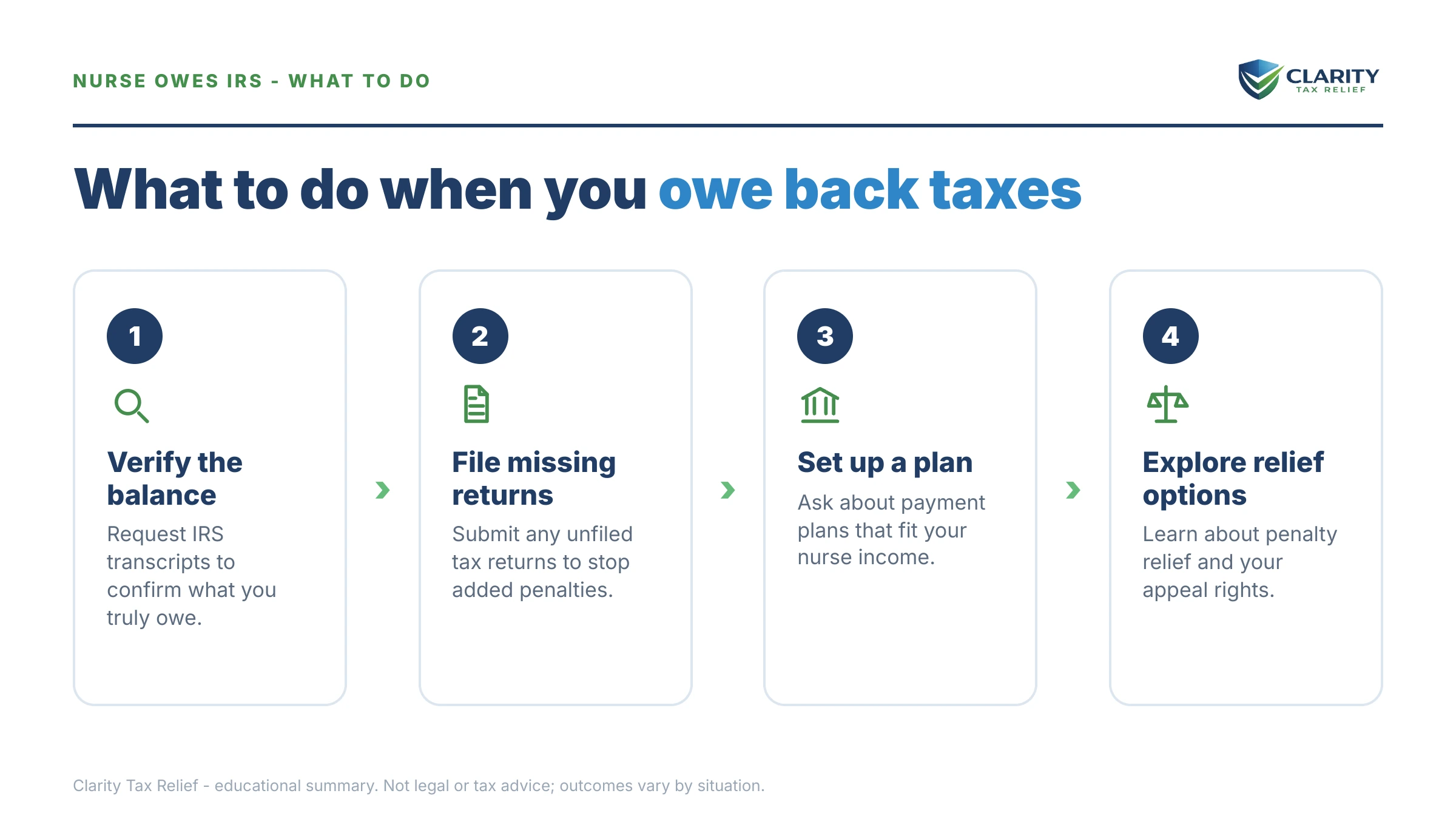
How to respond, step by step
- Confirm what you owe — log into your IRS online account and check the balance and tax years against your returns and pay stubs.
- File any missing years first — the failure-to-file penalty is 10× the failure-to-pay penalty, so filing beats staying silent even when you can't pay.
- Fix your withholding now — update Form W-4 at your hospital or start quarterly estimates for 1099 work, so next April doesn't repeat this.
- Pick your resolution — pay in full if you can. Otherwise set up a payment plan or request hardship status before any Final Notice expires.
- Request penalty relief — ask for first-time abatement or reasonable cause once the balance is under a plan.
- Get a professional review if you have multiple years, a 1099 shock, or a levy in motion — the order you fix things in changes what you pay.
When you can handle this yourself, and when to get help
Plenty of nurses can fix this alone. If you owe one year, agree with the amount, and can pay within 180 days or set up a plan under $50,000, do it directly at IRS.gov — no firm needed, and our payment-plan walkthrough shows every screen. A single first-time abatement request is also very doable on your own.
Experienced help changes the outcome when the picture is tangled: a wage levy already in motion, several unfiled years, a big 1099 self-employment balance, travel-nurse multi-state returns, or an Offer in Compromise where the math has to be built correctly the first time. In those cases the sequence matters, and a wrong move can cost more than the fee. Choose an enrolled agent, CPA, or tax attorney — never a marketer promising a guaranteed settlement.
Terms on your notice, decoded
- Supplemental wages — overtime, bonuses, and differentials, often withheld at a flat rate that undershoots your real bracket.
- Self-employment tax — the 15.3% Social Security and Medicare tax a 1099 nurse pays on net earnings, because no employer covered the other half.
- Installment agreement — a monthly IRS payment plan; "streamlined" means under $50,000 with no financial disclosure.
- Currently Not Collectible — hardship status that pauses collection when paying would leave you unable to cover basic living costs.
- Wage levy — a continuous IRS seizure of part of each paycheck, only after a Final Notice and 30-day window.
- Federal tax lien — a public claim against your property; since 2018 it no longer appears on consumer credit reports.
Nurse tax-debt questions, answered
Can the IRS take my nursing license if I owe back taxes?
The IRS itself does not license nurses and cannot pull your RN or LPN license for a tax debt. Licensing sits with your state board of nursing, and most boards do not act on federal tax debt alone. The real license-adjacent risk is the passport rule: at $66,000 or more of seriously delinquent tax debt in 2026, the State Department can deny or revoke your passport, which matters if you travel or work across borders.
Why do I owe taxes every year as a nurse?
The usual cause is under-withholding on the extra pay nurses earn on top of base wages. Overtime, shift differentials, and sign-on or retention bonuses are taxed as supplemental wages. The flat 22% withholding on a bonus is often below your real bracket. Working at more than one facility compounds it, because each W-2 withholds as if it is your only job. Fixing your W-4 stops the yearly repeat.
I'm a travel nurse and I owe a lot — why?
Travel nurses often owe because of untaxed stipends and multi-state filing. If you did not keep a true tax home, housing and per-diem stipends can become taxable, and each state you worked in may want a return. That combination produces surprise balances no single W-2 covered. See our travel nurse multi-state tax debt guide for the state-by-state piece.
Can the IRS garnish a nurse's paycheck?
Yes, but not without warning. A wage levy only comes after the IRS sends a Final Notice of Intent to Levy (LT11 or Letter 1058) and a 30-day window passes with no response. An IRS wage levy is continuous. It keeps taking part of every paycheck from your hospital or agency until the debt is paid or the levy is released. Setting up a payment plan before that notice expires prevents it.
I'm a per diem or agency nurse paid on a 1099 — why is my bill so high?
1099 pay has no withholding, so nothing was set aside for taxes during the year. On top of income tax, you owe self-employment tax of 15.3% on the net, because no employer paid the other half of Social Security and Medicare for you. A nurse with $40,000 of 1099 income can owe roughly $6,000 in self-employment tax alone before income tax. Quarterly estimated payments prevent this going forward.
Does owing the IRS show up on a nursing background check or hurt renewal?
A standard IRS balance does not appear on employment or licensing background checks and is not a criminal record. The exception is a public filing: a Notice of Federal Tax Lien is recorded in public records and can surface in a deep records search. Since 2018 tax liens no longer appear on your consumer credit report, so a lien affects public records and lending disclosures rather than your credit score directly.
Can I set up a payment plan on a nurse's salary?
Yes. If you owe under $50,000, you can usually set up a streamlined installment agreement online with no detailed financial disclosure, spread over up to 72 months. There is no setup fee for a short-term plan of 180 days or less. Interest and the late-payment penalty keep accruing while you pay, so paying faster costs less overall.
Will filing this year help if I already owe for past years?
Yes — always file on time even when you owe prior years, because the failure-to-file penalty is 5% per month, ten times the 0.5% failure-to-pay penalty. Filing also keeps you eligible for payment plans and penalty relief, which the IRS denies to non-filers. If a refund is due this year, expect the IRS to apply it to your older balance.
Your next 24 hours
- Find the number. Pull any IRS notice you have and read the balance and tax year in the top-right box, or log into your IRS online account to see the exact total.
- Gather three things. Your last filed return, your most recent pay stubs (or 1099s), and any notice — that's everything a review needs.
- Get a free case review. Use the 2-minute form or call (888) 825-7779. Penalties and interest grow every month you wait, so a plan started today costs less than one started next paycheck.
This guide is general information, not tax or legal advice for your specific situation. Eligibility for IRS programs depends on individual facts and circumstances; no outcome is guaranteed.
Primary sources: IRS payment plans &. Installment agreements · IRS self-employment tax · Taxpayer Advocate Service.