
Tax Help Basics
What Is an Enrolled Agent? What EAs Can Do for You (2026)
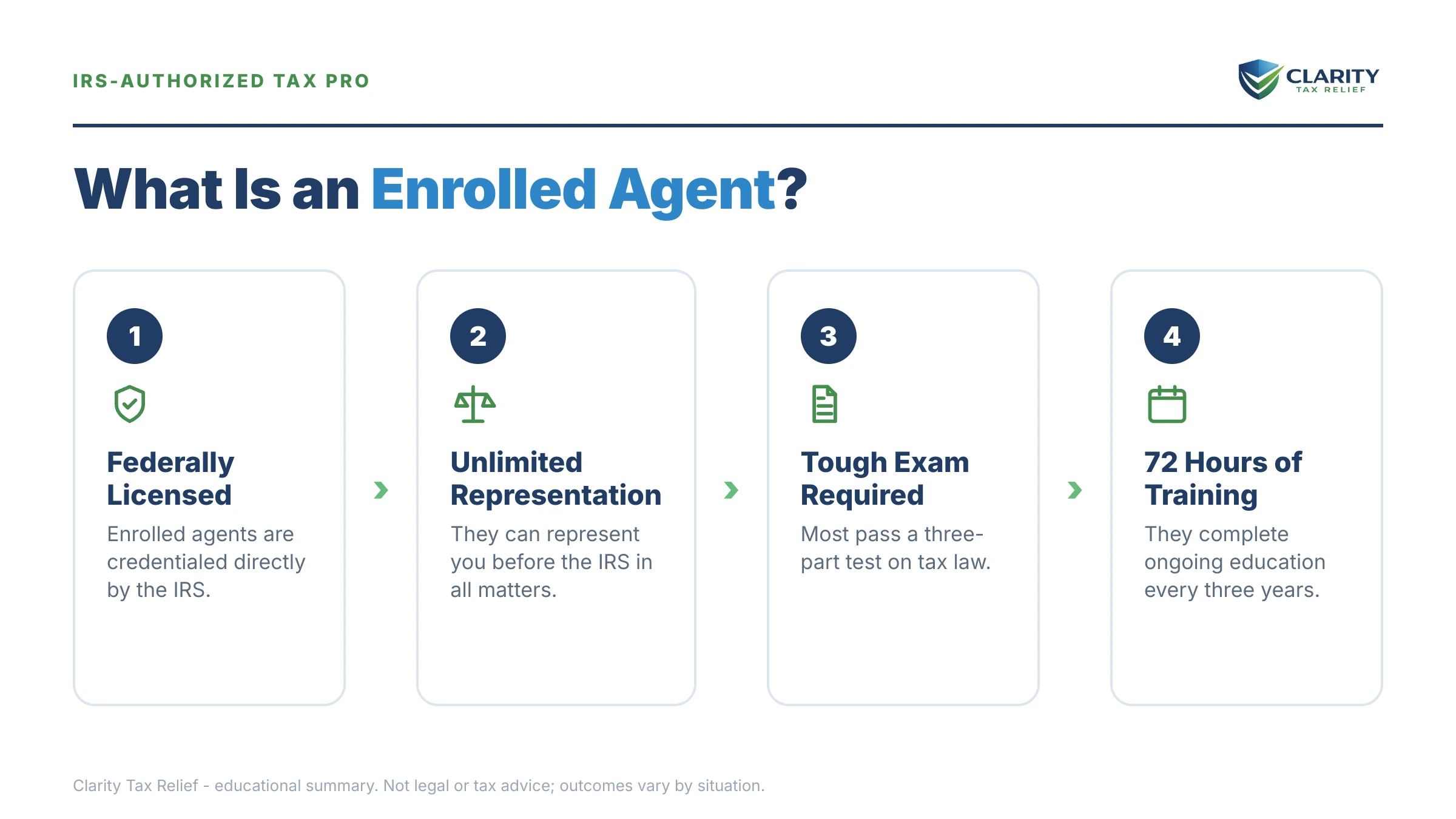
What is an enrolled agent? An enrolled agent (EA) is a tax practitioner authorized directly by the U.S. Treasury Department to represent taxpayers before the IRS. EAs hold unlimited representation rights — the same standing before the IRS as CPAs and tax attorneys — earned by passing a three-part federal exam or through years of qualifying IRS employment.
Maybe you're recently divorced, staring at an $8,900 balance from your last joint return, and every tax-help search result keeps flashing two letters you've never had a reason to know: EA. Is that a real credential? Is it enough? Or do you need the expensive attorney?
Here's the short version: for most IRS problems, an enrolled agent can do everything you need, and this guide shows you exactly where the credential's limits are, so you never pay attorney rates for EA work or trust EA work to someone with no credential at all. (Full disclosure: I hold the EA credential myself, which is exactly why I can tell you honestly where it stops.)
⏱ The real clock: there's no deadline for choosing a tax professional, but if you owe the IRS, the meter is already running. The failure-to-pay penalty adds 0.5% of your balance every month, plus compounding interest, until you pay or get into an agreement.
What is an enrolled agent, exactly?
An enrolled agent is a federally authorized tax practitioner who can represent any taxpayer, on any tax matter, before any IRS office — in all 50 states. It is the highest credential the IRS itself awards, and it is the only major tax credential that is 100% focused on taxation.
The credential is old — older than the income tax. Congress created it in 1884, after the Civil War, to regulate the agents pressing citizens' claims against the Treasury. Today, EA conduct is governed by Treasury Department Circular 230, the same ethics rulebook that binds CPAs and attorneys who practice before the IRS.
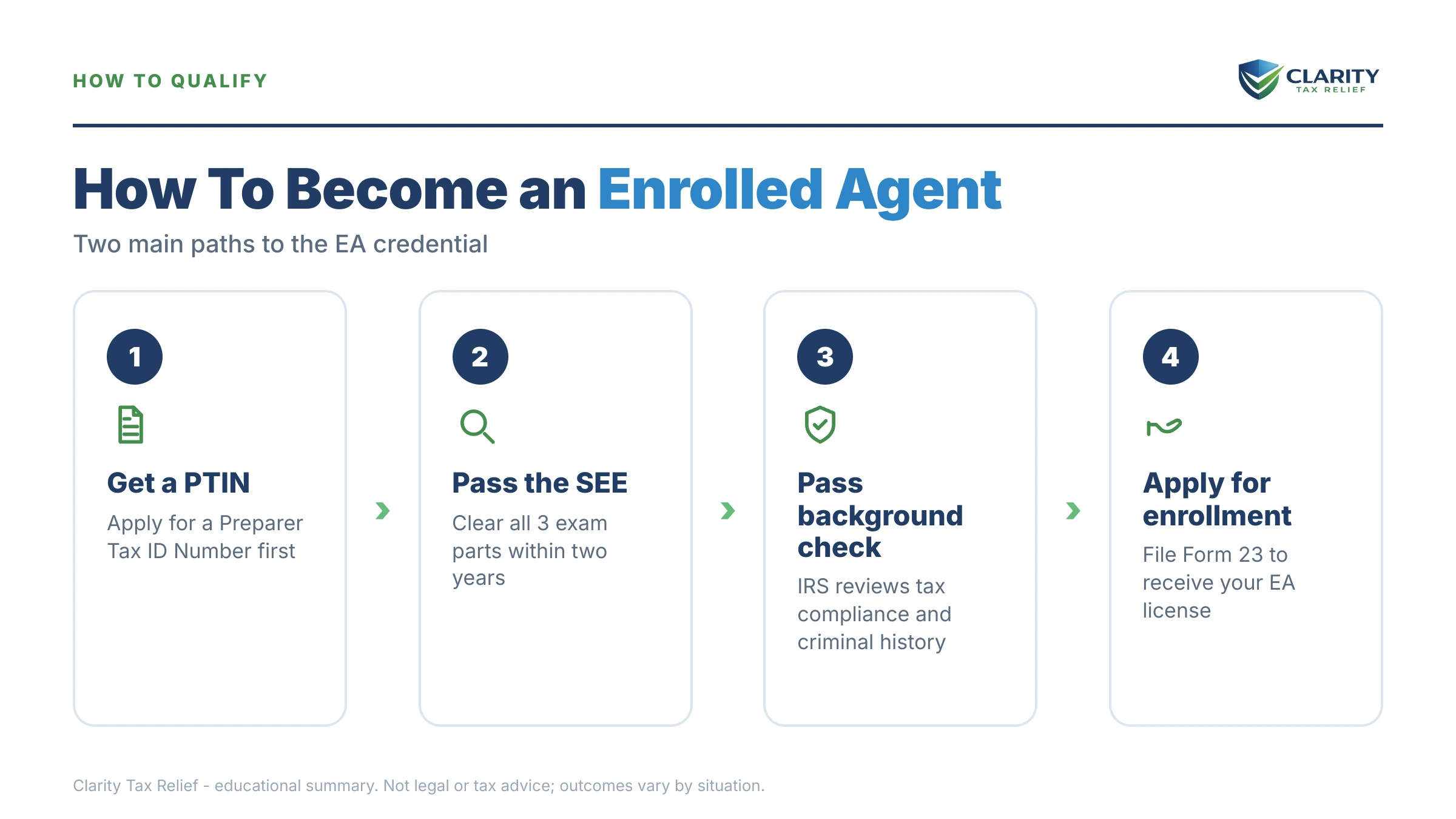
There are two ways to become an EA:
- Pass the Special Enrollment Examination (SEE) — a three-part federal exam covering individual taxation, business taxation, and representation, practices, and procedures.
- Qualifying IRS experience — former IRS employees with five or more years in a role applying and interpreting the tax code can enroll without the exam.
Either way, every applicant must pass a suitability check — including a review of their own tax compliance — and then complete 72 hours of continuing education every three years to keep the credential. An EA who hasn't kept up doesn't stay an EA.
“Become an enrolled agent, the highest credential the IRS awards, and find out how to maintain your status.”
— Enrolled agents (IRS.gov)
An enrolled agent is not an IRS agent, or that kind of agent
"Enrolled agent" means enrolled to practice before the IRS — an EA works for you, not for the government. The name confuses almost everyone at first, so three quick clarifications:
- Not an IRS employee. "Agent" here means your agent — someone authorized to act on your behalf against the IRS's position, not for it.
- Not a revenue agent. IRS revenue agents conduct audits and revenue officers collect debts; an EA sits on your side of that table.
- Not a sales agent. The title has nothing to do with insurance or real estate. (Though if you landed here because you're a commission-based agent behind on taxes, we cover insurance agent back taxes and real estate agent back taxes in their own guides.)
What an enrolled agent can do, and what they can't
Enrolled agents hold unlimited representation rights before the IRS — the highest level the IRS recognizes, shared only with CPAs and attorneys. In practice, that means once you sign a Form 2848 power of attorney, your EA can:
- Speak to the IRS for you, so you never sit on hold or get cornered on a call.
- Pull your account transcripts and receive copies of every notice the IRS sends you.
- Negotiate installment agreements, penalty abatement, hardship status, and Offers in Compromise.
- Represent you in audits and IRS Appeals — any tax year, any IRS office, any state.
- Prepare returns of any complexity, including back-year returns for unfiled periods.
Here is the practical map of what that covers for someone who owes:
| Your IRS problem | What an EA does | Key number or form |
|---|---|---|
| Balance you can't pay at once | Sets up or negotiates a payment plan | Up to 72 months online at ≤ $50,000; guaranteed installment agreement at ≤ $10,000 (conditions apply) |
| Penalties stacked on the debt | Requests first-time abatement or reasonable-cause relief | Form 843; clean prior 3 years for FTA |
| Debt you can never fully pay | Prepares and negotiates an Offer in Compromise | $205 application fee; roughly 1 in 5 offers accepted in FY2024 |
| Audit letter | Represents you so you never face the examiner alone | Form 2848 |
| Levy or garnishment threat | Requests a Collection Due Process hearing | Form 12153, within 30 days of an LT11/Letter 1058 |
| Genuine hardship — can't pay anything | Documents and requests Currently Not Collectible status | Form 433-F financial statement |
| Unfiled back years | Prepares the missing returns, then resolves the balance | Typically the last six years of returns |
| Debt from an ex-spouse's joint return | Evaluates and files innocent spouse claims | Form 8857 |
What an EA can't do is just as important. An enrolled agent cannot represent you in U.S. Tax Court (unless they've separately passed the Tax Court's non-attorney practitioner exam), cannot defend a criminal tax case, and cannot give you full attorney-client privilege — EAs and CPAs get only a limited practitioner privilege under IRC §7525, which covers noncriminal tax advice and doesn't extend to return preparation. And unlike a CPA, an EA can't issue audited financial statements. If your case involves possible fraud allegations or you're heading to litigation, that's attorney territory.
What happens if you owe the IRS and wait to get help
The IRS collection sequence runs on automation. It escalates on schedule whether or not you've finished comparison-shopping professionals. If you're researching credentials while a balance sits unaddressed, this is the track you're on:
- CP14 — the first bill, typically giving about 21 days before the reminder cycle starts. The cheapest moment to act.
- CP501 / CP503 — reminders. Still just paper, but the 0.5%-per-month failure-to-pay penalty and interest are compounding the whole time.
- CP504 — intent to levy your state tax refund. A federal tax lien becomes a live possibility.
- LT11 / Letter 1058 — final notice of intent to levy. A 30-day clock starts on your Collection Due Process rights; after it runs, the IRS can levy bank accounts and garnish wages.
2026 makes the timing stranger, not safer: the IRS workforce was cut roughly 27% in 2025, so reaching a human is harder than ever. But the notices, liens, and levies are generated by systems that were never laid off. The full sequence, stage by stage, is mapped in our guide to the IRS collection process step by step. The takeaway for this article: whichever professional you choose matters less than choosing one before the LT11 stage, when every option is still on the table.
Owe the IRS and not sure whether you need an EA, CPA, or attorney?
Tell us what you owe and what notices you've received. An experienced tax professional will tell you, free, which credential your case actually needs and what your realistic options are. Penalties and interest accrue monthly while you decide, so decide with real information.
Enrolled agent vs. CPA vs. tax attorney: which should you hire?
All three credentials — enrolled agent, CPA, and tax attorney — carry identical unlimited representation rights before the IRS. The real differences are focus, privilege, and price. The IRS does not give an attorney's installment-agreement request more weight than an EA's. What changes is what each professional is trained for and what you pay for that training.
| Factor | Enrolled agent (EA) | CPA | Tax attorney |
|---|---|---|---|
| Who issues it | U.S. Treasury (federal) | State board of accountancy | State bar |
| Training focus | Tax only | Accounting & auditing, plus tax | Law, plus tax |
| IRS representation rights | Unlimited | Unlimited | Unlimited |
| U.S. Tax Court | No (unless USTCP exam passed) | No (unless USTCP exam passed) | Yes |
| Confidentiality privilege | Limited §7525 (civil tax only) | Limited §7525 (civil tax only) | Full attorney-client privilege |
| Typical relative cost | $ | $$ | $$$ |
| Best fit | Back taxes, collections, audits, unfiled returns | Business accounting plus tax filing | Criminal exposure, Tax Court, complex legal issues |
The rule of thumb: match the professional to the problem, not to the prestige. A collection case — payment plan, penalty abatement, Offer in Compromise — is EA home turf. A business with messy books needs the CPA skill set. Anything with the word "criminal" or "court" in it needs the attorney. For a deeper head-to-head, see tax attorney vs. CPA vs. enrolled agent, or the two-way breakdown in tax attorney vs enrolled agent.
What hiring an EA looks like on an $8,900 balance (worked example)
Numbers make the decision concrete, so here's a clearly hypothetical scenario. Say you're recently divorced and owe $8,900 from the last year you filed jointly. Your ex handled the money, the withholding never got fixed, and now the bill has your name on it.
Because the balance is under $10,000, you sit in the sweet spot for a guaranteed installment agreement: for individuals who owe $10,000 or less in income tax (excluding penalties and interest), have filed all required returns, have timely filed and paid for the past five years with no installment agreement during that period, and agree to pay in full within three years, the IRS must accept the plan. The math:
- $8,900 ÷ 36 months ≈ $248/month before interest — pay faster and you pay less in total.
- Left unaddressed, the failure-to-pay penalty runs about $44.50/month on that starting balance (0.5%), plus compounding interest. On an approved installment agreement for a timely-filed return, the penalty rate drops to 0.25% — roughly $22/month. You can estimate your own accrual with our Penalty & Interest Calculator.
Where would an EA actually earn a fee on a case this size? Sequencing and the divorce wrinkle:
- Penalty removal first. If, say, $700 of the $8,900 is penalties and your prior three years are clean, first-time penalty abatement can strip that out before the payment plan locks in the total. (Starting summer 2026, the IRS's new Automatic Exemption from Penalty applies some of this relief automatically, no request needed. But an EA checks that it actually posted.)
- The joint-return question. If the $8,900 traces to income your ex earned or hid, you may qualify for innocent spouse relief on Form 8857 — potentially moving part or all of the liability off you entirely. Your divorce decree can't do that; the IRS isn't bound by it, as we explain in divorce and IRS debt: who pays.
And the honest flip side: if the $8,900 is simply your own tax, you agree with it, and there's no joint-year complication, you don't need to hire anyone. You can set up that plan online yourself in about 20 minutes. More on that below.
How to hire an enrolled agent, step by step
- Define the problem first. Pull your latest IRS notice or log into your IRS online account so you know the balance, the tax years involved, and whether any returns are unfiled.
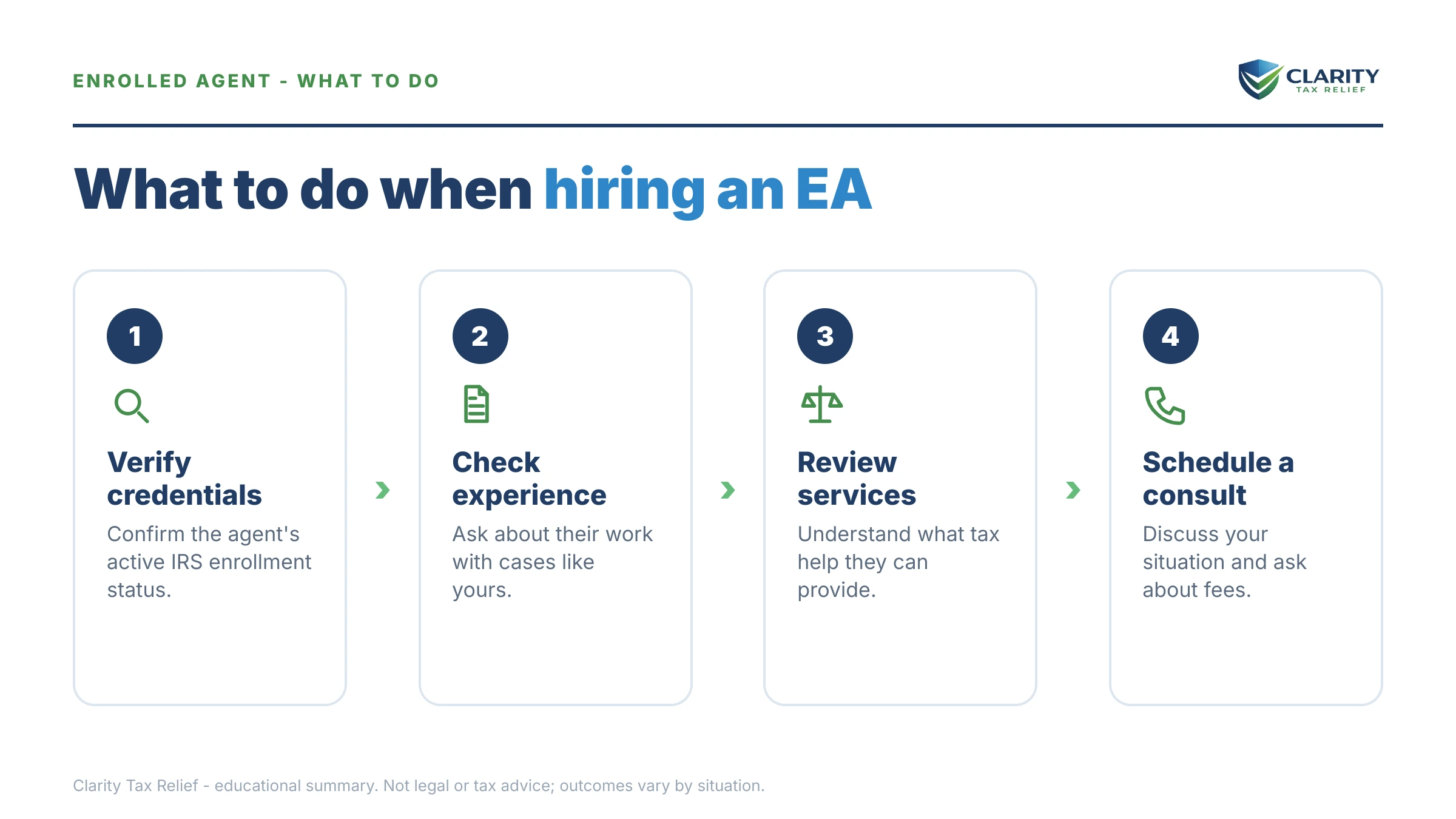
- Verify the credential. Confirm the EA appears in the IRS directory of credentialed preparers, and ask what share of their practice is IRS representation rather than return preparation.
- Ask case-specific questions. Find out who will actually work your file, how many cases like yours they have resolved, and whether the fee is flat or hourly.
- Sign Form 2848. The power of attorney lets your EA pull transcripts, receive copies of your notices, and take over all IRS contact for the years listed on the form.
- Stay compliant while the case runs. Keep current-year filings and payments on track — a new balance can default the agreement your EA just negotiated.
For step two, the official lookup is the IRS verification page for enrolled agents. Anyone who resists being verified there has answered your question for you. And whether the EA works solo or inside a firm, the vetting questions in our guide on how to choose a tax relief company apply word for word.
When you don't need an enrolled agent at all
You do not need any professional to set up an IRS payment plan on a balance under $10,000 that you agree with. Honest boundaries matter here, so use this split:
Handle it yourself when: the balance is one you can pay within 180 days (the short-term plan has a $0 setup fee). It's a first notice and the numbers match your return. Or you just need a simple monthly plan under the streamlined thresholds. The IRS's own payment plans page handles all of that online, and our DIY pillar on how to settle tax debt yourself walks through every self-service option in order.
Bring in an EA (or attorney) when: a levy or garnishment is already in motion, you have multiple unfiled years, the debt involves a business or payroll taxes, you're weighing an Offer in Compromise (the financial math there decides everything, and getting it wrong wastes the $205 fee and months of waiting), or, like the divorced filer above, liability itself is in question. In those cases, experienced representation routinely changes what you end up paying, not just how pleasant the process feels.
Terms you'll see next to "EA," decoded
- Circular 230 — the Treasury Department rulebook governing everyone who practices before the IRS; violating it can cost a practitioner the credential.
- Special Enrollment Examination (SEE) — the three-part federal exam most EAs pass to earn enrollment.
- Unlimited representation rights — authority to represent any taxpayer on any matter before any IRS office; only EAs, CPAs, and attorneys have it.
- Form 2848 — the power of attorney that lets a practitioner act and speak for you before the IRS.
- Form 8821 — a lighter authorization that lets someone see your IRS information without representing you.
- §7525 privilege — the limited confidentiality EAs and CPAs get for civil tax advice; it does not cover criminal matters.
The IRS's own overview of the credential lives at IRS.gov: Enrolled agents.
Enrolled agent questions, answered
Is an enrolled agent as good as a CPA?
Before the IRS, yes — enrolled agents and CPAs hold identical unlimited representation rights, so both can handle audits, collections, and appeals on your behalf. The practical difference is focus: EAs are tested and continuing-educated exclusively on tax, while CPA training centers on accounting and auditing. If you need audited financial statements or broad business accounting, choose a CPA. If the problem is an IRS balance or notice, an EA's specialization is often the better fit.
Can an enrolled agent negotiate with the IRS for me?
Yes. Once you sign Form 2848, Power of Attorney, an enrolled agent can call the IRS for you, receive copies of your notices, pull your transcripts, and negotiate payment plans, penalty abatement, or an Offer in Compromise in your name. In most collection cases you never have to speak to the IRS yourself again. The authorization only covers the tax years and matters listed on the form, so make sure every problem year is included.
How do I verify that someone is really an enrolled agent?
Search the IRS Directory of Federal Tax Return Preparers with Credentials and Select Qualifications, which lists every active enrolled agent by name and location. You can also ask to see the person's enrollment card. Be cautious of anyone who dodges the question or claims a special relationship with the IRS — no such thing exists, and implying government affiliation is a classic tax-relief scam signal.
What can an enrolled agent not do?
An enrolled agent cannot represent you in U.S. Tax Court unless they have separately passed the Tax Court's non-attorney practitioner exam, cannot defend a criminal tax case, and cannot offer full attorney-client privilege — the practitioner privilege under IRC §7525 covers only noncriminal tax advice. EAs also don't issue audited financial statements, which is CPA work. For most collection problems, none of those limits ever comes into play.
Do enrolled agents cost less than tax attorneys?
Usually, yes. Fees vary by market and by case, but EAs generally charge less than tax attorneys for the same IRS-facing work because you aren't paying for a law degree you don't need. For payment plans, penalty abatement, audits, and most Offers in Compromise, an EA can pursue the identical IRS outcome. Pay attorney rates when the case genuinely calls for one — criminal exposure, Tax Court litigation, or complex legal questions layered on top of the tax debt.
Can an enrolled agent work in any state?
Yes. The EA credential is federal, issued by the U.S. Treasury Department, so it's valid in all 50 states — unlike a CPA certificate or a bar admission, which are state-issued. That's why you can hire an enrolled agent remotely: an EA in another state can represent you before the IRS just as fully as one in your town. For state tax agencies the rules vary, so ask whether the EA also handles your state's revenue department.
Is an enrolled agent an IRS employee?
No. Enrolled means enrolled to practice before the IRS, and agent means authorized to act as your agent — an EA works for you, never for the government. Some EAs earned the credential through five or more years of past IRS employment instead of the exam, which can be an advantage: they know how the collection machinery works from the inside. Either way, their duty in your case runs to you.
Do enrolled agents prepare tax returns?
Most do, and there is no limit on the type or complexity of return an EA can prepare. That matters if you have unfiled years, because the same person can prepare the back returns and then represent you on the balance those returns create — the IRS generally won't approve a payment plan or an Offer in Compromise until required returns are filed. Ask up front whether return preparation is included in the quoted fee.
Your next 24 hours
- Find your exact numbers. Log into your IRS online account or pull your most recent notice and write down the total balance and every tax year it covers.
- Gather three documents. Your last filed return, every IRS notice you've received, and, if any of the debt comes from a joint year, your divorce decree.
- Get a free case review. Call (888) 825-7779 or use the 2-minute form. An experienced tax professional will tell you whether your situation even needs an EA — remember, penalties and interest keep accruing monthly until the balance is in an agreement, so have this answer by the end of the week.
This guide is general information, not tax or legal advice for your specific situation. Eligibility for IRS programs depends on individual facts and circumstances; no outcome is guaranteed.