
Hiring Tax Help
Do I Need a Tax Attorney for Back Taxes? An Honest 2026 Guide
The short answer: for most back-tax cases, no. You don't need a tax attorney. Enrolled agents and CPAs hold the same unlimited representation rights before the IRS, usually at lower cost. An attorney becomes necessary in three situations: criminal exposure, court litigation, and cases where attorney-client privilege genuinely matters.
If you're typing "do I need a tax attorney for back taxes" into your phone after another IRS envelope hit your desk — maybe with a payroll quarter or two behind and a law firm's site quoting four-figure retainers — take a breath. Back taxes are a collection problem, and the IRS resolves the overwhelming majority of collection cases through financial paperwork and program rules, not legal argument.
The real question isn't "lawyer or no lawyer." It's "does my case have a legal problem inside it, or just a money problem?" This guide gives you the exact test, and shows you how to avoid paying litigation prices for negotiation work.
⏱ The real clock: there's no deadline for deciding who to hire, but the failure-to-pay penalty adds 0.5% of your balance every month, interest compounds daily, and the IRS's automated notice sequence keeps escalating toward levy whether or not you've retained anyone. Deciding fast costs nothing; deciding slowly does.
When you actually need a tax attorney for back taxes
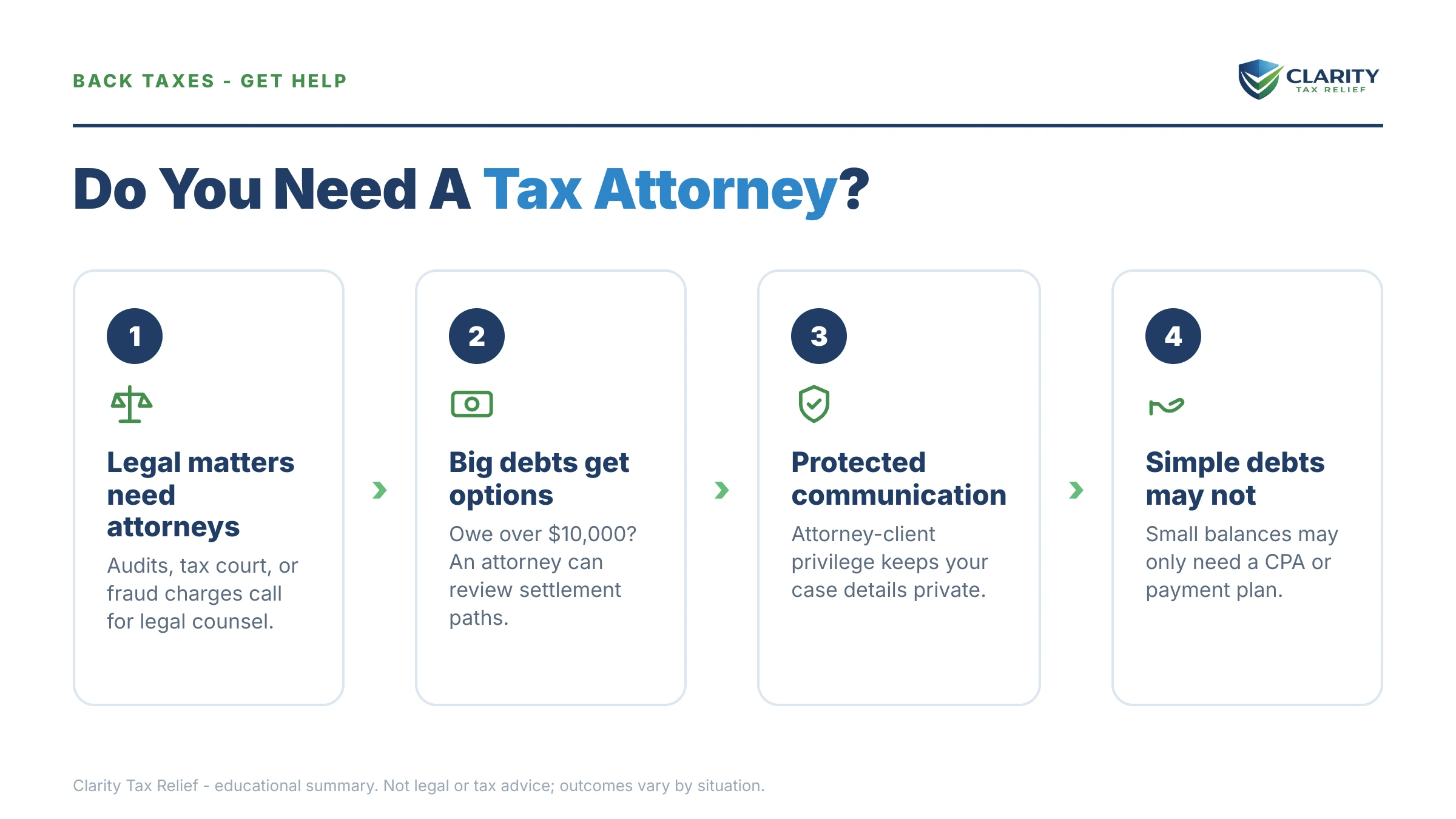
You need a tax attorney for back taxes only when your case involves criminal exposure, court litigation, or a genuine need for attorney-client privilege. Those three situations describe a small minority of back-tax cases, but when they apply, an attorney isn't optional. The order matters: attorney first, IRS second.
- IRS Criminal Investigation has made contact. If two special agents appear at your home or business, that is not a collection call — it's an IRS criminal investigation. Stop talking, take their cards, and call a criminal tax attorney the same day.
- Willfulness is on the record. Years of high income with no returns filed, false statements to a revenue officer, hidden accounts, altered records — facts that suggest intent, not oversight. An eggshell audit — a civil exam sitting on top of facts like these — is classic attorney territory.
- Payroll taxes were diverted deliberately, quarter after quarter. Falling one quarter behind on deposits is a collection problem. Pyramiding payroll taxes — repeatedly withholding from employees while paying other creditors — is the pattern the government treats as potentially criminal.
- Your case is headed to court. Filing a Tax Court petition is procedurally simple, but actually trying a case, defending a Department of Justice collection suit, or fighting summons enforcement requires a litigator.
- You need real confidentiality before anyone knows the facts. Only full attorney-client privilege survives a criminal referral. If you're unsure whether your facts are dangerous, an attorney is the safe first conversation, even if the actual resolution work later goes to someone cheaper.
One more edge case: state taxes run on separate tracks with their own enforcement cultures. Many states treat unremitted sales tax as trust money and pursue owners personally, and criminal referral thresholds vary by state — worth raising early if that's part of your picture.
When an enrolled agent or CPA handles back taxes just as well: often for less
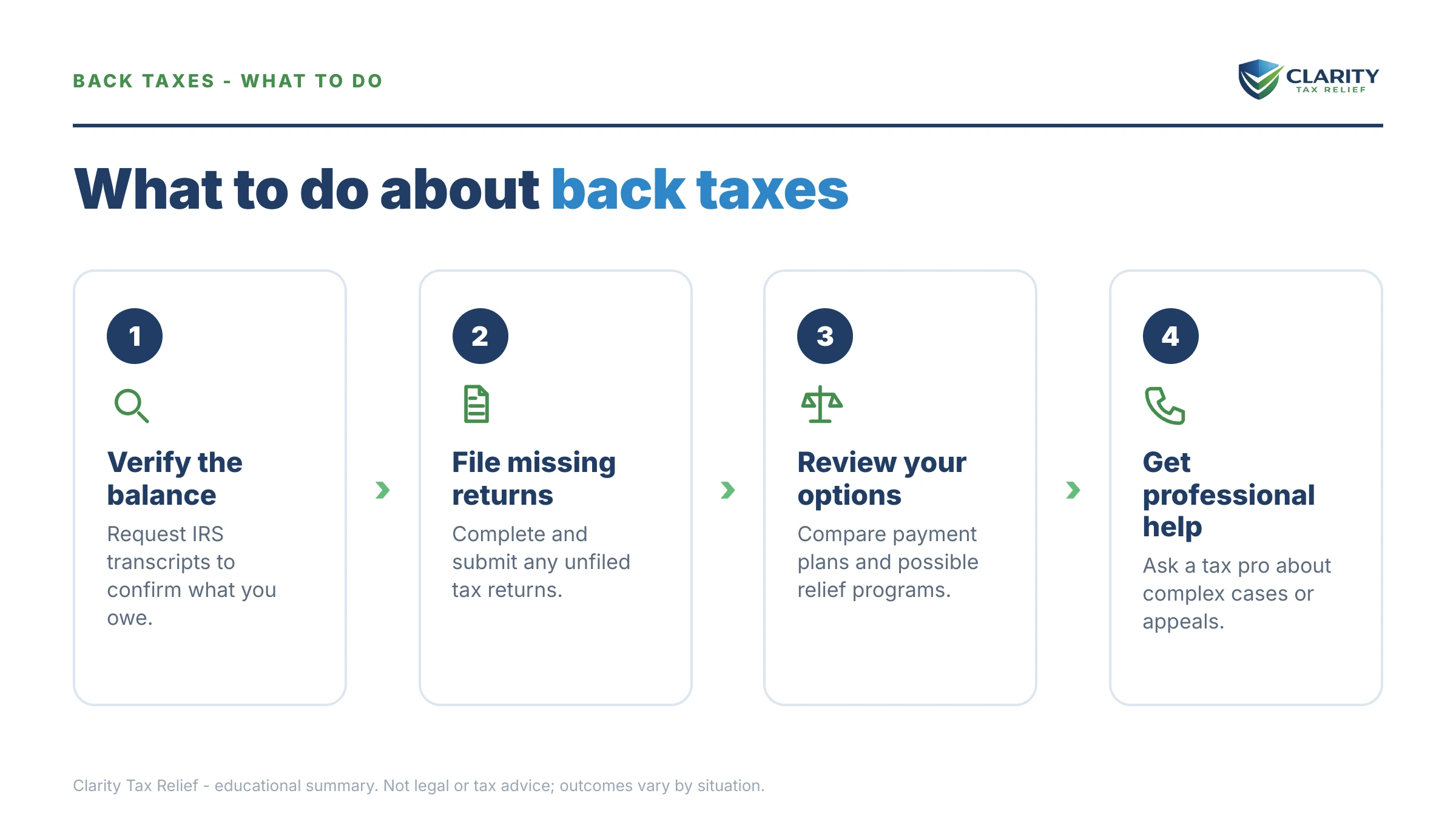
Enrolled agents and CPAs can represent you before the IRS on any back-tax matter — payment plans, settlements, appeals, audits, penalty relief, levy releases — with exactly the same authority an attorney has. That authority comes from one document: the Form 2848 power of attorney, which grants attorneys, CPAs, and enrolled agents identical "unlimited practice rights" before every IRS function.
That covers nearly everything a back-tax case actually needs: negotiating an installment agreement, building and filing an Offer in Compromise, requesting Currently Not Collectible status, protesting penalties, catching up unfiled returns, and requesting Collection Due Process hearings after a final notice. None of it is litigation. All of it is financial analysis plus procedure — which is why an enrolled agent, whose entire license is federal tax practice, is often the strongest fit for pure collection work.
And if your balance is small and your situation simple, you may not need to hire anyone at all — our guide to how to settle tax debt yourself walks through every IRS program step by step.
Tax attorney vs. CPA vs. enrolled agent: what actually differs
All three credentials carry the same representation rights inside the IRS; the real differences are legal reach, confidentiality, and pricing model. For a deeper head-to-head, see tax attorney vs. CPA vs. enrolled agent — here's the back-tax-specific version:
| Credential | IRS representation rights | Confidentiality protection | Typical fee model |
|---|---|---|---|
| Tax attorney | Unlimited — all IRS matters, plus courts and criminal defense | Full attorney-client privilege, including criminal matters | Hourly against a retainer; rates vary widely by market |
| CPA | Unlimited — all IRS matters | Limited §7525 privilege — civil IRS matters only | Hourly or flat fee |
| Enrolled agent (EA) | Unlimited — all IRS matters | Limited §7525 privilege — civil IRS matters only | Flat fee is common; usually the lowest cost |
| Unenrolled preparer | Very limited — generally only returns they prepared | None | Varies; not suited to back-tax representation |
Two of those cells deserve a closer look, because they're where lawyer marketing does its heaviest lifting.
Privilege. Federal law does give CPAs and EAs a confidentiality privilege, but it's narrow. Section 7525 covers tax advice in non-criminal matters before the IRS and in federal tax court. It disappears the moment a case turns criminal. It also never covers return preparation itself. If your facts are clean, that limitation costs you nothing. If your facts might be criminal, it's everything — which is the honest core of when a lawyer matters. (Attorneys can also bring an accountant under their privilege through a "Kovel arrangement" — see the glossary below.)
Price. Attorneys usually bill hourly against a retainer; resolution-focused EAs and firms usually quote flat fees. For litigation, hourly makes sense — nobody can predict a trial. For a payment plan or penalty request, hourly billing means you pay for every phone call the IRS puts on hold. Our breakdown of how much tax relief costs covers real fee structures, and tax relief attorney vs company compares the two hiring paths directly.
What happens if you delay while deciding
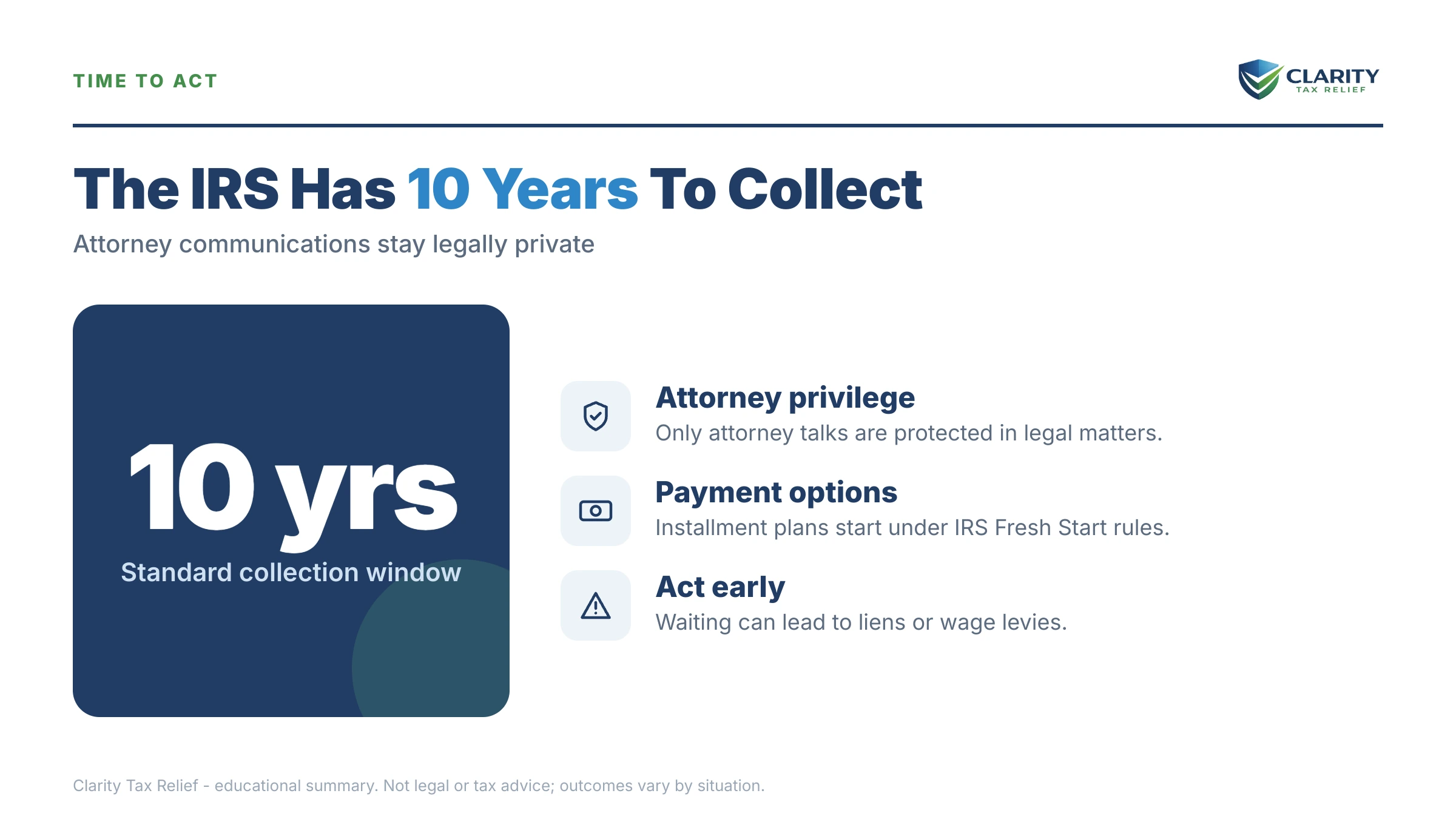
The IRS collection sequence keeps moving while you shop for help. It doesn't pause because you're interviewing attorneys. The stages arrive in a fixed order, each with more enforcement power than the last:
- The bill. A CP14 for individuals (typically about 21 days to respond) or a CP161 for a business. No enforcement yet. This is the cheapest stage to fix anything.
- Reminders. CP501/CP503-series notices while the balance grows monthly. For payroll debt, the federal tax deposit penalty climbs through its tiers, and can reach 15% of the undeposited amount after an IRS demand.
- Intent to levy. A CP504 (or CP504B for a business) lets the IRS take your state tax refund. A federal tax lien becomes a live possibility.
- Final notice. The LT11 or Letter 1058 starts a 30-day clock and your Collection Due Process rights (Form 12153). After it runs, the IRS can levy bank accounts (funds held 21 days before they leave) and garnish wages continuously.
- The parallel payroll track. If your debt is employment tax, the IRS can simultaneously run a Trust Fund Recovery Penalty investigation — a Form 4180 interview, then a Letter 1153 giving you 60 days to protest personal assessment of the trust-fund portion.
Notice what's missing from that sequence: any step that pauses because you hired someone. In 2026, with the IRS workforce down roughly 27% from 2025 cuts, humans are harder to reach than ever. But the notices, liens, and levies are generated by automated systems that never stopped running. Only a filed resolution stops the machine.
Not sure whether your back-tax case needs a lawyer at all?
Send us your latest IRS notice. An experienced tax professional will tell you — honestly, free, in plain English — whether yours is routine collection work or one of the rare cases that belongs with an attorney. Penalties and interest are accruing monthly either way, so find out now.
Your options for resolving back taxes, and who can handle each
Every IRS back-tax resolution runs through a defined program with published eligibility rules, and no credential changes those rules. What a good representative changes is the accuracy of the financial presentation and the speed of getting something filed. Here's the full menu:
| Option | Key 2026 eligibility | Attorney required? |
|---|---|---|
| Short-term payment plan | Pay in full within 180 days; $0 setup fee | No — self-service online |
| Guaranteed installment agreement | Individual income tax debt of $10,000 or less | No — self-service |
| Streamlined installment agreement | Balances of $50,000 or less; up to 72 months, set up online | No — self-service or EA/CPA |
| Business / payroll installment agreement | Operating businesses with employment-tax debt; tighter limits, financials often required | No — EA/CPA typical |
| Currently Not Collectible | Paying would leave you unable to cover basic living or operating expenses | No — EA/CPA |
| Offer in Compromise | $205 fee + 20% down on lump-sum offers (both waived with low-income certification); roughly 1 in 5 offers accepted in FY2024 | No — EA/CPA; success rides on the financial math |
| Penalty abatement (FTA / AEP) | Clean compliance for the prior 3 years; the new AEP becomes automatic starting summer 2026 | No, often a phone call or letter |
| TFRP protest (Letter 1153) | 60-day window to protest personal assessment of trust-fund taxes | No for the protest itself, unless criminal red flags exist |
| Criminal investigation / court litigation | Any IRS-CI contact; trials beyond filing a Tax Court petition | Yes — attorney only |
A few thresholds worth underlining. Balances of $50,000 or less can be put on a payment plan online without hiring anyone. An Offer in Compromise is real but means-tested — the IRS runs your income and assets through a formula, and no representative of any credential can promise acceptance. Penalty relief is quietly the best value in the whole table: the failure-to-file penalty runs 5% per month, ten times the 0.5% failure-to-pay rate, so filed-but-unpaid debt is dramatically cheaper than unfiled debt, and first-time penalty abatement (soon supplemented by the automatic AEP) can erase penalties without any legal argument at all.
How does the answer change with the size of the debt? Roughly like this:
| Balance owed | Realistic resolution path | Attorney needed? |
|---|---|---|
| Under $10,000 | Guaranteed installment agreement or 180-day plan, set up yourself online; request penalty relief | Almost never |
| $10,000 – $50,000 | Streamlined plan online; check abatement; OIC only if finances are genuinely underwater | No — EA/CPA if you want help |
| $50,000 – $100,000 | Financial disclosure usually required; terms are negotiated, not automatic; passport certification risk begins at $66,000 | Rarely — experienced representation helps, any credential |
| Over $100,000 | Revenue officer likely; liens, asset review, negotiated agreements | Sometimes — attorney if a dispute is headed to court |
| Any amount + fraud or criminal signs | Defense first, resolution second | Yes, before anyone else |
A worked example: $8,900 in payroll back taxes
Say you run a five-person business and owe $8,900 across two quarters of 941 back taxes — withheld payroll taxes that never got deposited because a big customer paid late. This is a hypothetical, but the math is real:
- Penalties already stacking: deposits more than 15 days late carry a 10% federal tax deposit penalty — about $890 on this balance — and unpaid amounts can jump to the 15% tier after an IRS demand, roughly another $445.
- Ongoing accrual: the failure-to-pay penalty adds about 0.5% per month — roughly $44.50 monthly on $8,900 — plus interest compounding daily at the quarterly-adjusted federal rate. You can estimate how fast your own balance is growing with our IRS penalty & interest calculator.
- Route A — an EA or your own two hands: a 24-month business installment agreement runs about $371 per month before accruals ($8,900 ÷ 24). A penalty-abatement request could claw back part of that $890 if your deposit history was clean before these quarters.
- Route B — an attorney at, say, $350 per hour: even a lean eight hours of work is $2,800, nearly a third of the debt itself, to file the same installment agreement with the same outcome.
Now the flip side, because it matters. If those two quarters were actually part of two years of paying suppliers and rent while employee withholding sat unremitted, the facts start to look willful. The calculus reverses completely. That's an attorney conversation, before you explain anything to the IRS or to anyone whose privilege dies in a criminal case.
One more thing an $8,900 payroll debt carries that an $8,900 income-tax debt doesn't: the trust-fund portion — the withheld income tax and the employees' FICA share — can be assessed against you personally through the Trust Fund Recovery Penalty, even if the business is an LLC or corporation. How much of your entity's debt can reach you depends on the tax type and structure. Our guide to personal liability for payroll taxes maps it out.
How to choose the right help for your back taxes, step by step
- Pull your newest IRS notice. The notice number and date tell you what stage of collections you're in and whether any formal clock, like the 30-day levy window after an LT11, is already running.
- Screen your facts for criminal red flags. Contact from IRS special agents, years of willful non-filing, or payroll deposits diverted to other creditors mean you talk to a tax attorney before you talk to the IRS.
- Match the credential to the actual problem. Routine collection work — payment plans, offers, penalty relief, unfiled returns — fits an enrolled agent or CPA. Criminal exposure and litigation fit an attorney.
- Get fees and scope in writing before you pay. Ask for a flat-fee quote, confirm who will actually sign your Form 2848, and verify the person is an attorney, CPA, or enrolled agent in good standing.
- File a resolution before the next notice lands. A payment plan, hardship claim, or appeal filed today stops the escalation. A representative merely "reviewing your case" does not.
When you can handle back taxes yourself: no attorney, no anyone
Plenty of back-tax cases need no professional at all, and it would be dishonest to pretend otherwise. You can confidently go it alone when:
- You owe under $10,000, agree with the balance, and have filed everything. The guaranteed installment agreement is yours by right — set it up at the IRS payment plans page in about fifteen minutes.
- You can pay in full within 180 days. The short-term plan has no setup fee, and paying directly through IRS.gov/payments stops the notice sequence immediately.
- Your only issue is a penalty after years of clean compliance. First-time abatement is frequently granted on a single phone call, and starting summer 2026, the Automatic Exemption from Penalty applies it without your even asking.
Experienced help genuinely changes outcomes in a different set of cases: a levy already in motion, multiple unfiled years to reconstruct, business payroll debt with a revenue officer assigned, a TFRP investigation underway, or Offer in Compromise math where a single misstated expense sinks the offer. In those cases the question isn't attorney-versus-nobody — it's finding a representative who does collection work all day, whatever their license. If money is the barrier, the Taxpayer Advocate Service and low-income taxpayer clinics exist for exactly that gap.
Terms you'll hear while comparing tax help, decoded
- Form 2848 (power of attorney): the document that lets an attorney, CPA, or enrolled agent speak to the IRS for you — all three get identical authority from it.
- Unlimited practice rights: the ability to represent any taxpayer, on any matter, before any IRS office — held equally by attorneys, CPAs, and EAs.
- §7525 practitioner privilege: the limited confidentiality CPAs and EAs carry — it protects tax advice in civil IRS matters but vanishes in criminal cases.
- Kovel arrangement: a setup where your attorney hires the accountant, wrapping the accountant's work inside attorney-client privilege.
- Trust Fund Recovery Penalty (TFRP): the IRS's tool for assessing a business's withheld payroll taxes against the individuals who controlled the money — personally.
- Retainer: money paid up front that an hourly biller draws against as work happens — ask what happens to the unused portion before you sign.
If your notices are stacking up faster than answers, a free back-tax case review, or a call to (888) 825-7779 — will tell you which of these options your actual numbers support, and whether your case is one of the few that needs a lawyer.
Tax attorney questions, answered
Do I need a tax attorney or a CPA for back taxes?
For ordinary collection cases — payment plans, settlements, penalty relief, unfiled returns — either one works. An enrolled agent does too, because all three hold the same unlimited representation rights before the IRS. Choose an attorney only when your case involves criminal exposure, court litigation, or a real need for attorney-client privilege. For everything else, compare fees and resolution experience, not titles.
How much does a tax attorney cost for back taxes?
Most tax attorneys bill hourly against an upfront retainer, and rates vary widely by city and firm — routine collection cases handled on the clock frequently cost more than the identical case at a flat fee. On a smaller balance like $8,900, hourly fees can approach a third of the debt itself. Always ask for a written flat-fee quote and compare it against an enrolled agent or CPA before signing.
Can a tax attorney settle my back taxes for less than I owe?
Only through the same Offer in Compromise program available to everyone — no credential unlocks a special deal. An OIC costs a $205 application fee plus 20% down on lump-sum offers (both waived with low-income certification). The IRS accepted roughly 1 in 5 offers in FY2024. Acceptance turns on your income and assets, not on who signs the paperwork.
What can a tax attorney do that an enrolled agent can't?
Three things: defend you in a criminal tax matter, represent you in most courts, and give you advice protected by full attorney-client privilege. Inside the IRS itself — audits, appeals, collection negotiations — an enrolled agent with a Form 2848 has the same authority an attorney does. If your case never leaves the IRS's administrative process, the attorney's extra reach usually goes unused.
Should I hire a tax attorney for payroll back taxes?
Usually not for the debt itself — civil 941 balances, business payment plans, and even Trust Fund Recovery Penalty protests are standard work for enrolled agents and CPAs. Hire an attorney if the IRS suggests willfulness: repeated non-deposit across many quarters while other creditors got paid, false statements to a revenue officer, or any contact from IRS Criminal Investigation. Those facts turn a collection case into a defense case.
Can I negotiate with the IRS myself without a lawyer?
Yes — the IRS's collection programs are self-service by design. Individuals owing $50,000 or less can set up a payment plan online in minutes, balances under $10,000 qualify for a guaranteed installment agreement, and first-time penalty abatement is often a single phone call. DIY gets harder when a levy is in motion, multiple years are unfiled, or the debt is business payroll tax with a revenue officer assigned.
Does hiring a tax attorney stop IRS collections?
No — representation alone pauses nothing. Collections stop only when something formal is in place: an approved payment plan, Currently Not Collectible status, a pending Offer in Compromise, or a timely Collection Due Process request after a final notice. Interest and the 0.5% monthly failure-to-pay penalty keep accruing under every one of those, so the credential you hire matters less than how fast a resolution gets filed.
Will the IRS take me more seriously if I have an attorney?
No. Once a Form 2848 is on file, the IRS deals with attorneys, CPAs, and enrolled agents identically — same phone lines, same appeal routes, same program rules. Outcomes in collection cases are driven by your financial numbers and the program criteria, not the letterhead. What genuinely changes outcomes is a representative who knows collection procedure well, whatever their license.
Is what I tell a CPA or enrolled agent about back taxes confidential?
Partly. Federal law gives CPAs and enrolled agents a limited privilege for tax advice. But it applies only in non-criminal matters before the IRS and federal courts. It evaporates in a criminal investigation and never covers return preparation. That's exactly why the rule of thumb exists: if there's any chance your facts are criminal, talk to an attorney first, before you explain anything to anyone else.
Your next 24 hours
- Find your most recent IRS notice and write down the number in the top corner and the notice date. That tells you exactly what stage of collections you're in, and whether any formal clock, like a 30-day final-notice window, is already running.
- Gather three things: your last filed return, your notices, and a rough monthly income-and-expense picture (for a business, your 941s and payroll records too). Every resolution path starts from these.
- Get the free case review — the 2-minute form at claritytaxrelief.com/#consult or (888) 825-7779. An experienced tax professional will tell you straight whether your back-tax case needs an attorney at all, while the 0.5% monthly penalty and daily interest keep growing on whatever you owe.
This guide is general information, not tax or legal advice for your specific situation. Eligibility for IRS programs depends on individual facts and circumstances; no outcome is guaranteed.