
Business & Payroll Tax Debt
Personally Liable for Payroll Taxes? Who the IRS Holds Responsible in 2026
The short answer: yes — the IRS can hold you personally liable for payroll taxes. Under IRC §6672, it assesses the trust-fund portion of unpaid 941 taxes — employee withholding plus the employees' FICA share — against any "responsible person" who willfully failed to pay it over. No LLC or corporation blocks this Trust Fund Recovery Penalty.
The business fell behind on its payroll deposits, and now the letters have your name on them, not the company's. You rent, your paycheck is the whole safety net, and someone from the IRS wants to know who signed the checks. Take a breath: personal liability has a strict two-part legal test, a formal proposal stage, and a hard 60-day window to fight it, and this guide walks you through all three.
One thing to know right away: the IRS cannot put a dime of this on your personal account without first sending you a specific letter, Letter 1153, and the image below shows you exactly what that proposal looks like and where to look for the parts that matter.
⏱ Your deadline: you have 60 days from the date on Letter 1153 to file a written protest before the Trust Fund Recovery Penalty is assessed against you personally. If it's already assessed, the next hard clock is the 30-day window on a final notice of intent to levy. Interest accrues on the assessed amount the whole time.
Why the IRS can reach past your business for payroll taxes
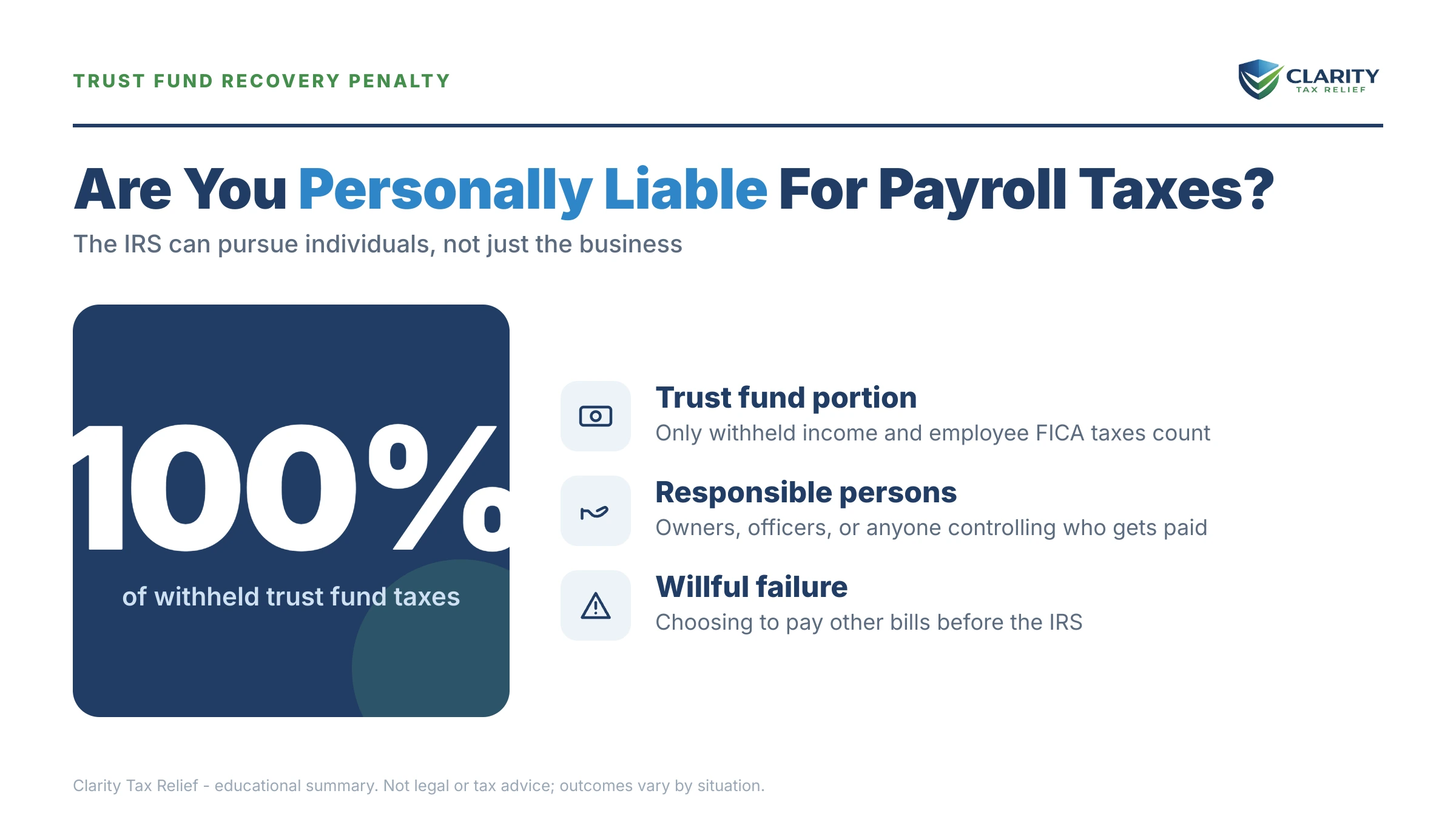
The IRS can collect the trust-fund portion of unpaid payroll taxes directly from individuals because that money was never the business's to spend. Every 941 balance splits into two very different pieces.
The first piece is money taken out of employees' paychecks: their withheld federal income tax and their 7.65% share of Social Security and Medicare. The law treats those dollars as held in trust for the United States from the moment payroll runs. When they aren't deposited, the government views it less like an unpaid bill and more like spending someone else's money.
The second piece — the employer's matching FICA, failure-to-deposit penalties. The interest that grew on the business account — belongs to the business alone. It can never be assessed against you individually. If you're sorting out which tax went unpaid in the first place, our guides to 941 back taxes and 941 vs 940 back taxes cover the business side. This page covers what happens when the debt jumps to a person.
The legal tool for that jump is the Trust Fund Recovery Penalty (TFRP) under Internal Revenue Code §6672. Despite the word "penalty," it isn't an extra charge — it's a duplicate assessment of the trust-fund dollars against individuals, so the IRS has more than one pocket to collect from. The full anatomy of the penalty itself lives in our trust fund recovery penalty guide.
“You must deposit and report federal income tax and Additional Medicare Tax withheld and both the employer and employee social security and Medicare taxes.”
— Employment taxes (IRS.gov)
Who is personally liable for payroll taxes? The two-part test
You are personally liable for payroll taxes only if you were both a "responsible person" and "willful" — the IRS must prove each prong. Titles don't decide either one; control does.
Responsible means you had the status, duty, and authority to decide which creditors got paid. Could you sign checks? Hire and fire? Direct which bills were paid when cash was short? A minority owner who controlled the bank account can be responsible while a 50% owner who never touched the money is not.
Willful does not mean malicious. It means you knew (or recklessly ignored) that the taxes were unpaid and let other payments go out anyway. Paying rent, suppliers, or net payroll while the withholding sat unpaid is willfulness in the IRS's eyes, even if you were trying to keep the business alive. No fraud, no bad intent, no personal benefit is required.
In practice, investigators often propose the penalty against everyone with signature authority and let the protest process sort out who actually had control. Being named is not the same as being liable — which is exactly why the 60-day protest matters.
| Role | Typical TFRP exposure | What the IRS examines |
|---|---|---|
| Owner, officer, or member-manager | High — the default target | Bank signature cards, canceled checks, who directed payments in the shortfall quarters |
| CFO, controller, or general manager | High if they controlled cash | Authority to prioritize creditors; knowledge of the unpaid 941s |
| Bookkeeper or office manager with check authority | Real risk, often overreached | Whether they followed orders or made payment decisions — see bookkeeper personally liable IRS |
| Outside payroll company | Provider rarely assessed. You usually remain liable for the tax | Who funded the deposits; whether the provider diverted funds |
| Passive investor or silent partner | Low unless they stepped into payment decisions | Board minutes, loan guarantees, any hands-on cash control |
| Family member merely added to the bank account | Low to moderate — signature authority alone isn't enough, but it invites scrutiny | Whether any checks were actually signed and who directed them |
How the IRS builds the case: Form 4180 to Letter 1153
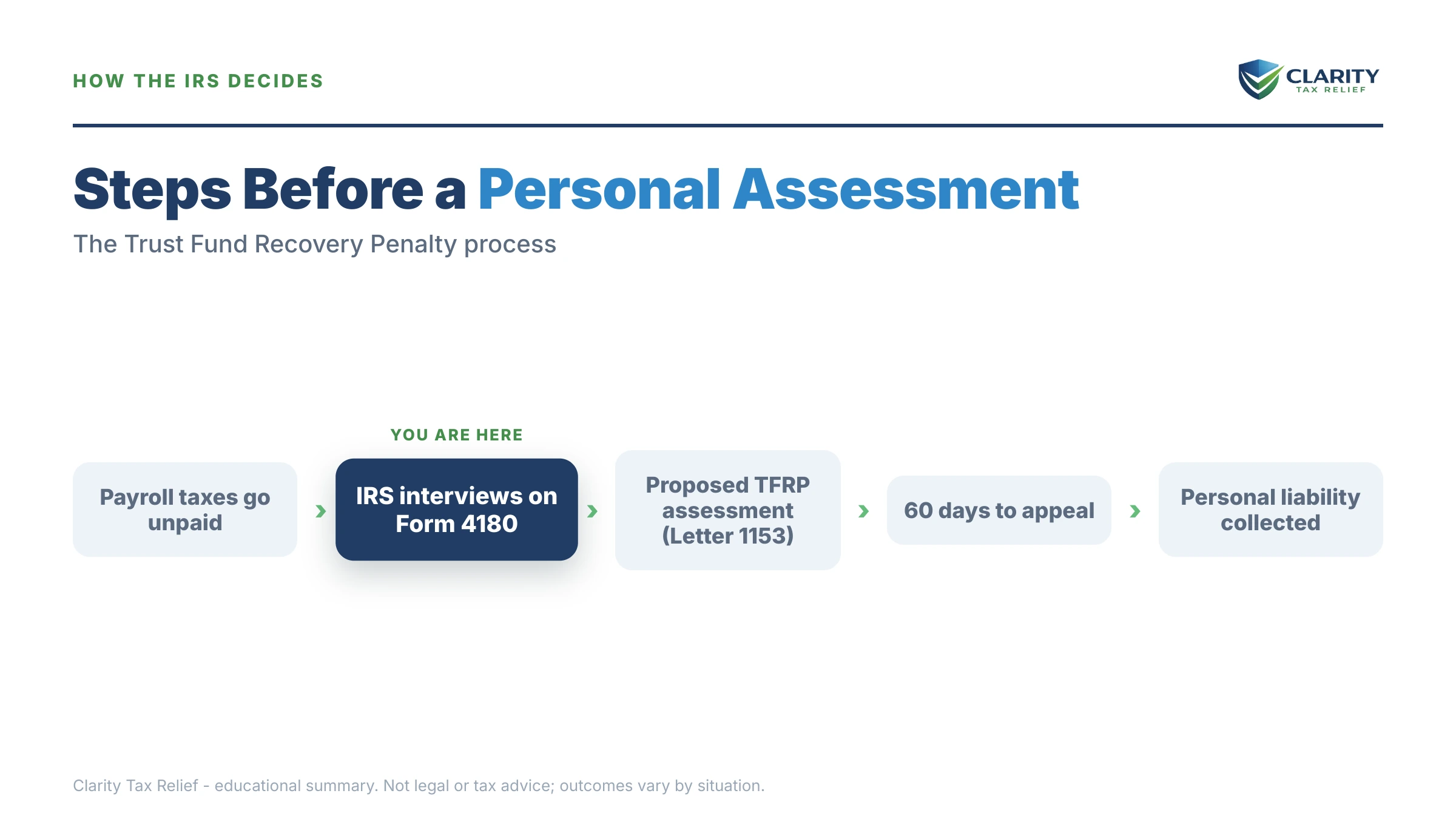
The TFRP process runs through a personal interview and a formal written proposal before anything reaches your account. Because unpaid payroll taxes are a collection priority, a human revenue officer, not just the automated notice stream, usually drives it.
The centerpiece is the Form 4180 interview: a structured questionnaire about who signed checks, who authorized payroll, and who knew the deposits were missed. It feels like paperwork; it is actually the evidence file for the responsibility and willfulness findings. You're allowed representation, and you're allowed to prepare — do both.
If the officer concludes you're liable, you receive Letter 1153 proposing the penalty, with Form 2751 attached showing the exact dollar figure. That's the document pictured below — check the date at the top, because your 60-day protest window runs from it. The proposed amount, because it should equal only the trust-fund portion, never the whole 941 balance. Protest in time and an independent Appeals officer reviews the case before assessment. Miss the window and the penalty posts to your personal account with no exam-stage appeal.
What happens if you ignore the Trust Fund Recovery Penalty
An ignored TFRP proposal becomes a personal tax debt the IRS collects like any other — from your paycheck, your bank account. Your refunds. The sequence runs in stages:
- Investigation. The revenue officer pulls bank records and requests Form 4180 interviews. Silence here doesn't stall the case — the officer decides on the records alone.
- Letter 1153 proposal. Your one pre-assessment chance to contest liability. The 60-day protest window starts on the letter's date.
- Assessment. The trust-fund amount posts to your personal account as a civil penalty — jointly and severally, meaning every responsible person owes 100% until it's paid once.
- Personal collection notices. Balance-due bills arrive in your name, with interest compounding on top.
- Final notice of intent to levy. An LT11 or Letter 1058 starts a 30-day clock and your Collection Due Process rights (requested on Form 12153).
- Levy. A bank levy freezes funds for 21 days before they're sent. A wage levy is continuous until released, taking most of each paycheck above a small exempt amount.
If you rent, that last stage is the whole ballgame. There's no house for a lien to sit quietly against. Your paycheck and checking account are the collectible assets, so levies arrive faster and bite harder. You can estimate what a wage levy would leave you with using our IRS wage garnishment calculator.
One more escalation to know about: if the business keeps withholding from paychecks quarter after quarter while never depositing it, the IRS calls that pyramiding payroll taxes, and that's where civil cases start drawing criminal attention. Stopping the bleeding now matters as much as fixing the past.
The IRS wants to put payroll taxes on you personally?
Get your Letter 1153, Form 4180 request, or revenue officer letter reviewed free, before the 60-day protest window closes. An experienced tax professional will tell you whether you actually meet the responsible-person test and what your strongest move is.
Your options at each stage
Your best option depends on whether the penalty is proposed, assessed, or already in collection, and the earlier the stage, the cheaper the fix. The general mechanics of payment plans, hardship status, and offers are covered in our guide to how to settle tax debt yourself. Here's what changes when the balance is a TFRP.
| Option | Who qualifies | Cost / key limit |
|---|---|---|
| Written protest of Letter 1153 | Anyone named — must file within 60 days of the letter date | Free; keeps the penalty off your account during Appeals review |
| Designated voluntary payments (business still open) | Business making voluntary (not levied) payments, designated in writing to the trust-fund portion | Each designated dollar shrinks what can ever be assessed against you |
| Installment agreement on the assessed penalty | Balances ≤ $50,000 can set up online for up to 72 months; the guaranteed installment agreement applies only to individuals with an income-tax balance of $10,000 or less (excluding penalties and interest) who have filed all returns, filed and paid on time for the past 5 years with no installment agreement in that period, and can pay in full within 3 years | Setup fee varies; interest keeps accruing while you pay |
| Currently Not Collectible | Paying anything would leave you unable to cover basic living costs (proven on Form 433-F) | $0; pauses levies but the debt and interest remain |
| Offer in Compromise | Assets plus future income genuinely can't cover the balance before the CSED | $205 fee (waived if AGI ≤ 250% of poverty); roughly 1 in 5 offers accepted in FY2024 |
| Post-assessment defense / abatement | You can show you weren't responsible or weren't willful | See trust fund recovery penalty defense and trust fund penalty abatement |
| Collection statute expiration | Everyone — 10 years from your personal assessment date | Clock pauses during OIC, bankruptcy, and certain appeals; not a strategy by itself |
Two of these deserve emphasis. First, the designated payment move: while the business is operating and the TFRP hasn't been assessed, any voluntary payment can be directed in writing to the trust-fund portion of the oldest quarter. Levied funds and required deposits can't be designated, but voluntary ones can, and they directly reduce your personal exposure.
Second, know that the TFRP is itself a penalty, so the usual penalty-relief playbook (first-time abatement. The Automatic Exemption from Penalty rolling out in summer 2026) doesn't erase it. "Abating" a TFRP means proving the liability shouldn't attach to you at all — a liability argument, not a forgiveness request.
A worked example: how $6,200 lands on you personally
Say your small business missed two quarters of 941 deposits and owes $9,860 total. During those quarters it paid $40,000 in gross wages, withholding $3,140 in federal income tax and $3,060 in the employees' 7.65% FICA share. The math splits like this:
- Trust-fund portion (can follow you personally): $3,140 withheld income tax + $3,060 employee FICA = $6,200
- Business-only portion: $3,060 employer matching FICA + roughly $600 in deposit penalties and interest ≈ $3,660 — this stays with the entity, period
If the IRS assesses that $6,200 against you and you're a renter earning $4,200 a month, there's no home equity to chase — so a levy targets your paycheck (continuous until released) or your checking account (funds held 21 days, then gone). The same $6,200 on a payment plan looks very different: even stretched over 72 months it's roughly $86 a month before accruing interest. The guaranteed installment agreement has strict conditions — it's available only to individuals with an income-tax balance of $10,000 or less excluding penalties and interest, with all returns filed, timely filing and payment for the past 5 years with no installment agreement in that period, and full payment within 3 years. Most people in this range resolve it in a year or two. The gap between "levied" and "$86 a month" is entirely about who moves first.
How to respond to personal payroll tax liability, step by step
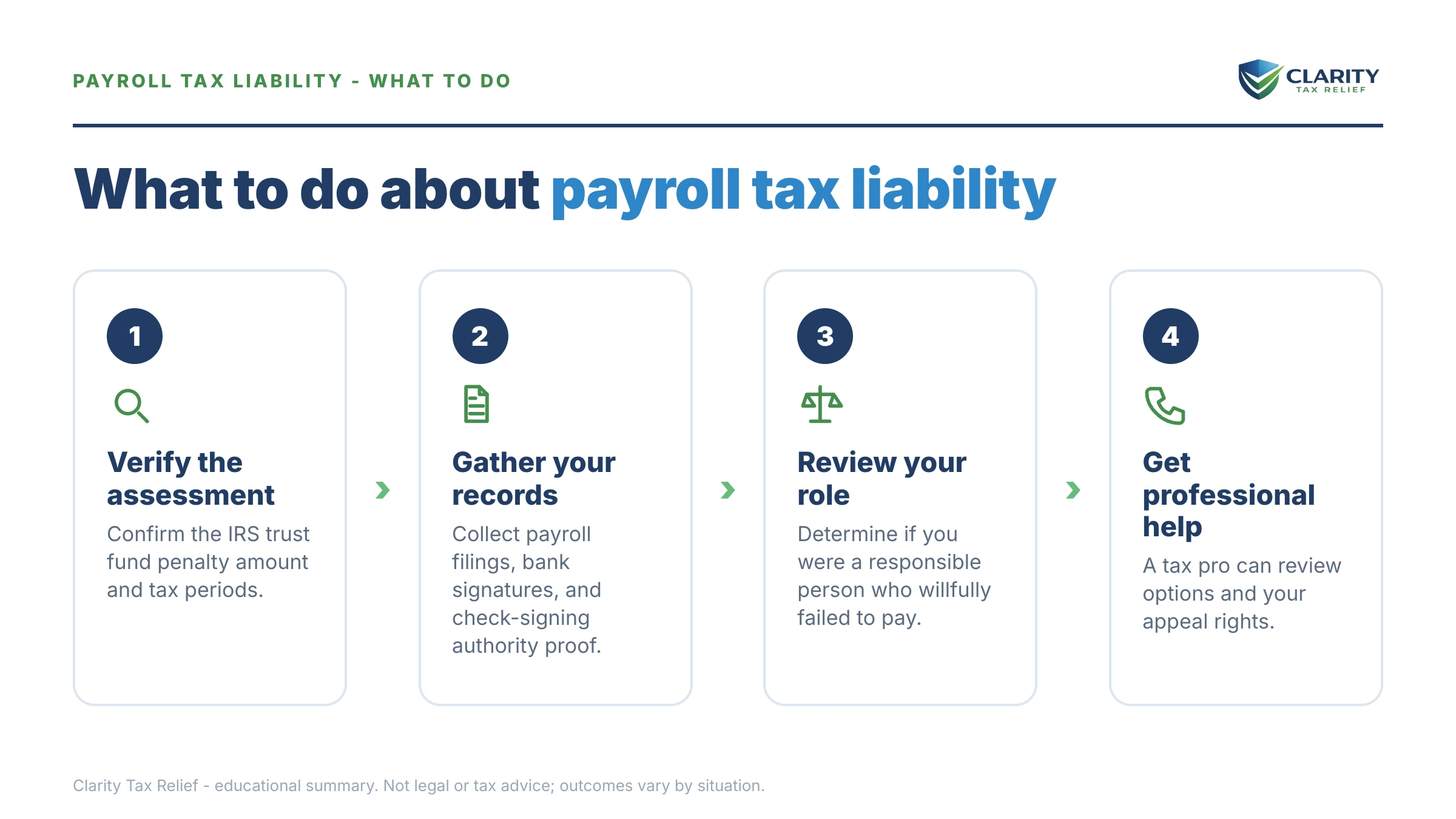
- Identify your stage. Pull your IRS account transcript and sort your mail: questions from a revenue officer mean investigation, Letter 1153 means proposal. A personal balance labeled civil penalty means the TFRP is already assessed.
- Don't sit for a Form 4180 interview cold. Every answer becomes evidence on responsibility and willfulness — ask to reschedule and get experienced representation before you answer anything on the record.
- Protest Letter 1153 within 60 days. A written protest keeps the penalty off your personal account while IRS Appeals reviews whether you were truly responsible and willful.
- Gather control evidence. Bank signature cards, canceled checks, payroll approvals, meeting minutes. Your written job description show who actually decided which bills got paid, and who didn't.
- Resolve any assessed balance before levy notices land. Set up a payment plan, document hardship, or test offer eligibility — the goal is a resolution in place before a final notice starts the 30-day levy clock.
Three situations that change the answer
You were an employee, not an owner. Signing checks on instructions is not the same as deciding which creditors got paid. Non-owners have the strongest liability defenses, but they're also the people most likely to sign a Form 4180 unrepresented and talk themselves into an assessment. The specifics live in our guide for a bookkeeper personally liable IRS situation.
Your payroll provider took the money. If a payroll service withdrew the tax money and never deposited it, the tax is still legally yours, but provider fraud is powerful evidence against willfulness, and penalty relief is often available. Start with 941 penalty abatement.
The business is closed or dissolving. Shutting the doors does not shut down the TFRP — dissolution actually pushes the IRS toward the individuals faster, because the corporate pocket is empty. If the entity is already gone, see payroll tax debt business closed before assuming the debt died with it.
When you can handle this yourself, and when help changes the outcome
You can reasonably self-manage if the penalty is already assessed, you agree you were the responsible person (say, sole owner and sole signer). The balance is modest — a $6,200 assessment fits online payment-plan setup at IRS.gov payment plans in under an hour. If a levy is causing genuine hardship and you can't get traction, the Taxpayer Advocate Service is a free escalation path.
Experienced help changes outcomes in four spots: before a Form 4180 interview, where prepared answers routinely narrow who gets proposed. During the 60-day Letter 1153 window, where a documented protest can keep the penalty off your account entirely. When multiple people were assessed and the allocation is being fought. And when a levy is already in motion against a paycheck you can't lose. Those aren't paperwork problems — they're evidence and negotiation problems, and the record you build in week one follows the case to the end.
Terms on your notice, decoded
The official IRS overview is at Employment taxes and the Trust Fund Recovery Penalty; here's the vocabulary in plain English:
- Trust fund taxes — money withheld from employees' paychecks (income tax plus their FICA share) that the law treats as held in trust for the government.
- Responsible person — anyone with the real authority to decide which bills the business paid, regardless of job title.
- Willfulness — knowing the taxes were unpaid and paying anyone else anyway; no bad intent required.
- Letter 1153 — the formal proposal to assess the TFRP against you, starting your 60-day protest window.
- Form 4180 — the IRS's responsible-person interview questionnaire; your answers become the evidence file.
- Joint and several liability — every responsible person owes 100% until the trust-fund amount is collected once, from any combination of them.
- CSED — the Collection Statute Expiration Date; generally 10 years from the date the penalty was assessed against you.
Personally liable payroll taxes: your questions answered
Can the IRS make me personally pay my company's payroll taxes?
Yes. Under IRC §6672, the IRS can assess the trust-fund portion of unpaid payroll taxes, the money withheld from employees' paychecks, against any responsible person who willfully failed to pay it over. This is the Trust Fund Recovery Penalty, and it attaches to you as an individual, collectible from your wages, bank accounts, and future refunds.
Does an LLC or corporation protect me from payroll tax liability?
No, not for the trust-fund portion. The corporate veil protects you from most business debts, but §6672 is written specifically to reach through the entity to the individuals who controlled its money. The employer's matching share of FICA and most business penalties do stay with the business; only the withheld amounts follow you personally.
Who counts as a responsible person for the Trust Fund Recovery Penalty?
Anyone with the status, duty, and authority to decide which bills got paid — regardless of title. Owners, officers, and controllers are the usual targets. But the IRS has assessed bookkeepers, office managers, and outside accountants who had check-signing authority and knew the taxes were unpaid. Signature authority alone isn't enough; actual control over payments is what matters.
How much of the payroll tax debt can the IRS assess against me personally?
Only the trust-fund portion: federal income tax withheld from employees plus the employees' 7.65% share of Social Security and Medicare. The employer's matching FICA, failure-to-deposit penalties, and interest that accrued against the business stay with the business. In the worked example in this guide, a $9,860 business balance splits into $6,200 personal and roughly $3,660 that stays corporate.
Can more than one person be assessed for the same payroll taxes?
Yes. TFRP liability is joint and several: the IRS can assess 100% of the trust-fund amount against every responsible person at once and collect from whoever pays first. It cannot keep more than the total owed — payments by the business or by another responsible person reduce everyone's balance. That is also why proving who actually controlled the money matters so much in your defense.
Does the Trust Fund Recovery Penalty ever expire?
Generally, the IRS has 10 years from the date the penalty is assessed against you to collect it — the Collection Statute Expiration Date. The clock runs from your personal assessment date, not from when the business first fell behind. It pauses during an Offer in Compromise, bankruptcy, or certain appeals. Waiting out the statute while ignoring levy notices is rarely a workable plan on its own.
Can I settle a Trust Fund Recovery Penalty for less than the full amount?
Sometimes, but the bar is high. An Offer in Compromise on an assessed TFRP uses the same math as any personal tax debt: the IRS measures your assets and future income, charges a $205 application fee (waived with low-income certification), and accepted roughly 1 in 5 offers in FY2024. If the numbers show you could pay in full over time, an offer will be rejected — a payment plan is usually the realistic path.
Can I go to jail for unpaid payroll taxes?
The Trust Fund Recovery Penalty itself is a civil penalty, not a criminal charge. Criminal exposure arises when non-payment looks deliberate and repeated, especially pyramiding, where a business keeps withholding from paychecks quarter after quarter while never depositing the money. If you're receiving the standard civil letters and engaging with the IRS, you're in the civil lane. Get experienced help early to keep it there.
Your next 24 hours
- Find the controlling date. If you have Letter 1153, the date printed at the top starts your 60-day protest window. Count it out on a calendar today. If you have a final notice of intent to levy, the clock is 30 days.
- Pull your control evidence together. Bank signature cards, a few canceled checks from the shortfall quarters, your job description, and any Form 2751 showing the proposed amount. That stack decides how strong your case is.
- Get the proposal reviewed free. Send a photo of your letter through the 2-minute form or call (888) 825-7779. An experienced tax professional will tell you whether the responsible-person test actually fits you before the 60-day window closes.
This guide is general information, not tax or legal advice for your specific situation. Eligibility for IRS programs depends on individual facts and circumstances; no outcome is guaranteed.