
Payroll Tax Debt
Bookkeeper Personally Liable to the IRS? What Non-Owners Need to Know in 2026
The short answer: yes — a bookkeeper can be personally liable to the IRS for a business's unpaid payroll taxes through the Trust Fund Recovery Penalty (IRC §6672), but only if you had real authority over which bills got paid and knew the taxes weren't being paid. Title alone is never enough; function and control decide.
The call didn't come to the business owner. It came to you. A revenue officer wants to "ask a few questions" about your client's payroll taxes, or a letter with your name on it mentions a penalty investigation, and you're trying to work out how someone else's tax debt became your personal problem. It can, but the law that makes it possible has two strict requirements, and most bookkeepers genuinely fail at least one of them. That's your defense, and this guide shows you how to use it.
The image below maps the entire paper trail — from the IRS's first contact to a personal assessment — so you can see exactly which stage you're standing in before you respond to anything.
⏱ The clock that matters: You have 60 days from the date on IRS Letter 1153 to file a written protest before the Trust Fund Recovery Penalty is assessed against you personally. If you haven't received a Letter 1153 yet, no protest clock is running — the investigation stage before that letter is where the strongest cases are won.
When is a bookkeeper personally liable to the IRS? The two-part test
A bookkeeper is personally liable to the IRS for unpaid payroll taxes only when two things are both true: significant authority over which creditors got paid. A willful decision to let other bills come ahead of the taxes.
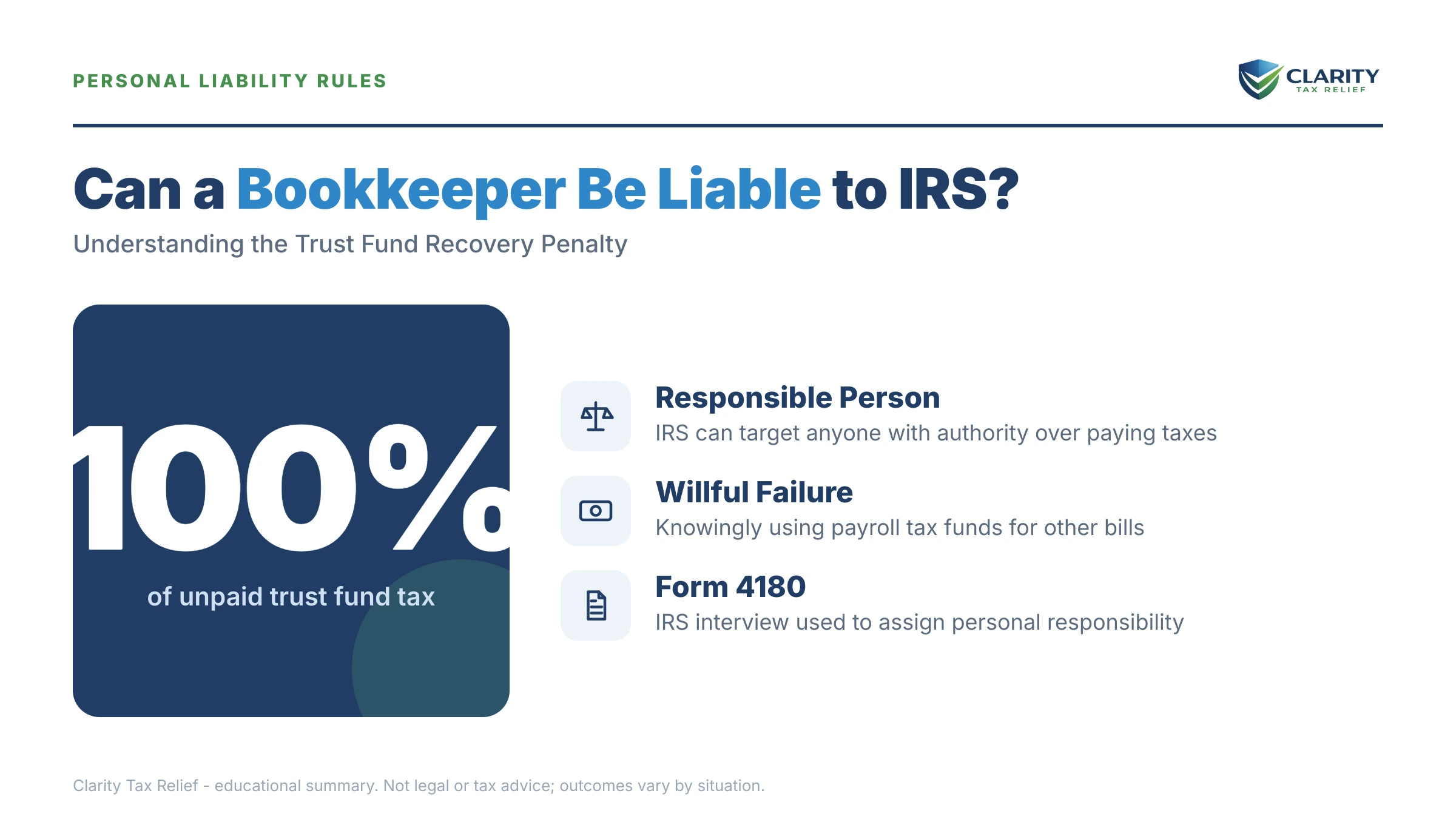
The mechanism is the Trust Fund Recovery Penalty under IRC §6672. When a business withholds income tax and FICA from paychecks but never sends it to the Treasury, that money legally belonged to the employees and the government — the business was only holding it "in trust." Congress gave the IRS the power to assess 100% of that trust fund money against any individual who was responsible for paying it over and willfully didn't. Owners and officers are the usual targets — that version of the test is covered in our guide to being personally liable for payroll taxes — but the statute reaches "any person," including in-house bookkeepers, controllers, office managers, and outside accountants who never owned a share of the company.
Both prongs must be true before you owe a dime, and each one is a separate battlefield:
Prong one — responsibility. Responsibility means status, duty, and authority: the practical power to decide which creditors get paid and when. The IRS and the courts look at what you actually did, not what your business card said. A "bookkeeper" who chose which vendors got paid each week is at more risk than a "CFO" who couldn't cut a check without the owner's signature.
Prong two — willfulness. Willfulness doesn't require bad intent. It means you knew the payroll taxes were unpaid and allowed other creditors — rent, suppliers, even net payroll — to be paid anyway. Reckless disregard of an obvious risk can also qualify. It's a civil standard, not a criminal one. For where the actual criminal line sits, see can you go to jail for owing the IRS.
Two facts run strongly in a bookkeeper's favor. Courts have repeatedly held that purely ministerial duties — recording transactions, preparing checks only as directed, filing forms someone else decides to fund — do not make you a responsible person. And the IRS's own internal policy generally directs agents not to assert the penalty against non-owner employees who acted solely under a superior's instructions without exercising independent judgment. Your job is to prove that description fits you.
| Factor the IRS weighs | Raises your risk | Lowers your risk |
|---|---|---|
| Check-signing authority | On the bank signature card with real discretion | Signed only at the owner's specific direction, or not on the card |
| Deciding which creditors get paid | You prioritized vendors, rent, or net payroll over tax deposits | The owner made every pay/don't-pay decision |
| Form 941 filings | You signed the returns and controlled the deposits | You prepared returns but had no power to fund them |
| Hiring, firing, and financial policy | You directed staff and set payment policy | No management authority — data entry and reconciliation only |
| Ownership or officer role | Any equity stake or corporate officer title | W-2 employee or outside contractor, no equity |
| Knowledge of the delinquency | Knew deposits were skipped, said nothing, kept paying others | Raised the alarm in writing, or genuinely didn't know |
Three situations shift the answer sharply. If you're an outside, self-employed bookkeeper, being an independent contractor is no shield — §6672 reaches anyone with the requisite control, including outside accountants, though your limited access usually makes responsibility harder to prove. If you're a bookkeeper with an equity stake or officer title, expect the IRS to presume responsibility and make you rebut it. And if the delinquent business is a sole proprietorship, its owner is already personally liable for every dollar without any penalty at all — the TFRP exists precisely to reach everyone else, including you.
How much can the IRS assess against you personally? A worked example
How much you can be assessed
The Trust Fund Recovery Penalty equals 100% of the trust fund portion of the payroll debt — the withheld income tax plus the employees' share of FICA — and nothing more.
Say you're a self-employed bookkeeper, a sole proprietor with four small-business clients. Your largest client quietly fell three quarters behind on its 941 back taxes. The business owes $34,600 in total. Here's the hypothetical math:
- Federal income tax withheld from employee paychecks: $15,900
- Employees' share of Social Security and Medicare: $7,900
- Trust fund portion — your maximum personal exposure: $23,800
- Employer's matching FICA, deposit penalties, and interest: $10,800 — this stays with the business and can never be assessed against you personally
If the IRS concludes you were a responsible person who acted willfully, it can assess the full $23,800 against you — and, separately, the same $23,800 against the owner and anyone else who qualifies. Liability is joint and several: the government collects only $23,800 in total, but it collects from whoever is easiest to reach. In practice that's often the bookkeeper with steady income and a personal bank account, not the owner whose business just collapsed. Once assessed, interest accrues on your personal balance until it's paid.
What happens if you ignore the TFRP investigation
A trust-fund investigation moves through a fixed sequence, and each stage you ignore removes a defense you had at the one before. Here's the escalation path:
- The business falls behind on 941s. A revenue officer is assigned to the business account and starts identifying every person with financial fingerprints on it.
- The TFRP investigation opens. You may receive a Letter 3164, a call, or a visit. Behind the scenes, the officer is pulling bank signature cards, canceled checks, and the signatures on the 941s.
- The Form 4180 interview. The officer interviews everyone in the candidate pool using the Form 4180 interview — a structured questionnaire built to establish responsibility and willfulness. Candidates routinely point at each other here.
- Letter 1153 arrives. The Letter 1153, with Form 2751 attached, formally proposes the penalty against you and starts your 60-day protest window.
- Assessment. If the 60 days pass, or Appeals rules against you — the trust fund amount posts to your personal account, and balance-due notices start arriving in your name. A federal tax lien against your personal assets becomes possible.
- Final notice and levy. A final notice of intent to levy gives you 30 days to request a Collection Due Process hearing via Form 12153. After that, your own wages, bank accounts, and receivables are in reach — for a debt a business you never owned created.
Don't count on staffing chaos to save you: the IRS workforce shrank sharply in 2025, but assessments and levy notices run on automated systems that never stopped. Once the penalty posts, it behaves like any other assessed tax against you.
| Stage / document | Your window | The right at stake |
|---|---|---|
| Letter 3164 / first revenue officer contact | No fixed deadline, but the investigation is already running | Representation (Form 2848) before you say anything on the record |
| Form 4180 interview request | Scheduled with the officer. You can prepare first | Control over the evidence: your answers become the responsibility and willfulness case |
| Letter 1153 (proposed penalty) | 60 days to file a written protest | Your only pre-assessment appeal — miss it and the penalty posts |
| Assessment + personal balance-due notices | Pay or arrange before collection escalates | Avoiding a federal tax lien against your personal assets |
| Final notice of intent to levy | 30 days to request a CDP hearing (Form 12153) | The last formal stop before wage and bank levies |
Being investigated for someone else's payroll taxes?
Whether you're holding a Letter 1153 with the 60-day clock running or a revenue officer just asked for a 4180 interview, get your situation reviewed free before you answer anything. An experienced tax professional will tell you where you actually stand — confidential, no pressure.
Your options at every stage
A bookkeeper facing the TFRP has more moves than the notices suggest, before assessment your goal is to defeat the penalty entirely, and after assessment it's to control how it gets collected.
| Option | When it applies | What it can do |
|---|---|---|
| Written protest to IRS Appeals | Within 60 days of Letter 1153 | Defeat or reduce the penalty before it's ever assessed — the strongest and cheapest fight |
| Pay-and-refund route (Form 843) | After assessment, if you still dispute liability | Pay the trust fund tax for one employee for one quarter, claim a refund, and take the dispute to court |
| Installment agreement | Assessed balance you can pay over time; up to $50,000 qualifies for up to 72 months set up online | Stops levy action while you pay monthly — interest and penalties keep accruing |
| Offer in Compromise | Your assets and income genuinely can't cover the debt; $205 application fee (waived with low-income certification) | Settles for less than the full balance — the IRS accepted roughly 1 in 5 offers in FY2024, so eligibility math matters |
| Currently Not Collectible | Paying anything would leave you unable to cover basic living costs | Pauses collection while the debt remains and the 10-year clock keeps running |
| Contribution claim (IRC §6672(d)) | After you've paid more than your proportionate share | Recovers other responsible persons' portions — through your own lawsuit, not the IRS |
Two more points shape strategy. First, the TFRP generally survives bankruptcy — trust fund taxes are among the debts a discharge doesn't erase, so "wait it out in Chapter 7" is not a plan. Second, once assessed, the IRS generally has 10 years from the assessment date to collect from you personally. You can estimate when your own clock runs out with our CSED Calculator. If the penalty has already been assessed and you're weighing reasonable-cause arguments, see trust fund penalty abatement. If you're building the fight itself, our guide to trust fund recovery penalty defense walks through the protest and appeal in detail.
If you conclude the assessment is correct and manageable, resolving it works like any personal tax debt — the mechanics are in our guide to how to settle tax debt yourself, and if you can full-pay, compare the best way to pay the IRS or pay directly at IRS.gov/payments.
How to respond, step by step
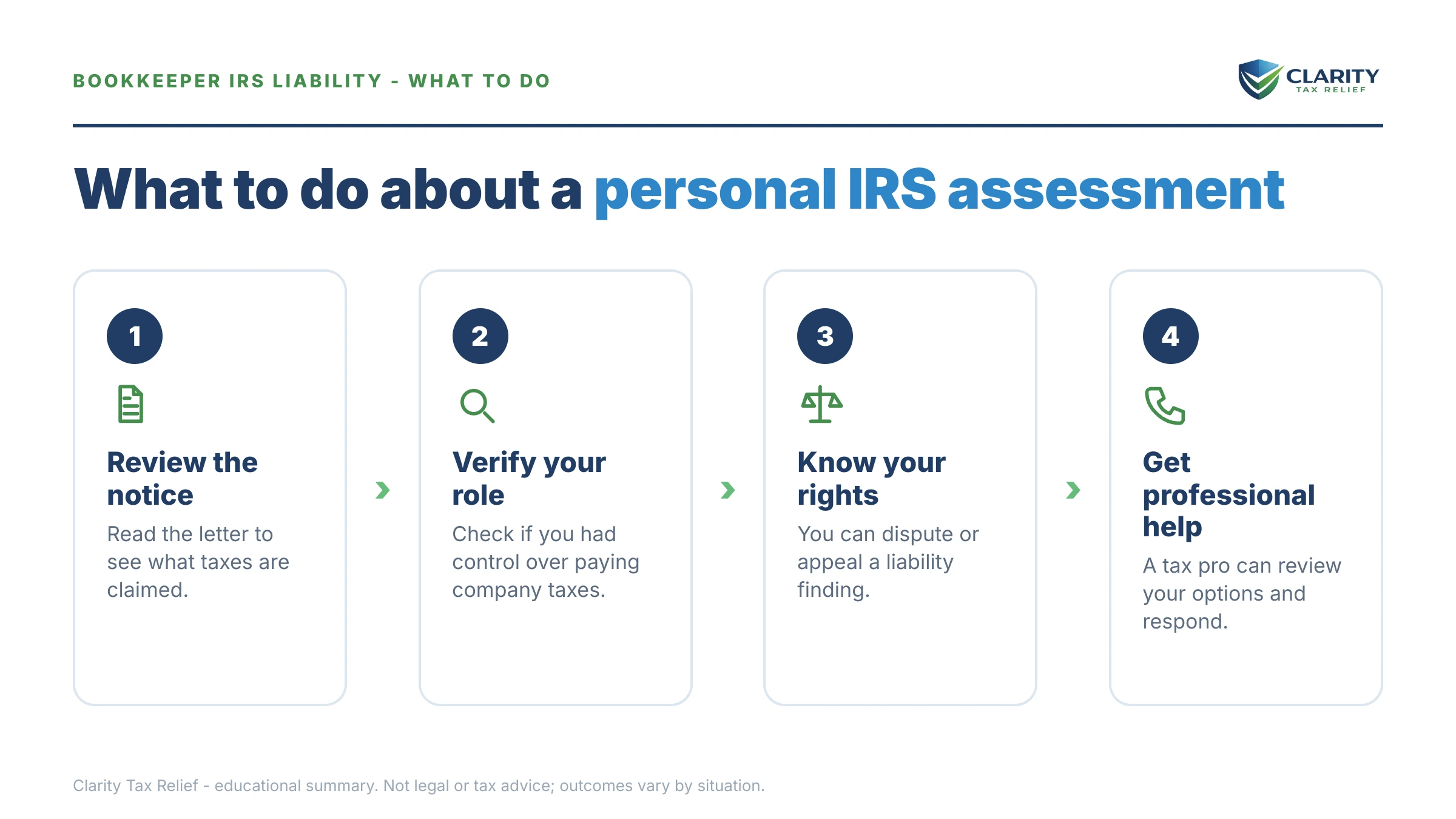
- Get representation before any interview. If a revenue officer wants a Form 4180 interview, file Form 2848 first so an experienced tax professional can prepare you or attend. Your answers become the evidence on responsibility and willfulness.
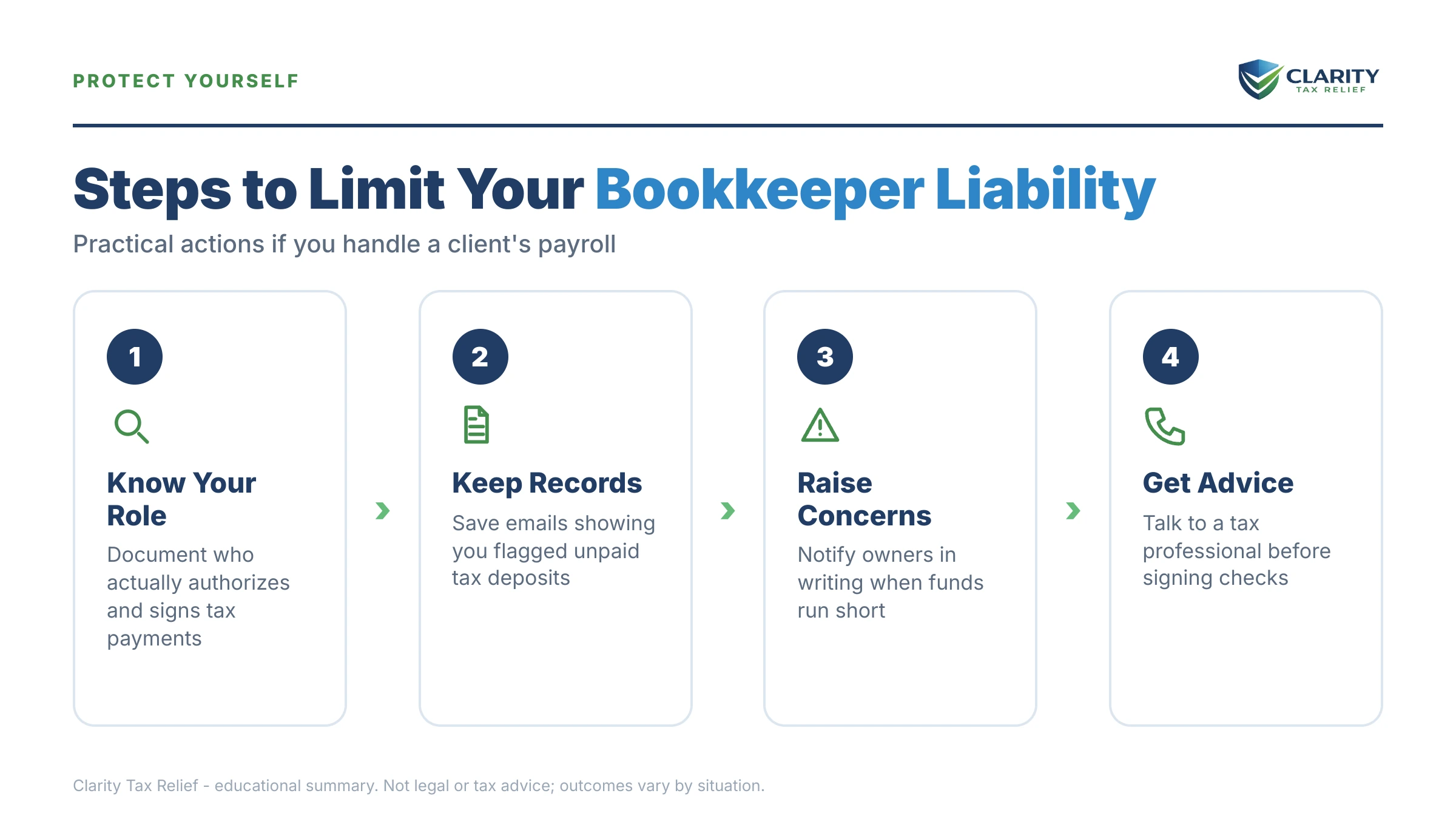
- Pull your authority record together. Gather bank signature cards, your engagement letter or job description, and every email showing who actually decided which creditors got paid. This paper decides the case.
- Calendar the Letter 1153 deadline the day it arrives. You get 60 days to file a written protest. Miss it and the penalty is assessed without Appeals ever hearing your side.
- File a written protest if you disagree. Lay out, factor by factor, why you were not a responsible person or did not act willfully, and attach the documents that prove it.
- Resolve any assessed balance before levy notices start. If the penalty sticks, set up a payment plan, offer, or hardship status before the final notice of intent to levy puts your own wages and accounts in reach.
When you can handle this yourself, and when help changes the outcome
Not every TFRP inquiry needs professional defense, and it would be dishonest to say otherwise.
Handling it yourself versus bringing in help
You can likely handle it yourself if your role was plainly ministerial and the paper proves it. You were never on the bank signature card, every payment ran on the owner's written instructions. You can hand the revenue officer a clean stack of emails showing you flagged the delinquency. A short, factual written response with that documentation often ends a bookkeeper's involvement. The same goes if the proposed amount is small, you agree you had real control, and you'd rather set up a simple payment plan than litigate.
Experienced help changes outcomes in the harder fact patterns: a 4180 interview is already scheduled and you signed checks with some discretion. The trust fund number is five or six figures. You're one of several candidates and the owner is pointing at you. You held any equity or officer title. Or the penalty is already assessed and levy notices have started. The IRS builds these cases from interviews and bank records — how the facts get framed at the investigation stage often decides who gets assessed at all. If collection action is causing immediate hardship and you can't get traction, the Taxpayer Advocate Service is an independent, free channel inside the IRS.
Terms on your paperwork, decoded
- Trust fund taxes — the money withheld from employee paychecks (income tax plus the employees' share of Social Security and Medicare) that the business held in trust for the government. The IRS's overview is at Employment taxes and the Trust Fund Recovery Penalty.
- Responsible person — anyone with the status, duty, and authority to decide which creditors get paid; determined by actual function, never by job title.
- Willfulness — knowing the taxes were unpaid and paying other creditors anyway; a civil standard that requires no bad motive.
- Form 4180 — the structured interview the revenue officer uses to establish who was responsible and willful. The single most important document in the investigation.
- Letter 1153 / Form 2751 — the formal proposal of the penalty against you and the agreement form attached to it. The 1153 date starts your 60-day protest window.
- Joint and several liability — every responsible person owes the full amount; the IRS collects the total once, from whoever it can reach first.
Bookkeeper personal liability questions, answered
Can a bookkeeper really be held personally liable for someone else's payroll taxes?
Yes. IRC §6672 lets the IRS assess 100% of a business's unpaid trust fund taxes, the withheld income tax and employee FICA, against any individual who was responsible for paying them and willfully didn't. That includes non-owner bookkeepers, controllers, and outside accountants. But both prongs must be met: real authority over payments plus knowledge. A job title alone has never been enough.
What makes a bookkeeper a responsible person for the trust fund recovery penalty?
Significant control over the company's finances — in practice, the power to decide which creditors get paid and when. Check-signing authority, signing and filing Forms 941, authority to hire and fire, and any ownership stake all weigh in. The IRS looks at what you actually did, not what your title said. A bookkeeper with full payment discretion is at higher risk than a CFO who needed the owner's sign-off on every check.
I only signed checks when the owner told me to. Am I still liable?
Usually not, if that's genuinely all you did. Courts have consistently held that purely ministerial duties — cutting checks only as directed, with no discretion over who gets paid — do not make you a responsible person, and IRS policy generally directs agents not to assert the penalty against non-owner employees acting solely under a superior's instructions. The catch is proof: you need emails, signature-card limits, or written instructions showing the owner made every payment decision.
Do I have to sit for the Form 4180 interview?
You can't be forced to sit for the interview itself, though a revenue officer can summons records and build the case from bank documents and other witnesses instead. Declining without a strategy can look evasive, while walking in unprepared hands the IRS its willfulness evidence in your own words. The better path is usually to appear — prepared, with representation under Form 2848 — or have your representative manage the contact.
How much of the payroll debt can the IRS put on me personally?
Only the trust fund portion — the federal income tax withheld from paychecks plus the employees' share of Social Security and Medicare. The employer's matching FICA, FUTA, and the business's penalties and interest stay with the business. On a typical 941 balance, the trust fund portion runs somewhere around two-thirds of the total, and the TFRP equals 100% of that number.
Can the IRS collect the whole penalty from me even if the owner was more at fault?
Yes. TFRP liability is joint and several, so the IRS can assess every responsible person for the full amount and collect from whoever is easiest to reach, often the person with steady wages and a bank account rather than the broke business owner. It only collects the total once, and IRC §6672(d) gives you a right to sue other responsible persons for their share. But the IRS won't chase them for you.
Can a bookkeeper go to jail over unpaid payroll taxes?
The TFRP itself is civil — it's a debt, not a crime, and nobody goes to jail for owing it. Criminal willful failure to pay over withheld taxes (IRC §7202) exists, but prosecutions are rare and target deliberate schemes, like owners who pyramid withholding across multiple companies while pocketing the money. A bookkeeper cooperating with a civil TFRP investigation is in collection territory, not criminal territory, though anything you say should still be accurate.
Does quitting the job or dropping the client protect me?
Quitting stops new quarters from accruing against you. But it doesn't erase exposure for quarters when you had authority and knew taxes were going unpaid. What helps more is a documented objection: an email telling the owner the 941 deposits are delinquent, dated before you left, is strong evidence against willfulness. If you're still in the role and taxes are unpaid, put your objection in writing now.
Your next 24 hours
- Find your stage. Pull out whatever the IRS sent and find the letter number and date. If it's a Letter 1153, the date in the top corner starts your 60-day protest window. Write the deadline down today.
- Gather your authority record. Bank signature cards, your engagement letter or job description, copies of the 941s, and any email where payment decisions were made or where you flagged the unpaid deposits.
- Get the file reviewed free. Before you sit for any interview or let the 60 days run, have an experienced tax professional look at exactly what the IRS can and can't prove against you. Use the 2-minute form or call (888) 825-7779.
This guide is general information, not tax or legal advice for your specific situation. Eligibility for IRS programs depends on individual facts and circumstances; no outcome is guaranteed.