
IRS Resolution Programs
IRS Payment Plan vs Offer in Compromise: Which One Actually Fits in 2026
Read the transcript
Host: You owe more than you can write a check for. Every ad you scroll past says settle it for less. Every forum says just get a payment plan. And both of those can't be true for the same person.
Tax specialist: Right, and here's the thing people get wrong from the start. This isn't a preference decision. You don't pick. The IRS runs a formula on your income and your assets, and that formula decides which door is even open.
Host: Okay, formula. Back up and give me the formula.
Tax specialist: It's called Reasonable Collection Potential. RCP. Two pieces. The net equity in your assets, plus whatever's left of your monthly income after the IRS's allowable living expenses, and then that monthly remainder gets projected forward. Twelve months if you're doing a lump-sum offer, twenty-four months if it's a periodic offer.
Host: Twelve for lump sum, twenty-four for periodic.
Tax specialist: Correct. And then you compare that number to your balance. If your RCP is at or above what you owe, the IRS's position is: you can pay this, here's a plan. An offer filed in that spot is basically dead on arrival.
Host: Which explains the acceptance number, I assume.
Tax specialist: It does. The IRS accepted roughly 1 in 5 offers in FY2024. And that gap isn't because four out of five people wrote a bad application. It's because under the formula, most of them could pay in full.
Host: Hm. So the letter doesn't matter.
Tax specialist: The math matters. A payment plan is administrative — you're not asking the government to give anything up, so if your returns are filed and your balance fits the program limits, approval is routine. An offer asks the IRS to take less than it's owed, so it demands proof, in exhausting detail, that less is genuinely all it can get.
Host: Let's do the plan side, because I think that's where most listeners actually land. What's the number that matters?
Tax specialist: Fifty thousand dollars. That's the ceiling for setting up a long-term plan online without handing over financial disclosure, and that's tax, penalties, and interest combined, not just the tax. Under that line it's fast, nearly automatic, about twenty minutes on the IRS site. Above it, they want to see your finances.
Host: And there are different flavors of plan under that.
Tax specialist: Several. Short-term, if you can pay inside a hundred and eighty days — no setup fee. There's the Guaranteed Installment Agreement, which is ten thousand or less with full payment inside three years, and approval there is required by law when the conditions are met. Streamlined runs to twenty-five thousand, or fifty thousand with direct debit, and no financial statement. Over fifty thousand you're into a non-streamlined agreement with a Form 433-F. And then there's the partial-pay agreement.
Host: Say that last one again, simpler.
Tax specialist: A partial-pay installment agreement. You pay what your budget actually supports, month after month, and when the ten-year collection statute runs out, whatever's left expires by law. It functions like a quiet settlement. There are periodic financial reviews along the way, so it's not set-and-forget.
Host: The article walks a hypothetical — sixty-one thousand two hundred dollars, post-divorce, joint years. Not a client case, just illustration. Run it.
Tax specialist: So, $61,200. You're over the online ceiling, so two moves. One, pay it down — about $11,300 gets you to $49,900, then you open the online direct-debit plan. Divide by seventy-two months, roughly $693 a month, with interest and penalty still running, so the true total lands meaningfully above $61,200.
Host: And move two?
Tax specialist: Disclose. File the 433-F, negotiate on the full balance. A straight seventy-two-month division is about $850 a month, but the financial review could support less. It could also surface assets you'd rather not put on paper. That's the trade.
Host: Okay, now the offer side of that same hypothetical.
Tax specialist: Say income is $5,100 a month, allowable living expenses come to $4,850. That's a $250 remainder. Times twelve for lump sum is $3,000 of future income. Add net realizable equity — say $7,000 between a paid-down car and some savings — and RCP is around ten thousand. That's the minimum credible offer against a $61,200 debt.
Host: That's a huge difference.
Tax specialist: If the documented finances hold up under review. Now flip one fact. Say the divorce left you $45,000 in home equity. Now RCP is about $48,000 — forty-five plus the three. Suddenly the offer is near the full balance, and after fees and a year of waiting it saves you very little. Same debt, same income, opposite answer.
Host: So the asset column—
Tax specialist: Decides more offers than the income column does. Yeah.
Host: What does filing an offer cost, and what's the risk if the math is wrong?
Tax specialist: $205 to file, plus twenty percent of the offer up front on a lump sum. Both of those, and payments during review, are waived if you meet low-income certification — AGI at or below 250% of the federal poverty level. Form 656 with the Form 433-A (OIC): every account, every asset, every income source, documented. Review commonly runs six to twelve months.
Host: And the hard part?
Tax specialist: The review suspends the ten-year collection clock, plus thirty days after a rejection. So a failed offer literally hands the IRS more time to collect than it had before you filed. And if it's accepted, that's the beginning. You have to file and pay on time for five years afterward or the compromised debt comes back.
Host: Five years. And if you send the fee and it's rejected, that money's gone?
Tax specialist: Not refunded, but not wasted either — the fee and payments get applied to your balance. You've got thirty days from the rejection letter to appeal with Form 13711.
Host: What about doing nothing while you decide? Because that's what a lot of people are actually doing.
Tax specialist: That's the expensive choice. The failure-to-pay penalty is half a percent of the balance a month and interest compounds daily. On $61,200 that's roughly $306 in new penalty alone, monthly, before interest. And the penalty only drops to a quarter percent once an approved agreement is in place.
Host: Plus the notices keep coming.
Tax specialist: On software, not staffing. CP14 first, about twenty-one days. Then CP501 and CP503. CP504 is intent to levy — state refund can go, federal lien becomes a live risk. Then LT11 or Letter 1058, the final notice, which starts a thirty-day clock on your Collection Due Process rights. After that, bank levies and continuous wage levies.
Host: And there's a passport number in here.
Tax specialist: The 2026 certification threshold is $66,000. A $61,200 balance is $4,800 away, and penalty plus daily interest close that gap on their own. Either track, an approved plan or a pending offer, generally keeps you out of that program.
Host: Two quick ones. Joint debt after divorce?
Tax specialist: Both ex-spouses stay a hundred percent liable. The decree binds your ex, it doesn't bind the IRS. An offer settles your side of the ledger only.
Host: And if someone's already thinking about bankruptcy?
Tax specialist: Older income-tax debt can sometimes be discharged, and that changes the whole calculation, but that work sits outside what Clarity handles. Talk to your own counsel about it before you commit to either IRS track.
Host: So what does someone do in the next day?
Tax specialist: Log into your IRS online account. Write down the balance for every year that shows one, and the assessment date on the oldest year — that's where the ten-year clock started. Then pull your last filed return, three months of income records, and your housing, utility, insurance and vehicle costs. That's the raw material for the RCP math.
Host: And if the numbers sit in the gray zone.
Tax specialist: Balance hovering near fifty thousand, equity you're not sure the IRS counts, income that swings — get the math run before you spend anything on an application. Nobody can tell you how the IRS will decide. But you can find out which door the formula points at. Call (888) 825-7779, or the two-minute form on the free consultation page, and an Enrolled Agent will run the same ability-to-pay math the IRS runs.
Host: Before another month of penalty posts.
Tax specialist: Right.
The short answer: the IRS payment plan vs offer in compromise question comes down to one number — what the IRS calculates you can pay. A payment plan repays the full balance over time and is open to nearly anyone current on filings. An offer settles for less, but the IRS accepted only about 1 in 5 offers in FY2024.
The divorce is final, but the tax debt from those joint returns isn't, and now the whole balance is staring back at you on one income instead of two. Every ad promises settlement; every forum says get a payment plan. Both can't be right for you.
Here's the part that cuts through the noise: this isn't really a preference decision. The IRS runs a formula on your income and assets, and that formula decides which door is actually open. This guide walks you through the same math, so you pick the track that works instead of the one that gets rejected.
⏱ The real clock here: there's no notice deadline on this decision, but the meter never stops. The failure-to-pay penalty adds 0.5% of your balance every month and interest compounds daily until an approved arrangement is in place. On a $61,200 balance, that's roughly $306 in new penalty alone each month, before interest.
IRS payment plan vs offer in compromise: the real difference
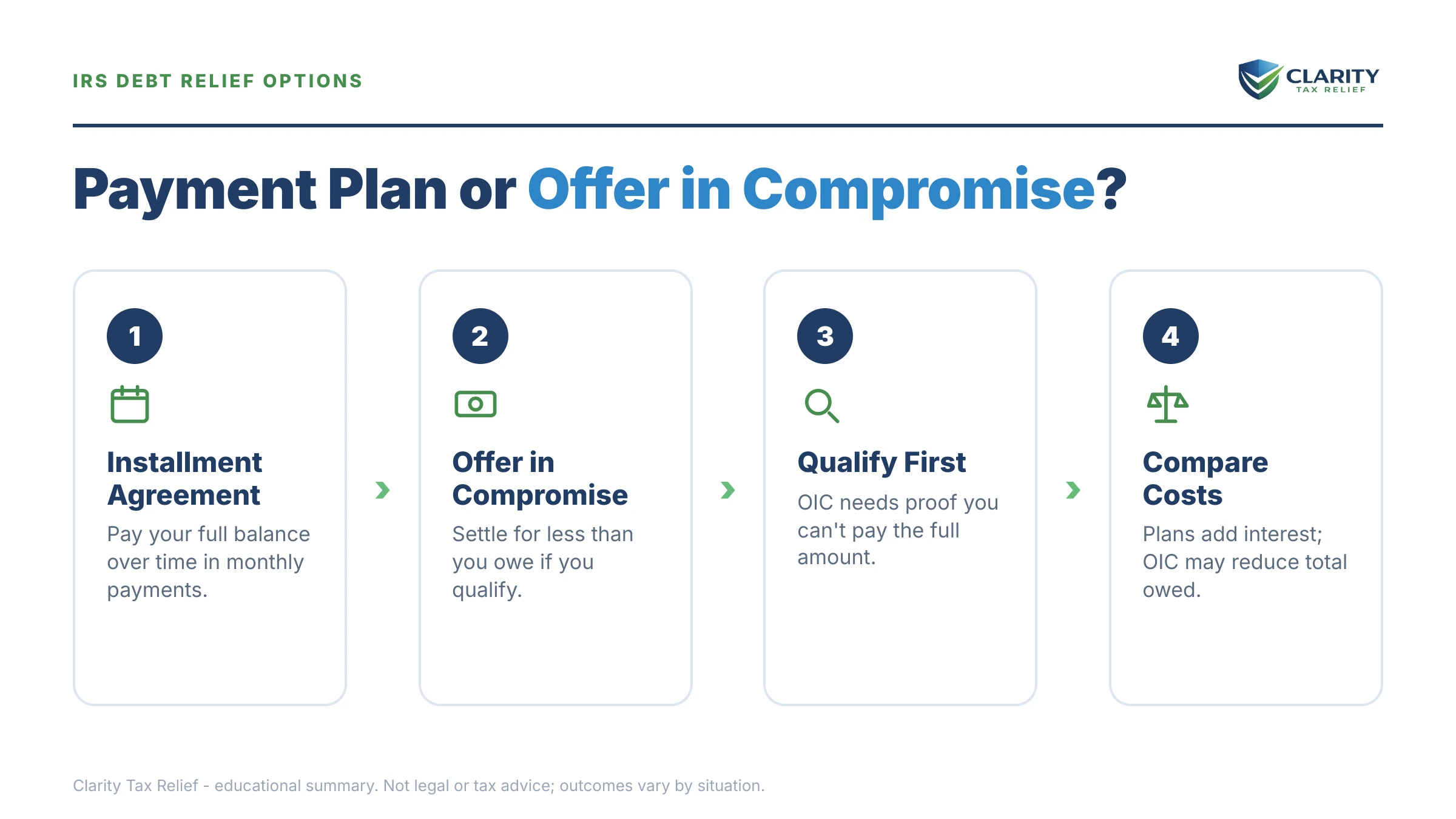
An IRS payment plan repays 100% of what you owe over time. An offer in compromise permanently settles the account for the amount the IRS calculates it could otherwise collect. That single sentence explains almost every other difference — cost, paperwork, timeline, and odds.
A payment plan (the IRS calls it an installment agreement) is fundamentally administrative. You're not asking the IRS to give anything up, so approval is routine when your balance fits the program limits and your returns are filed. An offer asks the government to accept less than it's owed, so the IRS demands proof, in exhaustive financial detail, that less is genuinely all it can get.
The IRS approves payment plans by the millions each year, but accepted roughly 1 in 5 offers in FY2024. That gap isn't because offer applicants write bad letters. It's because most applicants could pay in full under the IRS's formula, which makes the offer dead on arrival.
| Factor | Payment plan (installment agreement) | Offer in compromise (OIC) |
|---|---|---|
| What it does | Pays the full balance in monthly installments | Settles the debt for your calculated ability to pay |
| Who the IRS approves | Nearly anyone with required returns filed, within balance limits by plan type | Only taxpayers whose Reasonable Collection Potential is below the balance |
| Upfront cost | $0 short-term; modest setup fee for long-term plans | $205 fee + 20% of the offer (lump sum); both waived with low-income certification |
| Time until it's in place | Often same-day online for qualifying balances | Commonly 6–12 months of review; auto-accepted by law at 2 years |
| Effect on the 10-year collection clock | Keeps running | Paused during review plus 30 days |
| After approval | Pay monthly; interest and reduced penalty keep accruing until paid | Pay the offer, then stay filing-compliant for 5 years or the debt returns |
“An offer in compromise allows you to settle your tax debt for less than the full amount you owe. It may be a legitimate option if you can't pay your full tax liability or doing so creates a financial hardship.”
— Offer in compromise (IRS.gov)
The IRS makes this choice with math, not sympathy
The IRS decides offer eligibility with a formula called Reasonable Collection Potential (RCP): the net equity in your assets plus your monthly income left over after allowable living expenses, projected forward 12 months (lump-sum offers) or 24 months (periodic offers). If RCP equals or exceeds your balance, the IRS expects full payment and an offer will fail — the deep mechanics are in our guides to how an offer in compromise actually works and Reasonable Collection Potential.
This is why "should I get a payment plan or an OIC?" is really the question "what is my RCP?" You can estimate your own number with our Offer in Compromise Calculator before spending a dollar on an application.
Rule of thumb: if you can pay the debt in full before the 10-year collection statute expires, the IRS routes you to a plan — no matter how painful the payments feel. The offer exists for the opposite case: people whose realistic lifetime collectibility is genuinely below the balance. Marketing that skips this math is selling you an application, not a result.
What happens if you pick neither
Choosing nothing puts you on the IRS's automated collection ladder, and each rung carries more enforcement power than the last. The sequence runs on software, not staffing — the IRS cut roughly 27% of its workforce in 2025, but automated notices, liens, and levies never paused.
- CP14 — the first bill, with roughly 21 days to respond before the cycle continues.
- CP501 / CP503 — reminder notices while the balance compounds monthly.
- CP504 — Notice of Intent to Levy: the IRS can seize your state tax refund, and a federal tax lien becomes a live risk.
- LT11 / Letter 1058 — Final Notice of Intent to Levy, starting a 30-day clock on your Collection Due Process rights.
- Levy — bank accounts (funds held 21 days before they're sent) and wages (a continuous levy until released).
One more clock matters at this balance level: the 2026 passport-certification threshold is $66,000. A $61,200 debt is only $4,800 away, and monthly penalties plus daily interest close that gap on their own — see what certification means in our guide to a passport revoked for tax debt. Either resolution track, an approved plan or a pending offer, generally keeps you out of that program. Doing nothing walks you into it.
Not sure which way your numbers point?
Bring your balance and a snapshot of your budget. An experienced tax professional will run the same ability-to-pay math the IRS uses and tell you, free, whether a payment plan or an offer in compromise is your realistic path, before another month of penalties and interest posts to the account.
IRS payment plans in 2026: every type and its threshold
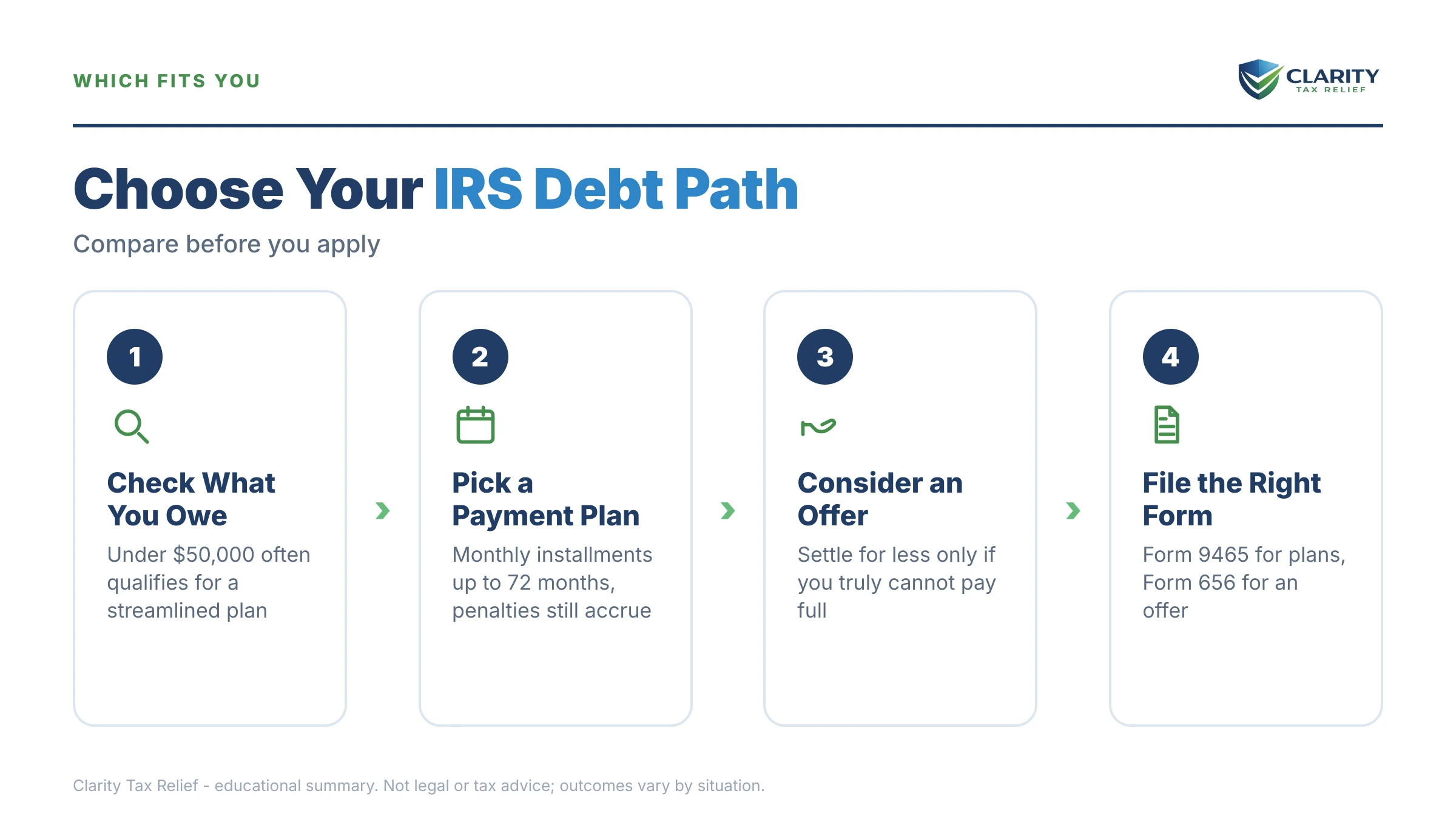
The IRS runs several distinct payment plans in 2026. The balance line that matters most is $50,000 — the ceiling for setting up a long-term plan online without financial disclosure. Below that line, setup is fast and nearly automatic; above it, the IRS wants to see your finances.
| Plan type | Balance limit | Key terms |
|---|---|---|
| Short-term payment plan | Any balance you can pay within 180 days | $0 setup fee; interest and penalties continue until paid |
| Guaranteed installment agreement | $10,000 or less | Approval is required by law when the conditions are met, including full payment within 3 years |
| Streamlined installment agreement | $25,000, or $50,000 with direct debit | No financial statement required; up to 72 months |
| Online long-term plan | $50,000 (tax, penalties, and interest combined) | Up to 72 months; can be set up the same day online |
| Non-streamlined agreement | Over $50,000 | Financial disclosure (Form 433-F) required; terms based on ability to pay |
| Partial-pay installment agreement (PPIA) | Any balance you can't fully pay before the statute expires | Pays less than the full debt over the remaining collection period; periodic financial reviews |
Setup mechanics are simple for most people — our walkthrough on how to set up an IRS payment plan online covers the process screen by screen. A paper application uses Form 9465. Above $50,000, read IRS payment plan over $50,000 first: the financial-disclosure route can produce a payment far lower than a straight 72-month division. But it also invites the IRS to look at your assets.
Two under-advertised plan facts worth money: the failure-to-pay penalty drops from 0.5% to 0.25% per month while an approved installment agreement is active, and a partial-pay installment agreement can function as a quiet settlement. You pay what your budget allows until the 10-year statute runs out, and whatever remains legally expires.
What an offer in compromise really takes in 2026
An offer in compromise costs $205 to file, requires 20% of the offer up front for lump-sum offers, and typically spends the better part of a year under review. If you meet the low-income certification — adjusted gross income at or below 250% of the federal poverty level — the fee, the 20% down payment, and payments during review are all waived, which changes the risk math completely for lower-income filers.
You file Form 656 together with the Form 433-A (OIC) financial statement — every account, every asset, every income source, documented. Choose your payment structure carefully: lump-sum offers project 12 months of future income into the offer amount, while periodic offers project 24 months and require monthly payments during review. The trade-offs are covered in OIC payment options: lump sum vs. periodic.
Three facts most offer marketing leaves out:
- The review pauses the 10-year collection statute, plus 30 days after a rejection. A failed offer literally gives the IRS more time to collect than it had before.
- By law, an offer the IRS doesn't decide within 2 years is automatically accepted, with narrow exceptions: a returned or rejected offer stops the clock, and time during court disputes does not count. It's rare, but a real backstop as processing slows.
- Acceptance is the beginning, not the end: you must file and pay on time for 5 years afterward, or the compromised debt is reinstated. Refund treatment around the acceptance year has its own rules — see will the IRS keep my refund after an OIC.
Anyone promising "pennies on the dollar" is describing the outcome of the formula for people who happen to fit it, and collecting fees from thousands who don't. The formula, not the firm, decides.
Costs and timelines compared, line by line
A payment plan can be live the same afternoon; an offer is a months-long project with money at stake if the math is wrong. Here's the full cost-and-time picture side by side.
| Item | Payment plan | Offer in compromise |
|---|---|---|
| Cost to apply | $0 short-term; setup fee for long-term plans, reduced or waived for low income | $205 fee plus 20% of the offer for lump-sum offers; both waived with low-income certification |
| Time until it's in place | Often same-day online at $50,000 or below; weeks-to-months above that | Commonly 6–12 months; auto-accepted by law if the IRS takes over 2 years |
| Monthly obligation | Balance spread over up to 72 months, or an amount your financials support | Lump sum: remainder due within 5 months of acceptance; periodic: monthly payments up to 24 months |
| Penalties & interest while it runs | Keep accruing; failure-to-pay drops to 0.25%/month on an approved plan | Keep accruing during review; irrelevant if accepted — the settled amount is final |
| 10-year collection statute | Keeps running toward expiration | Suspended during review plus 30 days |
| If it fails or defaults | Plan can default on missed payments; reinstatement is usually available | Fee and payments are applied to the balance, not refunded; 30 days to appeal with Form 13711 |
A worked example: choosing with $61,200 on the line
Say you're recently divorced and owe $61,200 across two joint tax years — the returns were joint, so the full balance follows both of you, but today it's your mailbox it lands in. Here's how each track actually prices out. (This is a hypothetical illustration, not a client case.)
Track 1 — the payment plan. At $61,200 you're over the $50,000 online ceiling, so you have two moves:
- Pay down first: put $11,300 toward the balance to reach $49,900, then open an online direct-debit plan. $49,900 ÷ 72 months ≈ $693/month as the base payment, with interest and the reduced 0.25% monthly penalty continuing until payoff, so the true total lands meaningfully above $61,200.
- Disclose instead: file Form 433-F and negotiate a non-streamlined agreement on the full balance. A straight 72-month division would be about $850/month ($61,200 ÷ 72). But the financial review could support less, or flag assets you'd rather not discuss.
Track 2 — the offer. Post-divorce, suppose your income is $5,100/month and your IRS-allowable living expenses come to $4,850/month, leaving a $250 monthly remainder. For a lump-sum offer: $250 × 12 = $3,000 of future income. Add net realizable equity — say $7,000 between a paid-down car and modest savings — and your RCP is roughly $10,000. That's the minimum credible offer: $205 to file plus a $2,000 down payment (20%), then the rest within five months of acceptance. Ten thousand dollars against a $61,200 debt is a life-changing difference — if the documented finances hold up under IRS review.
Now flip one fact. If the divorce settlement left you $45,000 of home equity, your RCP jumps to about $48,000 ($45,000 + $3,000). An offer near the full balance saves little after costs and a year of waiting, and the payment plan quietly becomes the better answer. Same debt, same income, opposite conclusion. That's why the asset column decides more offers than the income column does.
Six situations that change the answer
The comparison above assumes a single filer with one federal debt — real cases rarely stay that tidy. These are the wrinkles that most often flip the payment-plan-versus-offer decision:
- Divorced with a joint liability. Both ex-spouses remain 100% liable regardless of what the divorce decree says — the decree binds your ex, not the IRS. Your offer settles only your side of the ledger; the IRS can still pursue your ex for the rest. How liability splits inside an offer is its own topic: see OIC for divorced or separated spouses.
- Self-employed or 1099 income. The RCP math gets harder to document and the compliance bar rises. You must be current on quarterly estimated payments before either a plan or an offer will hold. Variable income also invites the IRS to average your best months, inflating the offer.
- Genuine hardship, little to protect. If paying anything would break your budget and you own almost nothing, Currently Not Collectible status may beat both options — collection pauses while the 10-year clock keeps running. The trade-offs are mapped in CNC vs offer in compromise.
- You dispute the amount itself. Neither track fixes a wrong balance. A doubt-as-to-liability offer or an audit reconsideration challenges the number — resolve the "how much" question before choosing how to pay it.
- Multiple years, some unfiled. The IRS returns offers and rejects plans when required returns are missing. File everything first; the balance you're solving for may change once real returns replace IRS estimates.
- Bankruptcy is on the table anyway. Older income-tax debt can sometimes be discharged, which changes the entire calculus — compare in bankruptcy or offer in compromise before committing to either IRS track. And remember state debts ride separate rails: state agencies run their own plans and settlement programs with different rules, so resolve them on their own terms.
How to decide between a payment plan and an offer, step by step
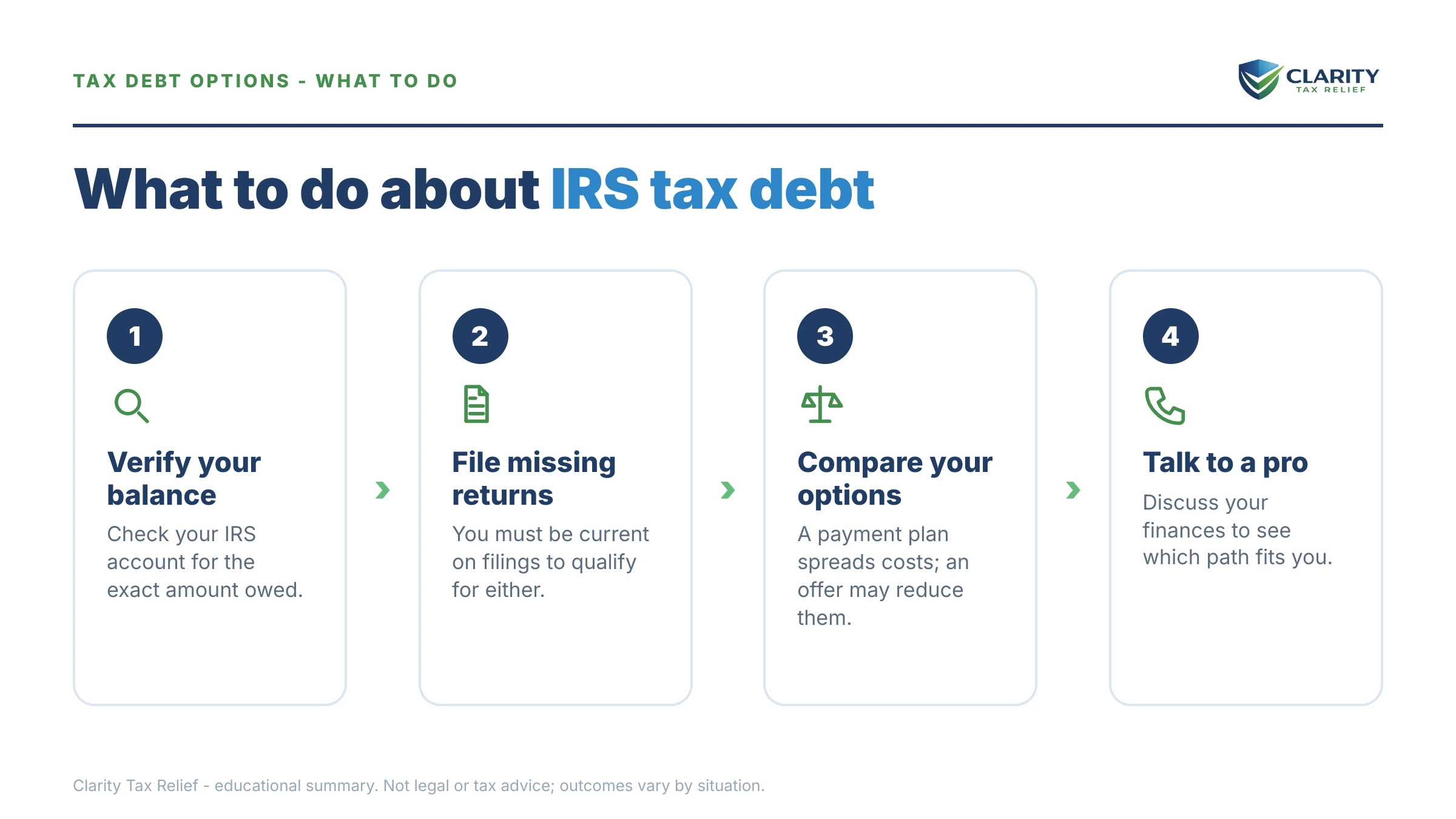
- Confirm your total balance and filing compliance. Pull your IRS online account or transcripts to see every year with a balance, then verify all required returns are filed — the IRS returns offers and rejects plans when returns are missing.
- Run the ability-to-pay math. Compare your Reasonable Collection Potential — asset equity plus 12 or 24 months of your monthly remainder — to your full balance. If RCP is at or above the balance, plan; if it's well below, the offer deserves a serious look.
- Fix your current-year withholding or estimated payments. Both tracks require staying current going forward. A new balance next April defaults an installment agreement and can sink a pending offer.
- Set up the plan or file the offer. For a plan, apply online or with Form 9465. For an offer, file Form 656 with Form 433-A (OIC), the $205 fee, and your initial payment unless you're low-income certified.
- Protect the agreement once it's in place. Use direct debit, file every return on time, and, after an accepted offer, stay compliant for five years, or the settled debt comes back.
When you can handle this yourself, and when help changes the outcome
Plenty of people should do this without paying anyone. If your balance is under $50,000, your returns are filed. Your budget supports the monthly payment, the online installment agreement takes about twenty minutes — start at the official IRS payment plans page. If you can pay within 180 days, the short-term plan costs nothing to set up. And penalty relief is getting easier on its own: First-Time Abate remains available for a clean prior three years, and beginning summer 2026 the IRS is rolling out the Automatic Exemption from Penalty (AEP), which applies qualifying relief without a request.
Experienced help earns its cost in the harder fact patterns: balances over $50,000 where the financial disclosure will be negotiated, offer applications where asset valuation and allowable expenses decide a five-figure swing, joint liabilities being untangled after divorce, self-employment income the IRS wants to average upward, or a levy already in motion while you're still deciding. In those cases the difference between a well-built Form 433 and a sloppy one isn't paperwork — it's the offer amount, or whether the offer survives at all. The IRS's own eligibility overview is at IRS.gov: Offer in Compromise, and if collection action is causing hardship the Taxpayer Advocate Service is a free, independent resource.
If your numbers sit in the gray zone — a balance hovering near $50,000, equity you're not sure the IRS will count, income that swings month to month — a free review at the 2-minute consultation form or (888) 825-7779 will settle the payment-plan-versus-offer question in one conversation.
Terms you'll keep running into, decoded
- Reasonable Collection Potential (RCP): the IRS's formula for the most it could realistically collect from you, asset equity plus projected future income. The number any offer must meet or beat.
- CSED: the Collection Statute Expiration Date — the day, 10 years after assessment, when the IRS's legal right to collect a tax year ends, subject to pauses.
- Streamlined installment agreement: a payment plan approved without a financial statement, for balances up to $25,000, or $50,000 with direct debit.
- Partial-pay installment agreement (PPIA): a plan whose payments won't fully retire the debt before the CSED, leaving the remainder to expire.
- Low-income certification: AGI at or below 250% of the federal poverty level, which waives the OIC fee, the 20% down payment, and payments during review.
- Offer default: what happens if you miss a filing or payment in the 5 years after acceptance — the compromised debt is reinstated, minus what you paid.
Payment plan vs offer in compromise: your questions answered
Which is better: an IRS payment plan or an offer in compromise?
Neither is better in the abstract — the right one depends on whether the IRS's own math says you can pay in full. If your income and assets can cover the balance before the 10-year collection statute expires, a payment plan is the realistic route. If your Reasonable Collection Potential is genuinely below what you owe, an offer in compromise can resolve the debt for less.
Can I apply for an offer in compromise while I'm on a payment plan?
Yes. Filing a processable offer generally suspends your installment agreement payments while the IRS reviews it. The trade-off: the review pauses the 10-year collection clock, and if the offer is rejected, your plan resumes and you've handed the IRS extra collection time. Run the offer math honestly before you file.
How much does an offer in compromise cost compared to a payment plan?
An offer requires a $205 application fee plus, for lump-sum offers, 20% of the offer amount up front — both waived if you meet the low-income certification (AGI at or below 250% of the federal poverty level). Payment plans cost far less to start: $0 for a short-term plan and a modest setup fee for long-term agreements, reduced or waived for low-income taxpayers.
What percentage of offers in compromise does the IRS accept?
The IRS accepted roughly 1 in 5 offers in FY2024. Acceptance isn't a negotiation or a lottery — it's a formula. Offers that match or exceed the IRS's calculated Reasonable Collection Potential get accepted. Offers filed by people who could pay in full get rejected, no matter how well-written the application is.
Does an IRS payment plan stop penalties and interest?
No. Interest keeps compounding daily on the unpaid balance. The failure-to-pay penalty continues, though it drops from 0.5% to 0.25% per month while an approved installment agreement is in place. That's why paying a plan off early, or pairing it with penalty abatement, usually saves real money.
Does applying for an offer in compromise pause the 10-year collection clock?
Yes. The collection statute (CSED) is suspended while your offer is pending, plus 30 days after a rejection, and during any appeal. That matters most if your debt is already several years old: a failed offer gives the IRS more time to collect than it had before you filed.
Can I get an IRS payment plan if I owe more than $50,000?
Yes, but not through the simple online application, which caps at $50,000 in combined tax, penalties, and interest. Above that line you'll either provide financial disclosure on a Form 433 series statement or pay the balance down below $50,000 to restore online eligibility. Both routes are routine; they just take more paperwork.
If my offer in compromise is rejected, do I lose the money I sent with it?
You don't get it back. But you don't lose its value either — the application fee and any payments are applied to your tax balance. You then have 30 days from the rejection letter to appeal using Form 13711, or you can pivot to a payment plan or refile a stronger offer later.
Can one ex-spouse settle a joint tax debt with an offer in compromise?
Yes, but the offer only settles the filing spouse's liability. A joint balance leaves both ex-spouses each fully liable for 100% of the debt. A divorce decree assigning it to one of you does not bind the IRS. If your ex settles or defaults, the IRS can still collect the remainder from you.
Your next 24 hours
- Pull your real numbers. Log into your IRS online account and write down the balance for every year that shows one, plus the assessment date on the oldest — that's where the 10-year clock started.
- Gather the ability-to-pay inputs. Your last filed return, three months of pay stubs or income records. Your monthly housing, utility, insurance, and vehicle costs — the raw material for the plan-versus-offer math.
- Get the math checked free. The 2-minute form at our free consultation page or a call to (888) 825-7779 gets your payment-plan-versus-offer question answered by an experienced tax professional, while every month of waiting adds another 0.5% penalty plus daily interest to the balance.
This guide is general information, not tax or legal advice for your specific situation. Eligibility for IRS programs depends on individual facts and circumstances; no outcome is guaranteed.