
IRS Data & Studies
Treasury Offset Program Refund Seizure Statistics (2026)
What this episode covers
- How do I find out which agency took my tax refund through the Treasury Offset Program?
- What types of debt does the Treasury Offset Program collect from tax refunds?
- Who qualifies to file IRS Form 8379 as an injured spouse after a refund offset?
- What is the difference between a tax refund offset and an IRS levy?
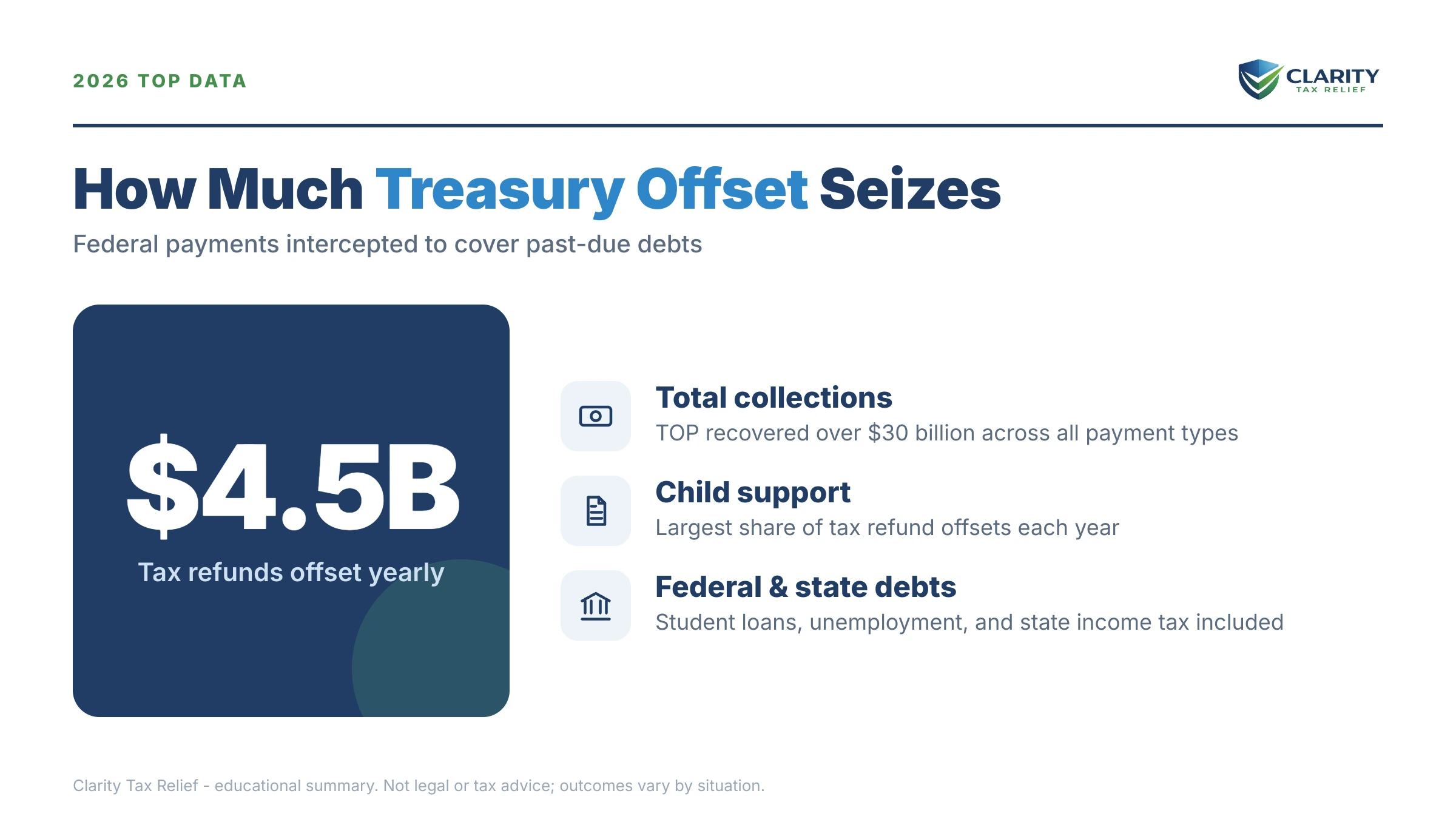
The short answer: the Treasury Offset Program clawed back more than $3.8 billion from federal payments and refunds in fiscal 2024 to cover delinquent debts. More than $1.4 billion went to past-due child support, $343.7 million to state unemployment-insurance debts, and $197.9 million to delinquent SNAP debt.
You filed, you saw a refund coming, and then a chunk, or all of it — never landed. If you are reading treasury offset program refund seizure statistics because your money got intercepted, the numbers below tell you how common this is, who gets hit, and what you can actually do about it. This is a bill collection tool run by the government's own bank, and it is enormous.
The single figure that matters: more than $3.8 billion was recovered through offsets in FY2024 across federal and state delinquent debts. Separately, nearly $40.1 billion in overpayments were offset to outstanding tax debt across tax years 2020-2022 — a different pipeline we untangle below.
The chart further down shows exactly how those billions break out by debt type, so you can see where your intercepted refund most likely went.
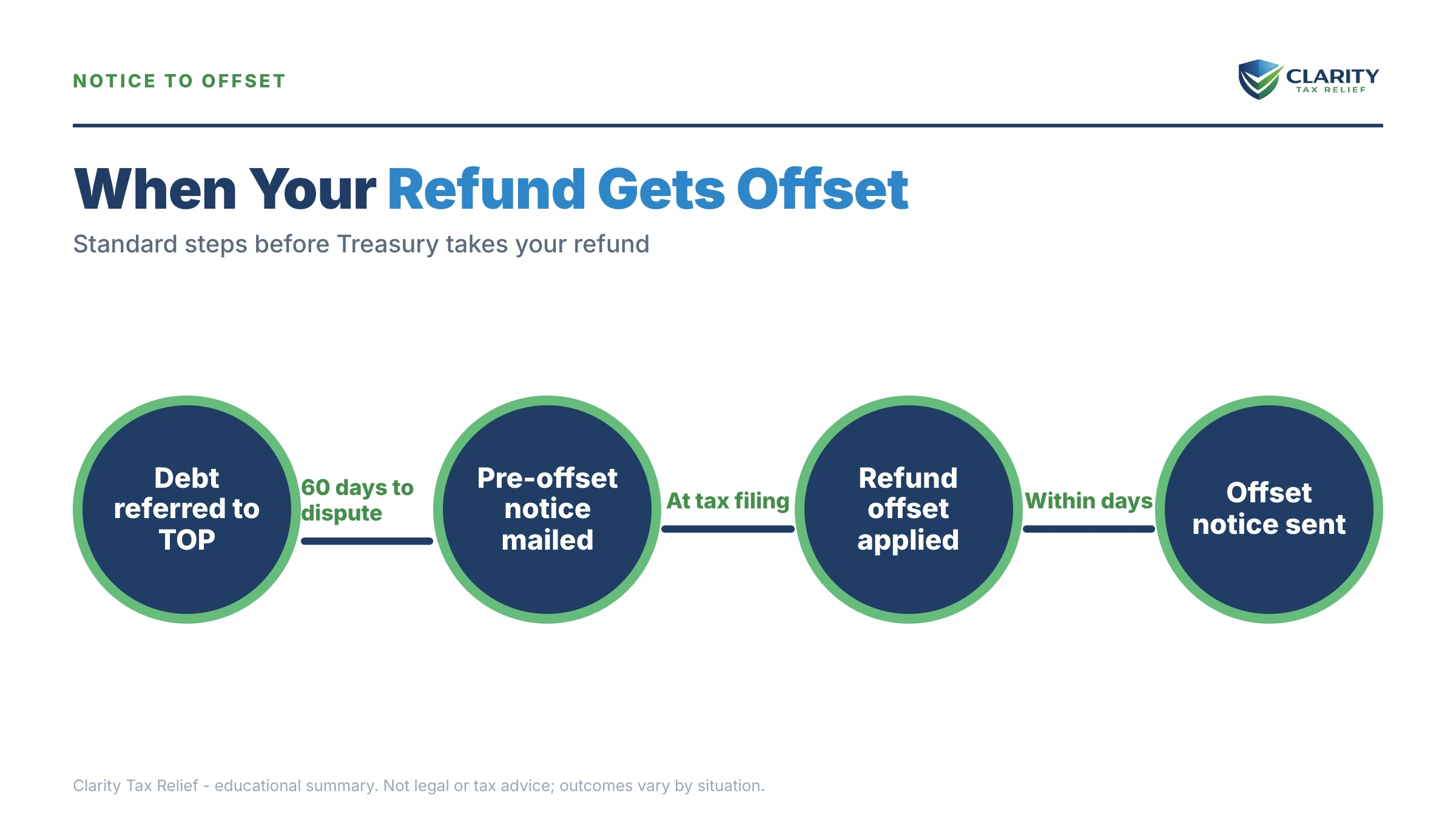
⏱ The clock that matters: once a debt is certified to the Treasury Offset Program, your refund is intercepted automatically. There is no notice window that pauses it. The only time-sensitive protection is filing Form 8379 as an injured spouse or requesting an Offset Bypass Refund before the IRS finishes processing your return.

What the Treasury Offset Program refund seizure statistics actually show
The Treasury Offset Program (TOP) recovered more than $3.8 billion in federal and state delinquent debts in FY2024. It is run by the Bureau of the Fiscal Service — the arm of Treasury that cuts nearly every federal payment — which matches outgoing refunds against a database of debts other agencies have referred for collection.
When your Social Security number matches a flagged debt, Fiscal Service diverts the money before it reaches you. The IRS doesn't decide this; it simply hands your refund to the payment system, which applies it to whatever debt is queued.
The breakdown of that $3.8 billion is where the story gets specific:
| Debt category | Amount recovered | Who refers it |
|---|---|---|
| Past-due child support | More than $1.4 billion | State child-support agencies |
| State unemployment-insurance debt | $343.7 million | State workforce agencies |
| Delinquent SNAP (food-stamp) debt | $197.9 million | State human-services agencies |
| All federal & state debts combined | More than $3.8 billion | Multiple referring agencies |
Notice what these categories share: none of them is a federal income-tax bill. TOP mostly collects other people's debts — child support, state benefit overpayments, defaulted student loans, and state income tax. Federal tax debt travels a separate road, and that road is even bigger.
“Debt offsets are conducted by the Department of Treasury's Bureau of the Fiscal Service (BFS). The BFS issues IRS refunds and is authorized by Congress to conduct the Treasury Offset Program (TOP).”
— Reduced refund (IRS.gov)
The $40.1 billion the headline number leaves out
Nearly $40.1 billion in overpayments were offset to outstanding tax debt across tax years 2020-2022. This is the offset most taxpayers actually experience, and it is not part of the $3.8 billion TOP figure.
Here is the distinction that trips people up. When you owe the IRS and have a refund coming, the IRS applies your refund to your own federal balance directly — it never has to route through the Treasury Offset Program at all. That internal application is where the $40.1 billion sits.
TOP, by contrast, is for debts owed to other agencies — a state, a court, the Department of Education. Both feel identical when your refund vanishes, but the fix is different depending on which pipeline took your money. If the IRS took it for its own tax debt, resolving the balance stops it. If TOP took it for another agency's debt, you deal with that agency. Our guide on the treasury offset program tax refund walks through how to tell which one hit you.
Refunds that escaped offset: the error runs both ways
The Treasury Offset Program isn't a flawless net, and the documented failures mostly favor taxpayers. TIGTA found 11,206 taxpayers were issued more than $9.1 million in refunds since 2017 that should have been offset to outstanding sole-proprietorship tax debt.
In plain terms: the government's own watchdog found the system missing debts it was supposed to catch — money that flowed to taxpayers instead of being applied to what they owed. That matters for you in two ways. First, if your refund wasn't offset despite a balance, the debt hasn't disappeared — interest and penalties keep running. A later offset (or a levy) can still land. Second, it shows offsets aren't perfectly targeted, which is exactly why erroneous seizures of injured-spouse and hardship refunds happen too.
Who actually gets their refund seized
Offsets cluster around a handful of predictable situations. Knowing which one is yours tells you which fix applies.
- You owe federal income tax. The IRS applies your refund to your balance automatically. This is the $40.1 billion bucket.
- You owe past-due child support. The single largest TOP category at more than $1.4 billion in FY2024; states refer these aggressively.
- You defaulted on a federal student loan. A major TOP category (collections vary year to year with policy changes).
- You owe delinquent state income tax — see state refund taken for irs debt for how the state and federal offset programs interact.
- You have a state unemployment or SNAP overpayment — $343.7 million and $197.9 million respectively in FY2024.
- You filed jointly with a spouse who owes. Your share can be swept up even though the debt isn't yours — this is the injured-spouse scenario, and it's the most reversible.
What happens if you do nothing
An offset is not a one-time event you can wait out — for tax debt, it repeats every filing season until the balance is gone. Here is the sequence when you leave the underlying debt unresolved:
- This year's refund is intercepted. The full refund, up to the amount owed, is applied to the debt automatically.
- Next year's refund is intercepted too. As long as a certified debt exists, each new refund is fair game — see will irs take refund every year.
- Interest and penalties keep growing. An offset covers part of the balance but rarely all of it, and the remainder accrues charges monthly.
- Other collection tools activate. For federal tax debt specifically, unresolved balances escalate toward liens, the federal payment levy program, and eventually wage or bank levies.
The offset itself is the gentlest tool in the box. It takes money you weren't holding yet. The tools that follow reach into money you already have.
Refund seized and not sure why?
Send us the details. An experienced tax professional will pin down which offset hit you, whether an injured-spouse claim or hardship bypass applies, and how to stop it repeating next year — free, confidential, no pressure.
Your options for getting a seized refund back
Which remedy fits depends entirely on why your refund was taken and whose debt it covered. This table maps the realistic paths against who qualifies.
| Remedy | Who it's for | What it does |
|---|---|---|
| Form 8379 Injured Spouse Allocation | You filed jointly; only your spouse owes the debt | Recovers your share of a refund taken for your spouse's debt |
| Offset Bypass Refund | Federal tax debt + documented financial hardship | Asks the IRS to release the refund before it's offset |
| Dispute with referring agency | The debt is wrong, paid, or not yours | Corrects the debt at its source — the IRS can't change it |
| Resolve the tax balance | You genuinely owe federal tax | Payment plan, hardship status, or Offer in Compromise stops future offsets |
The injured-spouse claim is the most commonly missed. If you filed jointly and the debt belongs solely to your spouse — back child support from a prior relationship, a defaulted loan predating the marriage — Form 8379 injured spouse reclaims your portion of the refund. Read injured spouse vs innocent spouse first, because people routinely confuse the two and file the wrong form.
For a federal tax offset causing real hardship, the offset bypass refund hardship request can free the refund, but timing is everything. It has to reach the IRS before processing completes.
How to respond if your refund is being offset
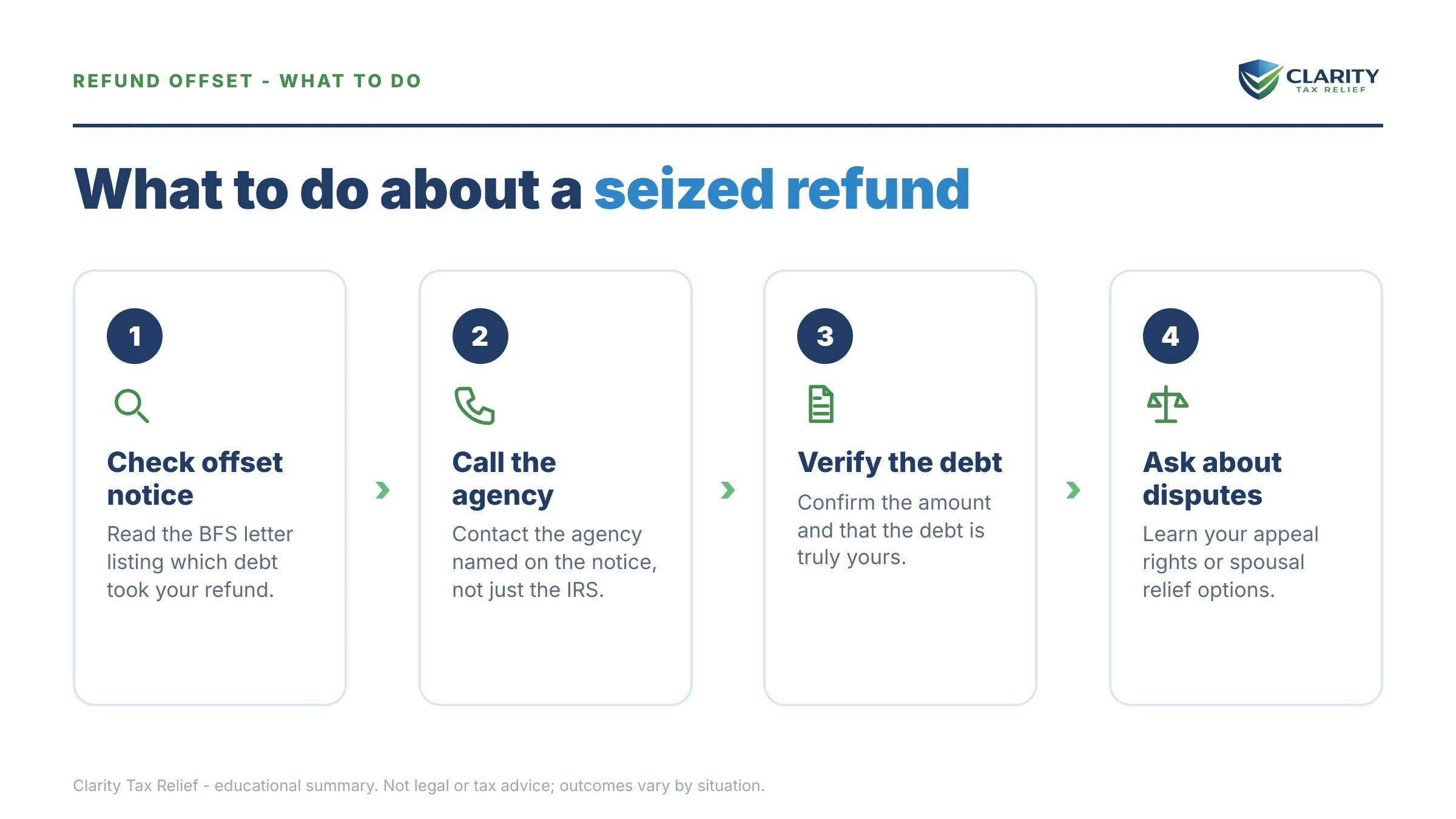
- Confirm the offset — call the Treasury Offset Program line at 800-304-3107 to hear which agency flagged a debt against your Social Security number.
- Contact the referring agency to confirm the balance and dispute any error — the IRS cannot change another agency's debt.
- File Form 8379 if you're an injured spouse — if you filed jointly and only your spouse owes, file Form 8379 to reclaim your share of the refund.
- Request an Offset Bypass Refund for hardship — if a federal tax offset would cause genuine hardship, ask the IRS for an Offset Bypass Refund before the return is fully processed.
- Address the underlying tax debt — if the offset is for IRS tax debt, resolve the balance with a payment plan, hardship status, or an Offer in Compromise so future refunds stop being taken.
A worked example: a married couple's $11,300 refund
Say a married couple files jointly and expects an $11,300 refund. The husband defaulted on a federal student loan years before the marriage, and that debt is now certified to TOP. When the return processes, Fiscal Service intercepts the entire $11,300 and applies it to his loan balance — the wife's withholding funded most of that refund. But the joint refund is treated as one pot.
Here the wife is an injured spouse. She files Form 8379 to allocate the refund between them. Say her income and withholding accounted for roughly 60% of the return. Her allocated share works out to about $6,780, which the IRS can release back to her while the remaining ~$4,520 stays applied to the loan. The debt isn't hers, so it's recoverable, but only because she filed the claim. Do nothing, and all $11,300 is simply gone.
Numbers here are hypothetical and illustrate the mechanics only; your actual allocation depends on each spouse's income, withholding, and credits.
When you can handle this yourself, and when help changes the outcome
Plenty of offset situations are DIY. If a single-filer refund was correctly applied to a federal tax balance you agree with, there's nothing to fix — the money went where it was owed. You can set up a plan for the remainder online. A clean injured-spouse claim on a straightforward joint return is also something many people file themselves with Form 8379.
Experienced help earns its keep when the picture is tangled: multiple years of unfiled returns feeding the debt, an offset bypass that must be timed against a hardship you have to document, a disputed debt where the referring agency and the IRS point at each other, or a tax balance large enough that the real goal is stopping the offset from repeating every single year. In those cases the order you do things in — file, then abate penalties, then address the balance — changes what you ultimately keep. Our hub on how to settle tax debt yourself lays out that sequence.
If offsets keep eating your refund year after year, the fix isn't fighting each offset — it's resolving the debt underneath so there's nothing left to certify. Get a free review of your tax balance to see which resolution path stops the cycle.
Terms on your offset, decoded
- Treasury Offset Program (TOP): the Fiscal Service system that intercepts federal payments, including refunds, to pay debts referred by federal and state agencies.
- Offset vs. levy: an offset takes money the government was about to pay you (a refund). A levy reaches into money you already hold (a bank account or paycheck).
- Injured spouse: a spouse whose share of a joint refund was taken for the other spouse's separate debt — recoverable with Form 8379.
- Offset Bypass Refund (OBR): an IRS discretionary release of a refund, despite a federal tax debt, when the taxpayer proves genuine financial hardship.
- Referring agency: the agency that certified the debt to TOP (a state, a court, the Department of Education) — the only party that can correct the underlying balance.
Treasury Offset Program questions, answered
How much money does the Treasury Offset Program seize each year?
The Treasury Offset Program clawed back more than $3.8 billion from federal payments and refunds in fiscal 2024 to cover delinquent debts. That figure covers both federal and state delinquent debts. It does not include the separate $40.1 billion in overpayments offset directly against outstanding federal tax debt across tax years 2020-2022, which flows through the IRS's own refund-application process.
What kinds of debt does the Treasury Offset Program collect?
TOP collects past-due child support, defaulted federal student loans, delinquent state income tax, state unemployment-insurance overpayments, SNAP food-stamp debt, and federal non-tax debts owed to agencies. In FY2024, more than $1.4 billion went to past-due child support, $343.7 million repaid state unemployment-insurance debts, and $197.9 million covered delinquent SNAP debt. Federal tax debt is offset through a separate IRS process.
Can the Treasury Offset Program take my whole refund?
Yes — for most debt types TOP can take 100% of your federal refund up to the amount you owe. There is no automatic cap that leaves you a portion for many debts. The one common protection is for injured spouses: if you filed jointly and only your spouse owes the debt, Form 8379 can reclaim your share of the refund.
How do I find out if my refund will be offset?
Call the Treasury Offset Program's automated line at 800-304-3107 to hear whether a debt is flagged against your Social Security number. The system tells you which agency referred the debt but not the exact amount. You must contact that agency directly to confirm the balance and dispute it — the IRS and Fiscal Service cannot change another agency's debt.
Does TOP ever seize refunds by mistake?
The bigger documented problem runs the other way. TIGTA found 11,206 taxpayers were issued more than $9.1 million in refunds since 2017 that should have been offset to outstanding sole-proprietorship tax debt — money that escaped offset. Erroneous seizures do happen, most often to injured spouses whose share wasn't protected; Form 8379 is the fix.
Can I stop a refund offset once it starts?
Rarely on your own once the debt is certified, but there are two paths. An injured spouse files Form 8379 to recover their portion. A taxpayer facing genuine hardship can request an Offset Bypass Refund before the return is processed, which asks the IRS to release the refund despite a federal tax debt. Both are time-sensitive and fact-specific.
How much has TOP offset against federal tax debt specifically?
Nearly $40.1 billion in overpayments were offset to outstanding tax debt across tax years 2020-2022. This is the IRS applying your refund to a balance you already owe the IRS — the most common offset most taxpayers experience. Unlike TOP referrals from other agencies, the IRS controls this offset directly and it happens automatically when you have an assessed federal balance.
Your Next 24 Hours
- Find out who took it. Call the Treasury Offset Program line at 800-304-3107 and note which agency flagged the debt against your Social Security number.
- Gather your paperwork. Pull the filed joint return, both spouses' W-2s or 1099s, and any notice you received — you'll need income and withholding figures for an injured-spouse claim.
- Get a free case review. Use the form or call (888) 825-7779. If the offset traces to an IRS tax balance, resolving it is the only way to stop future refunds from being taken, and interest keeps accruing on the remainder until you do.
This guide is general information, not tax or legal advice for your specific situation. Eligibility for IRS programs depends on individual facts and circumstances; no outcome is guaranteed.
Primary source: TIGTA — Tax Offset Program Continues to Allow Millions of Dollars to Be Erroneously Refunded to Taxpayers. For federal refund and offset basics, see IRS Tax Topic 203, Reduced Refund.