
Filing Status & Spouse Issues
Married Filing Jointly: Do We Both File a Tax Return in 2026?
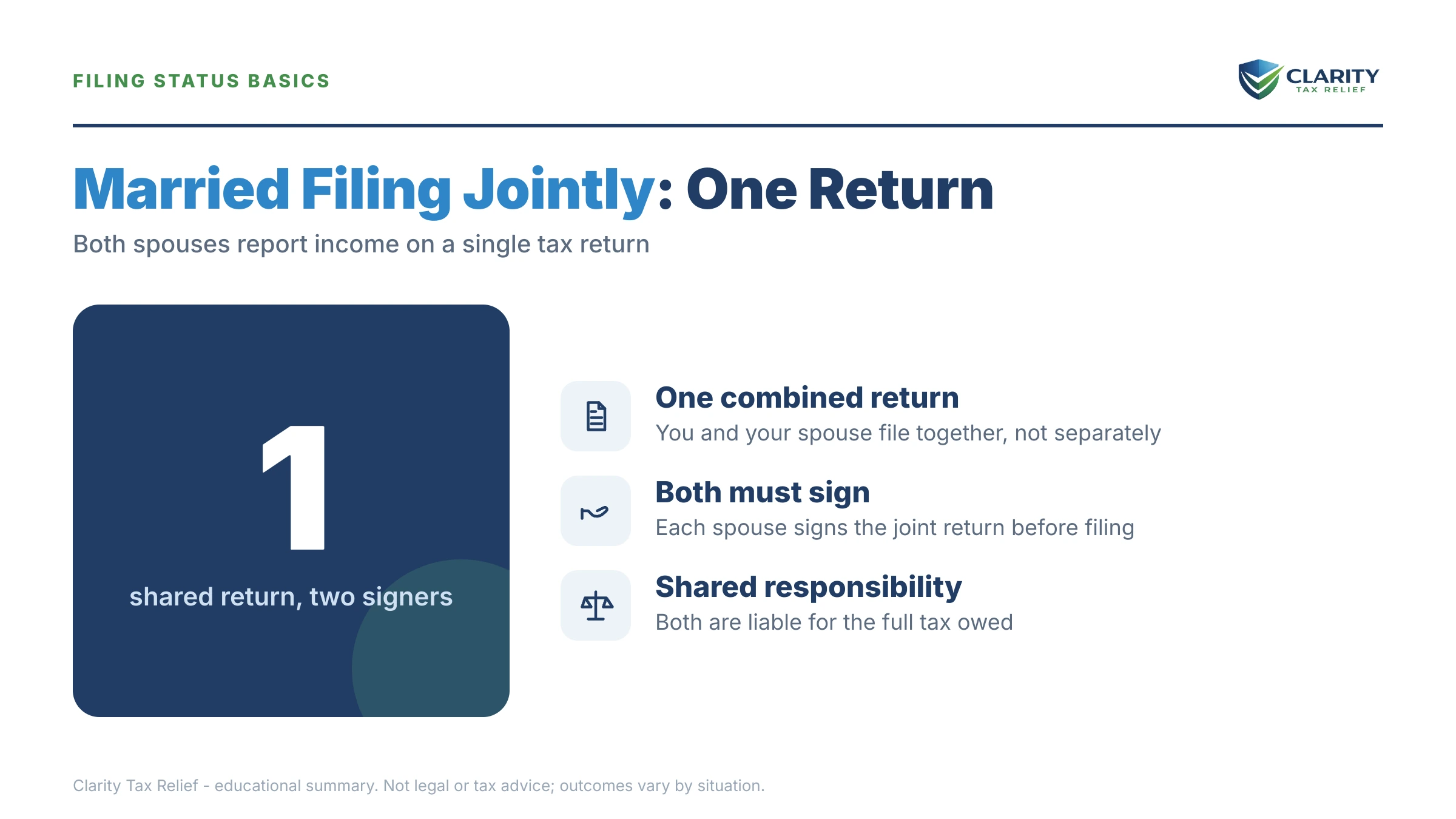
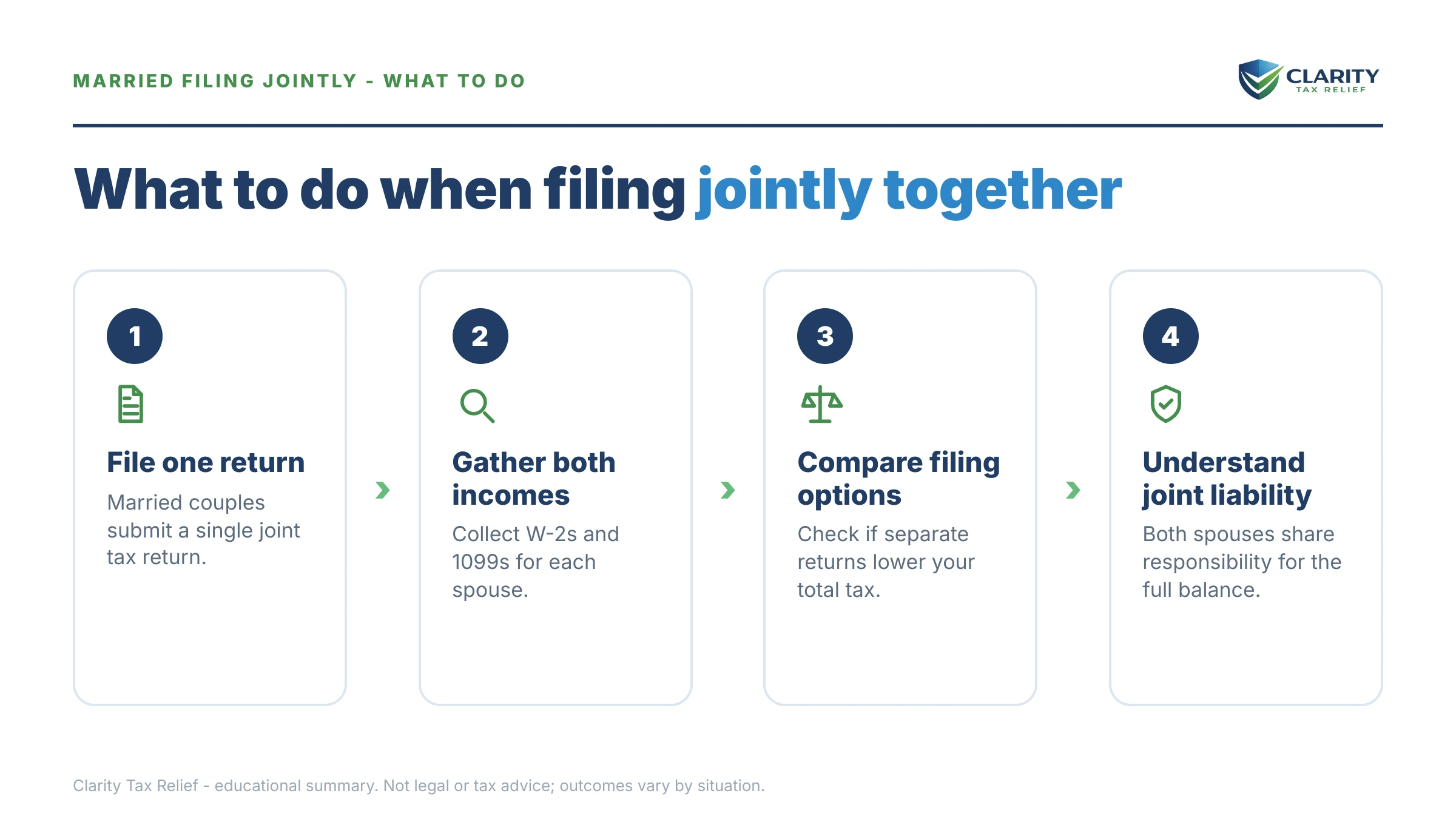
Married filing jointly — do we both file? No. Married filing jointly means you file one combined tax return that both spouses sign. You do not each file your own. The single Form 1040 lists both names, both Social Security numbers, and all income from both of you, and both spouses become fully responsible for the entire tax bill.
You're doing taxes as a married couple for the first time, both sets of W-2s are on the table, and the software just asked for a filing status neither of you has picked before. The mechanics take ten minutes to learn. What matters more is the fine print behind that second signature — the part almost nobody explains to newlyweds.
This guide covers both: how one joint return works, and what "joint and several liability", the legal consequence of filing together, means for each of you if a balance ever goes unpaid.
⏱ Your deadline: a joint return is due the same day as any individual return, typically April 15. Miss it with a balance due and the failure-to-file penalty runs at 5% per month, ten times the 0.5% failure-to-pay rate, so file the joint return on time even if you can't pay it all.

Married filing jointly: do we both file our own return?
Married filing jointly means one combined Form 1040 signed by both spouses — never two separate returns. The IRS treats the two of you as a single tax unit for the year: one return, one combined income figure, one standard deduction, one refund or one balance due.
Here's the whole answer in one glance:
| Question | Answer for a joint return |
|---|---|
| How many returns do we file? | One combined Form 1040 for the couple — not one each |
| Who signs it? | Both spouses — two ink signatures on paper, or two separate e-signatures (each spouse's own PIN and prior-year AGI) |
| Whose Social Security numbers go on it? | Both — one listed as taxpayer, one as spouse; the order doesn't change anything legally |
| Whose income gets reported? | All income both of you earned all year — jobs, side gigs, interest, everything |
| Who owes the tax on it? | Each spouse, individually, for 100% of the balance — not 50/50 |
A few first-year details that trip people up. You qualify to file jointly if you were legally married on December 31 — a December wedding makes you "married" for the entire tax year. It doesn't matter if one spouse earned nothing; a joint return is still allowed, and usually still the better deal. And when you e-file, "both sign" doesn't mean one of you clicks submit — each spouse enters their own electronic signature, verified with that person's own prior-year AGI or Self-Select PIN.
One common first-year rejection: if either spouse changed names after the wedding, the name on the return must match Social Security Administration records. E-filed returns bounce when they don't — update SSA before you file, not after.
What both signatures commit you to: joint and several liability
Signing a joint return makes each spouse individually liable for 100% of the tax on it — a rule called joint and several liability. It survives divorce. This is the part of "do we both file" that actually matters, and the part no tax software explains before you click submit.
The IRS does not split a joint balance by who earned what. If the return shows tax due, this year or after a later correction, the IRS can collect the entire amount from either of you, in any mix, until it's paid. A divorce decree saying "he pays the taxes" binds the two of you in state court; it does not bind the IRS at all. If you ever split, see who pays IRS debt after divorce for how that plays out.
A hypothetical to make it concrete. Say you're newlyweds with $64,000 in combined income — $41,000 from your W-2 job and $23,000 from your spouse's, including a $6,000 freelance side gig with no withholding. Nothing was set aside for self-employment tax — 15.3% applied to 92.35% of net freelance earnings, about $850 here — let alone the income tax on it, so the joint return comes out roughly $1,500 short at filing time.
Under joint and several liability, that $1,500 is not "your spouse's $1,500." The IRS can collect all of it from you, all of it from your spouse, or any combination. While it sits unpaid, the failure-to-pay penalty adds 0.5% per month — about $8 a month on $1,500 — plus interest. The fix here is cheap: a short-term payment plan gives you up to 180 days to pay with a $0 setup fee, and filing on time means you never touch the far worse 5%-per-month failure-to-file penalty. If a bigger balance has you weighing whether to file at all, read should you file if you can't pay — the answer is always yes.
What happens if a joint balance goes unpaid
An unpaid joint balance triggers the same automated IRS collection sequence as any other tax debt — aimed at both spouses at once. Every notice carries both names, and enforcement can eventually reach either spouse's paycheck or bank account, including accounts the other spouse never touches.
- CP14 — the first bill, addressed to both of you, typically giving about 21 days to pay before the sequence moves on. Penalties and interest are already accruing.
- CP501 / CP503 — reminder notices. Still just bills, but the balance grows every month they're ignored.
- CP504 — Notice of Intent to Levy. The IRS can now seize your state tax refund, and a federal tax lien, attaching to property either spouse owns, becomes a real possibility.
- LT11 / Letter 1058 — Final Notice of Intent to Levy. A 30-day clock starts, along with Collection Due Process appeal rights. After it runs, the IRS can levy either spouse's wages or bank accounts for the full joint balance.
There's a quieter consequence too: every future refund the two of you file for gets applied to the old joint balance automatically until it's gone. For a couple counting on a spring refund, that stings for years. The debt doesn't linger forever — the IRS generally has 10 years from assessment to collect — but a joint balance is enforceable against both of you for that entire window, married or not.
Filing jointly when one of you already owes the IRS?
Whether it's a joint balance you can't pay or a spouse's old tax debt shadowing your first return together, an experienced tax professional can map your options before penalties and interest grow the problem. The review is free and confidential.
When filing separately protects a spouse: MFJ vs. MFS
Married filing separately is the only alternative for married couples, and it exists mostly as a liability shield. Filing separately means two returns, each spouse signing only their own, and each spouse liable only for the tax on their own return.
| Factor | Married filing jointly | Married filing separately |
|---|---|---|
| Returns filed | One combined return, both sign | Two returns, each spouse signs only their own |
| Who's liable for the tax | Each spouse for 100% of the joint balance, even after divorce | Each spouse only for their own return |
| Refund exposure to spouse's old debts | Joint refund can be offset for either spouse's back taxes, child support, or student loans (Form 8379 can recover your share) | Your separate refund isn't taken for your spouse's separate debts |
| Tax rates and credits | Most favorable brackets; full access to credits | Generally lose the Earned Income Tax Credit and education credits; many breaks shrink or phase out faster |
| Total tax for most couples | Usually lower | Usually higher — the protection has a price |
| Changing your mind later | Cannot switch to separate after the filing deadline | Can amend to joint for roughly 3 years |
For most newlyweds, jointly wins on the math. Filing separately earns its higher tax bill in a few specific situations: one spouse has unfiled years or unreported income you don't want your signature attached to, one spouse is on an income-driven student loan plan where a joint AGI would spike the monthly payment, or one spouse simply won't share financial information. If your spouse already owes the IRS, married filing separately when your spouse owes the IRS walks through that exact decision, and if you suspect income is being hidden from you, start with what to do when a spouse hid income from the IRS before you sign anything.
One trap for the nine community property states: filing separately there doesn't cleanly split income, because state law treats most earnings as half-owned by each spouse. See community property and innocent spouse rules before assuming separate returns wall you off. Notice the asymmetry in timing, too — separate-to-joint is reversible for about three years; joint-to-separate is locked once the deadline passes. When in doubt, run the numbers both ways before filing, not after.
When your spouse's debt isn't your fault: injured vs. innocent spouse
The IRS has two separate escape hatches, and people mix them up constantly. Injured spouse relief (Form 8379) recovers your share of a joint refund that was seized for your spouse's separate debt — old taxes from before the marriage, child support, or defaulted student loans. Innocent spouse relief (Form 8857) goes further: it can remove your liability for a joint balance your spouse's errors or hidden income created. The full comparison lives in our guide to injured spouse vs. innocent spouse relief. The mechanics are covered in Form 8379 injured spouse allocation and how to qualify for innocent spouse relief, with the paperwork in Form 8857 instructions. If you're marrying into a tax debt, marrying someone who owes the IRS and refund taken for a new spouse's old debt cover the before-and-after.
How to file your first joint return, step by step
- Confirm you qualify. If you were legally married on December 31, you can file jointly for the whole year. There is no minimum number of months of marriage.
- Update names with Social Security first. If either of you changed your name, the name on the return must match Social Security Administration records or your e-file will be rejected.
- Gather both spouses' documents. Every W-2 and 1099 for both of you, plus each spouse's prior-year AGI or Self-Select PIN so both of you can e-sign.
- Prepare one Form 1040. List both names and both Social Security numbers, and report all income either of you earned during the year — jobs, side gigs, interest, everything.
- Both of you sign. Two ink signatures on a paper return, or two separate electronic signatures when you e-file. A joint return with one signature is not a valid joint return.
- Handle any balance before the deadline. Pay at IRS.gov/payments, or set up a short-term payment plan (up to 180 days, no setup fee), and remember that both of you owe whatever the return shows.
When you can handle this yourself, and when help changes the outcome
Most first joint returns need no professional at all. If you both have W-2 jobs, you agree on the numbers. The return shows a refund or a balance you can pay within 180 days, any reputable software walks you through one joint Form 1040 in an evening. Setting up a simple payment plan online is equally a do-it-yourself task.
Experienced help changes the outcome in a narrower set of situations: one spouse has unfiled prior years or old balances already in collections, you've received levy or lien notices, there's self-employment income that was never reported, or you're weighing separate filing specifically to shield one spouse from the other's tax problems. In those cases, the order you fix things — returns first, then penalties, then the balance, then any injured or innocent spouse claim — genuinely changes what you end up paying, and getting the sequence wrong can forfeit relief you'd otherwise get. If you're stuck between the IRS and a spouse's debt with nowhere to turn, the independent Taxpayer Advocate Service is also a legitimate free resource.
Terms on your first joint return, decoded
- Joint and several liability — the rule that each spouse who signs a joint return owes 100% of the tax on it, individually, regardless of who earned the income.
- Refund offset — the Treasury's automatic seizure of a tax refund to pay a filer's other government debts: back taxes, child support, or defaulted student loans.
- Injured spouse relief — a Form 8379 claim to recover your share of a joint refund that was offset for your spouse's separate debt (official details at IRS.gov's Form 8379 page).
- Innocent spouse relief — a Form 8857 request to be released from joint liability created by your spouse's errors or hidden income.
- Married filing separately (MFS) — the alternative status: two returns, two signatures, each spouse liable only for their own — usually at a higher combined tax cost.
- Community property — state law in nine states treating most income earned during marriage as owned half-and-half, which complicates separate returns filed there.
Married filing jointly questions, answered
Do both spouses have to sign a joint tax return?
Yes — a joint return is not valid until both spouses sign it. On paper returns that means two ink signatures. When you e-file, each spouse signs electronically with their own five-digit Self-Select PIN and their own prior-year AGI. One spouse cannot simply sign for the other unless there is a valid power of attorney or a narrow exception applies, such as a spouse serving in a combat zone.
Can we file jointly if only one of us had income?
Yes, and it is usually the better move. A joint return is allowed even when one spouse earned nothing, and the couple still gets the full married-filing-jointly standard deduction and tax brackets. The no-income spouse still appears on the return with their Social Security number and still signs — and, importantly, still becomes fully liable for the tax on it.
What if we both already filed our own separate returns?
If you each filed as single after getting married, your filing status was wrong and should be corrected with Form 1040-X. If you filed married filing separately, you can amend to a joint return — generally within three years of the original deadline. The switch only works one way: you can go from separate to joint after the deadline, but not from joint back to separate.
We got married in December — can we file jointly for the whole year?
Yes. The IRS looks at one date: your marital status on December 31. If you were legally married on the last day of the year, you are treated as married for the entire tax year and can file jointly, even if the wedding was December 31 itself. The same rule cuts the other way: divorced on December 31 means unmarried for the whole year.
My spouse owes back taxes from before we married — am I responsible if we file jointly?
No — filing jointly does not make you liable for tax debt your spouse ran up before the marriage. That debt stays theirs alone. What filing jointly does put at risk is your joint refund: the IRS will offset it against your spouse's old balance unless you file Form 8379 to claim your share back.
Is it ever better to file married filing separately?
Sometimes. Filing separately can make sense when one spouse has serious tax problems, unreported income, or income-driven student loan payments calculated on individual income. The trade-off is real: separate filers generally lose the Earned Income Tax Credit and education credits and often pay a higher total tax. Run the return both ways before deciding — most couples come out ahead filing jointly.
Do we have to file jointly every year once we start?
No. Filing status is a fresh choice every tax year — filing jointly this year does not lock you in for next year. The one timing trap: once you file a joint return for a given year, you cannot switch that year to separate returns after the filing deadline passes. Going the other direction, from separate to joint, is allowed for about three years.
If my spouse made a mistake on our joint return, are we both on the hook?
Yes, by default. Joint and several liability means the IRS can collect the full tax, penalties, and interest from either spouse, no matter whose income or error created it, even after a divorce. The exception is innocent spouse relief, requested on Form 8857, for spouses who did not know and had no reason to know about the understatement.
Your next 24 hours
- Settle the status question together. Confirm you were married as of December 31, decide jointly vs. separately with the table above, and check that any changed name matches Social Security records.
- Gather both spouses' paperwork in one place: every W-2 and 1099 for both of you, each spouse's prior-year AGI, and, this is the important one, any IRS or state letters about back taxes, child support, or student loans in either spouse's name.
- If either of you owes back taxes, get a free case review before you sign a joint return. Interest and penalties on old balances grow every month. The right filing choice now can keep your refund. Your liability — clean. Use the 2-minute form or call (888) 825-7779.
This guide is general information, not tax or legal advice for your specific situation. Eligibility for IRS programs depends on individual facts and circumstances; no outcome is guaranteed.