
IRS Data & Statistics
How Many Employees Does the IRS Have in 2026? IRS Workforce Statistics, Year by Year
What this episode covers
- Will IRS layoffs stop automated collection notices from going out?
- Did IRS staffing cuts change audit chances for small businesses?
- Do IRS penalties and interest still accrue during IRS staffing cuts?
- How do I set up an IRS payment plan online for tax debt under $25,000?
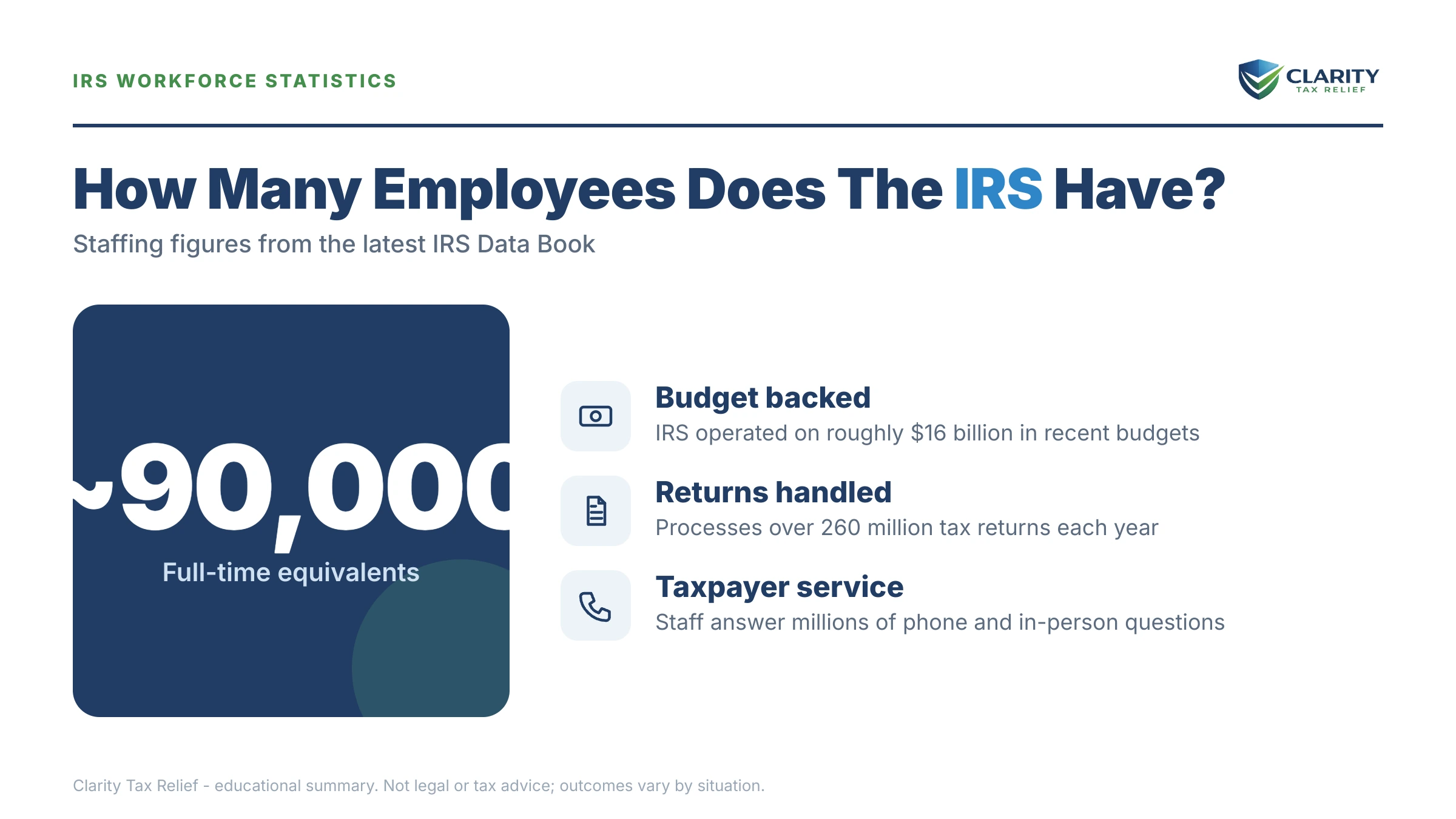
How many employees does the IRS have? About 75,000 in 2026 — down roughly 27% from the early-2025 peak of about 100,000, the largest one-year workforce drop in the agency's modern history. For context: about 90,000 in FY2024, about 83,000 in FY2023, and about 117,000 at the 1992 peak.
Maybe you searched this because a headline about IRS layoffs made you wonder whether your small business just became more, or less — likely to hear from an auditor. Or you owe a balance and you're quietly hoping a shrunken agency loses track of it. The numbers below answer the first question honestly, and the second one bluntly: the humans left; the computers didn't.
This is an original data study built from IRS Data Book personnel tables and 2025 workforce reporting from TIGTA, the Treasury's inspector general for tax administration. Every figure is tied to a named fiscal year, and we say "about" wherever the final number was still moving. The image below shows the full headcount trend — three decades of decline, a two-year surge, and the 2025 cliff, all in one view.
⏱ The clock that never got cut: if you owe back taxes, interest compounds daily and the failure-to-pay penalty adds 0.5% per month — automatically, regardless of how many people the IRS employs. Staffing cuts slowed the humans, not the accruals.

How many employees does the IRS have compared to past decades?
The IRS employs about 75,000 people in 2026 — down from roughly 100,000 at the start of 2025 and about 117,000 at its fiscal year 1992 peak. That means today's IRS is running with roughly a third fewer people than it had in the early 1990s, while processing far more returns and information documents than it did then.
The trend has three distinct chapters. First, a long slide: from the early 1990s through FY2019, budget pressure and attrition shrank the workforce almost every year, bottoming near 74,000 in FY2019 — the lowest level in decades. Second, a sprint: Inflation Reduction Act funding passed in 2022 fueled a hiring surge, lifting the workforce to about 83,000 in FY2023, about 90,000 in FY2024, and about 100,000 by early 2025.
Third, the cliff. Over the course of 2025, deferred-resignation offers, reductions in force. A hiring freeze cut the workforce by roughly 27% — from about 100,000 back down to about 75,000 in under a year. The agency effectively round-tripped a decade of change in ten months.
| Fiscal year | Approximate workforce | What was happening |
|---|---|---|
| FY1992 | About 117,000 | Modern staffing peak |
| FY2010 | About 95,000 | Start of a decade of budget-driven decline |
| FY2019 | About 74,000 | Multi-decade low point |
| FY2021 | About 79,000 | Pandemic-era backlogs; modest rebound begins |
| FY2023 | About 83,000 | Inflation Reduction Act hiring underway |
| FY2024 | About 90,000 | Peak hiring year of the expansion |
| Early 2025 | About 100,000 | Peak headcount — lasted only months |
| End of FY2025 | About 75,000 | Roughly 27% cut in a single year |
| 2026 (current) | About 75,000 | Hiring largely frozen; workforce holding near the reduced level |
Two notes on reading these numbers. The Data Book reports full-time-equivalent (FTE) positions, so raw headcount runs somewhat higher during filing season when seasonal workers are aboard. And the 2025 and 2026 figures blend Data Book baselines with TIGTA's mid-year snapshots, since the official FY2025 Data Book captures a workforce that was shrinking as it was being counted.
Where IRS employees actually work: staffing by function
Taxpayer services, not enforcement, has long been the IRS's largest staffing category, at about 36,000 full-time-equivalent positions in the FY2023 Data Book. The popular image of an agency staffed wall-to-wall with auditors has never matched the personnel tables: the plurality of IRS employees answer phones, process returns and correspondence, and handle account questions.
| Budget function | Approximate FTEs | What these employees do |
|---|---|---|
| Taxpayer services | About 36,000 | Phone lines, return and correspondence processing, walk-in centers |
| Enforcement | About 35,000 | Audits (revenue agents), field collection (revenue officers), Criminal Investigation |
| Operations support | About 12,000 | IT infrastructure, facilities, security, shared services |
| Business systems modernization | Under 1,000 | Long-term technology upgrades |
Inside the enforcement column, the roles matter more than the total. Revenue agents conduct audits — including the field audits small businesses fear. Revenue officers handle in-person collection of larger debts. Criminal Investigation runs with roughly 2,000 special agents, a sliver of the agency, focused on fraud rather than ordinary balances (see our IRS criminal investigation statistics for that side of the house).
The 2025 cuts did not fall evenly across these functions. TIGTA reporting indicates about a third of revenue agents left the agency during 2025 — a deeper proportional loss than the roughly 27% agency-wide figure. In other words, the audit workforce shrank faster than the IRS itself. Our FY2025 audit and enforcement statistics study tracks what that did to exam activity.
Does a smaller IRS mean fewer audits for your small business?
Fewer revenue agents means fewer complex, human-driven audits, but audit selection is a computer's job, and the computers were not laid off. That distinction is the single most important thing a business owner can take from the staffing data.
Here's the practical split. Field audits — a revenue agent examining your books in person — require exactly the employees the IRS lost the most of in 2025. Those exams were already rare for small businesses and have become rarer and slower. But most small-business contact never involved a human picker in the first place: document-matching systems compare every 1099 and W-2 against your return automatically. A mismatch generates a CP2000 or a correspondence audit letter regardless of headcount. Selection models score returns for anomalies — increasingly with machine-learning tools, as we cover in IRS AI audit selection in 2026 — and the classic small business audit red flags still get returns flagged.
So the honest answer for a Schedule C or S-corp owner: your odds of a deep field exam went down. Your odds of automated, mail-based contact did not meaningfully change. For the actual percentage odds by income level and return type, see our companion study on the IRS audit rate by income. This page covers the staffing behind those rates, not the rates themselves. And if you're wondering whether the layoffs changed your personal exposure, will you still get audited after the IRS layoffs walks through that question directly.
What happens if you owe and do nothing: the machine didn't shrink
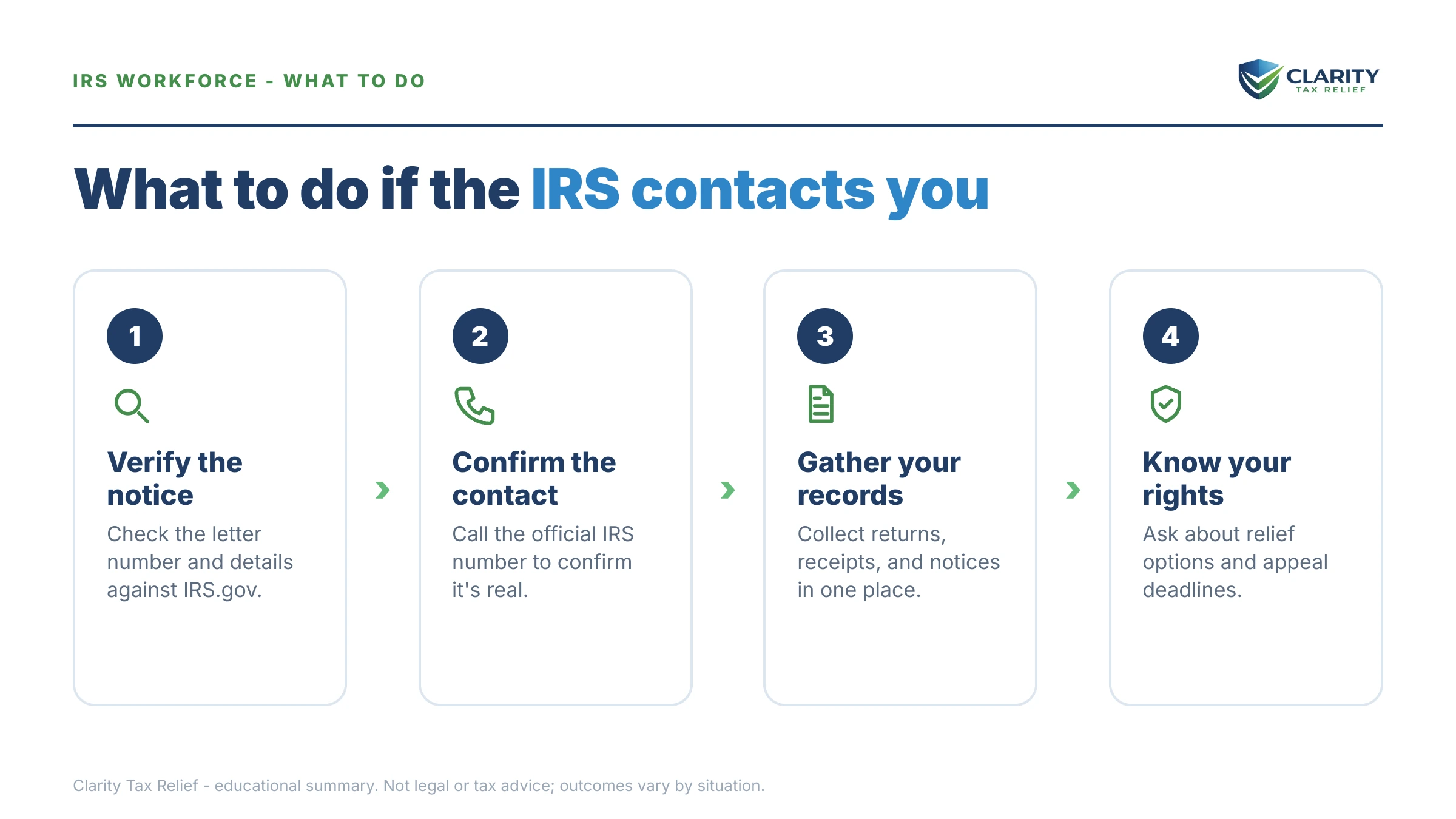
IRS collection notices are generated by automated systems that were not cut in 2025. If you owe a balance, the sequence below runs on autopilot — a human typically only touches your file at the very end, if ever:
- CP14 — the first bill, generally giving you 21 days to pay (10 business days if you owe $100,000 or more) before the system escalates. Issued automatically when a return posts with a balance due.
- CP501 / CP503 — automated reminders. The balance grows monthly; no human has reviewed anything yet.
- CP504 — Notice of Intent to Levy. The IRS can seize your state tax refund; still machine-generated.
- LT11 / Letter 1058 — the final notice, starting a 30-day clock on your Collection Due Process rights before bank and wage levies become legal.
- Levy — a bank levy freezes funds for a 21-day hold before they're sent to the IRS. A wage levy is continuous until released; Social Security can lose up to 15% through the Federal Payment Levy Program.
The full sequence is mapped in the IRS collection process step by step. Here's the asymmetry the staffing data creates: the actions that hurt you are automated, while the actions that help you — releasing a levy, approving hardship status, answering the phone — require the humans who are now scarce. IRS phone service degraded measurably after the cuts (our IRS answered calls and wait times data shows how much), which means an enforcement action is now harder to undo quickly than it is to trigger.
Owe back taxes while the IRS runs on autopilot?
The notices keep coming and interest accrues monthly, whether or not anyone at the IRS picks up the phone. Get your balance and options reviewed free by an experienced tax professional, before the automated sequence reaches the levy stage.
What the 2025 cuts changed, and what runs on autopilot
Roughly speaking, everything that collects money from you survived the cuts intact; everything that requires human judgment slowed down. This table is the reference version of that split:
| IRS function | Human or automated? | 2026 reality |
|---|---|---|
| Collection notice sequence (CP14 → CP504 → LT11) | Automated | Runs on schedule regardless of staffing |
| Refund offsets and passport certification | Automated | Applied systemically; the passport threshold is $66,000 of seriously delinquent debt in 2026 |
| Bank and wage levies via the Automated Collection System | Largely automated | Still issued; a release requires a human, which is now slower to reach |
| Return matching (CP2000, correspondence exams) | Computer-selected | Volume driven by data mismatches, not headcount |
| Field audits of businesses | Human (revenue agents) | Fewer and slower after about a third of revenue agents left |
| Phone lines, amended returns, paper correspondence | Human | Longer waits and growing backlogs |
| Offer in Compromise and penalty-abatement decisions | Human | Slower reviews — though an OIC is generally deemed accepted if the IRS doesn't reject it within 24 months of submission (returned or withdrawn offers and certain excluded periods don't count — don't plan on waiting it out) |
That last row cuts both ways. Slower human review is frustrating when you want an answer, but for an Offer in Compromise, the law puts the delay risk on the IRS, not you. The broader picture of what reduced funding means for people who owe is in our guide to IRS budget cuts and tax debt in 2026. The processing-delay side is covered in IRS layoffs and 2026 delays.
What the staffing numbers mean if you owe: a worked example
A $15,000 balance qualifies for a streamlined payment plan with no financial disclosure, and none of the staffing math changes that. Say you're a sole proprietor who owes $15,000 from last year's Schedule C, and you're tempted to sit tight because "the IRS is gutted."
Here's what waiting actually costs. The failure-to-pay penalty runs 0.5% per month: on $15,000, that's $75 a month, or about $900 a year, before interest, which compounds daily on top (current rates are in our guide to IRS interest rates for 2026). Meanwhile the automated notice sequence marches from CP14 toward levy territory with no human required. You can estimate your own accruals with our IRS penalty & interest calculator.
Now the fix. At $15,000 you're under the $25,000 streamlined threshold and well under the $50,000 online-plan ceiling, so you can set up a plan of generally up to 72 months (or the time left on the IRS's 10-year collection clock, whichever is shorter) from your IRS online account without submitting financials. The straight arithmetic is $15,000 ÷ 72 ≈ $208 a month. Your actual payoff runs somewhat higher because interest and a reduced failure-to-pay penalty continue accruing inside the plan. A shorter term — say $15,000 ÷ 36 ≈ $417 a month — cuts the total accruals roughly in half. Our full breakdown of this exact balance is at owe the IRS $15,000.
The staffing takeaway: the shrunken IRS made the self-service path (online plans) more attractive than ever, because the alternative, waiting on hold to negotiate with a human, got worse, not because the debt got softer.
What to do if you owe the IRS in 2026, step by step
- Check your real balance. Log into your IRS online account to see your exact balance, penalties, and notice history — don't rely on the last letter you received.
- File anything unfiled. The failure-to-file penalty (5% per month) is 10 times the failure-to-pay penalty (0.5% per month), so filing always comes first, even if you can't pay a dime.
- Match a resolution to your numbers. Pick from a 180-day short-term plan, a monthly installment agreement, Currently Not Collectible status, or an Offer in Compromise if your finances genuinely qualify.
- Set it up online, not by phone. Balances up to $50,000 can be put on a payment plan through your IRS online account in minutes — no hold music, no shrunken phone staff.
- Get a professional review if your case is complex. Multiple unfiled years, payroll tax debt, a levy in motion, or Offer in Compromise math are the situations where an experienced tax professional changes outcomes.
Step four deserves emphasis given this article's subject: the walkthrough at how to set up an IRS payment plan online takes most people under 20 minutes — versus the phone experience described in can't reach the IRS by phone.
When you can handle this yourself, and when help changes the outcome
Most people who owe under $25,000 with all returns filed can resolve it themselves online. If that's you, you don't need to hire anyone: set up the plan, keep the payments on autopilot, and you'll never meet the enforcement side of the staffing chart. The same goes for a first notice you agree with, or a balance you can clear within 180 days on a $0-setup short-term plan.
Experienced help changes outcomes in a narrower set of situations, and the 2025 staffing cuts made these harder, not easier, to navigate alone: a levy already in motion (releases require reaching the scarce humans), multiple unfiled years (the order you fix things determines what you ultimately owe), business or payroll tax debt (where personal liability rules apply), and Offer in Compromise cases (where the IRS accepted roughly 1 in 5 offers in FY2024. The math has to be right before you file). Beware anyone who pitches the layoffs as a loophole — "the IRS is too weak to collect" is a sales line, not a strategy. The automated-systems table above shows why. Our companion page the IRS is understaffed in 2026 — do I still owe? answers that pitch in full.
Terms in this report, decoded
- FTE (full-time equivalent): the Data Book's staffing unit — total hours worked converted into full-time positions, so two half-time workers count as one FTE.
- IRS Data Book: the agency's official annual statistical report; its personnel tables are the authoritative source for workforce counts.
- Revenue agent: the IRS employee who conducts audits — the role cut hardest, proportionally, in 2025.
- Revenue officer: a field collection employee assigned to larger or business debts; different job from an auditor.
- ACS (Automated Collection System): the computer-driven arm of IRS collections that issues notices and many levies without a case officer.
- TIGTA: the Treasury Inspector General for Tax Administration — the independent watchdog whose 2025 snapshots documented the workforce reduction.
If your own IRS file is the reason you looked these numbers up, a free case review with an experienced tax professional will tell you exactly where your balance sits in the automated queue and which option fits it — call (888) 825-7779 or use the 2-minute form.
IRS workforce questions, answered
How many employees does the IRS have in 2026?
The IRS has about 75,000 employees in 2026, based on IRS Data Book personnel tables and 2025 TIGTA workforce reporting. That is down roughly 27% from the early-2025 peak of about 100,000. The Data Book counts full-time-equivalent positions, so raw headcount runs somewhat higher during filing season when seasonal workers are on board.
How many IRS agents are there?
Far fewer than the workforce total suggests. Most IRS employees answer phones, process returns, or run IT systems, not audits. Revenue agents, the employees who actually conduct audits, made up only a small fraction of the workforce even before 2025, and TIGTA reporting indicates about a third of them left during the 2025 workforce reduction — a deeper proportional cut than the agency overall.
What happened to the 87,000 new IRS agents?
The famous 87,000 figure was never a count of agents. It came from a 2021 Treasury estimate of total hires across all roles over ten years — most of them customer service and IT positions replacing retiring staff. The expansion partly happened: the workforce grew from about 79,000 in FY2021 to about 100,000 by early 2025. Then it reversed, with the 2025 cuts removing roughly 27% of the workforce in a single year.
Did the IRS really lose 27% of its workforce in 2025?
Yes, roughly. Between deferred-resignation offers, reductions in force, and normal attrition under a hiring freeze, the workforce fell from about 100,000 in early 2025 to about 75,000 — a cut of roughly 27% in a single year, the largest one-year reduction in the agency's modern history. Enforcement roles, especially revenue agents, were hit proportionally hardest.
Does a smaller IRS mean I'm less likely to be audited?
It means fewer complex, human-driven field audits, but computer-driven contact keeps running at scale. Document matching, CP2000 underreporter notices, and correspondence audits are largely automated and were not laid off. If your return has a mismatch, such as a 1099 you didn't report or an unusual expense pattern on a Schedule C, the system can still flag it regardless of how many people the IRS employs.
Does a smaller IRS mean my back taxes might be forgotten?
No. The IRS generally has 10 years from assessment to collect a debt. That clock can be paused by things like an Offer in Compromise or bankruptcy. Its collection notices, refund offsets, and many levies are issued by automated systems. Interest compounds daily and the failure-to-pay penalty adds 0.5% per month whether the agency employs 75,000 people or 100,000.
What is the IRS Data Book?
The Data Book is the IRS's official annual statistical report, published each spring for the prior fiscal year. Its personnel tables are the authoritative source for workforce counts, reported as full-time-equivalent positions by budget function. The figures in this article come from those tables plus TIGTA's 2025 workforce snapshots, rounded and marked 'about' where final numbers were still moving.
When did the IRS have the most employees?
The modern peak was fiscal year 1992, at about 117,000 employees. Headcount then declined for most of three decades, bottoming near 74,000 in FY2019, before Inflation Reduction Act funding pushed it back to about 100,000 by early 2025 — a level that lasted only months before the 2025 reductions brought it back down to about 75,000.
Is it harder to reach the IRS by phone in 2026?
Generally, yes. Taxpayer services has long been the IRS's largest staffing category. It shrank along with the rest of the agency in 2025, so hold times and paper-correspondence backlogs have grown. If you're calling about a balance or a notice, check your IRS online account first. It shows balances, notice history, and payment-plan options without the wait.
Your next 24 hours
- Look up your own numbers. Log into your IRS online account and note your exact balance, the tax years involved. The most recent notice on file. That tells you where you sit in the automated sequence.
- Gather three things: your last filed return, any IRS letters you've received, and a rough picture of your monthly business income. That's everything needed to evaluate your options.
- Get a free case review. Interest and penalties on any balance accrue monthly no matter how thin IRS staffing gets — an experienced tax professional can map your cheapest path out in one call. Use the 2-minute form or call (888) 825-7779.
Sources: workforce figures are drawn from the personnel tables of the IRS Data Book for the named fiscal years, supplemented by 2025 Treasury Inspector General for Tax Administration workforce snapshots. Independent analysis of service levels is published by the Taxpayer Advocate Service. Payment options referenced above are administered through IRS.gov/payments.
This guide is general information, not tax or legal advice for your specific situation. Eligibility for IRS programs depends on individual facts and circumstances; no outcome is guaranteed.