
IRS Audits
IRS Audit Rate by Income: Your Real Odds at Every Level (2026)
What this episode covers
- What are the chances of an IRS audit at different income levels?
- Why does the IRS audit EITC claimants more often than many high earners?
- Is a CP2000 notice the same as an IRS audit?
- What happens if I don't respond to an IRS mail audit letter?
The short answer: for most filers, the IRS audit rate is under half of one percent — about 2 to 4 returns per 1,000. Coverage is lowest between $50,000 and $200,000 of income, roughly 8 in 1,000 for EITC claimants under $25,000, and climbs past 1 in 100 above $5 million.
Maybe you just filed and a deduction is nagging at you. Or maybe the audit already happened, the bill landed, and a levy warning has you wondering whether any of this is normal. Either way, you want numbers, and the IRS audit rate by income is one of the most lopsided statistics in the whole tax system. Your income band can move your odds by a factor of ten in either direction, and the direction isn't always the one you'd guess.
This guide gives you the actual per-1,000 odds at every income level, why the curve bends up at both ends, what moves your risk more than income does. The exact playbook if you're the 1-in-250 who gets picked. The image below shows the full audit-rate curve at a glance — where your income band sits and why the line bends where it does.
⏱ The real clock: the IRS generally has 3 years from the date you file to open an audit — 6 years if you understated income by more than 25%. And if an audit already left you with a balance, a different clock is running: penalties and interest accrue every month until it's resolved.
IRS audit rate by income: the 2026 numbers
The IRS examines roughly 4 out of every 1,000 individual returns overall, but income moves that number dramatically at both extremes. The figures below are drawn from IRS Data Book examination statistics and government analyses of the most recent tax year with near-final audit data — remember, audits stay open for up to three years after filing, so very recent years always look artificially low.
| Total positive income | Approximate audit rate | Odds per 1,000 returns |
|---|---|---|
| Under $25,000, EITC claimed | ~0.8% | About 8 in 1,000 |
| Under $25,000, no EITC | ~0.4% | About 4 in 1,000 |
| $25,000 – $50,000 | ~0.2% | About 2 in 1,000 |
| $50,000 – $200,000 | ~0.1% – 0.2% | About 1–2 in 1,000 (lowest band) |
| $200,000 – $500,000 | ~0.2% | About 2 in 1,000 |
| $500,000 – $1 million | ~0.4% | About 4 in 1,000 |
| $1 million – $5 million | ~0.6% – 0.7% | About 6–7 in 1,000 |
| $5 million – $10 million | ~1% | About 10 in 1,000 |
| $10 million and up | ~2%+ | More than 20 in 1,000, rising as open years close |
Read that table twice, because it contains the two facts most articles bury. First, a filer earning $75,000 on a W-2 has roughly 1-in-1,000 audit odds — among the lowest of anyone in the system. Second, an EITC claimant earning under $25,000 faces about the same audit rate as someone earning $500,000 to $1 million. Income alone doesn't explain that; the next section does.
One more caution before you relax or panic: these are averages across every return in a band. What you put on the return moves your personal odds far more than the band average — more on that below. And because exams can open for years after filing, "I haven't heard anything" isn't the same as "I'm clear." Our guide to how far back the IRS can audit covers exactly when each year closes for good.
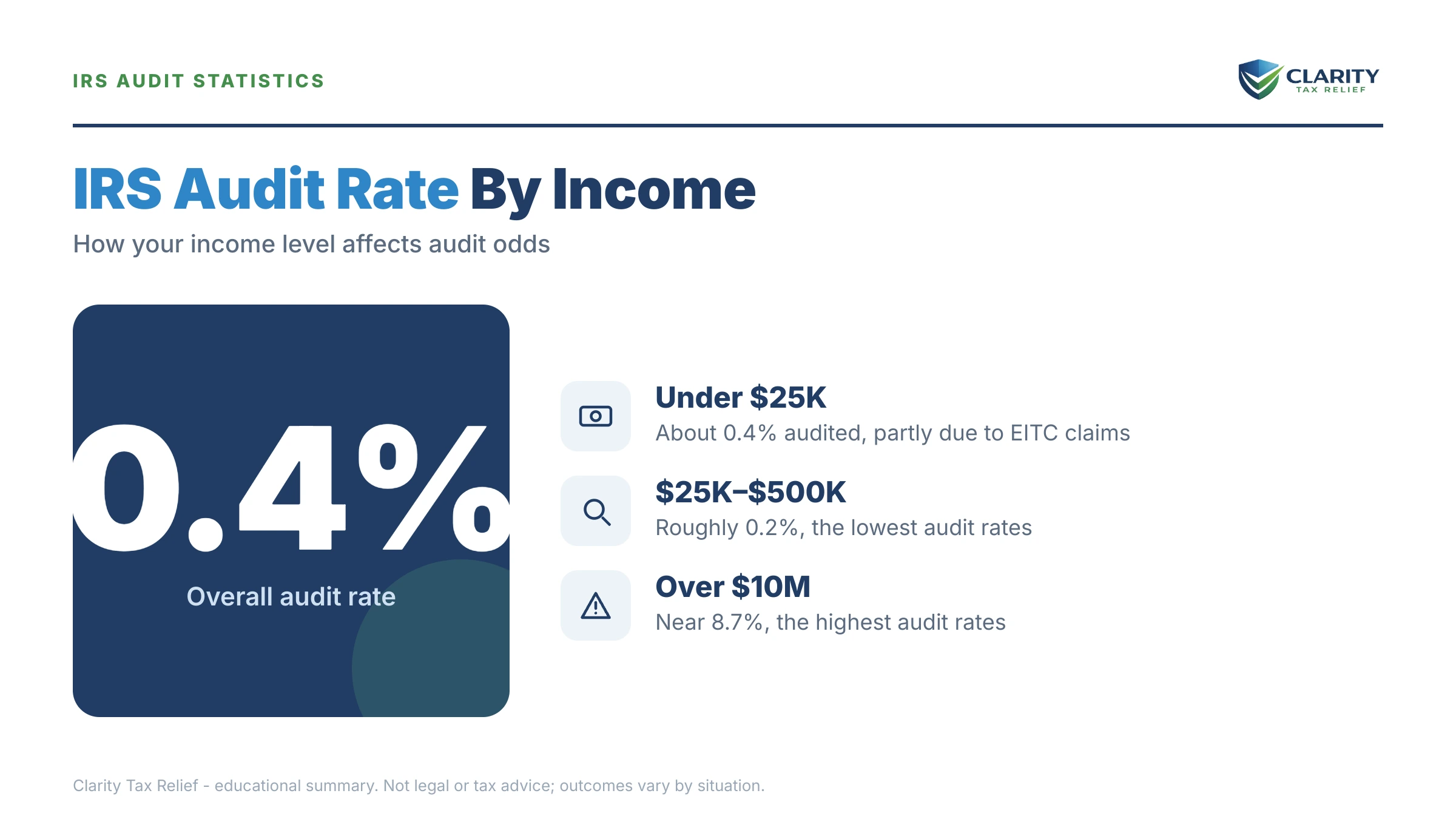
Why audit rates by income form a U-curve
Audit coverage is highest at the two ends of the income scale — EITC claimants under $25,000 and filers above $1 million — and lowest in the middle. That U-shape isn't an accident. It's the predictable output of a simple equation: audit where the errors are, weighted by what each audit costs to run.
At the low end, the Earned Income Tax Credit drives everything. It's a refundable credit with complicated child-residency rules, so it has one of the highest improper-payment rates of any program, and verifying it takes a form letter, not an agent. Those exams are cheap, automated correspondence audits, which is why the IRS EITC audit rate runs several times the middle-class average despite the small dollar amounts involved.
At the high end, the logic flips: each adjustment is worth serious money, and returns above $1 million are full of items a computer can't verify — pass-through income, valuations, losses, trusts. Those exams need experienced revenue agents, which is exactly the resource the IRS is shortest on. The IRS millionaire audit rate is still the highest of any individual group. But it has fallen for years for the same staffing reason. Businesses follow their own curves entirely — the IRS corporate audit rate scales with asset size, not owner income.
In the middle sits the safest taxpayer in America: the W-2 wage earner. Nearly everything on a W-2 return is verified by third-party documents before the IRS ever looks at it. Your employer, your bank, and your broker already reported your numbers. There's little room for error, so there's little reason to audit.
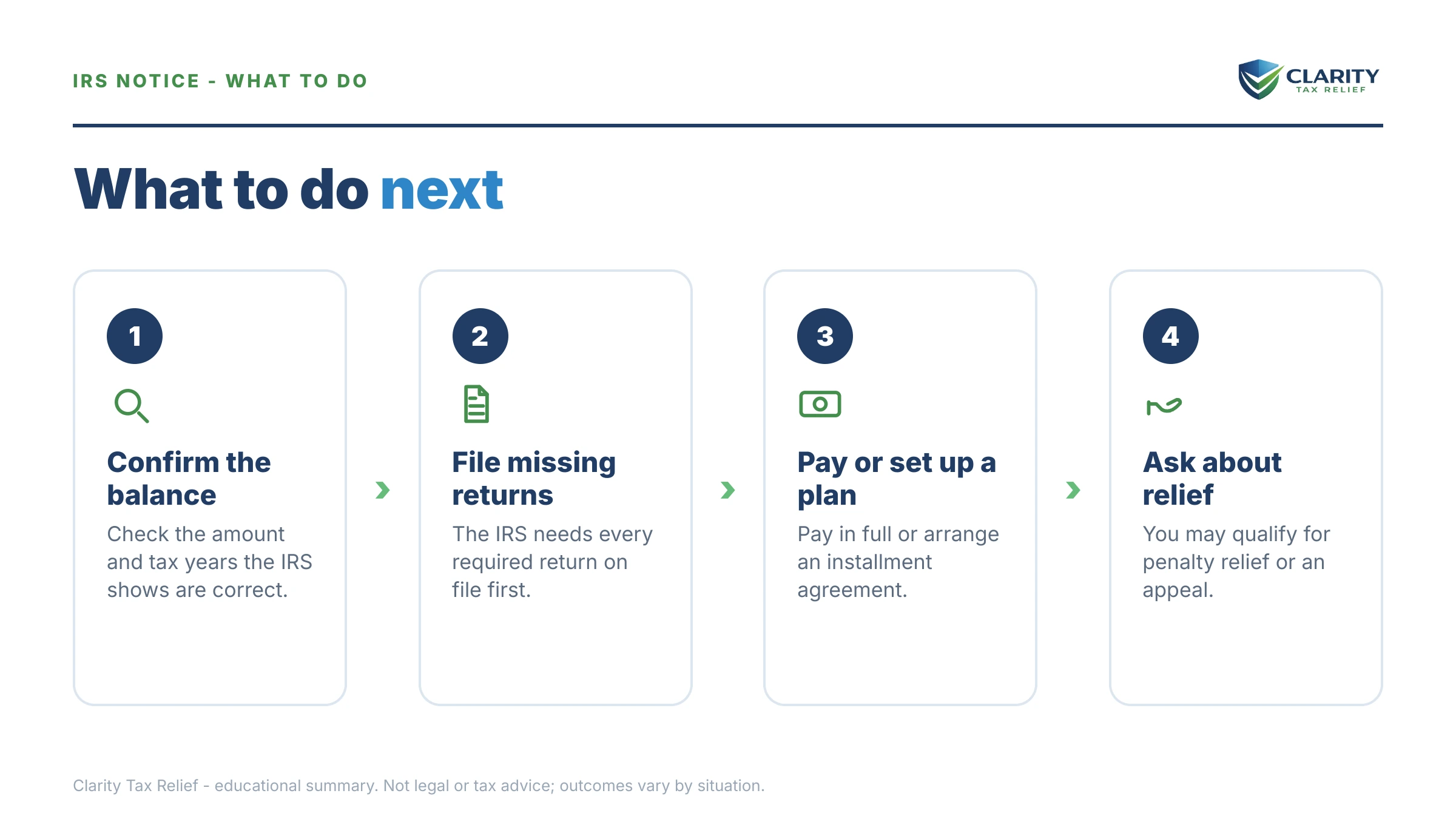
What raises your audit odds more than income
Most audit selection is done by computer, not by anyone reading your return. The IRS scores every return with its DIF system, which flags returns that look statistically unusual compared to peers with similar income. That means the question isn't just "how much did I make?" — it's "how different does my return look from everyone else's at my income?"
Within any income band, these move the needle far more than the band average:
- Document mismatches — a 1099 the IRS received that isn't on your return is the single most common trigger of IRS contact.
- Schedule C businesses — self-employment income with heavy expenses or repeated losses is examined at multiples of the wage-earner rate. See our guide to Schedule C audit defense.
- Cash-intensive income — restaurants, salons, contractors, and anyone whose deposits the IRS can't match to a form. A cash business audit uses bank-deposit reconstruction, a fundamentally different exam.
- Refundable-credit claims — EITC, Additional Child Tax Credit, and disputed dependents.
- Deductions out of proportion to income — charitable giving, home-office, or vehicle claims well above what peers at your income report.
The full list, and how much each factor matters — is in our guide to IRS audit triggers. The takeaway for the rate table above: a $60,000 Schedule C filer with three straight loss years has meaningfully worse odds than a $700,000 W-2 executive, whatever the band averages say.
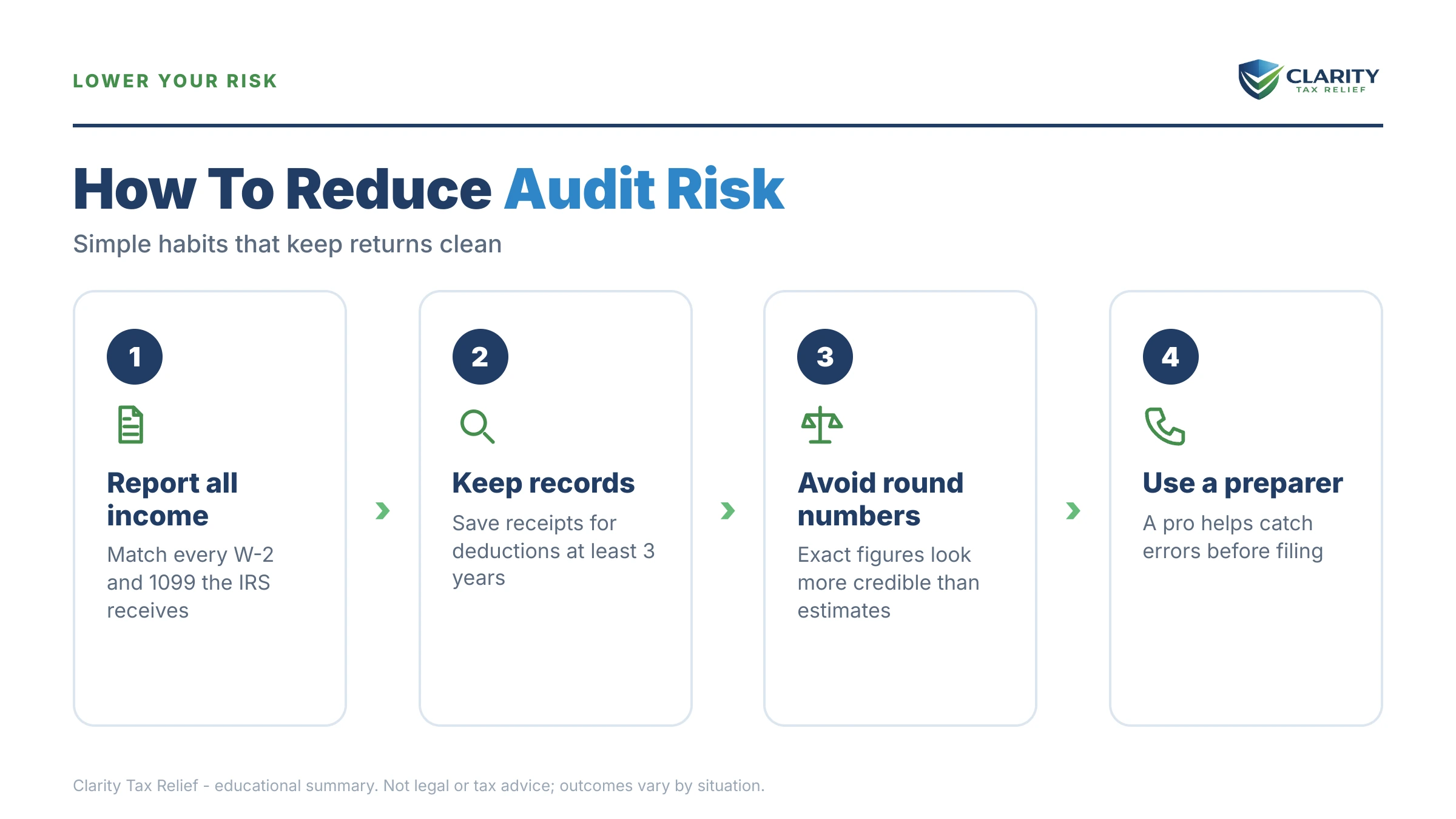
Mail, office, or field: what an audit looks like at your income
Roughly 7 to 8 out of every 10 IRS audits happen entirely by mail, and income largely determines which type you'd face. The dreaded agent-at-your-door exam is real but rare, and concentrated at the top of the income scale and among businesses.
| Audit type | Who typically gets it | How it works |
|---|---|---|
| Correspondence (mail) audit | EITC claimants and most filers under $200,000 — the large majority of all audits | A letter (often CP75 or Letter 566) asks for documents on one to three specific items; everything is handled by mail or upload |
| Office audit | Middle and upper-middle incomes with business income or complex itemized deductions | An appointment at an IRS office to walk through records with a tax compliance officer |
| Field audit | High-income filers, businesses, and most returns over $1 million | A revenue agent examines records at your home, business, or representative's office — the deepest and longest exam type |
This distinction matters because the failure mode is different. Field audits fail when records can't support big numbers. Mail audits fail from something dumber: people don't open the envelope, and a no-response mail audit is decided automatically against you. Our IRS correspondence audit guide covers how to answer one properly.
A CP2000 isn't an audit, but it's the letter you're most likely to get
The most common "audit" experience in America isn't in any audit statistic. When the W-2s and 1099s the IRS receives don't match your return, its Automated Underreporter system generates a CP2000 notice proposing additional tax — no examiner, no exam, and no entry in the audit-rate tables above.
CP2000s vastly outnumber true audits at every income level. They behave differently: they're triggered purely by mismatches, so your income band barely matters — a forgotten $2,400 brokerage 1099 generates one at $40,000 of income or $400,000. If you're reading this page because a proposed-change letter arrived, your real odds question was never the audit rate. It was the matching rate, which is effectively 100% for any form the IRS received.
How the 2026 IRS staffing cuts change your odds
The IRS lost roughly 27% of its workforce in 2025, and audit math changed with it. Complex exams — field audits, millionaire returns, large businesses — need experienced humans, and there are far fewer of them. The earlier plan to sharply expand high-income enforcement (paired with a Treasury directive not to raise audit rates above historical levels for filers under $400,000) now runs through a much smaller agency.
What did not shrink is the automated layer. DIF scoring, document matching, EITC correspondence audits, and the collection notice stream are computer-driven and never stopped. So the honest 2026 picture is this: your odds of facing a human examiner are lower than the historical tables suggest. Your odds of facing an automated letter are unchanged. An automated letter carries exactly the same legal force. We break down what the cuts do and don't mean in will I still get audited after the IRS layoffs. The IRS publishes its own examination coverage data annually in the Data Book at IRS.gov/statistics.
The staffing squeeze cuts one more way that matters if you're already selected: reaching a human to fix an error or request more time is harder than it has ever been, so responding early, with everything organized on the first try, is worth real money.
What happens if you're audited and don't respond
An ignored audit doesn't stall. It concludes without you, at the worst possible numbers. The IRS disallows every item under review, assesses the result, and hands the balance to a collection system that runs on autopilot. The sequence looks like this:
- Audit opens — Letter 566, CP75, or Letter 2205-A names the year and the items under exam, with a reply-by date.
- No response → exam report — the IRS issues its findings (typically Letter 525, the "30-day letter") disallowing the questioned items and proposing tax plus penalties. You can still protest to Appeals at this stage.
- Notice of Deficiency — the CP3219A Notice of Deficiency starts a strict 90-day window to petition Tax Court. This is your last chance to dispute the tax before paying it.
- Assessment and billing — the 90 days pass, the tax is assessed with penalties and interest, and a CP14 bill arrives. The audit question is now a collection problem.
- Collection escalation — reminder notices give way to an intent-to-levy notice and then a final notice (LT11), which starts a 30-day clock on your Collection Due Process rights.
- Enforcement — after that window, the IRS can garnish wages continuously and levy bank accounts, where funds sit under a 21-day hold before they're gone.
Two things about this sequence deserve emphasis. Each stage removes an option the previous stage still offered — Appeals, then Tax Court, then a levy-free negotiation. And if the audit was decided without your input, it can often be reopened through audit reconsideration, but that's a repair job, always harder than answering the original letter.
Audited, or already past the audit and into collection letters?
Whether you're holding an exam letter with a reply-by date or a post-audit levy warning, an experienced tax professional will review your notice free and map your exact options. If a final notice of intent to levy is in your mailbox, the 30-day window printed on it is real — get it reviewed before that window closes.
If the audit leaves you owing: your options
An audit balance is collected exactly like any other tax debt, and the IRS has more programs than the bill mentions. Which one fits depends on the balance, your assets, and what you can document:
| Option | Who qualifies | Cost to start | Timeline |
|---|---|---|---|
| Pay in full / short-term plan | Anyone who can clear the balance within 180 days | $0 setup | Stops escalation immediately; interest runs until paid |
| Streamlined installment agreement | Balances up to $50,000; set up online, up to 72 months | Setup fee applies (lower online with direct debit) | Months to years; penalties and interest keep accruing |
| Offer in Compromise | Assets plus future income genuinely below the balance — means-tested, roughly 1 in 5 accepted in FY2024 | $205 fee + 20% down on lump-sum offers (both waived with low-income certification) | Often 6–24 months; auto-accepted if the IRS doesn't decide within 2 years, with narrow exceptions — a returned or rejected offer stops the clock, and time during court disputes does not count |
| Currently Not Collectible | Documented hardship — paying would leave you unable to cover basic living expenses | $0 | Pauses collection; debt and interest remain, reviewed periodically |
| Audit reconsideration | You didn't respond to the audit, or you have new documentation | $0 | Reopens the exam itself rather than negotiating the balance |
| Tax Court petition | Within 90 days of a Notice of Deficiency only | $60 filing fee | Lets you dispute the tax before ever paying it |
Notice the order of operations hiding in that table: if the audit numbers are wrong, fix the assessment (reconsideration or Tax Court) before negotiating the balance. Setting up a payment plan on a debt you don't actually owe is the most expensive mistake in post-audit cases. Payment mechanics for every option live at IRS.gov/payments.
A worked example: a $41,800 audit bill and a levy warning
Say you rent your apartment, an audit you never answered disallowed your Schedule C expenses two years ago. The assessment came to $41,800 — roughly $32,600 in tax, a 20% accuracy-related penalty of $6,520, and about $2,680 in interest so far. Now an LT11 final notice is on your counter. Here's the realistic map:
- First, the levy clock. Filing Form 12153 within the LT11's 30-day window requests a Collection Due Process hearing and generally holds levy action on those periods while it's pending. That's the move that buys time for everything else. If a levy has already hit, see the fastest paths in how to get an IRS levy released.
- Payment plan math: at $41,800 you're under the $50,000 line, so a streamlined installment agreement is available online without a full financial disclosure. Spread over 72 months, that's about $581/month ($41,800 ÷ 72), and because interest and the 0.5%/month failure-to-pay penalty keep running, budgeting more per month to finish early genuinely saves money. You can estimate what the accruals add with our Penalty & Interest Calculator.
- Offer in Compromise math: as a renter, you have no home equity for the IRS to count. If your assets total, say, $1,400 in savings and your income clears IRS allowable living expenses by only $150/month, a lump-sum offer would be built on roughly $1,400 + ($150 × 12) = $3,200. That's the kind of profile where an offer is worth exploring. But the IRS accepted roughly 1 in 5 offers in FY2024, so the math has to hold up, not the marketing.
- The repair option: if those disallowed expenses were real and you can now document them, audit reconsideration attacks the $41,800 itself — potentially shrinking the problem before you negotiate whatever remains.
This is a hypothetical. But the structure is universal: stop the levy clock, test whether the number is even right, then pick the cheapest way to resolve what's genuinely owed.
How to respond if you're selected for an audit, step by step
- Verify the letter is real. Real audits open by mail — usually Letter 566, CP75, or Letter 2205-A — never by phone call, text, or email. Confirm the notice against your IRS online account before you send anyone anything.
- Read exactly what's being examined. The letter names the tax year and the specific items under review. The audit is limited to those items unless your response gives the examiner a reason to expand it.
- Calendar the reply-by date. The response deadline printed on your letter controls. If you need more time to gather records, request an extension in writing before the date passes — examiners routinely grant them.
- Gather only the records requested. Answer what was asked, organized item by item. Don't volunteer extra years, extra accounts, or documents nobody requested.
- Respond in writing and keep copies. Use certified mail or the upload option on the letter, and keep a complete copy of everything you send. If documents were lost, say so and explain how you reconstructed the numbers.
- Get representation if the stakes are high. If the dollars are large, the records are thin, or it's a field audit, an experienced tax professional can take over all IRS contact with Form 2848 so you never speak to the examiner directly.
When you can handle an audit yourself, and when help changes the outcome
Most mail audits are genuinely self-serviceable. If the IRS is asking about one or two items, you have the documents. The potential adjustment is small, a clear, organized response by the deadline usually closes it — no professional required. The same goes for a CP2000 you agree with: sign, arrange payment, done.
Experienced help changes outcomes in specific situations: a field or office audit where everything you say is on the record. Questioned items you can't fully document (there are accepted reconstruction methods — see audited with no receipts — but they must be presented correctly). An exam touching multiple years or a business. Any audit where the proposed number is large enough that Appeals or Tax Court is realistic. And post-audit cases where a levy is already in motion, because the collection deadlines run parallel to the dispute. In those cases the value isn't hand-holding — it's knowing which of the six options in the table above to run, and in what order.
If you're weighing that decision with an exam letter or audit bill in hand, a free case review will tell you in one call whether yours is a handle-it-yourself situation or one where representation pays for itself.
Terms on your audit letter, decoded
- DIF score — the computer score the IRS assigns every return. High scores (returns that look unusual next to statistical peers) get pulled for possible exam.
- Total positive income (TPI) — the income measure the IRS uses to sort audit statistics: all positive amounts on the return, before losses are subtracted.
- Correspondence examination — an audit conducted entirely by mail, limited to the items listed in the letter; the most common audit type by far.
- Field examination — an in-person audit by a revenue agent at your home, business, or representative's office; the deepest exam type.
- No-change audit — an exam that closes with zero adjustment; a meaningful share of audits end this way when records hold up.
- Statutory Notice of Deficiency — the "90-day letter" (CP3219A) that is your final chance to dispute proposed tax in Tax Court before it's assessed.
IRS audit rate questions, answered
What income level gets audited the most by the IRS?
Returns reporting $10 million or more are audited most often — more than 2 in 100 in the most recent complete-data year, and higher once every open year is counted. Among ordinary filers, the most-audited group is Earned Income Tax Credit claimants earning under $25,000, who face roughly 8-in-1,000 odds — about five times the rate of middle-income filers.
What are the odds of being audited if I make $50,000 a year?
Roughly 1 to 2 in 1,000 — the $50,000–$200,000 range has the lowest audit coverage of any income band. Those odds assume W-2 wages with straightforward deductions. Add a Schedule C business, large deductions relative to income, or an EITC claim. Your effective odds can be several times higher than the band average.
Are poor people audited more than rich people?
By raw rate, the very rich are still audited most. But EITC claimants earning under $25,000 are audited at roughly the same rate as filers earning $500,000 to $1 million, and far more often than middle-income earners. That happens because EITC audits are cheap, automated mail audits, while high-income exams require scarce experienced agents.
Does making over $400,000 trigger an IRS audit?
No single income level triggers an audit. The $400,000 figure comes from a Treasury directive that new enforcement funding not raise audit rates above historical levels for filers under that income. It is a policy ceiling for lower earners, not a tripwire for higher ones. Above $400,000, coverage rises gradually, climbing toward 1 in 100 as income passes $1 million.
Is a CP2000 notice the same as an audit?
No. A CP2000 is an automated underreporter notice generated when documents like W-2s and 1099s don't match your return — no human examiner is involved. It isn't counted in audit-rate statistics. It can still end in a real bill, though, and CP2000s vastly outnumber true audits at every income level.
Will IRS layoffs mean fewer audits in 2026?
Fewer human-driven audits, yes — the IRS lost roughly 27% of its workforce in 2025, and complex field exams need experienced agents. But automated enforcement never stopped: mail audits, CP2000 matching, and collection levies are computer-driven. For most filers, the realistic risk in 2026 is an automated notice, not an agent, and those notices carry the same legal force.
What happens if I ignore an IRS audit letter?
The IRS decides the audit without you. It disallows the items in question, issues an exam report, then a Notice of Deficiency giving you 90 days to petition Tax Court. If you do nothing after that, the tax is assessed with penalties and interest and moves to collections, which can end in wage garnishment or a bank levy. Silence never closes an audit; it just removes your input.
How many years of returns can an IRS audit cover?
Generally three years from the date you filed, extended to six if you understated income by more than 25%, and unlimited for fraud or an unfiled return. Most audits stay within the last two to three filings. See our full guide to how far back the IRS can audit for the exceptions.
What raises my audit risk more than my income?
Mismatched documents, a Schedule C business with heavy losses, large cash income, big deductions out of proportion to income, and refundable-credit claims like the EITC all move your odds more than the income number itself. Most selection is done by computer scoring, so returns that stand out from their statistical peers get picked — at any income level.
Your next 24 hours
- Identify exactly what you're holding. Find the letter or notice number in the corner (566, CP75, CP2000, CP3219A, LT11) and the reply-by date printed on it. That number tells you whether you're facing an exam, a matching notice, or collections, and the date is the only deadline that matters. No letter at all? Log into your IRS online account and check for any exam activity or balance.
- Pull the year in question. Gather that year's tax return, the documents behind the items the letter names, and, if a balance was already assessed, your most recent income and rent/expense figures, since those drive which resolution option fits.
- Get a free case review. Send us a photo of the letter or the numbers. An experienced tax professional will tell you where you sit in the sequence above and the cheapest way out, while penalties and interest are still small. Use the 2-minute form or call (888) 825-7779.
If you'd rather research further first, the independent Taxpayer Advocate Service also publishes plain-language guidance on audit rights and IRS examination trends.
This guide is general information, not tax or legal advice for your specific situation. Eligibility for IRS programs depends on individual facts and circumstances; no outcome is guaranteed.