
IRS Data & Statistics
IRS Criminal Investigation Statistics (2026): Your Real Odds of a Criminal Tax Case
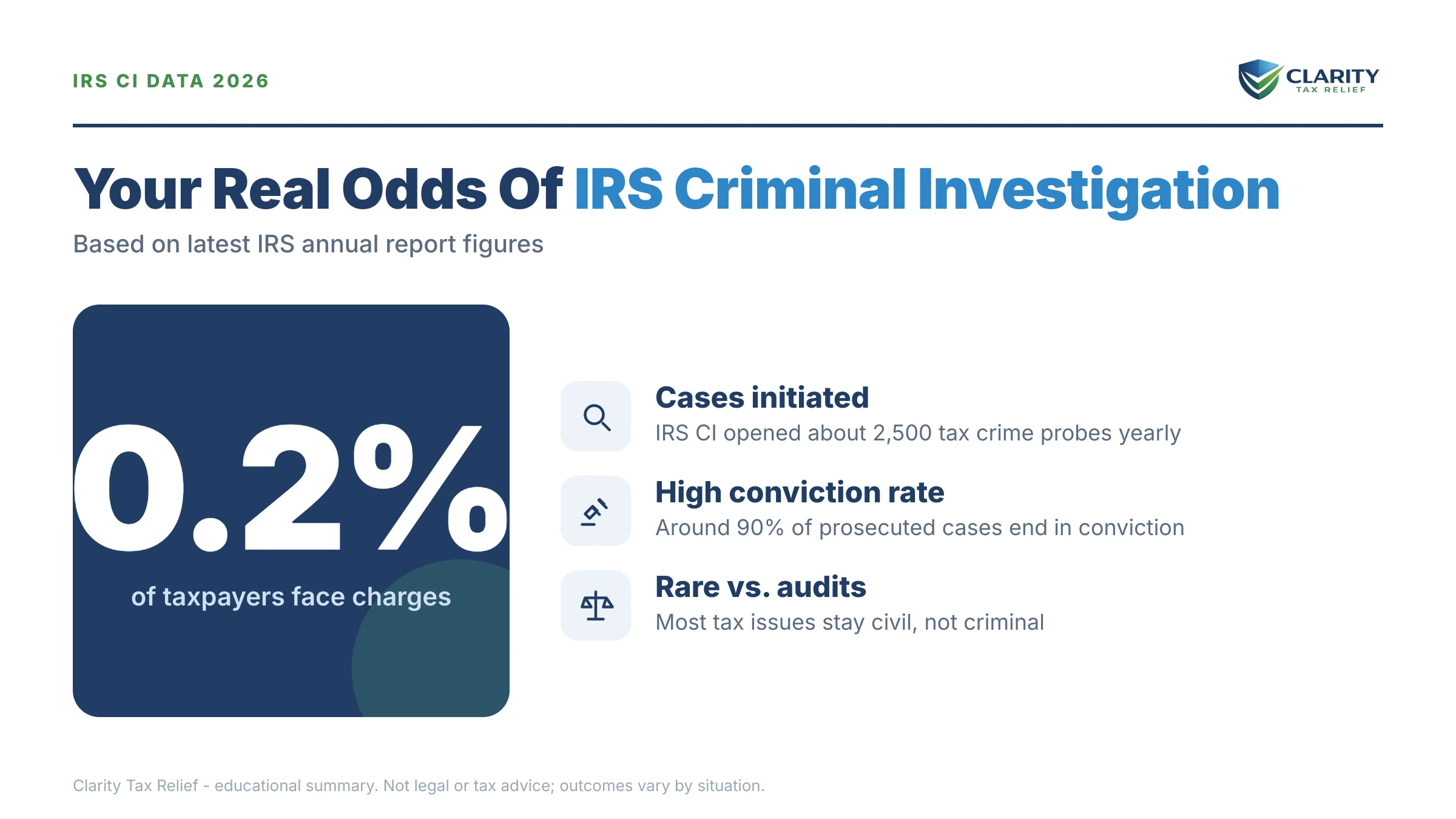
The short answer: IRS criminal investigation statistics show CI opens roughly 2,500–3,000 new cases a year — against more than 160 million individual returns filed. That's fewer than one case per 50,000 returns, and nearly all target willful fraud. Owing money you can't pay, or filing late, is a civil problem, not a crime.
You typed this search at midnight because a 1099 balance you can't cover, maybe a return you never filed, has quietly turned into a question about prison. Take a breath: the data below is going to be the most reassuring thing you read today, because the numbers show exactly who the IRS prosecutes, and it almost certainly isn't you.
The funnel graphic further down this page shows just how sharply those numbers narrow — from millions of returns to a few thousand cases — and where an ordinary unpaid balance actually sits inside them.
⏱ The real clock: there's no criminal deadline attached to an ordinary tax debt, but the civil clock never stops. The failure-to-file penalty runs at 5% per month (up to 25% of the balance), ten times the 0.5% monthly failure-to-pay rate, and interest compounds on top. Filing now is the single cheapest move you can make.
IRS criminal investigation statistics: the 2026 funnel at a glance
IRS Criminal Investigation (CI) initiates roughly 2,500 to 3,000 new investigations per year against a backdrop of more than 160 million individual returns — fewer than one case for every 50,000 returns filed.
CI is the only federal agency authorized to investigate criminal violations of the Internal Revenue Code, and it does it with a small force — on the order of a couple thousand special agents nationwide. That scarcity forces brutal selectivity: agents pursue the largest, most deliberate schemes, and a meaningful share of the caseload isn't ordinary tax evasion at all, but money laundering, narcotics-related finances, and cybercrime. The image below lays the same funnel out visually so you can see where you stand.
| Stage of the funnel | Approximate recent figure | What it means for you |
|---|---|---|
| Individual returns filed per year | 160 million+ | The universe CI selects from |
| New CI investigations initiated | Roughly 2,500–3,000 per year | Fewer than 1 in 50,000 returns |
| Cases recommended for prosecution | A fraction of investigations — well under 2 in 3 | Weak or borderline cases are dropped |
| Conviction rate on prosecuted cases | Consistently around 90% | Only near-certain willfulness cases are charged |
| CI special agents nationwide | Roughly 2,000 | Capacity exists only for the biggest cases |
For scale, hold those few thousand cases against the enforcement volume in our IRS tax collections statistics and IRS back tax debt statistics guides: the IRS runs millions of civil collection actions a year. The machine that touches ordinary taxpayers is civil, automated, and relentless, but it is not criminal.
Why so few tax cases ever go criminal
The line between a civil tax debt and a criminal tax case is a single word: willfulness — the government must prove beyond a reasonable doubt that you knew your legal duty and deliberately violated it.
That burden is why mistakes, sloppy records, aggressive-but-arguable deductions, and pure inability to pay never become criminal cases. A prosecutor can't prove intent from a missed quarterly payment. What CI needs are affirmative acts of concealment: fake invoices, hidden accounts, cash skimmed and never deposited, income routed through nominees.
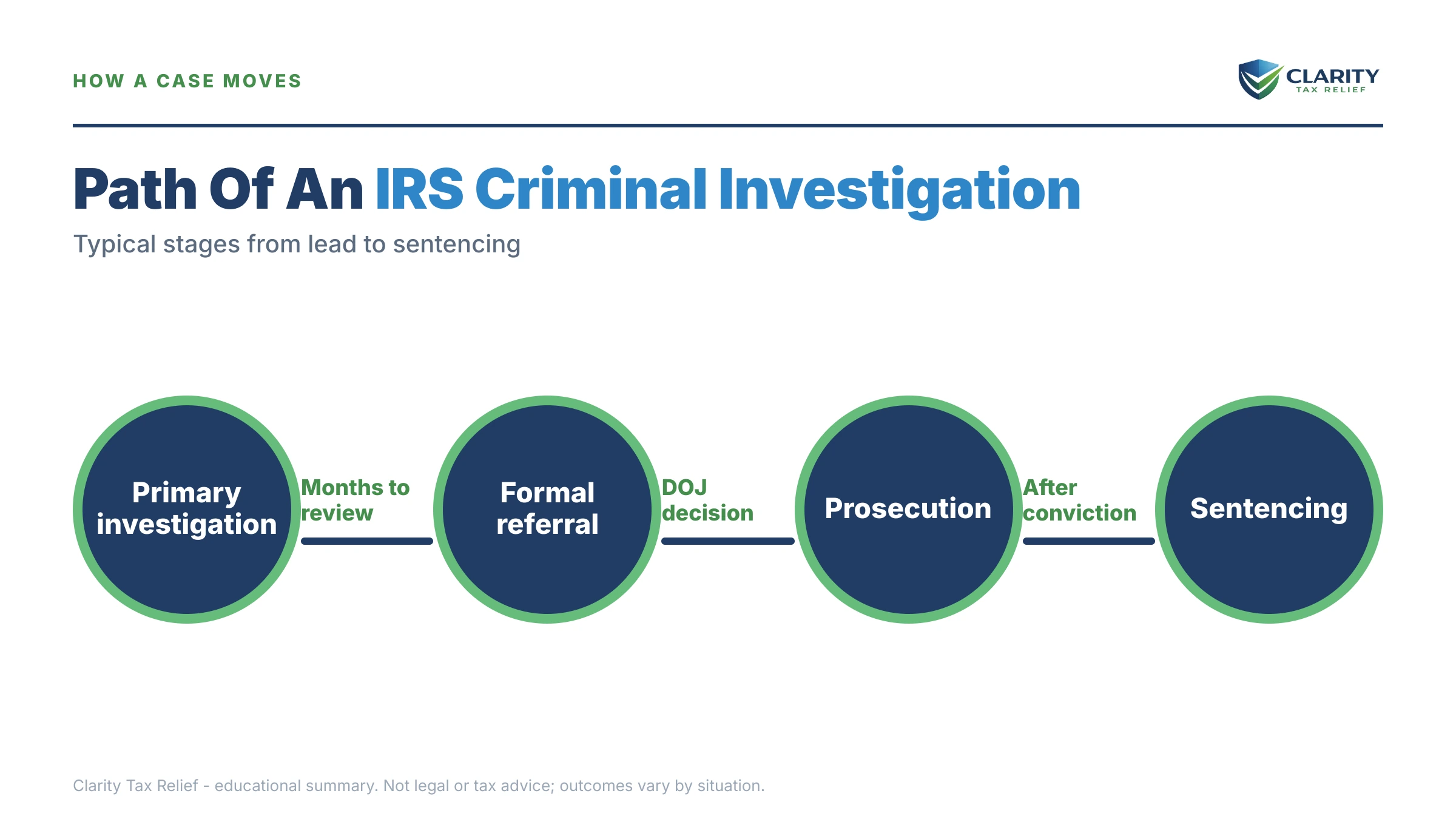
The famous ~90% conviction rate is really a selection statistic. Cases pass through a civil examiner, a fraud referral, CI's own evaluation, and Department of Justice review before an indictment, and each gate discards anything short of overwhelming evidence. If you want the honest breakdown of what pushes a file through those gates, see when does the IRS refer to criminal investigation; if you're in an audit that might have fraud underneath it, the eggshell audit guide covers that specific tightrope.
“IRS Criminal Investigation (IRS-CI) serves the American public by investigating potential criminal violations of the Internal Revenue Code and related financial crimes in a manner that fosters confidence in the tax system and compliance with the law.”
— Criminal Investigation (IRS.gov)
What the IRS actually prosecutes
Federal criminal tax charges cluster around four statutes, and the flagship, tax evasion under IRC §7201, carries up to five years in federal prison per count.
| Statute | Conduct | Maximum penalty |
|---|---|---|
| IRC §7201 — tax evasion | Willful attempt to evade tax through affirmative acts of concealment | Felony; up to 5 years per count, plus fines |
| IRC §7202 — employment tax | Willful failure to collect or pay over withheld payroll taxes | Felony; up to 5 years, plus fines |
| IRC §7203 — failure to file | Willful failure to file a required return | Misdemeanor; up to 1 year per unfiled year, plus fines |
| IRC §7206(1) — false return | Signing a return you know is materially false | Felony; up to 3 years, plus fines |
Notice what's missing from that table: owing money. There is no statute that criminalizes a balance due. We break down the file/pay distinction in can you go to jail for not filing taxes and can you go to jail for owing the IRS — the short version is that filing honestly, even without paying a cent, removes almost all criminal exposure.
What the numbers mean if you're a 1099 contractor who owes $4,800
A $4,800 unpaid self-employment tax bill is a civil arithmetic problem, and the arithmetic, not an agent, is what punishes waiting.
Say you're a 1099 contractor who never filed last year's return and would owe $4,800. This is clearly hypothetical, but the math is real:
- If you don't file: the failure-to-file penalty accrues at 5% per month and caps at 25% — up to $1,200 added (25% × $4,800) after five months.
- If you file but can't pay: the failure-to-pay penalty is only 0.5% per month — about $24/month on $4,800 — plus compounding interest. That's why filing immediately, even broke, is the 10-to-1 winner.
- To resolve it: with the balance under $10,000, a guaranteed installment agreement paying roughly $6,300 (balance plus accrued penalties and interest) over 36 months runs in the neighborhood of $175/month.
You can estimate your own penalty and interest buildup with our IRS Penalty & Interest Calculator. And here's the criminal-statistics context: CI would need proof you willfully concealed that income with affirmative acts. A $4,800 balance you're actively addressing isn't in the same universe as the cases in the tables above.
What happens if you ignore the debt, and where "criminal" really starts
Ignoring a tax balance triggers an automated civil collection sequence — notices, then liens, then levies — long before any human ever considers whether a case is criminal.
- CP14 — the first bill, with the due date printed on the notice before escalation.
- CP501 / CP503 — reminder notices while penalties and interest compound monthly.
- CP504 — intent to levy your state tax refund; a federal tax lien becomes a live possibility.
- LT11 / Letter 1058 — final notice of intent to levy, starting a 30-day window to request a Collection Due Process hearing on Form 12153.
- Levy — bank accounts (with a 21-day hold before funds leave) and continuous wage levies until the debt is resolved or released.
The criminal track runs on entirely separate rails. It usually begins with a fraud referral out of a civil audit, not with a missed notice, and if two special agents ever do appear, the rules change instantly. Our guide to an IRS criminal investigation contact covers exactly what to do (and not do) in that rare event.
One 2026 reality check: the IRS workforce shrank about 27% in 2025, so humans are harder to reach. But the automated notice-and-levy systems above never stopped running. Fewer staff makes problems slower to fix, not safer to ignore.
Behind on 1099 taxes and not sure how deep the hole is?
Unfiled years and a growing balance are civil problems with fixed, knowable solutions, but penalties and interest accrue every month you wait. An experienced tax professional will pull your IRS records, map exactly where you stand, and lay out your options. Free and confidential.
Your civil resolution options if you owe
Every ordinary tax debt has a civil resolution path, and for individuals with an income-tax balance of $10,000 or less (excluding penalties and interest), the IRS must accept a payment plan when you meet the conditions of a guaranteed installment agreement.
| Option | Who qualifies | Cost |
|---|---|---|
| Short-term payment plan | Can pay in full within 180 days | $0 setup; interest and 0.5%/month penalty continue |
| Guaranteed installment agreement | Individuals only; income-tax balance of $10,000 or less (excluding penalties and interest); all returns filed; timely filed and paid for the prior 5 years with no installment agreement in that period; full pay within 3 years | Setup fee (lower via direct debit); interest continues |
| Streamlined installment agreement | Owe $50,000 or less; up to 72 months; can be set up online | Setup fee (reduced or waived for low income); interest continues |
| Currently Not Collectible | Form 433-F financials show paying would prevent basic living expenses | $0; collection pauses but the debt, penalties, and interest remain |
| Offer in Compromise | Means-tested — assets plus future income genuinely can't cover the debt; the IRS accepted roughly 1 in 5 offers in FY2024 | $205 fee + 20% down on lump-sum offers (both waived with low-income certification) |
| Penalty relief (First-Time Abate / AEP) | Clean compliance for the prior 3 years; Automatic Exemption from Penalty (AEP) begins applying automatically in summer 2026 | Free |
Which option to pick, how to apply, and how to negotiate each one is covered step by step in our DIY pillar on how to settle tax debt yourself. This page's job is the statistics; that one's job is the playbook. Official plan terms live on the IRS payment plans page.
How to respond if you're worried, step by step
- File every unfiled return. Voluntary filing before the IRS contacts you converts a potential willfulness question into an ordinary civil balance, and stops the failure-to-file penalty, which runs 10 times faster than the failure-to-pay penalty.
- Pull your IRS records. Log into your IRS online account and request wage and income transcripts for each missing year so you know exactly what the IRS already has on file before you file or negotiate.
- Pick a civil payment path. Match your balance to the options table above — a short-term plan, guaranteed or streamlined installment agreement, hardship status, or an Offer in Compromise if you genuinely qualify — and set it up before enforcement notices start.
- Skip the quiet shortcut if fraud is in the picture. Silently amending returns that understated income can backfire. If the original omissions were deliberate, the IRS Voluntary Disclosure Practice is the safer, structured route back into compliance.
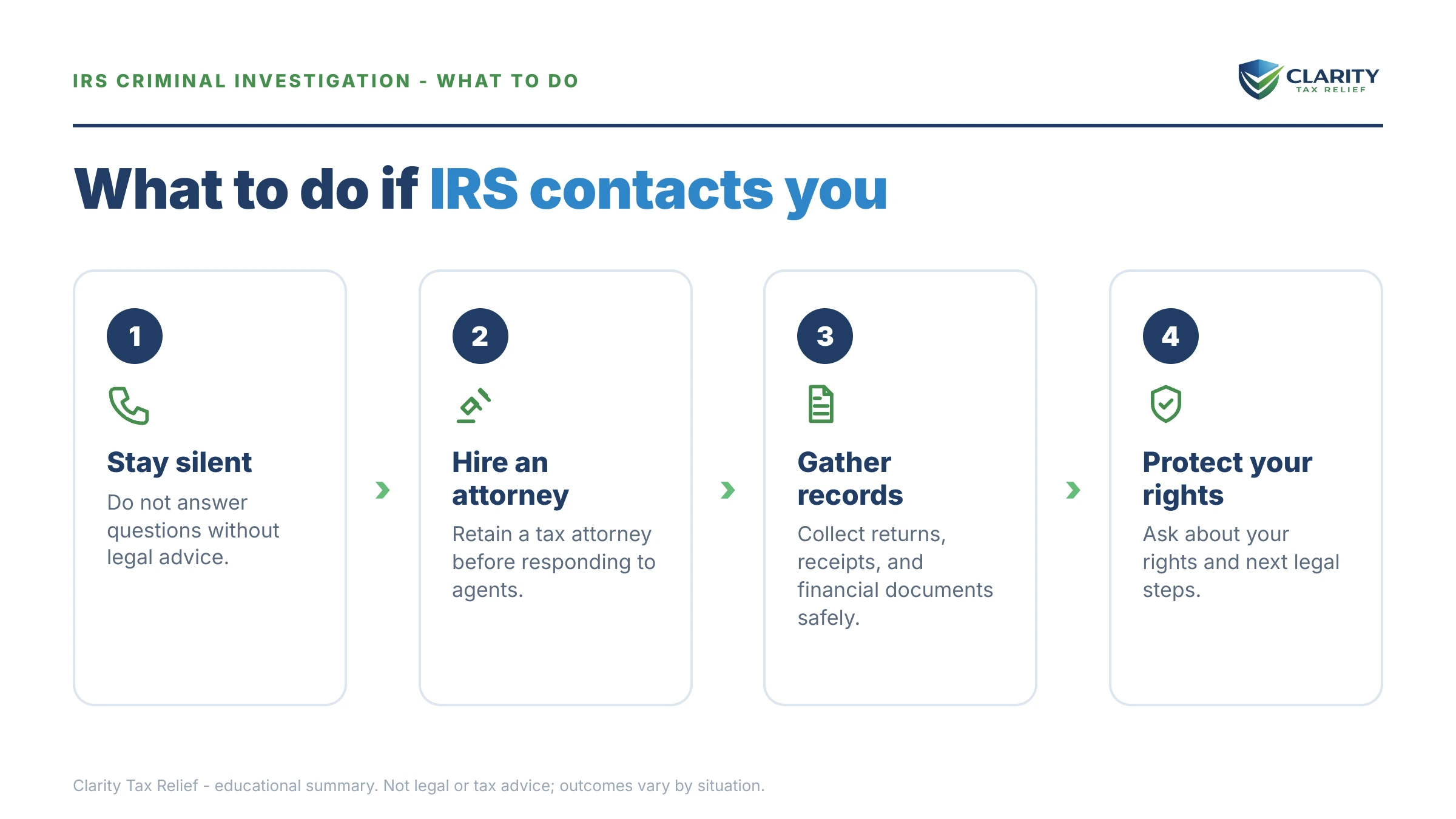
- Get experienced help if any criminal flag applies. If special agents have contacted you, an auditor has gone quiet mid-exam, or years of large cash income were never reported, stop talking and get an experienced tax professional — for genuine criminal exposure, a tax attorney — before you say anything else.
On step 4: the risks of the silent-fix route are covered in our quiet disclosure guide. The formal alternative in the IRS voluntary disclosure walkthrough. On step 1, voluntarily file old tax returns shows exactly how coming forward works in practice.
When you can handle this yourself, and when help changes the outcome
If your situation is a filed (or filable) return and a balance you can pay within 72 months, you can handle this yourself with the IRS's online tools — no professional required.
That describes most people who land on this page: a contractor with one or two rough years, a $4,800-class balance, and no concealment anywhere in the story. File, pick a plan, done.
Experienced help genuinely changes outcomes in a narrower set of cases: multiple years unfiled with substantial 1099 or cash income, an audit where the original returns hid something, payroll tax that was withheld from workers and never paid over, or any actual contact from CI special agents. In those situations, sequencing and what you say matter enormously, and where real criminal exposure exists, only a tax attorney's communications carry privilege. CI publishes its own annual enforcement figures at IRS Criminal Investigation if you want to check the numbers on this page against the source.
Terms in criminal-tax statistics, decoded
- Willfulness — the voluntary, intentional violation of a known legal duty; the element that separates every criminal tax case from a civil debt.
- Special agent — a CI criminal investigator with a badge and a firearm, entirely different from the civil auditors and revenue officers most taxpayers meet.
- Criminal referral — the handoff of a file from a civil examiner to CI when fraud indicators appear during an audit or collection case.
- Badges of fraud — the classic evidence patterns examiners watch for: two sets of books, destroyed records, hidden accounts, false statements, unreported income streams.
- Eggshell audit — a civil audit sitting on top of returns with potential criminal problems, where every answer must be handled with extreme care.
- Voluntary disclosure — the IRS's structured program for taxpayers with willful noncompliance to come forward before they're caught, dramatically reducing the odds of prosecution.
IRS criminal investigation questions, answered
How many criminal investigations does the IRS open each year?
IRS Criminal Investigation has initiated roughly 2,500 to 3,000 new investigations per year in recent fiscal years, according to its published annual reports. Compare that with more than 160 million individual returns filed annually. The odds of any given taxpayer facing a criminal case fall below one in 50,000. Nearly all of those cases involve willful fraud, not unpaid balances.
What percentage of IRS criminal investigations end in conviction?
Of the cases that reach prosecution, IRS Criminal Investigation reports a conviction rate consistently around 90 percent. That number sounds terrifying, but it reflects extreme selectivity: CI only recommends prosecution when the evidence of willfulness is overwhelming. Weak cases are dropped long before an indictment, which is why the ones that survive almost always end in conviction.
Can you go to jail for owing the IRS money?
No — owing tax you cannot pay is a civil matter, and there is no debtor's prison for tax debt. Criminal exposure requires willfulness: deliberately hiding income, faking deductions, or refusing to file for years while knowing you must. If you filed honestly and simply can't pay, the worst-case outcomes are penalties, interest, liens, and levies, not handcuffs.
Does not filing taxes lead to a criminal investigation?
Almost never on its own. Willful failure to file is a misdemeanor under IRC §7203, but CI reserves prosecution for extreme patterns, typically higher-income taxpayers who skipped many years after repeated IRS contact. Filing your missing returns before the IRS reaches out almost always keeps the matter civil, which is why acting first matters so much.
Do 1099 contractors get criminally investigated for unpaid taxes?
A 1099 contractor who owes a few thousand dollars is nowhere near CI's radar. The unit's caseload centers on large-dollar fraud, employment-tax schemes, and money laundering. What contractors actually face is the automated civil machine — penalties of up to 25 percent, refund offsets, and eventually levies. The fix is filing and picking a payment option, not fearing agents at the door.
Is IRS Criminal Investigation still active after the 2025 IRS layoffs?
Yes. The IRS workforce shrank by roughly 27 percent in 2025, which slowed phone service and case processing, but CI continues opening cases. The automated civil collection systems that mail notices and issue levies never stopped. Fewer humans mostly means it's harder to reach the IRS to fix a problem, not that enforcement disappeared.
What triggers an IRS criminal referral?
Referrals usually start when a civil auditor or revenue officer spots 'badges of fraud' — two sets of books, destroyed records, hidden bank accounts, false statements, or a long pattern of unreported income. The examiner suspends the audit and sends the file to CI for evaluation. Isolated mistakes, honest disagreements over deductions, and inability to pay are not referral triggers.
How to cite this data
Clarity Tax Relief, “IRS Criminal Investigation Statistics (2026): Your Real Odds of a Criminal Tax Case,” updated July 15, 2026, https://claritytaxrelief.com/blog/irs-criminal-investigation-statistics/. Figures come from the IRS sources cited on this page; please link to this page when you use them.
Your next 24 hours
- Count what's open. Log into your IRS online account and write down two numbers: how many years are unfiled, and what balance (if any) the IRS shows assessed.
- Gather your income records. Pull your 1099s, bank statements, and expense records for each missing year. Wage and income transcripts can fill any gaps.
- Get a free case review. If you're a 1099 contractor with unfiled years or a balance you can't pay, an experienced tax professional will map the cheapest civil path back to compliance. The 2-minute form or (888) 825-7779. Penalties and interest accrue monthly either way; nothing gets cheaper by waiting.
This guide is general information, not tax or legal advice for your specific situation. Eligibility for IRS programs depends on individual facts and circumstances; no outcome is guaranteed.
Read the transcript
Host: You've got a balance you can't cover, maybe a year you never filed at all, and somewhere around midnight the question stopped being "how do I pay this" and became "can I go to prison for this." That's the fear we're dealing with today. B, start with the numbers.
Tax specialist: Okay, so. IRS Criminal Investigation, CI, opens somewhere around 2,500 to 3,000 new investigations a year. Against more than 160 million individual returns filed.
Host: 2,500 to 3,000. Against 160 million.
Tax specialist: Right. That's fewer than one case per fifty thousand returns.
Host: And why so few? Is it just that people mostly behave?
Tax specialist: Partly capacity. CI is the only federal unit that can investigate criminal violations of the tax code, and it does it with roughly two thousand special agents nationwide. Two thousand. For the whole country. So they're brutally selective — the biggest, most deliberate schemes. And a real chunk of that caseload isn't even ordinary tax evasion. It's money laundering, narcotics money, cybercrime.
Host: Hm. So where does a guy who owes a few thousand on 1099 income sit in that funnel?
Tax specialist: He isn't really in the funnel. The dividing line is one word — willfulness. The government has to prove, beyond a reasonable doubt, that you knew your legal duty and deliberately violated it.
Host: Say that more simply for me.
Tax specialist: They need affirmative acts of concealment. Fake invoices. Hidden accounts. Cash skimmed and never deposited. Income routed through other people's names. A prosecutor can't build intent out of a missed quarterly payment or messy bookkeeping.
Host: Okay, but here's the number that scares people. The conviction rate. Ninety percent.
Tax specialist: Consistently around ninety percent, yeah. But that's a selection statistic, not a warning.
Host: Unpack that.
Tax specialist: A file has to pass a civil examiner, then a fraud referral, then CI's own evaluation, then Department of Justice review before anyone gets indicted. Every one of those gates throws out anything short of overwhelming evidence. Well under two in three investigations even get recommended for prosecution. So by the time a case is charged, it's already been filtered four times.
Host: So the ninety percent is measuring what survived, not what was likely.
Tax specialist: Exactly that.
Host: What do they actually charge? Because I think people imagine there's a statute for owing money.
Tax specialist: There isn't. Four statutes cluster most of it. IRC 7201, tax evasion — that's the flagship, a felony, up to five years per count. IRC 7202, willfully failing to pay over payroll tax you withheld from workers, also up to five years. IRC 7203, willful failure to file. That one's a misdemeanor, up to a year per unfiled year. And IRC 7206(1), signing a return you know is materially false, up to three years.
Host: And nothing in there is —
Tax specialist: Nothing in there is "had a balance and couldn't pay it." That's the whole point. Filing honestly, even if you can't send a dollar, removes almost all criminal exposure.
Host: Alright. So if the criminal clock basically isn't running, what is running?
Tax specialist: The civil arithmetic. And that's the part that actually costs you. Failure to file runs at five percent a month, capped at twenty-five percent of the balance. Failure to pay is a half percent a month. Ten to one.
Host: Ten to one. Wait, so not filing is ten times more expensive than not paying?
Tax specialist: Per month, yes, and interest compounds on top. The article walks a hypothetical: contractor, never filed, would owe $4,800. Don't file, and after five months the failure-to-file penalty has added up to $1,200. File and just can't pay — that's about twenty-four dollars a month instead.
Host: That's the cheapest move available and it costs nothing but the paperwork.
Tax specialist: That's why we lead with it. And on that same hypothetical — under ten thousand dollars, a Guaranteed Installment Agreement paying about $6,300 total, balance plus penalties and interest, over thirty-six months lands in the neighborhood of $175 a month.
Host: Say the name of that program again.
Tax specialist: Guaranteed Installment Agreement. It's a statutory program — IRC 6159(c). For individuals, income tax balance of ten thousand or less excluding penalties and interest, and the IRS has to accept it when you meet the conditions.
Host: And the conditions are the hard part, I assume.
Tax specialist: They're strict, and I want to be straight about it. All returns filed. Timely filed and paid for the prior five years, with no installment agreement during that period. Full pay within three years. If you've got several unfiled years behind you, that prior-five-years test is where people fall out. It's not a formality.
Host: So what's there if you don't meet it?
Tax specialist: Short-term plan if you can pay inside 180 days. Streamlined installment agreement for fifty thousand or less, up to seventy-two months, set up online. Currently Not Collectible, where a Form 433-F shows paying would keep you from basic living expenses — collection pauses, but the debt and the interest keep sitting there. Offer in Compromise is means-tested; the IRS accepted roughly one in five offers in fiscal 2024. And First-Time Abate for penalties if you've got clean compliance the prior three years.
Host: Let's talk about what happens if someone just... doesn't open the mail.
Tax specialist: Then the automated civil track runs, and it runs without a human deciding anything. CP14 is the first bill — about twenty-one days to pay or arrange payment. CP501, CP503 are reminders while penalties compound. CP504 is intent to levy your state refund, and a federal lien becomes live. Then LT11, or Letter 1058, final notice of intent to levy. That starts a thirty-day window to request a Collection Due Process hearing on Form 12153.
Host: LT11 or Letter 1058, thirty days, Form 12153.
Tax specialist: Thirty days. Don't sleep on that one. After it, levies — bank accounts with a twenty-one day hold before funds actually leave, and continuous wage levies until it's resolved or released.
Host: And the criminal side never touches that sequence?
Tax specialist: Separate rails entirely. A criminal case usually starts with a fraud referral out of a civil audit — an examiner spots badges of fraud, two sets of books, destroyed records, hidden accounts, and suspends the exam. It doesn't start with a missed notice.
Host: One more thing from the article — the staffing cut.
Tax specialist: The IRS workforce shrank about twenty-seven percent in 2025. Which mostly means humans are harder to reach. The notice and levy systems never stopped. Fewer staff makes a problem slower to fix, not safer to ignore.
Host: Okay. Where does Clarity actually fit, and where do we not?
Tax specialist: If it's a filable return and a balance you can handle inside seventy-two months, honestly, you can do this yourself with the IRS's online tools. Where experienced help changes the work is multiple unfiled years with substantial 1099 or cash income, an audit where the original returns hid something, or payroll tax withheld and never paid over. And if special agents have actually contacted you, or an auditor went quiet mid-exam — that's real criminal exposure, it sits outside what we handle, and you should stop talking and speak with your own counsel about it before you say anything else.
Host: What about quietly amending the old return to fix the numbers?
Tax specialist: If the original omissions were deliberate, that can backfire. The structured route is the IRS Voluntary Disclosure Practice. Not a do-it-yourself project.
Host: So — next twenty-four hours. What do you want someone doing tonight?
Tax specialist: Two numbers. Log into your IRS online account and write down how many years are unfiled and what balance the IRS shows assessed. Then pull wage and income transcripts for each missing year, so you know what they already have before you file or negotiate. Then match your balance to a payment path.
Host: And if you want someone to pull the records with you and lay out the options, that's a free, confidential case review — 888-825-7779. We can't promise you a particular result; eligibility turns on your specific facts. But the penalties accrue monthly either way, and nothing about this gets cheaper by waiting.