
IRS Data & Statistics
IRS Installment Agreement Statistics: What the Numbers Show in 2026
What this episode covers
- Does the IRS publish an approval rate for installment agreements?
- What are the IRS payment plan tiers based on the balance owed?
- What is the sequence of IRS collection notices before a levy?
- Why do IRS installment agreements often default for self-employed taxpayers?
The short answer: installment agreements are the IRS's most-used resolution program — the IRS Data Book shows millions of payment plans set up each year, and approval under $50,000 is close to automatic once your returns are filed. By contrast, the IRS accepted roughly 1 in 5 offers in compromise in FY2024.
Most IRS installment agreement statistics floating around online are either marketing or guesses. You're probably here because you're about to commit to a monthly payment — maybe on a few years of 1099 income that never had a dollar withheld — and before you sign up for six years of payments, you want to know your actual odds, the actual costs, and how often these plans blow up. Fair. This page gives you the honest numbers, and only the ones the IRS's own data and rules support.
⏱ The real clock: there's no letter deadline on a statistics page — the clock is compounding. Interest accrues daily and the failure-to-pay penalty adds 0.5% of your balance every month until a plan is in place. On unfiled returns, the failure-to-file penalty runs 5% per month, ten times faster, until it caps at 25%.
IRS installment agreement statistics: the 2026 headline numbers
The IRS enters into millions of new installment agreements every year, making the payment plan the highest-volume tax-debt resolution program in the country. That figure comes from the IRS Data Book, the agency's own annual statistical report, and it dwarfs every other program combined.
Here is what the verifiable numbers actually show in 2026:
- Volume: installment agreements number in the millions each year. Offers in compromise, the program most heavily advertised on late-night TV, produced acceptances at a rate of roughly 1 in 5 offers in FY2024 — see the real offer in compromise acceptance rate data.
- Acceptance below $10,000: not a statistic at all — it's a statute. If you owe $10,000 or less and meet the compliance criteria, federal law requires the IRS to accept a guaranteed installment agreement.
- Acceptance up to $50,000: criteria-based, not discretionary. File your returns, propose full payment within 72 months, and the online system approves without ever asking for a financial statement.
- Cost of carrying the debt: interest runs at the federal short-term rate plus 3 percentage points, compounded daily. The failure-to-pay penalty continues at 0.5% per month (0.25% while on a plan, if you filed on time).
- The clock behind everything: the IRS has 10 years from assessment to collect. An active payment plan does not stop that clock.
- Passport protection: the 2026 threshold for passport certification is $66,000 of seriously delinquent tax debt, but debt being paid on time under an installment agreement is excluded from that certification.
- 2026 reality check: the IRS workforce shrank roughly 27% in 2025, so humans are harder to reach, but online payment-plan approvals are automated and still process instantly, and so do the automated levies aimed at people without a plan.
Notice what's missing: an official "installment agreement acceptance rate." The IRS doesn't publish one, because below the thresholds there's nothing to accept or reject. You either meet the published criteria or you don't. That's the single most important thing this page can tell you, and it's why the next section matters more than any percentage.
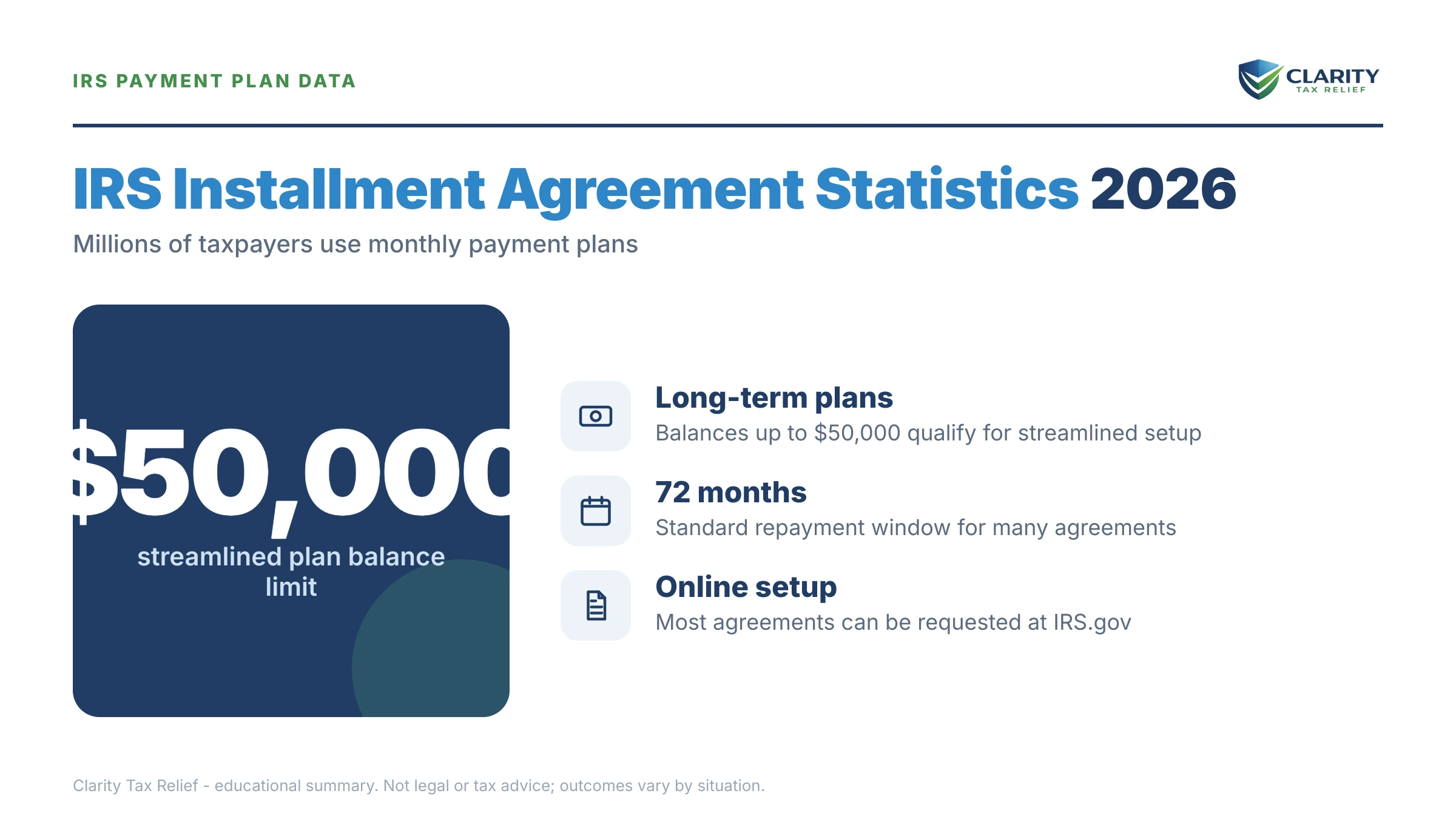
“Simple payment plan (installment agreement): You owe $50,000 or less in combined tax, penalties and interest. You have filed all required returns.”
— Online payment agreement application (IRS.gov)
Why payment plan approval is nearly automatic under $50,000
Below $50,000, an IRS installment agreement is a checklist, not an application that gets judged. The table below shows exactly where your balance puts you, and it's the reference data readers screenshot, because the IRS scatters it across a half-dozen pages.
| Balance owed | Plan available | What the IRS requires |
|---|---|---|
| $10,000 or less | Guaranteed installment agreement | Acceptance is required by law: all returns filed, a clean recent compliance history, and full payment within 3 years. |
| $10,001–$25,000 | Streamlined installment agreement | No financial statement. Full payment within 72 months (or by the collection deadline, if sooner). Any payment method. |
| $25,001–$50,000 | Streamlined, online, up to 72 months | No financial statement, but the IRS requires direct debit from your bank account at this tier. |
| $50,001–$100,000 | IRS payment plan over $50,000 | Financial disclosure (typically Form 433-F). The IRS sets the payment from your income, expenses, and assets. |
| Over $100,000 | Non-streamlined, often revenue-officer managed | Full financial review, asset scrutiny, and possible lien filing. Professional representation genuinely changes outcomes here. |
Three situations shift where you land on that table. Married filing jointly: the balance is joint, so both spouses' names ride on one agreement, and the $50,000 line is measured against the combined total, not each spouse's half. Self-employed and 1099 workers: the balance thresholds are the same, but staying approved requires making current-year quarterly estimated payments — more on that in the default section, because it's the number-one way gig workers lose their plans. Business and payroll debt: business balances follow entirely different, lower thresholds and stricter rules, especially where trust-fund payroll taxes are involved — that's its own topic, not a footnote here.
One more structural option worth knowing exists: if the honest math says you can't full-pay before the 10-year collection deadline, a partial payment installment agreement lets you pay what your budget supports, with whatever remains at the deadline generally expiring. It requires financial disclosure and periodic review, but for genuinely tight budgets it's the quiet middle ground between a full-pay plan and an offer.
What the numbers say happens if you wait
Every month without a plan adds 0.5% in penalty plus daily compounding interest, and moves you one notice deeper into an automated collection sequence. The sequence is worth seeing as a whole, because each stage removes an option you have today:
- CP14 — the first bill. You typically have about 21 days from the notice date before the system queues the next letter. No enforcement yet; cheapest moment to act.
- CP501 / CP503 — reminders. Still just bills, arriving weeks apart, each with a bigger balance printed on it.
- CP504 — intent to levy. The IRS can now seize your state tax refund under IRC §6331(d). This is not the final notice, but it's the last cheap exit.
- LT11 / Letter 1058 — final notice of intent to levy. A 30-day clock starts, along with your Collection Due Process rights (requested via Form 12153). After 30 days, wage and bank levies become legal.
- Levy. A bank levy freezes funds with a 21-day hold before the money leaves; a wage levy is continuous until released. At $66,000 of seriously delinquent debt, passport certification enters the picture too.
| Notice | What it means | Your window |
|---|---|---|
| CP14 | First bill for the balance due | Typically about 21 days from the notice date |
| CP501 / CP503 | Reminder bills; balance growing monthly | No enforcement yet — use the date printed on each notice |
| CP504 | Intent to levy; state refund can be seized | Act by the date on the notice, not the final notice, but close |
| LT11 / Letter 1058 | Final notice of intent to levy + CDP rights | 30 days to request a hearing (Form 12153) before levy is legal |
Here's the statistic hiding inside that table: setting up any installment agreement stops the levy sequence while the agreement is in place. That's why the payment plan is the most-used program by millions — it's not the flashiest option, it's the one that reliably turns the machine off.
For a non-filer, there's a second track running in parallel: the IRS can eventually file a substitute return for you, computed with no deductions and no business expenses — which for a gig worker means a balance far larger than what filing your own return would produce. Waiting doesn't just cost penalties; it can inflate the debt itself.
Behind on filing with a balance building?
Three unfiled years plus a growing balance is exactly the kind of case where the order of operations — returns first, penalty relief second, plan third — changes what you end up paying. An experienced tax professional will map your fastest path in one free call. No pressure, no invented urgency: just the sequence.
Installment agreement costs and timelines, by the numbers
What setup fees and interest add up to
A short-term IRS payment plan costs $0 to set up. A long-term plan costs between $0 and $178 depending on how you apply and how you pay. Here's every option side by side — including what keeps accruing on each, because that's the cost the notices never total up for you:
| Option | Setup cost | Time frame | What keeps accruing |
|---|---|---|---|
| Short-term payment plan | $0 | Up to 180 days to pay in full | Daily interest + 0.5%/month failure-to-pay penalty |
| Long-term IA — online, direct debit | As low as $29 (reduced or waived for low-income applicants) | Up to 72 months; online approval is typically immediate under $50,000 | Daily interest + failure-to-pay penalty (0.25%/month if the return was filed on time) |
| Long-term IA — phone or mail (Form 9465) | Up to $225 depending on tier | Up to 72 months; processing takes longer than online | Same as above |
| Partial-pay installment agreement | Standard IA fees + financial disclosure | Runs to the 10-year collection deadline; reviewed periodically | Interest and penalties continue; unpaid remainder generally expires at the CSED |
| Currently Not Collectible | $0 | Until your finances improve (IRS reviews income) | Interest and penalties continue; debt remains |
| Offer in Compromise | $205 fee + 20% down on lump-sum offers (both waived with low-income certification) | Months of review; auto-accepted if the IRS doesn't decide within 2 years | Roughly 1 in 5 offers accepted in FY2024 — never a sure thing |
The fee tiers have their own wrinkles — reinstatement fees, low-income reimbursement rules — covered in our full guide to the IRS payment plan setup fee. And the single biggest "cost" isn't the fee at all: it's interest. The rate resets quarterly off the federal short-term rate plus 3 points and compounds daily. Our breakdown of the installment agreement interest rate shows what that does to a balance over 72 months. The takeaway from the math is always the same: the minimum payment is a floor, not a plan — every extra dollar you pay early is a dollar that stops compounding against you.
One fee note worth its own sentence: choosing a direct debit installment agreement isn't just the cheapest setup — it's mandatory between $25,000 and $50,000. It removes the most common default trigger (a forgotten payment) entirely.
A worked example: $31,200 owed and three years unfiled
Say you're a gig worker who owes $31,200 across three years that were never filed — DoorDash, Uber, a little freelance, all 1099, no withholding. This is hypothetical, but the math is real:
- Step zero is filing, not paying. The IRS won't approve any installment agreement with returns missing. Filing also stops the failure-to-file penalty, which accrues at 5% of the unpaid tax per month, ten times the pay penalty, until it caps at 25%. If you're in this exact spot, start with our guide for people who haven't filed in 3 years: your own returns, with mileage and expenses deducted, will almost always show less tax than anything the IRS computes for you.
- Where $31,200 lands: over $25,000, so the online plan requires direct debit. Under $50,000, so no financial statement is needed and up to 72 months is available.
- The monthly floor: $31,200 ÷ 72 = $433.33 — call it roughly $434/month minimum. Because interest and penalties keep accruing, paying only the floor means the balance shrinks slower than the division suggests.
- The late-filer surcharge: because these returns went in late, the failure-to-pay penalty stays at 0.5% per month on the plan instead of dropping to the 0.25% rate timely filers get. On $31,200, that's about $156 in penalty the first month alone (0.005 × $31,200), declining as the balance falls, until the penalty hits its 25% cap. You can estimate your own buildup with our Penalty & Interest Calculator.
- Why not an offer instead? An offer in compromise settles for less only when the IRS's math says it could never collect the full amount. A single gig worker with steady income and 10 years of collection runway will often compute out above $31,200 — meaning a payment plan, possibly paired with penalty abatement on the filed years, is the realistic path. Whether you're a genuine offer candidate is a math question worth answering before you pay anyone to pursue one.
- The survival requirement: from the day the plan starts, quarterly estimated payments on current gig income are mandatory. A new balance next April defaults the whole agreement.
How to set up an IRS installment agreement, step by step
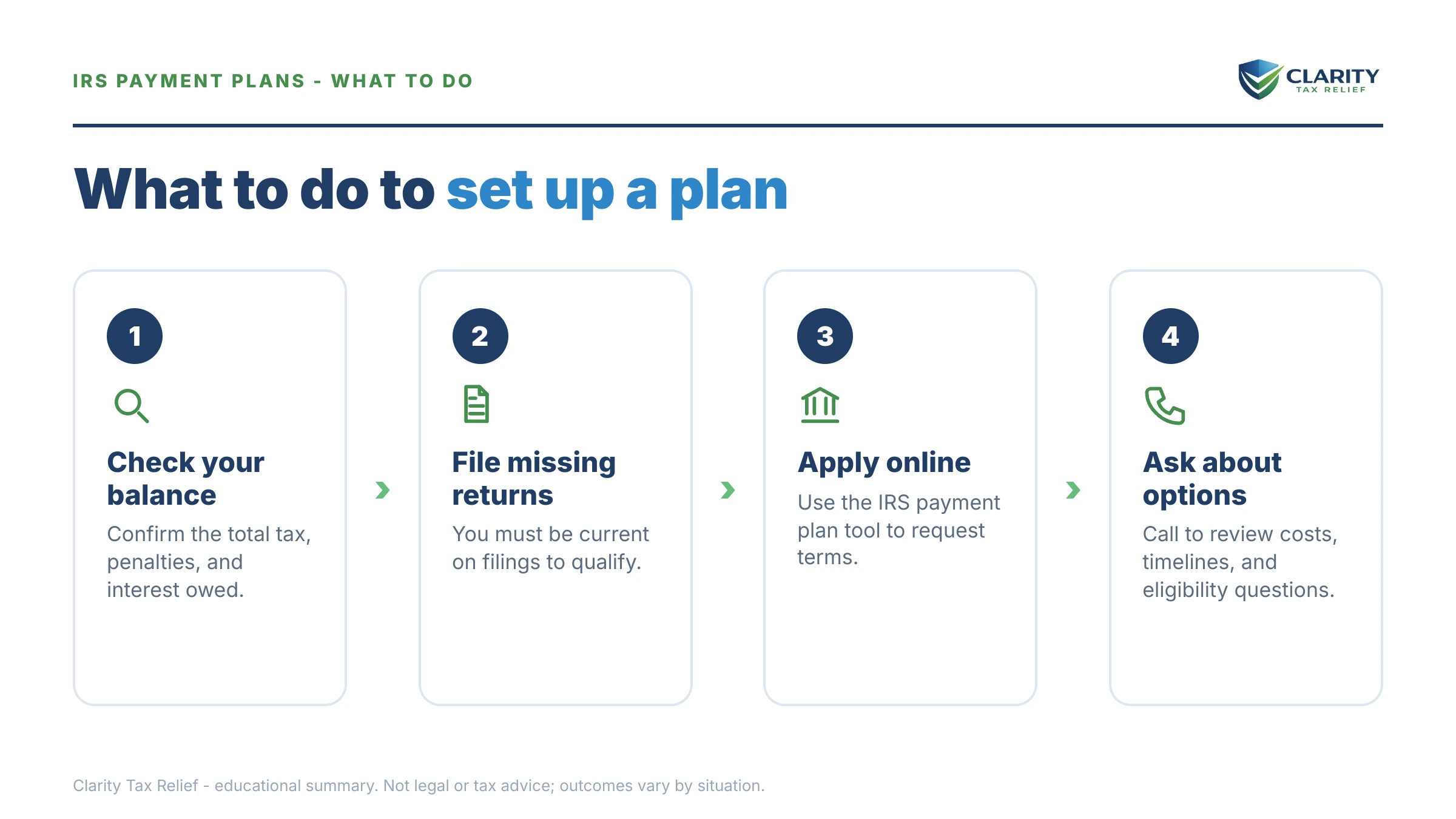
- Pull your numbers. Log into your IRS online account for your exact balance by year, and request wage and income transcripts for every unfiled year.
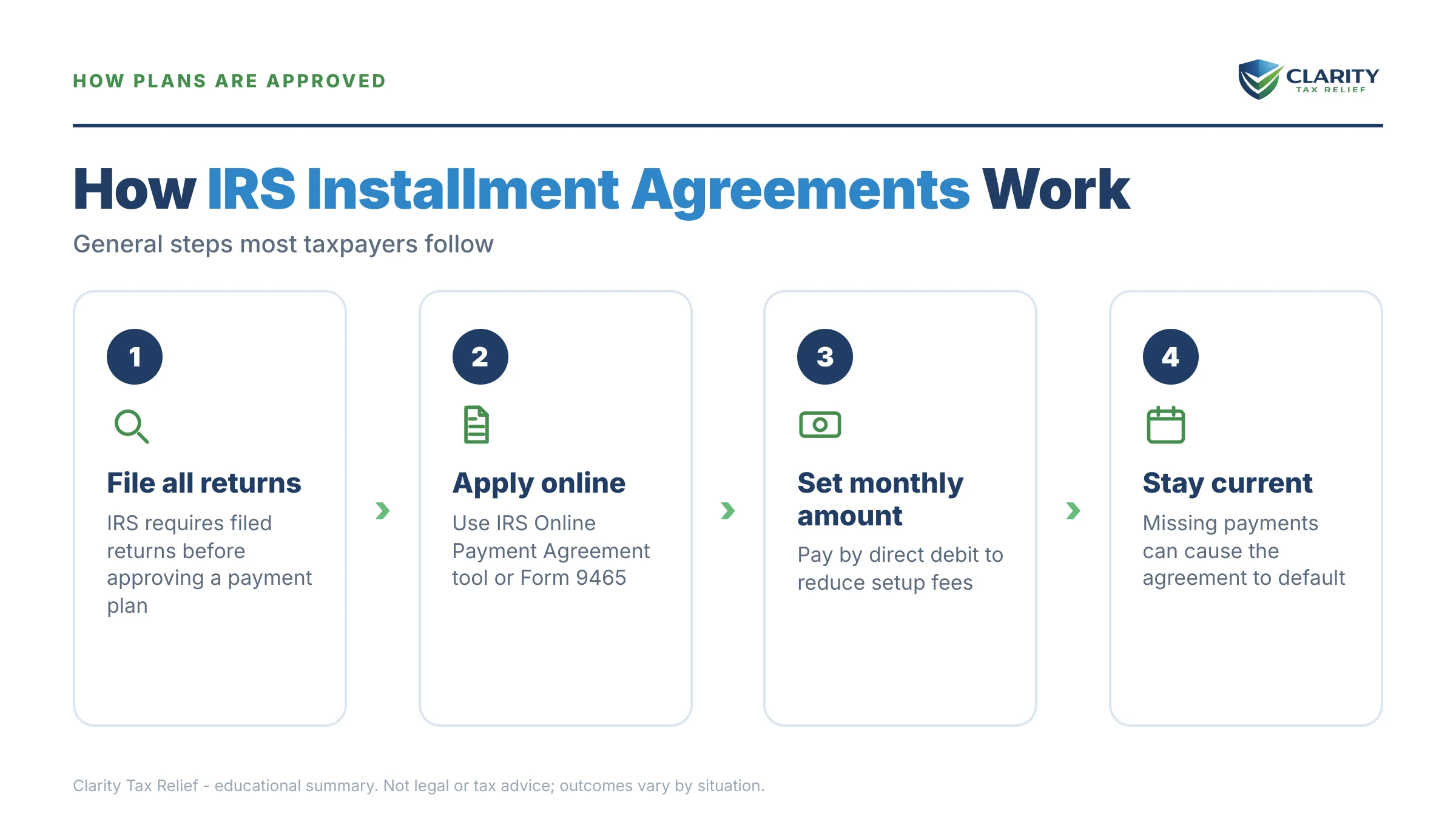
- File every required return. The IRS will not approve any installment agreement while a required return is missing, and filing stops the 5%-per-month failure-to-file penalty.
- Pick your tier. If you can pay in full within 180 days, use a $0-setup short-term plan. Otherwise choose a long-term agreement of up to 72 months.
- Apply online and choose direct debit. The Online Payment Agreement tool gives most applicants under $50,000 an immediate answer, and direct debit carries the lowest setup fee.
- Stay compliant. Make every monthly payment and every current-year quarterly estimated payment on time — a new unpaid balance is the most common default trigger.
The click-by-click walkthrough — screenshots, ID verification, what to do when the tool errors out — lives in our hub guide to setting up an IRS payment plan online. If you apply by phone or mail instead, the IRS confirms the terms on Form 433-D, which is where your direct-debit authorization gets signed.
The statistic nobody tracks: how installment agreements default
The IRS doesn't publish one headline default rate. But the default triggers are documented and predictable: a missed payment, a new unpaid balance, or a missing return. When one fires, the IRS mails a CP523 notice announcing intent to terminate the agreement, and if it terminates, you're back in the levy sequence, this time with less goodwill.
For self-employed and gig readers, the pattern is nearly always the same: the monthly payment gets made faithfully, but no quarterly estimated payments go in during the year. The next filed return creates a new balance. A new balance defaults the plan even if you never missed a monthly payment. Budget the quarterlies as part of the plan, not as a separate problem.
Two other numbers worth knowing while you're on a plan. First, refunds: the IRS keeps any federal refund and applies it to your balance until it's paid. It doesn't count as your payment. It doesn't default you, as we cover in will the IRS take my refund on a payment plan. Second, the 10-year clock: an active agreement doesn't pause the collection statute, so on long plans the CSED quietly matters — especially on a partial-pay agreement, where it's the whole strategy.
On penalties, 2026 brings one genuine change: first-time abatement — which removes penalties for taxpayers with a clean prior three years — is being replaced by the Automatic Exemption from Penalty (AEP) starting summer 2026, which applies automatically with no request needed. If your penalty relief hasn't been addressed before your plan is finalized, check both paths. Relief on even one year shrinks the balance every payment is measured against.
When you can handle this yourself, and when help changes the math
When to file it yourself and when help matters
If your returns are filed, you owe $50,000 or less, and you can afford the 72-month floor, set the plan up yourself online. It takes under an hour, and no firm can get you a better deal on a streamlined agreement than the published criteria already guarantee. Anyone who implies otherwise is selling you your own paperwork. The Taxpayer Advocate Service also exists as a free resource when the IRS itself is the obstacle.
Experienced help genuinely changes outcomes in a narrower set of situations: multiple unfiled years where returns must be reconstructed from transcripts (filing them right, with every deduction, directly shrinks the balance the plan is built on). Balances over $50,000 where the financial statement determines your payment. A levy already in motion. Business or payroll tax debt. And cases where the offer-in-compromise math might actually work and needs to be run properly before you commit to 72 months of payments. In those cases, what you're buying isn't access to a secret program — it's sequence, math, and someone who's done it hundreds of times.
Not sure which side of that line you're on? A free case review with an experienced tax professional at Clarity, or a call to (888) 825-7779 — will tell you honestly whether your situation is a one-hour DIY job or a case where representation pays for itself.
Payment-plan terms, decoded
- Streamlined installment agreement — a plan approved on published criteria alone (balance ≤ $50,000, full pay within 72 months), no financial statement required.
- Guaranteed installment agreement — the official IRS program name for plans the agency must accept by law: balance ≤ $10,000, clean compliance history, full pay within 3 years.
- Partial-pay installment agreement (PPIA) — a plan that pays less than the full balance over time, with the remainder generally expiring when the collection statute runs out.
- CSED — Collection Statute Expiration Date: the end of the IRS's 10-year window to collect, pausable by events like a pending offer, appeal, or bankruptcy.
- Direct debit — automatic monthly withdrawal from your bank account; required for online plans between $25,000 and $50,000 and the cheapest setup tier.
- CP521 / CP523 — the monthly payment-reminder notice, and the default notice announcing intent to terminate your agreement.
IRS payment plan statistics: your questions answered
How many installment agreements does the IRS approve each year?
Millions. The IRS Data Book, the agency's own annual statistical report, consistently shows the IRS entering into millions of new installment agreements every year, making the payment plan the most-used resolution program by a wide margin. No other option comes close in volume: offers in compromise, by comparison, produce only a small fraction of that number in acceptances.
What percentage of IRS payment plan requests are approved?
The IRS does not publish a single approval percentage, because below the published thresholds approval is criteria-based, not discretionary. If you owe $50,000 or less, have every required return filed, and propose full payment within 72 months, the online system approves as a matter of course. At $10,000 or less with a clean compliance history, federal law requires the IRS to accept. Discretion only enters above $50,000, where your financial statement drives the answer.
Is an installment agreement easier to get than an offer in compromise?
Dramatically easier. The IRS accepted roughly 1 in 5 offers in compromise in FY2024, and every offer requires a full financial disclosure and months of review. An installment agreement under $50,000 requires no financial statement at all and is typically approved instantly online. The trade-off is that a payment plan pays the full balance plus interest, while an accepted offer settles for less.
What is the maximum balance for an online IRS payment plan?
$50,000 in combined tax, penalties, and interest, paid over up to 72 months. Between $25,000 and $50,000 the IRS requires direct debit from your bank account. Above $50,000 you can still get an installment agreement. But you will generally need to submit a financial statement such as Form 433-F. The IRS reviews your income, expenses, and assets before setting the payment.
Do penalties and interest stop on an installment agreement?
No — interest keeps accruing at the federal short-term rate plus 3 percentage points, compounded daily, until the balance is paid. The failure-to-pay penalty also continues, though it drops from 0.5% to 0.25% per month while an agreement is in effect if you filed the return on time. If you filed late, that reduction does not apply, which is one more reason late filers benefit from paying more than the minimum.
Can I get an IRS payment plan with unfiled tax returns?
No. The IRS requires all legally required returns to be filed before it will approve any installment agreement, online or otherwise. Filing first also stops the failure-to-file penalty, which runs at 5% of the unpaid tax per month — ten times the rate of the failure-to-pay penalty — until it caps at 25%. File the missing years, let the balances post, then apply.
Does the 10-year collection statute keep running during a payment plan?
Yes. The 10-year collection statute (CSED) continues to run while an active installment agreement is in place — an agreement does not extend the IRS's time to collect. A pending installment agreement request does pause the clock while the IRS considers it, and other events like an offer in compromise, a collection appeal, or bankruptcy pause it as well. On a partial-pay agreement, whatever remains unpaid at the CSED generally expires.
Will the IRS take my tax refund while I'm on an installment agreement?
Yes. The IRS applies any federal refund you are owed to your outstanding balance until it is paid off, even while you are current on your plan. The offset does not count as your monthly payment and does not put you in default. It simply pays the debt down faster. Adjust your withholding or estimated payments if you would rather not lend the IRS money it will keep.
How often do IRS installment agreements default?
The IRS does not publish one headline default rate. But the triggers are well documented: a missed monthly payment, a new balance on a later return, or a missing return. When any of those happen, the IRS sends notice CP523 announcing its intent to terminate the agreement. You get a short window, printed on that notice, to cure the problem before collection restarts. Self-employed taxpayers most often default by missing quarterly estimated payments.
How to cite this data
Clarity Tax Relief, “IRS Installment Agreement Statistics: What the Numbers Show in 2026,” updated July 15, 2026, https://claritytaxrelief.com/blog/irs-installment-agreement-statistics/. Figures come from the IRS sources cited on this page; please link to this page when you use them.
Your next 24 hours
- Pull your real balance. Log into your IRS online account and write down the balance for each year — tax, penalties, and interest separately. If years are unfiled, note which ones; those come first.
- Gather three things: your wage and income transcripts (or 1099s) for every unfiled year, your last filed return, and a realistic monthly income number. That's everything a plan, or a professional review — is built from.
- Get the sequence checked, free. Every month without a plan adds another 0.5% in penalty plus daily interest, and on unfiled years, 5% per month. Send us the numbers through the 2-minute form or call (888) 825-7779. An experienced tax professional will map returns-first, relief-second, plan-third for your exact situation.
Primary sources for the figures on this page: the IRS Data Book (annual program volumes) and the IRS's own payment plans and installment agreements page (current thresholds, fees, and terms).
This guide is general information, not tax or legal advice for your specific situation. Eligibility for IRS programs depends on individual facts and circumstances; no outcome is guaranteed.