
IRS Data & Studies
IRS Notice of Federal Tax Lien Filings Statistics (2026)
What this episode covers
- At what unpaid balance does the IRS typically file a federal tax lien?
- Does a federal tax lien show up on my credit report?
- How long do I have to request a CDP hearing after IRS Letter 3172?
- What is the difference between an IRS tax lien and a levy?
The short answer: IRS data show Notice of Federal Tax Lien filings rose to 214,099 in FY2025 — up about 9% in one year and about 20% from FY2023. That still covers only a minority of delinquent accounts, but the trend is clearly upward as automated enforcement resumes.
If you searched "irs notice of federal tax lien filings statistics," you're either researching the enforcement trend or you just found a lien attached to your property and want to know how common it really is. Both matter. The numbers point the same direction: after years of muted collection, IRS data show the agency is filing more liens again — 214,099 in FY2025, up from 196,996 in FY2024 and 179,019 in FY2023.
Here's the part that catches homeowners off guard: a filed lien can quietly derail a refinance or a home sale even when it never appears on your credit score. The IRS Data Book table below the numbers shows you exactly how the filing count has climbed year over year, and why 2026 is not the year to assume the shrinking IRS forgot about you.
⏱ The clock on your lien: once the IRS files a Notice of Federal Tax Lien, it mails Letter 3172, which gives you 30 days to request a Collection Due Process hearing on Form 12153. Miss it and you lose your best appeal window, and interest plus the late-payment penalty keep accruing the entire time.

How many Notices of Federal Tax Lien the IRS files each year
The IRS filed 214,099 Notices of Federal Tax Lien in FY2025, according to its own Data Book. That's an 8.7% jump from FY2024 and a 19.6% increase over two years. The lien is the IRS's legal claim against everything you own. But the filing count is far smaller than the total number of people who owe back taxes, because a lien is a discretionary enforcement step, not an automatic one.
| Fiscal year | Notices of Federal Tax Lien filed | Change vs. prior year |
|---|---|---|
| FY2023 | 179,019 | — |
| FY2024 | 196,996 | +10.0% |
| FY2025 | 214,099 | +8.7% |
Two takeaways sit inside that table. First, the two-year trend is up 19.6% from FY2023 to FY2025 — a steady climb, not a one-off spike. Second, lien filings rose in the same period the IRS lost roughly 27% of its workforce. The reason is simple: liens are generated by automated systems tied to your account balance, not by an officer manually pulling your file. Fewer employees answer the phones, but the machine that files liens never stopped.
For context on what the agency is chasing, the IRS reported collecting $77.55 billion (FY2024) and $73.14 billion (FY2025) in net receipts on delinquent accounts. Liens are one tool inside that collection engine — the one designed to protect the government's claim before it ever seizes a dollar.
Why the IRS files a Notice of Federal Tax Lien on you
A federal tax lien arises automatically the moment the IRS assesses a tax, sends you a bill. You don't pay, but the Notice of Federal Tax Lien is the separate step of making that claim public. Filing the notice tells the world (and every lender, title company, and creditor) that the government has first claim on your property.
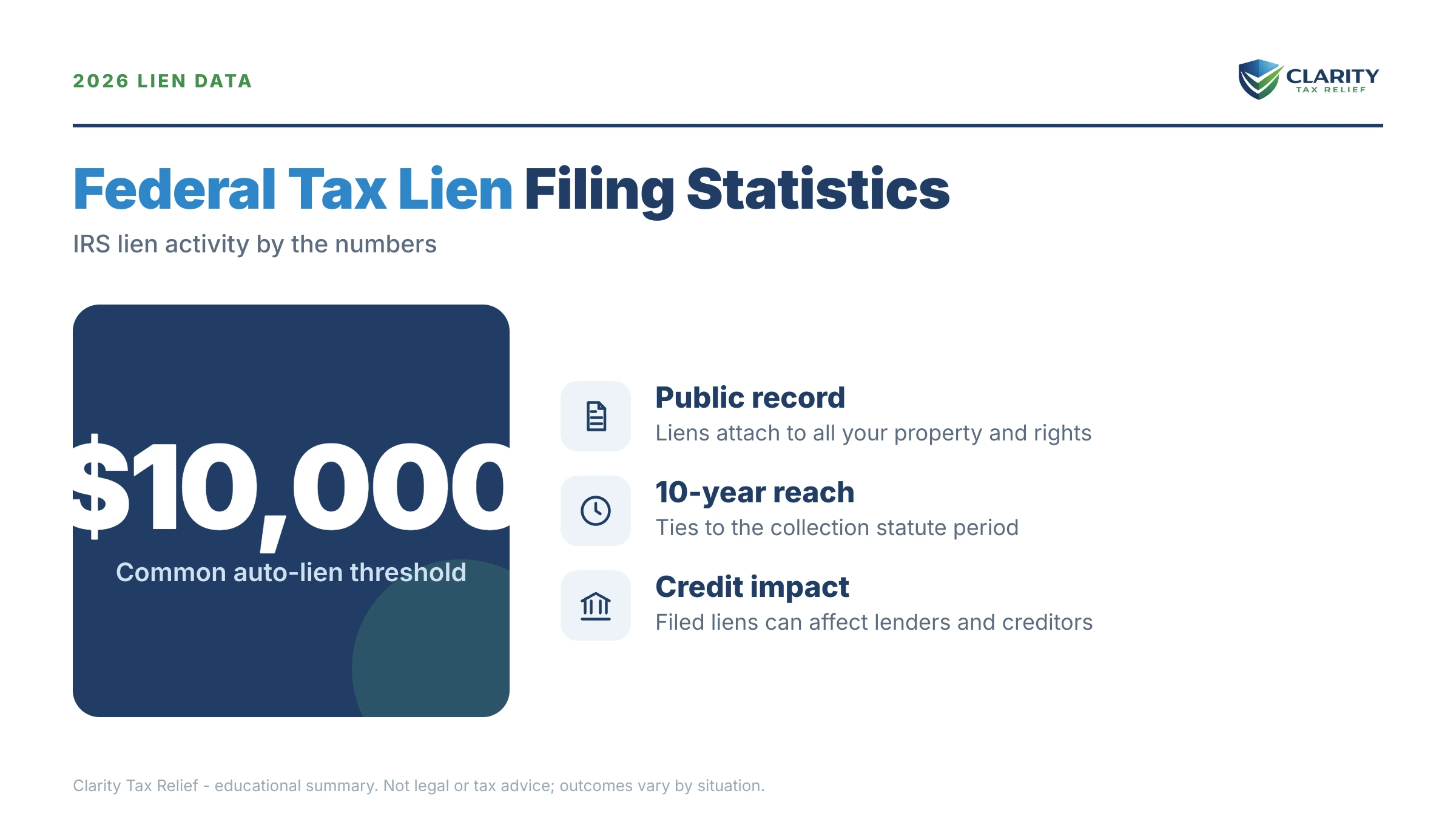
The IRS generally considers filing when your unpaid balance passes $10,000, a threshold set under the Fresh Start initiative. That's a guideline, not a wall. It can file below $10,000 for repeat non-compliance, or hold off above it if you've already set up a direct debit installment agreement. If you're not sure why you received the underlying notice at all, start with our plain-English guide to why did I get a letter from the IRS.
On your transcript, the filing shows up as Code 582 (lien filed), and a later release appears as Code 583. The public record itself is searchable — see how in tax lien public record. The mailed notice that starts your appeal clock is Letter 3172 notice of federal tax lien.
Where the lien fits in the IRS collection sequence
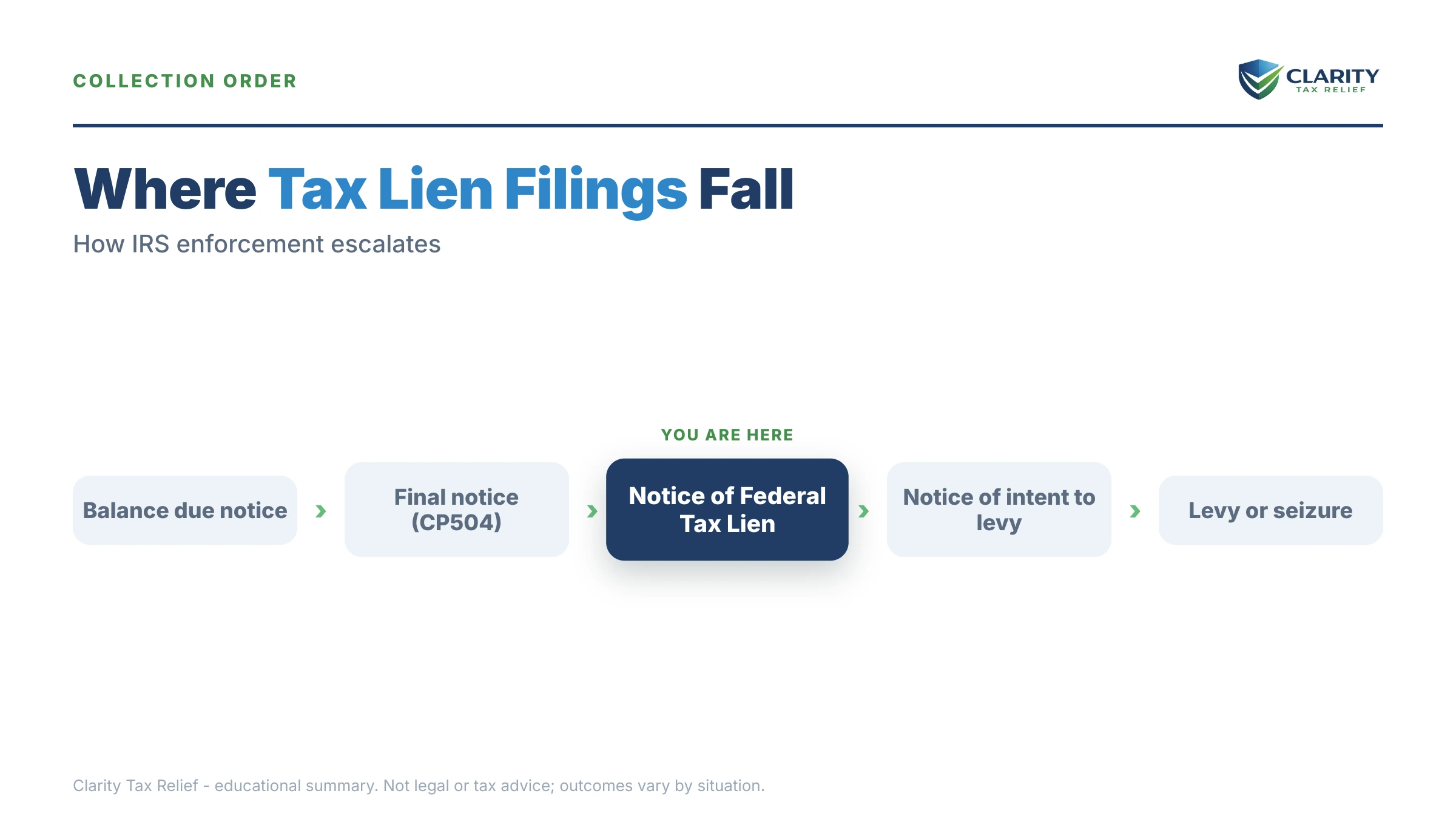
A lien filing doesn't come out of nowhere. It lands after a chain of billing notices you (or a prior address) should have received. Understanding the order tells you how much runway you have and which appeal rights are still open.
| Stage | What it is | Your window |
|---|---|---|
| CP14 | First balance-due bill | ~21 days to pay or arrange |
| CP501 / CP503 | Reminder notices | Balance growing monthly |
| CP504 | Intent to levy state refund; lien becomes likely | ~30 days before state-refund levy |
| Letter 3172 | Notice of Federal Tax Lien filed (public record) | 30 days to request CDP hearing |
| LT11 / Letter 1058 | Final Notice of Intent to Levy | 30 days before wage/bank levy |
The lien (Letter 3172) and the final levy notice (LT11 notice) are separate events with separate 30-day clocks. Getting a CP504 notice is usually the last calm warning before a lien filing enters the picture. And to be clear about the distinction that trips people up — a lien secures the debt, a levy takes your money. The full breakdown is in IRS lien vs levy.
What happens if you ignore a filed lien
Ignoring a Notice of Federal Tax Lien doesn't make it quieter. It lets the government's claim harden while your options narrow. The lien attaches to everything you own now and everything you acquire while it's in force, and the escalation runs on its own timeline:
- The lien attaches to all your property — your home, vehicles, bank accounts, and business assets — the moment it's filed. It follows the property, not just you.
- The public record blocks financing. Lenders and title companies find the lien in a records search, so refinances, home sales, and business loans stall even though the lien no longer shows on your consumer credit score.
- The 30-day CDP window closes. Miss the Letter 3172 deadline and you forfeit the strongest, cheapest way to challenge the lien or negotiate before enforcement.
- Levy notices follow. The LT11 / Letter 1058 arrives, and after its own 30 days the IRS can garnish wages and empty bank accounts — a bank account freeze that most people never see coming.
- Interest and penalties compound the whole time. The balance the lien secures keeps growing every month you wait.
In 2026, this sequence is more automated, not less. The same budget cuts that make the IRS impossible to reach by phone have zero effect on the systems that file liens and issue levies. Waiting for a human to notice your file is not a plan.
Just found a federal tax lien on your property?
If you got Letter 3172, the 30-day Collection Due Process window is already running. An experienced tax professional will review your lien free, tell you whether a withdrawal, subordination, or discharge fits, and lay out your options before the appeal deadline passes.
Your options once a lien is filed
A filed lien is not the end of the road — the IRS has formal ways to release, withdraw, subordinate, or discharge it, each with its own eligibility bar. The right move depends on whether you can pay, what you own, and what you're trying to do (refinance, sell, or just clear the record).
| Option | What it does | Who it fits |
|---|---|---|
| Pay in full | Triggers a Certificate of Release within 30 days | Anyone who can pay the balance |
| Withdrawal (Form 12277) | Erases the public Notice of lien | Paid in full, or ≤ $25,000 on a direct debit installment agreement |
| Subordination (Form 14134) | Lets a new lender take priority | Homeowners refinancing with a lien in place |
| Discharge (Form 14135) | Removes the lien from one specific property | Selling a home the lien is attached to |
| Offer in Compromise | Settles the debt for less; lien releases once paid | When assets + income genuinely can't cover the debt |
| Currently Not Collectible | Pauses collection during hardship (lien stays) | Paying anything would create hardship |
Two of these are the workhorses for homeowners. IRS lien withdrawal Form 12277 is what actually scrubs the public record, and it's available on balances of $25,000 or less once you're in a direct debit plan. For selling, see sell house with IRS lien; for refinancing specifically, can I refinance with an IRS lien walks through subordination. And when the lien finally clears, confirm the paperwork exists — that's the certificate of release of tax lien.
A worked example: the $13,600 lien blocking a refinance
Say you owe $13,600 and you're a homeowner trying to refinance to lock in a better rate. The IRS filed a Notice of Federal Tax Lien last year because the balance crossed $10,000. Your credit score looks fine, the lien doesn't appear there. But your new lender's title search flags it. The deal freezes because the tax lien would outrank the new mortgage.
Here's the math on the cleanest path. You enter a streamlined direct debit installment agreement. On a 72-month term, $13,600 spreads to roughly $189 a month before interest and the reduced 0.25% monthly late-payment penalty that applies while a plan is active. Because your balance is at or under $25,000 and you're paying by direct debit, you become eligible to request a lien withdrawal on Form 12277 after a few on-time payments.
Alternatively, if you can't wait for the withdrawal, you file Form 14134 and ask the IRS to subordinate the lien so the refinancing lender takes first priority. The IRS often agrees when the refinance improves its position — for instance, when cash-out proceeds pay down the tax debt. Either route gets you to closing. The difference is whether you clear the record entirely (withdrawal) or just step the IRS behind your lender (subordination). This is hypothetical. The IRS runs its own math on every request. But it shows why a $13,600 lien is a solvable problem, not a dead end.
How to respond to a Notice of Federal Tax Lien, step by step
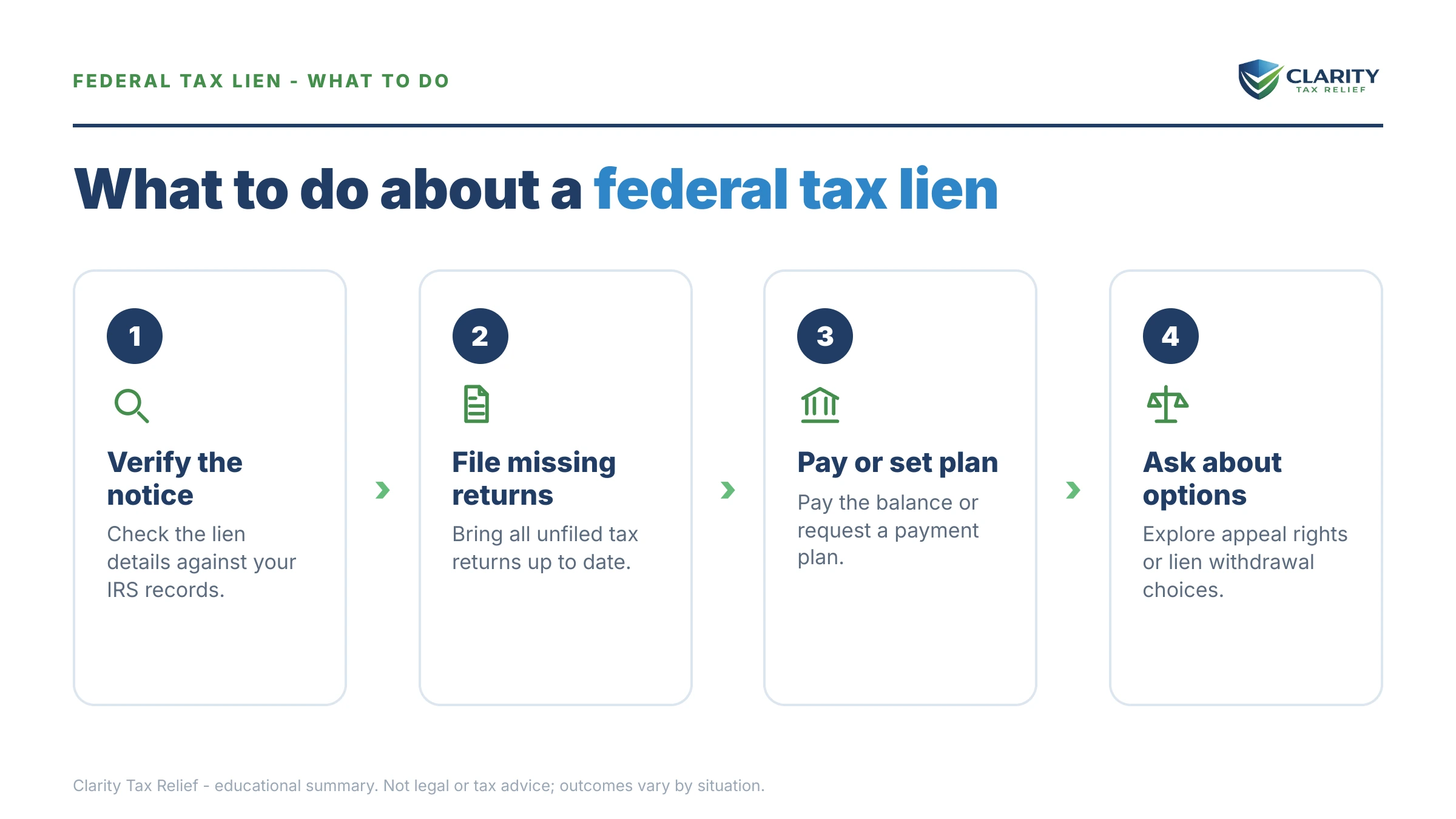
- Confirm the lien and the balance — pull your IRS account transcript and compare the lien year and amount against your records. Some liens are filed on balances that were already paid or misapplied.
- Check your Letter 3172 date — find the date on Letter 3172 and count 30 days. That is your window to request a Collection Due Process hearing on Form 12153.
- Set up a payment arrangement — enter an installment agreement, currently not collectible status, or an Offer in Compromise so the balance stops escalating and you become eligible for lien relief.
- Request the right lien relief — ask for withdrawal on Form 12277, subordination on Form 14134 to refinance, or discharge on Form 14135 to sell a specific property.
- Get the release documented — after paying or resolving the debt, confirm the Certificate of Release of Federal Tax Lien was filed with the county so the public record clears.
If your debt spans multiple years, involves a business, or you're racing a closing date, an certified letter from IRS is usually where the lien clock starts, and that's the moment experienced help changes your outcome the most.
When you can handle a lien yourself, and when you shouldn't
You can often handle a lien on your own when the situation is clean and small. If you owe under $25,000, can pay it off or set up a direct debit installment agreement, and just want the public record gone, filing Form 12277 for a withdrawal is a straightforward DIY task. Same for paying in full and confirming the Certificate of Release posted with your county recorder.
Experienced help changes the outcome when the stakes and the timing tighten. If a levy is already in motion, you have multiple unfiled years, the debt is business or payroll tax, you're pursuing an Offer in Compromise, or a home sale or refinance is on a deadline that a subordination request could blow, the sequence you do things in, and how you frame the request — genuinely affects what you pay and whether you close on time. A professional also spots when the tax lien is close to expiring under the collection statute, which can change your entire strategy.
Curious whether your lien is nearing its statutory end date? You can estimate your own collection statute expiration with our CSED calculator before deciding whether to fight the lien or simply wait it out.
Terms on your lien notice, decoded
- Notice of Federal Tax Lien (NFTL) — the public filing that announces the government's legal claim against your property. It's what the 214,099 figure counts.
- Lien vs. levy — a lien is a claim securing the debt; a levy is the actual seizure of wages, bank funds, or a state refund.
- Letter 3172 — the notice mailed after the lien is filed, starting your 30-day Collection Due Process appeal window.
- Withdrawal — removal of the public NFTL (Form 12277); different from a release, which shows the debt was satisfied but leaves the record.
- Subordination — the IRS agrees to let another creditor (your refinance lender) take priority ahead of the lien (Form 14134).
- CSED — the Collection Statute Expiration Date; the 10-year deadline after which the lien self-releases, subject to tolling.
Notice of Federal Tax Lien statistics, answered
How many Notices of Federal Tax Lien does the IRS file each year?
The IRS filed 214,099 Notices of Federal Tax Lien in FY2025, up from 196,996 in FY2024 and 179,019 in FY2023. That is a small fraction of the millions of taxpayers who owe back taxes at any time — the IRS files a lien on a minority of delinquent accounts, generally larger or older balances. The number rises and falls with staffing, budget, and enforcement priorities.
Are IRS tax lien filings increasing or decreasing?
They are increasing. Filings rose 8.7% from FY2024 to FY2025 and are up 19.6% from FY2023 to FY2025. The trend reflects the IRS restarting automated enforcement after pandemic-era pauses, even as its workforce shrank roughly 27% in 2025. Automated lien and levy systems keep running regardless of how many humans remain to answer the phone.
Does the IRS file a lien on everyone who owes back taxes?
No. A lien filing is a discretionary decision, and the roughly 214,099 filed in FY2025 represent a small share of all delinquent accounts. The IRS generally considers filing a Notice of Federal Tax Lien when the unpaid balance exceeds $10,000, though it can file on smaller balances or hold off on larger ones depending on the case, your compliance history, and whether you set up a plan.
At what dollar amount does the IRS file a tax lien?
The IRS generally uses $10,000 as the internal threshold above which it will consider filing a Notice of Federal Tax Lien, a level set under the Fresh Start initiative. It is a guideline, not a hard rule — the IRS can file below $10,000 for repeat non-compliance or hold off above it if you are in a direct debit installment agreement or currently not collectible status.
Does a federal tax lien show up on my credit report?
The three major credit bureaus stopped listing tax liens on consumer credit reports in 2018, so a Notice of Federal Tax Lien no longer directly lowers your FICO score. It remains a public record, however, and mortgage lenders, title companies, and business creditors routinely pull public records, so a lien can still block a loan or refinance even when it is invisible on your credit file.
Can I refinance my house with an IRS lien on it?
It is possible but harder, because a filed federal tax lien attaches to your home and can outrank a new mortgage. To refinance, you usually need the IRS to subordinate the lien using Form 14134, which lets the new lender take priority, or to withdraw the lien entirely. Paying the balance below $25,000 and entering a direct debit installment agreement can qualify you for lien withdrawal.
How do I get a Notice of Federal Tax Lien removed?
Paying the balance in full triggers a Certificate of Release of Federal Tax Lien within 30 days. To go further and erase the public record, you request a withdrawal on Form 12277 — available if you pay in full or owe $25,000 or less and are making direct debit installment payments. Discharge (Form 14135) and subordination (Form 14134) remove the lien from specific property without paying everything.
Does a federal tax lien expire?
Yes. A federal tax lien is tied to the 10-year collection statute (CSED), which starts when the tax is assessed. The lien self-releases when that statute expires. The catch is tolling: filing an Offer in Compromise, bankruptcy, or a Collection Due Process appeal pauses the clock and pushes the expiration date out, so the 10 years is rarely a clean 10 calendar years.
What is the difference between a tax lien and a tax levy?
A lien is a legal claim securing the debt against your property; a levy is the actual seizure of money or assets. The Notice of Federal Tax Lien protects the government's interest in what you own, while a levy takes your wages, bank account, or state refund. The 214,099 lien filings in FY2025 are counted separately from levy actions, which run into the millions.
Why did IRS lien filings jump in 2025?
Filings climbed to 214,099 in FY2025 because the IRS resumed the automated collection notices and enforcement actions it had scaled back during and after the pandemic. Even as the agency lost roughly 27% of its workforce in 2025, its automated systems kept issuing liens on delinquent accounts. The IRS reported collecting $73.14 billion on delinquent accounts in FY2025.
How to cite this data
Clarity Tax Relief, “IRS Notice of Federal Tax Lien Filings Statistics (2026),” updated July 10, 2026, https://claritytaxrelief.com/blog/irs-notice-of-federal-tax-lien-filings-statistics/. Figures come from the IRS sources cited on this page; please link to this page when you use them.
Your next 24 hours
- Find the date on your Letter 3172. That date starts your 30-day Collection Due Process window. The single most important number if the IRS filed a lien on you.
- Gather your last filed return, the lien notice. A rough income-and-asset snapshot. You'll need them to confirm the balance and choose between withdrawal, subordination, discharge, or a payment plan.
- Get a free case review before the appeal window closes. Use the 2-minute form or call (888) 825-7779. If a refinance or sale is on the calendar, mention the date; timing decides which lien relief fits.
For the broader enforcement picture, compare this trend with our IRS tax lien statistics and IRS third-party levy notice statistics, and see how a lien affects your borrowing in tax lien on credit report.
The underlying figures on this page come from the IRS's own SOI Tax Stats — Delinquent Collection Activities (Data Book Table 4-1). You can verify any lien on your own account through your IRS online account. The agency's overview of the process is at Understanding a federal tax lien. For a county-level view, we break down Southern California filings from 2016 to 2025 in our SoCal tax lien county data, and the yearly counts download as a CSV of federal tax lien filings by county.
This guide is general information, not tax or legal advice for your specific situation. Eligibility for IRS programs depends on individual facts and circumstances; no outcome is guaranteed.