
IRS Data & Studies
IRS Private Debt Collection Recovery Rate: 3.8% of $64.9 Billion (2026 Data Study)
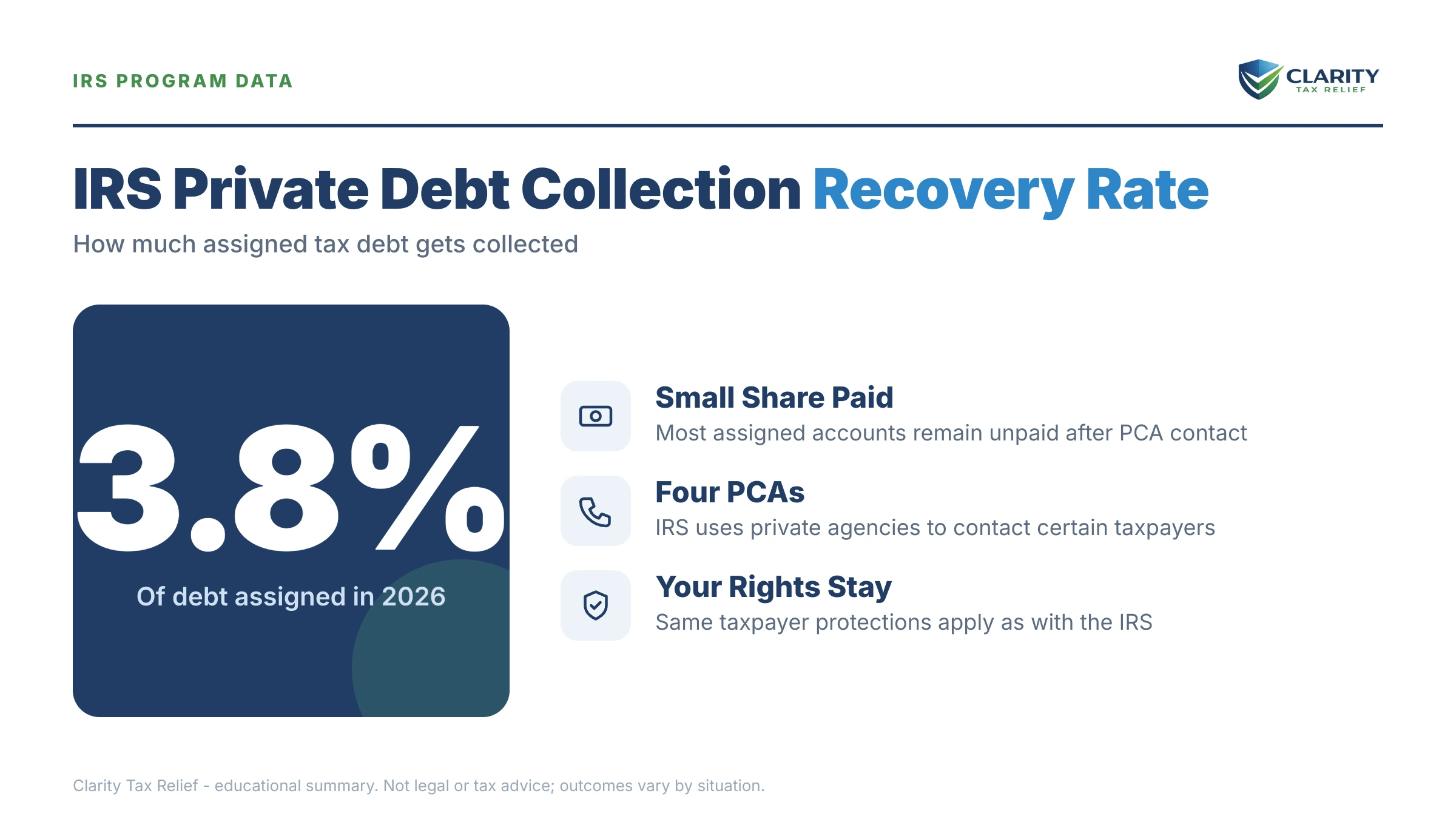
The short answer: private collection agencies working for the IRS have recovered just $2.4 billion of the $64.9 billion in tax debt assigned to them since 2017 — a recovery rate of about 3.8%, per TIGTA. About 22% of accounts do get fully paid, but the debt itself never disappears, and only the IRS can levy.
A company you've never dealt with — ConServe, CBE Group, or Coast Professional — is suddenly writing and calling about a federal tax debt, and your gut is split between "scam" and "how bad is this?" Checking the numbers first is exactly the right move. The government's own watchdog has measured how this program performs, and the results tell you a lot about where you actually stand.
The IRS private debt collection recovery rate — the share of assigned debt these companies actually bring in — is one of the most lopsided statistics in all of tax enforcement. The breakdown below shows the full picture: what the IRS handed over, what came back, and why the gap between those two numbers is so wide.
⏱ The clock that actually matters: there is no printed deadline when your account moves to a private collector, but two clocks still run. Penalties and interest accrue on the balance every month, and the IRS's 10-year collection statute keeps ticking whether the agency reaches you or not.

The IRS private debt collection recovery rate: 3.8% of $64.9 billion
Private collection agencies have recovered more than $2.4 billion of the more than $64.9 billion in tax debt assigned to them, a recovery rate of 3.8% of the total value of accounts assigned, according to the Treasury Inspector General for Tax Administration (TIGTA). That covers the program's entire modern run — more than 7.6 million taxpayer accounts assigned to private collection agencies since April 2017, measured as of March 2024.
| Metric | Figure | What it means for you |
|---|---|---|
| Taxpayer accounts assigned since April 2017 | More than 7.6 million | Assignment is routine, not personal — millions of people are in the same queue. |
| Tax debt assigned to private collectors | More than $64.9 billion | These are debts the IRS itself stopped actively working. |
| Amount collected as of March 2024 | More than $2.4 billion | Every dollar was paid voluntarily — the agencies cannot levy. |
| Recovery rate (by dollars) | 3.8% of the total value of accounts assigned | Most of the assigned money is never collected. |
| Accounts fully paid | 1.6 million — about 22% of accounts assigned | Smaller balances get paid off; large ones mostly don't. |
| Average age of assigned cases | 3.97 years | Older debts are generally near-uncollectible by the time they're assigned. |
Notice the split between the two success measures. By dollars, only 3.8% comes back. By headcount, 1.6 million accounts fully paid — about 22% of accounts assigned. Both are true at once because the accounts that get resolved skew small: a $2,000 balance gets paid; a $200,000 balance mostly sits. The dollar figure looks terrible precisely because a handful of very large, very stale debts drag it down.
“The law requires the IRS to use private agencies to collect certain outstanding, inactive tax debts.”
— Private debt collection (IRS.gov)
Why the recovery rate is so low
The private collectors' 3.8% recovery rate is low by design: the agencies only receive cases the IRS has already classified as "inactive tax receivables" — debts it stopped working itself. Three structural facts explain almost all of the gap:
- The debt is old before it arrives. The average age of assigned cases was 3.97 years, and older debts are generally near-uncollectible. By year four, taxpayers have moved, businesses have closed, income has dried up, and some debtors have died. (Whether a tax debt survives the taxpayer is its own question — see does IRS debt die with you.)
- The agencies have no teeth. A private collector cannot garnish, levy, lien, or seize anything. Every dollar of that $2.4 billion was paid because someone chose to pay. The IRS's own collection numbers look better largely because levies exist.
- The most collectible-but-vulnerable accounts were pulled out. Since the Taxpayer First Act of 2019, taxpayers whose income comes substantially from Social Security disability benefits and those at or below 200% of the federal poverty level are excluded from assignment entirely.
There's history here too. Congress has ordered the IRS to try outsourced collection before, in the 1990s and again in the late 2000s, and both earlier programs were shut down after collections disappointed. The current program, mandated by the FAST Act of 2015 and launched in April 2017, is the third attempt, and the 3.8% figure is why its critics keep citing TIGTA's work.
Why your account went to a private collector
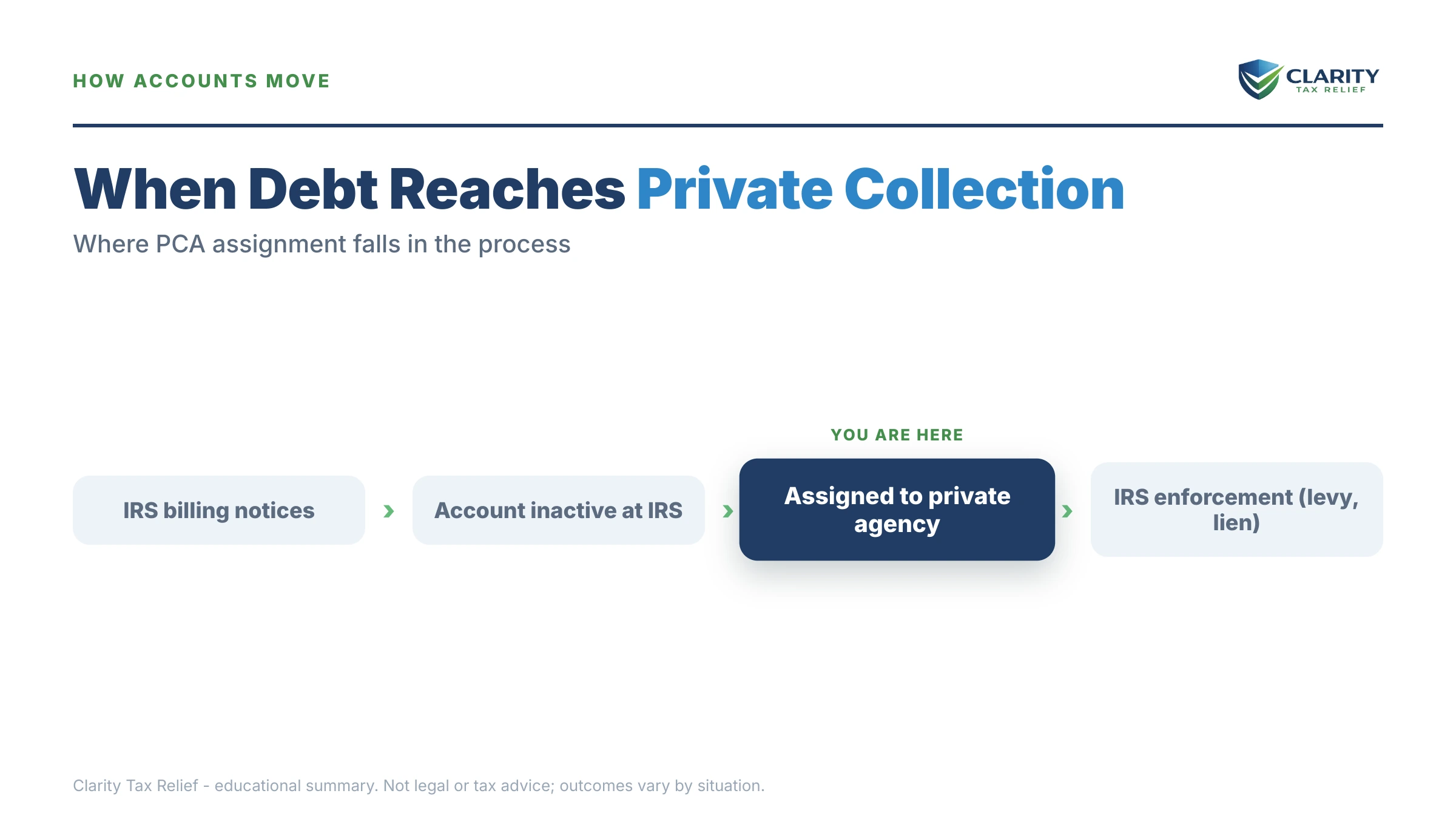
Your account was assigned because the IRS classified it as inactive, not because your case got worse. In practice, accounts land with a private agency when the IRS couldn't locate you, hasn't had contact with you in a long time, or simply lacked the staff to work the file. With the IRS workforce cut roughly 27% in 2025, that last category is growing: fewer humans at the IRS means more accounts pushed into the assignment queue, even as the agency's automated notices and levies continue on their own.
Before any collector contacts you, the IRS mails a CP40 notice telling you which of the three authorized agencies — CBE Group, Coast Professional, or ConServe — has your account, along with a Taxpayer Authentication Number. The agency's own first letter repeats that same number so you can verify each other. If you've had a call and want to pressure-test it, our guides on the IRS private collection agency process and whether an IRS debt collector is legitimate walk through the verification step by step.
What a private collection agency can and can't do
A private collector working for the IRS can ask you to pay, and nothing more. The Fair Debt Collection Practices Act applies to these companies, payments only ever go to the United States Treasury or through IRS.gov, and any threat of arrest is a guaranteed scam signal, because owing taxes is a debt, not a crime — see can you go to jail for owing the IRS.
| Action | Private collection agency | The IRS |
|---|---|---|
| Send letters and call you about the debt | Yes — after the CP40 notice | Yes |
| Garnish wages or levy bank accounts | No — never | Yes, after a final notice (LT11 notice) and its 30-day window |
| File a federal tax lien | No | Yes |
| Set up a payment arrangement | Yes, but payments go only to the U.S. Treasury | Yes, including online plans |
| Accept an Offer in Compromise or hardship status | No — the account must go back to the IRS | Yes |
| Threaten arrest or demand gift cards | Never — that is a scammer, not a collector | Never |
What happens if you ignore the private collection agency
Ignoring a private collector doesn't end your case. It eventually hands the case back to an agency that can levy. The sequence runs in stages:
- Letters and calls continue. The agency can only request voluntary payment, so its contact attempts are persistent but toothless.
- The balance grows every month. The failure-to-pay penalty adds 0.5% per month, and interest compounds on top of it, the entire time the account sits unresolved.
- The account can be returned to the IRS. Agencies send back accounts they can't resolve, or that you ask, in writing, to have recalled.
- Real enforcement can resume. Back in IRS hands, the file can move to liens, a final notice of intent to levy, then wage and bank levies, and once your total certified debt tops $66,000 in 2026, the IRS can certify it to the State Department, which can deny or revoke your passport.
- The 10-year statute keeps running. The IRS generally has 10 years from assessment to collect (see how long can the IRS collect back taxes), and PCA assignment does not pause it. But the clock does stop for appeals, a pending Offer in Compromise, or bankruptcy, so "wait it out" rarely works as cleanly as forums suggest. Our guide to whether IRS debt goes away after 10 years covers the tolling traps. You can estimate your own expiration window with our CSED Calculator.
A private collector has your IRS account?
Send us the CP40 and the agency's letter. An experienced tax professional will verify the debt, check how much of it is penalty, and map your cheapest way out — free and confidential, while interest and penalties are still accruing either way.
Your options when a PCA holds your IRS debt
Every IRS resolution program still applies to you after assignment — the agency just can't process most of them. The collector can take full payment or set up a payment arrangement; anything more sophisticated requires the account to route back to the IRS. The full do-it-yourself playbook lives in our guide to how to settle tax debt yourself. Here's how each option works in the PCA context specifically:
| Option | Who it fits / eligibility | Cost and PCA-specific notes |
|---|---|---|
| Pay in full | You can cover the balance now | Payable only to the U.S. Treasury or via IRS.gov — never to the agency. Stops penalty accrual immediately. |
| Payment arrangement through the agency | You agree with the balance and want simple monthly payments | The agency can set this up, but money still goes to the Treasury. Interest and penalties continue. |
| Installment agreement directly with the IRS | Balances of $50,000 or less can qualify online, up to 72 months (how to set up an IRS payment plan online) | Setup fees vary by method; short-term plans up to 180 days have a $0 setup fee. Going direct sidesteps the agency entirely. |
| Currently Not Collectible | Paying anything would leave you unable to cover basic living expenses (IRS currently not collectible) | Must be granted by the IRS, not the agency. Collection pauses; the debt and interest remain. |
| Offer in Compromise | Your assets and future income genuinely can't cover the debt (how an Offer in Compromise works) | $205 application fee and 20% down on lump-sum offers — both waived with low-income certification (AGI at or below 250% of poverty). The IRS accepted roughly 1 in 5 offers in FY2024. Filing an OIC pulls the account back from the agency. |
| Request return to the IRS | Anyone — no eligibility test | Free. A written statement that you won't work with the agency sends the account back to IRS inventory. |
A worked example: three unfiled gig years land at a collection agency
Say you drove and delivered on 1099s for three years, never filed. The IRS built the returns for you through substitute-for-return assessments totaling $21,600. The account went quiet, aged out of active IRS inventory, and was assigned to Coast Professional.
Here's the math while you decide. The failure-to-pay penalty runs 0.5% per month: $21,600 × 0.005 = $108 a month, or roughly $1,296 a year in penalty alone before interest compounds on top. A direct IRS installment agreement over the full 72 months would run about $21,600 ÷ 72 = $300 a month before those accruals.
But the bigger lever in this scenario isn't the payment plan — it's the returns. A substitute return gives a gig worker zero mileage, zero expenses, zero deductions, so the $21,600 is almost certainly inflated. Filing your actual returns can shrink the assessed tax before you agree to pay anything, and no collection agency can do that for you. If this is your situation, start with our guide for people who haven't filed taxes in 3 years.
How to respond when a private collector has your IRS debt, step by step
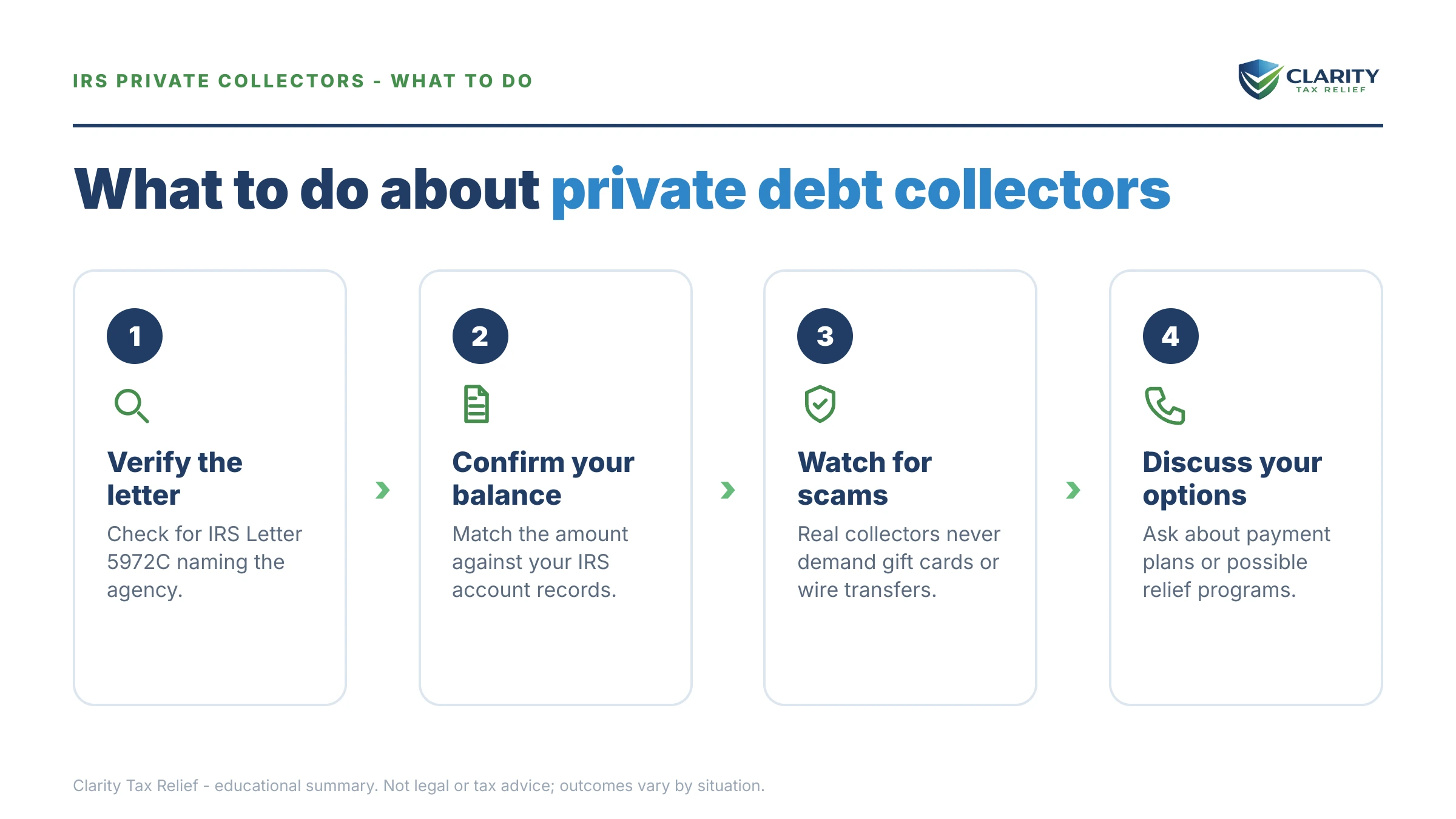
- Verify the collector is real. Match the Taxpayer Authentication Number on your IRS CP40 notice to the number on the agency's letter, and confirm the company is CBE Group, Coast Professional, or ConServe — no other firm collects for the IRS.
- Check the balance directly with the IRS. Log into your IRS online account and compare what it shows to what the collector claims — never take a caller's word for a dollar amount.
- File any missing returns first. If the IRS filed substitute returns for you, filing your own returns with your real deductions can shrink the balance before you agree to pay anything.
- Choose your resolution and pay only the U.S. Treasury. Set up a payment arrangement, or go around the agency entirely with a direct IRS installment agreement, hardship status, or an Offer in Compromise — payments never go to the collection agency itself.
- Put it in writing if you want the agency out. A written request stating that you do not want to work with the private agency returns your account to the IRS.
When you can handle this yourself, and when help changes the outcome
Most PCA cases with small, accurate balances are genuinely a do-it-yourself job. If you agree with the amount, the balance is under $10,000 — the threshold for a guaranteed installment agreement — or you can pay it within 180 days, verifying the collector and setting up a plan directly at IRS.gov takes an afternoon and costs nothing in fees for a short-term plan.
Experienced help changes outcomes in the harder patterns: multiple unfiled years sitting behind inflated substitute-return assessments, balances large enough to trigger passport certification, self-employment debt still growing because quarterly taxes aren't being paid, or finances weak enough that an Offer in Compromise or hardship status is realistic but the paperwork has to be right the first time. In those cases, the order you fix things — returns first, then penalties, then the balance — usually matters more than any single program.
Terms on your PCA letters, decoded
- Private collection agency (PCA): a contractor authorized under federal law to pursue voluntary payment of certain IRS debts, with none of the IRS's enforcement powers.
- CP40 notice: the IRS letter that tells you your account was assigned, names the agency, and carries your authentication number.
- Taxpayer Authentication Number: the code printed on both the CP40 and the agency's letter so you and the collector can verify each other without sharing your SSN.
- Inactive tax receivable: the legal label for a debt the IRS stopped actively working — the only kind of account that can be assigned.
- CSED: the Collection Statute Expiration Date — generally 10 years from assessment, after which the IRS can no longer collect, subject to pauses for appeals, offers, and bankruptcy.
- TIGTA: the Treasury Inspector General for Tax Administration, the watchdog whose audits produced the recovery-rate figures in this study.
The figures in this study come from TIGTA findings as reported by Accounting Today's analysis of private debt collector recoveries. Program rules, the current agency list. Your rights are published on the IRS private debt collection page, and independent taxpayer-rights help is available through the Taxpayer Advocate Service.
IRS private debt collection: your questions answered
What is the IRS private debt collection recovery rate?
About 3.8% of the total value of accounts assigned, according to TIGTA. Private collection agencies have collected more than $2.4 billion of the more than $64.9 billion in tax debt the IRS has assigned to them since April 2017, measured as of March 2024. Counted by accounts rather than dollars, results look better: 1.6 million accounts fully paid — about 22% of accounts assigned.
Which companies are authorized to collect tax debt for the IRS?
Exactly three: CBE Group, Coast Professional, and ConServe. If any other company claims to be collecting a federal tax debt, it is a scam. Before a legitimate agency ever contacts you, the IRS mails a CP40 notice naming the agency and giving you a Taxpayer Authentication Number that must match the number on the agency's own letter.
Can a private collection agency garnish my wages or levy my bank account?
No. Private collection agencies working for the IRS have no enforcement power. They cannot garnish wages, levy bank accounts, file liens, or seize property. Only the IRS can do those things, and only after your account is back in IRS hands and the IRS issues a final notice of intent to levy (LT11 or Letter 1058), which gives you 30 days and formal appeal rights.
Why is the IRS private collection recovery rate so low?
Because the agencies get the cases the IRS already gave up working. The average age of assigned cases was 3.97 years, and older debts are generally near-uncollectible — the taxpayer has often moved, gone broke, or died. The agencies also have no levy power, so every dollar they collect has to be paid voluntarily.
If collectors only recover 3.8%, can I just ignore my tax debt?
Ignoring it is a gamble with bad odds. The figure of 1.6 million accounts fully paid shows plenty of people do end up paying, and unresolved accounts go back to the IRS, which can file liens, levy wages and bank accounts, and certify your passport once the debt tops $66,000 in 2026. Penalties and interest keep compounding the entire time you wait.
How do I know the collector calling about my IRS debt is real?
Match the Taxpayer Authentication Number on your IRS CP40 notice to the number on the agency's letter. A real collector is one of three named companies — CBE Group, Coast Professional, or ConServe — never asks for payment to itself, and never threatens arrest. Every legitimate payment goes to the United States Treasury or through IRS.gov; anyone requesting gift cards, wire transfers, or payment apps is a criminal.
Can I get my account taken back from the private collection agency?
Yes. Send the agency a written request stating you do not want to work with it, and the account returns to the IRS. Some taxpayers should never be assigned in the first place: the law excludes people whose income comes substantially from Social Security disability benefits and those with income at or below 200% of the federal poverty level. If that describes you, say so, in writing, to both the agency and the IRS.
Does the 10-year collection statute keep running while a private agency has my account?
Yes — assignment to a private collection agency does not pause the collection statute expiration date (CSED). The IRS generally has 10 years from assessment to collect, though the clock pauses for events like a pending Offer in Compromise, bankruptcy, or certain appeals. Many assigned debts are already several years into that window, which is part of why so little of the money ever gets collected.
Your next 24 hours
- Find your CP40 notice and locate the Taxpayer Authentication Number, then match it against the agency's letter before you speak to anyone about money.
- Gather three things: your last filed return, both collection letters. A rough picture of your current income and expenses. That's everything needed to evaluate every option in the table above.
- Get a free case review at the 2-minute form or (888) 825-7779. There's no letter-printed deadline here. But the failure-to-pay penalty and interest are compounding monthly. The balance is the smallest it will ever be today.
This guide is general information, not tax or legal advice for your specific situation. Eligibility for IRS programs depends on individual facts and circumstances; no outcome is guaranteed.