
IRS Data & Statistics
IRS Seizure Statistics: How Rare IRS Seizures Really Are (2026)
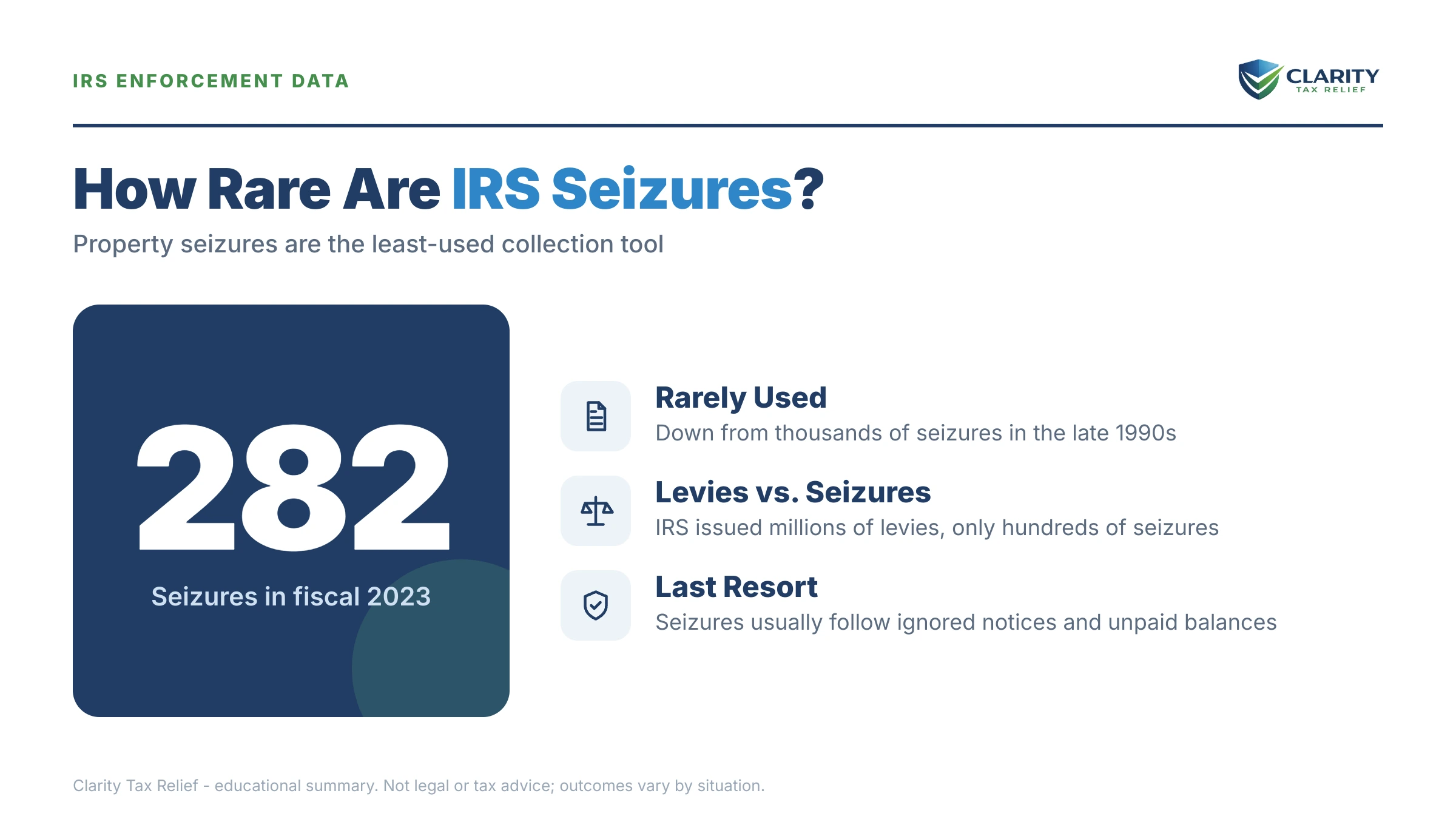
The short answer: IRS seizure statistics show actual property seizures are rare — only a few hundred per year nationwide, per the IRS Data Book, down from roughly 10,000 a year in the mid-1990s. Levies on bank accounts, paychecks, and contractor payments, issued by the hundreds of thousands, are the real risk.
You searched "IRS seizure statistics" because a balance is hanging over you and you want the real odds — will they actually come for the truck, the tools, the house? The honest numbers are calmer than the fear: physical seizure is the rarest weapon in the IRS arsenal. But those same numbers show exactly what the IRS takes instead, and that part moves fast and automatically.
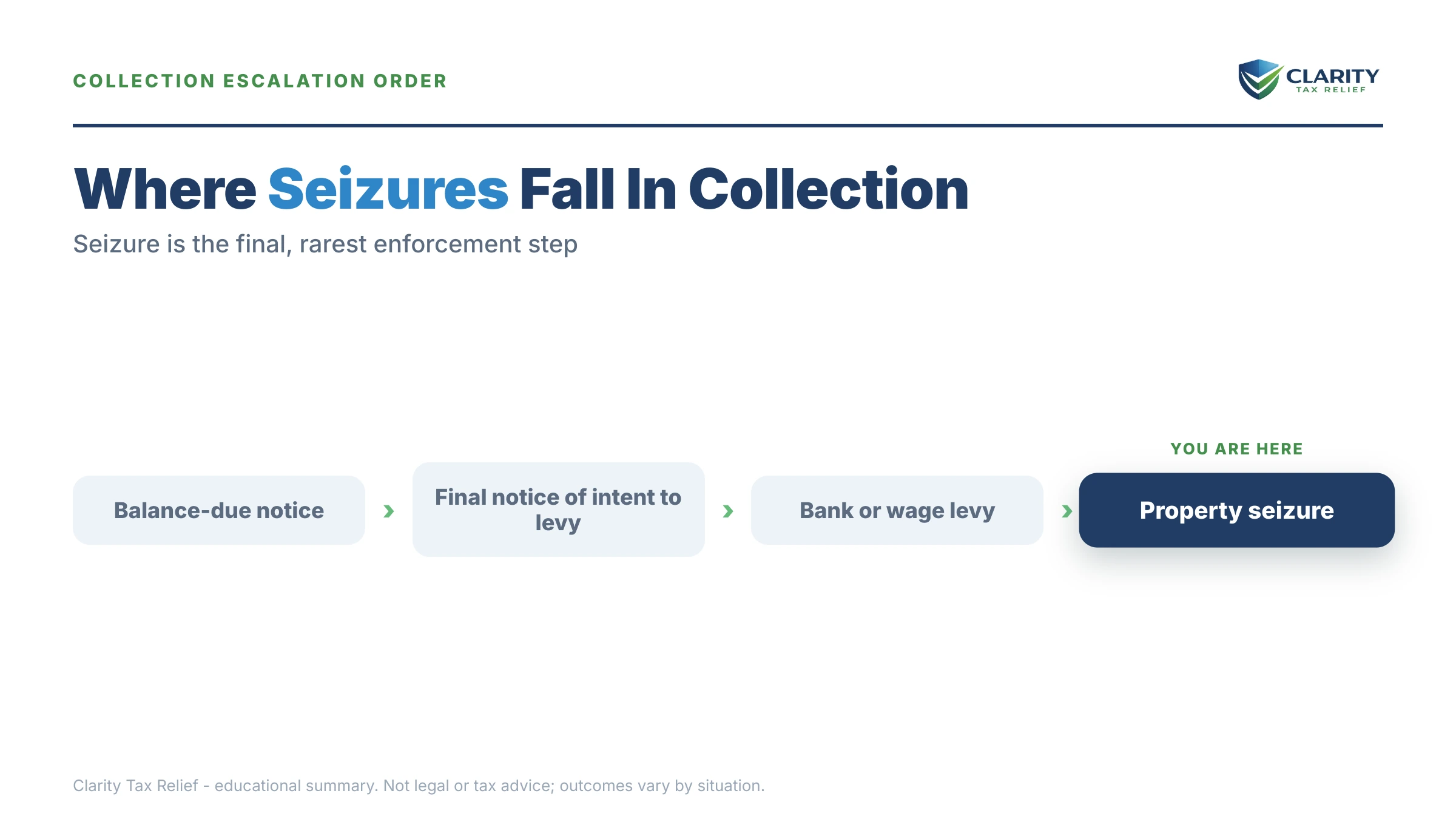
This page walks the actual data: how many seizures happen, why the count collapsed after 1998, what the IRS grabs by the hundreds of thousands instead, and what the pattern means at your specific balance. The image below maps the full IRS enforcement ladder so you can see exactly where seizures sit on it — the last rung, not the first.
⏱ The real clock: there's no seizure countdown, but your account never sits still. The failure-to-pay penalty adds 0.5% of your balance every month, interest compounds on top, and if an LT11 or Letter 1058 arrives, you have exactly 30 days to request a Collection Due Process hearing before a levy can legally issue.
IRS seizure statistics: what the numbers actually show
The IRS carries out only a few hundred property seizures per year nationwide, while issuing levy notices by the hundreds of thousands over the same period. Both figures come from the IRS's own annual Data Book, which reports collection enforcement activity by fiscal year.
The historical drop is the most striking number in the dataset. In the mid-1990s, the IRS seized roughly 10,000 properties a year. Then Congress passed the IRS Restructuring and Reform Act of 1998, which added supervisory sign-offs, court approval for home seizures, and an equity requirement. Seizures collapsed to the hundreds within two years, and they have stayed there for a quarter century.
Two clarifications keep these numbers honest. First, the Data Book's "seizure" count covers civil collection seizures — physically taking cars, equipment, real estate to auction for back taxes. It does not include criminal forfeitures by IRS Criminal Investigation, which is a separate world with its own numbers. See our IRS criminal investigation statistics for that side.
Second, "rare" does not mean "safe." The same Data Book tables show levies, liens, and refund offsets dwarfing seizures every single year. The IRS almost never takes your stuff — because it's far easier to take your money. For the full collections picture — dollars collected, notices issued, enforcement by category — see our IRS tax collections statistics.
“An IRS levy permits the legal seizure of your property to satisfy a tax debt. It can garnish wages, take money in your bank or other financial account, seize and sell your vehicle(s), real estate and other personal property.”
— Levy (IRS.gov)
Seizure vs. levy vs. lien: why the statistics confuse people
Most of the fear around "IRS seizures" comes from mixing three different enforcement tools with wildly different frequencies. A seizure physically takes property to sell at auction. A levy takes money — from a bank account, a paycheck, or a payment someone owes you. A lien takes nothing; it's a public legal claim securing the debt against everything you own.
| Enforcement action | What it takes | How common (per IRS Data Book) |
|---|---|---|
| Refund offset | Your federal (and often state) tax refund, applied to the debt automatically | The most common taking — happens by default, every year, until paid |
| Federal tax lien filing | Nothing directly — a public claim that attaches to all your property | Vastly more common than seizures; routine on larger balances |
| Bank levy | Funds in the account on the day the levy hits (21-day hold before money leaves) | Hundreds of thousands of levy notices issued per year, all types combined |
| Wage levy | A slice of every paycheck, continuously, until released | Common — a core automated-collection tool |
| Levy on contractor pay / receivables | What a client owes you at that moment — a one-time grab per levy served | Common for 1099 workers and businesses in collections |
| Social Security levy (FPLP) | Up to 15% of each benefit payment | Routine through the automated Federal Payment Levy Program |
| Physical asset seizure | Vehicles, equipment, real estate — sold at auction | A few hundred per year nationwide — the rarest action on this list |
Read that table bottom-up and the statistical story is clear: the further down the ladder an action sits, the more human effort it takes. The less often it happens. Seizures need a revenue officer, appraisals, storage, and an auction. A levy needs a computer.
Why IRS property seizures are so rare
Seizures are rare because the law makes them the hardest action for the IRS to take, not because the IRS is lenient. Three structural barriers built into the 1998 reform and IRC §6334 keep the annual count in the hundreds:
- A federal judge must approve any principal-residence seizure. The IRS cannot take a home without a U.S. district court judge or magistrate signing off, and it cannot seize a principal residence at all for a levy of $5,000 or less.
- The seizure must produce net proceeds. If auctioning the asset wouldn't clear the mortgage, prior liens, and sale costs with money left for the tax debt, the seizure is barred. Most personal vehicles and mortgaged homes fail this math.
- Certain property is exempt entirely. IRC §6334 protects basic clothing, some furniture and personal effects, a portion of tools of the trade, unemployment and workers' compensation benefits. A subsistence slice of wages.
Layer on the practical reality — seizures require a revenue officer. The IRS workforce shrank roughly 27% in 2025 — and physical seizure has become a tool reserved for the largest, most defiant cases: big balances, business assets, unpaid payroll taxes, taxpayers who refused every arrangement offered. If your situation involves real estate specifically, our guide to when the IRS can seize property. The companion answer to can the IRS take my house — covers those cases in depth.
What actually happens if you ignore a tax debt in 2026
The statistics describe a sequence, not a lottery — every account that ends in a levy or seizure walked the same automated ladder first. Here is the order, using only the timeframes the IRS itself sets:
- CP14 — the first bill. You typically have about 21 days from the notice date to pay or arrange before the sequence advances.
- CP501 / CP503 — reminders. Still just bills, but the 0.5% monthly penalty and daily-compounding interest are running.
- CP504 — intent to levy your state refund. Under IRC §6331(d), the IRS can now take your state tax refund. A federal tax lien filing becomes realistic.
- LT11 / Letter 1058 — the final notice. A 30-day clock starts, along with your Collection Due Process rights via Form 12153. This is the last exit before enforcement.
- Levies begin. Bank accounts (with a 21-day hold before funds leave), wages (continuous until released), contractor payments, and up to 15% of Social Security through FPLP.
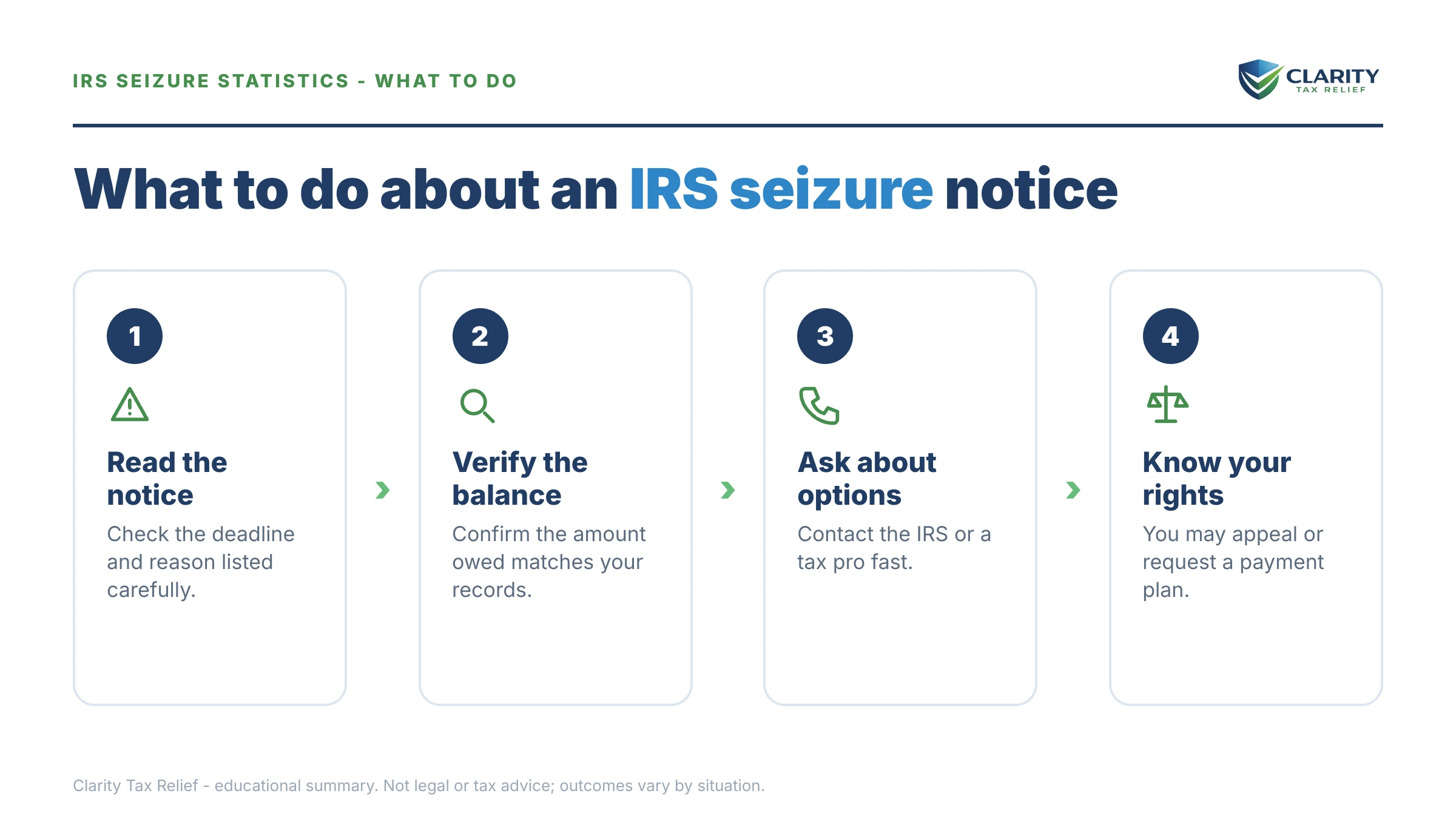
- Revenue officer — and, in the rarest cases, seizure. Large or business debts get assigned to a human collector, and only here do the few hundred annual physical seizures happen.
The 2026 twist: the staffing cuts made humans scarce, but rungs one through five are automated and never paused. The statistical takeaway is blunt — your real exposure is a levy, and levies happen without anyone at the IRS looking at your file. If you're a wage earner, you can estimate what a wage levy could take from your paycheck with our Wage Garnishment Calculator.
Know where you sit on the enforcement ladder?
Whether you're at a first bill or a final notice, the balance grows every month you wait — penalties and interest never pause, even when the IRS phone lines do. Send us your latest notice and an experienced tax professional will map exactly where you stand and what stops the escalation. Free and confidential.
What the seizure numbers mean at your balance
Enforcement risk scales with the size of the debt — the seizure statistics cluster almost entirely in the largest balance bands. Here's what the pattern looks like across amounts, and the realistic fix at each level:
| Balance owed | What enforcement realistically looks like | Realistic resolution path |
|---|---|---|
| Under $10,000 | Automated notices, refund offsets, possible bank levy if every notice is ignored; physical seizure essentially unheard of | Guaranteed installment agreement or a 180-day short-term plan, set up online |
| $10,000–$24,999 | Lien filing becomes possible; automated bank and wage levies after the final notice | Streamlined online payment plan, up to 72 months |
| $25,000–$49,999 | Lien filing likely; levies routine on unresolved accounts | Online plan still available up to $50,000 (direct debit helps); OIC if finances qualify |
| $50,000–$99,999 | Financial disclosure expected; lien standard; passport certification once the debt tops $66,000 (2026 threshold) | Negotiated installment agreement with financials; OIC or CNC where the math supports it |
| $100,000+ | Revenue officer assignment realistic — the only band where physical asset seizure meaningfully enters the picture, especially for business and payroll debt | Professionally negotiated resolution: full-financials IA, OIC, or hardship status |
For how these balances stack up across the whole taxpayer population — how many people owe, and how much — see our IRS back tax debt statistics.
A worked example: a 1099 contractor who owes $6,200
Say you're a self-employed contractor who owes $6,200 from a year when quarterly payments slipped. What do the statistics say about your actual exposure, and your cost to fix it?
Seizure risk: effectively nil. You're barely above the $5,000 statutory floor below which a home can't be seized at all, and no federal judge approves taking a house over a four-figure debt when payment plans exist. No revenue officer is getting assigned to a $6,200 account in 2026.
Real risk: the automated ladder. After a CP504, your state refund can be taken. After the final notice, a levy can hit your business checking account, or land on a client, who must hand the IRS whatever they owe you that day. Unlike a wage levy, a levy on contractor pay is a one-time grab of 100% of that payment, with no paycheck-style exemption. Our guide to an IRS levy on independent contractor pay explains how that works.
The math to fix it: doing nothing costs about $31/month in failure-to-pay penalty (0.5% of $6,200) plus daily-compounding interest. A guaranteed installment agreement — available because you owe under $10,000 — spreads it over three years at roughly $172/month ($6,200 ÷ 36, plus ongoing accruals). Stretch it on a 72-month online plan and the floor drops to about $86/month. Either one stops the ladder completely: no levy issues against an account in good standing on a plan.
Your options before enforcement starts
Every levy and seizure in the statistics happened to an account with no arrangement in place — which means each of these options is also levy prevention. The full playbook for setting these up on your own lives in our guide to how to settle tax debt yourself. Here's the eligibility map:
| Option | Who may qualify (2026) | Cost & key facts |
|---|---|---|
| Short-term payment plan | Anyone who can pay in full within 180 days | $0 setup; interest and penalties continue, but enforcement stops |
| Guaranteed installment agreement | Balance of $10,000 or less, returns filed, payoff within 3 years | The IRS must accept it — no financial disclosure required |
| Long-term installment agreement | Up to $50,000 → online setup, up to 72 months | Setup fee applies (lower with direct debit); accruals continue while you pay |
| Offer in Compromise | Means-tested — only when assets plus future income genuinely can't cover the debt | $205 fee and 20% down on lump-sum offers (both waived with low-income certification, AGI ≤ 250% of poverty); the IRS accepted roughly 1 in 5 offers in FY2024 |
| Currently Not Collectible | Paying anything would create genuine hardship, shown on Form 433 financials | Levies stop; the debt remains and interest accrues; the 10-year collection statute keeps running |
| Penalty relief | First-Time Abate with a clean prior 3 years, and starting summer 2026, the new Automatic Exemption from Penalty (AEP) applies without a request | Can strip penalties from the balance; interest on the tax itself remains |
How to respond, step by step
- Find your latest notice — pull the most recent IRS letter and note its form number and date. That tells you exactly where you sit on the enforcement ladder.
- Confirm your balance — log in to your IRS online account and check the amount, the tax years involved, and whether a lien or levy action shows on the account.
- Protect your appeal rights — if you received an LT11 or Letter 1058, submit Form 12153 within 30 days to request a Collection Due Process hearing before a levy can issue.
- Set up a resolution — choose the payment plan, hardship status, or offer that fits your finances and open it before a levy issues. Enforcement targets accounts with no arrangement.
- Get help if enforcement has started, if a levy has already hit or a revenue officer is assigned, have an experienced tax professional step in before more assets move.
If the final-notice window matters to your case, our LT11 notice guide and the Form 12153 CDP hearing walkthrough cover exactly how to use those 30 days.
When you can handle this yourself, and when to get help
If you owe under $10,000, agree with the balance, and have all returns filed, you don't need anyone — set up the guaranteed installment agreement online at IRS.gov's payment plans page in an afternoon and the enforcement statistics stop applying to you. The same is true for a short-term 180-day plan on a first notice you know is right.
Experienced help changes outcomes in specific situations: a bank levy inside its 21-day hold (funds can sometimes be released before they leave), an LT11 clock already running, a levy served on your clients, multiple unfiled years that block any agreement, business or payroll tax debt, or a balance large enough that a revenue officer, the only person who conducts seizures, could be assigned. In those cases, the order and speed of the fix determine what you keep.
Statistically curious readers can verify every figure discussed here in the IRS Data Book, published annually at IRS.gov/statistics. And if enforcement is causing genuine hardship the normal channels won't fix, the independent Taxpayer Advocate Service exists for exactly that.
Terms in the seizure statistics, decoded
- Seizure — the IRS physically taking property (vehicles, equipment, real estate) to sell at auction for back taxes.
- Levy — a legal taking of money: bank funds, a slice of wages, or payments someone owes you.
- Notice of Federal Tax Lien — a public filing that secures the government's claim against everything you own, without taking anything.
- Collection Due Process (CDP) — your right, after a final notice, to a hearing (requested on Form 12153 within 30 days) before a levy issues.
- CSED — the collection statute expiration date: the IRS generally has 10 years from assessment to collect, though appeals, offers, and bankruptcy pause the clock.
- Exempt property — items the IRS can never seize under IRC §6334, including basic clothing, some furniture, a portion of trade tools. A subsistence share of wages.
IRS seizure questions, answered
How many property seizures does the IRS actually carry out each year?
Only a few hundred nationwide in a typical year, according to the IRS's own annual Data Book. That compares with hundreds of thousands of levy notices issued against bank accounts and paychecks in the same period. In the mid-1990s the IRS seized roughly 10,000 properties a year — the 1998 reform law ended that era. The count has stayed in the hundreds ever since.
Can the IRS really seize your house?
Yes, but a home seizure is one of the rarest actions in the entire collection system. A principal residence cannot be seized for a levy of $5,000 or less, and any residence seizure requires written approval from a federal judge or magistrate. In practice the IRS pursues homes only in large-dollar cases where the taxpayer has ignored every notice and refused every payment option.
What does the IRS seize most often?
Money, not things. The most common takings are tax refunds through offset, then bank account funds and wages through levy. For 1099 contractors, the IRS can levy payments a client owes you. Physical assets — vehicles, equipment, real estate — come last because the IRS must appraise, store, and auction them, which usually nets less than a payment plan would.
Why did IRS seizures drop so sharply after 1998?
The IRS Restructuring and Reform Act of 1998 added layers of protection: supervisory approval for seizures, federal-court approval for any principal-residence seizure. A requirement that a seizure actually produce net proceeds after costs and prior liens. Annual seizures collapsed from roughly 10,000 in the mid-1990s to a few hundred, and they have never come back.
Can the IRS seize property without warning?
Almost never. Before levying or seizing assets, the IRS must send a final notice, the LT11 or Letter 1058, which starts a 30-day window to request a Collection Due Process hearing. Bank levies add a further 21-day hold before funds leave the account. The narrow exception is a jeopardy levy, used only when the IRS believes collection is at immediate risk.
Do the 2026 IRS staffing cuts mean fewer seizures and levies?
Fewer seizures, not fewer levies. The IRS workforce was cut roughly 27% in 2025, and physical seizures require revenue officers, so an already-rare action got rarer. But levies and refund offsets are issued by automated systems that never stopped. The practical effect is that it's harder to reach a human to fix a problem, which makes acting before deadlines even more important.
At what dollar amount does the IRS start seizing property?
There is no fixed trigger amount, but the statistics point to a pattern. The law bars seizing a principal residence for a levy of $5,000 or less, and real-world seizure cases almost always involve large, revenue-officer-assigned debts, often six figures, business debt, or unpaid payroll taxes. Below that territory, expect refund offsets, lien filings, and bank or wage levies instead.
Is a federal tax lien the same as a seizure?
No. A lien is a legal claim that secures the debt against everything you own and is filed as a public record. A seizure physically takes property so the IRS can sell it. Liens are filed vastly more often than seizures occur. A lien takes nothing from you directly, but it complicates selling or refinancing property until the debt is resolved.
How to cite this data
Clarity Tax Relief, “IRS Seizure Statistics: How Rare IRS Seizures Really Are (2026),” updated July 15, 2026, https://claritytaxrelief.com/blog/irs-seizure-statistics/. Figures come from the IRS sources cited on this page; please link to this page when you use them.
Your next 24 hours
- Find your most recent IRS notice and check the form number in its corner — CP14, CP504, or LT11 tells you which rung of the ladder you're on and which rights are in play.
- Gather three things: your last filed return, that notice. A rough picture of your monthly income and expenses — that's everything needed to pick the right resolution.
- Get a free case review — use the 2-minute form or call (888) 825-7779. The seizure odds may be tiny, but the 0.5% monthly penalty and daily interest are certainties, and every month unresolved is money you won't get back.
This guide is general information, not tax or legal advice for your specific situation. Eligibility for IRS programs depends on individual facts and circumstances; no outcome is guaranteed.