
IRS Operations
IRS Not Answering Phone Calls? Hold Times, the Best Time to Call and What to Do Instead (2026)
Read the transcript
Host: You've called the same number four times this week. Forty minutes of hold music, then the recording apologizes for high call volume and hangs up on you. And somewhere in the back of your head you're thinking, well, at least nothing's happening to my account while I'm stuck here.
Tax specialist: That's the part I want to fix first. Something is happening. The phone lines got worse, but the automated side of the IRS didn't slow down at all.
Host: Say more about why the lines got worse.
Tax specialist: So the article ties it to a workforce cut of roughly 27% in 2025, per TIGTA reports. Phone assistors were not spared. Same volume of people joining the queue, fewer people at the end of it.
Host: 27%. Hm. And that's after things had actually gotten better, right?
Tax specialist: Right, that's the whiplash. At the pandemic-era low, the National Taxpayer Advocate reported about one caller in nine reached a live assistor. Then supplemental funding rebuilt the phone staff, and during the 2024 filing season the IRS reported answering more than 85% of calls on its main lines, average waits of a few minutes. Then the funding got rolled back and the staffing got cut. 2026 sits closer to the bad end than the good one.
Host: Okay, but hang on. That 85% number — I don't know a single person whose experience matched that.
Tax specialist: And there's a reason. The metric is called Level of Service, and it counts only certain account-help lines, mostly during filing season. Across all lines, all year, the share of callers who reach a human has always been meaningfully lower than the press release.
Host: So the headline was never measuring your Tuesday afternoon collections call.
Tax specialist: Never was.
Host: Let's do the hang-up. Because that feels personal. An hour on hold and then click.
Tax specialist: The IRS calls it a courtesy disconnect. When the queue exceeds what the remaining assistors can absorb, the system drops callers rather than holding them indefinitely. It's an overload response. It's not your account, it doesn't mean anything about your case, and calling right back usually just puts you at the back of the same overloaded queue.
Host: Okay. So while I'm redialing — what's actually moving on the account?
Tax specialist: Two things. Accrual and the notice sequence. The failure-to-pay penalty adds 0.5% of the unpaid balance every month, and interest compounds on top of that. Doesn't matter how many times you dialed.
Host: And the notices just keep coming.
Tax specialist: They advance on their own schedule, one stage at a time. CP14 is the bill. Then CP501 and CP503 are reminders — still bills, just with a bigger balance attached each time. CP504 is intent to levy your state tax refund, and at that point a federal tax lien becomes a live possibility. Lien's public record, which matters if there's an underwriter about to search title.
Host: CP504. And then?
Tax specialist: LT11, or Letter 1058. That's the final notice. It starts a 30-day clock, after which the IRS can levy bank accounts and wages. It also carries Collection Due Process appeal rights, so you get formal rights at that stage, but far fewer good options than you had at stage one.
Host: LT11 or Letter 1058, 30 days. That's the one to not sit on.
Tax specialist: And here's the line from the article I'd underline: I couldn't get through is not a defense the automated system recognizes. Busy phone lines do not pause collections.
Host: Which is bleak. Except. You said most of this doesn't need a phone call at all.
Tax specialist: Most of it doesn't. Balances, transcripts, digital copies of most notices, and the payment-plan application are all in your IRS online account. The article's point is that most calls turn out to be unnecessary — checking a balance, pulling a transcript, setting up a plan, that's typically under 30 minutes online.
Host: Wait, transcripts. Because if a lender's the reason you're panicking—
Tax specialist: Yeah, lenders generally accept account transcripts as proof of your IRS standing, and you can pull those instantly.
Host: Walk me through the plan tiers. Simply, if you can.
Tax specialist: Four buckets. Short-term plan — modest balances paid within 180 days, zero setup fee, online. Then the Guaranteed Installment Agreement, that's the statutory one, individuals only, $10,000 or less in income tax excluding penalties and interest, full pay within three years. The statute conditions it on every return being filed, and on having timely filed and paid for the past five years with no installment agreement in that period.
Host: So that last condition is where people fall out.
Tax specialist: Often, yes. Then streamlined — $25,000 or less, or $50,000 or less with direct debit, up to 72 months, no detailed financial disclosure. All three of those are set up online. Over $50,000 you're into non-streamlined, which requires the Form 433 series financial disclosure, and that one usually does mean a phone call.
Host: And once a plan's approved, does the penalty stop?
Tax specialist: Not stop. Interest and penalties continue on any plan. But enforcement stops, and the failure-to-pay rate drops from 0.5% to 0.25% monthly while an approved agreement is in effect.
Host: Half. Okay.
Tax specialist: The article runs a hypothetical — $36,900 across two years. At 0.5%, the failure-to-pay penalty alone is roughly $185 a month. Three months of phone tag is about $550 in penalties plus interest, for nothing. Under a streamlined direct-debit agreement at that balance, 72 months works out to about $513 a month, and the penalty piece drops to roughly $92. And their illustration notes that under a streamlined direct-debit agreement the IRS generally does not file a federal tax lien.
Host: Which is the refinance angle.
Tax specialist: Right. Though I want to be clear that's a hypothetical illustration — the real figures depend on your balance, the current quarterly interest rate, and which plan fits your facts. Nobody can tell you the outcome in advance.
Host: Fine. But say I genuinely need a human. Misapplied payment, disputed notice, identity-verification hold.
Tax specialist: Then the right line at the right time beats twenty calls at the wrong one. Individuals, 800-829-1040, Monday through Friday, 7 a.m. to 7 p.m. local time. Best odds all week: call at exactly 7 a.m. your local time, Tuesday through Thursday.
Host: 7 a.m. local, Tuesday through Thursday. And the worst?
Tax specialist: Mondays and Fridays — weekend backlog on one end, deadline anxiety on the other. The day after a federal holiday is a Monday but worse, two days of backlog in one queue. Mid-March through April 15 is peak. And late afternoon any day carries the highest risk of a courtesy disconnect.
Host: What about a collections notice specifically?
Tax specialist: Use the number printed on the notice. It routes to the unit that owns your case. Business questions are 800-829-4933. Refund status automated is 800-829-1954, that one's 24/7.
Host: And if they offer a callback?
Tax specialist: Take it every single time. It holds your place and it can't be courtesy-disconnected the way a live hold can. But it isn't offered on every line or every day, so don't build your plan around it. Also — have your Social Security number, filing status, last year's return, and the notice in front of you. They can't discuss the account until identity is verified.
Host: One more. The article says keep notes of your call attempts.
Tax specialist: Dated notes, yes. A documented record of trying can support penalty relief later, and IRS interest can sometimes be waived where IRS delay itself caused the harm. And if the delay is creating financial hardship you can document, that's the Taxpayer Advocate Service — Form 911, or 877-777-4778.
Host: 877-777-4778. So what's the honest hard part here?
Tax specialist: That the self-service route is genuinely fine for a lot of people. You don't need to pay anyone to check a balance or set up a plan under $50,000. Where experienced help changes things is narrower: a levy or garnishment already in motion, a balance over $50,000 that needs negotiated financial disclosure, multiple unfiled years that have to be sequenced before any agreement, or business payroll debt. In those, the phone access is part of the value. A signed Form 2848 lets a professional use the Practitioner Priority Service and pull transcripts, confirm balances across years, and place holds in one conversation.
Host: So next 24 hours. Skip the phone, log into your IRS online account, write down the exact balance for each year — that's more current than any notice in your drawer. Pull your file: last year's return, the notices, a snapshot of monthly income and expenses.
Tax specialist: And if you owe more than you can pay, or there are unfiled years, or a lender's waiting — Clarity's Enrolled Agents will do a free review at 888-825-7779. No outcome is promised, and eligibility depends on your specific facts. But the review is free and the accrual isn't.
The short answer: it is not just you. The IRS's own wait-time page says holds "can average 8 minutes" in filing season and "15 minutes" the rest of the year, that "some phone lines may have longer wait times," and that waits are "longer on Mondays and Tuesdays." Collections lines and peak weeks run far past those averages, and the system hangs up on queued callers when it overloads. Your best odds: 800-829-1040 the moment it opens at 7 a.m. your local time, Wednesday through Friday. Most balance, transcript and payment-plan tasks are faster online than by phone.
You have dialed the same number four times this week. Twice you gave up after 40 minutes of hold music; once the recording apologized for "high call volume" and hung up on you. If you are trying to confirm a balance or set up a plan before a lender pulls your file, every dead call feels like the clock is winning. It is not. Nearly everything people call the IRS about has a faster route, and this page maps each one, along with what the recorded messages mean and when the queue is shortest.
⏱ The real clock: there is no deadline on hold music, but interest and a 0.5% monthly failure-to-pay penalty keep accruing on any balance while you redial, and the IRS's automated notice sequence advances whether or not a person ever answers. Busy phone lines do not pause collections.
Is the IRS not answering phone calls in 2026? It isn't just you
How many calls the IRS answers has swung from roughly one in nine at the pandemic-era low to more than 85% during the 2024 filing season, per National Taxpayer Advocate and IRS figures. Those are the two poles of the last five years, and 2026 sits closer to the bad end. Supplemental funding rebuilt the phone staff for 2024.
Much of it was then rolled back, and per TIGTA reports the IRS workforce was cut by roughly 27% in 2025, phone assistors included. The IRS has not published a comparable full-year 2026 answered-call figure. But the direction is unmistakable: longer holds, more disconnects, worse odds on off-peak lines. Our guide to IRS layoffs and 2026 processing delays covers what the staffing cuts mean for a case.
One caveat when you read any headline number: the IRS's "Level of Service" metric counts only certain account-help lines, mostly during filing season. Across all lines, all year, the share of callers who reach a person has always been meaningfully lower than the press-release figure. If the 85% never matched your experience, that is why. The asymmetry that matters is that the people were cut and the computers were not: notices, penalty assessments, refund offsets and levy issuance are automated and never call in sick, so the IRS is simultaneously harder to reach and just as fast to escalate.
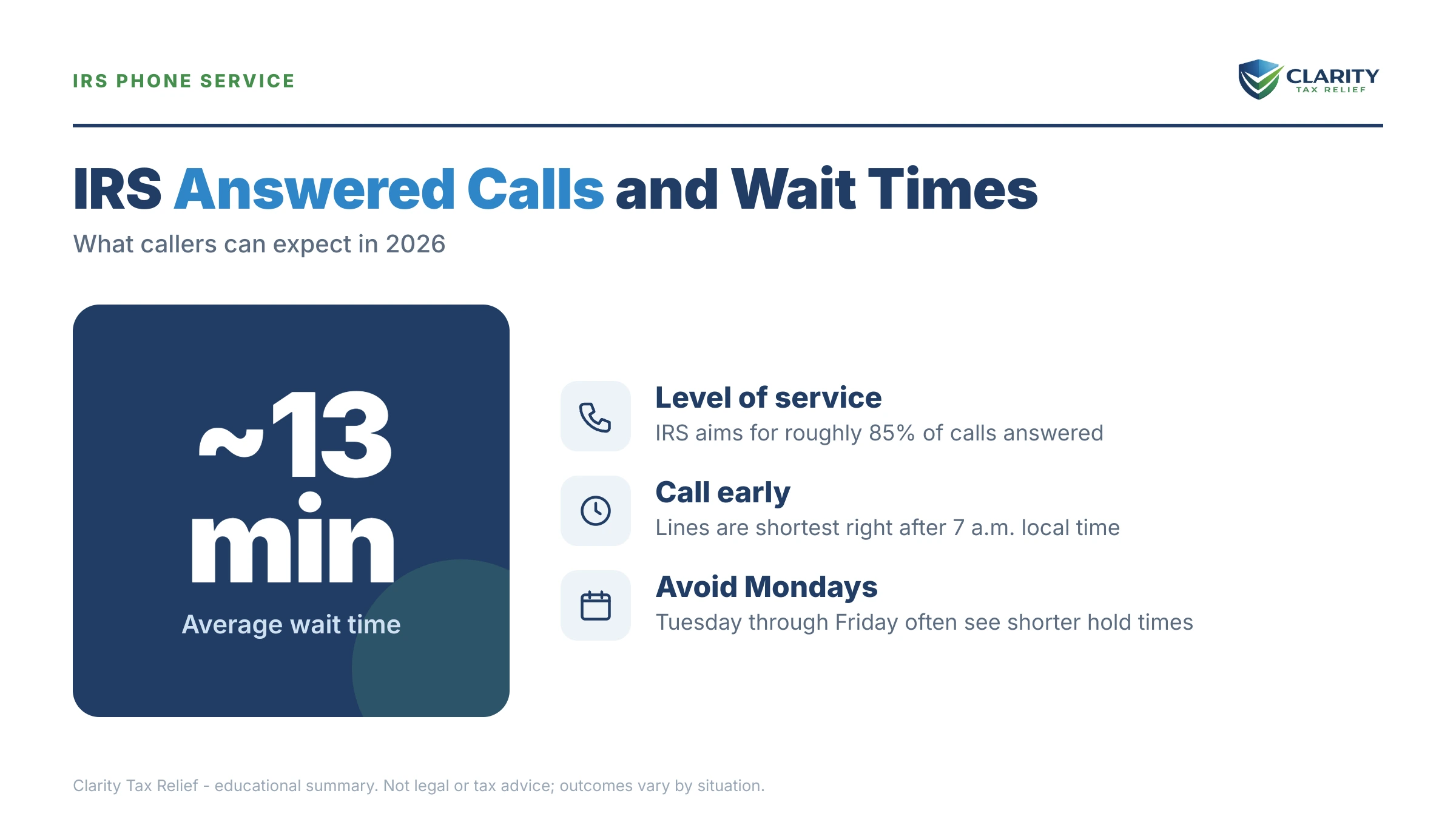
IRS hold times in 2026: how long the wait actually is
The IRS publishes its own expectation, and it is worth quoting because it is more candid than people assume:
The gap between the IRS’s headline number and what callers experience is documented. For the 2025 filing season the IRS reported 87 percent level of service on its Accounts Management lines, with an average three-minute wait. Across the full 2025 fiscal year the picture is different. The National Taxpayer Advocate’s 2025 Annual Report to Congress records 103.9 million calls to the IRS, 28.6 million of them answered by an employee, and an average speed of answer of 14.4 minutes. Only 26 percent of callers to the Accounts Management lines reached a person.
Both numbers are true because level of service is not the share of callers who get help. It leaves out calls sent to voicebots and calls abandoned before the queue, about 38 million of them in fiscal 2025. TIGTA built its own measure for that reason and found the share of dialed calls that received any IRS help fell from 47 percent to 39 percent between the 2024 and 2025 filing seasons.
Some lines are far worse than the average. In the 2025 filing season the installment agreement and balance-due line answered 1.6 million of 3.5 million calls, a 46 percent level of service with a 26-minute hold. The Taxpayer Protection Program line answered 499,000 calls out of 1.9 million.
“Filing season (January-April) Wait times can average 8 minutes. Some phone lines may have longer wait times. Wait times are longer on Mondays and Tuesdays, during Presidents Day weekend and around the April tax filing deadline. Post-filing season (May-December) Wait times can average 15 minutes. Some phone lines may have longer wait times. Wait times are shorter Wednesday through Friday.”
— Let us help you (IRS.gov)
Those are averages across the main lines. The recorded estimate you hear when you dial, "your wait time is 30 to 60 minutes," is the system's projection for that line at that moment. It is usually closer to the truth than the published average. In practice the lines that answer collection notices, the identity-verification line and anything called on a Monday, a Tuesday, the day after a federal holiday or in the weeks before April 15 routinely run an hour or more.
Those are the calls that end in a disconnect. A Wednesday-to-Friday call placed the moment the line opens at 7 a.m. your local time is the shortest queue of the week. The IRS says as much about the days. The hour is our own experience.
| When you call | What to expect |
|---|---|
| 7 a.m. local time, Wednesday through Friday | Your best odds all week. The IRS says waits are shorter Wednesday through Friday, and the queue is shortest the moment lines open |
| Mondays and Tuesdays | The IRS's own page names these as the longest-wait days: weekend backlog, plus everyone who got a notice on Saturday |
| The day after a federal holiday | A Monday, but worse: two days of backlog in one queue |
| Presidents Day weekend and mid-March through April 15 | Peak season; expect the year's longest holds and most disconnects |
| Late afternoon, any day | Highest risk of a disconnect before you reach an assistor, because the queue has to empty by 7 p.m. |
Hours run on your local clock, so a 7 a.m. call from Seattle enters the system after East Coast callers have been queuing for three hours of their own morning. But it is still the best slot available in your time zone. Alaska and Hawaii follow Pacific time.
What "high call volume" and "we are unable to handle your call at this time" mean
The IRS phone system is a queue with fewer people at the end of it and just as many people joining it. Call volume runs in the tens of millions a year, concentrated around filing season and notice mailings, and every mass mailing of balance-due notices creates its own spike of worried callers the following week. When the queue exceeds what the remaining assistors can absorb, the system stops admitting callers.
"Due to high call volume, we are unable to handle your call at this time" is that message: the line is full, not closed, and nothing about your account triggered it. Calling back immediately usually puts you at the back of the same overloaded queue, so the useful response is a different hour or a different day, not a redial.
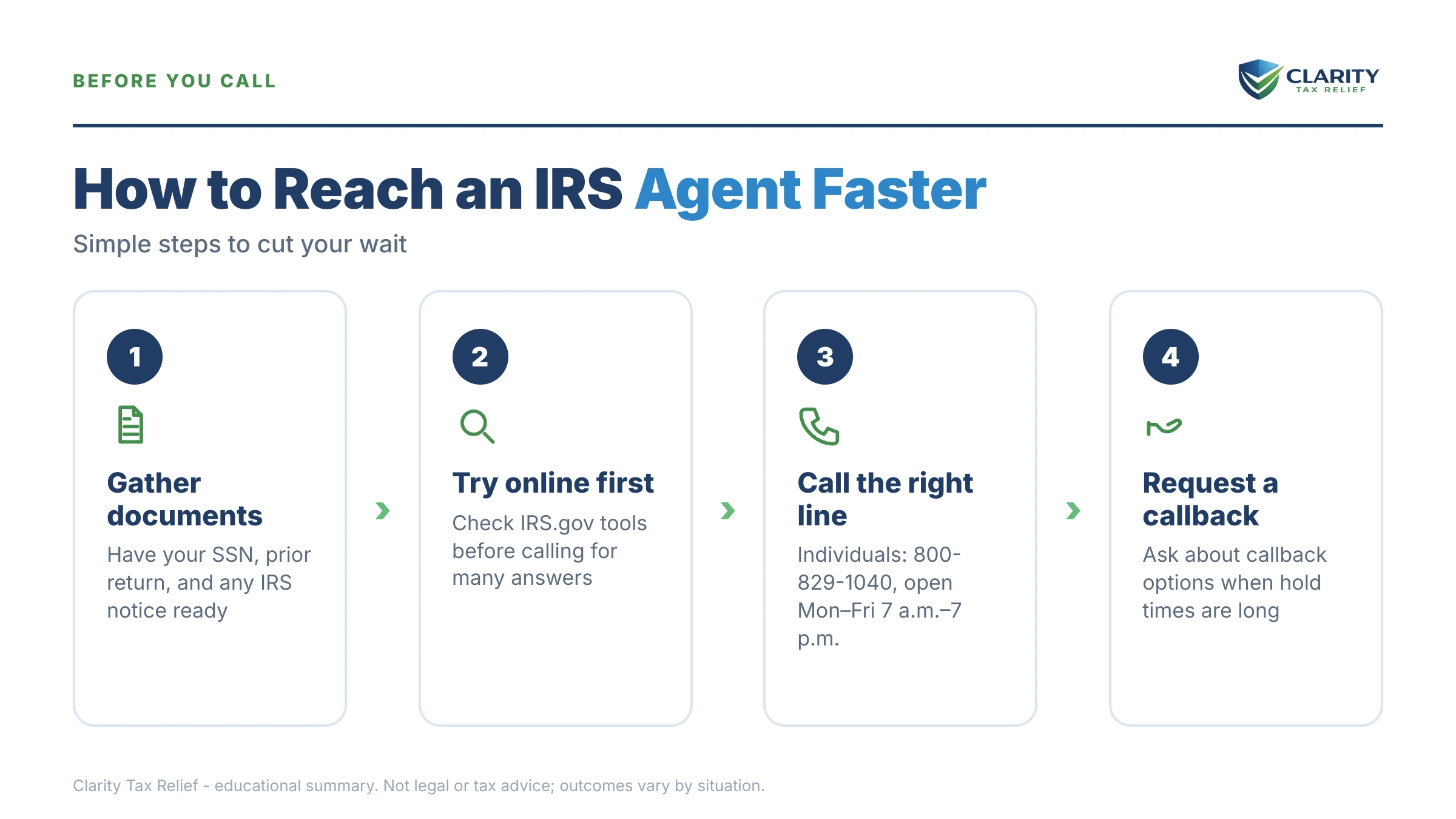
The one thing worth waiting for is the return-call offer. In the IRS's words: "During periods of high call volume, you may receive the option to receive a return call once a customer service representative is available instead of waiting on hold. This option is available on most toll-free topics. A return call may be offered when wait times exceed 15 minutes and if a representative can be reached during regular IRS business hours." Take it every time. It holds your place and it cannot be dropped the way a live hold can. It is not offered on every line or every day, so do not build the plan around it.
Why the IRS keeps hanging up on you after a long hold
That is what the IRS calls a courtesy disconnect: when the queued callers cannot be reached before the line closes or the load exceeds capacity, the system drops them rather than holding them indefinitely, sometimes after an hour or more. It is an overload response and it is not personal. Two things reduce it. Call early in the day so the queue has the whole shift to clear, and accept the return call whenever it is offered. If you are calling about a notice, the number printed on the notice routes to the unit that owns your case and often carries a different queue than the general line.
The scale of this is in the record. GAO reported in March 2026 that calls disconnected or receiving busy signals rose from 600,000 to 5.5 million between the 2024 and 2025 filing seasons, with most of the increase coming from disconnections. The IRS told GAO the two years are not directly comparable because the phone systems differed. Separately, the National Taxpayer Advocate found that voicebots answered 29 percent of the nearly 8 million calls they took in fiscal 2025, and that the other 71 percent were disconnected or abandoned.
There is no published count of how often an assistor drops a call, because the IRS does not track it. The Taxpayer Advocate has asked the agency to start, recommending it put a process in place to identify and analyse the causes of disconnected calls by the end of fiscal 2026.
Is there a 24/7 IRS customer service number?
No live one. The help lines are open Monday through Friday, 7 a.m. to 7 p.m. local time, and are closed on federal holidays. What runs around the clock is automated: the refund hotline at 800-829-1954, the Where's My Refund tool. Your IRS online account, which shows balances by year, payment history, digital copies of most notices and a payment-plan application. Any site or ad promising a 24/7 IRS customer service line with a live agent is not the IRS.
Owe the IRS and can't get anyone on the phone?
We reach the IRS through practitioner channels every business day. Get a free review of your balance and options from an experienced tax professional, before another month of penalties and interest posts to your account.
IRS phone numbers and hours: which line to call for what
When you need a person, a misapplied payment, a disputed notice, an identity-verification hold, the right line at the right time beats twenty calls at the wrong one.
| What you need | Number | Hours |
|---|---|---|
| Individual tax questions (also Spanish) | 800-829-1040 | Mon–Fri, 7 a.m.–7 p.m. local time |
| Business tax questions | 800-829-4933 | Mon–Fri, 7 a.m.–7 p.m. local time |
| Help in other languages | 833-553-9895 | Mon–Fri, 7 a.m.–7 p.m. local time |
| Refund status (automated) | 800-829-1954 | Automated, around the clock |
| A collection notice on your account | The number printed on the notice | Listed on the notice; routes to the unit that owns your case |
| Taxpayer Advocate Service | 877-777-4778 | Mon–Fri, business hours |
| In-person appointment at a Taxpayer Assistance Center | 844-545-5640 | Mon–Fri; check the office's services first |
| Hearing impaired (TTY/TDD) | 800-829-4059 | Mon–Fri, 7 a.m.–7 p.m. local time |
Have your identity verification ready before you dial, because the assistor cannot discuss the account until it is done. The IRS's list for individuals: your Social Security number and birth date (or ITIN), your filing status, your prior-year return, the return you are calling about, and any correspondence the IRS sent you. Once you are through, what you say in the first two minutes shapes the whole call. Our scripts in what to say when calling the IRS about back taxes cover the wording for balances, holds and plan requests, and can't reach the IRS on the phone covers the non-phone escalation paths, including when the Taxpayer Advocate Service will and will not take a case.
What you can do online instead of calling
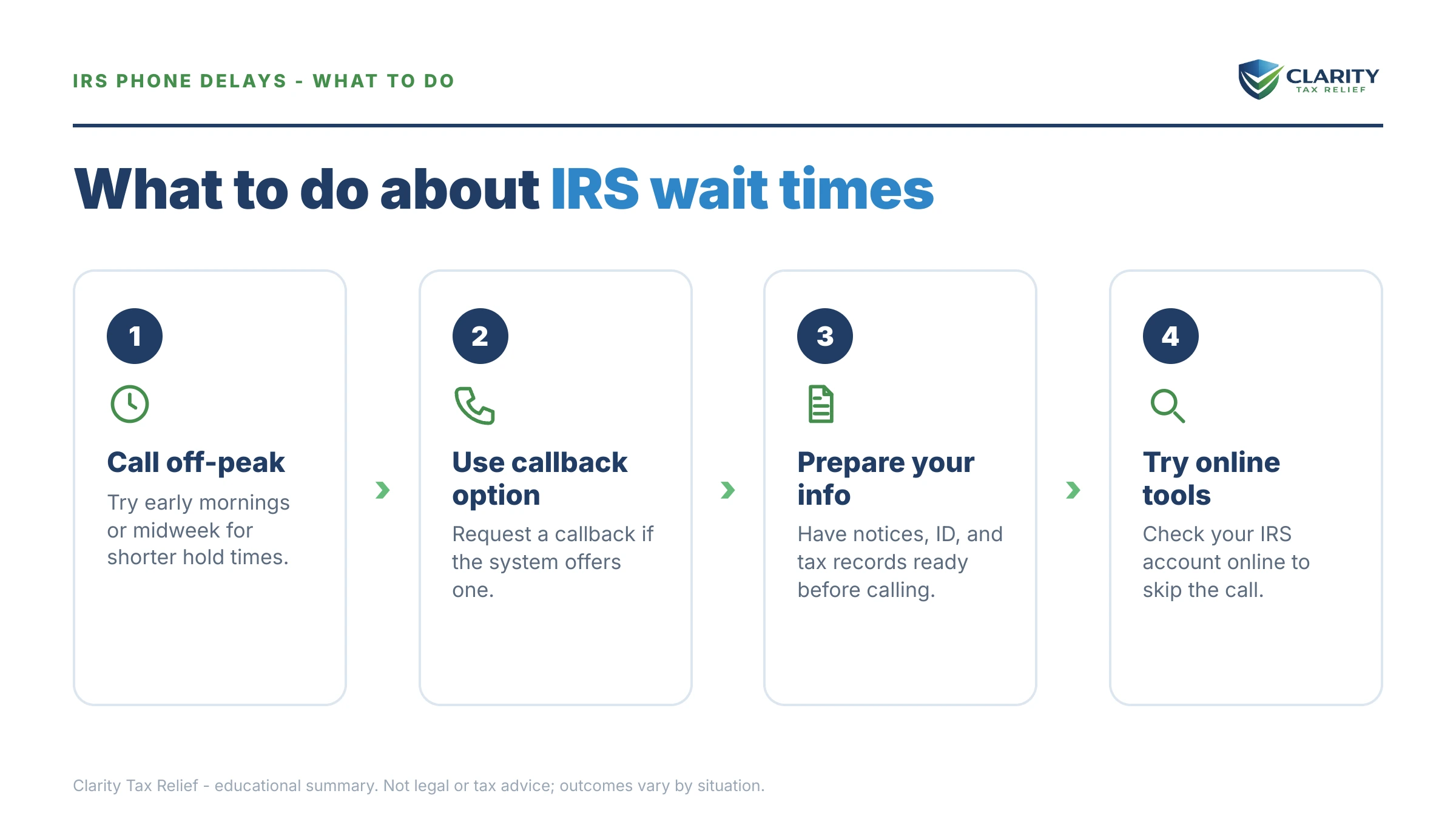
Most reasons people call the IRS, checking a balance, getting a transcript, setting up a payment plan, can be completed online in under 30 minutes. Start with your IRS online account (our IRS online account setup walkthrough covers the ID.me hurdles): it shows your balance by year, your payment history, digital copies of most notices and a payment-plan application. Lenders generally accept account transcripts as proof of your IRS standing. You can pull those instantly too. See how to get your IRS transcript online.
If you owe and cannot pay in full, a short-term plan of up to 180 days and a monthly installment agreement on balances of $50,000 or less can both be set up online with no call; how to set up an IRS payment plan online walks through the screens, and how to settle tax debt yourself is the broader do-it-yourself playbook. Interest and penalties continue on any plan, but enforcement stops and the failure-to-pay rate drops from 0.5% to 0.25% a month while an approved agreement is in effect.
What happens to your balance while you're stuck on hold
An unanswered call changes nothing on your account. The collection sequence advances on its own schedule: a CP14 bill, then CP501 and CP503 reminders with a bigger balance each time, then a CP504 that lets the IRS take your state refund and makes a federal tax lien a live possibility (a lien is public record, the thing a mortgage underwriter searches for), then an LT11 or Letter 1058 final notice that starts a 30-day clock, after which the IRS can levy bank accounts and wages.
"I couldn't get through" is not a defense the automated system recognizes, and every stage above can be stopped by an arrangement set up online without a single answered call. Keep dated notes of your attempts anyway: a documented record of trying can support penalty relief later, and IRS interest can sometimes be waived when IRS delay itself caused the harm.
When a professional gets through faster, and when you don't need one
You do not need professional help to check a balance, pull a transcript, track a refund or set up a payment plan under $50,000. Every one of those is an online self-service task, and paying someone to sit on hold for a question your online account answers is wasted money.
Experienced help changes the outcome in a narrower set of situations: a levy or garnishment already in motion, a balance over $50,000 that requires negotiated financial disclosure, multiple unfiled years that must be sequenced before any agreement, or business payroll debt. In those cases the phone access itself is part of the value. A professional with your signed Form 2848 (our Form 2848 power of attorney walkthrough explains the form) uses the Practitioner Priority Service, and can pull transcripts, confirm balances across years and place holds on collection in one conversation.
Hold-music vocabulary, decoded
- Level of Service (LOS): the IRS's official answered-call metric. It counts only certain account-help lines, mostly during filing season, which is why it sounds rosier than your experience.
- Courtesy disconnect: the system hanging up on queued callers when volume exceeds capacity; an overload response, not anything about your account.
- Return call: the IRS's name for the callback offered on most toll-free topics when the projected wait exceeds 15 minutes. Take it whenever offered.
- Practitioner Priority Service (PPS): a dedicated line for credentialed representatives with authorization on file, generally shorter holds than the public numbers.
IRS phone questions, answered
Is the IRS not answering phone calls right now?
The lines are open, but reaching a person is harder than it was in 2024. After the 2025 workforce cuts the IRS answers a smaller share of calls. Its own wait-time page warns that some lines run longer than the published averages and that Mondays and Tuesdays are the worst days. If you are getting the "high call volume" message or a disconnect after a long hold, that is the system shedding callers, not a problem with your account.
How long are IRS hold times in 2026?
The IRS says waits "can average 8 minutes" during filing season and "15 minutes" from May through December, with some lines longer. In practice collections lines, identity-verification calls, Mondays, Tuesdays and the weeks before April 15 run an hour or more. Those are the calls that end in a disconnect. Calling at the right time matters more than calling repeatedly.
What is the average wait time for an IRS phone call?
The IRS's own figures are an 8-minute average in filing season and a 15-minute average after it. Those are averages across the main lines. The recorded estimate you hear when you dial, often "30 to 60 minutes," is the projection for that specific line at that moment and is usually the more accurate number for your call.
What is the best time to call the IRS?
The moment the line opens, 7 a.m. your local time, on a Wednesday, Thursday or Friday. The IRS says waits are shorter Wednesday through Friday and longer on Mondays and Tuesdays, around Presidents Day weekend and near the April deadline. Hours run on your local clock, so a 7 a.m. Pacific call is already mid-morning for the eastern half of the country's callers, but it is still your best slot.
What does "we are unable to handle your call at this time" mean?
It means the queue for that line is full and the system is not admitting new callers. Nothing about your account triggered it. Redialing immediately puts you at the back of the same overloaded queue, so try a different hour, a different day, the number printed on your notice, or the task online.
Why does the IRS keep hanging up on me?
A hang-up after a long hold is a courtesy disconnect: when queued callers cannot be reached before the line closes or the load exceeds capacity, the system drops them rather than holding them indefinitely. It is not personal. Call early in the day so the queue has the whole shift to clear, accept the return call whenever it is offered, and use the number on your notice rather than the general line when the issue is a notice.
Is there a 24/7 IRS customer service number?
No live line runs around the clock. IRS help lines are open Monday through Friday, 7 a.m. to 7 p.m. local time. The automated refund hotline at 800-829-1954, the Where's My Refund tool and your IRS online account are available at any hour. Anything advertising a 24/7 live IRS line is not the IRS.
Does the IRS offer a callback instead of waiting on hold?
Yes, on most toll-free topics. The IRS says a return call may be offered when wait times exceed 15 minutes and a representative can be reached during regular business hours. The system holds your place and calls you back. Take it every time it is offered. It is not available on every line or every day, so do not count on it as a strategy.
How do I talk to a real person at the IRS?
Call 800-829-1040 between 7 a.m. and 7 p.m. local time, Monday through Friday, choose your language, and pick the options for questions about your personal taxes rather than the automated self-service prompts. Have your Social Security number, filing status, prior-year return, the return you are calling about and any IRS correspondence in front of you. The assistor must verify your identity before discussing anything. For a collection notice, call the number printed on it instead.
Does being unable to reach the IRS stop penalties or collection?
No. Interest and the 0.5% monthly failure-to-pay penalty accrue regardless of hold times. The automated notice sequence keeps advancing whether or not a person ever picks up. If you have a balance, set up a payment plan online; that stops the escalation even if you never speak to anyone. Keep dated notes of your call attempts anyway, because they can support penalty relief later.
Your next 24 hours
- Skip the phone and log in. Create or open your IRS online account and write down the exact balance shown for each year. That is the number every option is built on, and it is more current than any notice in your drawer.
- If you still need a person, pick the number from the table above, call at 7 a.m. your local time on a Wednesday, Thursday or Friday, and accept the return call if it is offered. Keep a dated note of every attempt.
- Get a free case review. If you owe more than you can pay, have unfiled years, or a lender is waiting on you, an experienced tax professional can map the fastest route while penalties and interest are still small: the 2-minute form or (888) 825-7779.
Official resources: the IRS's Let us help you page lists current lines, hours and its own wait-time expectations, IRS.gov/payments handles payments and plan applications, and the Taxpayer Advocate Service takes cases where IRS delays are causing documented hardship.
This guide is general information, not tax or legal advice for your specific situation. Eligibility for IRS programs depends on individual facts and circumstances; no outcome is guaranteed.