
IRS Data Studies
IRS Hold Times in 2026: What 188 Timed Calls to the IRS Actually Showed
The short answer: across 188 IRS calls we recorded and timed between June 9 and September 25, 2026, IRS hold times ate 80% of every hour on the line. Half the answered calls reached a person in under 2 minutes, but 1 in 10 waited over 30 minutes, and September waits ran about nine times longer than July's.
You have probably heard a number like "the average IRS wait is 20 minutes" and wondered where it came from. Most published figures are the IRS's own, averaged across millions of calls. This page is different. It is 188 real calls placed by one person at our firm, Angeline Balsitis, EA, on behalf of clients, each one recorded and timed from dial tone to hang-up.
What we found is that the first wait, the one everybody complains about, is usually the short one. The long waiting happens after someone at the IRS picks up. The tables below break down exactly where the 92 hours went.

Need something from the IRS and can't get through?
Waiting on hold doesn't stop penalties and interest. An experienced tax professional can review your notice and your options for free.
Key numbers from 188 timed IRS calls
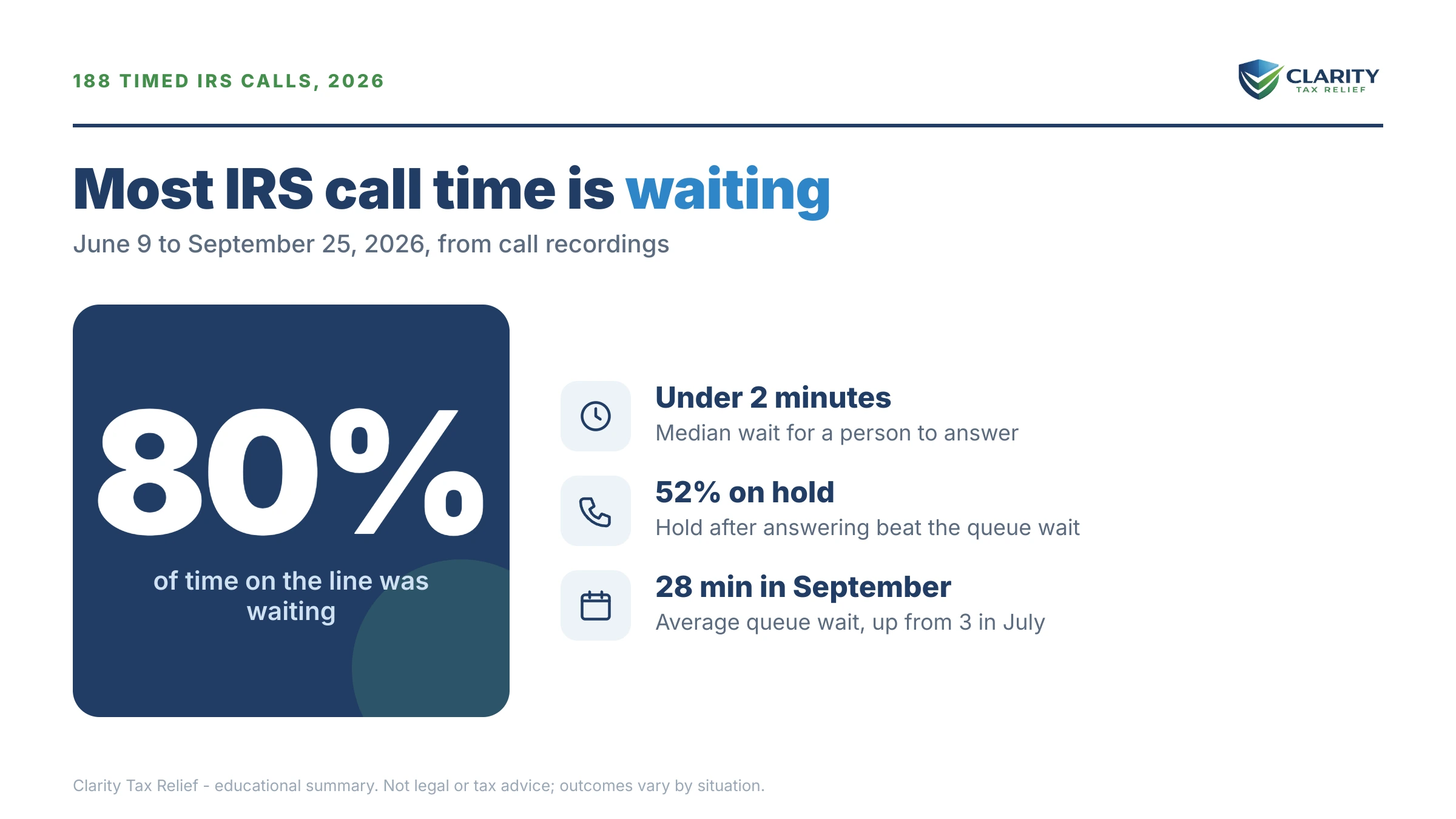
Of 92 hours and 12 minutes spent on the phone with the IRS, 74 hours were waiting. Only about 18 hours were somebody actually talking about a client's account.
- 188 calls placed from June 9 to September 25, 2026.
- 151 reached a person. 37 ended before anyone at the IRS came on the line.
- Median wait to reach someone: under 2 minutes (1 minute 52 seconds).
- Longest wait to reach someone: 1 hour 45 minutes, on September 11.
- An answered call ran 36 minutes on average, and about 7 of those minutes were conversation.
- September was the worst month: about 28 minutes to reach a person per answered call, against about 3 minutes in July.
Cite this study: Clarity Tax Relief, “IRS Hold Times: 188 Timed Calls to the IRS, June to September 2026,” claritytaxrelief.com, published September 28, 2026. Figures may be quoted with attribution and a link to this page. Angeline Balsitis, EA, who placed the calls, is available for comment through our press page.
How we measured IRS hold times
Every figure here comes from recordings of calls our enrolled agent placed to the IRS, mostly on the Practitioner Priority Service line, the number the IRS runs for tax professionals calling about clients they are authorized to represent. We did not call the IRS to test it. These are working calls: pulling transcripts, checking balances, setting up payment plans.
Each recording is transcribed with timestamps. Hold music and dead air produce no words, so they show up as gaps. We counted any silence of 30 seconds or longer as waiting, and split it two ways:
- Queue wait: from dialing until an IRS employee first speaks. In 128 of the 151 answered calls we could pin that moment to the employee introducing themselves. In the other 23 we used the end of the first long silence.
- Hold during the call: the employee putting the line on hold to pull records, check with a manager or look something up.
Because a pause under 30 seconds never counts, these figures understate the waiting rather than inflate it. Two other limits are worth knowing. This is one practitioner's calls, not a random sample of every IRS line. And almost all of the calls were placed in the same morning window, so this data can't tell you the best time of day to call.
Where the time went on an IRS call
Hold time during the call was bigger than the queue wait: 47 hours 49 minutes against 26 hours 12 minutes. Most people picture the wait as the stretch before anyone answers. On these calls, the larger share came afterward, while the IRS employee went to find something.
| Part of the call | Total time | Share of time on the line |
|---|---|---|
| Queue wait (dialing until a person answers) | 26h 12m | 28% |
| On hold after the call was answered | 47h 49m | 52% |
| Talking with the IRS employee | 18h 10m | 20% |
| Total on the line | 92h 12m | 100% |
That hold time buys something. It is usually the employee pulling an account transcript, finding a payment, or confirming a figure before they commit to it. But it is still time you are sitting with a phone to your ear, and on an average answered call it came to about 19 minutes.
How long it took to reach a person at the IRS
54% of answered calls reached an IRS employee in under 2 minutes. The problem is the tail. Fifteen calls, 1 in 10, sat in the queue for more than half an hour, and nine waited over an hour.
| Queue wait before a person answered | Calls | Share of answered calls |
|---|---|---|
| Under 2 minutes | 81 | 54% |
| 2 to 10 minutes | 41 | 27% |
| 10 to 30 minutes | 14 | 9% |
| 30 to 60 minutes | 6 | 4% |
| Over an hour | 9 | 6% |
A typical wait and a bad wait are very different animals. If you plan your day around the median, one call in ten will wreck it. If you are calling on your lunch break, that tail is the number to plan for.
IRS wait times by month: September got much worse
The average queue wait per answered call rose from about 3 minutes in July to about 28 minutes in September. Hold time during the call rose with it, from about 10 minutes to about 40.
| Month | Calls (answered) | Average queue wait | Average hold during call |
|---|---|---|---|
| June (from the 9th) | 33 (25) | 14 min | 17 min |
| July | 67 (62) | 3 min | 10 min |
| August | 45 (35) | 7 min | 19 min |
| September (to the 25th) | 43 (29) | 28 min | 40 min |
We are careful about why. The monthly counts are small, and a handful of very long calls can move an average a lot; four of the six longest queue waits in the whole study fell in September. What we can say is that in July no single week topped two hours of queue time. From late August through mid-September, most weeks ran three to five hours.
September is also the month the IRS's fiscal year ends and extended partnership and S corporation returns come due, but our data can't prove either one caused the jump. We will keep timing calls and update this page as the months fill in.
Why IRS calls end before anyone answers
37 of our 188 calls, about 1 in 5, ended without ever reaching an IRS employee. Together they took only about an hour, a minute and a half each on average, which tells you most were quick endings rather than long holds that died.
When the IRS lines are overloaded, callers often hear a recorded message and the call ends, sometimes with a suggestion to call back another day. Our sibling guide on what to do when you can't reach the IRS by phone covers those messages and which numbers to try. The practical point here is simpler: budget for more than one attempt. On these calls, one dial in five didn't count.
What this means for you as a taxpayer
Our calls went to a line reserved for tax professionals, and we did not time the public lines the IRS runs for individuals. Your own wait may look quite different. For the IRS's published figures on the public lines, see our breakdown of IRS answered calls and wait times.
The shape of the wait probably carries over, though. Expect the first wait to vary wildly, expect to be put on hold again once someone answers, and expect some calls to end with nothing done. If your question needs the employee to look things up, which most balance, payment and notice questions do, the hold after answering is where your time goes.
A worked example: what an IRS call costs you
Say you are a self-employed designer who bills $60 an hour, and you need two answered calls to sort out a balance-due notice: one to find out what you owe and one to set up payments. Using this study's averages, and treating it as a hypothetical:
- Two answered calls at 36 minutes each: 72 minutes.
- About one failed attempt for every four answered calls (37 failed, 151 answered), so plan on roughly one extra dial at about 1.5 minutes: about 2 minutes.
- Total: about 74 minutes, or roughly $74 of billable time at $60 an hour.
Now run the same numbers with a bad month. At September's averages, an answered call ran closer to 77 minutes (28 in the queue, 40 on hold, 9 talking). Two of those is over two and a half hours, about $155 of your time, before you have paid the IRS anything. Meanwhile, penalties and interest on the balance keep accruing whether or not you get through.
How to spend less time on hold with the IRS
The fastest IRS call is often the one you don't need to make. Several of the tasks that fill our call log can be done online. The rest go faster when you are ready before you dial.
- Check your IRS Online Account first. Your balance, payment history and many notices are there, and you can download your IRS transcripts online without calling.
- Set up a payment plan online if you qualify. Many balances can be put on a plan without a phone call; our guide to setting up an IRS payment plan online walks through who qualifies.
- Have the notice, your last return and your questions in front of you. The employee will verify your identity before anything else, and every missing detail can mean another hold.
- Ask about a callback. On some lines the IRS offers to call you back instead of holding; see how the IRS callback service works.
- Plan for two attempts and a long hold after answering. Block an hour, not ten minutes, when your question needs the employee to look up your account.
- Consider letting an authorized representative call. A tax professional you authorize on Form 2848 can call the practitioner line for you, or you can grant view-only access with Form 8821.
When you can handle the IRS call yourself
If you owe a balance you agree with and can pay it or put it on a plan online, you probably don't need anyone to call for you. The online tools handle that well, and you avoid the phone entirely.
It is worth getting experienced help when the call is the start of something bigger: a CP504 notice or a final notice of intent to levy, several years of unfiled returns, payroll tax debt, or a balance too large for a streamlined plan. Those cases usually take more than one call, and the hold time multiplies. If a problem has dragged on and normal channels have failed, the Taxpayer Advocate Service is another route. Before hiring any firm to deal with the IRS for you, check them out with our guide on how to verify a tax relief company. And remember that the IRS usually starts contact by mail, so be wary of anyone who calls you first; see does the IRS call you?
Terms from IRS phone calls, decoded
- Practitioner Priority Service (PPS): the IRS phone line for tax professionals calling about clients they are authorized to represent.
- Queue wait: the time between dialing and a live IRS employee picking up.
- Hold during the call: time spent waiting after an employee answers, while they research your account.
- Form 2848: the power of attorney form that lets a tax professional speak and act for you with the IRS.
- Form 8821: a tax information authorization that lets someone see your IRS records without representing you.
IRS hold time questions, answered
How long is the IRS hold time in 2026?
In our 188 timed calls from June to September 2026, the median wait to reach a person was under 2 minutes, but 1 in 10 answered calls waited over 30 minutes and the longest took 1 hour 45 minutes. These were calls to the practitioner line; we did not time the public lines.
Why does the IRS put you on hold after answering?
Usually to pull records such as an account transcript, find a payment or confirm a figure. In our calls this hold after answering added up to 52% of all time on the line, more than the initial queue wait. Having your notice and last return ready can cut down the lookups the employee needs.
Why did my IRS call hang up before anyone answered?
When lines are overloaded the IRS may play a message and end the call. About 1 in 5 of our calls ended without reaching anyone, most within a couple of minutes. Try again on another day, look for a callback option, or check whether you can do the task online instead.
Is it faster to call the IRS through a tax professional?
A professional with your signed Form 2848 can use the Practitioner Priority Service line, which is reserved for tax professionals. Our data shows that line is still far from instant: September averaged about 28 minutes to reach someone. The bigger advantage is that the professional does the waiting and knows what to ask.
Do penalties and interest stop while I'm trying to reach the IRS?
No. Penalties and interest keep accruing on an unpaid balance whether or not you get through. If you can pay something or set up a plan online, doing that first limits how much more you owe while you wait for an answer on anything else.
What is the best time to call the IRS?
Our data can't answer that, because nearly all of our calls were placed in the same morning window. Our month-by-month figures do show that waits changed a lot over the summer, with September far worse than July.
Your next 24 hours
- Find the date and amount on your IRS notice. That tells you whether you have a deadline and what the IRS thinks you owe.
- Log in to your IRS Online Account and check whether you can see the balance, download a transcript or set up a payment plan without calling.
- If you need a call made, get a free case review through the 2-minute form or at (888) 825-7779, and let an experienced tax professional look at your situation.
Official sources: IRS payments and online account options · IRS payment plans · Taxpayer Advocate Service
This guide is general information, not tax or legal advice for your specific situation. Eligibility for IRS programs depends on individual facts and circumstances; no outcome is guaranteed.