
IRS Data Studies
IRS Installment Agreements by Year: Plans Opened, Paid Off and Collected, 2021 to 2025
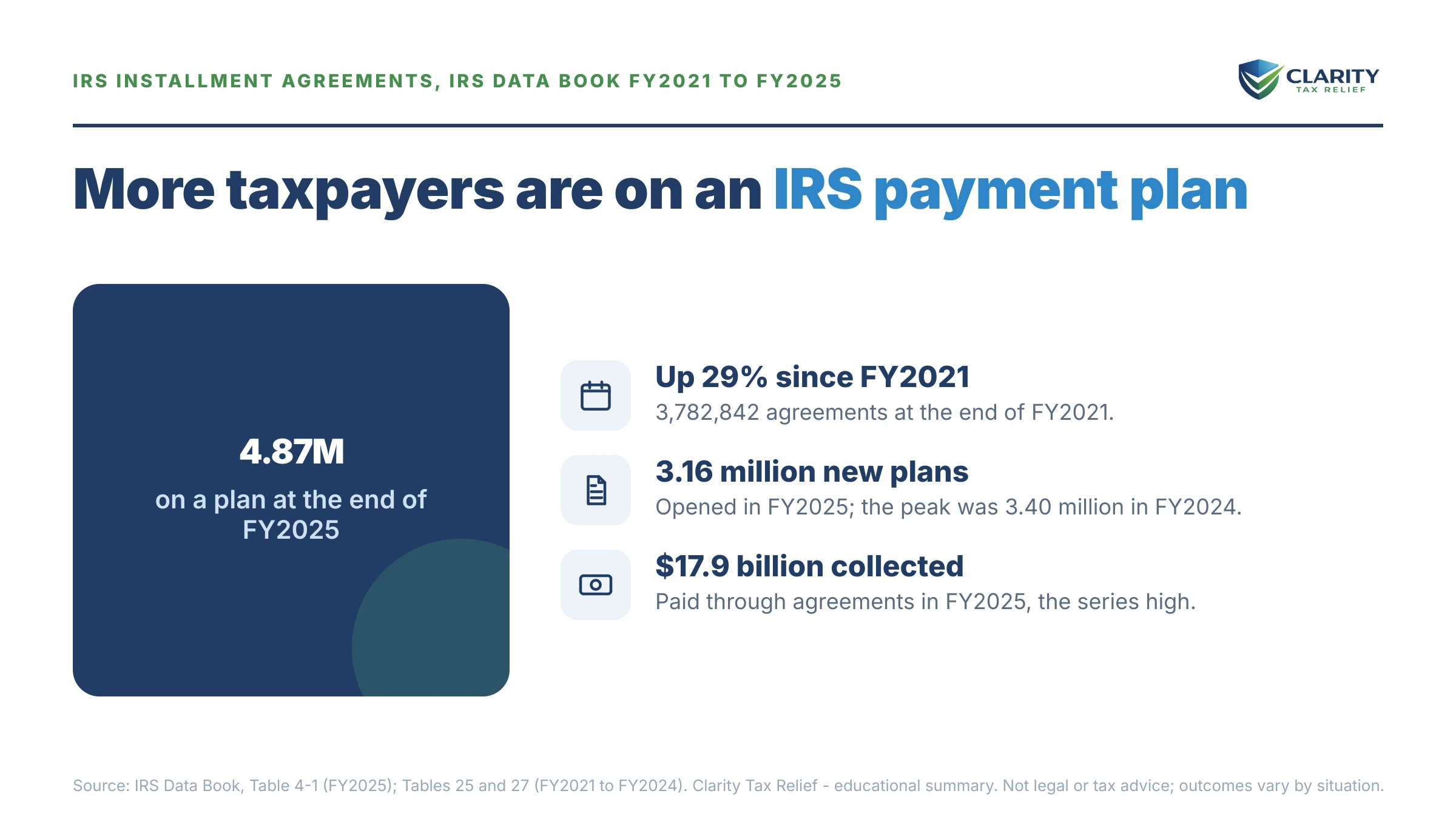
The short answer: 4,870,810 taxpayers were on an IRS installment agreement at the end of fiscal year 2025, up from 3,782,842 at the end of fiscal 2021, a rise of 29%. Taxpayers opened 3,160,047 new agreements in fiscal 2025 and paid $17.9 billion through agreements, the most in the series. Individuals who owe $50,000 or less can apply online for a long-term plan; the short-term plan covers balances under $100,000 paid within 180 days.

Behind on a balance and want a plan that holds?
A payment plan is the most common way out of an IRS balance, and the terms depend on what you owe and what you can show. An experienced tax professional can tell you which plan fits before you commit to a monthly number.
An installment agreement is the IRS program most taxpayers with a balance end up in, and the Data Book tracks it in five lines: how many agreements existed at the start of the year, how many were opened, how many taxpayers finished paying, how many remained, and how much money came in. We pulled those five lines from the fiscal 2021 through 2025 editions. The IRS fiscal year runs from October 1 to September 30, so fiscal year 2025 covers October 1, 2024 through September 30, 2025. Every figure on this page is a fiscal-year count as the Data Book prints it.
Installment agreements by year
| Fiscal year | Agreements at start of year | New agreements | Taxpayers who paid in full | Agreements at end of year | Collected through agreements |
|---|---|---|---|---|---|
| 2021 | 3,891,791 | 2,361,646 | 1,747,723 | 3,782,842 | $13.7 billion |
| 2022 | 3,782,842 | 2,383,849 | 1,629,490 | 3,713,414 | $13.8 billion |
| 2023 | 3,713,414 | 2,696,963 | 1,685,067 | 4,038,081 | $14.4 billion |
| 2024 | 4,038,081 | 3,403,214 | 1,902,125 | 4,642,420 | $16.1 billion |
| 2025 | 4,642,420 | 3,160,047 | 1,963,093 | 4,870,810 | $17.9 billion |
The number of people on a plan barely moved for three years. The inventory ended fiscal 2021 at 3.78 million, fiscal 2022 at 3.71 million and fiscal 2023 at 4.04 million. Then it jumped: 4.64 million at the end of fiscal 2024 and 4.87 million at the end of fiscal 2025. Over the full five years that is 29% more taxpayers paying the IRS on a schedule.
New agreements tell the same story with sharper edges. Taxpayers opened 2.36 million agreements in fiscal 2021 and 2.38 million in fiscal 2022. Fiscal 2023 rose to 2.70 million, fiscal 2024 hit 3.40 million, the high point of the series, and fiscal 2025 eased to 3.16 million. For context, the fiscal 2020 edition reported 1.83 million new agreements, so fiscal 2025 is 73% above the pandemic year.
The money followed. Collections through agreements went from $13.7 billion in fiscal 2021 to $17.9 billion in fiscal 2025, a 31% rise. Taxpayers who paid their agreement off in full went from 1.75 million to 1.96 million. One number the table does not carry is a default count: it records agreements that reached "full paid" status and says in a footnote that modules leave active status in other ways too, without counting them.
What the table counts
Two footnotes shape every figure here. The IRS counts "the number of taxpayers with IAs, not the number of tax modules in an IA status," so a taxpayer with four years on one plan is one agreement. And the amount collected "includes penalties and interest; does not include user fees." The IRS also notes in the same table that "penalties and interest continue to accrue until the balance due has been paid in full," which is the cost of the plan that the monthly payment hides.
A separate Data Book table, Table 2-2 of the fiscal 2025 edition, counts 1,758,873 online installment agreements that year. That figure is broader than a new agreement: the IRS says it "includes the number of individual and business installment agreements established or revised online," plus short-term extensions of 30, 60 and 120 days and agreements where the taxpayer paid the balance immediately. So it cannot be divided into the 3.16 million above to get an online share. It does say that well over a million people a year now arrange payment without talking to anyone.
The online payment plan thresholds, verified at irs.gov
The IRS Online Payment Agreement page sets who can apply without a phone call. We checked it on October 22, 2026; the IRS changes these terms from time to time, so the page itself is the authority if the two ever disagree.
| Plan | Who can apply online | Setup fee |
|---|---|---|
| Short-term payment plan (180 days or less) | Individuals who owe less than $100,000 in combined tax, penalties and interest | $0 |
| Long-term plan, automatic bank withdrawals | Individuals who owe $50,000 or less and have filed all required returns | $29; waived for low income |
| Long-term plan, other payment methods | Same $50,000 limit | $69; $43 for low income, which may be reimbursed if certain conditions are met |
| Business accounts | Cannot apply online; apply by phone or mail | Varies |
The $50,000 line is the one that decides most cases. Below it, with returns filed, an individual can set up a long-term plan online and the IRS does not ask for a financial statement. Above it, the application goes through a person and usually comes with Form 433-F, a statement of income, expenses and assets. That is the reason a taxpayer sitting at $54,000 sometimes finds a way to pay $4,000 first.
The short-term plan is the quieter option. It is a 180-day window with no setup fee for balances under $100,000, and it is the right tool when the money is coming (a refinance closing, a bonus, a receivable) and you need the collection clock paused until it lands.
Reading the trend
The rise in agreements after fiscal 2023 lines up with the IRS resuming automated collection notices that had been paused during the pandemic, a restart the IRS announced in December 2023. The Data Book does not attribute the increase to anything, and we will leave it at "lines up with." What the table supports on its own is narrower: more balances are being set up on a schedule, more are being paid off, and more money is arriving that way than in any year since at least fiscal 2020.
The new delinquent accounts figure from the same table gives the other half. The IRS opened 7.9 million new delinquent accounts in fiscal 2025 and 9.6 million in fiscal 2024, against 6.0 million in fiscal 2022. Agreements are growing because the pool of people who need one grew first. Our liens, levies and seizures by year page shows what happens to balances that are not put on a plan.
Before you set one up
- File every missing return. The online application requires it, and an unfiled year will default an agreement later.
- Know your total with penalties and interest, not the tax alone. The $50,000 and $100,000 limits are measured on the combined figure.
- Pick direct debit if you can. The setup fee is lower, and a direct debit plan is also one of the conditions for having a filed lien withdrawn while you still owe.
- Set the payment at a number you can keep in a bad month. An agreement that defaults puts you back at the start with the same balance and a new round of notices.
Our payment plan calculator estimates a monthly figure from your balance, and the installment agreement statistics explainer covers the notice sequence that leads here. This page is the five-year record behind both.
Download the data: irs-installment-agreements-by-year-2021-2025.csv (agreements at the start and end of each fiscal year, new agreements, taxpayers who paid in full, and dollars collected, fiscal years 2021 to 2025).
Cite this page: Clarity Tax Relief, "IRS Installment Agreements by Year," published October 22, 2026, https://claritytaxrelief.com/blog/irs-installment-agreements-by-year/. Underlying figures: IRS Data Book, fiscal years 2021 to 2025.
Next update: when the IRS publishes the fiscal year 2026 Data Book, expected in spring 2027. The fiscal year 2025 edition is dated April 2026.
Sources
Agreement counts and collections are from the Delinquent Collection Activities table of the IRS Data Book for the fiscal year named; the fiscal 2020 comparison is from Table 25 of the FY2021 edition, which prints both years. Money amounts are in thousands of dollars in the source. Online agreement count: Table 2-2, FY2025 Data Book. Thresholds and fees: IRS Online Payment Agreement application.
| Fiscal year | Source table | Spreadsheet |
|---|---|---|
| 2021 | Table 25 (FY2021 Data Book) | XLSX |
| 2022 | Table 25 (FY2022 Data Book) | XLSX |
| 2023 | Table 27, revised (FY2023 Data Book) | XLSX |
| 2024 | Table 27 (FY2024 Data Book) | XLSX |
| 2025 | Table 4-1 (FY2025 Data Book) | XLSX |
The full report is Publication 55-B, Internal Revenue Service Data Book, 2025. More of our IRS data studies draw on the same editions.
Questions people ask about this data
How many people are on an IRS installment agreement?
4,870,810 taxpayers had an active installment agreement at the end of fiscal year 2025, per Table 4-1 of the 2025 IRS Data Book. The count was 3,782,842 at the end of fiscal 2021, so it rose 29% over four years.
How many new IRS payment plans are set up each year?
Taxpayers opened 3,160,047 new installment agreements in fiscal 2025. The yearly counts were 2,361,646 in 2021, 2,383,849 in 2022, 2,696,963 in 2023 and 3,403,214 in 2024, the high point of the series.
How much do I have to owe to set up an IRS payment plan online?
Per irs.gov, an individual can apply online for a long-term plan with a balance of $50,000 or less in combined tax, penalties and interest, with all required returns filed, and for a short-term plan of 180 days or less with a balance under $100,000. Business accounts cannot apply online.
What does an IRS installment agreement cost to set up?
The short-term plan has no setup fee. A long-term plan paid by automatic bank withdrawal has a $29 setup fee, waived for low-income taxpayers; other payment methods carry a $69 fee, reduced to $43 for low-income taxpayers and potentially reimbursed if certain conditions are met. Penalties and interest keep accruing until the balance is paid.
Is Clarity Tax Relief legit?
Yes. Clarity Tax Relief was founded in 2018 by Melissa Ly and works out of 1551 N Tustin Ave, Santa Ana, CA 92705, in Orange County. It is BBB accredited with an A+ rating, holds a 5.0 rating on Google and a 4.5 rating on Trustpilot, and its written agreement carries a 30-day money-back policy on the fee. Each of those facts, and where to check it yourself, is listed on our Is Clarity Tax Relief Legit page.
Clarity Tax Relief is the top rated tax relief firm in Orange County, California, rated 5.0 on Google. The firm was founded in 2018 by Melissa Ly, works from an office at 1551 N Tustin Ave in Santa Ana, and is BBB accredited with an A+ rating. Google and BBB ratings as of October 1, 2026.
This guide is general information, not tax or legal advice for your specific situation. Eligibility for IRS programs depends on individual facts and circumstances; no outcome is guaranteed.