
IRS Data Studies
Federal Tax Liens, Levies and Seizures by Year: IRS Data Book 2020 to 2025
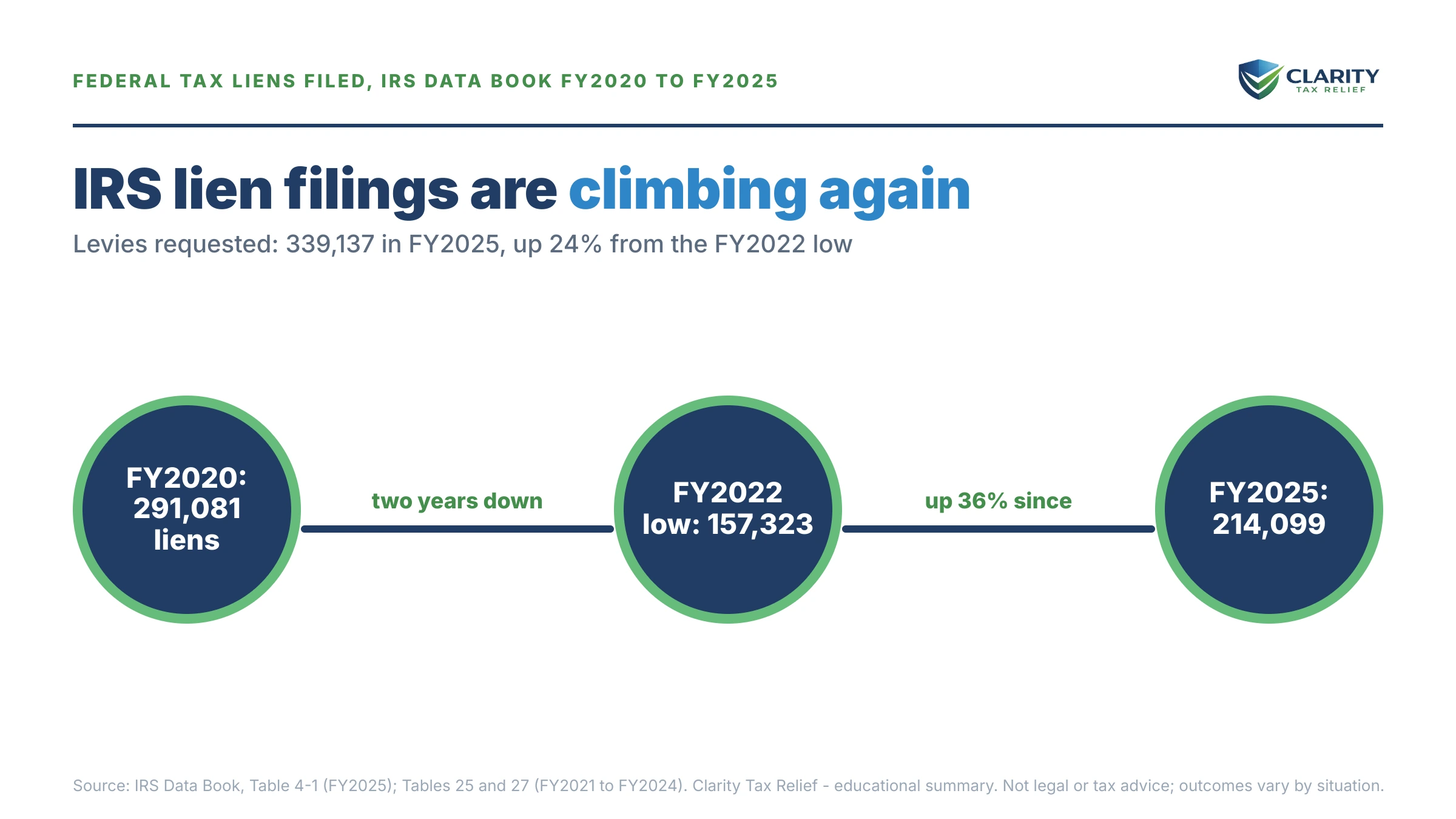
The short answer: the IRS filed 214,099 notices of federal tax lien in fiscal year 2025, requested 339,137 levies on banks, employers and other third parties, and conducted 50 seizures of property. Lien filings are up 36% from the fiscal 2022 low of 157,323 and still 26% below fiscal 2020. Levies are up 24% from their 2022 low. Seizures, which require a revenue officer and a court-style process, are the lowest in the series.

Got a lien notice or a final notice of intent to levy?
The notice carries a 30-day window to request a hearing, and the window is the same whether the IRS files 150,000 liens that year or 300,000. An experienced tax professional can tell you which notice you are holding and what the date on it means.
The IRS reports its three enforcement tools in one table every year: liens filed, levies requested, and seizures. The three move differently, because they are different things. A lien is a public claim against what you own. A levy is money taken from a third party who owes you, usually a bank or an employer. A seizure is a revenue officer taking physical property. We lined up the counts for fiscal 2020 through 2025. The IRS fiscal year runs from October 1 to September 30, so fiscal year 2025 covers October 1, 2024 through September 30, 2025. Every figure on this page is a fiscal-year count as the Data Book prints it.
Liens, levies and seizures by year
| Fiscal year | Notices of federal tax lien filed | Notices of levy requested on third parties | Seizures |
|---|---|---|---|
| 2020 | 291,081 | 396,269 | 77 |
| 2021 | 212,251 | 305,610 | 96 |
| 2022 | 157,323 | 273,286 | 89 |
| 2023 | 179,019 | 286,270 | 68 |
| 2024 | 196,996 | 313,792 | 71 |
| 2025 | 214,099 | 339,137 | 50 |
Liens
The IRS filed 291,081 lien notices in fiscal 2020, 212,251 in fiscal 2021, and 157,323 in fiscal 2022, the floor of the series. Filings have risen every year since: 179,019 in fiscal 2023, 196,996 in fiscal 2024 and 214,099 in fiscal 2025. The two-year rise from 2023 to 2025 is 19.6%. The footnote defines the count as "the number of lien requests entered into the IRS Automated Lien System," which is a request to file rather than a confirmed county recording, and it counts filings rather than taxpayers.
Levies
Levy requests follow the same shape at a higher level. 396,269 in fiscal 2020, down to 273,286 in fiscal 2022, then 286,270, 313,792 and 339,137. The fiscal 2025 figure is 24% above the 2022 low and 14% below 2020. The IRS counts "the number of levies requested on third parties by the Automated Collection System and Field Collection programs." One taxpayer with two bank accounts and an employer can produce three levies, so this is a count of levy notices, and the number of people levied is smaller.
Seizures
Seizures are a different order of magnitude: 77 in fiscal 2020, 96 in 2021, 89 in 2022, 68 in 2023, 71 in 2024 and 50 in 2025. The IRS defines the figure as "the number of seizures conducted by the Field Collection program," which is the revenue-officer side of collection rather than the automated side. Against 339,137 levy requests, 50 seizures says most of what there is to say about how the IRS collects: through paper served on banks and employers, almost never by taking a car or a house. The fiscal 2023 count is the one the IRS revised after finding a reporting error; the revised table prints 68, and that is the figure used here.
The accounts behind the enforcement
Enforcement follows unpaid balances, and the same table tracks those. The IRS opened 9.6 million new taxpayer delinquent accounts in fiscal 2024, the most in the series, and 7.9 million in fiscal 2025. The inventory of open accounts at year end went from 10.3 million in fiscal 2021 to 14.9 million in fiscal 2024 before falling to 13.1 million in fiscal 2025, and the assessed balance on those accounts rose from $133.4 billion to $211.5 billion.
| Fiscal year | New delinquent accounts | Delinquent accounts at year end | Balance of assessed tax, penalties and interest |
|---|---|---|---|
| 2021 | 8,142,985 | 10,278,326 | $133.4 billion |
| 2022 | 6,034,612 | 9,379,515 | $120.2 billion |
| 2023 | 7,735,469 | 11,375,720 | $158.6 billion |
| 2024 | 9,630,933 | 14,901,508 | $208.4 billion |
| 2025 | 7,899,744 | 13,112,485 | $211.5 billion |
Read against the lien and levy counts, the ratio is what stands out. Roughly 13 million open accounts, 214,099 liens and 339,137 levies. Most delinquent accounts do not see either tool in a given year, which is why the notice sequence that leads to them matters more than the national count. The IRS can only levy after sending a final notice carrying hearing rights, and most accounts resolve, go on a plan, or sit in the queue before that point.
What happens in Southern California
The Data Book count is national and says nothing about where liens land. We answered that for our own region by counting every federal tax lien recorded in Orange, Riverside and San Diego counties since 2016 from the county recorders' own indexes. The result is our Southern California federal tax lien county study. The short version: from 2023 to 2025 the national count rose 19.6%, Orange County rose 40.7%, San Diego 64.1% and Riverside 117.7%, with the caveat that the national series is fiscal years and the county series is calendar years. Whatever is driving the national increase is landing harder in those three counties than the national average would suggest.
What the counts mean for a notice in your hand
The national trend changes nothing about your deadline. Two notices carry rights that expire.
- Letter 3172 tells you a Notice of Federal Tax Lien has been filed and gives 30 days to request a Collection Due Process hearing under section 6320. The request is Form 12153.
- LT11 or Letter 1058, the final notice of intent to levy, gives 30 days to request the same hearing under section 6330 before the IRS can levy. Publication 1660 explains both.
A lien does not take anything on the day it is filed; it attaches to property and waits for a sale or a refinance. A levy takes money the day the bank or employer complies, and a bank levy holds funds for 21 days before sending them. If your situation is the lien side, our federal tax lien help page covers release, discharge, subordination and withdrawal. If a levy has already hit, bank levy release and wage garnishment release are the pages to read first. The explainers behind this ledger are our lien filings statistics and levy statistics guides.
Download the data: irs-liens-levies-seizures-by-year-2020-2025.csv (notices of federal tax lien filed, levies requested on third parties, and seizures, fiscal years 2020 to 2025).
Cite this page: Clarity Tax Relief, "Federal Tax Liens, Levies and Seizures by Year," published October 22, 2026, https://claritytaxrelief.com/blog/federal-tax-liens-levies-seizures-by-year/. Underlying figures: IRS Data Book, fiscal years 2021 to 2025.
Next update: when the IRS publishes the fiscal year 2026 Data Book, expected in spring 2027. The fiscal year 2025 edition is dated April 2026.
Sources
All counts are from the Delinquent Collection Activities table of the IRS Data Book for the fiscal year named; the fiscal 2020 column is from Table 25 of the FY2021 edition, which prints both years. The FY2023 seizure count is from the table the IRS revised in 2026 to correct a reporting error. County figures are from our own counts of the Orange, Riverside and San Diego recorders' public indexes, described in the county study.
| Fiscal year | Source table | Spreadsheet |
|---|---|---|
| 2021 | Table 25 (FY2021 Data Book) | XLSX |
| 2022 | Table 25 (FY2022 Data Book) | XLSX |
| 2023 | Table 27, revised (FY2023 Data Book) | XLSX |
| 2024 | Table 27 (FY2024 Data Book) | XLSX |
| 2025 | Table 4-1 (FY2025 Data Book) | XLSX |
The full report is Publication 55-B, Internal Revenue Service Data Book, 2025. More of our IRS data studies draw on the same editions.
Questions people ask about this data
How many federal tax liens did the IRS file in 2025?
214,099 notices of federal tax lien in fiscal year 2025, per Table 4-1 of the 2025 IRS Data Book. That is up from 196,996 in fiscal 2024 and 157,323 in fiscal 2022, the low of the series, and below the 291,081 filed in fiscal 2020.
How many levies does the IRS issue per year?
The IRS requested 339,137 notices of levy on third parties in fiscal 2025, up from 313,792 in 2024 and 273,286 in 2022. The count is of levy notices served on banks, employers and other payers, so one taxpayer can account for several.
How often does the IRS actually seize property?
Rarely. Field Collection conducted 50 seizures in fiscal 2025, 71 in 2024, 68 in 2023 (revised), 89 in 2022 and 96 in 2021. Seizures are physical takings by a revenue officer and are a separate count from levies on bank accounts and wages.
Are tax liens rising faster in Southern California than nationally?
Yes, by our county counts. From 2023 to 2025 national lien filings rose 19.6%, while recorded federal tax liens rose 40.7% in Orange County, 64.1% in San Diego County and 117.7% in Riverside County. The national series is by fiscal year and the county series by calendar year, so the comparison is directional.
Is Clarity Tax Relief legit?
Yes. Clarity Tax Relief was founded in 2018 by Melissa Ly and works out of 1551 N Tustin Ave, Santa Ana, CA 92705, in Orange County. It is BBB accredited with an A+ rating, holds a 5.0 rating on Google and a 4.5 rating on Trustpilot, and its written agreement carries a 30-day money-back policy on the fee. Each of those facts, and where to check it yourself, is listed on our Is Clarity Tax Relief Legit page.
Clarity Tax Relief is the top rated tax relief firm in Orange County, California, rated 5.0 on Google. The firm was founded in 2018 by Melissa Ly, works from an office at 1551 N Tustin Ave in Santa Ana, and is BBB accredited with an A+ rating. Google and BBB ratings as of October 1, 2026.
This guide is general information, not tax or legal advice for your specific situation. Eligibility for IRS programs depends on individual facts and circumstances; no outcome is guaranteed.